ISSN-L: 2501 - 1235 Available on-line at: www.oapub.org/edu
doi: 10.5281/zenodo.3627967 Volume 6 │ Issue 1 │ 2020
EXAMINING THE LEVEL OF STADIUM SECURITY AND SAFETY
DURING NIGERIA PROFESSIONAL FOOTBALL LEAGUE MATCHES
Abdulsamad Olajide Yusuf1i,
Adetoun T. Akinwusi2,3,
E. O Morakinyo4,5 1Department of Sports Management and Policy Development,
Pan African Institute of Life and Earth Sciences Including Health and Agriculture,
University of Ibadan, Nigeria
2Dr., Department of Human Kinetics and Health Education,
Faculty of Education, University of Ibadan, Nigeria
and
3Dr. Department of Sports Management and Policy Development,
Pan African Institute of Life and Earth Sciences Including Health and Agriculture,
University of Ibadan, Nigeria
4Prof., Department of Human Kinetics and Health Education,
Faculty of Education, University of Ibadan, Nigeria
and
5Prof., Department of Sports Management and Policy Development,
Pan African Institute of Life and Earth Sciences Including Health and Agriculture,
University of Ibadan, Nigeria
Abstract:
The purpose of this study was to examine the level of stadium security and safety employed during Nigeria Professional Football League Matches; this is due to the fact that security during the NPFL seems to be ineffective with reports of violence, assaults and pandemonium springing up indiscriminately. A descriptive survey research design was utilized with ten (10) stadia that participated in the NPFL 2018/2019 football league season and their managers being the respondents. Seven (7) security parameters were identified including entry and exit systems, Venue Operations Centre (VOC), Closed Circuit Television (CCTV), Protection of the field of play, public announcer room,
stewards’ management and police attendance. Results indicated that majority of the
security measures to ensure spectator safety are not followed as recommended by FIFA and the green guide; with CCTV and VOC non-existent in almost all the stadia in the study. Results are discussed in relation to previous studies.
Keywords: stadium security, stadium safety, spectator safety, NPFL, FIFA
1. Introduction
Security is described by several authors in different ways; Ekenado (2010) for instance, defined security as state of being free from danger, leading to loss of life or damage to property. Wolfers (1962), perceived security from a National security point of view and that it is the absence of threats to acquired values, and in a subjective sense, the absence of fear that such values will be attacked. Similarly, Waldron (2006) also believes security
comprises protection against harm to one’s basic mode of life and economic values, as
well as reasonable protection against fear and terror, and the presence of a positive assurance that these values will continue to be maintained into the future. Hence, the common belief of these authors is that security is the act or process of ensuring a state of being free from danger or threat to lives and properties.
Everyone involved in football from fans to officials and players should be able to enjoy the game in a safe and secure environment (CAF, 2019). Sports facility safety and security is the act or process of ensuring that a sports facility is free from threat or danger capable of leading to loss of lives and/or properties of sports producers and consumers including sports facility itself emanating from using or being in or around a sports facility.
It is the responsibility of the stadium manager in collaboration with other security providers to ensure proper management of the factors that determine sports ground safety. Football being one of the most crowd-pulling International sports, has become a target for hooligans and rioters because of the wide audience it enjoys through media coverage, hence, the indispensable nature of safety and security in and around a football stadium cannot be overemphasized. Safety and security are the most important aspects in the planning, design, construction, running and management of any stadium (UEFA 2011).
Over the past few years, the level of on-field spectatorship in the NPFL has witnessed a sharp decline, making the spectators settle for foreign football leagues as their source of sport entertainment (Walker, 2008). This may be as a result of past experience of such spectators who have been a victim of the security woes of the NPFL. The security operatives are quick to fire tear gas to disperse fans in an attempt to
“control” crowd behaviour. This usually makes the spectators scamper for safety and
injure themselves in the process, and in some extreme cases lose their lives during the stampede.
Most recently, an ugly scene erupted during an NPFL 2018/2019 Playoff match between Kano Pillars and Rangers FC; gates leading to the field were left open which gave way for charging fans to aim an attack on the Referee. The strength of security on ground during the match could not contain these fans as the Referee and his assistants had to run for their lives into the dressing room (Ekerete, 2019). Events as this have been occurring for decades in the NPFL and there seems to be no hope in sight as regards stadium security.
During NPFL matches, “show of force” is the usual modus operandi of the security
operatives where the security set up sometimes freak out spectators. The presence of heavily armed policemen, army, as well as armoured tank carrier sends a negative signal
to the security conscious spectators who might be wary of “accidental discharge”.
Security is to be covertly executed without interfering with the entire people event experience in the stadium. The first respondent to security related issues in the stadium are stewards while the police are the secondary respondents; the reverse is the case in the NPFL where armed policemen are found all around the stands ready to pounce on any erring spectator.
This study is purposely to examine the level of security during NPFL matches and identify factors (structural or operational) responsible for the perceived poor security state of NPFL matches.
With the first edition of the FIFA Stadium Safety and Security recommendation published in 1994; and revised editions produced occasionally, several countries including South Africa have adopted and adapted it to suit their football and sport event management but none is present in Nigerian football space.
The outcome of this study does not only serve as a basis for policy formulation and enforcement by CAF and NFF as regards adherence to the standard practices of
stadium security, especially as recommended by FIFA and the “Green Guide” but also
provide an avenue for scholars to build their further research and studies.
2. Literature Review
Human security means protecting fundamental freedoms – freedoms that are the essence of life. It means protecting people from critical (severe) and pervasive
(widespread) threats and situations. It means using processes that build on people’s
strengths and aspirations. It means creating political, social, environmental, economic, military and cultural systems that together give people the building blocks of survival, livelihood and dignity
Abbott & Geddie (2001) in their study stated that security is a significant feature of a crowd management plan. Security personnel should be experienced in handling disputes, protecting from theft, implementing emergency services, providing an overall safe and secure environment for the guests. They also stated that attendance spectator must be checked continuously to ensure that maximum capacity is not exceeded. Gate supervisors should communicate regularly with the control centre to impart the status of traffic flow to the venue (Abbott & Geddie, 2001).
The design and location of stadium entry points are such that they allow for even distribution of spectators in order to prevent pressure building up around a particular entrance. These entry points are advised not to provide opportunity for hand or foot-holds which might assist climbing with CCTV cameras connected to the Venue Operations Centre to assist in monitoring of crowd densities outside the stadium. Each entry point is required to possess a turnstile which allows for clear vision and communication between the steward and spectators (DCMS, 2008).
A stadium without a suitable structure that allows for the presence of venue operation centre is considered not suitable to host matches according to FIFA, 1994. The VOC is the communications room from which those persons responsible for safety and security operations at the stadium can monitor and direct resources in response to any situation before, during and after a match. The following systems according to FIFA Safety Regulations should be fully integrated into the VOC; Public address system override, fire alarm control panel, pitch lighting control panel, electronic video screen (giant screen) control system, CCTV monitors, communication system, and an uninterrupted power supply (UPS). The location of the VOC is such that it is in a secure area and has an overall view of the inside of the stadium.
According to Dóczi & Tóth (2009), a modern stadium must have a closed circuit television surveillance, spectators are identifiable by the number of their seats and their safety is guaranteed. They influence public participation in sports and effectively contribute to the quality of sports competitions. This is why FIFA has advised that all entrances and exits as well as public spaces inside and outside the stadium, including designated temporary used spaces during matches will be monitored by Video cameras. CCTV is used in monitoring crowd movement and behaviour and creates awareness for the security officers on potential safety problems and public disorder.
the spectators to access the field of play in the event of an emergency. Generally, the pitch area perimeter is adopted to ensure that the stadium has restricted access to the field of play from the stands and ensure that the evacuation system is certified by competent security authorities. According to Young (2002), barriers or fences can be used to separate opposing fans, field and players. This is to reduce the possibility of them clashing throughout their stay in the stadium arena. Abbott & Geddie in 2001 explained that properly placed and visible signs should be used to inform, warn, instruct and guide people to reduce conflict due to frustration and confusion. Aye & Htun, 2014 further opined that the spectators should be able to find their way easily to their seats; where all seats are properly numbered in such a way that it is easily and immediately identifiable. Communication between the stadium management and the spectators inside and outside the stadium is essential; this is enhanced by a sufficiently powerful and reliable Public Address (PA) system(FIFA, 2011). The PA system should be located in a position where the operator has a clear view of all spectator areas.
According to the (Department For Culture, Media And Sports, 2008), the police may be required to uphold public order and prevent the commission of offences, even though the responsibility for the safety of spectators lie with the stadium management. The stadium management should give the required assistance that will facilitate the success of the stipulated duties of the police. Police may be employed as stewards in some events having gone through the proper training. Increased visibility may be particularly effective at high-risk events, but officers should remain cognizant of the effect that their appearance may have on crowd behaviour (Weiss & Davis, 2005).
A steward is an individual who is trained to be responsible for the safety and care of spectators and other stadium users during a competition. The main reasons for using stewards are to assist with the circulation of spectators, prevent overcrowding, reduce the likelihood and incidence of disorder, and provide means to investigate report and take early action in an emergency (Department for Culture, Media and Sports, 2008). Stewards are expected to have undertaken training in the act of stewarding; the stadium management are recommended to draw up a code of conduct for all stewards as they are the only point of contact between the management and the public. The FIFA safety regulations recommend the ratio of one steward per 250 anticipated attendance for a low risk match while the ratio for a high-risk match should be one per 100 of the anticipated attendance. These stewards are expected to wear uniform that is easily identifiable in all
conditions while the word “STEWARD” is clearly written on the uniform for easy identification.
2.Materials and Methods
2.1 Study Design
describing existing phenomenon; which is the focal point of this study. Information was collected on the variables in order to examine the level of stadium security in the Nigeria Professional Football League matches.
2.2 Participants
Ten (10) stadium managers, as well as their stadia facilities participated in the study. Participants are stadiums and stadium managers of the teams partaking in the Nigeria Professional Football League.
2.3 Procedure
Following University’s Ethical approval, a letter was sought from the Country’s Football
governing body (Nigeria Football Federation) to introduce the researchers to the stadium management for appropriate assistance. Random selection of 50% of the total population of teams participating in the NPFL was done and the stadium management were contacted through the NFF in which they all agreed to participate. On arriving at the stadia, each manager completed a consent form signalling their approval to participate in the study.
The first author was on site at the stadia to examine the security apparatus available using a checklist drafted from FIFA Safety and Security Assessment as well as a questionnaire to address the questions of interest (security operations). As Babbie (2010) suggests, quantitative methods emphasize objective measurements and the statistical, mathematical, or numerical analysis of data collected through questionnaires, surveys, or by manipulating pre-existing statistical data using computational techniques. Given the deficiency/shortage of research on the security during NPFL matches, and the stumbling block of effective security coordination a quantitative approach was deemed proper for this study as it focuses on gathering numerical data and generalizing it across groups of people or to explain a particular phenomenon. The process of using the checklist in each of the stadia lasted about an hour, while the questionnaire was completed in about 45minutes by each stadium manager.
The questionnaire was administered to the stadium managers, the data assembled from the stadium managers would serve as a complement to the checklist. The checklist contained information regarding the temporary and permanent security installations/infrastructures in the stadium while the questionnaire focused on questions relating to stewards’ management, police attendance, and security search at the entrance gate.
3.Results and Discussion
3.1 Results
Separate percentage analysis was conducted on the FIFA checklist to identify each
stadium’s level of compliance to the infrastructure demands as stated by FIFA and the
protection of the field of play; players tunnel and dressing room area; police attendance; and stewards management. The higher the average percentage the greater the level of each security parameter.
3.2 Entry and Exit Systems
Table 1: Summary of Stadium’s Entry and Exit Systems
S/N Entry and Exit systems Yes No
1. Are there turnstiles fitted in all sections of the stadium? 6 (60%)
4 (40%)
2. Are the turnstiles sufficient for the stadium capacity? 2 (20%)
80 (80%)
3. Is counting mechanism is present? 2
(20%)
8 (80%)
4. Is the VIP entrance separate? 9
(90%)
1 (10%)
5. Are the gates by section sufficient? 8
(80%)
2 (20%)
6. Are there emergency gates leading onto the field? 10 (100%)
0 (0%)
7. Are exits easily identifiable? 10
(100%)
0 (0%)
8. Are there sufficient signages around the stadium? 2 (20%)
8 (80%)
Table 1 revealed that a little above average (60%) of the selected stadia had turnstiles fitted in their facility and only 20% of them are sufficient for the stadia capacity. Exit gates were adequate and quite visible with each stadium sections having emergency gates leading onto the field. Signages however, throughout the stadia in the study were grossly poor as only 20% had sufficient signages to direct spectators.
3.2 Venue Operations Centre
Table 2: Summary of Stadium’s VOC and its Components
S/N VOC Checklist Yes No
1. Is there a VOC? 5
(50%)
5 (50%)
2. Are there CCTV monitors? 2
(20%)
8 (80%)
3. Is the VOC capable of Overviewing the stadium interior? 1 (10%)
9 (90%)
4. Is there PA over-ride? 0
(0%)
10 (100%)
5. Is there a Giant screen control in the VOC? 4 (40%)
6 (60%)
6. Are there Radios in the VOC? 2
(20%)
7. Are there Telephones in the VOC? 3 (30%)
7 (70%)
8. Is Internet present in the VOC? 1
(0%)
9 (90%)
9. Is there an Entry counting mechanism? 0
(0%)
10 (100%)
10. Is UPS (Uninterruptable Power Supply) available in the VOC? 2 (20%)
8 (80%)
11. Fire control panel 2
(20%)
8 (80%)
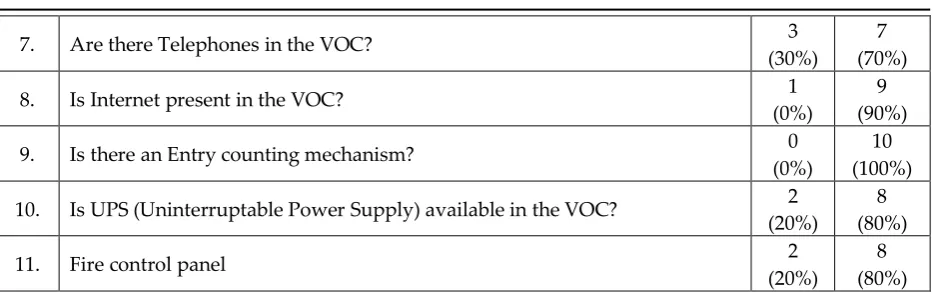
As indicated in Table 2, stadium control room (VOC) was present in only half of the stadia in the study with two stadia (20%) possessing CCTV monitors and few having the giant screen control present in their VOCS. Conversely, overview of the stadium interior, public address override, radios, telephones, internet, UPS, entry counting mechanisms and fire control panel were unavailable in majority of the stadia. Overall, only about 20% of the stadia had provisions for an operative Venue Operations Centre.
3.3 Closed Circuit Television
Table 3: Summary of CCTV Installation in the Stadia
S/N CCTV and its components Yes No
1. Permanent 3
(30%)
7 (70%)
2. Temporary 0
(0%)
10 (100%)
3. Inside the stadium 2
(20%)
8 (80%)
4. Outside the stadium 0
(0%)
10 (100%)
5. Are there Recording system? 1
(10%)
9 (90%)
6. Are CCTV recordings kept? 0
(0%)
10 (100%)
7. Is there Power supply and back-?up 2
(20%)
8 (80%)
8. Does CCTV effectively cover all entry and exit points? 0 (0%)
10 (100%)
9. Does CCTV effectively cover all spectator viewing areas? 0 (0%)
10 (100%)
capacity to effectively cover all entry and exit points, as well as effectively covering all spectator viewing areas.
3.4 Protection of the Field of Play
Table 4: Summary of Each Stadium’s Level of Protection of Field of Play
S/N Items Yes No
1. Is there a barrier between the field of play and the stands? 10 (100%)
0 (0%)
2. The barrier made of iron 9
(90%)
1 (10%)
3. Is it easily scalable? 9
(90%)
1 (10%)
4. Are there emergency gates leading through the barrier? 9 (90%)
1 (10%) Table 4 shows that barriers made with barbed wires were found in all the stadia (100%) between the pitch area and the stands; however, majority of these barriers are scalable although having emergency gates leading onto the field of play.
3.5 Public Address Announcer Room
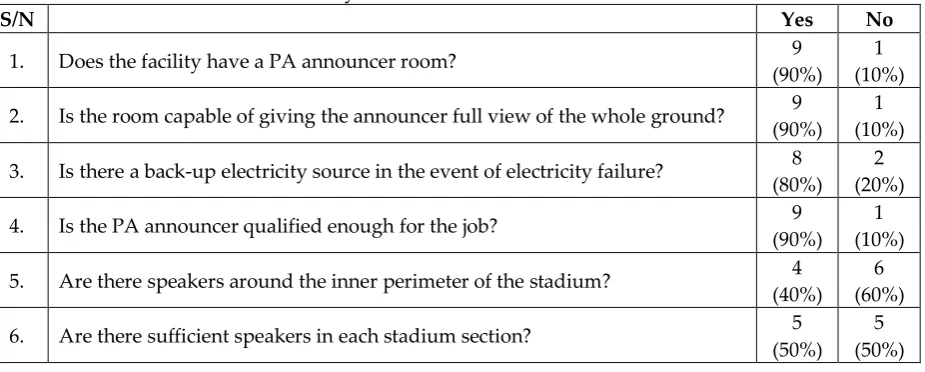
Table 5: Summary of Stadium’s Public Announcer Room
S/N Yes No
1. Does the facility have a PA announcer room? 9 (90%)
1 (10%)
2. Is the room capable of giving the announcer full view of the whole ground? 9 (90%)
1 (10%)
3. Is there a back-up electricity source in the event of electricity failure? 8 (80%)
2 (20%)
4. Is the PA announcer qualified enough for the job? 9 (90%)
1 (10%)
5. Are there speakers around the inner perimeter of the stadium? 4 (40%)
6 (60%)
6. Are there sufficient speakers in each stadium section? 5 (50%)
5 (50%)
3.6 Police Attendance
Table 6: Summary of Police Attendance during NPFL Matches
S/N Yes No
1. Does the club seek for the services of the police force to provide security during matches?
10 (100%)
0 (0%)
2. Are the police officers specially trained on sports safety and security? 3 (30%)
7 (70%)
3. Is there an inter-agency collaboration between the police and other agencies during matches?
8 (80%)
2 (20%)
4. Does the police commander also serve as the stadium/club’s safety officer? 4
(40%)
6 (60%)
Table 6 revealed that security service provision from the police force is peculiar to all stadia as they all sought for their services (100%); although, it was discovered that majority of the police officers are not specially trained on sports ground safety and security (70%), they only use their knowledge of maintaining law and order to provide security during matches. Inter-agency collaboration between the police and other agencies also exist in the policy of most of the stadia. Conversely, as opposed to the green
guide’s recommendation of appointing former police officers as stadium/club safety and security officers, majority of the stadium managers equally served as stadium security and safety officers.
3.7 Stewards’ Management
Table 7: Summary of Stadium’s Stewards’ Management
S/N Yes No
1. Steward deployment plan exist in the stadium management policy 6 (60%)
4 (40%)
2. There are specified roles of a steward in the plan 6 (60%)
4 (40%)
3. The stewards have an existing code of conduct 6 (60%)
4 (40%)
4. The stewards are provided with special identification devices 5 (50%)
5 (50%)
5. The ratio of stewards to the number of spectators employed in a match is sufficient
2 (20%)
8 (80)
6. The stewards have a medium of communication irrespective of their location in the stadium
2 (20%)
8 (80)
7. Trainings are provided for the stewards 2
(20%) 8 (80%)
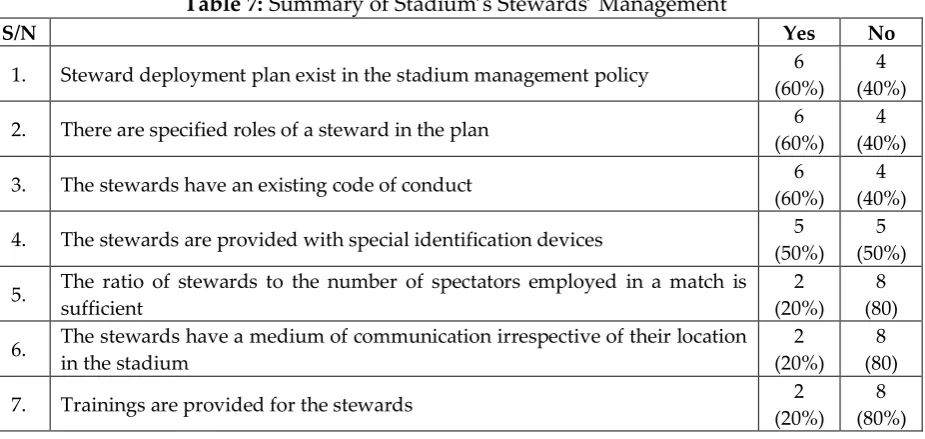
stewards (FIFA advised 1:250) to the number of spectators employed in matches are extremely poor (20%), with the few stewards having no medium of communication amongst them. It was also discovered that the stewards do not go through any training as regards their roles and responsibilities. The green guide specifically highlighted the importance of training stewards on issues such as preparing for spectator events (C29), dealing with accidents and emergencies (C36), as well as controlling the entry, exit and movement of people at spectator events (C210).
4. Discussion
The purpose of this study was to examine the level of security obtainable during Nigeria Professional Football League matches. The discussions are presented to explain stadium security parameters and how they fare during NPFL matches. The results are discussed independently for each of the stadium security parameters identified.
4.1 Entry and Exit Systems
As against the recommendation of the green guide (DCMS, 2008), stadium entry points in the NPFL do not allow for an even distribution spectators, hence, allowing pressure building up around a particular entrance. This is as a result of the number of entry points
designated for spectators’ entrance into the stands. Similarly, only very few of the
facilities in this study had more than a single turnstile which assists stewards to communicate effectively with the spectators. Some stadia have severed the turnstiles originally installed and turned into a gate for unexplainable reasons. Majority of the stadia had emergency gates leading onto the field and are easily identified. Signages whereas, which should serve as a means of directing spectators were mostly absent in the stadia, both within the stands as well as the inner stadium perimeters. Unfortunately, emergency gates leading onto the pitch are not properly manned as spectators gain entrance into the playing area without emergency evacuation being activated. The NPFL 2019 play offs is a perfect example of cases where gates are unmanned thereby placing the lives of players, officials and match officials at risks of being attacked by hoodlums. The implication of inadequate entry and exit gates relative to the maximum stadium capacity is that, emergency evacuation of spectators to a safe area might be unachievable within the estimated eight (8) minutes, hence, jeopardising the safety of the stadium users.
4.2 Venue Operations Centre (VOC)
Unsurprisingly, it is impossible for the stadium management during NPFL matches to effectively coordinate everybody involved in stadium safety and security. Resultantly, inadequacy of factors such as detailed stadium plan, emergency evacuation plan, CCTV monitors, telephones, and spectators’ attendance recording will ensure a haphazard
dispensation of stadium safety and security.
4.3 CCTV
Following the recommendation of FIFA that all entrances and exits as well as public spaces inside and outside the stadium be monitored by video cameras, a vast majority of the stadia in the NPFL do not have a single temporary or permanent CCVT in or around the stadium premises. This makes it difficult for those who coordinate safety and security to identify incidents, or potential problems, and take necessary actions to respond. Incidences such as crowd violence, assault on match officials could easily be curtailed by using digital video recordings. Doczi and Toth in 2009 affirmed that a stadium must have a CCTV surveillance system, where spectators are identifiable by their seat numbers, as well as monitoring of crowd movement to create awareness for the security officers to take necessary actions. The use of CCTV for monitoring and controlling crowd behaviour manifested in July 2019, when Chelsea FC of England placed a stadium ban on six of its
fans following racist abuse of Manchester City’s Raheem Sterling. These supporters were
discovered using the CCTV installed in the stands with the expertise of lip-reading professionals to decode the chants. According to (Cleland & Cashmore, 2016), 50% of fans from across United Kingdom opined that violence in stadia has reduced due to the deterrence provided by presence of CCTV. A similar study in Brazil by (Silveira, Cardoso, & Quevedo-Silva, 2019) also found out that on-field spectatorship is poor due to the lack of security apparatus such as CCTV in stadia. What this implies is that the presence of CCTV surveillance in the stadium during NPFL matches will not only enhance the job of those in charge of security and safety, but also serve as deterrence to those whose aim is to disrupt public order.
4.4 Protection of the Field of Play
4.5 Police Attendance
Despite the fact that the services of the Police force are always sought by teams/stadium management during NPFL matches, they do not undergo any specific training as regards coordination of security in sports arena. They only transfer their knowledge of maintaining public order into stadium safety and security which could be sometimes unsatisfactory. On the bright side, the police force and other agencies collaborate during football league matches; they assist one another in the security management. While FIFA (2011) advises that police officers (retired) are always best suited for the position of stadium safety and security officers (after undergoing the required training), it was learned that majority of the clubs in the NPFL do not follow this standard but instead ensure that their stadium managers automatically coordinate the security operations during match days.
4.6 Stewards’ Management
On paper, the plan for the deployment of stewards are available, but are poorly implemented; this plan contains specified roles of stewards and their codes of conduct but are not adhered to by majority of the teams participating in the NPFL. The number of stewards provided during NPFL matches are way below the required standards as set by FIFA and the Green guide, those available are overwhelmed by the huge population ratio of the spectators, hence, their effects on the security and safety management is bound to be poorly felt. A number of the teams provide their stewards with special identification devices but do not have any medium of communication when far apart. Ideally, the C29, C35 and C210 trainings should be provided by the stadium management for all stewards whose services are employed during NPFL matches, but such is not applicable, they do not undergo any training of such.
5.Recommendations
Based on the findings of the study, the following recommendations were made:
1) There is the need for Nigeria Football Federation (NFF) to have their Safety and Security Regulations and Recommendations which would be a guide for all football events in the country.
2) The League Management Company (LMC) through the Nigeria Football Federation (NFF) should provide capacities to train Security Officers that will enforce safety and security regulations in our football stadia; these trainings should equally be extended to police officers whose services are contracted during NPFL matches.
3) Legislation should be made by the NFF through the National Assembly for strict compliance with safety and security procedures (using stadium safety certificate); with punishments doled out to erring clubs.
ones in order to meet the safety and security standards as recommended by FIFA and the Green Guide.
6. Conclusion
Generally, it is clear from this study that stadium safety and security during NPFL matches are not practiced according to the international standards proscribed by FIFA and the Green guide; although some areas of operations are contained in the stadium plans, they are poorly implemented by teams participating in the league. Important parameters that enhance effective security during matches are not up to an acceptable standard in most of the stadia; they include provision of the VOC, CCTV, Entry and Exit systems, Stewards management and Police attendance. It is therefore of great importance that the NFF, being the body that coordinate all football activities in Nigeria, should ensure that teams follow the newly published CAF Safety and Security Regulations which aims at allowing a uniform approach to security across Africa. Bearing in mind that frequent training sessions are organized for the security officers in order to achieve a safe and secure stadium in Africa for all.
Acknowledgements
All praises and adorations go to Almighty Allah for giving me the Grace and Strength to begin and successfully finish this work, your name shall always be exalted. A special appreciation goes to my family for their unending support morally and financially throughout the course of this study, you are a reliable backbone. Massive gratitude belongs to the leadership of PAULESI and the African Union (AU) for fully sponsoring
my Master’s study and research; I hope that one day, I achieve the goals of the initiative and pay back the trust you had in me.
Sincere appreciation goes to Professor Morakinyo and Dr. Akunwusi who supervised and took me as their child; they were never tired of responding to my concerns and shortcomings. I pray Almighty God always be with you and your family. Worthy of appreciation is Dr. Dzekem Bonaventure Suiru who was always there to guide me through this research; you are a brother indeed and sincerely appreciated. Similarly, this work would not have been a success without the assistance of Dr Lateef Kehinde who never got tired of guiding me.
Lastly, my profound gratitude goes to all the lecturers and staff of the department of Human Kinetics and Health Education, University of Ibadan, especially Prof. I. O. Oladipo, may God continue to Bless you.
About the Author
Leadership training. He is passionate about youth sports development and has volunteered in various sports meets, including the maiden edition of the National Youth Sports Festival in 2014. He is the co-team lead of the Integrated Development and Peace Project; a project which is aimed at ensuring that young people living in refugee camps have access to health, physical and peace-building education by an innovative approach of using Sports and Games to increase interest in educational activities. During his undergraduate studies, Abdulsamad served in several leadership capacities which include General Secretary of the Departmental Association, Faculty of Education Sports Committee among others. He also led his Faculty to victory in various sports competitions including the prestigious Vice Chancellor’s cup which he won Gold Medals
in the football event twice in four years. Abdulsamad also served at the Nigeria Football Federation as undergraduate and graduate intern in 2014 and 2019 respectively.
References
Abbott, J. & Geddie, M. (2000). Event and Venue Management: Minimizing Liability Through Effective Crowd Management Techniques. Event management 6(4): 259-270.
Aye, T. N., & Htun, Z. M. (2014). Study on Analysis and Design of Football Stadium, 03(12), 2621–2630.
Babbie, Earl R (2010). The Practice of Social Research. 12th ed. Belmont, CA: Wadsworth Cengage; Muijs, Daniel. Doing Quantitative Research in Education with SPSS. 2nd edition. London: SAGE Publications
Confederation of African Football (2019). CAF Safety and Security Regulations (Vol. 1)
Cleland, J., & Cashmore, E. (2016). Football Fans’ Views of Violence in British Football:
Evidence of a Sanitized and Gentrified Culture. Journal of Sport and Social Issues,
40(2), 124–142. https://doi.org/10.1177/0193723515615177
DCMS. (2008). Guide to Safety at Sports Grounds, 44(0), 0–2. Retrieved from http://www.safetyatsportsgrounds.org.uk/sites/default/files/publications/green-guide.pdf
Dóczi, T., & Tóth, A. K. (2009). Football fandom in England: old traditions and new tendencies. International Quarterly of Sport Science, (2), 30–41. Retrieved from http://www.iqss.eu/issue/20092/3_doczi_toth_IQSS_2009_2.pdf
Ekenedo, G. O. 2010. Comprehensive first aid and safety for everyone, at home, at work, at
leisure. Port Harcourt: The Glory of the Latter House Publishing Company.
Ekerete Kelvin. (2019). Violence erupts in Lagos after Pillars, Rangers NPFL tie – Punch Newspapers. Retrieved August 4, 2019, from https://punchng.com/irate-fans-wreak-havoc-after-pillars-rangers-npfl-tie/
Silveira, M. P., Cardoso, M. V., & Quevedo-Silva, F. (2019). Factors influencing attendance at stadiums and arenas. Marketing Intelligence and Planning, 37(1), 50–65. https://doi.org/10.1108/MIP-02-2018-0048
Stott, C. & Adang C (2005). Crowd Dynamics, Policing, and “Hooliganism: “Euro2004”. Research Report for the Economic and Social Research Council.
Union des Associations Europeennes de Football (UEFA) 2011. UEFA guide to quality
stadiums. Nyon, Switzerland: Union of European Football Associations (UEFA).
Waldron, J. 2003. Security and Liberty: The Image of Balance. The Journal of Political Philosophy, 11 (2), 191 - 210.
Walker Andrew. (2008). BBC NEWS | Africa | Is Premier League killing Nigerian
football? Retrieved August 21, 2019, from
http://news.bbc.co.uk/2/hi/africa/7526005.stm
Wolfers, A. 1962. National Security as an Ambigous symbol, in Discord and collaboration: Essays on International Politics. Baltimore: John Hopkins Press, 147 - 65.
Creative Commons licensing terms