ISSN-L: 2501 - 1235 Available on-line at: www.oapub.org/edu
doi: 10.5281/zenodo.3858843 Volume 6 │ Issue 4 │ 2020
EFFECT OF CORE EXERCISES ON BALANCE AND VERTICAL
JUMP OF 12-14 AGED FEMALE VOLLEYBALL PLAYERS
Emrah Şahin,
Mustafa Özdali
Gaziantep University, Sport Science Faculty, Gaziantep, Turkey
Abstract:
The aim of this study is to investigate the effect of the 8-weeks core training program on balance and vertical jump in female volleyball players. 24 female volleyball players aged 12-14 (12 in experimental group, 12 in control group) voluntarily participated in the study. While the core training program and routine volleyball training was applied to the experimental group for 8 weeks, 3 days in a week/ 60 minutes per day, only routine volleyball training was applied to the control group for 8 weeks. Balance and vertical jump tests were applied to the subjects before (pre-test) and after (post-test) 8 weeks core training program. Paired and Independent Samples t Tests on SPSS 22.0 program were used for statistical analysis. There was a significant difference between the pre-test and the post-test in terms of balance and vertical jump values of the experimental group (p <0.05). While there was no statistically significant difference between the pre-test and post-test of the control group in non-blind standing stork test (p> 0.05), there was significant difference in blind stork test and vertical jump tests (p <0.05). When the change between the groups was examined by looking at the difference of the pre-posttests, non-blind stork test was 3.73 cm, non-blind stork test was 2.45 cm and vertical jump test was 2.50 cm. After 8 weeks of core training, a significant difference was found between the two
groups’ balance and vertical jump values (p <0.05). As a result, it could be said that the
core training program has positive effects on balance and vertical jump when applied with volleyball training.
Keywords: core, volleyball, training
1. Introduction
The main purpose of the sports branches is to develop the physical features required by that sport in a continuous harmony and to increase the performance of the people doing
the sport. Volleyball branch that has been in life for more than a century; is a team sports involving complex movements, constantly moving, requiring versatile coordination skills. Therefore, important physical features such as balance, agility, endurance, reaction speed, explosive force, and quick force are the most important features that should be found in athletes playing volleyball (1).
In order for a player who plays volleyball to be successful, he must apply very well the basic motoric features as well as an extraordinary technique (2). The individuals who are interested in the volleyball branch should be strong physically as well as their technical-tactical levels. Every move that takes place during a volleyball match or practice requires bounce, strength and balance that can lift that level. It is the time when technical skills such as cuff passes and finger passes are used extensively. Bounce and balance movement is a more needed biomotoric feature for volleyball (3).
Core training is indispensable for the volleyball branch, it is important for the volleyball branch to ensure the balance and strength of this region, to transfer the strength to the strength in a healthy way, to contribute to the development of the core training to less fatigue by using less energy and to perform more in the long-running rally that requires technical skills (4). Considering the importance of balance and jump force, which is a characteristic feature of volleyball, is that core training will contribute to athletes and be exposed to effective muscle contraction data. It is thought to be used by coaches as an alternative training system for branches. Based on these thoughts, our aim in the study is to determine the effect of the core training program, which is applied regularly for 3 days a week for 8 weeks and 60 minutes per day, on the balance and vertical jump in female volleyball players between the ages of 12-14.
2. Method
The research was carried out with the participation of the experimental group consisting of volunteer female volleyball players between the ages of 12-14 and the control groups (Table 1). Core exercise training for 60 minutes 3 days a week and volleyball training for other days of the female volleyball players participating in the study were performed for the 12-person subject group. Volleyball training was done with the experimental group for 12 female athletes who were the control group. The effects of core training on balance and vertical jump were examined by performing vertical jump (5) and eye open-eye closed stork tests (6) before and after 8 weeks of training.
Table 1: Descriptives
Experimental (df=11) Control (df=11)
Mean ±SD Min – Max Mean ±SD Min – Max
Age (years) 13.5±0.67 12-14 13.08±0.90 12-14
Height (cm) 159.33±6.13 149-167 159.16±8.75 142-172
Weight (kg) 45.75±5.25 39-57 48.16±11.27 36-65
The 8-week training period is planned to be 60 minutes a day, 3 days a week. Training was carried out on Tuesday, Thursday and Saturday every week. In order to determine the individual characteristics and needs of the subjects before the research, the records related to the athletes were examined, and the subjects were informed about the working procedure one week before after taking into account the conditions of life and education of the athletes and obtaining the necessary guardian permit documents.
The training program was randomly divided into two groups, 12 of which were volunteers, 12 of which were experimental and 12 of which were control groups. In addition to volleyball training, the core training program (3 days a week and 60 minutes a day for 8 weeks) was applied to the experimental group (7). Only volleyball training was done to the control group. Core exercises selected in the program are planned from easy to difficult. Equivalents were informed about the working procedure a week ago and no nutrition program was applied.
Paired and Independent Samples T tests were applied in SPSS 22.0 program to analyze the data. Significance value was accepted as 0.05.
3. Results
Table 2: Analysis of the data formed after the experimental group pretest-posttest
Mean ± SD df SD SE t p Standing stork test (pre-test) 7.14±3.44
11
1.26 0.36 11.25 0.000 Standing stork test (post-test) 11.26±3.81
Standing stork test-blind (pre-test) 4.15±2.17
1.05 0,30 8.89 0.000 Standing stork test-blind (post-test) 6.85±1.52
Vertical jump test (pre-test) 28.41±2.10
0,93 0,27 11.70 0.000 Vertical jump test (post-test) 31.58±2.27
The difference between the 8-week core training and volleyball studies of the experimental group was statistically analyzed and the findings are presented in Table 2. When the values of the experimental group were examined after the 8-week core training and volleyball studies, eye open-closed stork tests and vertical jump test were found statistically significant at p <0.05 level.
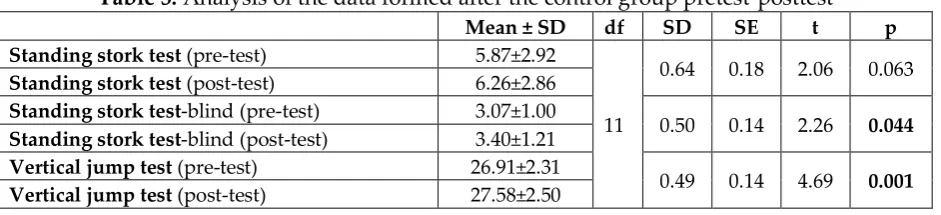
Table 3: Analysis of the data formed after the control group pretest-posttest
Mean ± SD df SD SE t p Standing stork test (pre-test) 5.87±2.92
11
0.64 0.18 2.06 0.063
Standing stork test (post-test) 6.26±2.86
Standing stork test-blind (pre-test) 3.07±1.00
0.50 0.14 2.26 0.044 Standing stork test-blind (post-test) 3.40±1.21
Vertical jump test (pre-test) 26.91±2.31
0.49 0.14 4.69 0.001 Vertical jump test (post-test) 27.58±2.50
3. When the values of the control group, where only volleyball was played for 8 weeks, the eye open stork test was not statistically significant at the level of p> 0.05, the eye-door stork test and the vertical jump test were statistically significant at the level of p <0.05.
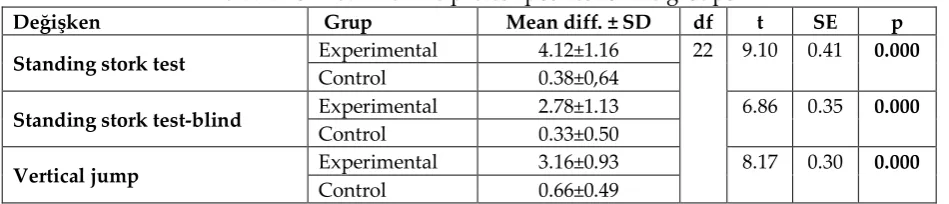
Table 4: Comparison of the differences of the data formed after the pretest-posttest of the groups
Değişken Grup Mean diff. ± SD df t SE p
Standing stork test Experimental 4.12±1.16 22 9.10 0.41 0.000
Control 0.38±0,64
Standing stork test-blind Experimental 2.78±1.13 6.86 0.35 0.000
Control 0.33±0.50
Vertical jump Experimental 3.16±0.93 8.17 0.30 0.000
Control 0.66±0.49
The findings obtained in the analysis made by taking the differences of the pretest-posttest data obtained from the subjects are presented in Table 4. After the research, volleyball training was applied to the experimental group besides 8-week core training, and only volleyball training was applied to the control group. Findings show that there is a significant difference between the experimental group and the control group in terms of balance and vertical jump values at p <0.05 level.
4. Discussion
The average age and height of the experimental and control groups participating in this study are close to each other, which shows that our study groups are homogeneous. After the core training and volleyball studies applied to the experimental group for 8 weeks, the eye open stork test pretest was found to be statistically significant at p <0.05 level, measured as 7.14 ± 3.44 cm, posttest 11.26 ± 3.81 cm. Blindfolded stork test pretest 4.15 ± 2.17 cm posttest 6.85 ± 1.52 cm measured as p <0.05 statistically significant. After the volleyball studies carried out by the control group, the eye open stork test pretest was 5.87 ± 2.92 cm posttest 6.26 ± 2.86 cm. statistically significant at the measured p <0.05 level. When the mean difference values of both groups were compared after the study, the experimental group eye stork test pretest-posttest mean difference was found to be 0.38 ± 0.64 cm in the 4.12 ± 1.16 cm control group and it was found statistically significant at the level of p <0.05. When the mean difference values of the blindfolded stork test were compared, it was found as 0.33 ± 0.50 cm in the pretest-posttest experiment group, 2.78 ± 1.13 cm, and it was found statistically significant at the level of p <0.05.
In their studies on sprinters, Franco et al. (2012) performed a core training program for 6 weeks and obtained a positive result in the study in which they investigated the effects of core exercises on open-closed balance (8).
Freeman et al. (2010) performed core training exercises on Multiple Sclerosis (MS) patients for 8 weeks and obtained positive results in the balance and gait of the patients (9). He observed the significant training changes of the dynamic balance characteristics of the athletes who applied the core training studies of Samson (2005) on individuals who do tennis sports (10).
Hessari, Norasteh, Daneshmandi, and Ortakand (2011) reported that in their
research titled “The effect of 8 weeks core exercise on the balances of deaf students”, it
increased the balance of core training (11).
In the study of Yaggie et al. (2006) on the effect of athletes on the static balance of core training, they used the empty ball and observed significant changes in the balance characteristics of the athletes as a result of their training for 4 weeks (12).
Emery et al. (2005) stated that the work done on the Wobble board on healthy adolescents for 6 weeks had positive effects on dynamic balance and static balance, and the subjects concluded that the disability risks that were followed for 6 months decreased (13).
Aggarwal et al. (2010) concluded that dynamic balance training is more meaningful in the study where they examined the effects of core stability and balance training on dynamic balance and static balance (14).
During the preparation period, Larcom (2013) conducted studies to indicate how the balance training affects the performance, in addition to the athletes playing American football, he had wobble boar and core balance training and observed that the balance performances of the athletes improved after the study (15).
Yüksel et al. (2016) applied the effect of 8-week core training exercises on dynamic balance on basketball players, and performed Star Excursion Balance test in their exercises, as a result of their studies, they obtained significant changes in the dynamic balance and hit shots of athletes (16).
The results of our studies with the data obtained in the literature are in parallel. The positive effects of core training studies on balance are considered, and our study supports the information in the literature.
Significant results were obtained in both groups in terms of vertical jump test, the fact that this result was significant in the experimental group supports the effect of the 8-week core training and volleyball study on vertical jump. It is thought that obtaining significant value of the control group has a positive effect on the vertical jump of their volleyball exercises for 8 weeks. It can be said that the core training exercises carried out by the experimental group have more impact than the volleyball exercises carried out by the control group.
Martel et al. (2005) had volleyball training for 6 weeks with plyometric training in water, volleyball training and flexibility training for the other group, and the effects of these training on vertical jump were examined at both intervals. While preliminary - postliminer test was applied at the beginning and end of the 4th week, no change was observed in the 4th week, while ploymetric training in water in the 6th week helped to reduce muscle pain, was seen as a promising training option (17).
In their study, Agopyan et al. (2018) examined the effects of "resistance band strength exercises applied on young female volleyball players on vertical jump, dunk hit speed and lower extremity peak strength parameters". They found that more meaningful results were achieved at height (18).
Şen's (2003) divided the subjects into two groups, examining the effects of the explosive force on the bounce properties of basketball players between the ages of 12-14 for 8 weeks, and the effects of anthropemetric, physical properties on physiological parameters were measured and as a result, they established a clear superiority on the vertical bounce values of explosive force studies. a significant improvement has been achieved (19).
In a study by Thomas et al. (2008) on the effects of different training programs on vertical jump, he divided the group into three. He applied plyometric training with wrestling balls to the first group of 12 people. The second group of 23 people had one day ball play 4 days a week strength training. The last group of 15 people had strength training and plyometric training. As a result of the studies, while there was a significant difference in vertical jump characteristics in all 3 groups, the values of 2 and 3 groups were more significant (20).
Markovic (2007), in the study where he studied the full effect of plyometric training on vertical bounce on healthy individuals for 4 weeks, combined the studies in which the subjects stood by jumping, active bounce, fall bounce and mutual jumps. As a result of the studies, it has obtained significant results in the effects of ploymetric training on vertical jump on healthy individuals (21).
The effect of the core training we performed on the vertical jump shows parallelism with the results in the literature. It is thought that the core exercises performed on the vertical jump have positive effects, and our study supports the information in the literature.
<0.05, while the control group was found to be statistically significant at the level of the eye open stork test at p <0.05, while the blindfold test and the vertical jump test at the level of p <0.05 were statistically significant. As a result, it can be said that the core training program applied with volleyball training has positive effects on balance and vertical jump performances in female volleyball players. Core training practices can be recommended to athletes and coaches to increase volleyball performance.
References
1. Wulf G. (2007). Attention and Motor Learning. Human Kinetics, Champaign, IL, 2007. 2. Koç H., Büyükipekci S. (2010). Basketbol ve Voleybol Branşlarındaki Erkek Sporcuların Bazı Motorik Özelliklerinin Karşılaştırılması. Mustafa Kemal Üniversitesi
Beden Eğitimi Ve Spor Bilimleri Dergisi; 1(1): 16-22.
3. Yılmaz Y. (1989). Voleybol Sporunda Antropometrinin Önemi. Ankara Üniversitesi,
Sağlık Bilimleri Enstitüsü, Yüksek Lisans Tezi, 154 sayfa Ankara, (Prof. Dr. Berna Alpagut).
4. Şatıroğlu, S., Arslan, E. ve Atak, M. (2013). Voleybolda core antrenman uygulamaları
5. Antrenman bilimi kongresi sunuldu, Ankara.
5. Özmen T., Güneş G. Y. (2017). Prepupertal Amatör Jimnastikçilerde Dinamik Denge,
Dikey Sıçrama ve Gövde Stabilitesi Arasındaki İlişki. Spor Bilimleri Dergisi.
2017;28(1):24-9.
6. Altan T., Eliöz M., Çebi M., Ünver Ş., Aşkın A. T. (2016). Basketbol antrenmanın
eğitilebilir zihinsel engelli çocukların motorik özelliklerine etkisinin incelenmesi. Spor
ve Performans Araştırmaları Dergisi;7(1):29-35.
7. Şahin E. (2020). Core egzersizlerin 12-14 yaş arası bayan voleybolcularda denge ve dikey sıçrama üzerine etkisi. Yüksek Lisans Tezi, Gaziantep Üniversitesi, Sağlık
Bilimleri Enstitüsü.
8. Romero-Franco, Natalia, et al. (2012). Effects of proprioceptive training program on core stability and center of gravity control in sprinters." The Journal of Strength & Conditioning Research 26.8: 2071-2077.
9. Freeman J. A., Gear M., Pauli A., Cowan P., Finnigan C., Hunter H., Mobberley C., Nock A., Sims R., Thain J. (2010). The effect of core stability training on balance and mobility in ambulant individuals with multiple sclerosis: a multi-centre series of single case studies. Mult Scler; 16(11):1377-84
10.Samson K. M. (2005). The effects of a five-week core stabilization-training program on dynamicbalance in tennisathletes. 2005: West Virginia University.
11.Hessari F. F., Norasteh A. A., Daneshmandi H., Ortakand S. M. (2011). The Effect of 8
Weeks Core Stabılızatıon Traınıng Program On Balance In Deaf Students. Med Sport
(2011). 15 (2): 56-61, Iran.
13.Emery, C. A., Cassıdy, J. D., Klassen, T. P., Rosychuk, R. J., & Row E, B. H. (2005).
Effectiveness of a home-based balance-training program in reducing sports-related injuries among healthy adolescents: a cluster randomized controlled trial. Canadian Medical Association Journal, 172(6), 749-754.
14.Aggarwal, A., Zutshi, K., Munjal, J., Kumar, S. and Sharma, V. (2010). Comparing Stabilization with Balance Training in Recreationally Active Individuals. International Journal of Therapy And Rehabilitation. 17(5), 244-253.
15.Larcom, A. (2013). The Effects of Balance Training on Dynamic Balance Capabilities in the Elite Australian Rules Footballer, Master Thesis, Victoria University, School of Sport and Exercise Sciences, Master Thesis of Applied Science, Australia.
16.Yüksel, O., Akkoyunlu, Y., Karavelioğlu, M. B., Harmancı, H., Kayhan, M. ve Koç, H.
(2016). Basketbolcularda Core Alt Ekstremite Kuvveti Antrenmanlarının Dinamik
Denge ve Şut İsabeti Üzerine Etkisi. Marmara Üniversitesi Spor Bilimleri Dergisi. 1(1),
495-499.
17.Martel G. F., Harmer M. L., Logan J. M., Parker C. B. (2005). Aquatic Plyometric Training Increases Vertical Jump in Female Voleyball Players. Medicine & Science in Sports & Exercise; 37(10):1814-1819.
18.Agopyan, A., Ozbar, N., & Ozdemir, S. N. (2018). Effects of 8-Week Thera-Band Training on Spike Speed, Jump Height and Speed of Upper Limb Performance of Young Female Volleyball Players. International Journal of Applied Exercise Physiology, 7(1), 63–76.
19.Şen A. (2003). 12-14 Yaş Grubu Basketbolcularda Uygulanan Patlayıcı Kuvvet
Çalışmalarının Sıçrama Özelliği Üzerindeki Etkileri. Sakarya Üniversitesi Sosyal Bilimler Enstitüsü, Yüksek Lisans Tezi. 131 Sayfa Sakarya. (Doç. Dr. Sevda Bağır).
20.Tomasz B., Jerzy U. (2008). The Effect Of Plyometrıc Traınıng On Strength-Speed
Abılıtıes Of Basketball Players. Research Yearbook 2008; 14(1):14-19.
21.Markovic G. (2007). Does Plyometric Training İmprove Vertical Jump Height A Meta
Creative Commons licensing terms