Ex uno
,
multis
: taxonomic revision in
Navarretia divaricata
(Polemoniaceae) and the recognition of four additional
cryptic or near-cryptic species
Leigh A. Johnson1, David Gowen2
1 Department of Biology and M.L. Bean Life Science Museum, Brigham Young University, Provo, Utah 84602, USA 2 111 Roble Road, Oakland, California 94618, USA
Corresponding author:Leigh A. Johnson ([email protected])
Academic editor:P. de Lange | Received 9 October 2017 | Accepted 20 November 2017 | Published 5 December 2017
Citation: Johnson LA, Gowen D (2017) Ex uno, multis: taxonomic revision in Navarretia divaricata (Polemoniaceae) and the recognition of four additional cryptic or near-cryptic species. PhytoKeys 91: 39–83. https://doi.org/10.3897/ phytokeys.91.21530
Abstract
Navarretia divaricata, endemic to western North America and most recently considered a single species with two subspecies, was re-examined in light of field work, DNA sequences, comparative morphology, and a review of herbarium specimens including types. From these studies, we lectotypify the material on which N. divaricata is based, elevate N. divaricata subsp. vividior, which is an allotetraploid, to species rank (as N. vividior comb. et stat. nov.), and recognize three additional species: N. modocensis sp. nov., N. aeroides sp. nov., and N. torreyella sp. nov.Navarretia modocensis, the diploid paternal progenitor of N. vividior, is morphologically cryptic with respect to its allotetraploid offspring and difficult to distin-guish on herbarium sheets. Navarretia aeroides, the diploid maternal progenitor of N. vividior, is nearly cryptic, but more easily distinguished from both N. modocensis and N. vividior by its smaller, more glan-dular inflorescences. Navarretia torreyella is readily distinguished from all of these species, but has been generally mistaken for N. divaricata subsp. vividior given its colored corolla tube and rare co-occurrence with the other vividior-like species. Conservation assessments, an identification key, and table of compara-tive morphological features are provided for each species, emended descriptions for N. divaricata and N. vividior, and a discussion of the syntypes for Gilia divaricata Torr. ex A.Gray.
Keywords
allopolyploidy, California, conservation assessment, exclusivity, species delimitation, taxonomy, unified species concept, western United States
http://phytokeys.pensoft.net
Copyright Leigh A. Johnson, David Gowen. This is an open access article distributed under the terms of the Creative Commons Attribution License
Introduction
Multiple criteria applied to assess the presence of homogenizing gene flow under the framework of the unified species concept (de Queiroz 2007) has provided strong evi-dence for the existence of previously unrecognized lineages in Polemoniaceae,
includ-ing in Navarretia (Johnson and Cairns-Heath 2010, Johnson et al. 2012, 2013, 2016).
Overlooked in the past because they resemble other species, re-examination of mor-phological variation in conjunction with molecular data has enabled these cryptic or nearly cryptic lineages to be delineated and lifted from obscurity as recognized taxa. In some cases, molecular data provided the first clues as to the uniqueness of these taxa (e.g., Johnson and Cairns-Heath 2010, Johnson et al. 2012), whereas in other cases, morphological variation was recognized first, and the biological significance of this variation confirmed with molecular data (Johnson et al. 2013, 2016). Stimulated by a need for nomenclatural housekeeping along with observations of variation in both morphological and molecular data, we here delimit several near-cryptic species from
what previously has been considered a single species, Navarretia divaricata Greene.
Within Navarretia Ruiz & Pav., N. divaricata is one of the more widely distributed
species with populations extending from central California (and adjacent Nevada) to
Idaho and British Columbia. It is also one of the smallest-flowered Navarretia. The
taxonomic concept associated with N. divaricata has been fairly stable since Greene’s
treatment of the species in this genus (Greene 1887), and Jepson’s subsequent parti-tioning of “coarser” specimens with more glandular-puberulent bracts and calyces, and
blue or blue-lobed corollas into variety vividior Jeps. & V.L.Bailey (in Jepson 1943;
currently subsp. vividior (Jeps. & V.L.Bailey) H.Mason). To preserve this stability,
clarification of the type for N. divaricata Greene and lectotypification of the basionym
upon which Greene’s replacement name is based is necessary. Furthermore, stemming
from observations that N. divaricata subsp. divaricata does not form a
monophyl-etic group with N. divaricata subsp. vividior in comparative DNA sequence analyses
(Johnson et al. 2016), that the two taxa co-occur without signs of hybridization, and
that material assigned to N. divaricata subsp. vividior is polymorphic, we initiated
fieldwork, a comprehensive review of herbarium specimens, and investigation of mor-phological and molecular variation across the geographic ranges of these taxa. Results
indicate that N. divaricata subsp. vividior merits recognition at the species level, and
that four evolutionarily unique lineages exist in the material heretofore generally
re-ferred to subsp. vividior. The taxonomy of this group is revised accordingly.
Historical background
Among plants provided to Asa Gray by John Torrey, two Navarretia collections are
relevant to the present study. The first, labeled simply “Navarretia” by Torrey, was
col-lected during his 1865 trip to California. The second, colcol-lected by Mr. Shelton, was
con-specific, but having a confused view of generic relationships in Polemoniaceae (Mason
1945), he published this new species, attributed to Torrey, in the genus Gilia (i.e., Gilia
divaricata Torr. ex A.Gray) where Gilia divaricata Nutt. (≡ Allophyllum divaricatum (Nutt.) A.D.Grant & V.E.Grant) already existed. Consequently, Gray’s action created an illegitimate later homonym that was replaced by Greene (1887). In the protologue, Gray (1870) states, “California, along the foot hills of the Sierra Nevada, coll. Shelton, Rattan, Bolander, Torrey, Mrs. Davis, C. Lee,” providing four additional syntypes be-yond the two that can be traced to Torrey. The last of these, a specimen attributed to C. Lee, cannot be located and its identity remains unknown to us. The remaining five syntypes represent four distinct taxa. Consequently, the choice of lectotype is critical
for maintaining the long-used taxonomic concept for N. divaricata.
Gray (1876, 1878) continued to recognize Gilia divaricata Torr., using
descrip-tions similar to his original. These descripdescrip-tions accentuate characteristics of the syntype Rattan s.n. (NY!; probable duplicates at UC × 2 (scan!), US (scan!), KEW (scan!)), which has larger flowers and a more densely pubescent head compared to the other syntypes, and is also a mixed collection from two gatherings. These specimens are
to-day recognized as N. prolifera Greene, which has the narrowest distribution of the taxa
represented by Gray’s syntypes.
Emphasizing the distinctiveness of the calyx in Navarretia, Greene (1887) began
the work of narrowing Gray’s concept of Gilia and provided a replacement name for
Gray’s illegitimate homonym by equating N. divaricata Greene with Gilia divaricata
Torr. ex Gray. There is no indication that Greene viewed the syntypes Gray worked
with, and good reason to believe he did not—for example, he described N. prolifera as a
new species immediately preceding N. divaricata, with no reference to any of the Gilia
divaricata Torr. ex Gray syntypes. Greene characterized N. divaricata flowers as “min-ute” and distributed in the Sierra Nevada from Kern County northward into Oregon;
he distinguished this taxon from N. prolifera and N. peninsularis Greene in part based
on smaller flower size. Beyond the description provided for N. divaricata, Greene’s
taxonomic concept can be reconstructed by examining the specimens he worked with.
Four sheets with five collections exist at NDG (scans!) labeled “Navarretia divaricata
Greene”, in Greene’s hand, with collection dates prior to Greene’s publication, and a sixth specimen, also on one of the four sheets, with a preprinted label collected in the
year of his publication, labeled “Gilia divaricata Torr.” Of these, Greene referenced two
in his publication.
M. K. Curran s.n. [NDG-40817], from Tehachapi, Kern County, California, was cited as representing the southern extent of the species range, but differs taxonomically
from the other specimens and is equivalent to N. peninsularis. Interestingly, this
collec-tion represents the northern extent of the latter species rather than the southern extent of N. divaricata. Greene described N. peninsularis based on larger plants from Low-er (Baja) California, considLow-erably distant from Tehachapi, so pLow-erhaps the Tehachapi
plants being more depauperate and proximal to other N. divaricata specimens played
a role in his misidentification and efforts to circumscribe taxa with little material on
as a putative hybrid between N. divaricata and N. minima Nutt. without explanation.
This specimen, along with C. C. Parry s.n., (Yosemite) [NDG-40820A], D. Cleveland
s.n. (Butte County) [NDG-40820B], and T. Howell s.n. (near Waldo, Oregon)
[NDG-40819B] all correspond to material congruent with Gray’s syntypes Bolander 4908 and
Mrs. Davis 49, while a second M. K. Curran s.n. specimen, from Colusa County,
Cali-fornia [NDG-40818], is congruent with Gray’s syntype Torrey 302 discussed further
below. Gray’s syntypes Bolander 4908 and Mrs. Davis 49 have minute flowers and the
species represented by them is the most common and widely distributed
geographi-cally of Gray’s syntypes, as well as the entity to which the name N. divaricata subsp.
divaricata has been applied.
Greene’s taxonomic concept influenced nearly all later botanists. For example,
Howell (1901) indicated N. divaricata occurs from “Washington to California, in the
high mountains,” with a description that borrowed more from Greene’s description of the species than Gray’s. Though referencing neither Gray nor Greene, the publication of Gilia atrata M.E.Jones with its type and two of three paratypes matching Bolander 4908 and Mrs. Davis 49 (and the third a similarly small-flowered entity that would fit within Greene’s concept) may stem from Jones’ (1908) recognition that Gray’s name
was illegitimate while disagreeing with Greene in recognizing Navarretia as distinct
from Gilia.Gilia atrata has not appeared in print, other than as a synonym, beyond its
original publication.
The syntype Torrey 302 was gathered in Lake County, California, well removed
from the Sierra Nevada. Circa 1936, Virginia Bailey began a study of N. divaricata
and noticed four specimens from Butte, Lake, and Mendocino counties that were stouter of habit, slightly larger flowered, produced more seeds per locule, and possessed
blue corollas or corolla lobes (note attached to Austin 827, UC!). Torrey 302, though
not seen by her, fits naturally into the group she was segregating. Jepson (1943) with
Bailey, recognized this material as a variety of N. divaricata and chose a specimen
also from Lake County as the type. Jepson and Bailey’s taxonomic concept for the
two varieties of N. divaricata is clear, with all 17 representative specimens listed for
N. divaricata var. divaricata morphologically congruent with Bolander 4908 and Mrs. Davis 49, and nine representative specimens listed for var. vividior (paratypes) that all share the larger flowering heads, more robust habit, and larger/more glandular heads
as described by Jepson and Bailey. Thus, in recognizing var. vividior, Jepson and Bailey
followed a taxonomic concept for the typical variety of N. divaricata that matches
the syntypes Bolander 4908 and Mrs. Davis 49, despite not examining these syntypes
or making reference to them. Mason (1951) treated these varieties as subspecies, but otherwise did nothing to alter the taxonomic concept for them. The description by
Cronquist et al. (1984) of N. divaricata includes features, such as unequal valves and
two of the three stigmas almost entirely fused, that exist only in material congruent
with var. divaricata as put forth by Jepson and Bailey, and congruent with the syntypes
Bolander 4908 and Mrs. Davis 49.
The remaining syntype, Mr. Shelton s.n. (NY!), is distinct morphologically from
divaricata, yet has a purple corolla throat and tube, three equal valves, and three equal stigma lobes that readily separates it from that taxon. While material matching this syntype was available to Jepson and Bailey, none of those collections were included
in the list of representative specimens for either var. divaricata or var. vividior. No
locality information is provided for Mr. Shelton’s collection, though the material that it matches occurs in only a portion of the Sierra Nevada, with known occurrences in close proximity to Sacramento where he lived (Ewan 1981). Mr. Shelton’s specimen
is of particular interest because it is the only syntype labeled “Navarretia divaricata n.
sp.” in Torrey’s hand. An unpublished annotation attached to the sheet at NY, upon
which Mr. Shelton s.n. and three of the remaining five syntypes are mounted,
sug-gests Shelton’s collection is the lectotype—attributing the first step to Jepson (1943) and the second step to Cronquist (1984). We, however, disagree with the inferences made by this annotation. Jepson did not specifically state he was indicating the type, but instead restated the type locality published by Gray with his exact words read-ing, “type loc. ‘foothills of the Sierra Nevada,’ Shelton (the first named collector).” This falls short of specifying the Shelton collection as the lectotype, particularly since there is no indication on the sheet that the Shelton collection comes from the Sierra Nevada (even though we have determined, based on morphology, that it does). Jepson (1943) elsewhere explicitly indicates his observation of types, such as the isotype for N. peninsularis, but no such indication is provided for N. divaricata. It is unlikely Jep-son would have specified as lectotype a specimen that varied from the concept he and Bailey defined through extensive specimen citations. Cronquist et al.’s actions also do
not constitute a second step lectotypification. The treatment of N. divaricata in this
work states “Shelton s.n., Sierra Nevada, Calif., is the first specimen cited by Gray, and the only one annotated by Torrey as ‘n. sp.’; isotype at NY!” Importantly, the citation
above is not an act of lectotypification; the first volume of the Intermountain Flora
expressly states, “When one of several collections cited in the protologue is obviously the primary basis for a name, we have given it as the type, without further comment. Sometimes the typification is less clear and a more cautious statement is necessary. Our citation is not to be taken as the formal selection of a lectotype, except when specifi-cally so indicated” (Cronquist et al. 1972: 8).
To summarize, for over 125 years, the name Navarretia divaricata has been equated
with a divaricately branched plant with minute flowers and branches that often arise immediately below a flowering head. Since 1943, the typical variety or subspecies has been associated with specimens having whitish flowers that dry with pink lobes, and a whitish to yellowish lower throat (sometimes streaked with red) and upper tube. Such
plants are represented among the syntypes of Gilia divaricata Torr. ex Gray by Bolander
4908 and Mrs. Davis 49. Choosing either Rattan s.n. (based on Gray’s original
descrip-tion, though multiple gatherings is problematic) or Mr. Shelton s.n. (based on
Tor-rey’s designation) as lectotype would result in needless and confusing nomenclatural
shuffling for one of the most recognizable and geographically widespread Navarretia
species. Similarly, considering N. divaricata Greene to represent a new name with
clearly not Greene’s intent), would make N. divaricata synonymous with N. peninsu-laris. This action would necessitate a new combination for the entity under
considera-tion based on Gilia atrata M.E.Jones, a name buried in obscurity and unused since its
original publication. As allowed by the code, we advocate the continued interpretation of Greene’s name as a replacement for Gray’s, with Gray’s syntypes as the original material, and designate one of these syntypes as lectotype to serve as the basionym of N. divaricata Greene.
Taxonomic treatment
Navarretia divaricata Greene, Pittonia 1(8): 136. 1887 emend. L.A.Johnson & D.Gowen
Figs 1, 2
Gilia divaricata Torr. ex A.Gray, Proc. Amer. Acad. Arts 8: 270. 1870, non Gilia di-varicata Nutt. 1848.
Type: United States of America. California: Mariposa County, Yosemite trail,
1866, Bolander 4908 (lectotype, designated here: GH scan! [GH-00274983];
isolectotypes: UC scan! [UC-23512], YALE scan! [YU-065402], US scan!
[US-322192], KEW, middle of three specimens, flanked on either side by Rattan s.n,
scan! [K-000769074]). Replaced synonym.
Gilia atrata M.E.Jones, Contr. W. Botany 12: 55. 1908.
Type: United States of America. Idaho: Washington County, Salmon Meadows,
4000 ft, 22 July 1899, Jones s.n. (holotype: POM, top three specimens on sheet,
scan! [POM-75127]).
Navarretia prolifera Greene var. breviflora M.Peck, Proc. Biol. Soc. Washington 50(24): 94. 1937.
Type: United States of America. Oregon: Douglas County, Diamond Lake, 3
July 1936, Peck 19234 (holotype: WILLU! [WILLU-18416]; isotype: OSC scan!
[OSC-43592]).
Type. Based on Gilia divaricata Torr. ex A.Gray, non Gilia divaricata Nutt. 1848.
Emended description. Taprooted annual herbs to 15 cm tall and 20 cm wide,
Figure 1.Navarretia divaricata. A Pressed specimen showing plant habit, scale bar = 1 cm (Johnson 14-143) B Flowering head in the field, scale bar = 2 mm (Johnson 15-045) C–E Equivalent magnification, scale bar = 2mm C Pressed flowering head showing typical coloration of dried flowers (Johnson 16-024) D Dried fruit, showing dehiscence from base upward typical in all of the species detailed herein (Johnson 16-024) E Fresh flowering head dissected with corolla removed to show style and two-lobed stigma (with third lobe nearly entirely fused to one of the two apparent lobes; Johnson 16-024) F, G Fresh flowers showing typical coloration (Johnson 15-045), equivalent magnification, scale bar = 2 mm. All photographs by L. A. Johnson and vouchers deposited at BRY.
less than 0.5 mm long. Cotyledons two, linear, entire, united at base. Leaves somewhat
commonly with 1–3 paired or unpaired linear lateral lobes 1–5 mm long attached along
the proximal 3(–15) mm of the leaf, with an elongated, linear terminal segment.
Inflo-rescences head-like, generally ≤ 10 mm diameter (exclusive of bract tips; ~15 mm with bract tips), mostly less than 15 flowered, villous proximally, obscurely glandular. Inflo-rescence bracts < 10(–13) mm long, ± palmatifid to subpalmatifid; outermost 1–2 bracts with a short achlorophyllous base and 2–3 pairs of lateral lobes flanking an elongate terminal lobe, the distal pair of lateral lobes sometimes shorter and reflexed somewhat out of plane relative to the other lobes; bract bases become larger and clasping centrip-etally with lateral lobes reduced to a single pair departing from near the apex of the bract base flanking the central terminal lobe, all bract lobes chlorophyllous, entire, long taper-ing acute. Bracts sparsely villous abaxially, more densely villous adaxially and proximally along the lobes just above their point of attachment, with the distal 1/2 of each lobe
more or less glabrous or with a few minute stipitate glands. Flowers actinomorphic,
calyces mostly 4.5–7.5 mm long, tube ~ 1.5–2 mm; costae entire, long tapering acute, strongly unequal to subequal with typically two costae longer than the other three; costae narrowing proximally, the shorter ones narrower at base than the intercostal membrane and the longer ones subequal with the membrane; calyx tube achlorophyllous, minutely glandular-puberulent on the intercostal membrane with the costae at least somewhat villous, the trichomes longest along the costae at the junction with the intercostal mem-brane, the free portion of the costae glabrous to very sparsely and minutely glandular
distally; intercostal membrane v-shaped at sinus. Corolla generally shorter than longest
calyx costae at anthesis but exceeding the calyx as fruit matures, narrowly funnelform, glabrous, 3.5–5.0 mm long, lobes 0.6–1.0 mm long × 0.4–0.9 mm wide, proximal tube white, distal tube and throat yellow, sometimes red-streaked, transitioning to white lobes suffused with pink or lavender at tips (drying pink); tube base expanding and investing
the fruit apex. Stamen filaments unequal, 0.1–0.6 mm long, inserted unequally to
sub-equally 0.2–1.0 mm below corolla sinuses, included in throat to slightly exserted; pollen white, apertures pantoporate, acolpate; sexine seimitectate, reticulate, heterobrochate.
Ovary two-chambered, unequally three-valved with two values bearing a septum and the third valve smaller and lacking a septum entirely or nearly so, stigma obscurely three-lobed, minute, unequally divided with two stigmatic lobes nearly entirely fused, generally included in the corolla throat; capsules mostly 2–2.5 mm long, dehiscing circumcisally around the base with valves splitting upward loculicidally (completely) and septicidally
(partially). Seeds generally 5–9(–12) per fruit, medium brown, ovoid-angular,
mucilagi-nous when wet. Nuclear gene loci showing diploid PCR amplification patterns.
Habitat, distribution, and phenology.Navarretia divaricata occurs on a variety
of soils from (800)1000–2600 meters in foothill and mountain habitats. It is widely distributed from Santa Barbara and Tulare Counties, California in the south to just within the borders of British Columbia, Canada, in the north, and east to Nevada and Idaho (Fig. 2). Flowering time is (May)June–July(September).
Conservation status.Navarretia divaricata has many occurrences throughout its
Figure 2. Distribution of Navarretia divaricata (black squares) occurrences across its native range in the western United States.
species is otherwise well established. It is a species of Least Concern following IUCN (2012) Red List version 3.1 criteria.
Etymology. From the Latin divaricatus, to spread or diverge at a wide angle, which
aptly describes the characteristic repeated pattern of nearly leafless stems diverging from under flowering heads to give rise to additional, well-separated flowering heads in this species and its morphological allies.
Representative specimens examined. CANADA. British Columbia: Anarchist
Mt., 1.6 km north of Hwy 3 rest stop, 6.5 km due east of Osoyoos Lake, 49.0275°N,
119.35°W, 1350 m, 10 July 2000, Lomer 3838 (UBC Scan); Anarchist Mt., 7 km due
east of Osoyoos Lake, 1.5 km due southwest of summit, 200 m northeast of tower,
UNITED STATES OF AMERICA. All seventeen specimens cited by Jepson
(1943) under Navarretia divaricata var. divaricata (JEPS); California:Alpine
Coun-ty, North side of Hwy 88 along an old dirt road, 38.7240°N, 119.9542°W, 2262
m, 10 July 2014, Johnson 14-179 (BRY); Amador County, down slope from Tragedy
Springs Monument, 38.6389°N, 120.1465°W, 2406 m, 8 July 2014, Johnson 14-159
(BRY); Butte County, ca. 0.7 miles up Humboldt Rd to Butte Meadows from Hwy 32,
40.0407°N, 121.6056°W, 1204 m, 11 June 2015, Johnson 15-045 (BRY); Calaveras
County, at entrance to old lumber road off of Hwy 4 ca. 1.6 miles northeast of Camp
Connell Maintenance station, 38.3356°N, 120.2278°W, 1 July 1993, Johnson 93-112
(BRY); North side of Avery-Sheep Ranch Road ca. 2 miles from Hwy 4, 38.1969°N,
120.4003°W, 1098 m, 4 June 2014, Johnson et al. 14-068 (BRY); El Dorado County,
ca. 0.1 mile west of NF-8N55 on Omo Ranch Road, 38.5542°N, 120.5401°W, 1172
m, 29 May 2013, Johnson 13-189 (BRY); off road to Ice House Reservoir, 6.4 miles from
jct. with Hwy 50, 38.7975°N, 120.4028°W, 1596 m, 30 May 2013, Johnson 13-219
(BRY); Sly Park Vicinity, Park Creek Road 3.7 miles from county road E16, 38.7493°N,
120.4970°W, 1207 m, 8 July 2014, Johnson 14-141 (BRY); Lassen County, west of
county road A21along dirt road leading to large moist swell, 40.3601°N, 121.0039°W,
1589 m, 2 August 2006, Johnson 06-129 (BRY); Nevada County, 39.32°N, 120.75°W,
1565 m, 3 June 2014, Johnson et al. 14-018 (BRY); Placer County, Off Sawtooth
Ridge Rd ca. 1.1 mile west of Dawson Spring, 39.21787°N, 120.6226°W, 1670 m, 3
June 2014, Johnson et al. 14-029 (BRY); Plumus County, south of Cascade and Lava
Top, access up FS road 21N22YA, 39.6827°N, 121.1665°W, 1402 m, 10 June 2015, Johnson & Ahart 15-024 (BRY); Tehama County, two miles south of Hwy 36/89 on
Hwy 32, 40.2661°N, 121.4509°W, 4590 ft, Johnson 04-140 (BRY); Shasta County, off
Hwy 89 ca. 1.3 miles north of jct with Hwy A19, 41.1612°N, 121.6609°W, 1257 m,
25 June 2011, Johnson & Smith 11-058 (BRY); Trinity County, 10.3 miles north along
Hastings Tie Road (FS-4N12), 40.5626°N, 123.5236°W, 1577 m, 27 June 2017, Johnson & Johnson 17-094 (BRY); Tulare County, Rabbit Meadows vicinity off Forest
Service road 14S11 near 14S13A, T14S R29E S18, 2300 m, Johnson 94-065 (BRY);
Tuolumne County, Twaine Harte vicinity, north side of highway 108, just west of
hairpin in Lava Drive, 38.0266°N, 120.2369°W, 1159 m, 5 June 2014, Johnson et al.
14-077 (BRY); east of the Punch Bowl, north side of 4N12 ca. 5.4 miles east-northeast from junction with highway 108, 38.2386°N, 119.9496°W, 2178 m, 5 June 2014, Johnson et al. 14-108 (BRY); Idaho: Blaine County, two miles above Alturas Lake,
above Alpine Creek, 7400 ft, 23 June 1941, Cronquist 2661 (IDS); Boise County, at
the 62 mile marker of Highway 21, ca. 8 miles south of Lowman, 44.02°N, 115.62°W,
1859 m, 14 July 2003, Porter & Machen 13772 (BRY); Idaho County, Trail to Lake
Serene, 45.1961°N 116.1907°W, 2169 m, 12 July 2013, Smith et al. 11162 (BRY, SRP
scan); Valley County, FR 626, west of Sagehen Reservoir, Sagehen Basin, 44.3196°N,
116.1547°W, 1845 m, 17 July 2011, Smith 9922 (BRY, SRP scan); Brundage Mt.,
7000 ft, 23 July 1940, Davis 2930 (IDS); Nevada: Douglas County, Carson Range,
Genoa Peak Road, 2560 meters, 13 August 1974, Williams 74-D-83 (RENO scan);
June 1974, Tiehm s.n. (RENO scan); Oregon: Crook County, Little Hay Creek vicin-ity, along Forest Service Road 150 0.1 miles north of jct with forest service road 2610,
T13S R19E S22, Johnson 97-133 (BRY); Harney County, Steens Mountain Loop
By-way, 1 km below jct with Kiger Gorge turnoff, 42.69°N, 118.59°W, 8251 ft, 21 July
2007, Johanson 07-76 (WTU scan); Jackson County, Just north of Hwy 66 along
Moon Prairie Rd, 42.1263°N, 122.3321°W, 1161 m, 29 June 2017, Johnson & Johnson
17-147 (BRY); Josephine County, Upper Biglow Lake, 10 July 1949, Baker & Ruhle
385 (IDS scan, WTU scan); Washington: Asotin County, Anatone Butte vicinity ca.
7.2 miles west of highway 129 on West Mountain Road, 1400 m, 2 July 1994, Johnson
& Johnson 94-049 (BRY); ca. 0.5 mile west of Anatone Butte, 10 miles southwest of
Anatone, T7N R45E, S2, 4700 ft, 12 June 1949, Cronquist 5847 (ID scan, WTU scan
WS); Chelan County, Rainbow Creek drainage, ca. 4.5 miles north of Stehekin River,
3000 ft, 19 June 1971, Naas & Naas 851 (WWB scan); Columbia County, Godman
Spring campground, 18.5 miles southwest of Dayton, 46.10°N, 117.7861°W, 1753
m, 12 July 2004, Legler 2014 (WTU scan); Klickitat County, dry hills, Falcon Valley,
18 July 1908, Suksdorf 168 (WTU ×3 scan).
Notes. By elevating Navarretia divaricata subsp. vividior to species status, as done
below, N. divaricata subsp. divaricata henceforth is designated simply N. divaricata.
Fresh N. divaricata have no noticeable odor. The reported presence of this species in
Montana is based on a single, misidentified specimen collected in an agricultural field;
that specimen differs from N. divaricata in branching structure, having pinnately
di-vided leaves, and possessing different bract and calyx morphology (our determination is N. squarrosa (Eschsch.) Hook. & Arn. [MONT-68910 scan!]. Though the
proto-logue provides no mention of N. divaricata, Peck’s rationale for recognizing N. prolifera
var. breviflora as distinct from N. divaricata can be inferred from the key and species
descriptions in the first edition of his Manual of the Higher Plants of Oregon (Peck
1941). Examination of the type reveals it is simply a narrow, more erect N. divaricata
that fits well within the range of variation observed in this species. Peck, perhaps
in-fluenced by Mason (1951), came to realize this and removed N. prolifera var. breviflora
from the second edition of his manual (Peck 1961).
Navarretia divaricata differs from the remaining divaricately branched taxa of Na-varretia (i.e., those treated below plus N. crystallina L.A. Johnson & D.Gowen, N. mi-wukensis D.Gowen & L.A.Johnson, and N. prolifera, in having two of its three stigmatic lobes nearly entirely fused, and in having unequal fruit valves with two of the three valves normal sized and bearing a septum, while the third valve is smaller and lacks a septum entirely or nearly so (Cronquist et al. 1984; personal observation). These other
species have three lobed stigmas and three equal valves, each bearing a septum.
Navarretia vividior (Jeps. & V.L.Bailey) L.A.Johnson & D.Gowen, comb. et stat. nov.
urn:lsid:ipni.org:names:60475570-2 Figs 3, 4
Navarretia divaricata var. vividior Jeps. & V.L.Bailey, Fl. Calif. 3(2): 156. 1943. Navar-retia divaricata subsp. vividior (Jeps. & V.L.Bailey) H.Mason, Ill. Fl. Pacific States 3: 449. 1951.
Type: United States of America. California: Lake County, Mt. Hanna, 15 July
1897, Jepson 15045 (Holotype: JEPS! [JEPS-2659]). Basionym.
Type. Based on Navarretia divaricata var. vividior Jeps. & V.L.Bailey.
Emended description. Taprooted annual herbs to 12(–15) cm tall and 20(–25)
cm wide, sometimes larger, often wider than tall. Primary stem erect, terminating in an inflorescence head 1–2(–4) cm above the cotyledons; generally greatly exceeded by sec-ondary stems, with tertiary, and quaternary stems present on larger plants; higher order branches arise from axils of proximal inflorescence bracts, axils of leaves subtending the primary head, or less commonly, leaves within 1 cm of an inflorescence head; branches ascending to spreading and ± leafless, except for leaves subtending higher order branch-es or within 1 cm of a head; stem and branchbranch-es reddish-brown, commonly glandular-villous, the trichomes generally greater than 0.5 mm (often ± 1mm) long, sometimes glabrescent; distal-most branches generally 0.3–0.5 mm in diameter. Cotyledons two,
linear, entire, united at base. Leaves somewhat glandular-pubescent proximally, less
so distally; leaves at the lowermost nodes opposite, linear-filiform, and widened at the point of stem attachment, the proximal nodes often congested with overlapping leaf bases. More distal leaves alternate, entire, or more commonly with 1–3(–5) paired or unpaired linear lateral lobes 1–10 mm long attached along the proximal 3–5(–15) mm
of the leaf, with an elongated, linear terminal segment. Inflorescences head-like, largest
generally ≥ 12 mm diameter (exclusive of bract tips; ≥ 18 mm with bract tips), mostly 10–25-flowered, glandular-pubescent with some minutely-glandular villous trichomes proximally. Inflorescence bracts < 15(–20) mm long, palmatifid to subpalmatifid; out-ermost 1–2 bracts with a short achlorophyllous base and 2–3(–4) pairs of lateral lobes flanking an elongate terminal lobe, the distal pair of lateral lobes sometimes shorter and reflexed somewhat out of plane relative to the other lobes; bract bases become larger and clasping centripetally with lateral lobes reduced to a single pair departing from near the apex of the bract base flanking the central terminal lobe, all bract lobes chlorophyllous, entire, long tapering acute. Bracts somewhat minutely-glandular vil-lous abaxially, often more densely vilvil-lous adaxially and proximally along the lobes just above the bract base, glands becoming more prominent and their stipe diminishing
in length toward the bract tips. Flowers actinomorphic, calyces mostly 4–7.5(–8.5)
Figure 3. Navarretia vividior. A Pressed specimen showing plant habit, scale bar = 1 cm (Johnson 16-066) B Flowering head in the field, scale bar = 2 mm (Johnson 16-063b) C–F Equivalent magnification, scale bar = 2mm C, D Pressed flowering head showing typical coloration of dried flowers and blue pollen (Johnson 16-029, 16-063b, respectively) E, F Fresh flowers showing typical coloration (Johnson 16-063b). All photo-graphs by L. A. Johnson and vouchers deposited at BRY.
on the intercostal membrane with the costae at least somewhat glandular-villous, the gland stipes longest along the costae at the junction with the intercostal membrane, diminishing in length toward the chlorophyllous costae tips (may be glabrescent with
age); intercostal membrane v-shaped at sinus. Corolla generally equal or shorter than
longest calyx costae at anthesis but exceeding the calyx as fruit matures, narrowly fun-nelform, glabrous, 5.0–7.2 mm long, lobes 0.8–1.1(–1.4) mm long × 0.6–0.9(–1.2) mm wide, tube white proximally, distal tube white or yellow, throat bluish, sometimes streaked with magenta, lobes medium bluish-lavender; tube base expanding and
unequal-ly 0.3–1.3 mm below corolla sinuses, anthers ± included in throat to exserted less than half the length of the corolla lobes; pollen blue (white rarely?), apertures pantoporate,
acolpate; sexine seimitectate, reticulate, heterobrochate. Ovary three-chambered,
stig-matic lobes three, included in to slightly exserted from corolla throat; capsule ~ 2.3– 3.3 mm long, dehiscing circumcisally around the base with valves splitting upward.
Seeds generally 5–7(8) per locule, medium brown, ovoid-angular, mucilaginous when
wet. Nuclear gene loci showing allotetraploid PCR amplification patterns.
Habitat, distribution, and phenology. Navarretia vividior occurs in soils
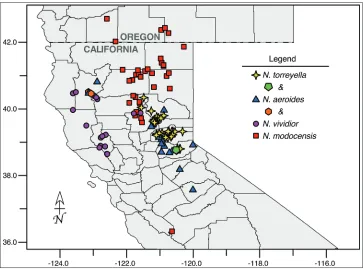
influ-enced by volcanic activity with favorable water status such as the edges of ephemeral pools and transient rivulets, to open flats or gentle slopes in forested areas from 300– 1600 meters elevation. It occurs predominately in the North Coast Range from Lake and Sonoma Counties, California in the south to Humboldt, Trinity, and the western edge of Shasta County in the north (Fig. 4). A few populations cross the central valley and occur on the western flank of the northern Sierra Nevada/southern Cascade Range in Butte County, California, where they flower in late May–early June, rather than late June–July as is typical for species in the North Coast Range.
Conservation status. As defined here, Navarretia vividior is distributed more
nar-rowly than previously considered. Some historical populations have not been revisited for ±100 years, though other known occurrences have been revisited multiple times over the past 20 years with no apparent change in local numbers (beyond what may be expected during drought years). Following IUCN (2012) Red List version 3.1 criteria, this species is most accurately characterized as data deficient, though it likely borders between being Vulnerable to a species of Least Concern.
Etymology. This specific epithet is derived from the Latin vividus, lively or
vigor-ous, with the comparative ending -ior, more so, in reference to the larger, more robust
habit and flowering heads this taxon possesses in comparison to N. divaricata.
Alterna-tive epithets of var. fertilior and var. vividia were considered by Jepson and Bailey for
this entity, as indicated by annotations on the type sheet.
Representative specimens examined. UNITED STATES OF AMERICA.
Cali-fornia: Butte County, North of Magalia at Old Coutelenc Site, along Coutelenc Rd, 1.7
miles south of junction with Skyway at Lovelock, 17 June 1980, Schlising & Banchero
3739 (CHSC); Upper Bidwell Park, Chico, on the north rim overlooking Sycamore
Creek Canyon about 1.8 miles east of the power lines, 1280 ft, 30 May 1983, Oswald
578 (CHSC); South of Cohasset off of Cohasset Highway, T23N R2W S8, 4 June 1979,
Schlising 3435 (CHSC); Colusa County, Along Pacific Ridge Road (16N06) 0.5 miles east of road to Spanish Ridge and Hough Springs, 39.2236°N, 122.625°W, 3450 ft, 3
July 1998, Janeway & Isle 5711 (CHSC); Humboldt County, Waif on river bar, valley of
Van Duzen River opposite Buck Mtn, 1000 ft, 27 June–30 July 1908, Tracy 2721 (UC);
Little Van Duzen River, 23 June 1937, Eastwood & Howell 4813 (CAS); Lake
Coun-ty, Mt. St. Helena, 6 June 1915, Eastwood 4706; Bartlett Springs, 9 June 1938, Jepson
18938 (JEPS); Boggs Lake, at base on Mount Hanna, 29 June 1945, Mason 12629 (DS);
Margin of Boggs Lake, 3000 ft, 29 June 1945, Baker 11088 (CAS); 3.5 miles by road
Figure 4. Distribution of Navarretia vividior (circles), N. modocensis (squares), N. aeroides (triangles), and N. torreyella (4-pointed stars) occurrences across their native range in California and southern Oregon, United States. Instances of observed syntopy are indicated with the hexagon and pentagon, as defined in the legend.
(AHUC); About 1/4 mile down Harrington Flat Road from Bottle Rock Rd, where
ac-cess road follows under powerlines, 2850 ft, 7 June 1981, Knight & Knight 4148 (CAS);
Bogg’s Lake Vicinity, between Harrington Flat Road and the Bogg’s Lake parking area, to the north side of road along the power line corridor, 38.8904°N, 122.7837°W, 862 m,
13 May 2004, Johnson 04-032 (BRY), and 12 July 2016, Johnson 16-029 (BRY); Bartlett
Mountain Ranger Station, 24 Sept 1949, Crampton 494B (AHUC, DAV); About 6.3
miles from Hwy 20 along Bartlett Spring Road, at junction with Pinnacle Rock Road,
39.1345°N, 122.7769°W, 3915 ft, 10 May 2005, Johnson 05-021 (BRY) and 12 July
2016, Johnson 16-032 (BRY); Mendocino County, Chamise Mt. north of Bell Springs,
3500 ft, 9 July 1934, Tracy 13326 (UC); Jeep trail above Bell Springs Rd 11 miles south
of jct with Harris Rd, 39.9667°N, 123.6113°W, 1092 m, 28 June 2017, Johnson &
John-son 17-119 (BRY); Eden Valley Ranch, vernal pool area, north of Hearst, 1249.6 m, 11
July 1978, Wheeler 506 (CAS); Napa County, Gravelly slope in chaparral, edge of the
Crater Country, 13 July 1930, Howell 5347 (CAS); Robert Louis Stevenson State Park;
along trail to Table Rock on East side of Hwy from parking area off Hwy 29, 38.6513°N,
122.5867°W, 802 m, 30 May 2009, Johnson & Gowen 09-049 (BRY); Shasta
3100 ft, 1 July 1996, Oswald, Ahart & Ondricek-Fallsheer 7906 (CHSC) and 13 July
2016, Johnson 16-062 (BRY); 0.3 miles north of Hwy 36 along NF-29, 40.3699°N,
122.9380°W, 893 m, 27 June 2017, Johnson & Johnson 17-052 (BRY); Sonoma County,
Mayacmas Mtns, Caldwell Pines, ca. 3.5 miles west of Glenbrook and Bottle Rock Rd,
38.841°N, 122.815°W, 2350–3000 ft, 27 June 1975, Neilson & Sholars 3294b (DAV);
Tehama County, West of Red Bluff and south of Platina on Forest Route 45 (Tedoc Mtn.
Rd), 6.3 miles south of Hwy 36, 3800 ft, 12 July 1995, Oswald & Ahart 7022 (CHSC)
and 13 July 2016, Johnson 16-058 (BRY); Trinity County, Along Wildwood Rd north
of Hwy 36 between mile post 7 and 8, where drainage crosses and goes under road, 24
June 2005, Gowen 452 (BRY, JEPS) and 13 July 2016, Johnson 16-063b (BRY); 6.2 miles
north of Hwy 36 along Hastings Tie Road, 40.5092°N, 123.5041°W, 1597 m, 27 June
2017, Johnson & Johnson 17-082 (BRY).
Notes.Navarretia vividior are mephic when fresh. Crampton 494B [AHUC-38375]
(collected by McMillan at the Bartlett Mountain Ranger Station) is a voucher for a tetraploid chromosome count from pollen mother cells. Our low copy nuclear gene
data indicate this species is an allotetraploid, with N. modocensis the paternal diploid
parent and N. aeroides the maternal diploid parent. Four of the eight paratypes listed
for N. divaricata var. vividior belong here: Chestnut & Drew s.n. [UC-52826], Tracy 2721 [UC-133661], Tracy 13326 [JEPS-70300], and Jepson 18938 [JEPS-70299]; a
fifth paratype, Condit s.n. [UC-455660], is difficult to place with confidence; it was
collected from ‘garden soil’ and thus its original source is uncertain, but its smaller
corolla features suggest N. vividior. The Torrey 302 syntype of Gilia divaricata Torr. ex
Gray also belongs here.
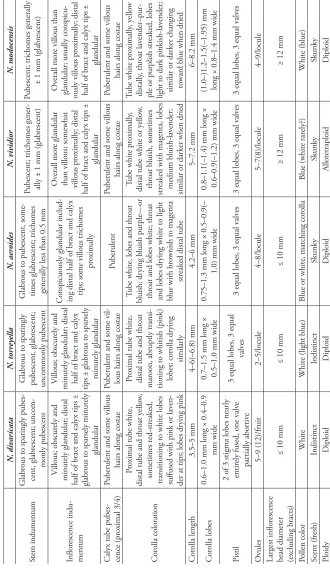
Navarretia vividior is readily distinguished from N. divaricata with its larger flow-ering head, larger flowers, equally divided 3-lobed stigma, typically blue pollen, and bluish-lavender corolla lobes and throat (Fig. 3). Stems are typically larger in diameter and invested with long, gland tipped hairs. The evenly 3-lobed stigmas, larger flowers, and some variation in flower color with colored lobes, throat, or both apply to three
additional species that have heretofore generally fallen under the umbrella of N.
divari-cata subsp. vividior. These species are described and differentiated below.
Navarretiamodocensis L.A.Johnson & D.Gowen, sp. nov.
urn:lsid:ipni.org:names:60475567-2 Figs 4, 5
Type. United States of America. California: Shasta County, west side of Hwy 89, ca
10 miles north of junction with Hwy 299. Meadow area adjacent to railroad tracks,
41.0450°N, 121.6326°W, 2992 ft, 17 June 2004, L.A. Johnson 04-130 (holotype BRY!
[BRY-614952]; isotypes JEPS! RSA! and to be distributed).
Diagnosis. A species similar to Navarretia vividior, but distinguished by being
that tend toward pinkish-lavender lobes with darker throat above a yellowish tube rather than bluish to bluish-lavender lobes with darker throat above a yellowish or whitish tube, and having white (rarely blue) rather than blue pollen.
Description. Taprooted annual herbs to 12(–15) cm tall and 20(–25) cm wide,
sometimes larger, often wider than tall. Primary stem erect, terminating in an inflo-rescence head 1–2(–4) cm above the cotyledons; generally greatly exceeded by second-ary stems, with tertisecond-ary, and quaternsecond-ary stems present on larger plants; higher order branches arise from axils of proximal inflorescence bracts, axils of leaves subtending the primary head, or less commonly, leaves within 1 cm of an inflorescence head; branches ascending to spreading and ± leafless, except for leaves subtending higher order branches or within 1 cm of a head; stem and branches reddish-brown, com-monly glandular-villous, the trichomes generally greater than 0.5 mm (often ± 1mm) long, sometimes glabrescent; distal-most branches generally 0.3–0.5 mm in diameter.
Cotyledons two, linear, entire, united at base. Leaves somewhat glandular-pubescent
proximally, less so distally; leaves at the lowermost nodes opposite, linear-filiform, and widened at the point of stem attachment, the proximal nodes often congested with overlapping leaf bases. More distal leaves alternate, entire, or more commonly with 1–3(–5) paired or unpaired linear lateral lobes 1–10 mm long attached along the
prox-imal 3–5(–15) mm of the leaf, with an elongated, linear terminal segment.
Inflores-cences head-like, largest generally ≥ 12 mm diameter (exclusive of bract tips; ≥ 18 mm with bract tips), mostly 12–20-flowered, sometimes more, glandular-pubescent, gener-ally with conspicuous, minutely-glandular villous trichomes proximgener-ally. Inflorescence bracts < 15(–20) mm long, ± palmatifid to subpalmatifid; outermost 1–2 bracts with a short achlorophyllous base and 2–3 pairs of lateral lobes flanking an elongate terminal lobe, the distal pair of lateral lobes sometimes shorter and reflexed somewhat out of plane relative to the other lobes; bract bases become larger and clasping centripetally with lateral lobes reduced to a single pair departing from near the apex of the bract base flanking the central terminal lobe, all bract lobes chlorophyllous, entire, long tapering acute. Bracts minutely-glandular villous abaxially, often more densely villous adaxially and proximally along the lobes just above the bract base, glands becoming
more prominent and their stipe diminishing in length toward the bract tips. Flowers
actinomorphic, calyces mostly 5–7.5(–12) mm long, tube ~ (1.5–)2–2.5(–3) mm;
cos-tae entire, long tapering acute, strongly unequal to subequal with typically two coscos-tae longer than the other three; costae narrowing proximally, the shorter ones narrower at base than the intercostal membrane and the longer ones subequal with the mem-brane; calyx tube achlorophyllous, glandular-puberulent on the intercostal membrane with the costae at least somewhat glandular-villous, the gland stipes longest along the costae at the junction with the intercostal membrane, diminishing in length toward the chlorophyllous costae tips (may be glabrescent with age); intercostal membrane
v-shaped at sinus. Corolla generally equal to exceeding the calyx costae at anthesis and
pinkish-lavender; tube base expanding and investing the fruit apex. Stamen filaments unequal, 0.3–1.3 mm long, inserted unequally 0.3–1.6 mm below corolla sinuses, anthers ± included in throat to exserted less than half the length of the corolla lobes; pollen white (uncommonly blue), apertures pantoporate, acolpate; sexine seimitectate,
reticulate, heterobrochate. Ovary three-chambered, stigmatic lobes three, included in
to slightly exserted from corolla throat; capsule ~ 2.6–3.8 mm long, dehiscing
circum-cisally around the base with valves splitting upward. Seeds generally 4–9 per locule,
medium brown, ovoid-angular, mucilaginous when wet. Nuclear gene loci showing
diploid PCR amplification patterns.
Habitat, distribution, and phenology. Navarretia modocensis occurs in volcanic
influenced soils in forest openings and sagebrush slopes from (390–)800–1700 meters predominately in the Modoc Plateau of northeastern California and adjacent south-ern Oregon, but extending south to the westsouth-ern flank of the northsouth-ern Sierra Nevada/ southern Cascade Range in Butte County, California, and with a long-distance dis-junct occurrence in San Benito County, California. Flowering occurs primarily in (April–)June–July.
Conservation status.Navarretia modocensis has many occurrences throughout its
range and is often abundant when encountered. It is a species of Least Concern follow-ing IUCN (2012) Red List version 3.1 criteria.
Etymology. From the Latin -ensis, origin or place, combined with Modoc, in
reference to the Modoc Plateau on which this taxon predominantly (but not exclu-sively) occurs.
Representative specimens examined (paratypes). UNITED STATES OF
AMERICA. California: Butte County, North east of Forest Ranch, 2.3 miles east and
southeast of Hwy 32 along Garland Road, T24N R3E S33, 2960 ft, 13 June 1980, Schlising & Azevedo 3699 (CHSC) and 20 May 2017, Johnson 17-027 (BRY); Top of North Table Mt, ca 200 meters north of junction of Cherokee Rd and east edge of Mt,
T20N R4E S17 NE1/4, 18 May 1979, Jokerst, Devine, & Greenstein 0462 (CHSC);
Ponderosa way on Musty Buck Ridge between Cohasset and Big Chico Creek, T24N
R2E S25 SE NW 1/4, 2500 ft, 16 May 1989, Oswald 3773 (CHSC); About 0.5 mile
east of Kunkle Creek, about 2.5 miles south-east of Paradise, 1500 ft, 29 May 1979, Ahart 1906 (CHSC); Lassen County, Off Hwy 139, up slope and across fence at a pull out area on west side of road, near mile marker 49.5, 40.9833°N, 120.7950°W, 1615
m, 9 July 2014, Johnson 14-176 (BRY); Murrer Meadow Rd, ca 3 miles east of Eagle
Lake Biological Station, 5100 ft, 24 June 1967, Stern 2418 (CHSC); 100 yards south
of Hwy 44, 34 miles northwest of Susanville, 26 June 1974, Stern 5863 (CHSC); Ash
Valley RNA/ACEC, T37N R11E S5, 5100 ft, 29 June 1993, Schoolcraft 2303 (CAS;
mixed collection with N. divaricata); Near Bar Springs road, just off Hwy 299 near top
of grade, ca. 7.4 miles east of county line, 41.0669°N, 121.2315°W, 1383 m, 14 July
2016, Johnson 16-075 (BRY); Modoc County, Vicinity of mile maker 9.37 off of Hwy
299, near Roney Flat and Johnson Creek Roads, 41.30602°N, 120.89584°W, 1428
m, 25 June 2011, Johnson & Smith 11-064 (BRY); Fandango Pass vicinity, helicopter
Creek Fire station and intersection with Jack’s Rd, 41.8639°N, 120.2849°W, 1586 m,
9 July 2014, Johnson 14-170 (BRY); About 0.3 miles up 41N25 (Shake Canyon) off
of Hwy 139/299, 41.3825°N, 120.9437°W, 1415 m, 9 July 2014, Johnson 14-173
(BRY); 0.6 miles along Johnson Creek road from jct with Hwy 299/139 about 9.5
miles north of county line, 41.3120°N, 120.8874°W, 1479 m, 14 July 2016, Johnson
16-083 (BRY); 0.7 miles east of Hwy 139 along road FS 46, 41.5090°N, 120.9750°W,
1519 m, 14 July 2016, Johnson 16-086 (BRY); Little Hot Spring Valley, 15 June
1894, Baker s.n. (UC 23519); San Benito County, Condon Peak vicinity, 36.3205°N,
120.63817°W, 4683 ft, 5 June 2016, O’Dell s.n. (BRY; JEPS); Shasta County, Fuller
Flat. north side of Hwy 299, just west of mile marker 64.71, about 14 miles west of
junction with Hwy 89, 40.86532°N, 121.8238°W, 3792 ft, 17 June 2004, Johnson
04-124 (BRY, JEPS, RSA) and 14 July 2016, Johnson 16-072 (BRY); Meadow 0.3 miles past Rock Creek, south side of road 37, 41.0245°N, 121.7164°W, 3180 ft, 17
June 2004, Johnson 04-137 (BRY); Rock Creek vicinity; north of Summit Lake Road
(Forest Route 38N10) ca. 3.5 miles from junction with Clark Creek Road, east of
Lake Britton & Hwy 89, 41.0218°N, 21.7217°W, 973 m, 17 June 2005, Johnson &
Zhang 05-157 (BRY); 0.4 miles south of Hwy 299 along Cassel road, 40.9561°N,
121.5772°W, 926 m, 14 July 2016, Johnson 16-073; Ahjumawi Lava Springs State
Park, 3 miles north of McArthur, along Spatter Cone Trail, 3450 ft, 24 May 2004, Fischer & Marr 0213 (CHSC); Fall River Springs, 3500 ft, June 1903, Hall & Babcock
4213 (UC); Montgomery Creek, 27 June 1912, Eastwood 631 (CAS); Willow Creek
Ranch about 6.8 miles south of the intersection of California State Rd 89 and Squaw
Valley Rd in McCloud, 2900 ft, 29 May 1995, Almeda & Eisenhardt 7417 (CAS);
Tehama County, High Cascade Range. Along Road 27N08 to Deer Creek and On-ion Butte, ca. 4.6 miles from jct with Hwy 32 at sharp hairpin bend (ca. 0.9 miles
from Deer Creek), 40.1624°N, 121.5999°W, 994 m, 11 June 2015, Johnson 15-047
(BRY); North side of Hwy 36 in ecotone gradation between mixed conifer forest and chaparral at mile marker 75.49, about 12.8 miles west of jct with Hwy 89 to Mt.
Lassen, 40.34734°N, 121.7299°W, 1138 m, 12 June 2015, Johnson 15-057 (BRY);
Along Ponderosa Way at crossing of Soap Creek; 40.3933°N, 121.8033°W, 2450 ft,
30 May 1997, Taylor 16013 (BRY, JEPS); North side of Ishi Wilderness at Rancheria
Creek Trailhead, 40.2052°N, 121.6141°W, 3210 ft, 31 May 2003, Hillaire & Elliott
327 (CHSC); 33 meters above Road 27N08, 2.3 km east of major hairpin turn,
40.1586°N, 121.6019°W, 1000 m, 30 May 2004, Janeway & Castro 8123 (CHSC);
North facing slope along Powerline Road just southwest of north fork of Little
Ante-lope Creek, 40.1833°N, 121.9186°W, 1890 ft, 25 April 2009, Castro & Janeway 1778
(CHSC); Oregon: Jackson County, Near trail, 19 June 1931, Howell 6766 (CAS); 7
miles southwest of Prospect, 2100 ft, 28 June 1939, Hitchcock and Martin 4992 (IDS;
OSC); On Copco Rd., about 1/2 mile south of Ranch, just north of California line,
T41S R4E S10 SW1/4, 18 June 1990, Rolle 237 (OSC); Klamath County, 11 miles
east of Blye, 30 June 1937, Peck 19655 (WILLU); Hwy 140, about 4.7 miles west of
Lake County line, to south of highway near old dirt road, 12 July 1995, Johnson
(WILLU); jct of FS-3870 and highway 140, 42.2632°N, 120.7197°W, 1529 m, 29
June 2017, Johnson & Johnson 17-159 (BRY).
Notes.Navarretia modocensis are mephic when fresh. Three of the nine paratypes
listed for N. divaricata var. vividior belong here: Baker s.n. [UC-23519], Hall &
Bab-cock 4213 [UC-127856], and Austin 827 [UC-133706]. A collection from Yosemite
National Park, Mason 12480a [UC-908393], likely belongs here also, representing a
second disjunct population for this species. Pollen is usually white in N. modocensis,
but blue pollen has been observed.
Navarretia modocensis is the species most likely to be visually confused with N. vividior. Though N. modocensis can have larger inflorescence heads, calyces, and
flow-ers than N. vividior, the range of measurements in these features overlap. We are fairly
confident (on fresh flowers) that N. modocensis has a yellow corolla tube on fresh
flow-ers, and that populations with blue pollen are uncommon, but we are less certain that N. vividior always has yellow on its tube, or that populations with white pollen do not exist (given white results from the absence of pigment; we have collected species in
several genera, including Navarretia that are characterized by blue pollen but
occasion-ally have populations with white pollen). The more robust features of N. modocensis
contrast more sharply with N. aeroides, which has smaller flowers, smaller inflorescence
heads, thinner branches, and is visually much more glandular and less villous in its inflorescence heads. The smaller dimensions and very different corolla coloration
pat-terns also readily distinguish N. divaricata and N. torreyella from N. modocensis.
Navarretiaaeroides L.A.Johnson & D.Gowen, sp. nov.
urn:lsid:ipni.org:names:60475568-2 Figs 4, 6
Type. United States of America. California: Calaveras County, west of Avery, at
the end of a short forest service road off of Avery Sheep Ranch Road, 38.19488°N,
120.39969°W, 3695 ft,17 June 2015, D. Gowen, 1303 (holotype BRY! [BRY-627257];
isotypes JEPS! RSA!).
Diagnosis. A species similar to Navarretia vividior, but distinguished by being
diploid, rather than allotetraploid, and being less robust in all respects; N. aeroides
has smaller inflorescence heads that are conspicuously stipitate-glandular throughout (sometimes inconspicuously villous proximally), thinner branches, tends toward small-er corollas, and has stem trichomes mostly 0.5mm or less rathsmall-er than mostly ± 1 mm.
Description. Taprooted annual herbs to 9(–12) cm tall and 15(–22) cm wide,
Figure 6. Navarretia aeroides. A Pressed specimen showing plant habit, scale bar = 1 cm (Gowen 1303) B Flowering head in the field, scale bar = 2 mm (Johnson 14-142) C–F Equivalent magnification, scale bar = 2mm C, D Pressed flowering head showing range of coloration in dried flowers (Johnson 16-070, Gowen 1303, respectively) E, F Fresh flowers showing range of coloration (Johnson 16-063a, Johnson 15-065, respectively). All photographs by L. A. Johnson and vouchers deposited at BRY.
entire, united at base. Leaves somewhat finely stipitate-glandular proximally, less so distally; leaves at the lowermost nodes opposite, linear-filiform, and widened at the point of stem attachment, the proximal nodes often congested with overlapping leaf bases. More distal leaves alternate, entire, or more commonly with 1–3(–5) paired or unpaired linear lateral lobes 1–8 mm long attached along the proximal 3–5(–15) mm
of the leaf, with an elongated, linear terminal segment. Inflorescences head-like,
gener-ally ≤ 10 mm diameter (exclusive of bract tips; ~15 mm with bract tips), mostly less than 10-flowered, sometimes more, ± conspicuously glandular. Inflorescence bracts < 10(–12) mm long, ± palmatifid to subpalmatifid; outermost 1–2 bracts with a short achlorophyllous base and 2–3 pairs of lateral lobes flanking an elongate terminal lobe, the distal pair of lateral lobes sometimes shorter and reflexed somewhat out of plane relative to the other lobes; bract bases become larger and clasping centripetally with lateral lobes reduced to a single pair departing from near the apex of the bract base flanking the central terminal lobe, all bract lobes chlorophyllous, entire, long tapering acute. Bracts sparsely glandular-villous abaxially, more densely glandular-villous adaxi-ally and proximadaxi-ally along the lobes just above the rachis, with the stipe of each gland
diminishing in length toward the bract tips. Flowers actinomorphic, calyces mostly
4.0–6.0(–8.5) mm long, tube ~ 1.3–2.2–(2.5) mm; costae entire, long tapering acute, strongly unequal to subequal with typically two costae longer than the other three; costae narrowing proximally, the shorter ones narrower at base than the intercostal membrane and the longer ones subequal with the membrane; calyx tube achlorophyl-lous, glandular-puberulent on the intercostal membrane and proximal costae, gland stipes lengthen on the costae at the junction with the intercostal membrane, diminish-ing in length toward the chlorophyllous costae tips; intercostal membrane v-shaped at
sinus. Corolla generally ± equal to the calyx costae at anthesis but exceeding the calyx
as fruit matures, narrowly funnelform, glabrous, 4.2–6.0 mm long, lobes 0.75–1.3 mm long × 0.5–0.9(–1.0) mm wide, tube white, transitioning to a bluish throat and lobes in some populations (drying bluish purple, with the distal tube showing hints of magenta or somewhat brownish) or remaining white in others (drying with white or light blue lobes and throat with brownish or magenta distal tube); tube base expanding
and investing the fruit apex. Stamen filaments unequal, 0.2–0.55 mm long, inserted
unequally 0.4–0.9 mm below corolla sinuses, anthers included in throat to slightly exserted; pollen blue or white, generally matching corolla lobe coloration, apertures
pantoporate, acolpate; sexine seimitectate, reticulate, heterobrochate. Ovary
three-chambered, stigmatic lobes three, included in to slightly exserted from corolla throat; capsule ~ 2.4–3.4 mm long, dehiscing circumcisally around the base with valves
split-ting upward. Seeds generally 4–8 per locule, medium brown, ovoid-angular,
mucilagi-nous when wet. Nuclear gene loci showing diploid PCR amplification patterns.
Habitat, distribution, and phenology Navarretia aeroides prefers (reddish) clay
Conservation status. Many historical collections of this species are sufficiently general in their locality descriptions in areas now populated that our efforts to relocate them, compounded by recent drought years, have been unsuccessful. On the other hand, all but two of our collections were made serendipitously, in the course of look-ing for other species, suggestlook-ing our present knowledge of occurrences is incomplete. Following IUCN (2012) Red List version 3.1 criteria, this species is most accurately characterized as data deficient, though it may be Vulnerable based on the fragmented nature of a limited number of occurrences.
Etymology. From the Latin aeroides, like the sky or sky-blue, in reference to the
typical color of the corolla.
Representative specimens examined (paratypes). UNITED STATES OF
AMER-ICA. California: El Dorado County, Lake Valley, July 1908, Brandegee s.n. (UC; mixed
collection with N. divaricata); 3 miles east of Camino at C.C.C. Camp Snowline, 3400
ft, 6 July 1943, Robbins 1247 (JEPS, UC); 0.1 mi north of Rescue, along deer valley
road, 1300 ft, 30 June 1945, Robbins 2015 (UC); 3 miles southeast of Greenwood,
Coloma Canyon, 18 June 1957, Crampton 4233 (AHUC); 6.4 miles east of Diamond
Springs, 6 June 1960, Crampton 5546 (AHUC); Sly Park Vicinity. Park Creek Road off
of county road E16, 38.7493°N, 120.4970°W, 1207 m, 8 July 2014, Johnson 14-142
(BRY, JEPS); Mariposa County, Telegraph Hill Road, ca. 7 miles from Hwy 140 via E.
Whitelock Road, 37.5773°N, 120.0038°W, 809 m, 9 June 2015, Johnson 15-005 (BRY,
JEPS); Nevada County, Colfax, 3 July 1882, Jones 3417. (POM, scan); Colfax, 20–22
Jun 1912, Eastwood 498 (CAS, UC); Rattlesnake Creek, 5 miles south of Grass Valley,
2000 ft, 29 May 1926, Mason 3279 (UC); Bed of dried pond west of Greenhorn Creek,
T16N R9E S24, 3000 ft, 27 August 1954, Raven 7980 (CAS); Placer County, Nevada
City, Hospital Farm, Sierra Nevada Mtns, 5000 ft, 31 July 1915, Brainerd & Baird 236
(JEPS); 10 miles west of Forest Hill, 15 June 1955, Crampton 2921 (AHUC); Plumas
County, 2.5 miles northeast of Quincy Junction on Mt Hough-Crystal Lake Road,
T24N R10E S4, 4200 ft, 24 June 1981, Barbe, Fuller, & Howell 3181 (CHSC); East of
Quincy, about 2.3 miles along Mt. H road from its junction with Quincy Jct Road, at
intersection with 25N14, 39.9747°N, 120.8761°W, 1321 m, 12 June 2015, Johnson
15-065 (BRY, JEPS) and 14 July 2016, Johnson 16-087 (BRY, JEPS); Trinity County, Hills
south above Hayfork, between Kingsbury Rd. and Bridge Gulch Rd, 25 June 2005, Gowen 462; East side of Hwy 3 south of Clair Engle Lake, ca 2.3 miles south of Tannery
Gulch Road, 40.8225°N, 122.8887°W, 947 m, 16 July 2009, Johnson 09-109 (BRY);
About 7.3 miles up Wildwood Rd (NF-3) from Hwy 36, 40.4514°N, 123.0649°W,
1003 m, 13 July 2016, Johnson 16-063a (BRY); South of Hayfork about 3.3 miles
along Kingsbury road from jct with Morgan Hill road, 40.5074°N, 123.1469°W, 851
m, 13 July 2016, Johnson 16-070 (BRY, JEPS); Yuba County, along margin of New
York Flat Road, 0.5 miles north from jct with Laporte road (possible waif), 39.4812°N,
121.2606°W, 2255 ft, 18 June 2004, Johnson 04-150 (BRY).
Notes. Navarretia aeroides are mephic when fresh. In 2015, the population first
found to have been sprayed with 2,4-D (and blue indicator dye), along with N.
propin-qua, in an area designated for ORV use, perhaps having been mistaken for immature
thistle. To date, occurrences in the Trinity Mountains can be distinguished morpho-logically (white corollas with magenta streaking in the throat and white pollen) from occurrences in the Sierra Nevada (blue to light blue corollas and blue pollen), yet we have resisted recognizing this difference at the subspecific level. As in any species with colored corollas, occasional white flowered individuals are observed in the Sierra
Ne-vada among a sea of blue flowered individuals. The paratype of Gilia atrata M.E.Jones
from Colfax, California [POM-75128 scan!] belongs here.
Navarretia aeroides is a smaller-featured plant than either N. vividior or N. modo-censis, though its corolla overlaps in size with N. vividior. The more conspicuously glan-dular inflorescence heads (in side-by-side comparisons) contrasts with all of the other species detailed here, and corolla coloration, fresh and dried, readily distinguishes this
taxon from N. divaricata and N. torreyella.
Navarretia torreyella L.A.Johnson & D.Gowen, sp. nov.
urn:lsid:ipni.org:names:60475569-2 Figs 4, 7
Type. United States of America. California: El Dorado County, Peavine Ridge Road,
along left fork (11N55) about 4.7 miles from junction with Icehouse Road, 38.7961°N,
120.4770°W, 1480 m, 26 June 2013, L.A.Johnson, R.L.Johnson, & A. Yankee 13-230
(holotype BRY! [BRY-619469]; isotypes JEPS! RSA! and to be distributed).
Diagnosis. A species similar to Navarretia divaricata, but distinguished by having
three equal stigmatic lobes and three fully developed fruit valves, and generally larger corollas with a deep maroon distal tube and throat abruptly transitioning to nearly white or less commonly pink lobes, the lobes drying lighter than the much darker throat and tube.
Description.Taprooted annual herbs to 7(–10) cm tall and 14(–20) cm wide,
sometimes larger, generally wider than tall. Primary stem erect, terminating in an inflorescence head 1–2(–3) cm above the cotyledons; generally greatly exceeded by secondary stems, with tertiary, and quaternary stems present on larger plants; higher order branches arise from axils of proximal inflorescence bracts, axils of leaves sub-tending the primary head, or less commonly, leaves within 1 cm of an inflorescence head; branches ascending to spreading and ± leafless, except for leaves subtend-ing higher order branches or within 1 cm of a head; stem and branches reddish-brown, sparsely minutely glandular pubescent to glabrescent, less often villous, the trichomes generally less than 0.5 mm long; distal-most branches filiform, generally no more than 0.3 mm in diameter. Cotyledons two, linear, entire, united at base.
at-Figure 7. Navarretia torreyella. A Pressed specimen showing plant habit, scale bar = 1 cm (Johnson et al, 13-230) B Flowering head in the field, scale bar = 2 mm (Johnson 16-008) C–E Equivalent magnification, scale bar = 2mm. C Pressed flowering head showing coloration of dried flowers (Johnson 16-008) D, E Fresh flowers showing coloration (Johnson 13-218) F Fresh flowering head with maturing fruit, showing stretched corolla base that typically clings to fruit through maturity common in all of the species detailed herein, scale bar = 2 mm (Johnson 16-008). All photographs by L. A. Johnson and vouchers deposited at BRY.
tachment, the proximal nodes often congested with overlapping leaf bases. More distal leaves alternate, entire, or more commonly with 1–3 paired or unpaired linear lateral lobes 1–5 mm long attached along the proximal 3(–15) mm of the leaf, with