EFL Graduate Students’ IELTS Writing Problems
and Students’ and Teachers’ Beliefs and
Suggestions Regarding Writing Skill
Improvement
Mohammad Sadegh Bagheri
Department of Foreign Languages, Shiraz Branch, Islamic Azad University, Shiraz, Iran
Mohammad Javad Riasati
Department of Foreign Languages, Shiraz Branch, Islamic Azad University, Shiraz, Iran
Abstract—This study aimed at finding the EFL graduate and post-graduate writing problems. Moreover, it sought teachers and students’ beliefs regarding why they had some problems and where the sources of problems could be detected so that they would be taken into account and rectified. To answer the research questions the participant were given IELTS task1 and task 2 writing mock tests and then they were interviewed. Some university professors teaching writing classes were also interviewed to find out why students had some problems regarding the writing tasks assigned and performed. The findings revealed that PhD candidates outperformed their M.A students counterparts and they could achieve higher overall and component scores. The differences and discrepancies between groups were significant but the differences within groups were not significant. The scores achieved by the students through tasks 1 and 2 revealed their writing problems as well as their strengths. The unstructured interviews conducted with the students and their teachers could elicit some potential sources of trouble and some inspirations and eye-opening facts were gained through the interviews. It is hoped the findings of this study can help students improve their writing skills and teachers can take some measures to help students learn how to improve their writing.
Index Terms—writing problems, students’ beliefs, teachers’ beliefs, writing improvement, IELTS writing tasks, cohesion, coherence, lexical resources, task response, task achievement
I. INTRODUCTION
Out of the four skills Listening, Speaking, Reading, and Writing the one which is highly instrumental for graduate students is writing because such students are required to write assignments, publish papers and work on theses and dissertations. Yet, the courses offered and passed to fulfill the writing requirements are meager and hence the students are not mostly proficient enough to write impeccably and flawlessly. Hence, this project aims at finding EFL graduate and post-graduate students’ writing problems and students’ and teachers’ beliefs and suggestions regarding writing skill improvement.
A. Significance and Objectives of the Study
The findings of the study might contribute a lot to the graduate and post-graduate students and teachers teaching such students. The findings might also help curriculum and materials developers. Knowing writing problems and areas of difficulty can significantly improve our awareness and hence some major steps can be taken by policy makers so that the students improve their writing skill. It is assumed that if students improve their writing they can disseminate their research findings and what they write is more publishable and up to the international writing standards.
Students studying graduate and post-graduate are assumed to have a good writing command because they are required to write papers, theses and dissertations. Moreover, after they graduate they are assumed to teach, do research and publish books and articles. Nonetheless, experience reveals the bitter fact that most students are not good at writing and this seriously cripples them when they are assigned to write papers or do research. Thus, the main objectives of this study are:
- finding the participants’ writing problems
- detecting the type and frequency of writing problems
- seeking suggestions and beliefs regarding where the writing problems lie and how they can be rectified - finding out whether students have more strengths or weaknesses in writing graphs or essays
- finding and comparing the level of writing proficiency of graduate and post-graduate students.
Question #1: Is there any significant difference between TEFL PhD candidates and M.A. students’ overall performance regarding Task 1 IELTS writing academic module(bar graph, table, process description)?If so in which writing components the differences are significant?
Question #2: Is there any significant difference between TEFL PhD candidates and M.A. students’ overall performance regarding Task 2 IELTS writing academic module (essay writing)? If so in which writing components the differences are significant?
Question #3: Do M.A. students perform differently overall and specifically regarding writing Task 1 and Task 2? Question #4: Do PhD students perform differently overall and specifically regarding writing Task 1 and Task 2? Question #5: Overall what writing problems do the students have regarding task 1 components?
Question #6: Overall what writing problems do the students have regarding task 2 components? Question #7: What do writing teachers believe about students writing errors and their related reasons? Question #8: What do students believe about their writing errors and their related reasons?
II. LITERATURE REVIEW
In this section, the literature regarding writing will be presented and highlighted. First, Assessment of written works will be discussed and then IELTS writing and second language acquisition will be elaborated. The next sections deal with assessment of writing and memorization and assessment of writing and task authenticity. Then, handwriting and IELTS writing assessment will be discussed and the role of using IELTS model essays in improving learners’ writing and their awareness of writing features will be illustrated. Finally, the components of writing or the assessment criteria features (i.e., IELTS writing and task response (TR) assessment of written performances and cohesion & coherence (CC) assessment of written work and lexical resource (LR)assessment of written performance and grammatical range & accuracy (GRA) will be presented.
A. Assessment of Written Works
Astika (1993) looked into the native speaker ESL teachers’ assessment of foreign students' writing. The measurement, in this study, used an analytical scoring technique based on the ESL Composition Profile (whose equivalence in our research is IELTS writing band descriptor with four key features), which contains five key features or assessment criteria: Content, Organization, Vocabulary, Language Use, and Mechanics. Consequently, the nature of the quoted work here happens to be largely analogous to that of the researcher of this paper.
Schoonen (2005) highlights that writing skill evaluation is arguably hard to accomplish. Various aspects of writing assessment might affect the evaluation task result. Moreover, many factors such as writing proficiency of the candidate, writing task topic, the features evaluated like language use or content and even the manner through which such features are assessed may all have a say in the writer’s achieved score. This study highlights generalizability issues regarding such traits and facets through some statistical analyses to reach a hypothetical model. In this study, 89 students were asked to write four essays which were later on rated by five assessors employing two different scoring procedures, namely, analytical and holistic, focusing on two features of language use & content and organization. The data analysis revealed that writing scores generalizability, rater assessment and the topics were greatly dependent on how essays are evaluated and the features or traits being scored. Overall, the general finding was that type of writing tasks and topics contribute more to the variance of scores than raters assessments.
B. IELTS Writing and Second Language Acquisition
An investigation by Banerjee, Franceschina, and Smith (2004) sheds light on the merits of cooperation among researchers in second language acquisition and language assessment as advocated by Bachman and Cohen (1998) and Ellis(2001).The study concentrates on how different levels of competence might be associated with what has been revealed concerning different second language developmental phases. This study focusing on IELTS writing tasks 1 and 2 delves into writing features of IELTS bands 3 to 8 candidates regarding the three out of the four basic IELTS assessment criteria, that is, coherence and cohesion, lexical resource and grammatical range & accuracy. The findings are indicative of the fact that proficiency level might affect the frequency and types of writing error. The study results revealed that grammatical range and accuracy component has a high correlation with lexical resources and that these two might balance each other significantly. Moreover, this study shows that L1 writing assignments have fundamental impacts on some of the writing criteria.
C. Assessment of Writing and Memorization
Wray and Pegg (2005) elaborate on written performance assessment problems, highlighting that especially for essay writing, it is likely that candidates memorize some clichés and templates to lengthen their sentences and beautify their production; thereby, making attempts to impress assessors and achieve higher scores. They worked on 233 scripts of Chinese candidates and as anticipated when band scores improved the number of errors decreased. Likewise, high band scores were more native-like productions. However, it seems that different ability candidates had a tendency to copy from the input questions posed to them.
Test tasks authenticity regarding writing assessment is a crucial issue which a candidate might face in test situations. In the same vein, More and Morton (1990) delved into task 2 components authenticity. In particular, the study tried to find out to what extent test components match requirements of non-test university context. The survey used interviews with university staff to find out the truth behind validity of IELTS test.
Accordingly, an investigation done by Mickan (2003) studied the rating inconsistency regarding IELTS and called for working on valid assessment criteria to rate different writing performance levels. The findings revealed that it is hard to spot the lexical and grammatical features discriminating different performance levels of candidates. Actually, it was found that the overall integration of writing traits might create flourishing and impressive writings. Hence, it was concluded that holistic approaches are much better than discrete and analytical methods of assessment.
E. Handwriting and IELTS Writing Assessment
Brown (2003) examined two research questions. Firstly, in the context of a move to deliver IELTS in two different modes, pen-and-paper and computer, she explored the impact of legibility on ratings awarded to IELTS Task Two essays. The study found that legibility plays a small but significant role in scores, and that the volume of the effect is relative to the quality of handwriting and presentation. However, the direction of the effect in this study was unexpected; whereas it had been hypothesized on the basis of numerous studies of L1 writing assessment that poor legibility would lead to lower scores, the opposite was, in fact, the case. Given that the assessment of L2 writing differs significantly from Ll assessment in that, there is a much stronger emphasis on 'linguistic' features (syntax, grammar, and vocabulary).
F. Assessment of Written Performances and Cohesion & Coherence (CC)
Although cohesive devices and coherence are quite necessary for the text unity and connectedness, Jones (2007) believes that cohesion involves bottom-up processing whereas coherence necessitates top-down processing. It is assumed that raters might pay more attention to immediately noticeable and tangible cohesive devices and hence pay inadequate attention to a more serious concern, that is, coherence. Canagarajah (2002) revealed that examiners believe that CC evaluation as compared with other criteria is more difficult. He argues that the CC jargon may not be quite to the point and tangible.
Majdeddin (2010) also conducted a study to see if candidates get trained on CC, it can actually improve their scores. He gave the participants of his study explicit instructions on cohesive ties highlighting referencing, reiteration, synonyms, substitution and other related construct components. The results indicated significant changes in use of cohesive devices especially reference and super-ordinate words leading to higher scores.
G. Task Response (TR)
Task response is the first criteion out of the four main criteria of assessing Task 2 (essay writing) for both general and academic modules.This criterion demands that candidates develop a position or stand regarding the given input prompt.In this task, candidates should support their positions by offering evidence and examples from their own experience.The minimum number of words for this task is 250 and underlength essays will be penalized (ESOL, 2008-Present).
Chandrasegaran (2000) argues that many students produce some information from the essay topic without parapharasing or restructuring the content and they get penalized for producing oblique output which is copied from input.He highlights that to produce something of significance a writing should reveal the writer’s creativity, innovation, critical and interpretive understanding as well as independent and autonomous thoughts.He also indicates that good writing should offer some evidence of flexibility, critical thinking, analysis and synthesis of information as well as organisation.He maintains that to achieve a high score originality is of high importance.He implicitly highlights that we human beings can view an idea or problem from different angles or perspectives based on our life experience, creativity, critical thinking and originality.
H. Assessment of Writing Performance and Grammatical Range & Accuracy
Rimmer (2006) highlights the significance of grammatical range and accuracy to generate an average band score. He maintains that candidates should manifest a good grammatical competence to generate complex structures; however, he maintains that this construct is not fully defined and we need more advancement to teach grammar and test grammatical competence through essays. In the same vein, (Galloway, 2005) maintains that it is not likely that corpora will offer any sudden breakthroughs in understanding and testing grammatical complexity, even taking into account “the tremendous rate of technological advancement in corpus linguistics”.
I. Assessment of Written Work and Lexical Resource (LR)
The third criterion in the assessment of writing (task 2) in the test of IELTS is Lexical Resources. LR refers to vocabulary range of candidates and how flexibly and appropriately candidates can show and manifest their lexical resources, knowledge of idiomatic expressions and collocations (ESOL, 2008-Present).
authentic and genuine texts to generate naturally sophisticated and advanced levels of writing. It should not be neglected that to get a high score in writing having a good knowledge of vocabulary is not enough. Familiarity and orientation with different topics and communication skills matter a lot. Thus, it is vital that IELTS candidates get to know how to use the vocabulary learned in genuine communication. Measuring candidates’ vocabulary size is sometimes difficult when poor candidates cannot generate a good essay mostly due to not being familiar with some certain topics.
Laufer (1991) indicates that vocabulary size can be measured independent of writing as an autonomous construct. However, it can be argued that learning vocabulary involves activating passive vocabulary, paying more attention to words use and usage and practicing words in writing tasks. Thus, it remains to be seen whether vocabulary should be tested as an isolated construct or it should be checked through writing tasks. To gauge vocabulary knowledge depth, breadth and size in context or out of context, directly or indirectly remains to be a controversial issue. Moreover, Laufer emphasizes that it is possible to check the vocabulary knowledge through “Lexical Proficiency Profile” and discriminate different proficiency levels. In his paper, he argues that Lexical Proficiency Profile” has a high relationship with independent vocabulary measure. He implicitly mentions that vocabulary growth is more related to appropriate, flexible and natural vocabulary use rather than having a passive or impractical knowledge of vocabulary.
Alderson (2007) advocated that judgments of relative word frequency by expert and proficient assessors can replace frequency counts and he called for devising much better teaching curriculum, authentic tests as well as research instruments to achieve better results.
J. The Role of Using IELTS Model Essays in Improving Learners’ Writing and Their Awareness of Writing Features Bagheri and Zare (2009) aimed at exploring the function of using IELTS model essays in improving Iranian EFL learners’ writing ability. They also attempted to see the learners’ perceptions as of what aspects of their writing they noticed to have improved after being exposed to model essays. In their study, candidates’ attention to writing features was classified into four language related episodes, which they called, “LREs”. It comprised for components: lexical resources, form, discourse, and relevance. The participants were 65 learners, forming three groups. Group A were intermediate students with no model essay exposure. Group B was consisted of intermediate students with exposure to model essays. Finally, group C included advance students with model essay exposure. A posttest was administered whose results revealed that using model essays did bear a significant impact on the writing improvement of the learners. Immediately after the posttest, 17 randomly selected participants were asked to think aloud as they were going over their own essays to say in what aspects of writing they had benefited from model essays. The same participants were interviewed to ascertain their general attitude towards using model essays. The findings indicated that there was a significant difference in the frequencies of learners’ LREs denoting their deferential attention to the writing features and all interviewees expressed their satisfaction with using model essays.
III. METHOD
The participants of the study comprised 25 graduate and 25 post-graduate students studying Teaching English as a Foreign Language at I.A.U. Shiraz. Regarding the ethnicity of the participants, they were all Iranian students and concerning their level of proficiency they were proficient enough to pass the required proficiency bar exam designed to screen and select the students to enter university. The participants ages ranged from 22-40 (mean 29) and they were native speakers of Farsi. The reason behind choosing such participants was that graduate students are involved in writing assignments, papers, theses and dissertations and if they are not good at writing they may lose a lot. Hence, this research can locate problems and take some steps toward improving the current state of affairs.
A. Instruments
The instruments used for the study were the public versions of assessment criteria released by Cambridge and IDP Australia. These instruments help the assessors or raters grade the writing samples and the main criteria for assessment are Task Response/Task Achievement, Cohesion and Coherence, Lexical Resources, and Grammatical Range and Accuracy.
To tap the writing proficiency of the participants a bar graph and an essay taken from past released versions of the IELTS tests were used. Moreover, to obtain the teachers’ and students’ suggestions, recommendations and beliefs unstructured interviews were conducted.
B. Data Collection Procedures
IV. RESULTS
In this part, the research questions posed will be highlighted once more and the answers to research questions will be offered and discussed.
Question #1:Is there any significant difference between TEFL PhD candidates and M.A. students’ overall performance regarding Task 1 IELTS writing academic module(bar graph, table, process description)?If so in which writing components the differences are significant?
Table 1 reveals the mean differences regarding M.A. students and PhD candidates’ overall and components performance scores. As it can be observed, the score means for total band scores and all components (i.e., Task Achievement, Cohesion and Coherence, Lexical Resources and Grammatical Range and Accuracy) are higher for PhD candidates thereby indicating PhD candidates outperformed M.A. students.
TABLE 1. GROUP STATISTICS
level N Mean Std. Deviation Std. Error Mean
mean MA 25 6.7200 .50166 .10033
PhD 25 7.3200 .62716 .12543
TR MA 25 7.0000 .50000 .10000
PhD 25 7.3600 .70000 .14000
CC MA 25 6.8400 .62450 .12490
PhD 25 7.3600 .63770 .12754
LR MA 25 6.5600 .65064 .13013
PhD 25 7.3200 .69041 .13808
GRA MA 25 6.2400 .59722 .11944
PhD 25 7.2000 .64550 .12910
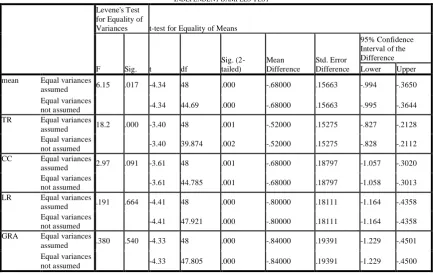
Table 2 depicts the results of the independent samples t-test showing that all the mean differences are significant and hence we can conclude that PhD candidates’ writing in general and specifically is much better than their M.A. counterparts (P value 0.05 &0.01).
TABLE 2. INDEPENDENT SAMPLES TEST
Levene's Test for Equality of
Variances t-test for Equality of Means
F Sig. t df
Sig. (2-tailed)
Mean Difference
Std. Error Difference
95% Confidence Interval of the Difference Lower Upper mean Equal variances
assumed 6.15 .017 -4.34 48 .000 -.68000 .15663 -.994 -.3650 Equal variances
not assumed -4.34 44.69 .000 -.68000 .15663 -.995 -.3644
TR Equal variances
assumed 18.2 .000 -3.40 48 .001 -.52000 .15275 -.827 -.2128 Equal variances
not assumed -3.40 39.874 .002 -.52000 .15275 -.828 -.2112
CC Equal variances
assumed 2.97 .091 -3.61 48 .001 -.68000 .18797 -1.057 -.3020 Equal variances
not assumed -3.61 44.785 .001 -.68000 .18797 -1.058 -.3013 LR Equal variances
assumed .191 .664 -4.41 48 .000 -.80000 .18111 -1.164 -.4358 Equal variances
not assumed -4.41 47.921 .000 -.80000 .18111 -1.164 -.4358 GRA Equal variances
assumed .380 .540 -4.33 48 .000 -.84000 .19391 -1.229 -.4501 Equal variances
not assumed -4.33 47.805 .000 -.84000 .19391 -1.229 -.4500
Question #2: Is there any significant difference between TEFL PhD candidates and M.A. students’ overall performance regarding Task 2 IELTS writing academic module (essay writing)? If so in which writing components the differences are significant?
TABLE 3. GROUP STATISTICS
level N Mean Std. Deviation Std. Error Mean
mean MA 25 6.7200 .50166 .10033
PhD 25 7.3200 .62716 .12543
TR MA 25 7.0000 .50000 .10000
PhD 25 7.3600 .70000 .14000
CC MA 25 6.8400 .62450 .12490
PhD 25 7.3600 .63770 .12754
LR MA 25 6.5600 .65064 .13013
PhD 25 7.3200 .69041 .13808
GRA MA 25 6.2400 .59722 .11944
PhD 25 7.2000 .64550 .12910
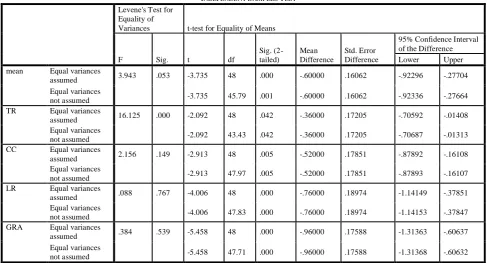
Table 4 depicts the results of the independent samples t-tests showing that all the mean differences are significant and hence we can conclude that PhD candidates’ task 2 writing in general and specifically regarding all the components is much better than their M.A. counterparts (P value 0.05 &0.01).
TABLE 4. INDEPENDENT SAMPLES TEST
Levene's Test for Equality of
Variances t-test for Equality of Means
F Sig. t df
Sig. (2-tailed)
Mean Difference
Std. Error Difference
95% Confidence Interval of the Difference Lower Upper mean Equal variances
assumed 3.943 .053 -3.735 48 .000 -.60000 .16062 -.92296 -.27704 Equal variances
not assumed -3.735 45.79 .001 -.60000 .16062 -.92336 -.27664
TR Equal variances
assumed 16.125 .000 -2.092 48 .042 -.36000 .17205 -.70592 -.01408 Equal variances
not assumed -2.092 43.43 .042 -.36000 .17205 -.70687 -.01313
CC Equal variances
assumed 2.156 .149 -2.913 48 .005 -.52000 .17851 -.87892 -.16108 Equal variances
not assumed -2.913 47.97 .005 -.52000 .17851 -.87893 -.16107
LR Equal variances
assumed .088 .767 -4.006 48 .000 -.76000 .18974 -1.14149 -.37851 Equal variances
not assumed -4.006 47.83 .000 -.76000 .18974 -1.14153 -.37847
GRA Equal variances
assumed .384 .539 -5.458 48 .000 -.96000 .17588 -1.31363 -.60637 Equal variances
not assumed -5.458 47.71 .000 -.96000 .17588 -1.31368 -.60632
Question#3: Do M.A. students perform differently overall and specifically regarding writing Task 1 and Task 2?
TABLE 5. PAIRED SAMPLES STATISTICS
Mean N Std. Deviation Std. Error Mean
Pair 1 meanMA1 6.6600 25 .47258 .09452
meanMA2 6.7200 25 .50166 .10033
Table 5 reveals the means comparing M.A. students’ performances on Task 1 and Task 2.As it can be observed the means difference of M.A. students’ task 1 and task 2 writing scores is the same indicating that the students enjoyed the same level of performance regarding writing task 1 and task 2.
TABLE 6. PAIRED SAMPLES TEST
Paired Differences
t df
Sig. (2-tailed) Mean
Std. Deviation
Std. Error Mean
95% Confidence Interval of the Difference Lower Upper Pair 1 meanMA1 -
meanMA2 -.06000 .48563 .09713 -.26046 .14046 -.618 24 .543
TABLE 7. PAIRED SAMPLES STATISTICS
Mean N Std. Deviation Std. Error Mean
Pair 1 TRMA1 6.9200 25 .40000 .08000
TRMA2 7.0000 25 .50000 .10000
TABLE 8. PAIRED SAMPLES TEST
Paired Differences
t
df
Sig. (2-tailed) Mean
Std. Deviatio n
Std. Error Mean
95% Confidence Interval of the Difference
Lower Upper Pair 1 TRMA1 -
TRMA2 -.08000 .49329 .09866 -.28362 .12362 -.811 24 .425
TABLE 9. PAIRED SAMPLES STATISTICS
Mean N Std. Deviation Std. Error Mean
Pair 1 CCMA1 6.6400 25 .56862 .11372
CCMA2 6.8400 25 .62450 .12490
TABLE 10. PAIRED SAMPLES TEST
Paired Differences
t df Sig. (2-tailed) Mean
Std. Deviation
Std. Error Mean
95% Confidence Interval of the Difference Lower Upper Pair 1 CCMA1 -
CCMA2 -.20000 .70711 .14142 -.49188 .09188 -1.414 24 .170
TABLE 11. PAIRED SAMPLES STATISTICS
Mean N Std. Deviation Std. Error Mean
Pair 1 LRMA1 6.5200 25 .65320 .13064
LRMA2 6.5600 25 .65064 .13013
TABLE 12. PAIRED SAMPLES TEST
Paired Differences
t df Sig. (2-tailed) Mean
Std. Deviation
Std. Error Mean
95% Confidence Interval of the Difference
Lower Upper Pair 1 LRMA1 -
LRMA2 -.04000 .53852 .10770 -.26229 .18229 -.371 24 .714
TABLE 13. PAIRED SAMPLES STATISTICS
Mean N Std. Deviation Std. Error Mean
Pair 1 GRAMA1 6.4000 25 .70711 .14142
TABLE 14. PAIRED SAMPLES TEST
Paired Differences
t df
Sig. (2-tailed) Mean
Std. Deviation
Std. Error Mean
95% Confidence Interval of the Difference Lower Upper Pair 1 GRAMA1 -
GRAMA2 .16000 .68799 .13760 -.12399 .44399 1.163 24 .256
Question#4: Do PhD students perform differently overall and specifically regarding writing Task 1 and Task 2?
TABLE 15. PAIRED SAMPLES STATISTICS
Mean N Std. Deviation Std. Error Mean
Pair 1 meanPHD1 7.3400 25 .62450 .12490
meanPHD2 7.3200 25 .62716 .12543
As for PhD candidates, Table 15 highlights that the means obtained for both task 1 and task 2 are almost the same and the same trend can be viewed observing the components’ mean scores and their related significance values (no significant differences, Tables 16-23).
TABLE 16. PAIRED SAMPLES TEST
Paired Differences
t df
Sig. (2-tailed) Mean
Std. Deviation
Std. Error Mean
95% Confidence Interval of the Difference Lower Upper Pair 1 meanPHD1 -
meanPHD2 .02000 .42032 .08406 -.15350 .19350 .238 24 .814
TABLE 17. PAIRED SAMPLES STATISTICS
Mean N Std. Deviation Std. Error Mean
Pair 1 TRPHD1 7.4400 25 .65064 .13013
TRPHD2 7.3600 25 .70000 .14000
TABLE 18. PAIRED SAMPLES TEST
Paired Differences
t df
Sig. (2-tailed) Mean
Std. Deviati on
Std. Error Mean
95% Confidence Interval of the Difference Lower Upper Pair 1 TRPHD1 -
TRPHD2 .08000 .7023 .14048 -.20993 .36993 .569 24 .574
TABLE 19. PAIRED SAMPLES STATISTICS
Mean N Std. Deviation Std. Error Mean
Pair 1 CCPHD1 7.3200 25 .74833 .14967
CCPHD2 7.3600 25 .63770 .12754
TABLE 20. PAIRED SAMPLES TEST
Paired Differences
t df Sig. (2-tailed) Mean
Std. Deviation
Std. Error Mean
95% Confidence Interval of the Difference Lower Upper Pair 1 CCPHD1 -
TABLE 21. PAIRED SAMPLES STATISTICS
Mean N Std. Deviation Std. Error Mean
Pair 1 LRPHD1 7.3200 25 .62716 .12543
LRPHD2 7.3200 25 .69041 .13808
TABLE 22. PAIRED SAMPLES TEST
Paired Differences
t df
Sig. (2-tailed) Mean
Std. Deviation
Std. Error Mean
95% Confidence Interval of the Difference Lower Upper
Pair 1 LRPHD1 - LRPHD2 .00000 .57735 .11547 -.23832 .23832 .000 24 1.000
TABLE 23 PAIRED SAMPLES STATISTICS
Mean N Std. Deviation Std. Error Mean
Pair 1 GRAPHD1 7.2400 25 .66332 .13266
GRAPHD2 7.2000 25 .64550 .12910
TABLE 24. PAIRED SAMPLES TEST
Paired Differences
t df Sig. (2-tailed) Mean Std. Deviation
Std. Error Mean
95% Confidence Interval of the Difference Lower Upper Pair 1 GRAPHD1 -
GRAPHD2 .04000 .67577 .13515 -.23894 .31894 .296 24 .770
Question #5: Overall what writing problems do the students have regarding task 1 components?
Regarding task 1 performance the participants had some flaws in the following categories which deserve attention: Task Achievement
Some inconsistencies in tone, some irrelevant or inappropriate information and some missing information were observed and further illustration and extension seemed missing.
Cohesion and Coherence
Cohesion within and between sentences were faulty, mechanical or repetitive. Some overuse and/or underuse of cohesive devices could be observed.
Lexical Resources
Some occasional errors in spelling and word formation could be detected. Grammatical Range and Accuracy
Some problems in complex sentences and punctuation were noticed.
Question #6: Overall what writing problems do the students have regarding task 2 components?
As for task 2 performance flaws, the following points pertaining to the relevant components can be highlighted: Task Response
Lack of focus was observed and some issues were more or less fully covered than others. Cohesion and Coherence
Some overuse/underuse of reference and substitution could be observed.
Faulty or mechanical and misuse/underuse and overuse/no use of cohesive devices were observable. Sometimes no clear topic sentence and no logical paragraphing could be detected.
Lexical Resources
Low ability to use natural collocations and idiomatic expressions, errors in spelling and word formation and some inappropriate and inaccurate use of vocabulary could be noticed.
Grammatical Range and Accuracy
Some errors in grammar and punctuation and limited or wrong use of complex sentences could be detected. Question #7: What do writing teachers believe about students writing errors and their related reasons? Teachers’ opinions
A series of interviews were held with 5 experienced university professors teaching writing to graduate students for 10-20 years and the unstructured interview revealed the possible reasons why students had difficulty writing in English. The following comments were the main highlights of the interviews.
-Iranian students do not have access to newspapers and magazines in English and they mostly do not listen to news and watch films in English. Thus, exposure to English is very poor.
-Writing teachers are not products of a sound education system. They do not receive enough and efficient training and they do not attend writing workshops.
-Many students cannot write as they should because they do not know grammar very well, they do not enjoy rich vocabulary, and their writings are replete with circularity of some forms and content due to lack of resources and poor knowledge of coherence, cohesion and paragraph development
-There are too many students in writing classes and the teachers do not have time to correct or provide any immediate or delayed feedback to their students.
Writing classes are mostly reading classes and writing is taught and considered mostly as a product not a process. Plagiarism, copying and cut and paste with no due modification, elaboration or reflection is a common practice among the students.
Teachers are mostly reluctant to have and run writing classes.
The students are poor writers in L1, let alone L2 due to the fact that from primary school up to university they do not have good writing classes.
-Writing is a sophisticated skill needing a good knowledge of grammar, collocations, vocabulary, cohesion and coherence.
-Many students cannot develop a good topic sentence/thesis sentence and they cannot think of and develop a sound outline.
-They have no ideas due to not studying inspiring resources and lack of exposure to English media. -Students are lax and have a lukewarm and lackadaisical attitude towards writing.
-Fear, writing phobia and lack of accountability and commitment lead to poor writing.
-Writing classes are mostly like “garbage in garbage out”. Poor attitude and attempt, poor methods of teaching and lack of good samples lead to poor output.
-Most students correspond in Farsi or Penglish when sending emails or texts to friends and acquaintances -The students do not feel a strong need for writing in English.
-Teachers and classes mainly focus on passive skills of reading and listening rather than productive and active skills of speaking and writing.
-Students have no access to expert writing teachers and native teachers. -Writing contests, rewards and awards are missing.
-Libraries need more resources and facilities to attract students.
-Assignments are based on single skills and mostly do not follow an integrated approach. Question #8: What do students believe about their writing errors and their related reasons? Students’ opinions
To have a better understanding of the students’ writing problems and finding reasons and solutions to think of and reflect on possible amendments almost all the students were interviewed and they asserted that they had writing problems due to the following reasons:
-Lack of confidence -Debilitating stress and fear
-Resorting to avoidance strategy because of not knowing the rudiments of writing -Lack of practice
-Bad teachers who do not teach writing properly, waste time, and do not introduce good resources and references -Poor and negative attitude, not taking writing seriously, considering it boring and lame
-Bad teachers not assigning writing tasks and not pushing students to work hard enough to improve their writing skill -No serious need to write in English
-No opportunities provided to write in English
-Multiple choice questions not requiring the students to write short answers or essays -Thinking in Farsi because of lack of mastery over English
-Lack of exposure to authentic materials and resources
-Not reading extensively to develop ideas and background knowledge -Dearth of writing classes
-Lack of commitment and accountability by students and teachers -Receiving poor or no feedback
-Poor or no time allocation on writing skill leading to poor knowledge of vocabulary, grammar and the right format -Lack of concentration
-Not being used to writing
-Bad effects of technology making the students lazy -Boring classes, materials and tasks
-Being afraid of criticism, sarcasm, embarrassment and getting belittled
-Lack of reading and writing culture
V. DISCUSSION
Writing is a skill which needs more attention as we pave the way towards perfection and civilization. To interact with others in a global village we have to improve our writing skills and this leads to much better interpersonal communication leading to better understanding and interaction. Despite the importance of writing, this skill has not received enough attention. Some recent studies have mentioned the problem areas in writing and they have tried to reveal how we can improve writing skills. To name but a few studies the following research in the EFL context of Iran can be mentioned:
Farazmand (2010) highlighted the effects of different kinds of feedback on EFL learners’ writing and delineated how feedback can enhance writing. Yarabbi (2012) investigated the impact of critical thinking on Iranian students IELTS writing skill through an integrative process oriented approach and she contributed a lot on this issue. Popari (2012) highlighted the relationship between multiple intelligences and writing strategies and revealed which intelligences are more influential regarding writing proficiency. Mohammaditabar (2013) tried to find the strengths and weaknesses of Iranian IELTS candidates in essay writing and revealed some eye-opening facts. Ghassemi (2013) made an attempt to find out whether there is a relationship between emotional intelligence and writing performance of IELTS learners to show that lots of factors can influence our writing ability and skill. Dokoohaki (2014) elaborated on the effect of integrating skills on willingness to communicate among Iranian EFL classes to show that writing can be reinforced and scaffolded through integrated tasks.
This study first revealed that education matters a lot and paves the way towards perfection. PhD candidates had a better writing skill and overall and component-wise they did much better than their M.A. counterparts. However, regarding task achievement, task response, coherence and cohesion, lexical resources and grammatical range and accuracy there is still room for progress and in the light of the feedback and assessment results they receive they can move towards perfection. M.A. students lagged way behind their PhD counterparts and the findings of this study can help them get to know their problem areas and reflect on possible amendments.
It is hoped that this study will help both teachers and students have a better grasp of what writing is and how it can be enhanced.
ACKNOWLEDGEMENT
The writers acknowledge their deep respect and appreciation towards all teachers and students who helped this study start and end best way possible. This study was supported and received the grant by Islamic Azad University Shiraz Branch and we genuinely thank the university research committee authorities who sponsored this research.
REFERENCES
[1] Alderson, J.C. (2007). Judging the frequency of English words. Applied Linguistics,28(3), 383-409. [2] Astika,G.G. (1993). Analytical assessment of foreign students’ writing. RELK Journal, 24, 61-70. [3] Bachman, L.F. & Palmer, A.S. (1996). Language testing in practice. Oxford: Oxford University Press.
[4] Bagheri, M.S. & Zare,M. (2009).The role of using IELTS model essays in improving learners’ writing and their awareness of writing features.Journal of English Language Studies, 1(1), 115-130.
[5] Banerjee, J., Franceschina, F., & Smith, A. M. (2004). Documenting features of written language production typical at different IELTS band score levels. Retrieved 9/3/2014 from www.ielts.org.
[6] Brown, A. (2003).Legibility and the rating of second language writing: An investigation of the rating of handwritten and word processed IELTS Task 2 essays. Retrieved 11/3/2014 from www.ielts.org.
[7] Canagarajah, A. (2002).Critical academic writing and multilingual students. Ann Arbor: University of Michigan Press. [8] Chandrasegaran, A. (2000).An analysis of obliqueness in student writing.RELC Journal, 31, 23-44.
[9] Dokoohaki, M. (2014). The effect of integrated skills on willingness to communicate in Iranian EFL classes. Unpublished M.A.thesis, Islamic Azad University, Shiraz, Iran.
[10] Engber, C. (1993). The relationship of lexis to quality in L2 compositions. TESOL.
[11] Farazmand, Y. (2010). The effects of different kinds of feedback on EFL learners’ writing. Unpublished M. A. thesis, Islamic Azad University, Shiraz, Iran.
[12] Ghassemi, E. (2013). The relationship between emotional intelligence and writing performance of IELTS learners. Unpublished M.A. thesis, Islamic Azad University, Booshehr, Iran.
[13] Laufer, B. (1991).Vocabulary size and use. Lexical richness in L2 written production. Applied Linguistics, 16(13), 307-322. [14] Majdeddin, K. (2010). Cohesive devices in students’ IELTS writing tasks. International Journal of Language Studies, 4,1-8. [15] Mohammaditabar, M. (2013). The strengths and weaknesses of Iranian IELTS candidates in essay writing. Unpublished
M.A.thesis, Islamic Azad University, Shiraz, Iran.
[16] Moore,T. & Morton, J. (1999). Authenticity in the IELTS academic module writing test:A comparative study of task two items and university assignments.Retrieved 9/6/2014 from www.ielts.org.
[17] Popari, M. (2012). The relationship between multiple intelligences and writing strategies. Unpublished M.A. thesis, Islamic Azad University, Shiraz, Iran.
[19] Schoonen, R. (2005). Generalizability of writing scores: An application of structural equation modeling. Language Testing, 22(1), 1-30.
[20] Wray, A. & Pegg, C. (2005). The effect of memorized learning on the writing scores of Chinese IELTS test takers. Retrieved 10/5/2014 from www.ielts.org.
[21] Yarabbi, A. (2012).The impact of critical thinking on Iranian EFL learners IELTS writing skill through an integrative process oriented approach. Unpublished M.A.thesis, Islamic Azad University, Shiraz, Iran.
Mohammad Sadegh Bagheri was born on February 29, 1964 in Shiraz Iran. He holds a PhD in Teaching English as a foreign language (TEFL) from Shiraz University, earned in 2006.
He has been teaching at several universities and language institutes for the past thirty years. Currently he is Shiraz Islami c Azad University Literature and Foreign Languages College Dean. So far, he has published more than sixty articles &thirty books and presented papers at thirty national and international conferences. His most famous book is Crack IELTS series and his research areas are international proficiency exams, research and teaching methods as well as assessment.
Dr. Bagheri is a member of some associations like TESOL Arabia and ACLA and he is currently a member of Shiraz Islamic Azad University Research Committee.
Mohammad Javad Riasati was born in 1979 in Shiraz, Iran. He holds a PhD in Teaching English as a Second Language (TESL) from University Putra Malaysia.
He has been teaching at several universities and language institutes for several years. Currently he is Shiraz Islamic Azad University faculty member. So far, he has published several articles and books and has presented articles at national and international conferences.