Proceedings of the
XII Spanish Conference on Programming and Computer
Languages
(PROLE 2012)
String-based Multi-adjoint Lattices for Tracing Fuzzy Logic
Computations
Pedro J. Morcillo, Gin´es Moreno, Jaime Penabad and Carlos V´azquez
17 pages
Guest Editors: Mar´ıa-del-Mar Gallardo
Managing Editors: Tiziana Margaria, Julia Padberg, Gabriele Taentzer
String-based Multi-adjoint Lattices for Tracing Fuzzy Logic
Computations
Pedro J. Morcillo1, Gin´es Moreno1, Jaime Penabad1and Carlos V´azquez1
1[email protected] [email protected]
[email protected] [email protected]
Faculty of Computer Science Engineering University of Castilla-La Mancha
02071 Albacete (Spain)
Abstract: Classically, most programming languages use in a predefined way the notion of “string” as an standard data structurefor a comfortable management of arbitrary sequences of characters. However, in this paper we assign a different role to this concept: here we are concerned with fuzzy logic programming, a some-how recent paradigm trying to introduce fuzzy logic into logic programming. In this setting, the mathematical concept ofmulti-adjoint latticehas been successfully exploited into the so-calledMulti-adjoint Logic Programmingapproach, MALP in brief, for modeling flexible notions of truth-degrees beyond the simpler case of true and false. Our main goal points out not only our formal proof verifying that string-based lattices accomplish with the so-calledmulti-adjoint property(as well as its Cartesian product with similar structures), but also its correspondence with interest-ing debugginterest-ing tasks into the FLOPER system (from “Fuzzy LOgic Programming Environment for Research”) developed in our research group.
Keywords:Cartesian Product of Multi-adjoint Lattices; Fuzzy (Multi-adjoint) Logic Programming; Declarative Debugging
1
Introduction
In essence, the notion of multi-adjoint lattice considers acarrier set L (whose elements ver-ify a concrete ordering≤) equipped with a set of connectives like implications, conjunctions, disjunctions and otherhybrid operators (not always belonging to an standard taxonomy) with the particularity that for each implication symbol there exists its adjoint conjunction used for modeling themodus ponensinference rule in a fuzzy logic setting. For instance, some adjoint pairs -i.e. conjunctors and implications- in the lattice([0,1],≤) are presented in the following paragraph (from now on, this lattice will be calledV along this paper), where labelsL,GandP
&P(x,y) , x∗y ←P(x,y) , min(1,x/y) Product
&G(x,y) , min(x,y) ←G(x,y) , (
1 ify≤x
x otherwise G¨odel &L(x,y) , max(0,x+y−1) ←L(x,y) , min{x−y+1,1} Łukasiewicz
Moreover, in the MALP framework [MOV04], each program has its own associated multi-adjoint lattice and each program rule (whose syntax, described in detail in Section3, extends very sig-nificantly a Prolog clause1) is “weighted” with an element of L, whereas the components in its body arelinkedwith connectives of the lattice. For instance, in the following propositional MALP program (where obviously @averrefers to the classical average operator):
p ←P @aver(q,r) with 0.9
q ← with 0.8
r ← with 0.6
the last two rules directly assign truth values 0.8 and 0.6 to propositional symbolsq andr, re-spectively, and the execution ofpusing the first rule, simply consists in evaluating the expression “&P(0.9,@aver(0.8,0.6))”, which returns the final truth degree 0.63.
In the following section we describe the shape of the elements, ordering relation and behaviour of the connectives of new multi-adjoint lattices obtained by applying the Cartesian product to pre-vious ones. The main application of such structures into the MALP framework is that it is very easy to attach to program rules and fuzzy connectives “labels” related not only with truth de-grees, but also with “augmented information” very useful for designing furtherdebuggingtasks devoted to “document” proof procedures. Our work is inspired by [RR08,RR09], where authors use the so-calledqualification domain of weightsW for counting the number of computational steps performed along derivations: however, our proposed technique surpass such approach by providing deeper details on the nature of every fuzzy-logic evaluation step.
As far as we know, there exists only another fuzzy system calledRFuzzy[MCS11] (a sequel of Fuzzy Prolog[GMV04]) implemented in Prolog and equipped too with debugging/tracing capabilities. However, these techniques have been developed in anad hocway, in contrast with the high level approach offered by FLOPER, which simply relies on the use of lattices associated to fuzzy programs2.
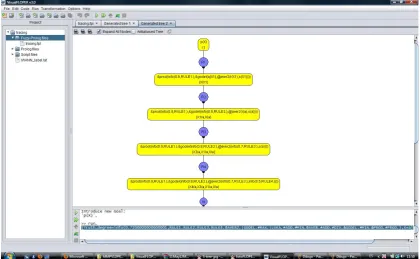
In Section3we present the syntax and procedural semantics of the MALP framework, which exploits multi-adjoint lattices for modeling richer notions of truth degrees to be managed by fuzzy programs. Next, we present the FLOPER tool recently equipped with a graphical inter-face as shown in Figure 1 [MMPV10b, MMPV11b, MMPV11a] (please, visit the web page
http://dectau.uclm.es/floper/), which currently is successfully used for compiling (to standard Prolog code), executing and debugging MALP programs in a safe way and it is ready for being extended in the near future with powerful transformation and optimization techniques designed in our research group in the recent past [JMP05,GM08,JMM+11].
Figure 1: Screen-shot of a work session with FLOPER.
After describing some guidelines for easily managing multi-adjoint lattices expressed by means of Prolog clauses into the FLOPER system, in Section4we propose a sophisticated kind of lat-tices based on the Cartesian product of previous latlat-tices (based on strings) capable for taking into account details on declarative traces, such as the sequence of computations (regarding program rules, fuzzy connectives and primitive operators) needed for evaluating a given goal. Finally, in Section5we give our conclusions and provide some lines for future work.
2
String-based Multi-adjoint Lattices and Cartesian Product
In this section we focus on the theoretical results which guarantee that a lattice based on strings is also a multi-adjoint lattice, as well as its Cartesian product with any other multi-adjoint lattice (this kind of sophisticated lattices can be associated to MALP programs in order to report at exe-cution time, a detailed description of the computational steps performed for reaching solutions). We start this section with the formal definition of multi-adjoint lattice.
Definition 1 Let (L,≤) be a lattice. A multi-adjoint latticeis a tuple (L,≤,←1,&1, . . . ,←n ,&n)such that:
i) (L,≤)is a complete lattice, namely,∀S⊂L,S6=/0,∃in f(S),sup(S)3.
ii) (&i,←i)is anadjoint pairin(L,≤), i.e.:
1) &iis non-decreasing in both arguments, for alli,i=1, . . . ,n.
2) ←iis non-decreasing in the first argument and non-increasing in the second one.
3) x≤(y←iz)if and only if(x&iz)≤y, for anyx,y,z∈L(adjoint property).
iii) >&iv=v&i>=vfor allv∈L,i=1, . . . ,n, where>=sup(L).
This last condition, called adjoint property, is the most important feature of the framework. From now, we are going to focus on the classical notion of Cartesian product applied on these structures, which necessarily returns objects inheriting the required properties of such lattices.
Theorem 1 If L1, . . . ,Lnare multi-adjoint lattices, then its Cartesian product L=L1× · · · ×Ln is also a multi-adjoint lattice.
Proof. In order to simplify our sketch but without loss of generality, we only consider two multi-adjoint lattices(L1,≤1,&1,←1)and(L2,≤2,&2,←2), each one equipped with just a sin-gle adjoint pair. L=L1×L2 has lattice structure with an order induced in the product from
(L1,≤1) and (L2,≤2) as follows: (x1,y1)≤(x2,y2)⇔x1 ≤1x2, y1≤2 y2. Moreover, being >1=sup(L1),⊥1=in f(L1),>2=sup(L2)and ⊥2=in f(L2), we have that(>1,>2) =sup(L) and(⊥1,⊥2) =in f(L), which implies that the Cartesian productLis a bounded lattice if both
L1andL2are also bounded lattices.
Analogously,L1×L2is a complete lattice ifL1andL2verify too the same property.
Finally, from the adjoint pairs(&1,←1)and(&2,←2)inL1andL2, respectively, it is possible to define the following connectives in L: (x1,y1)&(x2,y2),(x1&1x2,y1&2y2) and (x1,y1)←
(x2,y2),(x1←1x2,y1←2y2), for which it is easy to justify that they conform an adjoint pair inL1×L2(thus satisfying, in particular, the adjoint property).
In a similar way, it is also possible to define new connectives (conjunctions, disjunctions, etc.) in the Cartesian productL1×L2from the corresponding pairs of operators defined in both lattices
L1andL2.
Moreover, if we are interested in knowing more detailed data about the set of program rules and connective definitions evaluated for obtaining each solution then it will be mandatory to use a new latticeS based onstringsorlabels(i.e., sequences of characters) for generating the Cartesian productV ×S. In order to achieve our purposes, we firstly must show not only that
S is a multi-adjoint lattice, but also that the concatenation operation of strings, usually called
appendin many programming languages, plays the role of an adjoint conjunction in such lattice (this last condition is required by practical aspects which are explained in Section4).
When trying to solve both problems, we have analyzed several alternatives for establishing ordering relations among the elements ofS, such as the classical lexicographic ordering typ-ically used for sorting words in dictionaries, or those ones based on prefixes, sub-strings, etc., (for instance ’ab’ and ’bc’ are respectively a prefix and a sub-string of ’abcd’). Unfortunately we have observed that it is never possible to prove thatappendacts as a t-norm.
string as a natural number by associating to each character its corresponding ASCII code. So, it is possible to establish a bijective mapping[ ]withN.
Let beA={a0, . . . ,an−1}a set, called alphabet, whose elements are symbols. A stringsover
Ais a finite sequence of elements of this set, that is,s=a1. . .am, whereai∈A,i=1, . . . ,m. The set of all strings overA, denoted byS, is defined asS=∪k∈NA
k. The definition ofSguarantees
its numerable character, that is,Scontains a (numerable) infinite number of strings likea1. . .am formed by elements ofA. Although the mentioned numerable character is obtained from well known results of set theory, in Theorem2we will justify it by formalizing a bijection (and its reverse function) fromStoNwhich will be relevant in the multi-adjoint scope.
Each element ofAk is a string ofkelements (with length k) that can be viewed as words; in this case,S could be interpreted as the set of all words with finite length. This interpretation is attractive since each formal language with alphabetAis the set of formulae constructed with ele-ments or words ofSthat are, also, constrained to the syntactic rules established by that language. Any language with alphabetAwould be, accordingly, a subset ofS.
Moreover, in setSwe define the concatenation, denoted by·, as the internal operation
Ap×Aq→Ap+q
(s,t)7→s·t
such that, givens=a1. . .ap,t=b1. . .bq, thens·t=a1. . .apb1. . .bq.
Let be the primitive functionscod:A→Im(cod)andasc:Im(cod)→A, such thatcod(ai) =i andasc(i) =ai. It is trivial to proof thatcod is the inverse of functionasc and reciprocally. Symbol00 represents the empty (with length 0) string. We define the map[ ]:S→N through rulesR1andR2:
R1: [00] =0
R2: [a1. . .am] = (cod(a1) +1)nm−1+· · ·+ (cod(am) +1)n0
whereai∈A,∀i, anda1. . .am∈S. RuleR2can be rewritten as:
R∗2: [s.a] = [s]n+cod(a) +1
where s.a indicates a string obtained after adding the symbol a at the end of string s, s.a= a1. . .am.a=a1. . .ama.
In order to illustrate this mapping, consider the alphabet{a,b,c}and the strings=cab, where
[cab] = (cod(c) +1)32+ (cod(a) +1)3+ (cod(b) +1) =3∗9+1∗3+2=32.
Theorem 2 The map[ ], defined by R1and R2(or R∗2), is bijective.
Proof. Indeed, it is map since each strings∈Sis associated with a unique natural number. In order to proof the bijective character of[ ], we will demonstrate that its inverse function is the map<>:N→S, defined as:
<0>=00
wherebc:R→Nis the floor function, sob(m−1)/ncis the floor of the quotient, and(m−1)%n
is the remainder modulon(number of elements ofA) of the integerm−1.
We will see that compositions(<>◦[ ]):S→Sand([ ]◦<>):N→Ncoincide with the
iden-tity map (idSandidN, respectively), which justifies that[ ]is the inverse of<>, and reciprocally. Firstly, we prove that(<>◦[ ])(s) =s,∀s∈S.
1. (<>◦[ ])(00) =<[00]>=<0>=00
2. (<>◦[ ])(s.a) =
<[s.a]>=<[s]n+cod(a) +1>=
<b([s]n+cod(a) +1−1)/nc> .asc(([s]n+cod(a) +1−1)%n) =
<b([s]n+cod(a))/nc> .asc(([s]n+cod(a))%n) =
<b[s]n/nc> .asc(cod(a)%n) =<b[s]c> .asc(cod(a)) =
<[s]> .a
Hence,<[s.a]>=<[s]> .a, that is, ifs=a1. . .am, then<[a1. . .ama]>=<[a1. . .am]> .a=
· · ·=<[00]> .a1. . . . .am.a=s.a=idS(s.a), whereidS:S→Sis the identity map ofS. Secondly, we will demonstrate that([]◦<>)(j) =j,∀j∈N:
1. ([]◦<>)(0) = [<0>] = [00] =0
Since jcan be expressed asxn+y, wherex,y∈N,0<y≤n, if j>0, we have
2. ([ ]◦<>)(j) =
([ ]◦<>)(xn+y) = [<xn+y>] =
[<b(xn+y−1)/nc> .asc((xn+y−1)%n)] =
[<b(xn+y−1)/nc>]n+cod(asc((xn+y−1)%n)) +1= [<bxn/nc>]n+cod(asc(y−1)) +1=
[<x>]n+ (y−1) +1= [<x>]n+y
Therefore,[<xn+y>] = [<x>]n+y,0<y≤n. That is, jcan be expressed as j=y1nm−1+ · · ·+ym−1n1+y, withy1, . . . ,ym−1∈ {1, . . . ,n}, so[< j>] = [<y1nm−1+· · ·+ym−1n1+y>] =
[<y1nm−2+· · ·+ym−1n0>]n+y=· · ·= [<0>]n+y1nm−1+· · ·+ym−1n1+y= j.
Consequently, if [ ]is the inverse function of<>(and reciprocally) both are bijective func-tions, which proves our desired result.
In Example1 we illustrate these maps with a reduced alphabet, while Example 2 works in a real-world setting, giving an idea of the usefulness of this approach.
Example 1 Consider the alphabet A={a,b,c}. Then, the string associated to the number
32 is <32>=<b31/3c> .asc(32%3) =<10> .asc(1) =<b9/3c> .asc(9%3).b=<3> .asc(0).b=<b2/3c> .asc(2%3).a.b=<0> .asc(2).a.b=00.c.a.b=cab
• [s] =
[sea] = (cod(s)−1)1282+ (cod(e)−1)128+ (cod(a)−1) = (115−1)1282+ (101−1)128+ (97−1) =
1880672
• [t] =
[son] = (cod(s)−1)1282+ (cod(o)−1)128+ (cod(n)−1) = (115−1)1282+ (111−1)128+ (110−1) =
1881965
• [s·t] =
[season] = (cod(s)−1)1285+ (cod(e)−1)1284+ (cod(a)−1)1283+ (cod(s)−1)1282+ (cod(o)−1)128+ (cod(n)−1) =
(115−1)1285+ (101−1)1284+ (97−1)1283+ (115−1)1282+ (111−1)128+109=
3944056928109
Starting from the reverse usual order(N,≤), we define an ordering relation inSthat compares
stringss,t∈Sby
s≤t ⇐⇒ [s]≤[t]
so the supreme element of S is the empty string, 00. The application of append over strings
seaandson from the Example2, which is s·t=season, is less than boths andt, that is (by the definition ofS), [s·t]≤[s] and [s·t]≤[t]. As a result of Theorem 2, we have that S is bijective withN. Therefore, the completion (see [MMPV12]) ofS, which isS =S∪ {in f(S)},
is bijective with the completion ofN, (N∪ {in f(N)}), expressed also asW [RR08,RR09]. So,
since(W,≤) = (N∪ {in f(N)},≤)is amulti-adjoint lattice, thenS inherits the same property4.
After showing thatS is a multi-adjoint lattice via the mapping bijection established with the multi-adjoint latticeW, and before illustrating the benefits that the Cartesian productV ×S, among others, might play in several software engineering tasks, it is mandatory to explain in the following two sections some details of the MALP language and its associated FLOPER tool.
3
Multi-adjoint Logic Programming and FLOPER
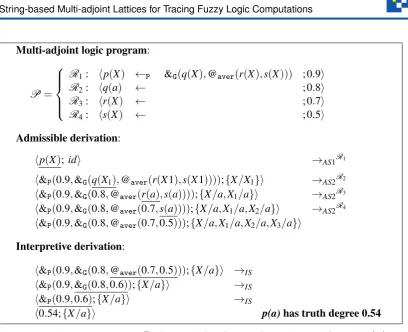
This section summarizes the main features of multi-adjoint logic programming as illustrated in Figures2 and3 (see [MOV04, JMP09] for a complete formulation of this framework). We work with a first order language, L, containing variables, constants, function symbols, pred-icate symbols, and several (arbitrary) connectives to increase language expressiveness: impli-cation connectives (denoted by←1,←2, . . .); conjunctive connectives (∧1,∧2, . . .) adjoint con-junctions (&1,&2, . . .), disjunctive connectives (∨1,∨2, . . .), and hybrid operators called “aggre-gators” (usually denoted by @1,@2, . . .). Although these connectives are binary operators, we usually generalize them as functions with an arbitrary number of arguments. So, we often write @(x1, . . . ,xn) instead of @(x1, . . . ,@(xn−1,xn), . . .). By definition, the truth function for an n-ary connective [[@]]:Ln →L is required to be monotonous and fulfills [[@]](>, . . . ,>) =>,
[[@]](⊥, . . . ,⊥) =⊥.
4It is easy to prove that &
Multi-adjoint logic program:
P=
R1: hp(X) ←P &G(q(X),@aver(r(X),s(X))) ; 0.9i
R2: hq(a) ← ; 0.8i
R3: hr(X) ← ; 0.7i
R4: hs(X) ← ; 0.5i
Admissible derivation:
hp(X); idi →AS1R1
h&P(0.9,&G(q(X1),@aver(r(X1),s(X1))));{X/X1}i →AS2R2 h&P(0.9,&G(0.8,@aver(r(a),s(a))));{X/a,X1/a}i →AS2R3 h&P(0.9,&G(0.8,@aver(0.7,s(a))));{X/a,X1/a,X2/a}i →AS2R4 h&P(0.9,&G(0.8,@aver(0.7,0.5)));{X/a,X1/a,X2/a,X3/a}i
Interpretive derivation:
h&P(0.9,&G(0.8,@aver(0.7,0.5)));{X/a}i →IS
h&P(0.9,&G(0.8,0.6));{X/a}i →IS
h&P(0.9,0.6);{X/a}i →IS
h0.54;{X/a}i p(a)has truth degree 0.54
Figure 2: MALP programPwith admissible/interpretive derivations for goalp(X).
Additionally, our language L contains the values of a multi-adjoint lattice
(L,≤,←1,&1, . . . ,←n,&n), equipped with a collection ofadjoint pairs(←i,&i) as detailed in previous sections. In general, L may be the carrier of any complete bounded lattice where a
L-expression is a well-formed expression composed by values and connectives ofL, as well as variable symbols andprimitive operators (i.e., arithmetic symbols such as∗,+,min, etc.). In what follows, we assume that the truth function of any connective @ inLis given by its corre-spondingconnective definition, that is, an equation of the form @(x1, . . . ,xn),E, whereE is a L-expression not containing variable symbols apart fromx1, . . . ,xn. See for instance, the classical set of adjoint pairs (conjunctors and implications ofŁukasiewicz logic,G¨odel intuitionistic logic
andproduct logic) in([0,1],≤)defined at the beginning of this paper in Section1.
Aruleis a formulaH ←i B, whereH is an atomic formula (usually called thehead) andB (which is called thebody) is a formula built from atomic formulasB1, . . . ,Bn—n≥0 —, truth values ofL, conjunctions, disjunctions and other connectives. Agoalis a body submitted as a query to the system. Roughly speaking, a multi-adjoint logic program is a set of pairshR;vi(we often write “Rwith v”), whereR is a rule andvis atruth degree(a value ofL) expressing the confidence of a programmer in the truth of ruleR. By abuse of language, we sometimes refer a tuplehR;vias a “rule”.
C[A]denotes a formula whereAis a sub-expression which occurs in the –possibly empty– con-textC[]. Moreover,C[A/A0]means the replacement ofAbyA0 in contextC[], whereasVar(s)
refers to the set of distinct variables occurring in the syntactic objects, andθ[Var(s)]denotes the substitution obtained fromθby restricting its domain toVar(s).
Definition 2(Admissible Step) LetQbe a goal and letσ be a substitution. The pairhQ;σiis astateand we denote byE the set of states. Given a programP, anadmissible computationis formalized as a state transition system, whose transition relation→AS⊆(E ×E)is the smallest relation satisfying the followingadmissible rules(where we always consider thatAis the selected atom inQandmgu(E)denotes themost general unifierof an equation setE):
1)hQ[A];σi →AS h(Q[A/v&iB])θ;σ θi, ifθ=mgu({H=A})andhH←iB;viinP.
2)hQ[A];σi →AS h(Q[A/v])θ;σ θi, ifθ=mgu({H=A})andhH←;viinP.
As usual, rules are taken renamed apart. We shall use the symbols→AS1and→AS2to distinguish between computation steps performed by applying one of the specific admissible rules. Also, the application of a rule on a step will be annotated as a superscript of the→ASsymbol.
Definition 3 Let P be a program, Q a goal and id the empty substitution. An admissible derivationis a sequencehQ;idi→AS· · · →AShQ0;θi. WhenQ0is a formula not containing atoms (i.e., aL-expression), the pairhQ0;
σi, whereσ=θ[Var(Q)], is called anadmissible computed answer(a.c.a.) for that derivation.
If we exploit all atoms of a given goal, by applying admissible steps as much as needed during the operational phase, then it becomes a formula with no atoms (aL-expression) which can be then directly interpreted w.r.t. latticeLas follows.
Definition 4(Interpretive Step) LetP be a program,Qa goal andσ a substitution. Assume
that[[@]]is the truth function of connective @ in the lattice(L,≤)associated toP, such that, for valuesr1, . . . ,rn,rn+1∈L, we have that[[@]](r1, . . . ,rn) =rn+1. Then, we formalize the notion of
interpretive computationas a state transition system, whose transition relation→IS⊆(E ×E)is defined as the least one satisfying:hQ[@(r1, . . . ,rn)];σi →IS hQ[@(r1, . . . ,rn)/rn+1];σi. An interpretive derivationis a sequencehQ;σi→IS· · · →IShQ0;σi. IfQ0=r∈L, being(L,≤)the lattice associated toP, thenhr;σiis called afuzzy computed answer(f.c.a.) for that derivation.
From now on, we proceed with more practical aspects regarding multi-adjoint lattices and im-plementation issues. The parser of our FLOPER tool [MM08,MMPV10a,MMPV11b] has been implemented by using the Prolog language. Once the application is loaded inside a Prolog inter-preter, it shows a menu which includes options for loading/compiling, parsing, listing and saving MALP programs, as well as for executing/debugging fuzzy goals. Moreover, in [MMPV10b] we explain that FLOPER has been recently equipped with new options, called “lat” and “show”, for allowing the possibility of respectively changing and displaying the multi-adjoint lattice as-sociated to a given program.
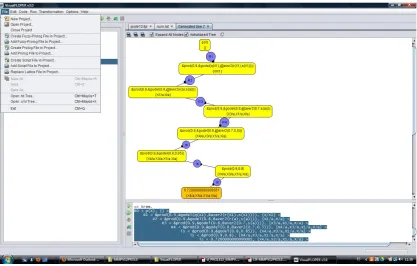
Figure 3: A work session with FLOPER mirroring Figure2.
of a minimal set of predicates defining the set of valid elements (including special mentions to the “top” and “bottom” ones), the full or partial ordering established among them, as well as the repertoire of fuzzy connectives which can be used for their subsequent manipulation. In order to simplify our explanation, assume that file “bool.pl” refers to the simplest notion of (a binary) adjoint lattice, thus implementing the following set of predicates:
•member/1which is satisfied when being called with a parameter representing a valid truth degree. For instance, in the Boolean case, this predicate can be simply modeled by the Prolog factsmember(0).andmember(1).
•bot/1andtop/1obviously answer with the top and bottom element of the lattice, respec-tively. Both are implemented into “bool.pl” asbot(0).andtop(1).
•leq/2models the ordering relation among all the possible pairs of truth degrees, and obvi-ously it is only satisfied when it is invoked with two elements verifying that the first parameter is equal or smaller than the second one. So, in our example it suffices with including into “bool.pl” the factsleq(0,X).andleq(X,1).
• Finally, if we have some fuzzy connectives of the form &label1 (conjunction), ∨label2
(dis-junction) or @label3 (aggregation) with aritiesn1,n2andn3respectively, we must provide clauses
member(X) :- number(X),0=<X,X=<1. bot(0).
leq(X,Y) :- X=<Y. top(1).
and_luka(X,Y,Z) :- pri_add(X,Y,U1),pri_sub(U1,1,U2),pri_max(0,U2,Z). and_godel(X,Y,Z):- pri_min(X,Y,Z).
and_prod(X,Y,Z) :- pri_prod(X,Y,Z).
or_luka(X,Y,Z) :- pri_add(X,Y,U1),pri_min(U1,1,Z). or_godel(X,Y,Z) :- pri_max(X,Y,Z).
or_prod(X,Y,Z) :- pri_prod(X,Y,U1),pri_add(X,Y,U2), pri_sub(U2,U1,Z).
agr_aver(X,Y,Z) :- pri_add(X,Y,U),pri_div(U,2,Z). agr_aver2(X,Y,Z):- or_godel(X,Y,Z1),or_luka(X,Y,Z2),
agr_aver(Z1,Z2,Z).
pri_add(X,Y,Z) :- Z is X+Y. pri_min(X,Y,Z) :- (X=<Y,Z=X;X>Y,Z=Y). pri_sub(X,Y,Z) :- Z is X-Y. pri_max(X,Y,Z) :- (X=<Y,Z=Y;X>Y,Z=X). pri_prod(X,Y,Z) :- Z is X * Y. pri_div(X,Y,Z) :- Z is X/Y.
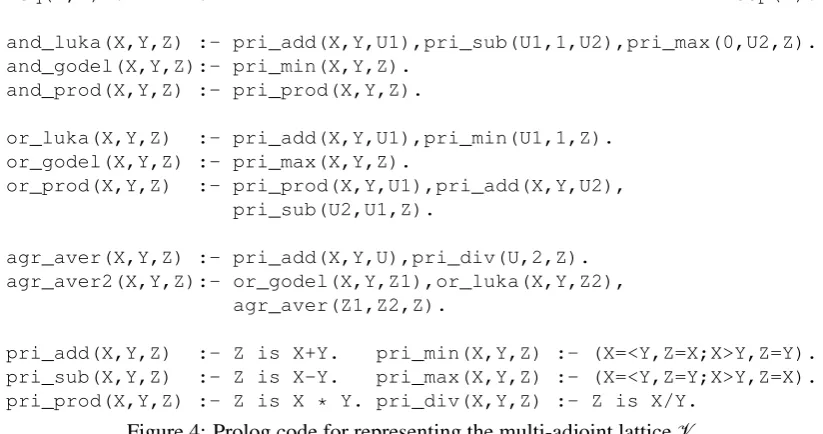
Figure 4: Prolog code for representing the multi-adjoint latticeV.
The reader can easily check that the use of lattice “bool.pl” when working with MALP programs whose rules have the form: “H ←bool &bool(B1, . . . ,Bn) with 1”, beingHandBitypical atoms, successfully mimics the behaviour of classical Prolog programs where clauses accomplish with the shape “H :− B1, . . . ,Bn”. As a novelty in the fuzzy setting, when evaluating goals according to the procedural semantics described in Section3, each output will contain the corresponding Prolog’s substitution (i.e., thecrispnotion of computed answer obtained by means of classical SLD-resolution) together with the maximum truth degree 1.
As shown in Figure 4, it is also possible to describe by means of Prolog clauses the more flexible latticeV for working with truth degrees in the infinite space of the real numbers between 0 and 1, allowing too the possibility of using conjunction and disjunction operators recasted from the three typical fuzzy logics proposals described before, as well as two useful descriptions for the hybrid aggregatoraverage.
4
Declarative Traces via Cartesian Product of Lattices
p(X,_TV0) :- q(X,_TV1), r(X,_TV2),s(X,_TV3),agr_aver(_TV2,_TV3,_TV4), and_godel(_TV1,_TV4,_TV5),and_prod(0.9,_TV5,_TV0).
Moreover, the second clause in our target program in Figure2, becomes into the pure Prolog fact “q(a,0.8)” while a fuzzy goal like “p(X)”, is translated into the pure Prolog goal: “p(X, Truth degree)” (note that the last truth degree variable is not anonymous now) for which the Prolog interpreter returns the desired fuzzy computed answer [Truth degree=0.54,X=a]. The previous set of options suffices for running fuzzy programs (the “run” choice also uses the clauses contained in “num.pl”, which represent the default lattice) where all internal compu-tations (including compiling and executing) are pure Prolog derivations whereas inputs (fuzzy programs and goals) and outputs (fuzzy computed answers) have always a fuzzy taste, thus pro-ducing the illusion on the final user of being working with a purely fuzzy logic programming tool.
member(info(X,Y)):-number(X),0=<X,X=<1,atom(Y). top(info(1,’’)).
and_prod(info(X1,X2),info(Y1,Y2),info(Z1,Z2))
:-pri_prod(X1,Y1,Z1,DatPROD),pri_app(X2,Y2,Dat1),
pri_app(Dat1,’&PROD.’,Dat2),pri_app(Dat2,DatPROD,Z2).
pri_prod(X,Y,Z,’#PROD.’):-Z is X * Y.
pri_app(X,Y,Z) :-name(X,L1),name(Y,L2),append(L1,L2,L3),name(Z,L3).
append([],X,X). append([X|Xs],Y,[X|Zs]):-append(Xs,Y,Zs). ...
Figure 5: Lattice modeled in Prolog for representing the Cartesian productV ×S.
On the other hand, in the previous section we have explained that FLOPER is equipped with two new options, called “lat” and “show”, for allowing the possibility of respectively changing and displaying the multi-adjoint lattice associated to a given program. Assume now that, instead of computing the average of two truth degrees, we prefer to compute the average between the results achieved after applying to both elements the disjunctions operators described by G¨odel and Łukasiewicz, that is: @aver2(x1,x2),@aver(∨G(x1,x2),∨L(x1,x2)). See the corresponding Prolog clause modeling such definition listed in Figure 4. Now, by selecting again the “run” option, the system would display the new solution:[Truth degree=0.72,X=a].
In what follows, we plan to exploit a much more powerful lattice to cope with more involved
form “info(Fuzzy Truth Degree, Label)” as shown in Figure5(we simply show an incomplete but representative set of predicates).
Here, we see that when implementing for instance the conjunction operator of the Product Logic, in the second component of our extended notion of “truth degree”, we haveappendedthe labels of its arguments with the label’&PROD.’(see clauses definingand prod, pri app
andappend). Of course, in the fuzzy program to be run, we must also take into account the use of labels associated to the program rules. For instance, the set of rules in our example (where we use the complex version of average, i.e.,@aver2in the first rule) must have the form:
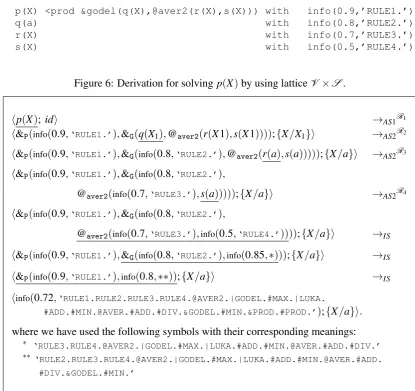
p(X) <prod &godel(q(X),@aver2(r(X),s(X))) with info(0.9,’RULE1.’).
q(a) with info(0.8,’RULE2.’).
r(X) with info(0.7,’RULE3.’).
s(X) with info(0.5,’RULE4.’).
Figure 6: Derivation for solving p(X)by using latticeV ×S.
hp(X); idi →AS1R1
h&P(info(0.9,‘RULE1.’),&G(q(X1),@aver2(r(X1),s(X1))));{X/X1}i →AS2R2
h&P(info(0.9,‘RULE1.’),&G(info(0.8,‘RULE2.’),@aver2(r(a),s(a)))));{X/a}i →AS2R3
h&P(info(0.9,‘RULE1.’),&G(info(0.8,‘RULE2.’),
@aver2(info(0.7,‘RULE3.’),s(a)))));{X/a}i →AS2R4
h&P(info(0.9,‘RULE1.’),&G(info(0.8,‘RULE2.’),
@aver2(info(0.7,‘RULE3.’),info(0.5,‘RULE4.’))));{X/a}i →IS
h&P(info(0.9,‘RULE1.’),&G(info(0.8,‘RULE2.’),info(0.85,∗)));{X/a}i →IS
h&P(info(0.9,‘RULE1.’),info(0.8,∗∗));{X/a}i →IS
hinfo(0.72,‘RULE1.RULE2.RULE3.RULE4.@AVER2.|GODEL.#MAX.|LUKA.
#ADD.#MIN.@AVER.#ADD.#DIV.&GODEL.#MIN.&PROD.#PROD.’);{X/a}i.
where we have used the following symbols with their corresponding meanings:
∗ ‘RULE3.RULE4.@AVER2.|GODEL.#MAX.|LUKA.#ADD.#MIN.@AVER.#ADD.#DIV.’
∗∗
‘RULE2.RULE3.RULE4.@AVER2.|GODEL.#MAX.|LUKA.#ADD.#MIN.@AVER.#ADD.
#DIV.&GODEL.#MIN.’
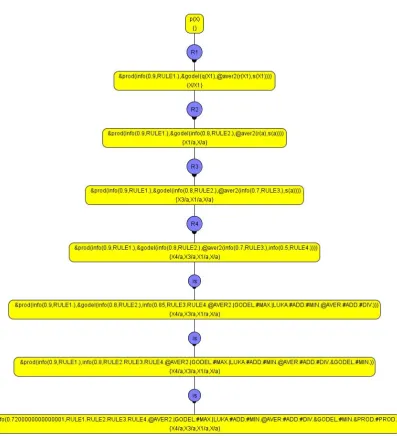
Now the reader can easily check that, after executing goalp(X), we obtain the desired fuzzy computed answer which includes a nice declarative trace collecting the exact sequence of “program-rules, fuzzy-connectives and primitive-operators” evaluated till finding the final so-lution, which has the following shape by using FLOPER:
Figure 7: Evaluation tree depicted by FLOPER associated to derivation shown in Figure6.
[Truth_degree=info(0.72, RULE1.RULE2.RULE3.RULE4. @AVER2.|GODEL.#MAX.|LUKA. #ADD.#MIN.@AVER.#ADD.#DIV.
&GODEL.#MIN.&PROD.#PROD.), X=a]
RULE3 and RULE4, in this order) as well as the list of fuzzy connectives evaluated during the interpretive phase, also detailing the set of primitive operators (of the form #label) that they call: in our case, note that we have firstly evaluated aggregator @AVER2(which calls to connectives|GODEL- defined in terms of the primitive operator#MAX-,|LUKA- which invokes the arithmetic operations#ADDand#MIN- and@AVER- expressed with the use of the primitive operators#ADDand#DIV-), then we need to evaluate the conjunction &GODEL(solved again via the arithmetic symbol#MIN) and the final exploited connective is&PROD(described in terms of the primitive operator#PROD).
5
Conclusions and Future Work
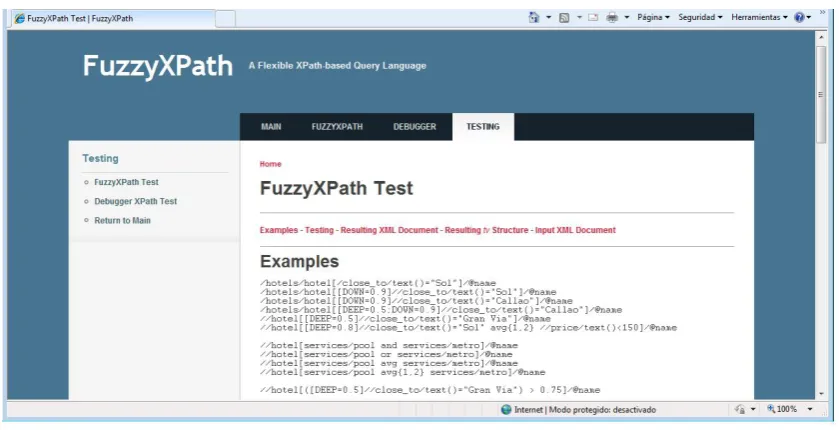
This paper has been mainly concerned with theoretical and practical issues focusing into the MALP framework (which could be seen as a very enriched fuzzy extension of Prolog), regarding the use of a string-based multi-adjoint lattice calledS. In a more precise way, we have proved and illustrated that the Cartesian product ofS with any other multi-adjoint lattice, is useful to obtain a new, more powerful lattice which can be used for obtaining, at a very low costs, declara-tive traces on fuzzy computed answers when executing MALP programs inside the FLOPER tool developed in our research group. We nowadays continue exploring new uses of such kind of so-phisticated lattices in other domains. For instance, we advance in [ALM11,ALM12a,ALM12b] that the Cartesian product ofV with a lattice modelinglistswith a similar shape toS, is very useful for coding with MALP rules a fuzzy variant of the well-known XPath language for the flexible management of XML documents retrieved from the web (our first real-world applica-tion using the FLOPER tool -see Figure8- can be freely downloaded and tested on-line from
http://dectau.uclm.es/fuzzyXPath/).
Bibliography
[ALM11] J. Almendros-Jim´enez, A. Luna, G. Moreno. A Flexible XPath-based Query Lan-guage Implemented with Fuzzy Logic Programming. In Bassiliades et al. (eds.),
Proceedings of 5th International Symposium on Rules: Research Based, Industry Focused, RuleML’11. Barcelona, Spain, July 19–21. Pp. 186–193. Springer Ver-lag, Lecture Notes in Computer Science 6826, 2011.
[ALM12a] J. M. Almendros-Jim´enez, A. Luna, G. Moreno. Fuzzy Logic Programming for Implementing a Flexible XPath-based Query Language.Electr. Notes Theor. Com-put. Sci.282:3–18, 2012.
[ALM12b] J. Almendros-Jim´enez, A. Luna, G. Moreno. A XPath Debugger Based on Fuzzy Chance Degrees. In Herrero et al. (eds.), Proceedings of Confederated Inter-national OTM 2012 Workshops, ODBASE’12, Rome, Italy, September 10-14. Pp. 669–672. Springer Verlag, Lecture Notes in Computer Science 7567, 2012.
[GM08] J. Guerrero, G. Moreno. Optimizing Fuzzy Logic Programs by Unfolding, Aggre-gation and Folding.Electronic Notes in Theoretical Computer Science, Elsevier
219:19–34, 2008.
[GMV04] S. Guadarrama, S. Mu˜noz, C. Vaucheret. Fuzzy Prolog: A New Approach Using Soft Constraints Propagation.Fuzzy Sets and Systems, Elsevier144(1):127–150, 2004.
[JA07] P. Juli´an, M. Alpuente. Programaci´on L´ogica. Teor´ıa y Pr´actica. Pearson Edu-caci´on, S.A., Madrid, 2007.
[JMM+11] P. Juli´an, J. Medina, P. Morcillo, G. Moreno, M. Ojeda-Aciego. A Static Pre-process for Improving Fuzzy Thresholded Tabulation. In Cabestany et al. (eds.),
Advances in Computational Intelligence - Proc of the 11th International Work-Conference on Artificial Neural Networks, IWANN’11, Torremolinos, Spain, June 8-10. Pp. 429–436. Springer Verlag, Lecture Notes in Computer Science 6692, 2011.
[JMP05] P. Juli´an, G. Moreno, J. Penabad. On Fuzzy Unfolding. A Multi-adjoint Approach.
Fuzzy Sets and Systems, Elsevier154:16–33, 2005.
[JMP09] P. Juli´an, G. Moreno, J. Penabad. On the Declarative Semantics of Multi-Adjoint Logic Programs. In Cabestany et al. (eds.),Proceedings of the 10th International Work-Conference on Artificial Neural Networks, IWANN’09, Salamanca, Spain, June 10-12. Pp. 253–260. Springer, Lecture Notes in Computer Science 5517, 2009.
[MCS11] S. Mu˜noz-Hern´andez, V. P. Ceruelo, H. Strass. RFuzzy: Syntax, semantics and implementation details of a simple and expressive fuzzy tool over Prolog.Inf. Sci.
181(10):1951–1970, 2011.
[MM08] P. J. Morcillo, G. Moreno. Programming with Fuzzy Logic Rules by Using the FLOPER Tool. In Bassiliades et al. (eds.), Proc. of “Rule Representation, In-terchange and Reasoning on the Web”International Symposium, RuleML’08, Or-lando, FL, USA, October 30-31. Pp. 119–126. Springer Verlag, Lecture Notes in Computer Science 5321, 2008.
[MMPV10a] P. J. Morcillo, G. Moreno, J. Penabad, C. V´azquez. Modeling Interpretive Steps into the FLOPER Environment. InProceedings of the 2010 International Con-ference on Artificial Intelligence, ICAI’10, July 12-15, 2010, Las Vegas Nevada, USA, Volume 2 (ISBN 1-60132-148-1), CSREA Press. Pp. 16–22. 2010.
[MMPV10b] P. Morcillo, G. Moreno, J. Penabad, C. V´azquez. A Practical Management of Fuzzy Truth Degrees using FLOPER. In Dean et al. (eds.), Proceedings of 4th Intl Symposium on Rule Interchange and Applications, RuleML’10. Washington, USA, October 21–23. Pp. 119–126. Springer Verlag, Lecture Notes in Computer Science 6403, 2010.
[MMPV11a] P. J. Morcillo, G. Moreno, J. Penabad, C. V´azquez. Declarative Traces into Fuzzy Computed Answers. In Bassiliades et al. (eds.),Proceedings of 5th International Symposium on Rules: Research Based, Industry Focused, RuleML’11. Barcelona, Spain, July 19-21. Pp. 170–185. Springer Verlag, Lecture Notes in Computer Sci-ence 6826, 2011.
[MMPV11b] P. Morcillo, G. Moreno, J. Penabad, C. V´azquez. Fuzzy Computed Answers Col-lecting Proof Information. In Cabestany et al. (eds.),Advances in Computational Intelligence. Proceedings of the 11th International Work-Conference on Artifi-cial Neural Networks, IWANN’11, Torremolinos, Spain, June 8-10. Pp. 445–452. Springer Verlag, Lecture Notes in Computer Science 6692, 2011.
[MMPV12] P. J. Morcillo, G. Moreno, J. Penabad, C. V´azquez. Dedekind-MacNeille comple-tion and Cartesian product of multi-adjoint lattices.Int. J. Comput. Math. 89(13-14):1742–1752, 2012.
[MOV04] J. Medina, M. Ojeda-Aciego, P. Vojt´aˇs. Similarity-based Unification: a multi-adjoint approach.Fuzzy Sets and Systems146:43–62, 2004.
[RR08] M. Rodr´ıguez-Artalejo, C. A. Romero-D´ıaz. Quantitative logic programming re-visited. In Garrigue and Hermenegildo (eds.),Functional and Logic Programming (FLOPS’08). Pp. 272–288. Springer, Lecture Notes in Computer Science 4989, 2008.
[RR09] M. Rodr´ıguez-Artalejo, C. A. Romero-D´ıaz. Qualified Logic Programming with Bivalued Predicates. Electronic Notes Theoretical Computer Science, Elsevier