Volume 29 (2010)
Proceedings of the
Ninth International Workshop on
Graph Transformation and
Visual Modeling Techniques
(GT-VMT 2010)
Efficient Analysis of Permutation Equivalence of
Graph Derivations Based on Petri Nets
Frank Hermann , Andrea Corradini , Hartmut Ehrig , Barbara K¨onig
14 pages
Guest Editors: Jochen K ¨uster, Emilio Tuosto
Managing Editors: Tiziana Margaria, Julia Padberg, Gabriele Taentzer
Efficient Analysis of Permutation Equivalence of
Graph Derivations Based on Petri Nets
Frank Hermann1, Andrea Corradini2, Hartmut Ehrig1, Barbara K¨onig3
1[frank,ehrig]@cs.tu-berlin.de, Institut f¨ur Softwaretechnik und Theoretische Informatik,
Technische Universit¨at Berlin, Germany
2andrea(at)di.unipi.it, Dipartimento di Informatica,
Universit`a di Pisa, Italy
3barbara koenig(at)uni-due.de, Abteilung f¨ur Informatik und Angewandte
Kognitionswissenschaft, Universit¨at Duisburg-Essen, Germany
Abstract: In the framework of graph transformation systems with Negative Ap-plication Conditions (NACs) the classical notion of switch equivalence of deriva-tions is extended topermutation equivalence, because there are intuitively equiva-lent derivations which are not switch-equivaequiva-lent if NACs are considered. By def-inition, two derivations are permutation-equivalent, if they respect the NACs and disregarding the NACs they are switch equivalent. A direct analysis of permutation equivalence is very complex in general, thus we propose a much more efficient anal-ysis technique. For this purpose, we construct a Place/Transition Petri net, called dependency net, which encodes the dependencies among rule applications of the derivation, including the inhibiting effects of the NACs.
The analysis of permutation equivalence is important for analysing simulation runs within development environments for systems modelled by graph transformation. The application of the technique is demonstrated by a graph transformation system within the context of workflow modelling. We show the effectiveness of the ap-proach by comparing the minimal costs of a direct analysis with the costs of the efficient analysis applied to a derivation of our example system.
Keywords: graph transformation, Petri nets, process analysis, adhesive categories
1
Introduction
Given a workflow of a system, it is often interesting to know whether the workflow can be im-proved, by executing the tasks in a different order, which might be more convenient for the user or preferable from an efficiency point of view. If the workflow is modelled by a Petri net, representing a deterministic process, these questions can be fairly easily answered: processes incorporate a notion of concurrency that can be exploited to rearrange the tasks, while still re-specting causality.
con-ciseness, the definitions and results in this paper are presented forgraphtransformation systems, and we refer to the companion technical report [HCEK10] for the general notions based on adhe-sive categories. As a second dimension, we take into account Negative Application Conditions (NACs) that are used to ensure the “absence” of forbidden structures when executing a transfor-mation step: NACs significantly improve the specification formalisms based on transfortransfor-mation rules leading to more compact and concise models as well as increased usability and as a matter of fact they are widely used in non-trivial applications. The presence of NACs leads to more complex interdependencies of tasks.
For this reason, we introduce a notion of permutation equivalence on derivations with NACs, which is coarser and more adequate than the switch equivalence in the double-pushout (DPO) approach including NACs. As defined in [Her09] two derivations are called permutation-equivalent, if they respect the NACs and disregarding the NACs they are switch-equivalent. Using the notion of switch equivalence with NACs directly does not lead to all permutation-equivalent derivations of a given derivation in general. The main remaining problem is how to derive the complete set of all permutation-equivalent derivations to a given one. For this purpose, we construct a subobject transformation system (STS) via a standard colimit construction and from this STS we construct a dependency net, given by a standard P/T Petri net, which includes a complete account of the inhibiting effects of the NACs. The main result shows that complete firing sequences of this net are one-to-one with derivations that are permutation-equivalent to the given derivation, allowing us to derive the complete set of permutation-equivalent derivations. Finally, for a given derivation of a simple example system with NACs, we perform a detailed complexity analysis of the cost of identifying all permutation equivalent derivations using the reduction to a Petri net and its reachability graph, and compare it with a lower bound of the costs for a direct analysis, i.e. for computing all shift-equivalent derivations first, and then filtering out the ones which do not respect the NACs. We obtain a significant improvement in speed, which shows that the proposed technique can be efficient for many applications which involve the gen-eration of permutation-equivalent derivations. Furthermore, the constructed P/T Petri net can be used to derive specific permutations without generating the complete set first. In the context of workflow analysis, both goals are of central interest for the modelling of a system.
The structure of the paper is as follows. Sec. 2 reviews the main concepts of permutation equivalence for graph transformation systems. The construction of the dependency net is pre-sented in Sec.3and in our main result it is shown to be sound and complete for computing the set of permutation-equivalent derivations. Sec.4validates the efficiency of the analysis based on an extended version of the running example. Finally, Sec.5sums up the main results, discusses related work, and points out aspects of future work.
2
Permutation Equivalence
Definition 1 (Graph Transformation System with NACs) A rule p = (Lp ←−l Kp→−r Rp) is
a pair of injective graph morphisms. A Negative Application Condition (NAC) for a rule
p is an injective graph morphism n :Lp ,→ N, having the left-hand side of p as source.
A rule with NACs is a pair hp,Ni where p is a rule and N ={ni : Lp ,→ Ni}i∈I is a
fi-nite set of NACs for p. A match of a rule p in a graph G is an injective graph mor-phism1 m:Lp,→ G; match m satisfies the NAC n:Lp ,→N for p, written m|=n, if there
is no arrow g : N → G such that g◦n = m.2 We say that there is a direct derivation G=p=,m⇒Hfrom an objectGtoHusing a rule with NACshp,Ni
and a matchm:Lp→G, if there are two pushouts (1) and (2) in
Graphs, as depicted. A derivationrespects the NACs, ifm|=n
for each NAC(n:Lp,→N)∈N. A typedgraph transformation N / I I I $ $ I I I Lp n o o
m (1) Kp
r // l
o
o
(2) Rp
Goo D //H
system (GTS) with NACs is a tuple G =hQ,πNi where Q is a set of rule names, and πN
maps each name q∈Q to a rule with NACs πN(q) =
π(q),Nq
in the category GraphsTG
of graphs typed over a given type graphTG. Aderivation (respecting NACs)ofGis a sequence
G0= q1,m1
===⇒G1· · ·= qn,mn
===⇒Gn, whereq1, . . . ,qn∈Qanddi=Gi−1=
π(qi),mi
====⇒Giare direct derivations
(respecting NACs) fori∈1, . . . ,n. Sometimes we denote a derivation as a sequenced=d1;. . .;dn
of direct derivations.
worksOn member connectedTo device Person name: String accessLevel: Int Task name: String description: String acessLevel: Int AccessPoint IP: String Subnet: String started MobileDevice IP: String task Team name: String
continueTask (NACs are not depicted)
L :worksOn K R 3:started member task 2:Task accessLevel=lv 1:Person acessLevel=lv 2:Team 3:started member task 2:Task accessLevel=lv 1:Person acessLevel=lv 2:Team 3:started member task 2:Task accessLevel=lv 1:Person acessLevel=lv 2:Team Attributed Type Graph TG*
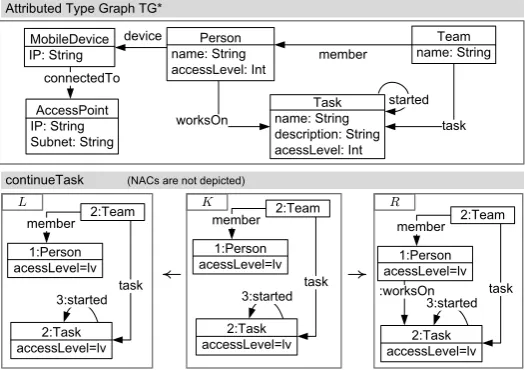
Figure 1: Part of attributed transformation systemGS∗, modeling mobile adhoc networks
Example 1 (Graph Transformation System with NACs) Fig. 1 shows a part of an attributed graph grammar for modelling a workflow system in mobile adhoc networks, where persons can be assigned to teams and tasks and they can change their location implying that their mobile communication devices may need to reconnect to new access points. In order to simplify the further constructions we will use the reduced version of this grammar in Fig.2. The type graph
TGshows that nodes in the system represent either persons or tasks: a task is active if it has a
1In the general case NAC-morphisms(n:L→N)and matches are not required to be injective. For the general case,
our technique can be extended by the results in [HE08].
2Intuitively, the image ofL
continueTask (short: “cont“) L :worksOn 1:Person 3:started K 1:Person R 1:Person 2:Task NAC2 :worksOn 1:Person 2:Task 3:started 2:Task 3:started 2:Task R :worksOn 1:Person 2:Task K 1:Person 2:Task L 1:Person 2:Task NAC1 :worksOn :Person 2:Task 1:Person
stopTask (short: “stop“)
3:started 3:started :worksOn :started TG Person Task Type Graph
Figure 2: Reduced transformation systemGSas running example
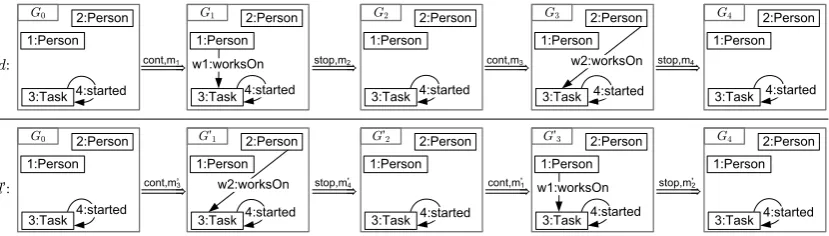
“:started” loop, and it can be assigned to a person with a “:worksOn” edge. Rule “stopTask” cancels the assignment of a task to a person; rule “continueTask” instead assigns the task, and it has two NACs to ensure that the task is not assigned to a person already. Fig.3shows two derivations respecting NACs ofGS. In derivationdthe only task is first continued by “1:Person”, and then, after being stopped, by “2:Person”. Ind0the roles of the two Persons are inverted.
G1 w1:worksOn 1:Person 3:Task 4:started 2:Person G0 1:Person 3:Task 4:started
2:Person G2
1:Person
3:Task 4:started
2:Person G3
w2:worksOn 1:Person
3:Task 4:started
2:Person G4
1:Person
3:Task 4:started 2:Person
G’1
w1:worksOn 1:Person 3:Task 4:started 2:Person G0 1:Person 3:Task 4:started
2:Person G’2
1:Person
3:Task 4:started
2:Person G’3
w2:worksOn
1:Person
3:Task 4:started
2:Person G4
1:Person
3:Task 4:started 2:Person
cont,m1⇒ stop,m⇒2
stop,m⇒4
cont,m3⇒
cont,m⇒1
stop,m⇒4
stop,m⇒2
cont,m⇒3’ ’ ’ ’
d:
d’:
Figure 3: Derivationd(respecting NACs) ofGSand permutation-equivalent derivationd0
The classical theory of the DPO approach (without NACs) introduces an equivalence among derivations which relates derivations that differ only in the order in which independent direct derivations are performed (see [Kre86,BCH+06]). Theswitch equivalenceis based on the notion ofsequential independenceand on theLocal Church-Rosser theorem. This is briefly summarised in the next definition.
Definition 2 (Switch Equivalence on Derivations) Let d1 = G0 = p1,m1
===⇒ G1 and d2 = G1=
p2,m2
===⇒G2 be two direct derivations. Then they are se-quentially independent if there exist arrows i:R1 →D2 and j:L2→D1such thatl20◦i=m01andr01◦j=m2(see the diagram
on the right, which shows part of the derivation diagrams). Ifd1
K1
/
/R1 m01
//
// i "" L2 m2 j | | K2 o o
D1 r01 //G1oo l20 D2
andd2are sequentially independent, then according to the Local Church Rosser Theorem (Thm.
5.12 in [EEPT06]) they can be “switched” obtaining direct derivationsd20 =G0= p2,m2
===⇒G01 and
d10 =G01====p1,m1⇒G2, which apply the two rules in the opposite order.
Now, letd= (d1;. . .;dk;dk+1;. . .;dn)be a derivation, wheredkanddk+1are two sequentially
the Local Church Rosser Theorem. Then, d0 is aswitching of d, written d sw∼ d0. The switch equivalence, denotedsw≈, is the smallest equivalence on derivations containing both sw∼ and the relation∼=for isomorphic derivations.
Corresponding notions of parallel and sequential independence have been proposed for graph transformation systems with NACs [HHT96, LEO06]. However, the derived notion of switch equivalence does not identify all intuitively equivalent derivations. The reason is that, in presence of NACs, there might be an equivalent permutation of the direct derivations that cannot be derived by switch equivalence. Looking atd in Fig.3there is no pair of consecutive direct derivations which is sequentially independent if NACs are considered. However, the derivationd0 should be considered as equivalent. There are also examples in which even the switching of blocks of several steps would not lead to all permutation-equivalent derivations. This brings us to the following, quite natural notion of permutation equivalence of derivations respecting NACs, first proposed in [Her09]. Note that for permutation-equivalent derivationsd ≈π d0 the sequence of rules used ind0is a permutation of those used ind.
Definition 3 (Permutation Equivalence of Derivations) Two derivations d andd0 respecting NACs are permutation equivalent, writtend ≈π d0 if, disregarding the NACs, they are switch equivalent as for Def.2.
3
Dependency Net of a Derivation
In order to efficiently analyse permutation equivalence of derivations we introduce the construc-tion of the dependency net of a given derivaconstruc-tion with NACs. This Place/Transiconstruc-tion Petri net purely encodes the dependencies between the derivation steps. The reachability graph of this net with initial marking determines the class of derivations which are permutation-equivalent to a given one.
The construction of the dependency net is based on the construction of the subobject trans-formation sytem (STS) of a given derivationd according to [CHS08] and its extension to NACs in [Her09]. Subobjects of a graph Gform the category of subobjectsSub(G), which contains subgraphs ofG3as objects and injective graph morphismsm:G1→G2between subgraphs as morphisms, wheremis required to respect the injective embeddings ofG1andG2toG. We will
writeG1∩G2for the componentwise intersection andG1∪G2for the componentwise union of
subgraphs ofG, where items are identified with respect to the injective embeddings ofG1 and
G2intoG.
In order to construct the STS for a derivation d = (d1;. . .;dn) we compute the colimit T of the
se-quence of DPO diagrams, where all morphisms are injective. Thus, all objects and morphisms of this di-agram are in the categorySub(T). The NACs of the rules do not occur in this diagram.
Lk
Kk
o
o //
Rk
G0
+
+
W W W W W W W W W W W W W W W W . . .
o
o //Gk−1
#
#
H H H Hoo Dk //
Gk
}
}
{{{{
. . .
o
o //Gn
t
t
hhhhhhhhhh hhhh
T
3More formally, a subgraph is given by an equivalence class of injective graph morphisms toG, such that the image
Definition 4(STS of a derivation) Asubobject transformation system S=hT,Q,πi consists
of a super objectT, a set of rule namesQ, and a functionπ, which maps a nameq∈Qto arule,
i.e., to a tripleπ(q) =Lq,Kq,Rq
of subobjects ofT such thatKq=Lq∩Rq.
Now, letG=hQ,πibe a graph transformation system, and letd= (G0= q1,m1
===⇒. . .====qn,m⇒n Gn)
be a derivation of G. The STS generated from d is defined as STS(d) =hT,P,πˆi, where T is the colimit object of the diagram underlying the derivation d, P={k |dk = (Gk−1 =
qk,mk ==⇒
Gk)is a step ofd}, and ˆπ(k) =hLk,Kk,Rki, whereqk= (Lk←Kk→Rk).
For the rest of the paper, we consider only derivations such that the colimit T is afinite object, i.e. Sub(T)is a finite lattice. This is guaranteed if each rule ofGhas finite left- and right-hand sides, and if the start object of the derivation is finite. The generation of an STS with NACs from a given derivation works as in Definition4, but additionally each rule will be equipped with a list of NACs, i.e., those obtained as “instances” of the original NACs in the colimit objectT. Note that one original NAC can have several instances, but also not a single one.
Definition 5 (Instantiated NACs) Letd =d1;. . .;dk;. . .;dn be a derivation respecting NACs
and letT be the colimit object of the derivation. Lethp,Nibe the rule with NACs used in direct derivationdkand letNACS(p) ={n:Lp,→N|n∈N}. The set of all instantiated NACs inT of
the NACs of a rule pis given byNACST(p) ={N−−t→N T inSub(T)|n∈N,s.t. tN◦n=tL}for Lp−t→L T inSub(T).
Definition 6 (STS of a Derivation with NACs) Let G be a GTS with NACs and let d be a derivation ofG respecting NACs. TheSTS with NACs generated by d is given bySTSN(d) =
hT,P,πˆNi, whereT andPare as in Def.4, ˆπN(k) =hπˆ(k),Nki, ˆπ(k)is as in Def.4, andNkis an
arbitrary but fixed linearisation of the instantiated NACsNACST(pk) as in Def. 5, where pk is
the rule ofGused indk.
q1=cont1
L w1:worksOn 1:Person 4:started K 1:Person R 1:Person 3:Task
N1[2]
w2:worksOn 2:Person 3:Task 4:started 3:Task 4:started 3:Task R w2:worksOn 1:Person 3:Task K 1:Person 3:Task L 2:Person 3:Task
N1[1]
w1:worksOn 1:Person
3:Task
1:Person
q4=stop2
R w1:worksOn 1:Person 3:Task K 1:Person 3:Task L 1:Person 3:Task
q2=stop1
q3=cont2
L w2:worksOn 2:Person 4:started K 2:Person R 2:Person 3:Task 4:started 3:Task 4:started 3:Task 4:started 4:started
N3[2]
w2:worksOn 2:Person
3:Task
N3[1]
w1:worksOn 1:Person 3:Task 2:Person 4:started 4:started T w1:worksOn 1:Person 3:Task 4:started 2:Person w2:worksOn Super Object
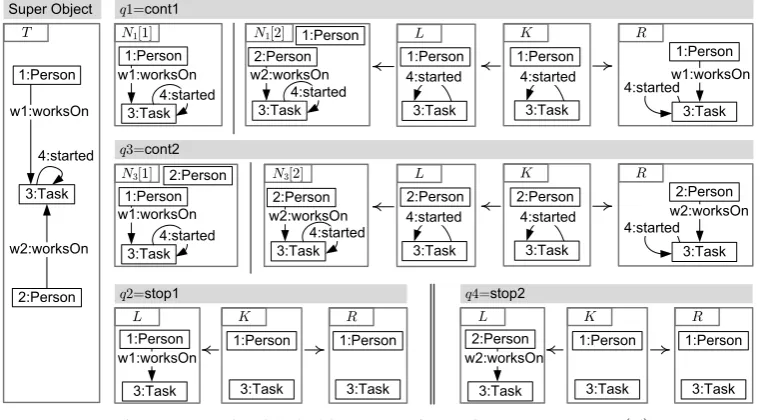
Example2 (Derived STSSTSN(d)) For the derivationd in Ex.1we derive the STS as shown in Fig.4. The super object T is derived by taking the first graph of the derivation and adding the items, which are created during the transformation, i.e. the two edges of type “worksOn”. The derivationd involves the rules “continueTask” and “stopTask” and thus, the derived STS contains the rule occurrences “1,cont1”, “2,stop1”, “3,cont2” and “4,stop2”, where the NACs of the rule “continueTask” are instantiated.
The following relations between the rules of an STS with NACs specify the possible depen-dencies among them: the first four relations are discussed in [CHS08], while the last two are introduced in [Her09]. In our case the STS with NACs is generated from a derivationd accord-ing to Def.6.
Definition 7 (Relations on Rules) Let q1 and q2 be two rules in an STS with NACs S = (T,P,πN)with πN(qj) = (
Lj,Kj,Rj
,Nj)for j∈ {1,2}andNj= (Nj[i])i=1..nj. The relations
on rules are defined onPas follows:
Name Notation Condition
Read Causality q1<rcq2 R1∩K2 *K1
Write Causality q1<wcq2 R1∩L2 *K1∪K2
Deactivation q1<dq2 K1∩L2 *K2
Independence q1♦q2 (L1∪R1)∩(L2∪R2) ⊆K1∩K2
Weak NAC Enabling q1<wen[i]q2 1≤i≤ |N2| ∧ L1∩N2[i] *K1∪L2
Weak NAC Disabling q1<wdn[i]q2 1≤i≤ |N1| ∧ N1[i]∩R2 *L1∪K2
Read causality specifies that rule q1 produces an item that is read by q2, but not deleted by q2 and in the case of write causality we have that q2 also deletes such an item. Deactivation
occurs when ruleq2deletes an item that is read byq1, but not created and two rule occurrences are independent if they overlap only on items that are neither produced nor deleted by one of the rules. Ruleq1 weakly enables the ruleq2atiifq1 deletes a forbidden part q2, i.e. an item of
thei-th NAC ofq2that is not contained inL2. The ruleq2weakly disablesq1atiifq2produces a piece of thei-th NAC ofq1. It is worth stressing that the relations introduced above are not
transitive in general.
Example 3 (Relations on Rules) The rules ofSTSN(d) in Fig.4 are related by the following dependencies. For write causality we have “cont1 <wc stop1” and “cont2 <wc stop2”. Weak enabling/disabling are shown in the table below, while read causality and deactivation are empty.
Weak Enabling Weak Disabling
stop1<wen[1]cont1 stop2<wen[2]cont1 cont1<wdn[1]cont1 cont2<wdn[2]cont2
stop1<wen[1]cont2 stop2<wen[2]cont2 cont2<wdn[1]cont1 cont1<wdn[2]cont2
given by a P/T Petri net which specifies only the dependencies between the derivation steps. All details about the internal structure of the graphs and the transformation rules are excluded, allowing us to improve the efficiency of the analysis of permutation equivalence.
Definition 8(Dependency NetDNetof a derivation) Letd = (d1;. . .;dn)be a derivation
re-specting NACs of a GTS with NACs, letSTSN(d) = (T,P,πˆ)be the generated STS with NACs
and lets=seq(d) =hq1, . . . ,qni=h1, . . . ,nidenote the sequence of rule names inPaccording
to the steps ind. Thedependency netofd is given by the marked Petri netDNet(d) =hN,Mi,
N=hPL,TR,pre,posti, constructed by the steps in Fig.5, where the steps are performed in the order they appear in the table.
3. For all q ∊P with q ≮wdn[i]q, i ∊ ℕ 2. For all q,q’∊P, q<xq’, x ∈{rc,wc,d }
1.For eachq∊P
STS(d) = (T,P,¼) DNet(d)= ((PL,TR,pre,post),M)
a) N[i] of q
b) For all q’ ∊P: q’ <wen[i] q
c) For all q’ ∊P: q <wdn[i]q’
3. For all q ∊P with q ≮wdn[i]q, i ∊ ℕ 2. For all q,q’∊P, q<xq’, x ∈{rc,wc,d }
1.For eachq∊P
STS(d) = (T,P,¼) DNet(d)= ((PL,TR,pre,post),M)
a) N[i] of q
b) For all q’ ∊P: q’ <wen[i] q
c) For all q’ ∊P: q <wdn[i]q’
p(q<xq’)+ + q’ +
q + p(q<xq’)+ + q’
q
p(q,N[i]) q
+ p(q,N[i]) + q
+ +
p(q,N[i]) q’ + p(q,N[i]) q’ +
q’
+ +
p(q,N[i]) q’
+ +
p(q,N[i]) p(q) q
+ + + +
p(q) q
+ + + +
^
Figure 5: Construction of the Dependency Net
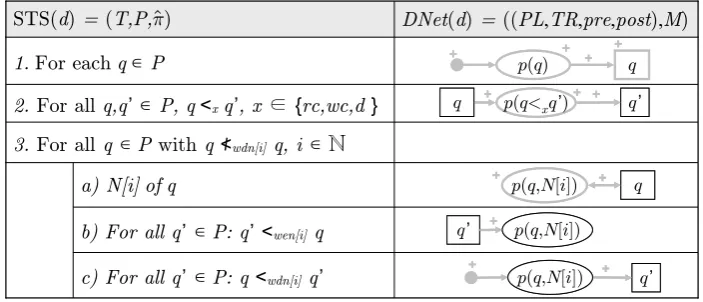
Fig.5shows the steps of the construction of the dependency net. The steps are given as visual-ized rules, where gray line colour and plus-signs mark the inserted elements. In the first step they are created without context, but e.g. in step two the new place “p(q<xq0)” is inserted between
the already existing transitionsqandq0. The tokens of the marked Petri net are represented by bullets that are connected to their places by arcs. The first step creates a transition for each rule and the transition is connected to a marked place for ensuring that it cannot fire twice. In step 2, between each pair of transitions in each of the relations<rc,<wcand<d, a new place is created
in order to enforce the corresponding dependency. The rest of the construction is concerned with places which correspond to NACs and can contain several tokens in general. Each token in such a place representsthe absenceof a piece of the NAC; therefore if the place is empty, the NAC is complete. In this case, by step (3a) the transition cannot fire. Consistently with this intuition, ifq0<wen[i]q, i.e. transitionq0consumes part of the NACN[i]ofq, then by step (3b)q0produces
a token in the place corresponding toN[i]. Symmetrically, ifq<wdn[i]q0, i.e. q0produces part of
NACN[i]ofq, then by step (3c)q0consumes a token from the place corresponding toN[i]. No-tice that each item of a NAC is either already in the start graph of the derivation or produced by a single rule. Furthermore, if a rule generates a part of one of its NACs, sayN[i](q<wdn[i]q), then
by the acyclicity ofSTSN(d)the NACN[i]cannot be completed before the firing ofq: therefore
we ignore it in the third step of the construction of the dependency net.
that the constructed net in general is not a safe one, because the places for the NACs can contain several tokens. Nevertheless it is a bounded P/T net, where the bound to the number of tokens is given by the maximum, taken over places representing NACs, of the number of rules that either weakly disable or weakly enable the specific NAC.
1=cont1 3=cont2
2=stop1 4=stop2
p(1<wc 2)
p(3)
p(1,N[2])
p(1) p(2)
p(3<wc 4)
p(3,N[1])
p(4)
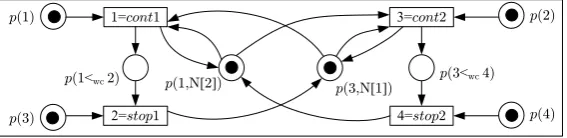
Figure 6: Dependency NetDNet(d)as Petri Net
Example 4 (Dependency Net) Consider the derivation d from Ex. 1 and its derived STS in
Ex.2. The marked Petri net shown in Fig.6is the dependency netDNet(d)according to Def.8.
The places encoding the write causality relation are “p(1<wc2)” and “p(3<wc 4)”. For the NAC-dependencies we have the places “p(1,N[2])” for the second instantiated NAC in the first derivation step ofd and “p(3,N[1])” for the third derivation step and its first instantiated NAC. The other two instantiated NACs are not considered, because the corresponding rules are weakly self-disabling (q<wdn[i]q). At the beginning the transitionscont1 andcont2are enabled. The
firing sequences according to the derivations d andd0 in Fig. 3 can be executed and they are the only firing sequences of this net. Thus, the net specifies exactly the derivations which are permutation-equivalent tod.
We now show by Thm. 1below that we can exploit the constructed Petri netDNet(d)for a derivationd to characterise all derivations that are permutation-equivalent tod, by analysing the firing behaviour of DNet(d). Note that according to Def. 8each sequence s of rule names in the STSSTSN(d)can be interpreted as a sequence of transitions in the derived marked Petri net DNet(d), and vice versa. This correspondence allows us to transfer the results of the analysis back to the STS. More precisely, we can generate the set of all permutation-equivalent sequences by constructing the reachability graph ofDNet(d), which therefore can be considered as a com-pact representation of this equivalence class.
Recall that atransition complete firing sequenceof a Petri net is a firing sequence where each transition of the net occurs at least once; notice also that in a dependency net according to Def.8, each transition can fire at most once by construction. This means in our case each transition fires exactly once. The following Thm.1presents a sound and complete analysis of permutation equivalence by complete firing sequences in the corresponding dependency net.
Theorem 1 (Analysis of Permutation Equivalence of Derivations) Let d be a derivation re-specting NACs of a GTS with NACs, and let DNet(d)be its dependency net. Then a derivation d0
is permutation equivalent to d (d0 ≈π d) if and only if the sequence of names sd0, which contains
all the direct derivations of d in the order they are actually fired in d0, is a transition complete firing sequence of the marked P/T Petri net DNet(d).
constructed dependency net. We can interpret a transition complete firing sequencesofDNet(d)
within the STS STSN(d) and show that it corresponds to a valid derivation in STSN(d). This
allows us to use Thm. 1 in [Her09] showing that the derivation derived fromsis permutation-equivalent tod. Vice versa, given a derivationd0, which is permutation-equivalent tod, we can show that the corresponding sequencesd0 is a transition complete firing sequence in DNet(d). For a complete proof see Cor. 1 in [HCEK10].
4
On the Cost of Analysis
Besides soundness and completeness of the analysis as presented in Thm.1 we now focus on its efficiency. Therefore, we extend the previous example and compare the analysis efforts of the new technique with those of a direct analysis of the derivation. This comparison shows a significant advantage of the technique and the effect is not limited to specific examples. The benefit is high for transformation sequences, where many steps overlap on matches and include dependencies because of NACs. Clearly, if NACs are not involved permutation equivalence is equal to switch equivalence and in this case the reachability graph of the Petri net specifies all switch-equivalent derivations.
q1=cont1', i ∈ {0,1,2,3,4}
L
w1:worksOn 1:Person
4:started
K
1:Person
R
1:Person
3:Task
N1[2i+1]
w(2i+1):worksOn 1:Person
3:Task
4:started
3:Task
4:started
3:Task
N1[2i+2]
w(2i+2):worksOn 2:Person
3:Task 1:Person
4:started 4:started
T ’
w1:worksOn 1:Person
3:Task 4:started
2:Person
w2:worksOn w3:worksOn
w5:worksOn w7:worksOn
w9:worksOn
w4:worksOn w6:worksOn w8:worksOn w10:worksOn
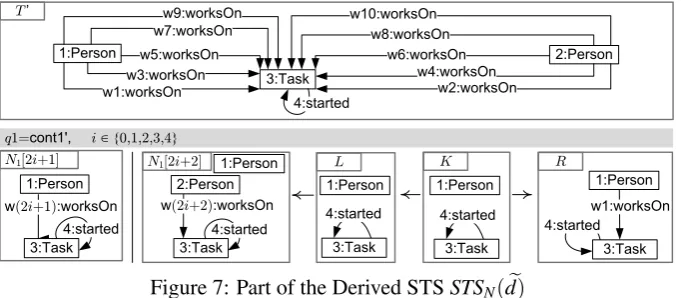
Figure 7: Part of the Derived STSSTSN(d)e
Example5 (Extended Derivation) We extend the derivationdof Ex.1to a derivationde, which specifies that the two persons are working on the same task, but they continue and stop their work five times, i.e.de= (d;d;d;d;d)is a derivation with 20 steps. The derived STSSTS(d)e contains 20 rule occurrences and Fig.7shows its super objectT0and the rule occurrence “cont1’ ” for the first step ofde. This rule occurrence has 10 NACs, one for each possible edge of type “worksOn” inT0. These NACs are visualised in the figure by two NACs with a parameter iranging from zero to four. The derivation consists of 10 blocks of the form “contx; stopx”. Each permutation-equivalent derivation ofdehas to preserve these blocks, otherwise a NAC would not be fulfilled or the causality relation would be violated. Thus there are10!=3.628.800permutation-equivalent derivations.
Based on the dependency netDNet(d)e we can construct the reachability graphRG(DNet(d))e
10 2.375.880.850 2.375.880.860
20
Switch Equivalence
without NACs Permutation Equivalence
3,6 2.375.880.867,4
Amount of Equivalent Sequences for 20 Steps
In Millions
Amount of Equivalent Sequences
Logarithmic Scale
1,0E+00 1,0E+02 1,0E+04 1,0E+06 1,0E+08 1,0E+10 1,0E+12 1,0E+14 1,0E+16
4 6 8 10 12 14 16 18 20
Transformation Steps
Eq
u
iv
al
en
t
Se
q
u
en
ce
s Switch Equivalencewithout NACs Permutation Equivalence
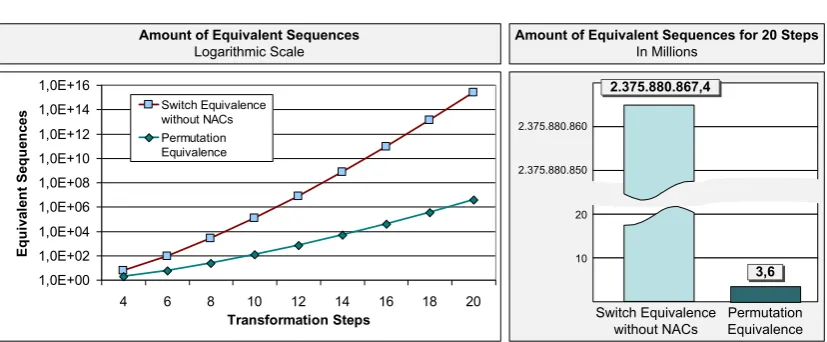
Figure 8: Comparison of the Amount of Equivalent Sequences
RG(DNet(d))e is given by: eff <9·n, wherenisn=20·10!=72.576.000, which is the
num-ber of derivation steps in the set of all permutation-equivalent derivations. The details of these and the following numbers are given in [HCEK10]. A direct generation of the permutation-equivalent derivations based on Def. 3 (brute force method) starts with a computation of the complete set of switch-equivalent derivations disregarding the NACs and thereafter the invalid ones are filtered out. This would lead to F =654.729.075 times as many derivations as the number of permutation-equivalent derivations, because the blocks “cont(x);stop(x)” are split and many steps “cont(x)” can be shifted backwards. Thus, the lower bound for the brute force effortEFFis given byF·n≤EFF. In comparison we have for the efforteff of constructing the reachability graph of the dependency net:
eff <1,4×10⁻⁸EFF.
Fig.8shows how the different amounts of equivalent sequences develop for 2 up to 10 blocks of “continue;stop” steps. Both analyses are fairly brute-force, since we did not integrate reduc-tions, such as symmetry or partial-order reduction. However, the figures show that a definite gain in efficiency can be obtained, which we expect similarly also with additional reductions, which are mainly orthogonal to the reduction technique studied in this paper.
Of course, the effort for constructing the Petri net has also to be taken into account, but it does not significantly change the result. In general, the construction of the STSSTS(d)with its relations is shown to be of polynomial time complexity with respect to the length of the derivation
d[Her09]. Furthermore, the construction of the dependency net is linear with respect toSTSN(d)
equipped with the derived relations and for this example contains only 120 places. Note that still all steps indeare sequentially dependent with NACs and therefore, no direct switching is possible.
5
Conclusion
modelling of workflows of reconfigurable mobile adhoc networks [EHP+07,HEP07]. Each of them has its specific features, which support the modelling of systems in the concrete applica-tion domain. Negative Applicaapplica-tion Condiapplica-tions (NACs) are an important control structure for these techniques and they are widely used for applications. However, the analysis of processes of such systems, i.e. the study of equivalence of derivations in the presence of NACs going be-yond switch equivalence including NACs as studied in [HHT96,LEO06], was introduced only recently in [Her09]. This new notion of equivalence, called permutation equivalence, is stud-ied in this paper. More precisely, we study the problem how to obtain, in an efficient way, all derivationsd0which are permutation-equivalent to a given derivationd.
In order to provide a sound, complete and efficient analysis technique for permutation equiv-alence we have shown how the dependency net for the derivation can be constructed, which purely specifies the dependencies between the transformation steps including the inhibiting ef-fects of the NACs. Based on the reachability graph of the dependency net we derive all valid permutations of the derivation steps of a given derivationd, i.e. the order of the applied rules together with the new matches. The derived derivations are exactly the permutation-equivalent derivations ofd. While the example in this paper was kept compact, the overall approach can be applied to adhesive HLR systems in general, if suitable side conditions are fulfilled [HE08], which is the case for e.g. typed attributed graph transformation systems.
The efficiency of the Petri net approach is based on two advantages. First of all, the constructed Petri net only specifies the dependencies among the steps of the derivation, ignoring the concrete structure of the involved graphs: This advantage is independent of the presence of NACs. The second advantage is that NACs are respected during the generation of the permutation-equivalent sequences. Thus, the number of generated sequences during the analysis is reduced significantly if NACs are involved, as shown by the presented example.
Some of the problems addressed in this paper are similar to those considered in the process semantics [KK04] and unfolding [Bal00,BKS04] of Petri nets with inhibitor arcs, and actually we could have used some sort of inhibitor arcs to model the inhibiting effect of NACs in the dependency net of a derivation. However, we would have needed some kind of “generalised” inhibitor nets, where a transition is connected to several (inhibiting) places and can fire if at least one of them is unmarked. To avoid the burden of introducing yet another model of nets, we preferred to stick to a direct encoding of the process of a derivation into a standard marked P/T nets, leaving as a topic for future research the possible use of different models of nets for our dependency net.
Future work will encompass the extension of the presented technique to general application conditions in the form of nested application conditions [HP05,HP09], for which we already have concrete ideas. Further improvements of efficiency could be obtained by observing the occurring symmetries in the P/T Petri net, and applying symmetry reduction techniques on it. Additionally, the space complexity of the analysis could be reduced by unfolding the net and then representing all permutation-equivalent derivations in a more compact, partially ordered structure. We already implemented the construction of a dependency net from a given graph transformation derivation with NACs based on a recently developed graph transformation engine in Mathematica called AGT (Algebraic Graph Transformation) [BHE09].
References
[Bal00] P. Baldan. Modelling Concurrent Computations: from Contextual Petri Nets to Graph Grammars. PhD thesis, Dipartimento di Informatica, Universit`a di Pisa, 2000. Available as technical report n. TD-1/00.
[BCH+06] P. Baldan, A. Corradini, T. Heindel, B. K¨onig, P. Sobocinski. Processes for Adhesive Rewriting Systems. InFoSSaCS’06. LNCS 3921, pp. 202–216. Springer, 2006.
[BHE09] C. Brandt, F. Hermann, T. Engel. Security and Consistency of IT and Business Mod-els at Credit Suisse realized by Graph Constraints, Transformation and Integration using Algebraic Graph Theory. In Proc. Int. Conf. on Exploring Modeling Meth-ods in Systems Analysis and Design 2009 (EMMSAD’09). LNBIP 29, pp. 339–352. Springer Verlag, Heidelberg, 2009.
[BKS04] P. Baldan, B. K¨onig, I. St¨urmer. Generating Test Cases for Code Generators by Un-folding Graph Transformation Systems. InProc. of ICGT ’04. LNCS 3256, pp. 194– 209. Springer, 2004.
[CHS08] A. Corradini, F. Hermann, P. Soboci´nski. Subobject Transformation Systems. Ap-plied Categorical Structures16(3):389–419, June 2008.
[EEPT06] H. Ehrig, K. Ehrig, U. Prange, G. Taentzer.Fundamentals of Algebraic Graph Trans-formation. EATCS Monographs in Theoretical Computer Science. Springer, 2006.
[EHP+07] H. Ehrig, K. Hoffmann, J. Padberg, U. Prange, C. Ermel. Independence of Net Trans-formations and Token Firing in Reconfigurable Place/Transition Systems. In Kleijn and Yakovlev (eds.),Proc. of ATPN’07. LNCS 4546, pp. 104–123. Springer, 2007.
[HCEK10] F. Hermann, A. Corradini, H. Ehrig, B. K¨onig. Efficient Process Analysis of Trans-formation Systems Based on Petri nets. Technical report 2010-3, Fak. IV, Technische Universit¨at Berlin, 2010.
http://www.eecs.tu-berlin.de/menue/forschung/forschungsberichte/2010
[HE08] F. Hermann, H. Ehrig. Process Definition using Subobject Transformation Systems.
EATCS Bulletin95:153–163, 2008.
[HEP07] K. Hoffmann, H. Ehrig, J. Padberg. Flexible Modeling of Emergency Scenarios us-ing Reconfigurable Systems. InProc. of IDPT’07. Society for Design and Process Science, 2007.
[Her09] F. Hermann. Permutation Equivalence of DPO Derivations with Negative Applica-tion CondiApplica-tions based on Subobject TransformaApplica-tion Systems. In Proc. of the Doc-toral Symposium of ICGT’08.Electronic Communications of the EASST 16, 2009.
[HP05] A. Habel, K.-H. Pennemann. Nested constraints and application conditions for high-level structures. In Proc. of Formal Methods in Software and System Modeling. LNCS 3393, pp. 293–308. Springer, 2005.
[HP09] A. Habel, K.-H. Pennemann. Correctness of high-level transformation systems rela-tive to nested conditions.Mathematical Structures in Computer Science19(2):245– 296, 2009.
[KK04] H. C. M. Kleijn, M. Koutny. Process semantics of general inhibitor nets.Information and Computation190(1):18–69, 2004.
[Kre86] H.-J. Kreowski. Is parallelism already concurrency? Part 1: Derivations in graph grammars. InGraph-Grammars and Their Application to Computer Science. LNCS 291, pp. 343–360. Springer, 1986.
[LEO06] L. Lambers, H. Ehrig, F. Orejas. Conflict Detection for Graph Transformation with Negative Application Conditions. In ICGT’06. LNCS 4178, pp. 61–76. Springer, 2006.