http://scienceasia.asia
_______________
2010 Mathematics Subject Classification: 90C05.
Key words and phrases: Leontief model; input-output; linear programming; inventory control; complementarity problem.
© 2014 Science Asia 1 / 7
THE LEONTIEF INPUT-OUTPUT PRODUCTION MODEL AND ITS APPLICATION TO INVENTORY CONTROL
CLARE OBIKWERE, ANIEKAN A. EBIEFUNG
Abstract. The standard input-output production model is relaxed in order to handle more problem instances. The relaxed model is solved as a minimization linear program. It is shown that a solution to the minimization linear program is the solution that will satisfy both internal and external demands of the sectors with minimum inventory level. A numerical example of a six-sector economy is used to illustrate the utility of the proposed model.
INTRODUCTION
For an economic analyst to understand and be able to analyze the economy of any nation, a region or a state, he may need to come up with a model that is based on the different sectors or industries of that economy. The input-output production model or the Leontief model is an analytical framework in this direction. The input–output production model was first developed by Wasily Leontief in the 1930s.
Basically, the input-output production model uses a matrix format or system of linear equations to represent a nation’s economy. The model shows how the output of one industry is an input to other industries. This representation shows how dependent each industry or sector is on all others in the given economy.
The Leontief input-output model has a wide range of economic applications. In Ebiefung and Kostreva (1993), and Ebiefung (2010), the Leontief input-output production model is generalized and applied to choice of technologies. Some of the applications of the model in pollution control issues are recorded in Ebiefung (2013), Ebiefung and Isaac (2012), and Leontief (1986). For more applications of the Leontief model, see the references at the end of this paper.
purpose of this paper is to show how the Leontief model could be used to control inventory in any given economic system. This is done by relaxing the standard input-output production model and proving that its solution components are the production quantities needed by the economic sectors to satisfy both internal and external demands at minimum inventory costs.
MODEL FORMULATION
In this section, we formulate the standard input-output production model and then show the relaxation procedure. Assume that the economy is divided into n sectors. As in the standard Leontief production model, we will also assume that prices are fixed and demands are stable.
NOTATION Let
i
x = total output of sector i, 1 i n
i
b = total final demand (external demand) for the products of sector i, 1 i n
ij
a = input of sector i required by sector j to produce one unit of its product, 1 i,
j n.
Then the total output of sector i is expressed as
1 n
i ij j i
j
x a x b
, 1 i n
Let
x
n x x x
2 1
, b
n b b b
2 1
, A =
1 1 1 2 1
2 1 2 2 . 2
1 2
...
...
... n
n
n n n n
a a a
a a a
a a a
where
x production vector
b = external demand vector for the outputs of the sectors
= technology matrix for the economy
Then
OR
(I A)x b
x 0
where I is the identity matrix of size n. The matrix (I – A) is called the Leontief matrix. If the Leontief Matrix is invertible (non-singular), then the unique solution of the system is given by
1 (I A)
x b
where (1 A)-1 is called the Leontief Inverse.
THE RELAXATION PROCEDURE
The condition that the amount of products produced by sector i is equal to or greater than what is needed to satisfy both internal and external demands is equal to
1 n
i ij j i
j
x a x b
0 , 1
i
x i n
This is our relaxed or extended Leontief’s input-output production model.
In the context of inventory control, we assume that if bi > 0, then bi represents the quantity of goods to be produced by sector i. And if bi < 0, then -bi represents the quantity of goods already in inventory which sector i will use to satisfy demands. In matrix notation, the relaxed model is equivalent to:
RLM: (I – A) x ≥ b (1)
0
x
FORMULATION AS A LINEAR PROGRAM
Consider the minimization linear programming model corresponding to the parameters in Equation (1):
MLP: min
n
i i ix c z
1
Subject to
(I A)
0
x b
x (2)
The following theorems show that the MLP’s solution is the one needed by the sectors in order to satisfy both internal and external demands at minimum inventory costs. The results of Cottle and Venoit (1972) are used to prove Theorem 1. We first provide notation and definition.
Consider the polyhedral set X corresponding to the feasible region of the relaxed
input-output model:
1
1
, , , , 0
n
n i i j j i i
i
X x x x a x b x
x : x
where 1 2 ...
n n = x , x , , x R
x , i, j = 1, . . ., n.
DEFINITION
Let x=x , x ,1 2 ..., xn X . We call x the least element of X if for ally X , xj yj, j = 1, . . .,
n.
THEOREM 1
If X , then it has the least element.
PROOF
By definition, aij ≥ 0 for all i, j. Hence, the matrix I – A is a Z-matrix, a matrix in which all off-diagonal entries are non-positive. Since X is defined by a Z-matrix I – A, it has the
least element property by Cottle and Venoit (1972). THEOREM 2
If x solves the MLP, then x is the least element ofX .
PROOF
Suppose thatx solves the linear programming problem. Assume thatx is not the least element ofX . Then there existsy X , the least element of X , such that y x .
Let C = 1 2 ...
n n
c , c , , c R such that ci > 0 for all i. Since C > 0 CTy CTx. This implies that
y is the optimal solution of the MLP, which contradicts the assumption that x is the
optimal solution. This completes the proof.
production quantity that will satisfy both internal and external demand when the Relaxed Input-Output Model is implemented.
APPLICATION OF THE RLM TO INVENTORY CONTROL
The following example is used to illustrate the utility of the relaxed model towards inventory control.
EXAMPLE
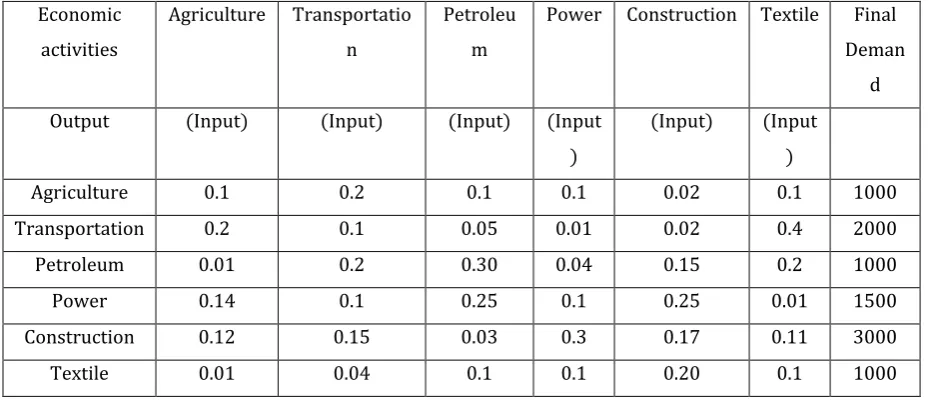
Assume the economy of a nation is divided into six sectors, namely, agriculture, transportation, petroleum, power, construction, and textiles. Assume that the input-output technology matrix is given as in Table 1 and that the unit is in millions of dollars. The problem is to determine production levels for the sectors of the given economy that will satisfy both internal and external demands at minimum inventory cost.
Table 1: Technology matrix
Economic activities
Agriculture Transportatio n
Petroleu m
Power Construction Textile Final Deman
d Output (Input) (Input) (Input) (Input
)
(Input) (Input )
Agriculture 0.1 0.2 0.1 0.1 0.02 0.1 1000
Transportation 0.2 0.1 0.05 0.01 0.02 0.4 2000
Petroleum 0.01 0.2 0.30 0.04 0.15 0.2 1000
Power 0.14 0.1 0.25 0.1 0.25 0.01 1500
Construction 0.12 0.15 0.03 0.3 0.17 0.11 3000
Textile 0.01 0.04 0.1 0.1 0.20 0.1 1000
Using the same notation as in Section 2, the quantities A,b, (I-A) are given by:
A = 0.10 0.20 0.10 0.10 0.04 0.01 0.11 0.17 0.30 0.03 0.15 0.12 0.01 0.25 0.10 0.25 0.10 0.14 0.20 0.15 0.04 0.30 0.20 0.01 0.40 0.02 0.01 0.05 0.10 0.20 0.10 0.02 0.10 0.10 0.20 0.10
b =
(I – A) = 0.90 -0.20 0.10 --0.10 -0.04 0.01 -0.11 -0.83 0.30 --0.03 -0.15 0.12 -0.01 --0.25 0.90 -0.25 -0.10 0.14 -0.20 --0.15 0.04 -0.70 -0.20 0.01 -0.40 --0.02 0.01 --0.05 0.90 0.20 -0.10 0.02 0.10 0.10 0.20 0.90
The linear programming problem, MPL, corresponding to the technology matrix is: Min z = x1 x2 x3 x4 x5 x6
Subject to
1 2 3 4 5 6
1 2 5 4 5 6
1 2 3 4 5 6
1 2 3 4 5 6
1 2 3
0 .9 0 .2 0 .1 0 .1 0 .0 2 0 .1 1 0 0 0
0 .2 0 .9 0 .0 5 0 .0 1 0 .0 2 0 .4 2 0 0 0
0 .0 1 0 .2 0 .7 0 .0 4 0 .1 5 0 .2 1 0 0 0
0 .1 4 0 .1 0 .2 5 0 .9 0 .2 5 0 .0 1 1 5 0 0
0 .1 2 0 .1 5 0 .0 3 0 .3
x x x x x x
x x x x x x
x x x x x x
x x x x x x
x x x x
4 5 6
1 2 3 4 5 6
1 2 3 4 5 6
0 .8 3 0 .1 1 3 0 0 0
0 .0 1 0 .0 4 0 .1 0 .1 0 .2 0 0 .9 1 0 0 0
, , , , , 0
x x
x x x x x x
x x x x x x
where ci 1, i =1, 2, …, n.
The above LP was solved by LINDO to obtain the following results: Objective value z = 40559.24
x = (4949.140137, 6302.836426, 7189.734375, 7750.520996, 9213.341797, 5153.665527)
INTEPRETATION OF THE RESULT
CONCLUSION
The Relaxed Input-Output production model is shown to be equivalent to a linear program (LP) and a linear complementarity problem (LCP). The model can be used to control production inventory in the sense that a solution of the associated LCP or LP ensures that production quantities from all the sectors of the economy satisfy both internal and external demands at minimum inventory costs. The feasibility part of the LCP ensures that both internal and external demands are satisfied. The complementarity conditions ensure that production quantities satisfy both internal and external demands exactly with no goods left in inventory or ensure that there is no production when what is in inventory can be used to satisfy both internal and external demands. Thus demands are met at no or minimum inventory costs. An example of a six-sector economy is used to illustrate the utility of the model.
REFERENCES
[1] Ebiefung A, Kostreva M. The generalized Leontief input-output model and its application to the choice of new technology. Annals of Operations Research. 1993; 44(2); 161-172.
[2] Ebiefung A. Choice of Technology, Industrial Pollution, and the Vertical linear Complementarity Problem. Global Journal of mathematical Sciences. 2010; 9(2) 113-120.
[3] Ebiefung A, Kostreva M. Production equilibrium point in multi-unit manufacturing systems and the vertical linear complementarity problem. Annals of Operations Research. 2003; 124; 183-192. [4] Ebiefung A. A generalization of the input-output pollution control model and product selection.
Applied Mathematics 2013; 4; 360-362.
[5] Ebiefung A, Isaac I. An input-output pollution control model and product selection. Journal of Mathematical Research. 2012; 4(5);1-7.
[6] Leontief W. Input-Output Economics. New York: Oxford University Press; 1986.
[7] Ebiefung AA, Udo GJ. Products selection and inventory control in multi-unit manufacturing systems. Proceedings of the Decision Sciences Institude. 1996; 1076-1078.
[8] Cottle RW, Venoit AF. Polyhedral sets having least elements. Mathematical Programming. 1972; 3; 238-249.
CLARE OBIKWERE,DEPARTMENT OF MATHEMATICS/STATISTICS,UNIVERSITY OF CALABAR, CALABAR,
CRS,NIGERIA
ANIEKAN A.EBIEFUNG,DEPARTMENT OF MATHEMATICS,UNIVERSITY OF TENNESSEE,CHATTANOOGA,