Asian Journal of Pharmaceutical Research and Health Care, Vol 8(S1), 7-11, 2016 DOI: 10.18311/ajprhc/2016/7714
Abstract
Several studies have so far focused on occupational stress among dentists and the results have shown that many factors can cause stress. However, the level of stress among experts in the fields of dentistry has not yet been studied in Iran. The aim of this study is to examine the causes and levels of job stress among dental professionals in Tabriz University of Medical Sciences. This cross-sectional study included all dental professionals of Dentistry Faculty; an overall of 55 subjects in Tabriz were studied in this research and their level of stress was evaluated using “The Health and Safety Executive Management Standards Indicator Tool” (HSE stress questionnaire) from September up to October 2014. The level of stress in each dental specialty was examined descriptively (mean, standard deviation). Statistical analysis was performed using SPSS 20. The findings of the study showed that the highest stress among dental professionals from different fields was observed in the field of oral and maxillofacial radiology; fields of oral medicine, endodontics, oral and maxillofacial surgery and pediatric dentistry ranked later. The lowest stress was seen among orthodontics specialists. Based on the results of the present study, the rate of job stress varied significantly among dental professionals.
Keywords: Burnout, Dental, Education, Professional, Stress
The Comparison of Job Stress among Dental
Professionals of Dentistry Faculty
Members of Tabriz University
Seyyed Vahid Dehnad
1, Mohammad Ali Ghavimi
2*, Arezu Ghoreishizadeh
3, Parisa Falsefi
4,
Ramin Negahdari
5and Amir Reza Babalou
61Resident of Oral and Maxillofacial Surgery, Tabriz University of Medical Sciences, Tabriz, Iran 2Department of Oral and Maxillofacial Surgery, Tabriz University of Medical Sciences, Tabriz, Iran;
3Department of Pediatric Dentistry, Tabriz University of Medical Sciences, Tabriz, Iran 4Department of Oral Medicine , Tabriz University of Medical Sciences, Tabriz, Iran 5Department of Prosthodontics, Tabriz University of Medical Sciences, Tabriz, Iran 6Department of Priodontology, Tabriz University of Medical Sciences, Tabriz, Iran
1. Introduction
Stress is a reaction to compromise with factors or circumstances that put individuals under physical or mental pressure1. In the 1930s, a new concept of stress was
presented which included anything unpleasant, harmful, or excessively exhausting2,3. Some experts believe that
stress at work is the result of high demand and low control of the situation4. The importance of job stress is second
only to the stresses in the family5. Factors of individuals’
jobs due to interference in the lifestyle, social status, and income, work environment, and it is stressful nature can cause psychological pressure that can lead to behavioral,
psychological, and social disorders6. Dentistry is
commonly known as a stressful profession among various occupations. The general level of stress depends on the patient-dentist relationship and job satisfaction, the high demands of work, exposure to toxic substances, and long working hours as the most important reasons underlying job stress among dentists7. Stress often roots in the
to time and patients were identified as the most important factors9. In another study, stress levels among dentists
working in surgery and dentists in dental care centers were compared and there was a statistically significant difference between the two groups, although the identified stress sources were different due to differences in the workplaces10. Henry presented the association of stress
and coronary heart disease among American dentists11.
Wilson et al., also, introduced time management as the highest source of stress among dentists12. The Swedish
Dental Association claims that dentists live an average of 10 years less than the total population of the country because of some occupational hazards, such as exposure to psychological stress, emotional exhaustion, tension, sadness, and anxiety13. Another study presented common
stressors among dentists in New Zealand, including the treatment of children as patients (52%), time pressure (48%), and difficulty in concentration (42%). Suggested strategies for coping with stress included interaction with people, exercise, and easing about job problems14. Dental
students are more stressed than students studying in other fields of medical sciences15. Cameiro et al. concluded
that the majority of oral-maxillofacial surgeons, exercise their profession in unsatisfactory working conditions, as less than 1/3 of the population studied worked under the ideal condition of low demand16. Chingarande et al.
revealed that there was a high incidence of occupational stress among medical radiographers working in general radiology. The results also showed that the most frequently encountered stressors in the general radiology department were pressure to complete tasks, overwork, inadequate salaries, and inadequate holiday or vacation time17. A
mental health study of 317 medical and dental students in Saudi Arabia concluded that the level of stress and anxiety was different among students in different academic years; stress and anxiety increased when students progressed to upper semester. Female students were stressed more than male students, and dental students were more stressed students of other fields of medical sciences18. Dental
students experience a significant amount of stress during their training (due to the nature of dental education). In addition, the adverse effects of stress can be shown to dental students’ health as well19.
Given the importance of the issue and considering the fact that job stress can have very negative impacts on job performance and job satisfaction and it can cause physical and psychological conditions and diseases
among the working people, and taking into consideration the fact that no comprehensive study on job stress among dental professionals has been done in this country22,23,
the present researchers decided to conduct a study to examine the variety and intensity of job stress among dental professionals in Tabriz.
2. Materials and Methods
2.1 Statistical Population of the Study
The statistical population of this cross-sectional study included dental specialists who were faculty members at Tabriz University of Medical Sciences. The sample size included all dental specialists of Tabriz University of Medical Sciences, an overall of 55 subjects. The amount of stress was measured through the Job Stress Questionnaire (HSE), including 35 questions with a five-option Likert scale (never, rarely, sometimes, often, or always) completed by dental specialists. The validity and reliability of the Farsi version of the questionnaire were previously studied by Azadmarzabadi et al.20; however,
the content validity of the questionnaire was assessed by four professors and the required changes were made. In order to study the reliability, a pilot study was performed among twenty cases and Cronbach’s alpha was estimated as 0.79.
The individual score of each item represented a measured value, ranging from 1 to 5, where 1 is the least desirable and 5 is the most desirable possible. Items 3, 5, 6, 9, 12, 14, 16, 18, 20, 21, 22, and 34 were scored reversely.
The minimum score achieved on the questionnaire was 35, while the maximum was 175. Respondents with scores over 105 were considered to have higher than average stress. For implementation, we explained the general plan to all eligible individuals and after that participant was asked to complete questionnaires to assess job stress. Once the questionnaires were completed, they were collected. Incomplete questionnaires were excluded. SPSS 20 was, then, used for data analysis. The Kruskal-Wallis test was used to compare averages among different groups. A P-valueof less than 0.05was considered significantin the comparison of the averages among different groups.
2.2 Ethical Considerations
of Medical sciences and required written consent was taken; a necessary fund to conduct the present study was provided by the authors.
2.3 Statistical Population of the Study
This study included 55 subjects active in ten different fields of Dentistry. Table1 shows the frequency of each field separately.
Table 1. The frequency of professionals in each field of dentistry
Item Number Percentage
Oral and maxillofacial radiology 4 7.27
Oral medicine 5 9.09
Prosthesis 11 20.00
Oral and maxillofacial pathology 4 7.27
Endodontics 3 5.45
Periodontics 6 10.91
Orthodontics 8 14.55
Oral and maxillofacial surgery 4 7.27
Restorative dentistry 5 9.09
Pediatric dentistry 5 9.09
Total 55 100.0
Table 2. Average, standard deviation, and minimum-maximum levels of job stress among dental professionals
Number
Mini-mum Maxi-mum Aver-age deviationStandard
Job
stress 55 74.00 151.00 117.62 15.30
The average of job stress in 55 dentistry specialists was 117, ranging from 74 up to 151 variables (Table 2). It should be noted that a maximum score achieved in HSE
questionnaire of job stress is 175 and a score of more than 105 (average) means higher than average level of stress.
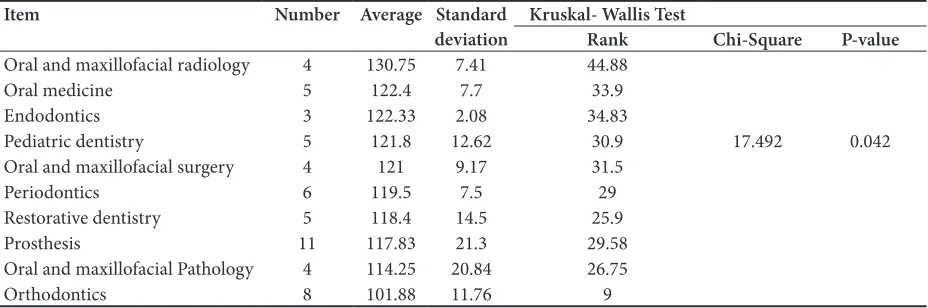
As the Kruskal-Wallis test ranking showed, the oral and maxillofacial radiology field, with a score of 88/44, ranked highest in terms of stress, followed by oral medicine, endodontics, oral and maxillofacial surgery, and pediatric dentistry, which ranked 33.9, 34.83, 31.5 and 30.9 in order. Prosthesis, pathology, periodontics, and restorative were ranked at the third level, at 29.58, 26.75, and 25.9, respectively, and orthodontics ranked last in terms of job stress [needs mean] (Figure 1).
Figure 1. Average job stress among study participants in terms of specialty.
3. Discussion
The Swedish Dental Association claims that, due to occupational hazards, dentists live 10 years less than the total population of the country on average because they are subjected to psychological factors such as stress,
Table 3. Comparison of job stress among dental professionals based on their field
Item Number Average Standard
deviation Kruskal- Wallis Test Rank Chi-Square P-value
Oral and maxillofacial radiology 4 130.75 7.41 44.88
Oral medicine 5 122.4 7.7 33.9
Endodontics 3 122.33 2.08 34.83
Pediatric dentistry 5 121.8 12.62 30.9 17.492 0.042
Oral and maxillofacial surgery 4 121 9.17 31.5
Periodontics 6 119.5 7.5 29
Restorative dentistry 5 118.4 14.5 25.9
Prosthesis 11 117.83 21.3 29.58
Oral and maxillofacial Pathology 4 114.25 20.84 26.75
emotional exhaustion, tension, sadness, and anxiety13.
The results showed that the mean stress among studied dental professionals in Tabriz was 117.62, which was higher than average. Dental specialists’ job stress was higher than average across all fields except orthodontics. The results were compatible with the findings of a study conducted by Rusli et al.7 The researchers stated that the
specialists’ high stress was due to long working hours. The results of the study conducted by Makames et al.8 were
also consistent with findings of this study; the researchers showed that the lack of time enhances clinical skills as the reason for high stress among dentists. Myers12 and Wilson
et al.1 also introduced time management as the most
prominent stressor among dentists. Elani et al. cited that the nature of the work is the major source of stress among dentists19. Birks et al. stated that dental students’ stress
was higher than the level of stress among students of other fields of Medical Sciences15. All these studies showed high
rate and level of stress among dental specialists, which is consistent with the results of this study. In this study, oral radiology specialists had the highest stress (130.75), compared to other specialists. Such a result is reasonable considering the nature of the field and the risks resulting from X-rays. Chingarande and Ndlovu also declared high job stress among medical radiologists and showed that job stress among female radiographers was significantly higher than that of male radiographers17. The results
showed that, after oral radiology, specialists in the fields of oral medicine (122.4), endodontics (122.33), oral and maxillofacial surgery (121) and pediatric dentistry (121.8) had the highest stress among the fields studied. In addition, the stress level in the fields of prosthetics (117.83), pathology (114.25), periodontics (119.5), and rehabilitation (118) were ranked the third (in terms of job stress ranking among dental professionals in Tabriz), while the lowest level of job stress was related to orthodontic specialists (101.88). Ayera et al. also introduced the treatment of children as a common stressor among dentists. Child patients are often panicked and resistant to dental treatment; so that it is understandable that endodontic specialists experience more stress during root canal therapy of children. All results related to the field of endodontics, oral and maxillofacial surgery, and pediatric dentistry are compatible with the results of the present study14. In this study, periodontics, prosthesis and
pathology specialists were ranked third in terms of job stress. Stress was lowest among orthodontic specialists. In a study carried out by Newton et al., pediatric, endodontic,
and prosthesis specialists had the highest levels of stress, which is consistent with the results of the present study in terms of stress among pediatric and root canal therapy specialists. However, stress among prosthesis specialists is in contrast to the results of our study; additionally, a dentures specialty was introduced as one of the three most stressful fields, which is inconsistent with results of this study21. These differences may be due to age, gender,
or work experience of the respondent specialists. Stress is a psychological problem related to gender. According to Radillo et al.5, stress is higher among female dentists
in comparison to male dentists5. In Aboalshamat et
al. study, female students had higher stress levels than male students as well18. Russek stated that the number
of heart complaints in the fields of Periodontology and Orthodontics was higher than in other fields, as much as three times higher in periodontics specialists than in other professionals. The results of that study were inconsistent with results of this study11. As mentioned
previously, the differences between the results of this study with the other conducted studies may be due to some factors such as gender, age, and work experience, which were not homogenized in the study specialized groups. Therefore, the homogenization of samples is essential in terms of gender, age, and work experience in studying stress among dental specialists. However, lack of control for confounding factors in the present study was due to the unavailability of the professionals, as well as a lack of cooperation from them side; further studies are required in order tom provide more authentic findings and cover more expanded related areas.
4. Conclusions
The results of this study showed that the highest stress among dental specialists in different fields of dental specialties was in the field of Oral and Maxillofacial Radiology, followed by the fields of Oral Medicine, Endodontic, Oral and Maxillofacial Surgery and Pediatric Dentistry. The lowest job stress was seen in Orthodontics professionals.
Considering high stress in professionals, the use of stress management strategies in educational programs through workshops seems necessary. To improve the living standards of dentists, it is recommended that the study be done as mandated by the health care system.
5. Acknowledgement
Deepest gratitude goes to all professors of Dentistry School of Tabriz University of Medical Sciences and all the stuff cooperating in the present research.
6. Competing Interest
The authors declare that they have no conflict of interest.
7. References
1. Wilson RF, Coward PY, Capewell J, Laidler TL, Rigby AC, Shaw TJ. Perceived sources of occupational stress in general dental practitioners. Br Dent J. 2008; 184:499–502.
2. Roth S, Heo J, Varnhagen C, Glover K, Major P. Occupa-tional stress among Canadian orthodontists. Angle Orthod. 2003; 73(1):43–50.
3. Radillo B, Lopez T, Velasco M, Pezes G. Stress associ-ated factors in Mexican dentist. Brazo Oral Res J. 2008; 22(3):223–8.
4. Arandelovia M, Llia I. Stress in workplace-possible preven-tion. Medicine and Biology. 2006; 13(3):139–44.
5. Radillo BEP, López TMT, Velasco MLA, Fernández MA, Perez GJG. Stress-associated factors in Mexican dentists. Braz Oral Res. 2008; 22(3):223–8.
6. Moore R, Brodsgaard I. Dentists’ perceived stress and its relation to perceptions about anxious patients. Community Dent Oral Epidemiol. 2001; 29(1):73–80.
7. Rusli BN, Edimansyah BA. Prevalence and associated fac-tors of stress in dental healthcare workers of a higher in-stitution of learning in Kelantan. Arch Orofac Sci. 2006; 1:51–6.
8. Makames RA, Alkoot EM, Almazidi BM, Elshazly MK, Kamel ML. Sources and expressions of stress among phy-sicians in a general hospital. Alex J Med. 2012; 48:361–66. 9. Cooper CL, Watts J, Kelly M. Job satisfaction, mental health
and job stressors among general dental practitioners in the UK. Br Dent J. 1987; 162:77–81.
10. Humphris G, Peacock L. Occupational stress and job satis-faction in the community dental service of North Wales: A pilot study. Community Dent Health. 1992; 10:73–82. 11. Russek H. Emotional stress and coronary heart disease in
American physicians, dentists and lawyers. Am J Med Sci. 2000; 243:716–25.
12. Myers HL, Myers LB. It’s difficult being a dentist: stress and health in the general dental practitioner. Br Dent J. 2004; 197(2):89–93.
13. Kamin V. Fear, stress and the well dental office. Northwest Dent. 2006 Mar-Apr; 85(2):10-1,13,15-8.
14. Ayera KM, Thomson WM, Newton JT, Rich AM. Job stress-ors of New Zealand dentist and their coping strategies. Oc-cup Med (Lond). 2008 Jun; 58(4):275–81.
15. Birks Y, McKendree J, Watt I. Emotional intelligence and perceived stress in healthcare students: a multi-institution-al, multi-professional survey. BMC Medical Education. 2009; 9(1):61.
16. Carneiro SCA, Vasconcelos BC, Nascimento MMM, Leal JLF, Orestes MS, Porto GG. Occupational stress among Brazilian oral-maxillofacial surgeons. Med Oral Patol Oral Cir Bucal. 2009 Dec 1; 14 (12):e646–9.
17. George RC, Bekezela N. The prevalence and antecedents of occupational stress among radiographers in Zimbabwe: In-terplay of economics and culture. Int J Med Res Health Sci. 2013; 2(2):233–8.
18. Aboalshamat KH, Hou X-Y, Strodl E. Psychological health of medical and dental students in Saudi Arabia: A longi-tudinal study. Public Health Research. 2014; 4(5):179–84. DOI: 10.5923/j.phr.20140405.05.
19. Elani HW, Allison PJ, Kumar RA, Mancini L, Lambrou A, Bedos C. A systematic review of stress in dental students. J Dent Educ. 2014 Feb; 78(2):226–42.
20. Marzabadi A, Gholami F. Reliability and validity assess-ment for the HSE job stress questionarie. J Behav Scien. 2011 Win; 4(4):291–7.
21. Newton JT, Mistry K, Patel A, Patel P, Perkins MM, Saeed K , Smit C. Stress in dental specialists: A comparison of six clinical dental specialtie. Primary Dental Care. 2002; 9(3):100–4.
22. Abedi GH, Rostami F. Regression model analysis of service desirability in a group of Mazandaran hospitals. Health MED. 2012; 6(1):24–8.