Received 11 June 2020; received in revised form 21 July 2020; accepted 20 August 2020.
Mechanical properties (scratch test) of silicanizing process on mild
steel substrate using Tronoh silica sand
Yusnenti Faziran Mohd Yunos *, Mohd Yusri Ibrahim
Mechanical Engineering Department, Polytechnic Kuching Sarawak, 93050 Sarawak, MALAYSIA.
*Corresponding author: [email protected]
KEYWORDS ABSTRACT
Mild steel Scratch test Silica sand Diffusion Coating
This paper presented a new approach of producing coating onto a mild steel substrate called ʺsilicanizingʺ by using natural silica sand originated from Tronoh Silica Silica Sand (TSS) at elevated temperature. . Influence of the silicanizing process parameters especially temperature and time on the silicanized coating layer’s microstructure and mechanical properties were studied. In addition, effect of Silica Sand (SiO2) at elevated
temperatures with time onto the mechanical properties of the coating and substrate were also investigated. Formation of Fe-SiO2 via interdiffusion of Fe and SiO2 were
determined by the rate of grain boundary diffusion of SiO2
through the growing Fe-SiO2 phase shown at silicanizing
process temperature of 1000°C for 4 hours. The scratch test result found that the comparisons of penetration depth and acoustic emission curves shows that high strength coated mild steel show the best adhesion with SiO2 coating. Least adhesion is shown by the uncoated
mild steel substrate. It can concluded that harder coated substrates show better adhesion properties with SiO2
1.0 INTRODUCTION
The protection of materials by hard coating is one of the most important and versatile means of improving component performance. Problems with the coating selection for specific applications arise mainly because many desired properties such as good adherence at the substrate-coating interface or high hardness and high toughness cannot be achieved. For example, increasing hardness and strength usually lead to the decrease in toughness, adherence, low notch sensitivity and poor resistance to crack propagation (Holmberg & Mattews 1994). Many of the surface treatment technique can be applied very economically to large and complex components. Most surface treatments are employed to increase surface hardness, wear resistance, minimizes adhesion and to improve the corrosion resistance of the tool base. The surface treatments are normally applicable to ferrous alloy, but some of them can be applied even to nonferrous alloys (Schwatz, 1990).
Silicanization is a surface treatment process, the objective of which is to prevent undesirable interactions between the treated surface (mild steel) and powder pack, SiO2. The implication is
that SiO2-like properties are desirable and well-defined. The coatings are formed by deposition
(adhesion) of metals into a substrate at elevated temperatures. The deposition elements modify the surface chemical composition and produce new phase transformations. In the siliconizing process that master alloy can be either pure silicon or silicon alloy depending on the desired activity of the pack powder (Robert & Tucker, 2002). The length of time the sample and powders are held at temperature will be a primary factor in the thickness of the coating is the amount of pack powders (Fitzer, 1978). Such findings led to a concluding remark about the coating time at temperature define the thickness of the coating formed during the solid diffusion step (Brookes et al., 1972). This formation and growth characteristics of the diffusion layer formed at the SiO2
-substrate interface depend on several factors, such as the crystal structure, the range of solid solubility, the magnitude and sign inter atomic interaction potentials between the atoms of substrate (mild steel) and coating elements.
normal force which is increased either stepwise or continuously until the coating became detached.
In this paper, the influence of the microstructure and mechanical properties of “silicanizing” process during scratch test was studied. Relevant silicanizing microstructure and mechanical properties involved in transforming TSS particles into thin film coating on mild steel substrate is expected to be established.
2.0 EXPERIMENTAL PROCEDURE
2.1 Material and Silicanizing Process
The rectangular mild steel specimen with dimension 18 mm (length) x 18 mm (width) x 5mm (thickness) were embedded in silica sand fine particles (80-90%.wt). This was performed using fire clay jacket as crucible, which subjected to surface hardening treatment. For this, samples surface was ground with series of SiC paper of 600 grits. Subsequently, the sample were cleaned in acetone baths and dried in air. TSS powder with size below 150 µm was used in silicanizing experiments. In the next step, the sample was subjected to heat treatment in furnace at elevated parameters. The silicanizing parameters in term of temperatures range between 1000C with soaking time of 4 hours were involved in this study. Scanning Electron Microscope (SEM) was used to analyze the size of microstructure. The SEM analysis was performed to analyze the different element produced due to the different parameter as well as diffusion of SiO2 in mild steel
substrate.
2.2 Scratch Testing Procedure
The scratch experiments were carried out using scratch tester (CSM instruments SA). The recommended set of conditions shown in Table 1 is based on ASTM C1624-05. Both the specimen surfaces and indenter tip were cleaned using ethanol prior to the scratch test. These scratches were then analyzed under an optical microscope to define the critical loads and observe the mechanism of failure. It should be noted that the main advantages of the test are its repeatability and versatility.
Table 1: ASTM C1624-05 of mild steel operating condition using scratch tester (Holmberg, 2001).
Sample Possible Range Recommended
Indenter Rockwell Diamond 200µm
Progressive Scratch Load increment Scratch length Scratch speed
-35 N/min 1mm 1.5 mm/min
1/5 of the critical load determined with the increasing load test
3.0 RESULTS AND DISCUSSION
3.1 Microstructure Analysis
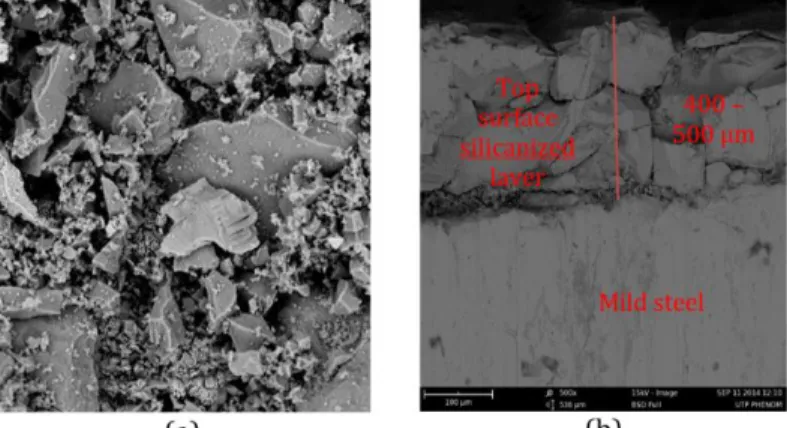
The silicanized coating layer was seen gold in colour, solid and free from voids except for a few flakes on the surface. The SiO2 concentrations vary steadily across of thin layer to the surface
(Figure 2) and diffused and deposited into substrate, which led to the formation of uniform coating layers rich in SiO2.
Figure 1: Camera ready photo of the silicanizing process at 1000°C for 4 hours.
Figure 2: SEM image of (a) Top surface of silicanizing process at 1000°C for 4 hours (b) siliconized layer thickness measurement.
In particular, the pack mixture containing 80-90 wt% SiO2 resulted in deposition of Fe-SiO2
with an average thickness ≈ 500µm (Figure 2(b)). The as-formed coatings were very rough but more homogeneous, crystallize structure and of low porosity. Formation of the coating compounds is the result of reaction of the SiO2 with the chemically deposited mild steel substrate
and their chemical composition concentration. It has been reported that deposition of SiO2 in steel
is very fast under conditions used in this work (Fitzer, 1978). Silicanized formation is, therefore, an interface-limited process at the Fe-SiO2 interface. However, in this study oxides including SiO2
were assumed to form on the surface of the substrate in order to reduce the surface energy, maximize the oxygen supply, and simplify the scale problem found by previous researchers.
3.2 Scratch Test Analysis
coated substrate (Figure 4) coatings are much more brittle than the uncoated substrate (Figure 3).
Moreover, the cohesive failure of the coatings is shown to be by tensile cracking. Nevertheless, the adhesive failure of the coatings was different for each case. The coated substrate inclined towards compression spallation, often mixed with gross spallation, where both defined as brittle failure modes. In addition, the microscope examination could not determine the load at which cracking of the coating begins to occur, where the surface of the coating is too rough. Furthermore, the examination of the scratch trace in the delaminated region revealed that it was initially smooth. Nonetheless, a transition to brittle machining of the SiO2 substrate occurred at a higher
load (̴ 8- 26N).
Figure 3: Microphotograph of the scratching scars on the surfaces of uncoated mild steel. Thin coatings that are assessed by the scratch adhesion test are usually brittle. While a coating can withstand the compressive stress induced by the indenter to a certain extent, it may fracture if a high tensile or shear stress field is induced simultaneously. The thickness of such coatings can range from nanometers to several hundred micrometers. The mechanical properties of the coatings play a crucial role in the reliability of the products to which they are applied. This is particularly obvious for the coatings that are actually applied to offer mechanical protection.
Figure 4 demonstrates that the optical micrographs depicts the region of critical load, where initial cracking in the coated surface appears and the appearance of first adhesive failure and the end of scratch respectively. There was no appreciable wear on the coated surface. The dense cracking within the scratch is the result of excessive amount of load and also because the same area was scratched three times (Figure 3).
Figure 4 reveals a build-up of material on the right-hand side of the trench, which is a common feature in nano-indentation. This is caused by the accumulation of material derived from the scratch. The width and depth of the v-type profile were 17.105 µm-13.263 µm and 72.24 µm, respectively. Penetration of the tip corresponded with approximately 0.4% of its total height as the pyramidal diamond tip had a 200 µm base and height of 50 µm. Hence, a nanotrench was formed by the scratch on the 1.5 µm silicanized layer coating.
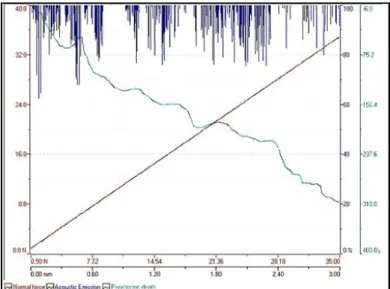
substrate. The test was performed using a progressive increase in the normal load values from 0.9 N to 35 N, during a scan of the diamond tip along 3 mm displacement. In this case, the silicanized layer coating was deposited onto mild steel substrate, since the mild steel coated substrate could suffer cleavage under these higher loads. In addition, the adherence and flaws of the silicanized film coating were analyzed in which there were regions outside the scratch. Hence, there was evidence of flaws, but without exposure of the substrate.
Figure 4: Microphotograph of the scratching scars on the surfaces of coated mild steel. Figure 5 and Figure 6 demonstrates the comparison of the penetration depth curves between different coated and uncoated substrates. The findings indicated that uncoated mild steel has the largest penetration depth in the range 119-250 µm (Figure 6). This is because the uncoated mild steel is the softest among the coated substrates and the indenter has easily penetrated the surface. Figure 5 demonstrates the least penetration by high strength coated mild steel (silicanized layer), which is in range 19.8 – 23.6 µm.
Figure 5 and 6 demonstrates the acoustic emission curves between coated and uncoated substrates. The result indicated that coated mild steel had maximum acoustic emission, while uncoated mild steel had minimum acoustic emission. This might be due to the brittleness of coated substrates in which the coating produces heavy noise when it delaminated. This is an important characteristic of coatings that will completely spall when failure occurs. It is generally the case for brittle coatings on the soft substrates. Figure 6 reveals a change of slope or rms fluctuations, which is marked by progressive spallation of the coating. Nevertheless, the abrupt discontinuity is an excellent indication of the coating failure.
load was lower, which is consistent with previous studies on the brittle substrates. In addition, results have shown that the scratch tester yields valuable information for systems. The plots are applicable to more brittle substrates. In short, plot offer a rapid assessment of the critical load, which is the significant finding of this study.
Figure 5: A plot of displacement curves coated mild steel substrate of the silicanizing process at 1000°C for 4 hours.
4.0 CONCLUSION
The formation of SiO2 (TSS) layer on mild steel substrate is caused by a new heat treatment
process called "silicanizing" at elevated temperatures which produced a thin silicanized layer. Silicanizing process (heat treatment) and produced thin coating layer (silicanized layer) due to high temperature with time, 1000°C for 4 hours in furnace using fine particles TSS. Fe-SiO2 phases
can be formed spontaneously on the silicanized layer. The silicanized layers formed at 1000°C for 4 hours were having nearly uniform and homogeneous thickness which was the reason for their choice for scratch test experiments. The scratch tests showed difference behavior of uncoated substrate and silicanized layer (coated substrate) sample. Thicker coatings tend to be harder and more brittle. This research also proposed that the improvement in hardness and good adhesion in coating is due to diffusion of SiO2 compound onto mild steel substrate which formed a hard
phase Fe-SiO2.
ACKNOWLEDGEMENT
This work was supported by the Minister of Education’s Fundamental Research Grant Scheme FRGS/2/2013/TK04/UTP/02/3. The authors would also like to acknowledge the assistance provided by Universiti Teknologi PETRONAS.he authors gratefully acknowledge the financial support of Department of Technical Sciences of the Romanian Academy.
REFERENCES
Baker, S.H., Marshall, J. (2018). Structure and properties of high-hardness silicide coatings on cemented carbides for high temperature application, J. Mater. Res, 8, 247.
Brookes, C.A., Green, P., Harrison, P.H., Moxley, B. (1972). Some observation on scratch and indentation hardness measurement, J.Phys. D: Allp. Phys, 5, 1284-1293.
Bull, S.J. (1991). Failure mode maps in the thin film scratch adhesion test, Surf. Coat. Technol, 50, 25.
Fitzer, F. (1978). Materials and coatings to resist high temperature corrosion, Applied Science, London, 253.
Holmberg, K. (2001). Coating tribology: contact mechanisms and surface design, Tribology International 31, 1-3, 107-120.
Holmberg, K., Mattews, A. (1994). Coating tribology, properties, technique and applications in surface engineering, Elesvier Science B.V.
Ichimaru, H., Rodrigo, A. (2000). The correlation of scratch adhesion with composite hardness for TiN coatings, Surface and Coating Technology, 126, 152-158.
Robert, C., Tucker Jr. (2002). Surface engineering technology, Advanced Materials Processes, April, 36-38.
Schwartz, M.M. (1990). Ceramic joining, ASM International Material Park USA:A.