R E S E A R C H
Open Access
Concomitant inhaled corticosteroid use and
the risk of pneumonia in COPD: a
matched-subgroup
post hoc
analysis of the UPLIFT®
trial
Donald P. Tashkin
1*, Marc Miravitlles
2, Bartolomé R. Celli
3, Norbert Metzdorf
4, Achim Mueller
5,
David M. G. Halpin
6and Antonio Anzueto
7Abstract
Background:Use of inhaled corticosteroids (ICS) increases the risk of pneumonia in chronic obstructive pulmonary disease (COPD), but the magnitude of risk with different ICS remains unclear.
Methods:Apost hocanalysis of the 4-year UPLIFT® trial to assess whether pneumonia risk differed by type of ICS (fluticasone propionate [FP], other ICS, or no ICS) in permanent users (defined by use until end of study) or in users at baseline (sensitivity analysis).
Results:For the permanent-users analysis, 825 patients receiving FP throughout the trial, 825 patients receiving other ICS and 825 patients not receiving ICS were matched on relevant baseline features 1:1:1. A significantly greater risk of pneumonia was observed for FP versus no ICS: the hazard ratio (HR) for risk of pneumonia was 1.33 (95% confidence interval [CI] 1.00, 1.75; p= 0.046) and the rate ratio (RR) was 1.58 (95% CI 1.05, 2.37;p= 0.028). A greater risk was also found for FP versus other ICS: HR 1.28 (95% CI 0.97, 1.68;p= 0.078) and RR 1.48 (95% CI 1.00, 2.19; p= 0.049). A higher proportion of patients on FP were hospitalized with pneumonia (7.9%) versus other ICS (6.7%) or no ICS (5.9%). Whilst other ICS use was associated with the highest number of fatal pneumonia events, the total number of fatal pneumonia incidents was low. A similar pattern was observed in the sensitivity analyses, which included 4002 patients on different treatments at baseline (FP, other ICS, and no ICS) and considered potential switches during the study.
Conclusion:The results support existing evidence of an increased pneumonia risk with FP use compared with other ICS and no ICS use in patients with COPD. Healthcare professionals should evaluate the risk–benefit ratio of using ICS when making treatment decisions with their patients.
Trial registration:Post hocanalysis of UPLIFT®.ClinicalTrials.govnumber:NCT00144339. Retrospectively registered September 2, 2005.
Keywords:COPD, Pneumonia, Inhaled corticosteroids, Fluticasone propionate, UPLIFT®
* Correspondence:[email protected]
1Department of Medicine, David Geffen School of Medicine, University of
California Los Angeles, 10833 Le Conte Avenue, Los Angeles, CA 90095-1690, USA
Full list of author information is available at the end of the article
Plain english summary
People with chronic obstructive pulmonary disease (COPD) who take inhaled corticosteroids (ICS) have a
higher risk of pneumonia than those who don’t.
How-ever, it is not clear how big this risk is.
To help answer this question, we looked at findings from UPLIFT®, a large study of patients with COPD. We assessed whether ICS use affected pneumonia risk, and whether different types of ICS (fluticasone propionate or other types of ICS) had different effects. Unlike past inves-tigations, we only included people who remained on the same type of ICS for the whole study, and compared these carefully to people who didn’t take any ICS but were otherwise similar. Therefore, any change in the risk of pneumonia was likely due to the ICS treatment rather than other potential effects, such as differences in disease severity between patients.
The results suggest that people taking fluticasone pro-pionate have roughly 33% greater risk of pneumonia compared with those not taking ICS. They also have a 28% greater risk compared with people taking other ICS. Overall, this study agrees with the results of other studies, and suggests that fluticasone propionate in-creases the risk of pneumonia compared with other ICS or no ICS in people with COPD. This is important be-cause many people with COPD use fluticasone propi-onate. This study can help doctors to decide on the most appropriate treatment for people with COPD who are at risk of pneumonia.
Background
Inhaled corticosteroids (ICS) are widely used for the treatment of chronic obstructive pulmonary disease (COPD) [1]. The Global Initiative for Chronic Obstruct-ive Lung Disease (GOLD) report currently positions ICS in combination with bronchodilators as a second-line option to reduce exacerbation rates in patients in GOLD groups C and D who have experienced frequent exacerba-tions [2]. Despite this, it has been estimated that more than 70% of patients with COPD are treated with high doses of ICS, including those at low risk of exacerbations [3].
Recent randomized controlled trials suggest that ICS can be discontinued in some patients with stable COPD for whom ICS treatment may not be indicated without
compromising safety and efficacy [4]. Moreover, the
therapeutic benefits of widespread use of ICS remain controversial [3, 5–11]. High doses potentially result in systemic effects that could lead to glaucoma, cataracts, adrenal suppression, osteoporosis, bone fractures, skin bruising, and diabetes mellitus [4,7,8,12–16].
While evidence for some of these adverse effects is weak, there is strong support (mainly from large clinical trials, population-based studies, and systematic reviews) for a significant increase in the risk of pneumonia in
patients with COPD prescribed ICS (alone or in combin-ation) [5, 6,12,17–24]. Published data in trials of up to 3 years in duration have shown an increased risk of pneumonia associated with ICS therapy in patients with COPD [19,24,25]. In light of this increased risk, it has been suggested that the use of ICS therapy should be re-stricted to the minority of patients with COPD who are likely to be particularly responsive to ICS therapy and in whom the benefits of treatment outweigh the risks [4]. Sev-eral studies suggest that the magnitude of pneumonia risk varies between types of ICS, with the greatest risk associ-ated with fluticasone propionate (FP) [5, 6, 18, 22, 26]. However, there is conflicting evidence regarding the risk of pneumonia associated with different types of ICS, and this adds complexity when making treatment decisions [22,27]. Interpretation of the clinical significance of many of the previous analyses of pneumonia risk in COPD is lim-ited by the fact that they are from short-term studies [12] or that they only record the type of ICS use at base-line [28], and thus do not provide information on pa-tients who remain on ICS in the long term. However, these issues can be overcome in subgroup analyses of the 4-year Understanding Potential Long-term Impacts on Function with Tiotropium (UPLIFT®) study, which permitted inhaled ICS use during both the run-in and treatment periods [29].
The UPLIFT® study included a large population of
patients with COPD over 4 years [29]. Reflecting a
close-to-real-life scenario, the patients were permitted to continue using respiratory medications, with the excep-tion of other anticholinergics. This provides a large data set, in which we can investigate the effects of different types of ICS and their prescribing patterns, and how this relates to pneumonia outcomes. The initial study results showed similar overall risk of pneumonia during treat-ment with tiotropium 18μg and placebo (risk 14.5% and 13.9%, respectively; relative risk [corrected for exposure] 0.96 [95% confidence interval (CI) 0.84, 1.10]) [29]. However, the original analysis of the study did not evalu-ate the risk of pneumonia in the subgroup of patients re-ceiving concomitant ICS versus those without ICS throughout the duration of the trial, nor did it look at the individual effects of FP. A previous retrospective subgroup analysis of the UPLIFT® study data found that incidence rates of pneumonia were significantly higher in patients taking ICS, and that this increase was mainly associated with patients using FP (versus other ICS) at randomization [28]. However, this previous analysis had an uneven distribution of baseline characteristics be-tween subgroups, which made interpretation of the re-sults difficult.
We conducted this current post hoc analysis of the
according to the type of ICS used (FP, other ICS, and no ICS). We ran an analysis on matched subgroups of pa-tients whom we know remained on the same ICS treat-ment throughout the study (permanent users), and repeated this type of analysis on the subgroups defined by baseline ICS use alone (two sensitivity analyses: FP, other ICS, and no ICS; and any ICS versus no ICS).
Methods
Study design and population
UPLIFT® was a 4-year, randomized, double-blind,
placebo-controlled, parallel-group trial involving 5993 patients with moderate-to-very severe COPD, random-ized to either tiotropium (n= 2987) or placebo (n= 3006) [29]. The trial evaluated the impact of tiotropium
HandiHaler® 18 μg versus placebo on lung function,
quality of life, exacerbations, and mortality.
Patients had a confirmed diagnosis of COPD and were aged≥40 years, with a smoking history of≥10 pack-years and a post-bronchodilator forced expiratory volume in 1 s (FEV1)≤70% of the predicted value and an FEV1≤
70% of forced vital capacity. Patients were excluded if they had a recent severe cardiac event or unstable COPD (exacerbation within 4 weeks), moderate or se-vere renal impairment, or other significant lung diseases. Pneumonia history was not assessed as an eligibility cri-terion for the study. Patients were permitted to use their usual background treatment for COPD (including ICS), except for other inhaled anticholinergics. Medication could be adjusted by the treating physician during the 4-year study duration; however, dose was not captured at baseline or during the study. For this analysis, the route of administration was derived from brand names and indication for use.
Full details of the UPLIFT® methodology have been published previously [29,30].
Post hocanalysis of pneumonia events
This post hoc analysis included ICS-treated patients matched with patients who had not received ICS during the UPLIFT® trial. Pneumonia risk was derived from gen-eral adverse event reports while patients were receiving a study drug (up to and including the last day of a study drug). Treatment arms were pooled for this analysis.
A diagnosis of pneumonia was determined by
investigator-reported adverse events based on evidence of typical symptoms and clinical findings, together with chest radiology (where available) and laboratory findings. A mortality adjudication committee, comprised of mem-bers external to the study sponsor and of those involved in the conduct of the trial, adjudicated all reported deaths in the UPLIFT® trial; this committee provided a consistent, systematic, and independent assessment of the primary cause of death (e.g. fatal pneumonia).
Statistical analysis
The study treatments – tiotropium and placebo– were
pooled for the analyses, as there was no difference in risk of pneumonia between these treatment groups in the original analyses [31].
For the initial analysis, patients were classified by type of ICS use during the course of the study. Patients using FP throughout the study period were classified as “ per-manent FP users”. Patients using ICS from baseline to end of treatment (but not FP) were classified as “ per-manent users of other ICS”(mostly budesonide or beclo-methasone). Patients in this “permanent users of other ICS” group could switch between different types of ICS, but not to FP or no ICS; 684 out of the 825 patients (82.9%) in this group did not switch to nor added an-other ICS. Those patients not taking any ICS during the course of the study were classified as “permanent no ICS users”.
A secondary sensitivity analysis was carried out on subgroups defined by type of ICS use at baseline (FP, other ICS, or no ICS); a third analysis investigated ICS use (all types) versus no ICS use at baseline. Further-more, the number of pneumonia events was also ana-lyzed according to the type of ICS use (FP, other ICS, or no ICS) reported at the last clinic visit before the first pneumonia event. All the patients in these latter analyses did not necessarily receive this background treatment regimen for the entire duration of the trial.
In order to minimize potential bias caused by differ-ences in baseline characteristics between subgroups, pa-tients were matched in a 1:1:1 ratio using the following baseline features: race, age (± 5 years), FEV1% predicted
(± 5% predicted), GOLD stage, emphysema diagnosis, and antibiotic usage during the year prior to study start. The triplets of patients were generated randomly until no further matched triplets could be identified. Further matching processes were conducted for use of FP, other ICS or no ICS use at study baseline, and for ICS use ver-sus no ICS use (secondary analyses).
For all analyses, Cox regression with matching factors as covariates was used to calculate hazard ratios (HR) and 95% CIs comparing time to first pneumonia, pneu-monia requiring hospitalization, and pneupneu-monia result-ing in death between the matched subgroups. Annual rates, rate ratios (RR), and respective 95% CIs were cal-culated for pneumonia events and hospitalizations due to pneumonia using a Poisson regression model with matching factors as covariates.
Results
Analysis populations
permanent users comprised 2475 patients (825 perman-ent FP users, 825 permanperman-ent users of other ICS, and 825 no ICS users). In the second analyses, which evaluated patients by type of ICS use at baseline, 4002 patients were matched, with 1334 patients per subgroup (FP, other ICS, and no ICS). Finally, 3948 patients were in-cluded in the analysis of any ICS versus no ICS use at baseline, with 1974 in each matched subgroup.
The demographic and baseline characteristics of the
first two sets of matched subgroups – permanent users
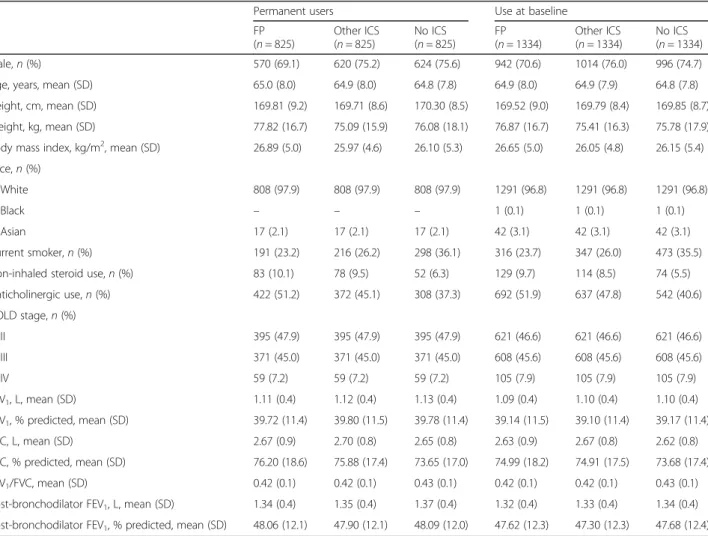
and users at baseline – are shown in Table 1.
Corre-sponding data for the third analyses (patients receiving ICS versus no ICS at baseline) are provided in the data supplement (Additional file 1: Table S1). Baseline char-acteristics of the subgroups, including weight, height, and body mass index (BMI), were generally similar. The average age was approximately 65 years among the pa-tients, and three-quarters of participants were male. Pa-tients were mostly overweight (BMI > 25 kg/m2) and approximately one-third were current smokers. There
was a higher proportion of current smokers in the per-manent and baseline no-ICS groups than in the other groups. Over half of the patients had severe (GOLD Stage III) or very severe (GOLD Stage IV) COPD. There was also a lower proportion of patients receiving anti-cholinergics at baseline in the permanent and baseline no-ICS groups than in the other groups.
Risk of pneumonia
Permanent-user analysis
The results of the first analysis show that the time to first pneumonia was shorter and the rate of pneumonia (per patient-year) was greater in permanent users of FP
compared with no ICS (HR 1.33 [95% CI 1.00, 1.75;p=
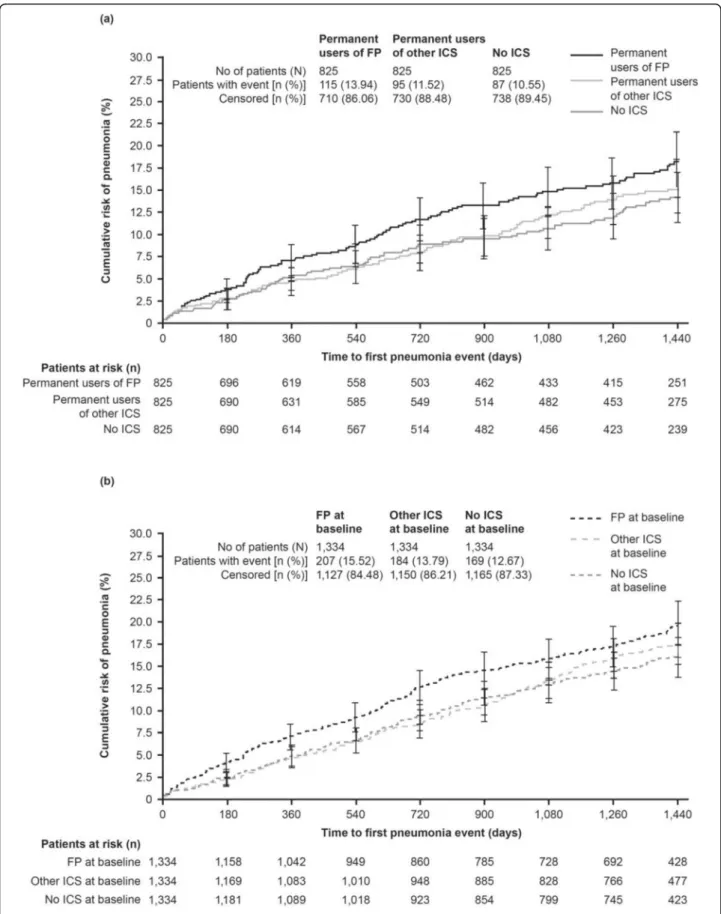
0.046] and RR 1.58 [95% CI 1.05, 2.37; p= 0.028], re-spectively) and compared with other ICS (HR 1.28 [95% CI 0.97, 1.68;p= 0.078] and RR 1.48 [95% CI 1.00, 2.19; p= 0.049], respectively; Table2). However, HRs and RRs of pneumonia events did not differ between permanent
Table 1Baseline characteristics of patients in matched subgroups by type of ICS use
Permanent users Use at baseline
FP (n= 825)
Other ICS (n= 825)
No ICS (n= 825)
FP (n= 1334)
Other ICS (n= 1334)
No ICS (n= 1334)
Male,n(%) 570 (69.1) 620 (75.2) 624 (75.6) 942 (70.6) 1014 (76.0) 996 (74.7)
Age, years, mean (SD) 65.0 (8.0) 64.9 (8.0) 64.8 (7.8) 64.9 (8.0) 64.9 (7.9) 64.8 (7.8)
Height, cm, mean (SD) 169.81 (9.2) 169.71 (8.6) 170.30 (8.5) 169.52 (9.0) 169.79 (8.4) 169.85 (8.7)
Weight, kg, mean (SD) 77.82 (16.7) 75.09 (15.9) 76.08 (18.1) 76.87 (16.7) 75.41 (16.3) 75.78 (17.9)
Body mass index, kg/m2, mean (SD) 26.89 (5.0) 25.97 (4.6) 26.10 (5.3) 26.65 (5.0) 26.05 (4.8) 26.15 (5.4)
Race,n(%)
White 808 (97.9) 808 (97.9) 808 (97.9) 1291 (96.8) 1291 (96.8) 1291 (96.8)
Black – – – 1 (0.1) 1 (0.1) 1 (0.1)
Asian 17 (2.1) 17 (2.1) 17 (2.1) 42 (3.1) 42 (3.1) 42 (3.1)
Current smoker,n(%) 191 (23.2) 216 (26.2) 298 (36.1) 316 (23.7) 347 (26.0) 473 (35.5)
Non-inhaled steroid use,n(%) 83 (10.1) 78 (9.5) 52 (6.3) 129 (9.7) 114 (8.5) 74 (5.5)
Anticholinergic use,n(%) 422 (51.2) 372 (45.1) 308 (37.3) 692 (51.9) 637 (47.8) 542 (40.6)
GOLD stage,n(%)
II 395 (47.9) 395 (47.9) 395 (47.9) 621 (46.6) 621 (46.6) 621 (46.6)
III 371 (45.0) 371 (45.0) 371 (45.0) 608 (45.6) 608 (45.6) 608 (45.6)
IV 59 (7.2) 59 (7.2) 59 (7.2) 105 (7.9) 105 (7.9) 105 (7.9)
FEV1, L, mean (SD) 1.11 (0.4) 1.12 (0.4) 1.13 (0.4) 1.09 (0.4) 1.10 (0.4) 1.10 (0.4)
FEV1, % predicted, mean (SD) 39.72 (11.4) 39.80 (11.5) 39.78 (11.4) 39.14 (11.5) 39.10 (11.4) 39.17 (11.4)
FVC, L, mean (SD) 2.67 (0.9) 2.70 (0.8) 2.65 (0.8) 2.63 (0.9) 2.67 (0.8) 2.62 (0.8)
FVC, % predicted, mean (SD) 76.20 (18.6) 75.88 (17.4) 73.65 (17.0) 74.99 (18.2) 74.91 (17.5) 73.68 (17.4)
FEV1/FVC, mean (SD) 0.42 (0.1) 0.42 (0.1) 0.43 (0.1) 0.42 (0.1) 0.42 (0.1) 0.43 (0.1)
Post-bronchodilator FEV1, L, mean (SD) 1.34 (0.4) 1.35 (0.4) 1.37 (0.4) 1.32 (0.4) 1.33 (0.4) 1.34 (0.4)
Post-bronchodilator FEV1, % predicted, mean (SD) 48.06 (12.1) 47.90 (12.1) 48.09 (12.0) 47.62 (12.3) 47.30 (12.3) 47.68 (12.4)
Abbreviations: FEV1forced expiratory volume in 1 s,FPfluticasone propionate,FVCforced vital capacity,GOLDGlobal Initiative for Chronic Obstructive Lung Disease, ICSinhaled corticosteroid,SDstandard deviation. Patients within each group were matched by race, age (± 5 years), FEV1% predicted (± 5% predicted), GOLD stage,
users who received other ICS and patients who received no ICS (Table2; Fig.1a).
The risk of hospitalized pneumonia, based on time to first pneumonia hospitalization, was also greater in per-manent users of FP treatment compared with other ICS and no ICS (Fig. 2). A numerically higher proportion of permanent FP users was hospitalized with pneumonia events (7.9%) compared with patients treated with no ICS (5.9%) or other ICS (6.7%; Table 2). Based on small patient numbers, a numerically higher proportion of pa-tients receiving other ICS (n= 13, 1.58%) had fatal pneu-monia events than those receiving no ICS (n= 9, 1.09%) or users of FP (n= 7, 0.85%) (Table2).
Matched-subgroups analysis by type of ICS use at baseline
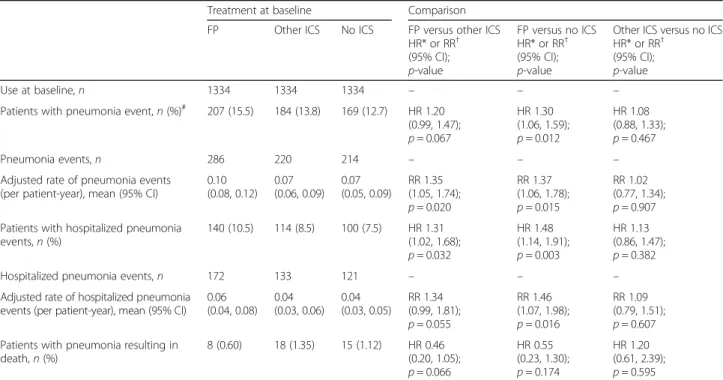
A similar pattern was observed in this second analysis, which evaluated patients according to their ICS use at the start of the study. Patients treated with FP at baseline had an increased risk of pneumonia, in terms of time to event, versus patients not on ICS (HR 1.30 [95% CI 1.06, 1.59;p= 0.012]; Table 3), with a 20% higher risk with FP than for other ICS (HR 1.20 [95% CI 0.99, 1.47;p= 0.067]; Table3; Fig.1b). Likewise, the annual rate of pneumonia was high-est in patients receiving FP versus no ICS (RR 1.37 [95% CI
1.06, 1.78; p= 0.015]) or other ICS (RR 1.35 [95% CI
1.05, 1.74;p= 0.020]) at baseline (Table3). Only minor dif-ferences were observed between pneumonia events in pa-tients on other ICS and those on no ICS (Table3; Fig.1b).
A higher proportion of patients treated with FP at base-line was hospitalized with pneumonia events (10.5%) com-pared with patients receiving no ICS (7.5%) or on other ICS (8.5%) at baseline. The risk of hospitalization due to pneumonia was greater in patients treated with FP at baseline compared with no ICS (HR 1.48 [95% CI 1.14, 1.91;p= 0.003] and RR 1.46 [95% CI 1.07, 1.98;p= 0.016], respectively) or other ICS (HR 1.31 [95% CI 1.02, 1.68;p = 0.032] and RR 1.34 [95% CI 0.99,1.81; p= 0.055], re-spectively). The HR and RR of hospitalized pneumonia events were slightly increased for other ICS versus no ICS use at baseline (Table3). However, based on small patient numbers, numerically more patients receiving other ICS at baseline (n= 18, 1.35%) had fatal pneumonia events than those receiving no ICS (n= 15, 1.12%) or FP (n= 8, 0.60%) at baseline (Table3).
ICS therapy proximate to the first pneumonia event (last visit before event)
As the UPLIFT® study allowed changes in the concomitant therapy of the patients, pneumonia events were also ana-lyzed according to the type of ICS use (FP, other ICS, or no ICS) reported at the last clinic visit before the first pneumo-nia event. Table4shows the percentage of patients with a first pneumonia or hospitalized/fatal pneumonia event who received FP, other ICS, or no ICS at baseline, and also de-scribes the percentage who were on these treatments at the last visit before the event occurred. All patients switching Table 2Risk of pneumonia by type of ICS in permanent users
Treatment throughout study Comparison
FP Other ICS No ICS FP versus other ICS HR* or RR†(95% CI);
p-value
FP versus no ICS HR* or RR†(95% CI);
p-value
Other ICS versus no ICS HR* or RR†(95% CI);
p-value
Permanent users,n 825 825 825 – – –
Patients with pneumonia events,n(%)# 115 (13.9) 95 (11.5) 87 (10.5) HR 1.28
(0.97, 1.68);
p= 0.078
HR 1.33 (1.00, 1.75);
p= 0.046
HR 1.03 (0.77, 1.38);
p= 0.830
Pneumonia events,n 159 111 98 – – –
Adjusted rate of pneumonia events (per patient-year), mean (95% CI)
0.10 (0.07, 0.14)
0.07 (0.04, 0.10)
0.06 (0.04, 0.10)
RR 1.48 (1.00, 2.19);
p= 0.049
RR 1.58 (1.05, 2.37);
p= 0.028
RR 1.07 (0.69, 1.65);
p= 0.773 Patients with hospitalized pneumonia
events,n(%)
65 (7.9) 55 (6.7) 49 (5.9) HR 1.24 (0.86, 1.77);
p= 0.249
HR 1.30 (0.90, 1.88);
p= 0.168
HR 1.05 (0.71, 1.54);
p= 0.802
Hospitalized pneumonia events,n 78 64 51 – – –
Adjusted rate of hospitalized pneumonia events (per patient-year), mean (95% CI)
0.05 (0.03, 0.08)
0.04 (0.03, 0.07)
0.04 (0.02, 0.06)
RR 1.25 (0.78, 2.02);
p= 0.355
RR 1.47 (0.88, 2.44);
p= 0.141
RR 1.17 (0.69, 1.99);
p= 0.560 Patients with pneumonia resulting in
death,n(%)
7 (0.85) 13 (1.58) 9 (1.09) HR 0.54 (0.22, 1.36);
p= 0.194
HR 0.75 (0.28, 2.01);
p= 0.567
HR 1.38 (0.59, 3.23);
p= 0.460
Abbreviations: CIconfidence interval,FEV1forced expiratory volume in 1 s,FPfluticasone propionate,GOLDGlobal Initiative for Chronic Obstructive Lung Disease, HRhazard ratio,ICSinhaled corticosteroid,RRrate ratio. Matched-subgroup population. *Cox regression analysis with ICS use on-treatment and matching factors as covariates.†Poisson regression with ICS use on-treatment and matching factors (age, FEV1% predicted, GOLD stage, emphysema diagnosis, and courses of
antibiotics) as covariates.#
treatments prior to the event, as well as those who had no pneumonia event and switched at any time during the study, were counted in each respective group, thereby in-creasing the denominator compared with the patients in the baseline analysis so that all percentages are lower. Tak-ing switches into account did not result in important changes in the overall results. The relative pattern of the
frequency of pneumonia and hospitalized pneumonia events according to treatment was maintained (Table4).
Matched-pairs analysis by any ICS versus no ICS use at baseline
Analyses based on patients treated with all types of ICS versus no ICS at baseline are reported in the data Fig. 2Time to first pneumonia hospitalization by type of ICS (permanent users).Abbreviations:FP: fluticasone propionate; ICS: inhaled corticosteroid
Table 3Risk of pneumonia by type of treatment (FP, other ICS, no ICS use) at baseline
Treatment at baseline Comparison
FP Other ICS No ICS FP versus other ICS
HR* or RR† (95% CI);
p-value
FP versus no ICS HR* or RR† (95% CI);
p-value
Other ICS versus no ICS HR* or RR†
(95% CI);
p-value
Use at baseline,n 1334 1334 1334 – – –
Patients with pneumonia event,n(%)# 207 (15.5) 184 (13.8) 169 (12.7) HR 1.20 (0.99, 1.47);
p= 0.067
HR 1.30 (1.06, 1.59);
p= 0.012
HR 1.08 (0.88, 1.33);
p= 0.467
Pneumonia events,n 286 220 214 – – –
Adjusted rate of pneumonia events (per patient-year), mean (95% CI)
0.10 (0.08, 0.12)
0.07 (0.06, 0.09)
0.07 (0.05, 0.09)
RR 1.35 (1.05, 1.74);
p= 0.020
RR 1.37 (1.06, 1.78);
p= 0.015
RR 1.02 (0.77, 1.34);
p= 0.907 Patients with hospitalized pneumonia
events,n(%)
140 (10.5) 114 (8.5) 100 (7.5) HR 1.31 (1.02, 1.68);
p= 0.032
HR 1.48 (1.14, 1.91);
p= 0.003
HR 1.13 (0.86, 1.47);
p= 0.382
Hospitalized pneumonia events,n 172 133 121 – – –
Adjusted rate of hospitalized pneumonia events (per patient-year), mean (95% CI)
0.06 (0.04, 0.08)
0.04 (0.03, 0.06)
0.04 (0.03, 0.05)
RR 1.34 (0.99, 1.81);
p= 0.055
RR 1.46 (1.07, 1.98);
p= 0.016
RR 1.09 (0.79, 1.51);
p= 0.607 Patients with pneumonia resulting in
death,n(%)
8 (0.60) 18 (1.35) 15 (1.12) HR 0.46 (0.20, 1.05);
p= 0.066
HR 0.55 (0.23, 1.30);
p= 0.174
HR 1.20 (0.61, 2.39);
p= 0.595
Abbreviations: CIconfidence interval,FEV1forced expiratory volume in 1 s,FPfluticasone propionate,GOLDGlobal Initiative for Chronic Obstructive Lung Disease, HRhazard ratio,ICSinhaled corticosteroid,RRrate ratio. Matched-subgroup population. *Cox regression analysis with ICS use at baseline and matching factors as covariates.†Poisson regression with ICS use at baseline and matching factors (age, FEV1% predicted, GOLD stage, emphysema diagnosis, and courses of antibiotics)
as covariates.#
supplement (Additional file 1: Table S2, Figure S1). In summary, the risk of pneumonia events was increased in patients with ICS use at baseline as compared with those without ICS (HR 1.20 [95% CI 1.01, 1.42; p= 0.037]; RR 1.18 [95% CI 0.95, 1.48; p= 0.134]). The proportion of patients with pneumonia leading to hospitalization was higher in the ICS subgroup (8.9%) compared with the no-ICS subgroup (7.4%). Whilst the annual rate of
hos-pitalized pneumonia (RR 1.17 [95% CI 0.89, 1.54; p=
0.251]) supports the decreased time to hospitalized pneumonia events with ICS use versus no ICS at base-line (HR 1.22 [95% CI 0.98, 1.52;p= 0.076]), the number of deaths from pneumonia did not differ by ICS use at baseline (HR 1.01 [95% CI 0.52, 1.98;p= 0.979]).
Discussion
Despite recommendations for the use of ICS in combin-ation with long-acting bronchodilators for the
manage-ment of patients with frequent exacerbations [32],
uncertainties about the efficacy and potential side effects of ICS therapies have led to concerns regarding their use [4]. In thispost hoc analysis of the 4-year UPLIFT® trial, we assessed whether ICS use, and particularly FP, when taken long-term in the treatment of COPD was associ-ated with a higher risk of pneumonia. Our findings indi-cate that long-term use of FP was associated with a 48% increased rate of pneumonia compared with other types of ICS, and a 58% increased risk compared with no ICS treatment. In this analysis, there was no significant dif-ference between patients who received other ICS com-pared with patients who received no ICS, suggesting that FP may have a stronger association with pneumonia than alternative ICS therapies. These findings were also supported by two sensitivity analyses that investigated
the risk of a pneumonia event by ICS treatment at base-line, and taking switches during the study into account.
In this analysis, the risk of pneumonia (based on time to first event and annual rate) was higher in patients treated with FP compared with other ICS or no ICS, and this was consistent whether patients were receiving those treatments permanently throughout the study or at baseline. Our results add to those of a previous retro-spective post hoc analysis of UPLIFT®, which concluded that FP usage was associated with excess morbidity (in-cluding risk of pneumonia and increase in COPD exacer-bations) compared with other ICS or no ICS [28]. In the previous analysis, the subgroups were not matched ac-cording to their baseline characteristics and permanent users were not analyzed; therefore, our analysis makes it unlikely that differences between the ICS groups may be due to different disease severity at baseline.
An increased risk of pneumonia with FP versus other ICS or no ICS has been reported previously by other randomized studies of FP-containing regimens in COPD [5, 6, 11, 18, 20, 28]. A review of 43 randomized con-trolled studies of COPD treatments found that flutica-sone (either alone or in combination with long-acting
β2-agonist [LABA] therapy) increased the risk of
non-fatal serious adverse pneumonia events (requiring hospital admission) compared with placebo or LABA monotherapy [6]. Furthermore, fluticasone was associ-ated with a higher risk of any pneumonia event (includ-ing community-treated cases) compared with the ICS budesonide, with an odds ratio of 1.86 (95% CI 1.04, 3.34) [6]. A relatively high risk of pneumonia with FP therapy compared with budesonide use was also re-ported by a large cohort study of more than 160,000 pa-tients with COPD over 5 years of follow-up, specifically with regard to serious events [5]. The 2-year Investigat-ing New Standards for Prophylaxis in Reduction of Exacerbations (INSPIRE) and the 3-year Towards a Revolution in COPD Health (TORCH) trials both
stud-ied high daily doses of FP (1000 μg per day) in COPD
patients [18, 20]. In INSPIRE, the HR for time to first pneumonia was 1.94 (95% CI 1.19, 3.17) for the salme-terol/FP combination (SFC) versus tiotropium [20]; in TORCH, the HRs were 1.64 (95% CI 1.33, 2.02) for SFC versus placebo, and 1.53 (95% CI 1.24, 1.89) for FP ver-sus placebo [18]. Additionally, in a meta-analysis of 54 randomized controlled studies including 61,551 patients with COPD, the two treatments that were shown to in-crease the risk of pneumonia compared with placebo were FP and SFC [22].
More recent studies have also looked at the association of fluticasone furoate (FF) with pneumonia; this is a dif-ferent salt form compared with FP, with distinct proper-ties [33]. Data for the association of pneumonia with FF from recent large-scale studies (the Salford Lung Study, Table 4Percentage of patients experiencing pneumonia events,
stratified by treatment at baseline and last visit proximate to event
Treatment
FP Other ICS No ICS
Patients with first pneumonia event (%)
Treatment at baseline 15.5 13.8 12.7
Treatment at last visit before eventa 12.9 10.1 8.6 First hospitalized pneumonia event (%)
Treatment at baseline 10.5 8.5 7.5
Treatment at last visit before eventa 8.3 6.6 5.2 Pneumonia event resulting in death (%)
Treatment at baseline 0.6 1.3 1.1
Treatment at last visit before eventa 0.6 0.9 0.7 Abbreviations: FPfluticasone propionate,ICSinhaled corticosteroid. Patients were matched at baseline (matched subgroup by baseline ICS use population, N= 4002).a
N= 2799) [34] and the Study to Understand Mortality
and MorbidITy in COPD [SUMMIT], N= 16,485) [35]
are difficult to interpret. The Salford Lung Study did re-port a trend toward a higher mean number of serious pneumonia adverse events with FF/vilanterol (FF/VI) in the subgroup of patients who had not been receiving ICS at baseline [34]. However, in patients receiving ICS at study baseline, the study was effectively comparing FF/VI versus other ICS (including FP), and showed no notable difference between the two groups. In SUMMIT, the results were also mixed, with no obvious increase in pneumonia rates for the comparison of the FF-contain-ing arms versus placebo; however, compared with the VI arms, the rates per 100 patient-years were 3.9 for the FF/VI combination and 4.2 for FF monotherapy, com-pared with 2.8 for VI monotherapy [35]. A greater risk of pneumonia with FF/VI compared with VI monother-apy was also reported previously in an analysis of two 1-year studies of patients with moderate-to-very severe airflow limitation and at least one COPD exacerbation in the previous year [21]. Most recently, in the FULFIL trial, a head-to-head comparison showed that pneumo-nia was reported in 20/911 (2.2%) patients in the FF arm compared with 7/899 (0.8%) in the budesonide arm (p< 0.01) [36,37].
In a nested case-controlled study with a large cohort of 175,906 patients with COPD, current use of ICS (within the last 60 days) was associated with a significant 70% increase in the risk of being hospitalized with severe pneumonia [17]. This effect was even greater with higher doses of ICS (equivalent to 1000μg fluticasone per day) [17]. Although the impact of particular ICS therapies was not assessed, this suggests that patients with COPD receiving ICS in general practice should be closely moni-tored for pneumonia events and treated promptly to avoid the need for secondary care.
In our post hoc analysis, a higher proportion of pa-tients on FP were hospitalized with pneumonia events compared with patients treated with other ICS or no ICS, and the annual rate of hospitalization was also highest with FP. The sensitivity analysis by type of ICS use at baseline supported the higher annual rate of hospitalization with FP. This suggests that patients with COPD receiving FP may require particularly careful surveillance.
With regard to pneumonia events leading to death, the numbers with FP were somewhat smaller than with other ICS. However, the overall numbers of fatal pneu-monia events in UPLIFT® are too small to adequately ad-dress this topic here.
It is unclear why patients receiving FP may be more likely to experience pneumonia (including events requir-ing hospitalization) relative to those receivrequir-ing alternative ICS. It has been suggested that the difference between
FP and budesonide is the longer retention of FP in the airways [38]. FP can persist for hours in the airway lining fluid, whereas budesonide is absorbed away within mi-nutes. In this way, FP can suppress the immune system, enhance susceptibility to respiratory infections, and in-crease the load of pathogenic microbiome in the airways and lungs, leading to pneumonia in the weeks following an unresolved exacerbation [38]. Another potential ex-planation is due to the dosing of FP. ICS are often pre-scribed to patients with COPD at high doses, and the association between pneumonia and ICS use may be dose-related, with high doses of ICS having the greatest risk of pneumonia compared with low and medium doses [19,39]. As FP is likely to be given at higher doses than other ICS, this could be one explanation for the re-sults seen here, although other data have shown that an increased risk of pneumonia can be associated even with low doses of ICS [40], and therefore dose may not fully explain the association with pneumonia.
It has been reported that the risk of pneumonia is in-creased in patients with more advanced COPD or severe airflow limitation [41]. Therefore, for the purposes of ourpost hoc analysis, patients were matched by baseline
FEV1% predicted and GOLD stage, thus avoiding
con-founding by severity of underlying disease. Just over half of the patients included in the present analyses had se-vere (GOLD Stage III) to very sese-vere (GOLD Stage IV) COPD, similar to the primary study demographic [29]. An observational study of patients hospitalized for monia reported that of 4121 community-acquired pneu-monia episodes, 23.9% occurred in patients with COPD, and 58% of these patients were GOLD Stage III or IV [42]. Given the likelihood of an increased risk of pneu-monia with both the progression of disease and ICS use (particularly FP, as supported by the current and previ-ously published analyses of large-scale COPD trials), physicians need to consider pneumonia as part of the risk–benefit ratio of ICS use (and in the choice of ICS) relative to disease severity prior to prescribing [7].
between the subgroups. In addition, since the dosage of FP or other ICS at baseline and at the end of treatment was not captured during the UPLIFT® study, and as dos-age will vary between countries, it was not possible to evaluate the treatment dose-response. Not all of the pneumonia events during UPLIFT® were verified by chest X-ray, although patients with a hospitalization for suspected pneumonia were likely to have their diagnosis confirmed radiographically. Furthermore, due to the overlap in presentation of pneumonia and exacerbations in a primary care setting, there can be difficulties in dis-tinguishing between these. Here, this may have led to biases, particularly as patients were not matched for pre-vious exacerbation history in this analysis. Additionally, in this analysis, smoking status was not included in the matching baseline features, as doing so resulted in a considerably smaller sample size and there was a differ-ence in smoking status between subgroups. There was also a greater proportion of anticholinergic users at baseline in the FP group than in the no-ICS group. A pooled safety analysis showed that tiotropium does not have a significant effect on pneumonia [31], but if tiotro-pium’s beneficial effect on exacerbations reduced pneu-monia reporting in the FP group, this would have attenuated the apparent effect of FP on pneumonia rates. Finally, it is possible that FP treatment before the study was a marker of a patient’s sensitivity to pneumonia, and this could not be balanced by matching the patients. However, it is difficult to see why this would be different for other ICS, which showed a smaller risk of pneumo-nia than FP.
Conclusions
Thispost hocanalysis of the UPLIFT® trial indicated that use of FP over 4 years was associated with an increased risk of pneumonia compared with no ICS treatment or other types of ICS. This did not appear to be con-founded by factors associated with ICS treatment (such as disease severity), as a matched-subgroup analysis was conducted. In the current analysis, other ICS showed only numerical increases in pneumonia risk versus no ICS treatment.
The findings add to the existing evidence regarding pneumonia risk associated with ICS therapy and, in par-ticular, long-term FP use in patients with COPD.
Additional file
Additional file 1:Matched-pairs analysis by ICS versus no ICS use at baseline. (DOCX 453 kb)
Abbreviations
BMI:Body mass index; CI: Confidence interval; COPD: Chronic obstructive pulmonary disease; FEV1: Forced expiratory volume in 1 s; FF: Fluticasone
furoate; FP: Fluticasone propionate; GOLD: Global Initiative for Chronic
Obstructive Lung Disease; HR: Hazard ratio; ICS: Inhaled corticosteroid; INSPIRE: Investigating New Standards for Prophylaxis in Reduction of Exacerbations; LABA: Long-actingβ2-agonists; RR: Rate ratio; SFC: Salmeterol/
fluticasone propionate combination; SUMMIT: Study to Understand Mortality and MorbidITy; TORCH: Towards a Revolution in COPD Health; UPLIFT®: Understanding Potential Long-term Impacts on Function with Tiotropium; VI: Vilanterol
Acknowledgments
Helen Moore, PhD, at MediTech Media provided editorial assistance in the development of the manuscript, funded by Boehringer Ingelheim.
Funding
The UPLIFT® trial and this subsequentpost hocanalysis were funded by Boehringer Ingelheim.
Availability of data and materials
The data sets used and/or analyzed during the current study are available from the corresponding author on reasonable request.
Authors’contributions
All of the authors have made substantial contributions to study design, data acquisition, analysis or interpretation, drafting the article, or critically revising the content; and provided final approval of the submitted version. AM performed the statistical analyses.
Ethics approval and consent to participate
The UPLIFT® study was performed in accordance with the provisions of the Declaration of Helsinki (1996 version), in accordance with the International Conference on Harmonization Tripartite Guideline for Good Clinical Practice, and in accordance with applicable regulatory requirements and Boehringer Ingelheim Standard Operating Procedures. All patients provided written informed consent. This article does not report individual patient data; all data presented here is anonymized. The clinical trial protocol (dated 12 February 2002) and the informed consent and patient information forms were reviewed and received approval/favorable opinion from a constituted local Institutional Review Board or an Independent Ethics Committee at each center prior to the start of the study.
Competing interests
DPT has been an advisory board member and speaker for Boehringer Ingelheim, AstraZeneca and Sunovion; and a consultant for Mylan and Theravance/Innovative Pharmaceuticals. MM has received speaker fees from Boehringer Ingelheim, Chiesi, Cipla, Menarini, ROVI, Grifols and Novartis; and consulting fees from Boehringer Ingelheim, Chiesi, GlaxoSmithKline, Gebro Pharma, CSL Behring, Novartis and Grifols. BRC has received consulting fees from Almirall, AstraZeneca, Boehringer Ingelheim and GlaxoSmithKline; lecture fees from Almirall, AstraZeneca, Boehringer Ingelheim and GlaxoSmithKline; and grant support from Boehringer Ingelheim, Forest Laboratories and GlaxoSmithKline. NM and AM are employees of Boehringer Ingelheim. DMGH has received personal fees from AstraZeneca, Boehringer Ingelheim, Chiesi, GlaxoSmithKline, Pfizer and Novartis. AA received grants or fees from AstraZeneca, Boehringer Ingelheim, Forest Laboratories, GlaxoSmithKline and Novartis.
Publisher’s Note
Springer Nature remains neutral with regard to jurisdictional claims in published maps and institutional affiliations.
Author details
1Department of Medicine, David Geffen School of Medicine, University of
California Los Angeles, 10833 Le Conte Avenue, Los Angeles, CA 90095-1690, USA.2Pneumology Department, Hospital Universitari Vall d’Hebron, CIBER de Enfermedades Respiratorias (CIBERES), Barcelona, Spain.3Brigham and
Women’s Hospital, Boston, MA, USA.4TA Respiratory/Biosimilars, Boehringer
Ingelheim International GmbH, Ingelheim am Rhein, Germany.5Biostatistics
and Data Sciences Europe, Boehringer Ingelheim Pharma GmbH & Co. KG, Biberach an der Riss, Germany.6Royal Devon and Exeter Hospital, Exeter, UK. 7Pulmonary/Critical Care, University of Texas, and South Texas Veterans
Received: 3 July 2018 Accepted: 27 August 2018
References
1. NICE National Clinical Guideline Centre. Chronic obstructive pulmonary disease in over 16s: diagnosis and management 2010.
2. Vogelmeier CF, Criner GJ, Martinez FJ, Anzueto A, Barnes PJ, Bourbeau J, et al. Global strategy for the diagnosis, management, and prevention of chronic obstructive lung disease 2017 report: GOLD executive summary. Am J Respir Crit Care Med. 2017;195:557–82.
3. Barnes PJ. Inhaled corticosteroids in COPD: a controversy. Respiration. 2010; 80:89–95.
4. Miravitlles M, Cosio BG, Arnedillo A, Calle M, Alcazar-Navarrete B, Gonzalez C, et al. A proposal for the withdrawal of inhaled corticosteroids in the clinical practice of chronic obstructive pulmonary disease. Respir Res. 2017;18:198. 5. Suissa S, Patenaude V, Lapi F, Ernst P. Inhaled corticosteroids in COPD and
the risk of serious pneumonia. Thorax. 2013;68:1029–36.
6. Kew KM, Seniukovich A. Inhaled steroids and risk of pneumonia for chronic obstructive pulmonary disease. Cochrane Database Syst Rev. 2014;(3): CD010115.
7. Price D, Yawn B, Brusselle G, Rossi A. Risk-to-benefit ratio of inhaled corticosteroids in patients with COPD. Prim Care Respir J. 2013;22:92–100. 8. Babu KS, Kastelik JA, Morjaria JB. Inhaled corticosteroids in chronic obstructive
pulmonary disease: a pro-con perspective. Br J Clin Pharmacol. 2014;78:282–300. 9. Burge PS, Calverley PM, Jones PW, Spencer S, Anderson JA, Maslen TK.
Randomised, double blind, placebo controlled study of fluticasone propionate in patients with moderate to severe chronic obstructive pulmonary disease: the ISOLDE trial. BMJ. 2000;320:1297–303.
10. Latorre M, Novelli F, Vagaggini B, Braido F, Papi A, Sanduzzi A, et al. Differences in the efficacy and safety among inhaled corticosteroids (ICS)/ long-acting beta2-agonists (LABA) combinations in the treatment of chronic obstructive pulmonary disease (COPD): role of ICS. Pulm Pharmacol Ther. 2015;30:44–50.
11. Calverley PM, Anderson JA, Celli B, Ferguson GT, Jenkins C, Jones PW, et al. Salmeterol and fluticasone propionate and survival in chronic obstructive pulmonary disease. N Engl J Med. 2007;356:775–89.
12. Singh S, Loke YK. An overview of the benefits and drawbacks of inhaled corticosteroids in chronic obstructive pulmonary disease. Int J Chron Obstruct Pulmon Dis. 2010;5:189–95.
13. Loke YK, Cavallazzi R, Singh S. Risk of fractures with inhaled corticosteroids in COPD: systematic review and meta-analysis of randomised controlled trials and observational studies. Thorax. 2011;66:699–708.
14. Weatherall M, Clay J, James K, Perrin K, Shirtcliffe P, Beasley R. Dose-response relationship of inhaled corticosteroids and cataracts: a systematic review and meta-analysis. Respirology. 2009;14:983–90.
15. Tashkin DP, Murray HE, Skeans M, Murray RP. Skin manifestations of inhaled corticosteroids in COPD patients: results from lung health study II. Chest. 2004;126:1123–33.
16. Woods CP, Argese N, Chapman M, Boot C, Webster R, Dabhi V, et al. Adrenal suppression in patients taking inhaled glucocorticoids is highly prevalent and management can be guided by morning cortisol. Eur J Endocrinol. 2015;173:633–42.
17. Ernst P, Gonzalez AV, Brassard P, Suissa S. Inhaled corticosteroid use in chronic obstructive pulmonary disease and the risk of hospitalization for pneumonia. Am J Respir Crit Care Med. 2007;176:162–6.
18. Crim C, Calverley PM, Anderson JA, Celli B, Ferguson GT, Jenkins C, et al. Pneumonia risk in COPD patients receiving inhaled corticosteroids alone or in combination: TORCH study results. Eur Respir J. 2009;34:641–7. 19. Drummond MB, Dasenbrook EC, Pitz MW, Murphy DJ, Fan E. Inhaled
corticosteroids in patients with stable chronic obstructive pulmonary disease: a systematic review and meta-analysis. JAMA. 2008;300:2407–16. 20. Calverley PMA, Stockley RA, Seemungal TAR, Hagan G, Willits LR, Riley JH, et
al. Reported pneumonia in patients with COPD: findings from the INSPIRE study. Chest. 2011;139:505–12.
21. Crim C, Dransfield MT, Bourbeau J, Jones PW, Hanania NA, Mahler DA, et al. Pneumonia risk with inhaled fluticasone furoate and vilanterol compared with vilanterol alone in patients with COPD. Ann Am Thorac Soc. 2015;12:27–34. 22. Tricco AC, Strifler L, Veroniki AA, Yazdi F, Khan PA, Scott A, et al. Comparative
safety and effectiveness of long-acting inhaled agents for treating chronic obstructive pulmonary disease: a systematic review and network meta-analysis. BMJ Open. 2015;5:e009183.
23. Festic E, Scanlon PD. Incident pneumonia and mortality in patients with chronic obstructive pulmonary disease. A double effect of inhaled corticosteroids? Am J Respir Crit Care Med. 2015;191:141–8.
24. Singh S, Amin AV, Loke YK. Long-term use of inhaled corticosteroids and the risk of pneumonia in chronic obstructive pulmonary disease: a meta-analysis. Arch Intern Med. 2009;169:219–29.
25. DiSantostefano RL, Sampson T, Le HV, Hinds D, Davis KJ, Bakerly ND. Risk of pneumonia with inhaled corticosteroid versus long-acting bronchodilator regimens in chronic obstructive pulmonary disease: a new-user cohort study. PLoS One. 2014;9:e97149.
26. Wedzicha JA, Calverley PM, Seemungal TA, Hagan G, Ansari Z, Stockley RA, et al. The prevention of chronic obstructive pulmonary disease exacerbations by salmeterol/fluticasone propionate or tiotropium bromide. Am J Respir Crit Care Med. 2008;177:19–26.
27. Sharafkhaneh A, Southard JG, Goldman M, Uryniak T, Martin UJ. Effect of budesonide/formoterol pMDI on COPD exacerbations: a double-blind, randomized study. Respir Med. 2012;106:257–68.
28. Morjaria JB, Rigby A, Morice AH. Inhaled corticosteroid use and the risk of pneumonia and COPD exacerbations in the UPLIFT study. Lung. 2017;195:281–8. 29. Tashkin DP, Celli B, Senn S, Burkhart D, Kesten S, Menjoge S, et al. A 4-year
trial of tiotropium in chronic obstructive pulmonary disease. N Engl J Med. 2008;359:1543–54.
30. Decramer M, Celli B, Tashkin DP, Pauwels RA, Burkhart D, Cassino C, et al. Clinical trial design considerations in assessing long-term functional impacts of tiotropium in COPD: the UPLIFT trial. COPD. 2004;1:303–12.
31. Halpin DM, Dahl R, Hallmann C, Mueller A, Tashkin D. Tiotropium HandiHaler(®) and Respimat(®) in COPD: a pooled safety analysis. Int J Chron Obstruct Pulmon Dis. 2015;10:239–59.
32. Global Initiative for Chronic Obstructive Lung Disease. Global strategy for the diagnosis, management, and prevention of chronic obstructive pulmonary disease. 2017. http://goldcopd.org/gold-2017-global-strategy-diagnosis-management-prevention-copd/. Accessed 26 Oct 2017.
33. Biggadike K. Fluticasone furoate/fluticasone propionate - different drugs with different properties. Clin Respir J. 2011;5:183–4.
34. Vestbo J, Leather D, Diar Bakerly N, New J, Gibson JM, McCorkindale S, et al. Effectiveness of fluticasone furoate-vilanterol for COPD in clinical practice. N Engl J Med. 2016;375:1253–60.
35. Vestbo J, Anderson JA, Brook RD, Calverley PM, Celli BR, Crim C, et al. Fluticasone furoate and vilanterol and survival in chronic obstructive pulmonary disease with heightened cardiovascular risk (SUMMIT): a double-blind randomised controlled trial. Lancet. 2016;387:1817–26. 36. Morice AH, Hart SP. Increased propensity for pneumonia with fluticasone in
COPD. Am J Respir Crit Care Med. 2018;197:1229–30.
37. Lipson DA, Barnacle H, Birk R, Brealey N, Locantore N, Lomas DA, et al. FULFIL trial: once-daily triple therapy for patients with chronic obstructive pulmonary disease. Am J Respir Crit Care Med. 2017;196:438–46. 38. Janson C, Stratelis G, Miller-Larsson A, Harrison TW, Larsson K. Scientific rationale
for the possible inhaled corticosteroid intraclass difference in the risk of pneumonia in COPD. Int J Chron Obstruct Pulmon Dis. 2017;12:3055–64. 39. Yawn BP, Li Y, Tian H, Zhang J, Arcona S, Kahler KH. Inhaled corticosteroid
use in patients with chronic obstructive pulmonary disease and the risk of pneumonia: a retrospective claims data analysis. Int J Chron Obstruct Pulmon Dis. 2013;8:295–304.
40. Dransfield MT, Bourbeau J, Jones PW, Hanania NA, Mahler DA, Vestbo J, et al. Once-daily inhaled fluticasone furoate and vilanterol versus vilanterol only for prevention of exacerbations of COPD: two replicate double-blind, parallel-group, randomised controlled trials. Lancet Respir Med. 2013;1:210–23. 41. Mullerova H, Chigbo C, Hagan GW, Woodhead MA, Miravitlles M, Davis KJ,
et al. The natural history of community-acquired pneumonia in COPD patients: a population database analysis. Respir Med. 2012;106:1124–33. 42. Gomez-Junyent J, Garcia-Vidal C, Viasus D, Millat-Martinez P, Simonetti A,
![Fig. 1b). Likewise, the annual rate of pneumonia was high- high-est in patients receiving FP versus no ICS (RR 1.37 [95% CI 1.06, 1.78; p = 0.015]) or other ICS (RR 1.35 [95% CI 1.05, 1.74; p = 0.020]) at baseline (Table 3)](https://thumb-us.123doks.com/thumbv2/123dok_us/8148889.2161058/5.892.84.808.149.517/likewise-annual-pneumonia-patients-receiving-versus-baseline-table.webp)