PROGRAMMATIC AND NON-PROGRAMMATIC PARTY-VOTER LINKAGES IN TWO INSTITUTIONALIZED PARTY SYSTEMS: CHILE AND URUGUAY IN COMPARATIVE
PERSPECTIVE
Juan Pablo Luna Fariña
A dissertation submitted to the faculty of the University of North Carolina at Chapel Hill in partial fulfillment of the requirements for the degree of Doctor of Philosophy in the Department of Political Science
Chapel Hill 2006
Approved by Advisor: Evelyne Huber Reader: Jonathan Hartlyn Reader: Lars Schoultz
ii
© 2006iii
ABSTRACTJUAN PABLO LUNA FARIÑA: Programmatic and Non-Programmatic Voter Linkages in Two Institutionalized Party Systems: Chile and Uruguay in Comparative Perspective
(Under the direction of Evelyne Huber)
Failures in political representation are a key hindrance to the quality of democracy in Latin America, and the degree to which parties link to voters on a programmatic basis is crucial for the quality of representation. This dissertation analyzes the nature of party-voter linkages in two highly institutionalized party-systems of the region: Chile and Uruguay. Both cases should produce high-quality representation given certain important preconditions: partisan capacities, democratic contestation opportunities, and potential for grievance mobilization. However, this work shows that even in these best case scenarios the possibilities for structuring programmatic representation in contemporary Latin America are low.
I explain differences in political representation through a framework of conjunctural causation that incorporates the long-term evolution of social and state structures into the analysis of party-systems and party-voter linkage configurations. Performing a multi-level comparison combining survey research and extensive fieldwork in paired-sample districts representing divergent causal configurations, I explain predominant linkage configurations in each country and district.
iv
programmatic preferences, while low-educated voters present extreme programmatic confusion and a combination of alienation from politics and instances of strongly localized, non-partisan (personalized), and non-programmatic linkages with candidates (financed by private-sector contributions, illegal municipal contracting, or focalized social policy); c) in Uruguay, economic crises have weakened traditional parties’ clientelistic machines, reinforcing discontent with both parties and generating the opportunity for the leftwing Frente Amplio to grow by programmatically opposing neoliberal reforms; d) nonetheless, in a relatively favorable systemic context, a weaker pattern of segmented linkage strategies also emerged in Uruguay. Institutional and elite-centered analyses have predominated in the literature on political representation.
v
vi
ACKNOWLEDGMENTS
vii
Since my arrival in 1999, Ngetta Kabiri contributed significantly in creating a home away from home. Particularly during the first semester of each academic year his friendship helped me endure the semesters. I will always remember our cabbage -perfumed talks, very late at night, in-between reading assignments and papers to be written by the next morning. Oscar Chamosa, Maria Marta Sobico, Claudio Fuentes, Leticia Ruíz-Rodríguez, José Miguel Sandoval, Indira Palacios, and Merike Blofield also turned into “best friends”. Such friendship has stood the tests of time and distance and constitutes an unanticipated gift that I take from Chapel Hill. Leticia, Claudio, and Merike, as well as Ian Down, Christina Ewig, and Gaby Ondetti also guided me to the intricacies of my first year of graduate student life in the Department and provided much needed advice. After coming back from fieldwork in 2003, most of my old friends were no longer at UNC. However, I was fortunate to meet Jennifer Pribble, Agustina Giraudy, Marco Cerletti, Mireya Davila, Ryan Carlin, and Billy Acree, whose friendship and companion I now cherish. Having inflicted on Ryan, Jenny, and Billy the pain of editing my English in an endless series of drafts (including this “monster”), I am also deeply indebted to them. Laura Doerfer and her children (Zachary, Leila, Sofía, and Ian) frequently helped to put things in perspective and offered their love to Karina and me. Dan and Nancy Leigh also provided fresh air to our Chapel Hill lives. All of them made our life in North Carolina substantially more enjoyable, for which I could never thank them enough.
viii
ix
Clara Caponi, Denisse Gelber, and Pablo Alegre provided high-quality research assistance and feedback at that time. The original fieldwork experience was partially funded by the Facultad de Ciencias Humanas and IPES at the Universidad Católica. IPES’ Director, Rubén Kaztman, supported that project from the first day and therefore I am also indebted to him.
The final version of this dissertation was (almost entirely) written during the first semester of 2005, half in Santiago de Chile and half at home, in Los Titanes. In Santiago, the Department of Political Science at the Universidad Católica provided an ideal working and academic environment. I am particularly thankful to Tomás Chuaqui and the Faculty Board, who decided to hire me trusting that I would finish the dissertation in due time. David Altman, Rossana Castiglioni, Claudia Heiss, Claudio Fuentes, and Robert Funk provided encouragement and support during the final stages of the project. Throughout our mutual first semester at PUC, Jael Goldsmith carried the weight of TAing my courses while I was busy with the dissertation. I know this was a heavy-load and I am thankful for her understanding and professionalism. She has also provided invaluable editorial assistance in preparing this final copy. At home, fresh air was provided by Ailén and Bruno, while my friends and family supported the enterprise from a safe distance. When work seemed insurmountable, a horse-ride with Dandy or “un partidito de Frontón” with Martín, Andrés, Zapata, el Tony, or Fernando did the trick.
x
Memories of their sense of dignity in facing the rigors of a tough life will always overwhelm me. In a way, I hope that some of this work helps to improve the lives of others like them in the future.
xi
TABLE OF CONTENTS
Page
LIST OF TABLES………....xviii
LIST OF FIGURES……… ………xxi
LIST OF MAPS………xxiii
Chapter I INTRODUCTION………….………...…………1
The Quality of Political Representation in Latin America ….…………...1
The Study of Political Representation ...………..………...4
Political Parties, Representation, and the Quality of Democracy in Latin America ..………..……….………7
The Logic of Case Selection and Research Design…………...………16
Dissertation Outline and an Overview of the Argument…………...………16
II EXPLAINING PROGRAMMATIC LINKAGES AND PARTISAN COMPETITION PATTERNS ………..……….19
Introduction ...19
The Quality of Representation: Definition, Operationalization, and Research Hypotheses ...……….………20
The Determinants of Programmatic Linkages ………...23
The Nature of the Argument: Critical Junctures, Path-Dependence, and Programmatic Competition …...………….………....41
Defining and measuring programmatic linkages………...56
III THE EVOLUTION OF PARTY -VOTER LINKAGES IN CHILE ………...59
A General Characterization of the Chilean Party-System ……… 69
xii
From Independence (1810) to the Consolidation of State
Power and Oligarchic Rule (1830-1860) ….………...……….70 The Conservative-Liberal Cleavage and the Strengthening of
Congress (1860-1891) ……….72 The Parliamentary Republic (1891-1920) ………...…75 The First Anti-Systemic Challenge and the Emergence of the Class-cleavage (1920-1932) ………76 Centrist (bipolar) Politics and the Radical Dominated System (1935-1952)………..81 The Second Anti-Systemic Challenge (1952-1964)……….83 Polarizing Politics and the Breakdown of Democratic Rule
(1964-1973)………..86 The Bureaucratic -Authoritarian Period (1973-1989)………...90
Main Stages of the Authoritarian Regime and its
Economic Project………94 The Pace and Nature of the Transition to Democracy …..100 The Evolution of the Opposition to Pinochet and its
Implications for the Emerging Party-System ………103 The Post-Transitional Party-System (1990-2004) and the
Contemporary Configuration of Programmatic Party-Voter Linkages…...109 IV THE EVOLUTION OF PARTY -VOTER LINKAGES IN URUGUAY …………113 The nature of programmatic linkages in the post-transitional period……..113 A General Characterization of the Uruguayan Party-System………..120 The Historical Evolution of the Uruguayan Party-System ………. 125
Nineteenth-Century Uruguay and the Origins of the
Tradit ional Party-System (1830-1904) ………..………125 Batllismo and its imprint in the system (1904-1920) ...………….134 The halt of reformism and the first authoritarian coup
against democracy (1920-1944) ...……….142 Neo-Batllismo: A mild populist attempt and its limits
xiii
The New Colegiado, Alternation, and the Blanco
Governments (1958-1966) ……….151
Political Polarization and the advent of authoritarianism (1967-1973) ………...155
The Bureaucratic -Authoritarian Regime and the Transition to Democracy (1973-1984)……….160
The Post-Transitional System (1984-2004)………. 164
The political economy of market-reforms………...172
Patterns of party-competition………..173
V THE NATURE AND CONTENT OF PROGRAMMATIC DIVIDES IN CHILE AND URUGUAY………..……….176
Introduction……….176
Methods ………..178
Left-Right Polarization and Substantive Programmatic Associations …...181
Cross-National Partisan Alignments in Three Ideological Divides: Elite Alignments ……….189
1993-1997 and 1995-2000 Legislatures ………....189
1997-2001 and 2000-2005 Legislatures ………193
Cross-National Partisan Alignments in Three Ideological Divides: Party-Identifiers Alignments ………..……198
1988 ………...198
1996 ………...202
Elite and Mass Country Specific Factors and Voter Heterogeneity: Chile ………...205
National Congressional-Elite Alignments in Chile ..……...205
xiv
Uruguay ………..217
National congressional-elite alignments in Uruguay ……….217
National Party-Identifiers Alignments and Social Heterogeneity of Programmatic Preferences in Uruguay ...…….221
Predicting Partisan Coalitions on the Basis of Programmatic Divides ...227
Summing up ...………..………...………...230
VI ISSUE-CONGRUENCE AND THE HETEROGENEITY OF PROGRAMMATIC PREFERENCES OF PARTY ELECTORATES IN CHILE……….233
. Introduction ……… 233
Methods ………..236
Mapping single -issue congruence ………..247
Mapping multidimensional issue- congruence ………...251
Assessing Partisan Heterogeneity ………...253
Single Issue -Congruence in Chile ………..253
Multidimensional Issue -Congruence in Chile ....………271
Programmatic Partisan Heterogeneity in Chile ..………281
VII ISSUE-CONGRUENCE AND THE HETEROGENEITY OF PROGRAMMATIC PREFERENCES OF PARTY ELECTORATES IN URUGUAY………..284
Introduction ...………. 284
Single Issue -Congruence in Uruguay………..285
Multidimensional Issue -Congruence in Uruguay………302
Programmatic Partisan Heterogeneity in Uruguay………..309
A comparative overview of programmatic linking in both systems………311
VIII NON-PROGRAMMATIC LINKAGES IN CHILE: A DISTRICT-LEVEL EXPLORATION………...316
xv
Non-Programmatic Linkages in Pre-Authoritarian Chile ………...318
Programmatic Linkages, Societal Changes, and the Overall Nature of Non-Programmatic Linkages in Contemporary Chile ………...………321
Decentralization and District Heterogeneity in Metropolitan Santiago…..326
Non-Programmatic Linkages in Three District Ideal-Types………...332
Upper-income sectors: “Rightist Ghettos”………. 337
Lower-Income Sectors Without Available Territories: “Leftist Ghettos” and Pinochet’s Successful Mayors in Congress ………...….338
Middle and Lower-Income Sectors with Available Territories: Heterogeneous Societies and Segmented Political Strategies……346
Some Implications and Overarching Trends………..352
The emerging nature of brokerage networks………...353
Emergent Trends in Local Governance………...355
Partisan Organizations………. 357
IX SUCCESSFUL PARTISAN ADAPTATION IN CHILE: THE CASE OF THE UNIÓN DEMÓCRATA INDEPENDIENTE (UDI)………...360
The UDI………...360
Explaining UDI’s Electoral Growth………365
Lavín and the emergence and expansion of the “Popular Party”…………365
UDI’s internal politics………. 370
Privileged access to campaign resources and media ………..371
Movement Building: Recruitment and training of UDI’s social activists and leaders ………373
District Level Comparison and Linkage Substitution in the Concertación ………...377
X NON-PROGRAMMATIC LINKAGES IN URUGUAY ………...379
xvi
The evolution of non-programmatic linkages in post-transitional
Uruguay………...386
The recession of non-programmatic linkages in the system………...389
The Mutation and (Municipal) Refuge of Non-programmatic Linkages…394 The current nature of non-programmatic linkages in Uruguay …………..399
Some Implications and Overarching Trends ………..404
Towards National-Local dealignment?...404
Patterns of Local Governance in Uruguayan Municipalities ……….405
Ideological Families and the Re-Crafting of Local Party-Systems: A Tentative Characterization of District Types in Uruguay………...409
The weakening of traditional party brokerage networks vis-à-vis Frente Amplio’s……..………..411
XI SUCCESSFUL PARTISAN ADAPTATION IN URUGUAY: THE CASE OF FRENTE AMPLIO………..………..415
Introduction………. 415
Frente Amplio’s Historical Trajectory………416
Origin and historical development………..416
Electoral Growth……….417
Asamblea Uruguay’s organization and electoral tactic………...423
Movimiento de Participación Popular’s organization and electoral tactic………424
The recent transformation of the FA’s social base………..428
XII CONCLUSION………434
Main Arguments and Findings………434
Theoretical Framework and General Expectations on Case Configurations………. 434
Programmatic Linkages in Chile: Historical Patterns and Post- Transitional Trends………..439
xvii
Partisan Adaptation in Chile : The Case of UDI………..447
Programmatic Linkages in Uruguay: Historical Patterns and Post- Transitional Trends ……….449
Non-Programmatic Linkages in Post-Transitional Uruguay………...455
Partisan Adaptation in Uruguay: The Case of FA………...458
Comparative Analysis of both cases: similarities and differences………..459
The Determinants of Cr oss-National Divergence………...459
The Determinants of Sub-National Divergence………..463
Implications………. 468
Methodological Implications………...468
Implications for the quality of democracy………...470
The future………474
Tentative avenues for future research………..476
APPENDIX I……….478
APPENDIX II………494
xviii
LIST OF TABLES
Table Page
2.1. A dynamic typology of ideal-types of linkage strategies based on the interaction between
successful grievance mobilization potential, opportunities, and capacities………...……..29
2.2. A dynamic typology of ideal-types of linkage strategies based on the interaction between successful grievance mobilization potential, opportunities, and capacities…...………...34
2.3. Long-term evolution of Chile and Uruguay in selected socio-political and economic indicators………...48
2.4. General Patterns Predicted for Each Case………..……….56
3.1. Evolution of opportunities in Chile……...………...………....67
3.2. Evolution of capacities in Chile ………..…………67
3.3. Evolution of Potential for Successful Partisan Mobilization of Grievances around three divides in Chile ...…..………..………68
3.4. Total Enterprises and Banks under government control in Chile (1970 1980)…..……..…...…94
3.5. Rate of public investment in relation to the GDP and per capita social spending… ...….…..….96
3.6. Citizen’s justifications for their vote in the 1988 plebiscite………...………..………….102
4.1. Evolution of opportunities in Uruguay………...117
4.2. Evolution of capacities in Uruguay…...………...………...….118
4.3. Evolution of Potential for Successful Partisan Mobilization of Grievances around three divides in Uruguay……...………. ..……118
4.4. Electoral Results (%) in Uruguay: 1942-1999………...………..………..…151
4.5. Ideological Orientations and Electoral Support of Partisan Fractions in 1966 and 1971……..158
5.1. Left-Right self -placement and polarization of university students in pre-authoritarian Chile and Uruguay………...…..182
5.2. Evolution of Left-Right self-placements and polarization in post-transitional Chile and Uruguay………..………187
5.3. Correlations between left-right self-placements and three programmatic divides...….……187
xix
(Second Wave)…………..………...……...………195
5.6. Bonferroni post-hoc ANOVA test for Cross-National Citizen Surveys 1988 (First Wave)...199
5.7. Bonferroni post-hoc ANOVA test for Cross-National Citizen Surveys 1996 (Second Wave)……….203
5.8. Bonferroni post-hoc ANOVA test for Elite Survey, Chile 1994………..…….…206
5.9. Bonferroni post-hoc ANOVA test for Elite Survey, Chile 1998………..……….208
5.10. Bonferroni post-hoc ANOVA test for Citizen Survey, Chile 1988…………..……….……..211
5.11. Bonferroni post-hoc ANOVA test for Citizen Survey, Chile 1996………..………….……..213
5.12. Bonferroni post-hoc ANOVA test for Citizen Survey, Chile 2000……..……….…..215
5.13. Bonferroni post-hoc ANOVA test for Elite Survey, Uruguay 1998………...….218
5.14. Bonferroni post-hoc ANOVA test for Elite Survey, Uruguay 2001………...……….220
5.15. Bonferroni post-hoc ANOVA test for Citizen Survey, Uruguay 1988………....222
5.16. Bonferroni post-hoc ANOVA test for Citizen Survey, Uruguay 1996……...….225
5.17. Bonferroni post-hoc ANOVA test for Citizen Survey, Uruguay 2002………...…...226
5.18. Chile 1988…………...………...228
5.19. Chile 2000………...………...228
5.20. Uruguay 1988………...………...….……229
5.21. Uruguay 2002………...………...……...…..230
6.1. Pairs of questions constructed to reflect underlying issues to map relative issue-congruence on the basis of WVS (Third Wave) and Salamanca Legislators Survey (First Wave)………...238
6.2. Classification of individual issues into programmatic divides……...………...…....251
6.3. Issue-Congruence Scores for Chile 1994-1996/1998-2000… ...………...….265
6.4. Summary Representation Scores (Overall and per Programmatic -Divides) by Educational Levels…...………...…270
6.5. Proximities between Partisan Elements in 1994-1996: Summary Results………....282
6.6. Proximities between Partisan Elements in 1998-2000: Summary Results..…...………...282
xx
7.2. Summary Representation Scores (Overall and per Programmatic -Divides) by
Educational Levels………...………..………302
7.3. Proximities between Partisan Elements in 1996: Summary Results…………...………..310
7.4. Proximities between Partisan Elements in 2000-2002: Summary Results……….…...311
8.1. District Characterization, Political Trajectory, Party Strategy, and Recent Electoral Outcomes ……….………….329
8.2. A comparative glance at two municipalities operating in extreme social contexts…....…...330
8.3. District Configuration, Partisan Strategies, and UDI’s Electoral Performance……….………334
9.1. Congressional (1989-2001) and Municipal Election (2004) results per Electoral Pact and Mainstream Partie s…...………….………...364
10.1. District Characterization, Political Trajectory, Party Strategy, and Recent Electoral Outcomes………..………...…..381
10.2. Electoral Results in Selected Districts, Congressional and Municipal (1984-2004 Elections)………...382
10.3. Electoral Trajectory and Current Configuration of Selected Uruguayan Districts…...383
11.1. Electoral Results 1942-1999 (in percent)………..………...…...418
11.2. R-Spearman between FA's levels of supports across 26 electoral zones 1984-1999…...…...429
11.3. Type of FA vote Evolution by Social Structure Index….…..……….430
11.4. Internal distribution of votes in FA by social structure index (1999)…...…..……...………..432
AII-1. An exemplary input table for mapping issue-congruence through CA………...…………..498
AII-2. Aggregate party data for Chile, first wave……...………..………....499
AII-3. Cross-sectional (education) party data for Chile, first wave…………..………...………….504
AII-4. Aggregate party data for Uruguay, first wave……...………...………..506
AII-5. Cross-sectional (education) party data for Uruguay, first wave……...………....….507
AII-6. Proximity Matrices, Chile First Wave ...…...………..………..508
AII-7. Proximity Matrices, Chile Second Wave ………...……… .……..………..……..510
AII-8. Proximity Matrices, Uruguay First Wave………..………512
xxi
LIST OF FIGURES
Figure Page
3.1. Explaining the nature and evolution of competitive political divides in Chile…...……… …….65
4.1. Explaining the nature and evolution of competitive political divides in Uruguay………119
4.2. Electoral support for "traditional" parties and "challenger" parties (1942-2004)…………...165
5.1. Evolution of Independents and Non-identifiers with the Left-Right Axis…..………...……...184
5.2. Electoral Turnout, Blank and Invalid Voting in Presidential and Legislative Elections in both Post-transitional Systems………..………….185
5.3. Elite First Wave (Circa 1995) Degree of Partisan Polarization in Three Crossnational Divides………..…….193
5.4. Elite First Wave (Circa 1995) Partisan Std. Dev. Per Crossnational Factors………...……….193
5.5. Elite Second Wave (Circa 1998-2001) Degree of Partisan Polarization in Three Crossnational Divides…...197
5.6. Elite First Wave (Circa 1998-2001) Partisan Std. Dev. Per Crossnational Factors………...197
5.7. Electorates' First Wave (Circa 1988) Degree of Partisan Polarization in Three Crossnational Divides... ... ...201
5.8. Electorates' First Wave (Circa 1988) Partisan Std. Dev. Per Crossnational Factors…..…...208
5.9. Electorates' Second Wave (Circa 1996)Degree of Partisan Polarization in Three Crossnational Divides...205
5.10. Electorates' Second Wave (Circa 1996) Partisan Std. Dev. Per Crossnational Factors..…...205
6.1. Left-Right Positioning…....………...……238
6.2. In the context of pluralism and partisan competition elections are the best way to express preferences………..…..………....251
6.3. Democracy is always best even in the context of economic crisis and social unrest ...……255
6.4. Importance of strengthening popular participation in government……..………..…257
6.5. Importance of corruption in the country……… ..……..………258
6.6. Importance of keeping the prices under control………..…..…258
xxii
6.8. Preference on State's intervention to reduce income differentials…………..………..……….260 6.9. Preference on Social Policy………...261 6.10. Preference on divorce...262 6.11. Preference on abortion...263 6.12. Importance of taking care of the environment………...….……….264 7.1. Left-Right Positioning…..………..………...286 7.2. In the context of pluralism and partisan competition elections are the best way to
express preferences...287 7.3. Democracy is always best even in the context of economic crisis and social unrest ...………288 7.4. Importance of strengthening popular participation in government...289 7.5. Importance of corruption in the country ...290 7.6. Importance of keeping the prices under control...290 7.7. Preference on the privatization of public enterprises and services...291 7.8. Preference on State's intervention to reduce income differentials...292 7.9. Preference on Social Policy ...293 7.10. Preference on Divorce...294 7.11. Preference on Abortion...295 7.12. Importance of taking care of the environment ...296 10.1. Subnational Governments Expenditures 1985-1997…..………..…406 10.2. Execution of Local Budgets and Revenues from National Sources 2002………..……..……407 AII-1. Theoretical perfect issue-congruence with 5 parties competing on a
two-dimensional setting…….………498 AII-2. Theoretical ideological-cartelization (in dimension y) with 5 parties competing
xxiii
LIST OF MAPSMap Page
xxiv
CHAPTER I INTRODUCTION
The Quality of Political Representation in Latin America
Since the mid 1980s, formal democratic rule has endured and political contestation is relatively open in Latin America. At the same time, however, the mechanisms of politic al representation have weakened and political parties are among the least legitimized political institutions in the region (Hagopian 1998; Garretón 2000; PNUD 2004). Facing this scenario, some authors have directly argued that Latin American democracies are stable today precisely because they fail to represent the interests of subordinated sectors in society, which face important organizational challenges in the wake of the transition from the state-centered model of development consolidated around import-substitution industrialization(ISI) to a market-centered model epitomized in the prescriptions of the Washington Consensus (Huber and Stephens 1999; Cavarozzi et al 2003). Therefore, a paradox lies at the center of contemporary Latin American democracies. Precisely when politics should play a fundamental role in integrating an increasingly fragmented and segmented society, politics loses its meaning and centrality, hurting the legitimacy (and eventually, the stability) of democratic rule and weakening parties’ capacity to represent societal interests and build relatively stable and consistent support bases and policy-making coalitions (Lechner 1998). Closing the circle, the distributive results produced by flawed (or socially skewed) political representation would reinforce this “low-quality” equilibrium.
2
1999; Riquelme Segovia 1999; Montes et al 2000).1 As claimed by Linz and Stepan (1996) among
others, this obviously relates to highly constraining institutional factors and the electoral system inherited from the dictatorship led by General Pinochet. However, in this dissertation I claim that this outcome is fundamentally driven by the mutation of party-voter linkages in post-transitional Chile which results from economic restructuring and political decentralization, social fragmentation and the decline of collective actors in society, the rise of media -politics, and the decreasing room for parties to compete programmatically on some salient policy-divides.
As a counter-case, the also highly institutionalized party-system of Uruguay has escaped the “curse” affecting other systems that shared in the past similar levels of institutionalization and non-programmatic linking between parties and society (e.g. Venezuela, Colombia, and to a lesser extent Costa Rica) and those in which popular discontent combined with economic malaise hindered political parties and democratic institutions (e.g. Perú, Argentina, Bolivia). Indeed, in spite of a sharp recent economic decline, the case presents the highest levels of support for political parties in the region and its party-system has gained programmatic -structure through the representation of distributive conflicts generated by the processes of ISI-dismantling and the implementation of neoliberal reforms. The gradual electoral development of the leftist party Frente Amplio (FA) has been instrumental in that respect. Yet, while confronting tight policy-making restrictions, the recently elected FA now faces the challenge of representing in government a truly heterogeneous social base that is crossed by internal conflicts of interests and which has, as a lowest common denominator, the discontent with the traditional parties that governed the country for the last 175 years.
In this context, it is necessary to ask: How well are political parties able to articulate and represent salient societal interests in contemporary Latin American societies? To what extent do
1For instance, whereas more than 40% of the Chilean electorate does not align today with the left -right scale,
3
they provide channels for political debate in society? How is programmatic representation distributed across different societal groups? Do partisan ideologies make a difference? And finally, what factors trigger or hinder programmatic representation through political parties?
In spite of the importance of such questions, recent research on Latin American party-systems has been scarce and faces important shortcomings in addressing those questions.
In this work, I propose to bring “society back in” to the analysis of political representation in the region, which has been recently dominated by institutional accounts that fail to successfully explain the observed variance in the levels of programmatic party-system structuring both between (Kitschelt et al forthcoming) and within (this dissertation) cases. In this project, socio-structural variables are addressed by looking at the long-term political economy of both party-systems and by analyzing the contemporary effects of social-structures and the organization of societal interest (at different levels of aggregation) on the nature of programmatic and non-programmatic linking between parties and voters. The interaction between those factors, the societal availability of specific resources for structuring programmatic (salient conflicts in society that can be mobilized by parties to attract specific constituencies) and non-programmatic (patronage and clientelistic resources, the capacity to provide public goods at the local level) party-voter linkages, specific partisan strategies, and intervening institutional factors will determine the nature of political representation in a given system or electoral circumscription. In this respect, the logic of my causal argument is not additive, but conjunctural.2 Furthermore, in the context of contemporary Latin
American societies, the influence of the me dia in campaigns should also be considered in the analysis of political representation. Although in some cases the increasing importance of the media might have helped politicians to establish programmatic appeals to voters, in others it might have helped to consolidate personalized media-leaderships, bypassing (and therefore, weakening) organic partisan structures. Furthermore, if access to the media (as to other campaign resources) is not equally distributed between different political parties, the fairne ss of the electoral game can be
2
4
seriously distorted producing important externalities in terms of the societal distribution of access to programmatic -representation.
The next two sections present an overview of extant research on political representation and on Latin American party-systems, identifying the specific methodological and theoretical deficits that this project seeks to tackle. Then, a definition (both theoretical and operational) of the quality of representation is offered along with the rationale for operationalizing this concept by comparatively looking at the nature of party-voter linkages between national cases and within cases at different socioeconomic levels and across districts. That section also sets forth a set of a conjunctural explanatory framework for predicting the nature of party-voter linkages under different competitive scenarios. Subsequently, the overall methodological design of this dissertation is presented along with an explanation of the logic driving case selection and hypotheses testing. Finally, the structure of the dissertation is outlined.
The Study of Political Representation
Two main approaches characterize the study of political representation: 1) the
“votes-seats” paradigm and 2) the “substantive representation” paradigm (Powell 2004).
Cox’s
Making Votes Count
(1997) and Lijphart’s
Patterns of Democracy
(1999) are
archetypical illustrations of the former. These studies analyze how votes translate into
seats, given certain electoral rules and party-system structures (which, at least partially, are
endogenous to those electoral arrangements), and how those structures shape regime
outcomes.
5
(principals) choose between parties (agents) offering alternative policy packages on the basis of their substantive preferences (see e.g. Dalton 1985, Converse and Pierce 1986, Thomassen 1994, Schmitt and Thomassen 1999; Adams 2001).
The interest on substantive policy representation can be traced back to Miller and Stokes’ 1963 article: Constituency Influence in Congress. Comparing mass issue positions across different US districts with the policy positions of each district’s Congress representatives, Miller and Stokes assessed the degree of constituency control over Congress. One of the fundamental problems in this literature, already acknowledged by Miller and Stokes’ seminal work, is the gap between citizen’s relatively unstructured and frequently inconsistent policy preferences and those of their representatives, characterized by higher levels of information, structure, and consistency. Miller and Stokes’ analysis demonstrated that given the specific characteristics of an issue domain (e.g. salience and complexity) politicians could either follow citizen’s preferences or engage in issue-leadership. Miller and Stokes compared elite and mass issue positions across three different policy-domains (in which they reported different results, in terms of interaction patterns between the constituency and its Congressional representative).
6
Along with a rich research tradition, Miller and Stokes’ article also stimulated several methodological and substantive criticisms. On the former, Achen (1978) criticized the use of correlation coefficients in measuring the representational connections between masses and elites. Achen advocated the use of multiple measures in order to assess both the absolute distance between the positions of masses and elites (“proximity” and “centrality”) and the extent to which our knowledge of each party’s constituency positions allowed the prediction of their party representatives. On the latter, Weissberg (1978) showed that Miller and Stokes’ measures of “dyadic” representation, which focused on the relationship between district constituencies and their congressional representatives, could significantly downplay situations of “collective” representation between the whole citizenry and the national legislature.
Following this critique, the comparative research tradition on substantive representation focused almost exclusively on political representation by political parties (instead of each district’s representative), which came to be seen as the appropriate agents of representation. However, the focus on political parties and their constituencies has not produced yet a reasonable model in order to estimate “collective” or aggregate representation in the national legislature (Powell 2004).
7
Political Parties, Representation, and the Quality of Democracy in Latin America
Recent developments in countries such as Argentina, Ecuador, and Bolivia suggest that anti-party electoral movements can be extremely effective in reaching office, but face important challenges at the time of shaping stable policy-coalitions. Furthermore, once in office, successful electoral movements and parties that draw on popular discontent with reforms and corruption to contest elections, face growing challenges at the time of fulfilling their pre-electoral promises (Stokes 2001). The iteration between highly popular electoral movements that successfully oppose unpopular governments and then quickly become illegitimate once in office, reinforces the vicious circle of low partisan institutionalization and democratic weakness in the region.
The combination of these situations leads to a puzzle. In Latin America, formal democratic rule has endured and some institutional improvements regarding scholars’ new standards have been accomplished (see Hartlyn 2002). At the same time; however, as noted above, the mechanisms of political representation have weakened and political parties are the least legitimized political institutions in the region (Hagopian 1998; Garreton 2000; PNUD 2004).
The socio -structural changes produced by the social and economic repercussions of the “debt crisis” and the need to implement market-oriented reforms during the 1980s and 1990s complicated the scenario for democratic consolidation in Latin America. With a few partial exceptions, poverty has increased in the region during the 1990s and Latin American societies are today less egalitarian and more socially polarized and fragmented than they were in the early 1980s (Kaztman 2002).
8
9
Second, greater social equality correlates with a less skewed distribution of educational opportunities, which not only provide channels for upward mobility, but also increase the general level of political sophistication of the population. One of the resulting consequences of higher levels of political awareness and sophistication is precisely the organization of civil society discussed above. However, political sophistication also provides greater incentives for political parties and their constituencies to communicate on programmatic grounds, contributing to higher levels of ideological coherence and consistency, usually reinforced by organizational mechanisms partially designed to preserve those commitments.
As the new social movements that many scholars thought would help to democratize Latin American societies have rapidly disappeared or weakened in the aftermath of the transitions to democracy, in socially fragmented societies, the lack of strong political parties with the capacity to represent salient socio-political conflicts hinders the cycles of responsiveness and accountability that characterize stable democratic governance. Although low -quality equilibriums can be enduring, without such cycles, the quality of democracy and its long-term sustainability are endangered.
Briefly stated, the quality of political representation critically affects three crucial dimensions of the regime. First, it influences the resilience and longevity of democracy by: a) shaping the degree of support and satisfaction with democracy as practiced in one’s country (Linz and Stepan 1996); b) significantly affecting the patterns of citizens’ participation (voter turnout, citizens’ propensity to engage in protest and civil strife); and c) influencing the degree of political polarization in the party system, which might lead, for instance to, the rise of anti-system parties and movements (Sartori 1976) or to the breakdown of democracy (in combination with the institutional characteristics of presidentialism, Valenzuela 1994).
10
acts as a guarantee of the policy commitments of its candidates, enhancing the transparency and predictability of voters’ choice (Hinnich and Munger 1994). The process of coalition-building is also facilitated when parties are ideologically coherent and disciplined. And in the context of relatively decent levels of party competition, the system of checks and balances is reinforced, creating guarantees for the enforcement of the rule of law and the prevention (and eventual prosecution) of corruption. When parties organize around well-defined programmatic commitments, the efficacy and efficiency of state action is also enhanced by the provision of well-institutionalized mechanisms for selecting officials (Sartori 1976; Sani and Sartori 1983; Mainwaring and Scully 1995, Hagopian 1998; Mainwaring 1998). Arguably then, state struc tures and capacities derive, in part, from the nature of the party-system and its interface with society.
Third, the nature of political representation affects the policy-making process and its outcomes. For instance, the nature of economic stabilization programs (controlling for the severity and type of economic crisis) and the extent of economic and social inequality in a democratic society is contingent on the access of subordinated classes to channels of political representation (Huber et.al.. 1999; Huber and Stephens 1999; Boix 2003).
11
contemporary nature of political representation in the region (Collier and Collier 1991; Rueschemeyer et al 1992). Finally, recently published comparative edited volumes (e.g. Diamond et al 1999; Cavarozzi and Abal Medina 2002; Domínguez and Shifter 2003) either lack systematic comparisons between country-cases and/or do not specifically address political representation issues.
Meanwhile, O’Donnell’s (1994) description of “delegative democracies” as regimes in which a neohobbesian pattern of representation arose, Hagopian’s (1998 and 2002) exploratory assessment on the crisis of political parties and its relationship with economic reforms, and Stokes’ (2001) account of “policy switches” and “mandates” are notable exceptions. Two explicitly comparative volumes by Kenneth Roberts and Kitschelt et al will fill an important gap in the literature; however, they also present important limitations.
12
Therefore, although I will consider party-system institutionalization as a necessary condition for programmatic linking to occur in a system, it is also necessary to transcend the focus on institutionalization in order to account for different patterns of political representation and their dynamic evolution.
Even though it is an important antecedent for this project, the recent assessment on the extent of issue-congruence in nine Latin American countries presented in Luna and Zechmeister (2005) has two fundamental shortcomings. First, it is not dynamic and therefore, it only captures a single moment in time 1997-1998. Given the fluidity of Latin American party-systems such approach is obviously limited. Second, the authors only look at the aggregate level, without accounting for social heterogeneity (in terms of age, gender, socioeconomic status, or regional and ethnic background of constituents) in the access of citizens to programmatic representation. Both shortcomings are shared with the two book projects currently under way (Roberts forthcoming and Kitschelt et.al. forthcoming).
13
The Logic of Case Selection and Research Design
Though for different historical reasons both Chile and Uruguay can be thought today as “best case scenarios” for programmatic representation to occur in Latin America (Luna and Zechmeister 2005; Kitschelt et al forthcoming). Indeed, such countries have two of the most institutionalized party systems in the region and, in terms of ideological scope, both party systems present alternatives all along the left-right spectrum, sharing comparable aggregate levels of political representation. These cases also share comparable levels of human development and a similar position in the global economy. However, they differ sharply in terms of the independent variables that I want to test as possible causal factors driving the quality of representation in the region: a) divergent party-system historical trajectories in terms of the nature of party-voter linkage s in the past; b) divergent scope and nature of market-oriented and state structure reforms in both countries; and c) very different electoral institutions (proportionality of electoral rules, district sizes, concurrency of elections, and the configuration of partisan lists). Moreover the combination of comparative and cross-sectional analyses in both cases and across districts within and between cases will allow me to observe the relative existence of representation gaps between different social groups in society. This will provide the opportunity to test the influence of diverging socio-structural configurations (socioeconomic levels and the scope and strength of organized interests groups in society) on the nature and distribution of partisan representation in society. While such socio-structural configurations and their influence in shaping partisan competition within each case derive from the long-term and path-dependent patterns of party-competition in the system (variable a above) and from the political economy of ISI dismantling (variable b above), they are independent from electoral rules which remain constant across districts in each individual case.
14
levels of programmatic partisan structuration in Latin American party-systems (Kitschelt et al forthcoming). Therefore, by attempting to bring “society back in” to the analysis of political representation in the region, this project sheds light into the eventual causal dynamics explaining the overall levels of programmatic linking observed in two of the most institutionalized party systems of the region and the social distribution of such linkages across different sectors of society. The latter could eventually illuminate the policy-making logics that drive the different patterns that are also observed between both cases in terms of the levels of partisan and electoral alienation and the distributive outcomes (e.g. income inequality) produced by each post-authoritarian regime (O’Donnell 1998; CEPAL various years).
In short, this unique combination of factors makes the comparison of Chile and Uruguay extremely interesting and illuminating, as the analysis of the causal factors that foster or hinder political representation within cases that are conceived as “best cases scenarios” for programmatic representation to occur will provide fundamental theoretical insights to the analysis of less institutionalized party systems in the region’s “dual societies.”
The methodological design of this project is specially framed in order to overcome the two methodological limitations identified in current research on political representation in Latin America, e.g. the lack of studies that account for the dynamic evolution and voter heterogeneity of political linkages and the absence of simultaneously quantitative and qualitative (case-study) comparative surveys on the nature of parties and party-competition.
15
pending tasks on the analysis of comparative issue -congruence recently identified in the literature review by Powell (2004), namely: the scarcity of simultaneously dynamic and comparative issue-congruence studies, the analysis of multi-dimensional issue-issue-congruence, and the study of the non-programmatic counterparts of observed issue-congruence levels in a particular case.
The first component of this research project is based on the statistical analysis of available survey research (the third and fourth waves of the World Values Survey of the University of Michigan-Ann Arbor and a parallel survey applied in Uruguay in 2002, and the first and second waves of the Encuesta de Elites Parlamentarias de América Latina of the Universidad de Salamanca).
Such analyses are developed on the basis of a triangulation of citizen and party representative issue-positions on a set of relevant programmatic dimensions that include preferences on: 1) social policy, 2) economic development strategy, 3) political regime, and 4) value and moral predispositions. As two roughly contemporary replications are available on each of the questionnaires, this allowed me to perform a valid set of cross-temporal, cross-national, and cross-sectional comparisons. The specific methodology applied in order to generate those comparisons is based on the use of descriptive analyses and a set of multivariate techniques that include: factor analysis, hierarchical cluster analysis and the computation of Euclidean distance matrixes, correspondence analysis, and logistic regressions. This methodology is fully described in Chapters 5, 6 and in Appendix II.
16
Drawing on this second element, I will also analyze the nature of successful partisan adaptation to the emerging configuration of programmatic and non-programmatic linkages observed in each country. As extant literature argues, beyond demand-side explanations, partisan adaptation (supply) is crucial in order to account for the electoral success of a specific party in a system (Kitschelt 1989; Kitschelt 1994; Levitsky 2003). In turn, those explanations should deal with relative partisan endowments in terms of campaign resources (which can range from intangible programmatic affinities with the median voter in a given moment to the deployment of very tangible campaign resources in the field). However, it is also necessary to analyze the organizational features that turn feasible in a concrete competitive scenario the pursuit of an optimal (vote-maximizing) competitive strategy (Panebianco 1988; Przeworski and Sprague 1986; Kitschelt 1994).
Dissertation Outline and an Overview of the Argument
The next chapter presents a more elaborated linkage-type classification discussing specific empirical instances in Latin America. In the same chapter, I also present a stylized analytical framework to predict the level of programmatic linking (opposed to non-programmatic linking) in a given system, on the basis of the conjunctural configuration of opportunities, capacities, and the potential for successfully mobilizing grievances.I extend this framework to party-voter linkages at the local level, as well. Finally, the chapter discusses the applicability of critical juncture path-dependence to understand the current nature of political representation in the region based on the analysis of political cleavages as originally conceived in Lipset and Rokkan’s (1967) classic work. This discussion concludes by favoring a soft-path-dependent approach focused on a more dynamic analysis of constant causes driving specific competitive configurations on salient programmatic divides.
17
original configuration of the party-system and party-voter linkages is contrasted with the one emerging from ISI development, stagnation, and its dismantling. The political economy of such dismantling is considered key in shaping the particular configuration of capacities and grievance mobilization potential observed in each system in the post-transitional period. On the basis of this analysis specific hypotheses for each case are derived, predicting that the relatively high levels of programmatic linking observed in Chile in the pre-authoritarian period are progressively receding, while Uruguayan parties are moving away from clientelistic mobilization and increasingly competing on programmatic divides. More specifically, expectations are derived for three theoretically defined programmatic divides: state/market, democratic/authoritarian, and religious/secular (or moral predispositions). While the first of those divides is expected to lead programmatic alignments in Uruguay, the second is predicted to be the central focus of programmatic competition in Chile.
bi-18
polar logic of opposition between the left (statist) and the elites and voters of both traditional parties (relatively more pro-market) who form an “ideological family.”
Drawing on these insights on the nature, extent, and distribution of programmatic linking in each system, chapters 8 and 10 analyze the parallel evolution of non-programmatic linking in Chile and Uruguay on the basis of fieldwork evidence in selected districts. These chapters evaluate how in the context of a given national configuration, district characteristics shape the nature of party-voter linkages in each case. In turn, chapters 9 and 11 discuss the electoral strategies and organizational characteristics of the parties that had been recently most successful in electoral races in each country: the Unión Demócrata Independiente in Chile and the Frente Amplio in Uruguay. In spite of their opposite ideological leanings, both parties have adapted efficiently to the evolving nature of party competition in their respective political systems by combining programmatic appeals to upper-sectors of society (and middle sectors in the case of FA) and developing territorial structures on the basis of non-programmatic linkages with lower-class voters (particularistic side-payments financed through private-sector donations in the case of UDI; brokerage and social organizational development at the neighborhood level in the case of FA). These adaptations have helped both parties reap significant electoral yields in recent years.
CHAPTER II
EXPLAINING PROGRAMMATIC LINKAGES AND PARTISAN COMPETITION PATTERNS
Introduction
The next two chapters present a historical narrative on the nature and evolution of partisan competition in Chile and Uruguay analyzing the extent and nature of cleavage mobilization in each country and how it evolved from independence to the present day. This is not an exhaustive account, but it highlights specific historical junctures that are crucial to formulating hypotheses about the current patterns of programmatic competition at work in each system.
Specifically, I will discuss the divergent historical evolution of both party-systems (Collier and Collier 1991; Dix 1989; Roberts forthcoming; Rueschemeyer, Huber and Stephens 1992) and its manifestation in clearly distinct pre-authoritarian characteristics (Collier and Collier 1991; Dix 1989) and divergent experiences under the bureaucratic -authoritarian regimes that ruled both societies from the early 1970s to the late 1980s (Diamond 1999; Linz and Stepan 1996; Stepan 1984). These diverse experiences make different adaptation strategies in the context of the demise of ISI particularly salient (Castiglioni 2005; Filgueira and Filgueira 1997a; Filgueira and Filgueira 1997b; Roberts 2002; Roberts forthcoming; Roberts 1998).
lend more parsimony to the hypothesized causal relationships that are first presented in my general set of hypotheses. I also discuss the “critical juncture” model in order to propose an alternative (soft) path-dependent approach, to explain the nature of representative linkages in both countries. Finally, to avoid “conceptual stretching,” the last section provides a theoretical and empirical definition of issue-divisions that can eventually become the basis for partisan mobilization and competition in programmatically-oriented systems, setting the basis for their empirical analysis in Part II of this work.
The Quality of Representation: Definition, Operationalization, and Research Hypotheses In this dissertation, the quality of representation in a given system is defined as: the extent to which political parties have well-structured and stable ideological commitments that constitute the basis for: a) the link between the party and its constituency; b) the electoral competition among parties; and c) the policy making process. This definition considers political parties as the main representative agents in a democratic polity and seeks to capture three fundamental dimensions that lie beneath our understanding of political representation.
First, it accounts for mandate representation or the degree of party responsiveness to the preferences of its constituency (Dalton 1985; Iversen 1994a; Iversen 1994b; Powell 1982; Powell 1989; Przeworski, Stokes and Manin 1999b; Ranney 1962). For this to take place, responsible party government requires at least three additional conditions implied by the definition: 1) policy divergence among the parties contesting the election; 2) policy stability on the part of the parties contesting the election; and 3) policy voting on the part of the electorate (Adams 2001).
Finally, the definition explicitly acknowledges the organizational factors that trigger mandate and accountability representation. For instance, the degrees to which parties mobilize activists and devise intra-organizational decision-making mechanisms are central components of this organizational dimension. It should be noted, however, that not every organizational articulation leads to programmatic representation. On the contrary, clientelistic machines could be extraordinarily organizationally developed, while at the same time, detrimental for the quality of (universalistic) political representation by parties.3 Complementarily, the core organizational cadres of a political party may well be unrepresentative of the voter. Finally, it is also possible to think of alternative situations in which reasonable aggregate representation at the national level lacks its organizational counterpart at the district level.4 Therefore, it is necessary to account for both the strength of the link between a political party and its constituency and the nature of that link –e.g. programmatic vs. clientelistic (Kitschelt 2000).
Simply put, parties can either relate to voters on the basis of indirect exchanges around programmatic platforms, relate to voters directly through particularistic exchanges, or in any intermediate combination of both. Drawing on this basic definition, I present below a more elaborated typology of linkage-types introducing scenarios in which individual candidates have preeminence over partisan organizations in structuring representation in a particular system.
On explanatory grounds, this work departs from the two classic explanations of clientelism (or more generally, non-programmatic linking), namely: the culturalist and the developmental thesis. Whereas the former explains clientelism as a permanent trait of certain cultures, the latter sees clientelism as a political arrangement that corresponds to traditional societies as opposed to modern ones. Both explanations have proved unsatisfactory (Piattoni
3Piattoni (2001) argues on the need to overcome our normative bias against clientelism. She sees
clientelism as a form of interest representation which acts as a “a counterbalance to rigid and often clogged institutional channels”. According to her, current conditions in Europe (globalization, European integration, and the increase of particularistic politics), might favor the resurgence and resilence of clientelism, which in turn could help to stabilize contemporary European democracies. Nonetheless, even if clientelism is assesed in terms of normatively neutral criteria, it seems clear that, when widespread, it is conducive to political co-optation and democracy is significantly devalued.
4
2001; Shefter 1994). Departing from these traditional views and following the lead of Shefter and Piattoni, I seek to explain the different types of representation defined above as the result of given exchange relations between voters and politicians, which can in turn be explained by the strategic considerations of both.
What constrains those strategic options on the part of politicians (supply) and voters (demand)? According to the following general hypothesis, those strategic options can be understood on the basis of a combination of structural, historic -institutional, and agency-related factors.
Hypothesis: The divergent patterns of representation across systems can be explained on the basis of the interaction between: a) the historical development of each party-system and its legacies (experience with democracy, the degree of institutionalization of the party system, the relationship between interests groups and parties, the configuration of partisan identities and subcultures); b) the political economy of structural reforms and its impact on state structures, decentralization, and the resulting room for parties to articulate alternative policy-packages to represent divergent societal interests; c) the level of interest aggregation in society, resulting from a combination of a and b; d) agency on the part of each party (determined both by its ideological and organizational imprints and by the party’s relative access to media and other campaign resources); and e) the mediating influence that electoral institutions exert on factors a, c, and d.
The following hypotheses translate the macro-logic implicit in the previous statement to the district level and state directional relations between the independent variables and the quality of political representation.
levels of human capital, since in such contexts the presence of organized societal groups structured around high-levels of interests aggregation (and therefore, programmatically oriented) and/or the provision of public goods is less likely.
Hypothesis 2: All things being equal, in those systems and districts where the extent of public sector participation is higher, we should expect less programmatic linking resulting from the higher availability of clientelistic and patronage resources.
Hypothesis 3: All things being equal, political parties will have a stronger incentive to engage in ideological representation when the competitiveness of the system and district are high. Additionally, if the opposition is moderately successful in challenging the incumbent in ideological terms and/or the incumbent becomes increasingly unable (due to economic inefficiency) to satisfy its clients, the quality of ideological representation might improve.
Hypothesis 4: All things being equal, the specific ideology of the party will have an impact on its representational strategies. Given their doctrinaire and organizational profiles, parties on the left will tend to engage more in programmatic representation than those on the right.5
The Determinants of Programmatic Linkages
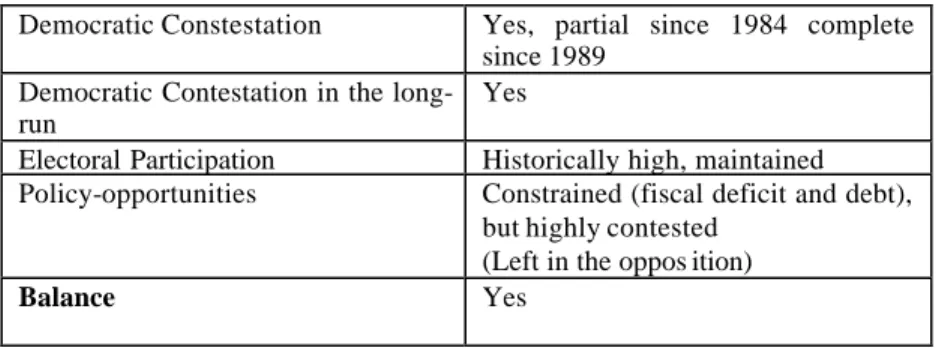
During the 1990s, the Chilean and Uruguayan party systems exhibited the highest levels of programmatic structure in Latin America. In both cases, this outcome is driven by the interaction of long and short term causal factors that yielded at that particular moment (1997-8) a series of opportunities, capacities, and potential for successfully mobilizing grievances
5
(salient interest conflicts) that enabled programmatic linking between voters and parties (Kitschelt et.al. forthcoming).6
In the explanatory framework proposed by Kitschelt et al, programmatic linking between parties and constituents is only one among multiple possible linkage-strategies. We are most likely to observe programmatic linking when capacities and resources tied to socio-structural and historico-institutional factors provide incentives to construct partisan organizations centered on programmatic linkages and the pursuit of collective goods (as opposed to particularistic side-payments), when grievances (predominantly economic/distributive conflicts) provide incentives for organizations to mobilize for/against the status quo in society, and when opportunities (e.g. institutionalized democratic contestation over time) are present.7
According to Kitschelt et al (forthcoming) the emergence of programmatic linkages can be thought of as one of the possible results of a set of nested games, assuming fixed preferences (office-seeking maximization) on the supply side (political entrepreneurs).8 First, there is a principal-agent game played between voters (principals) and politicians (agents). This principal-agent relation is structured around different levels of aggregation depending on the interaction between the level and nature of organization of collective interests in society and the degree to which politicians have access to private goods and subsidies that can be discretionally allocated (Verdier 1995). Theoretically, electoral institutions can also affect politicians’ choice to pursue a “personal-vote” as opposed to one based on collective interests (Carey and Shugart 1995).9 When structural conditions favor higher levels of interest aggregation (capacities),
6
See Kitschelt et al (forthcoming) for an analytic framework centered on capacities, opportunities, and grievances. This section draws subs tantially on this framework. The notion of capacities, opportunities, and grievances draws on the literature on political psychology and was applied by Zechmeister (2003) to explain individual-level outcomes. However, it can also be directly traced to the literature on social mobilization (e.g. McAdam et.al. 2001), in which in a given structural setting social movements emerge (or not) as a consequence of the interaction between grievances, opportunities, and resources (capacities).
7
Kitschelt et.al. forthcoming.
8
programmatic coordination is likely. Therefore, the presence of organized interests groups seeking the provision of collective benefits and who are able to guarantee political parties an “appealing” constituency, provides incentives for parties to focus on higher levels of aggregation. In addition, augmenting the electoral relevance of the median voter, higher levels of electoral contestation would tend to increase the centrality of redistributive policies structured at high levels of aggregation, centered on the provision of collective goods.
However, the availability of resources to be discretionary allocated as individual side-payments or club-goods could also significantly affect the level of aggregation of party-voter linkages, dynamically interacting with the previous factors. For instance, there are highly-competitive systems in which only some parties (typically those in government) have massive access to resources that can be individually allocated. In those systems, the opposition has strong incentives to foster programmatic linkages with its constituents, eventually challenging the status-quo and forcing --especially under situations of crisis—an incremental systemic change. Alternatively, in a system where virtually all mainstream parties enjoy parallel access to those resources, strong inertias exist even in spite of the high fiscal irrationality entailed but that systemic linkage-strategy. In these cases, the rapid implosion of the party-system becomes more likely. As argued below, while the cases of Brazil and Uruguay approach the first scenario, Venezuela illustrates the latter. Finally, together with the availability and eventual partisan distribution of clientelistic side-payments, the social distribution of organizational capacity of interests groups and collective actors, also has important implications for parties’ and candidates’ strategizing.
However, even when structural and competitive conditions promote the pursuit of programmatic -linkages, the consolidation of such a strategy also requires a set of “successful” iterations in subsequent elections over time (opportunities), in which programmatic commitments are nurtured and fulfilled. In other words, programmatic commitments become
9
credible and established (or erode), through the functioning of several cycles of democratic accountability.
This implies that office-seeking politicians in programmatic -prone systems must solve subsequent collective action and coordination dilemmas in order to create and sustain programmatically-committed partisan organizations that can compete through the mobilization and representation of conflictive social interests (grievances). Aldrich (1995) presents a detailed elaboration of the dilemmas involved in the process of party-creation and maintenance. Briefly put, these organizations select, socialize, and bring together office-seeking politicians with simila r programmatic agendas, which are then enforced through organizational mechanisms in order to maintain party-platform commitments. For their part, political parties provide an efficient vehicle for ambitious politicians by pooling symbolic and economic resources to be deployed in campaigns, maintaining a reputation, and providing a party-label that voters can use as cognitive shortcuts as efficient links to parties based on their policy preferences (Zechmeister 2003; Hinnich and Munger 1994). These shortcuts are essential if we conceive of voters as “rational information misers” who most likely lack tightly structured belief systems (Campbell et.al. 1967; Converse 1964) and for whom it is irrational to become fully acquainted with complex party manifestos.
This set of complex interactions among voters, office-seeking politicians, and parties occur inter-temporally. Therefore, both parties' ability to compete over extended periods of time and their chance to promote and (while in office) pursue alternative policy-packages (in accordance to their redistributive stances around salient grievances) strengthens (or erodes) the conditions for programmatic linkages. At this point, it is worth nothing that grievance mobilization is partly endogenous to partisan strategies.10 Arguably, exogenous conditions (both institutional and socioeconomic) certainly widen or restrict the room for such mobilization to occur. For instance, in contemporary Latin America, the development of ISI until the 1970s and the current stage reached by each country in the transition from the
10