SEEKING HARMONIZATION: MEASURING THE EFFECTIVENESS OF THE COMMON EUROPEAN ASYLUM SYSTEM
Drew Sampson
A thesis submitted to the faculty of the University of North Carolina at Chapel Hill in partial fulfillment of the requirements for the degree of Master of Arts in the Department of Political
Science, Concentration European Governance.
Chapel Hill 2013
ii Abstract
DREW SAMPSON - Seeking Harmonization: Measuring the Effectiveness of the Common European Asylum System
(Under the direction of Milada Vachudova and Ingo Peters)
This thesis is an examination of the effectiveness of the European Union’s efforts to create a unified asylum system. For over two decades, the EU has been taking action to ensure the upholding of human rights; create an efficient system via the fusion of national systems and implementation of EU institutions and instruments; and to better integrate immigrants. While
there have been many new developments in the last decade alone, this thesis observes continuing human rights violations, insufficient coherency in the between member states, and
a lacking effort to truly integrate migrants. In conclusion, this thesis advises that greater oversight and enforcement, more binding directives, and increased efforts made directly by the EU to integrate migrants are all necessary actions which could alleviate burden disparities
iii
Acknowledgements
I would like to take a brief moment to acknowledge all whom have assisted me in this endeavor. This thesis has given me the chance to explore a topic of great importance, and
without the help of those with similar interests in the betterment of governances and advancement of human rights, I would not have achieved this feat. Dr. Milada Vachudova,
thank you very much for you enthusiasm and the many reminders of the more pragmatic components of this process. I would also like to thank Dr. Ingo Peters for the many discussions we have had, the times of sheer abstraction, and for taking on this challenge with
me in a new field. I would also like to thank the faculties of UNC – Chapel Hill, Humboldt Universität zu Berlin, and Freie Universität zu Berlin for their consistent support during the months it has taken to write this thesis and for having provided me necessary coursework to
expand my understanding of yet another component of the social sciences. Lastly, but certainly not of any lesser importance, I want to thank my family, friends, and academic colleagues. You all have provided support each in your own unique ways, and for this I am
iv
Table of Contents
LIST OF ABBREVIATIONS………...……...v
Sections I. Introduction...1
II. Methodology...6
Operationalization...7
Measurement of Effectiveness...9
III. Human Rights and Asylum...11
Protocol Directives, Bilateralism, and Enforcement...12
IV. Regimes, Institutions, and Instruments of the EU...16
Restructuring and Transference of Authority...17
Convergence through Legislation...18
The New Institutions and Instruments...20
V. Integration and Post-Asylum Processing Challenges...24
The Biopsychosocial Approach of Measuring Health...25
Integration Efforts of the EU...27
VI. Discussion and Conclusions...31
APPENDIX: TABLES, FIGURES, AND DATA...34
v
List of Abbreviations
1. EU – European Union
2. CEAS – Common European Asylum System
3. UNHCR – United Nations High Commissioner for Refugees 4. EASO – European Asylum Support Office
5. EIF – European Integration Fund 6. ERF – European Refugee Fund
7. EURODAC – European Dactlyoscopy
Introduction
2
the actions and desired outcomes of the European Union to which these states are members. The result of these interactions is an ineffective system of asylum which ultimately results in devolution of a cornerstone of modern, democratic governance.
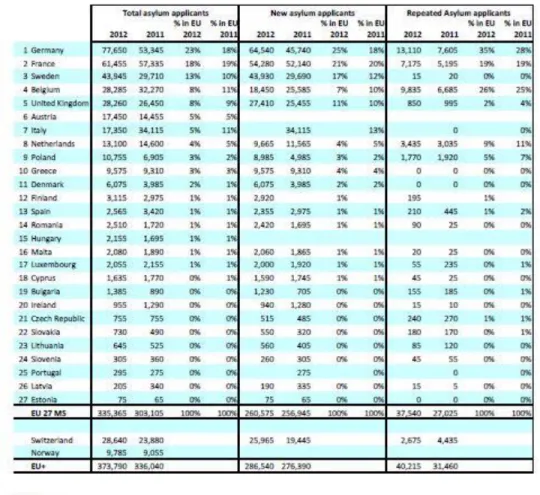
In more recent times, Europe has been faced with further influxes of migrants seeking asylum. The main points of origin of these people are from Syria, Afghanistan, and Russia, with Syria having the largest increase in applications and Afghanistan displaying the largest quantity of refugee seekers. What is even more interesting about the recent figures is that the increase in applications has only risen by a mere 1% of the 11% increase in applications both new and pending. This most recent influx is precisely the new pattern forced migration has taken since the early 1990s with the only main difference between then and now being point of origin. In the foundational actions of the EU building a unified systems, many of the influxes originated from within European regions, but currently many are coming from outside of Europe. The most current data estimates 330,000 in 2012 according to Eurostat statistics (EUROSTAT 2012). This has complicated the national and supranational perspectives and approaches towards asylum. Because much authority still remains at the national level, border states have been circumnavigating much of the EU’s efforts to create an effective, unified system with the use of bilateral readmission agreements, aversion of non-binding EU legislation, and domestic border control. It is important to measure the effectiveness of the EU's asylum policies to shed light on how national and supranational factors have interacted over time.
3
Thomas 2012). To achieve a valid, objective measurement, it is necessary for main components of the regime changes to be operationally defined as well as developing a clear method of measurement. In the case of the effectiveness of the Common European Asylum System (CEAS), effectiveness will naturally have a differing operational definition than that of, for example, the effectiveness of the European Central Bank. Though both topics may share similarities in what signifies a system (or group of systems) effective or not, the difference of inputs and outcomes remain unique. More importantly, the issue of asylum is and will always be highly dynamic in nature for the inconsistent set of circumstances which increase or decrease refuge-seeking along with the ever changing interests of European states remain themselves non-static entities. Thus, forced-migration creates moving targets for all nations which seek to provide international protection
4
thesis, I will explore, deficiency of convergence measures, bilateral readmission agreements, differences in the degree of burden between member states (see figures one, two, three, and four), and lacking oversight/enforcement by the EU as factors contributing to a declining capacity in fostering an effective asylum system. Penultimate to the need to maintain the European ethos of human rights, there remain other reasons as to why effectiveness of the CEAS is of great importance to the EU.
The convergence of asylum systems would not only further ensure maintaining human rights standards, but would also decrease the overall costs and lessen the burden of those providing refuge. Through the creation of new institutions and instruments along with the unification of existing national and supranational systems, the EU would certainly create an effective system of asylum during times of high influx emigration due to warfare and revolution in the Middle East and Africa. However, despite these sought after benefits of a unified system, the EU has not been able to fully reach this end. Unbinding legislation concerning procedural obligations, incoherent allocation of funding to vague objectives and the perpetual contrary interests between nations (which in effect alters the composition of EU legislation) bring about a system of contradiction and usurpation. This lack of convergence limits the effectiveness of security, keeps costs to states higher than needed, and diminishes uniformity in international-EU relations.
5
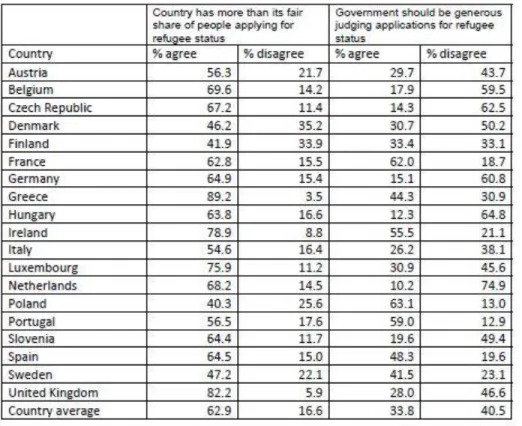
tertiary remains often overlooked (see figures five and six). Not only can effectiveness be measured by observing the interactions occurring before and upon reception of a refugee applicant, but one ought to also observe what occurs after reception. Provision of necessary entitlements, such as, healthcare, employment, and education are crucial to the success of refugees (Farwell 2001) and decreasing the likelihood of refugees remaining a liability to the host state. Furthermore, public perception of migrants or how much a state and other states have contributed enable one to further see the likelihood of assimilation of refugees while also indicating the lack of effectiveness of an EU asylum system in advancing tolerance. Without this exploration, this thesis would be but an attempt to see how non-porous European borders are. If human rights standards and the European promise of a better life were not integral to EU aims, then such an exploration of asylum systems would be sufficient, but this is certainly not the case.
6
sovereignty in political, economic, and cultural forms additionally to the developing super powers?
In the conclusion of this thesis, I argue that in order for the EU to create an effective asylum system, the Union will need to make greater advancements in protecting human rights with greater oversight and enforcement of binding legislation, converging institutions and instruments with centralized institutions and instruments rather than converging national systems, and integrating refugees through both unified entitlements and funding of integration programs outside of national control. In all these components of asylum, there are repeated patterns of lacking capability to enforce directives, maintain thorough oversight of funds, converging national systems, and non-binding language in the legislation defining protocols and standards. Without these advancements, the CEAS will remain in a similar ineffective form as it has now for twenty years.
Methodology:
7
expenditure, and manifests a higher sense of solidarity. As Jorgensen argues, one must forwardly define whether effectiveness is externally or internally measured (Jorgensen 1998), but seeing as asylum policies inherently aim to protect externalities (refugees) and restructure national asylum systems, this thesis’ measurement is naturally one measuring both internally and externally. The binding international treaties on human rights, EU law and political rhetoric concerning human rights, and the need for integration in a sociological sense are also inherent in the measurement of effectiveness of these institutions. Therefore, measuring effectiveness has three major components: Upholding human rights standards and a real prospect of improving the quality of life for the refugee through integration, and increasing the uniformity and efficiency of national systems. To exclude the human aspect of asylum solely to observe the functionality of the asylum system in and of itself would be erroneous and narrow-sighted.
The sequence of themes and supporting evidence in this thesis are as follows:
1. Effectiveness of the CEAS to prevent human rights violations
2. Effectiveness of existing and created institutions and instruments, the coherency
of these systems, and the mitigation of burden disparities.
3. Effectiveness of integration efforts put forth by the EU.
Operationalization:
8
9
available healthcare and basic physiological necessities, such as water, food, and shelter. Psychologically, the refugee is in a healthy psychological standing and receives psychological assistance. As many forced migrants are leaving catastrophic living circumstances which have created not only major psychological problems but also comorbidities (see figure nine), psychological health is to be addressed by the EU as a major facet of the effectiveness of integration programs. Lastly, socially, integration is key to the success of refugees in a new society. Public opinion polls are in this sense very useful to measuring this aspect of integration, as well as the funding of civil society programs (see figures seven and eight). The utilization of the biopsychosocial paradigm is essential to this thesis’ measurement of the effectiveness summated by a simple fundamental truth: How are the refugees and host states to be successful if refugees are in poor physical and psychological health while having little prospects to be socially integrated into their new society? In these circumstances, not only do individuals lose, but the host states lose prospective economic assets, thus maintaining refugees as expenditure. Lastly, burden is a theme which appears often in literature pertaining to asylum in Europe. For the scope of this paper, burden is not only the financial differences which exist between states, but also the perceived burden of host states integrating refugees economically and civically.
Measurement of Effectiveness:
10
expenditure of asylum systems, equalization of burden (financially and socially), and creating a uniform foreign relations in the sense of a common safe third country (Collinson 1996) listing and common readmission agreements. The latter aspect of the measurement of effectiveness is constituted by maintaining internationally and European recognized human rights standards, the reception and processing components, and a real prospect of improving the standard of living in the host country via the means of civic and social integration. The main subset criteria for the integrative aspect of the human component of this analysis is thereby derived from available entitlements for the refugee, available social integration programs, employment opportunities, and EU investments made in effort to bolster integration of refugees. While the spectrum of this form of measurement seems broad, it fully measures the effectiveness of a common EU system of asylum outcomes.
11
to provide similar outcomes for others as they do for refugee-seekers. In considering the effectiveness of the CEAS, it is also of importance to observe if the benefits provided by the EU are better than those of international systems.
Lastly, in gauging the effectiveness of the CEAS, I maintain that effectiveness should not be considered black and white, but rather a spectrum. From this sense, effectiveness is either in a low, moderate, or high status. Given human rights standards have improved, convergence methods have created a more coherent system, and integration increases, it is clear that the CEAS is of high effectiveness. If only two of the three, are met, the CEAS is moderately effective. Logically, if the CEAS meets only one criterion, then the system is of low effectiveness. In summation, the methodology implemented in determining the effectiveness is derive mainly from the achievement of goals set out by the EU, the maintenance of European values concerning human rights, and the domestic efforts made to better integrate migrants economically and civically.
Human Rights and Asylum:
12
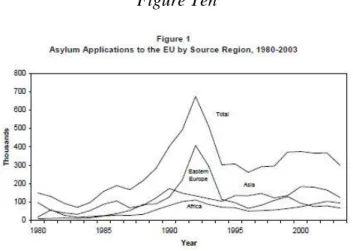
rights. Furthermore, the displacement of many various groups of people played a large role not only directly after the end of the Second World War but also onward until the Iron Curtain fell, where once again a massive influx of displaced peoples were again on the move to a different land to call home and seek refuge (see figure ten) (Hatton et. al. 2004; Marshall 2007; Vachudova 2007). While the groups of migrants seeking refuge or replacement have varied over the course of the last six decades, two aspects remain the same: Migrants are moving in influxes without a current or predictable rate as in earlier times in history, and, the responsibilities of states taking these migrants in are bounded by internationally recognized and longstanding treaties and laws.
Much of the treaties and international, normative recognitions of human rights have even been further integrated into domestic law. In the case of the EU, human rights and rule of law are cornerstones of the democratic foundation upon which the EU (and subsequently) the member states are built. Looking deeper into EU political rhetoric, one can easily observe the focus put on a need for maintaining human rights in its actions and outwardly projected positions on current international affairs. However much valuation the EU gives to the maintenance and recognition of human rights, its rhetoric remains overshadowed by failures in the EU asylum system, whereby bilateral agreements, improper use of safe third countries, loosely-based procedural directives, and lack of convergence all contribute to the susceptibility of human rights violations.
Protocol Directives, Bilateralism, and Enforcement
13
throughout the last half of a decade. Because much of the legislation is non-binding, in that the EU often invites member states to take part in these convergences in the spirit of solidarity (C115/01), nations can easily circumnavigate EU approaches. As this thesis will later explore, these national differences in interests, and thus behavior, are not the sole cause of ineffectiveness of EU asylum objectives. Furthermore, the EU directives are naturally passed through a system which ultimately is run by the heads of states. If the European Parliament had more political power, it could very well be that the legislation passed would be more binding and impose a uniform solidarity instead of simply inviting member states to act as the EU desires and the current influxes of forced migrants need. Again, effectiveness in the form of vertical coherency would mean that national policies would be in line with policies at the EU level. The non-binding nature of the EU legislation is too open for coherency to occur which has resulted in nations behaving within their own self-interests. While one would not presume nations are seeking to push applicants back to third countries or points of origin, the EU legislation is not binding enough to prevent this.
14
15
Greece requested additional assistance from FRONTEX. As Carrera and Guild argue in their article examining the 2010 push back by Greece and FRONTEX:
The presentation of Frontex Operation RABIT 2010 as ‘the solution’ to the situation at the external borders of Greece with Turkey illustrates the kind of responses that the EU priorities in situations such as those taking place in Greece: more security (FRONTEX) and not going at
the heart of the issue, which is that of human rights protection of refugees and undocumented migrants. (Carrera & Guild 2010)
The non-binding EU legislation, remaining sovereignty to implement bilateral readmission agreements, and varied conceptualizations of which countries are considered as safe third countries all have made a landscape where human rights violations are occurring. As long as the EU does not directly assess the issues concerning the coherency of the CEAS while continuing to grant states with these open-ended options, these violations will continue to occur.
16
their points of origin. Later in this thesis, I explore furthermore the precise weaknesses in institutions and instruments which create this incapacity for oversight and enforcement.
Lastly, there is a large issue with the institutional uniformity of the EU as an international actor. While superficially this aspect seems unconnected to the human rights aspect of the EU asylum system, it remains a final component of ineffectiveness. This is not to denote that the Union should see all refugee applicants as equal but has more to do with international relations. The need for a safe third country listing is as crucial to the human rights component as the bilateral agreements component. The bilateral agreements issue is the same problem as the safe third country issue, in that they both defy uniformity of action with the only difference between the two being at which level of governance this abdication is occurring, respectively at the national and supranational level. To delve further into this matter, one can easily observe that member states would naturally be inclined to abdicate responsibility and refute invitations in the name of solidarity when the EU is doing precisely the same act with a non-uniform approach to international relations as the member states are doing.
Regimes, Institutions, and Instruments of the EU:
17
effectively secures the borders. While the EU has indeed created many new structures (ERF, EIF, EASO, and the protocol directives), the overall effectiveness of these new approaches have not rendered any better outcomes than those of the past twenty years. Member states still believe that they each absorb their fair share (see figures one, two, three, four and eleven [many nations have felt they have cared their fair share but in comparison with the most recent data, there are still major differences between application rates and acceptance rates), the EU still has problems enforcing new directives, and there has been further investment into the asylum system where one could infer that the CEAS is not any more cost efficient than it has been before.
18
created a more efficient system. The latter is of high importance solely because, as previously mentioned, a characteristic trait of an effective system is a system which is also efficient.
Restructuring and Transference of Authority
19
movement where polities often have the open interpretation of laws since much of maritime geopolitical authority is still without a governing body (Haddad 2008; Moreno-Lax 2011). Since much of the EU legislation concerning asylum is written in a manner of invitation, cooperation, and a spirit of solidarity, this has devolved the obligation and effectiveness of the governing departments not due to one department or branch governing better than the other, but due to an inconsistent coherency between the many parties involved in creating an effective, European system of asylum.
Convergence through Legislation
20
providing a uniform but lacking set of directives, non-binding by nature and without much enforcement on behalf of the EU.
21
The New Institutions and Instruments
Structural reconfiguration and the new directives are only one side of the convergence efforts made by the European Union. There have also in the last decade been new institutions created to directly assess newer obstacles and objectives to the issue of asylum. The European Asylum Support Office (EASO) came into fruition in 2010 and is to be a unifying entity between the EU and national level governances. EASO’s main approach to unifying these polities is through informational exchanges and, in a secondary sense, through support in processing asylum cases (“Annual Report on the Situation of Asylum in the European Union 2012” 2013). Lastly, of due importance is the fact that the EU truly does retain much authority over the department which denotes an opportunity to express and implement mainly European perspectives and actions respectively. How the EASO plays into the measurement of effectiveness of the CEAS lies in the limited expanse of the department in the sense that it does not act in lieu of national processing centers. While arguably the department has not been in existence long enough for it to have clear spill-over effects and override path dependencies of national asylum systems, this truth remains an important piece of evidence of the suppressed authoritative powers of the EU in forming a unified system of asylum. In essence, the department is adding to effectiveness by increasing the overall coherency of national systems with the spread of information concerning influxes and migration patterns, but the small parameters of processing leave the national systems able to override the EU system. In this sense, if the department cannot override the national systems, then EASO is, much like FRONTEX, an underused institution.
22
towards converging systems is the European Refugee Fund (ERF). This fund is manifested through national allocation of funds and is therefore available to all contributing states. The main purpose of this instrument is to assist in decreasing the difference of financial burden between states of high and low migration flows. More so, the fund exists to better ensure that refugees have access to legal and social assistance as they apply and are processed. The most recent update of the allotted funds is from the time period of 2008 until 2013, wherein the fund had accumulated 630 million euros for disbursement in said time period. While this amount is indeed a great increase from the last overall funds made available to states, again the key to effectiveness is not only the availability of needed funds but the utilization of funds.
23
Not only are there issues with coherency in the mechanisms fueling the ERF, but there is also an issue pertaining to the usage of funds. According to the structuring of this instrument, there are baseline funds and contributions which are created by an omnibus of statistical data pertaining to the amounts of first applications, granted protection, migration flows, resettled peoples, and number of effected returns. While these criteria are certainly proper in assessing the needs of various nations, the EU has decided that these funds provided by the ERF are to be run through national programs instead of through the European Asylum Support Office or another EU institution. Because of this decision, one can infer that the use of funds is only as good as the national offices which control asylum, and, since the states with the most need will receive the highest amount of funding, this action further funds deficient systems. As mentioned in the previous section, Italy has had major problems in maintaining a migration system which adheres to both international and EU law, resulting in what many have justifiably deemed as contributing to human rights violations. For the 2014-2020 set of funding, Italy will receive over 325 million euros, which is second only to the UK (“Annual Report on the Situation of Asylum in the European Union 2012” 2013). How Italy will utilize these funds through national means is of great concern to all invested parties. Simply providing funds not only does not prove an effective system, but can clearly exasperate outstanding problems found in the national level, which the CEAS in many senses was created to resolve.
24
European Union (fortunately and commonly known as FRONTEX). The agency has been in action for more than eight years now, but the overall impact of it in relation to the effectiveness of EU instruments is yet to be seen as highly effective. A main foundation for this argument is derived not from the institutional functionality of the agency itself, but rather, the EU legislation concerning in which manner the agency is to be used. Again, the cause of this problem is founded in the vague, abdicating nature of the EU legislation wherein the EU cannot seize full authority over the use of the agency. Instead, the EU has drafted legislation which states the use of FRONTEX is dependent on the request of additional manpower by nations either experiencing influx in illegal or dangerous migration patterns or in times of emergency. Most of the use of FRONTEX is in the areas of longstanding, high patterns of entry, namely, Greece and Italy. If the use of FRONTEX were of the discretion of the EU itself, then uniformity and convergence of systems would be much more effective rather than leaving each nation to utilize its own form of border control based on its own protocol legislation. In a larger scope, one can also argue that the agency is a waste of funds since the EU does not fully have control over the use of the agency, thus, the agency remains a passive entity to be funded constantly but used seldom.
25
In effect, if one is not processed according to the common directives set out by the EU, then this omniscient system will make reversing an error of processing much more difficult. Further complicating matters, the EU’s guarantee of free legal aid has been insufficient mainly due to lacking funds (“Annual Report on the Situation of Asylum in the European Union 2012” 2013). Without legal assistance, language assistance, or a common appeals system, these technologically advance security systems create a deficient relationship between applicant and host country. In order for the informational systems to be truly effective, there must also be convergence of national systems as a foundation to which this information/legal system would then truly benefit the greater goods the EU wishes to obtain.
With the many changes which have occurred structural in the last years leading up to the second phase of the CEAS, there have clearly been path-dependencies which are too difficult for the EU to break. Though the creation of new instruments and institutions are indeed examples of the European prioritization of asylum, their effectiveness in bolstering an effective, unified system continues to be lacking. The provision of more binding policies, more specific use of funds, and a greater focus on the need for oversight and enforcement are all solutions to the structural problems the CEAS is experiencing.
Integration and Post-Asylum Processing Challenges:
26
after the acceptance or denial of asylum to an applicant is a defining feature of the institution, for if a refugee cannot achieve a safer, better quality of life, then why have the institution of asylum at all?
The Biopsychosocial Approach of Measuring Health
In the field of psychology, a paradigm of understanding the general health of an individual and the contributing factors to one’s health is known as the biopsychosocial paradigm. Though this approach to understanding individual health is often utilized in addiction rehabilitation methods, it can also be implemented to assess the health of any individual. For the scope of this essay, one should not delve too deeply into the philosophical aspects of why this argumentation holds true, but suffice it to say, we all have vices, seek homeostasis, and work within this paradigm for the influences of our behavior (and thus health) are both internally and externally derived while most certainly interdependent upon another. The biopsychosocial approach claims that an individual’s behavior is derived from biological influences (neurological, physiological, and organ systems), psychological influences (capacity of the brain and nervous systems, presence of psychological pathologies, and personality traits), and social influences (exogenously and endogenously derived social interactions; dyadic, familial, and interpersonal relationships; and integration/belongingness factors) (Frankel 2003). All of these influences attribute to the behavior of an individual, the overall health of an individual, and his/her interaction with other people.
27
28
aspect of the paradigm, resulting in both the need for healthcare services and an often deeply complicated set off pathologies which may well be very difficult to cure (Farwell 2001). In measuring the effectiveness of the EU asylum system, it is of great importance to not only observe the human rights and convergence issues, but also to observe what the EU is doing to integrate asylum seekers in economic, social, and health terms.
Integration Efforts of the EU
What is most perplexing of the entire issue of European asylum efforts is that the EU is often hindered if not entirely stopped from taking full authority of the area of refuge due to shared national interests to retain sovereignty in this area. More so, by taking authorities over solely EU level institutions, the spread of norms is increased in the sense of collective perception and spill-over effects, “Norms research suggests that the origin of many international norms lie not in the preexisting state interests but in the strongly held principled ideas (ideas about right and wrong) and the desire to convert others to those ideas (Sikkink 1998). A component which the EU could indeed strengthen without much national contradiction is in the area of integration. The creation of integration programs, basic fundamental entitlements via the ERF, and influencing national perspectives are all approaches which the EU could implement without member states having much political power to oppose these actions. Unfortunately, much of the focus is placed on issues directly related to before and during an applicant is processing, and, to the domestic issues explored in the second section.
29
are directives concerning the entitlements, rights, and necessities of refugees. What is more complex about this facet of integration is the integration of refugees. Despite the general animosity held against refugees, While refugees do not provide as abundantly to a host country economically (this is not to say they never, but rather are less likely than one who chooses to migrate), refugees provide states with reinforcement of the values modern, democratic states maintain and project socially (Hatton 2004). In other words, refugees are clear evidence that the society both citizens and refugees live in is indeed a free, peaceful, and prosperous land. To further extend this argumentation, one should consider the dynamics which are tied to economic and civic assimilation. Without social inclusion, how could one then presume that an individual can or would desire to contribute to the collective whole economically or civically?
30
31
Another newly implemented approach to the CEAS is the European Integration Fund (EIF). This program is another more recent program which is similar to the ERF in that it is managed through shared competencies and is funded through allocated EU funds. The main goals of the fund are to better integrate non-EU citizens, which implicitly incorporates those who have been granted refuge by member states. The fund’s most recent term of disposable funds spans from 2008-2013 in excess of 825 million euros (considerably larger than the ERF – but one should keep in mind the expanded demographical interests the EU has in this field for the recipients of this fund are not only refugees and asylum-orientated institutions and instruments). In measuring the effectiveness of the CEAS, the EIF is crucial to a deeper understanding of European interests.
32
socio-cultural benefits of integration of both free and forced migrants is of great benefice in that the diversity provided by foreigners has the capability to reiterate in a collective sense the very ethos Europe proclaims in its rhetoric concerning modern, democratic principles.
The efforts to integrate foreigners in both rational and normative terms in order to reach greater assimilation economically, socially, and cultural are not increasing effectiveness of the EU asylum system because it treats free migrants differently from refugees, and the directives concerning provisions do not have the power to converge national systems whereby refugees would be treated more equally and in a more coherent manner. As mentioned before, integration is the key final step to ensuring an effective asylum system for the main goal in providing international protection is to provide protection and a better standard of living than the original state a migrant has fled. If the EU cannot take more steps to ensure integration as a direct result of EU action (rather than abdication to national levels of governance), then regardless of how efficient the asylum system may be, it will fail to reach the end goal which is indeed the main reason why this twenty year endeavor has continued.
Discussion and Conclusions:
33
existing endogenous and exogenous challenges. It is imperative that the EU further invest in European level institutions and instruments, such as the ERF, EIF, and EASO while also seeking to differentiate and separate these structures from the national systems already in existence. The creation of new structures will be inevitable, but these structures ought not to be susceptible to the same political pathology deteriorating most of the CEAS: abdication of responsibility with the false perception that more restrictions bring forth less expenditure. In summation, the next policy cycle would be much more effective if convergence went beyond invitation, funding to EU endeavors were allocated and controlled fully by the EU itself, oversight and enforcement were increased with further involvement of third-party organizations as well as authorities controlled solely by the EU, and integration were recognized before, during, and after the asylum process takes place. To the last aspect listed in this broad prescription of plausible solutions, I remind the reader that the rights of all individuals remain and will continue to be the only real common denominator we as humans share. What a state can provide its own citizens, they most certainly can provide all, and more importantly, if this end is achieved, normative spill-over is the true end effect thus lessening the burden western states have already obliged themselves to take.
34 Appendix
TABLES AND DATA:
35
36
37
Figure Four
38
Figure Six
39
Figure Eight
40
Figure Ten
41
42 References
Andrijasevic, Rutvica. "DEPORTED: The Right to Asylum at EU’s External Border of Italy and Libya."
International Migration. (2009). Web.
Balzacq, Thierry, and Sergio Carrera. "MIGRATION, BORDERS AND ASYLUM TRENDS AND
VULNERABILITIES IN EU POLICY." Centre for European Policy Studies. (2005). Web.
Bourgeais, Vincent. European Union. Eurostat. Asylum in the EU27 The number of asylum applicants
registered in the EU27 rose to more than 330 000 in 2012. Luxembourg: , 2013. Web.
Bouteillet‐Paquet, Daphne. "European harmonisation in the field of read mission agreements." International
Journal of Human Rights. 1.3 (1997): 31-43. Web.
Byrne, Rosemary, Gregor Noll, and Jens Vedsted-Hansen. "Understanding Refugee Law in an Enlarged
European Union." European Journal of International Law. (2004). Web.
Cameron, Kim S. "Effectiveness As Paradox: Consensus and Conflict in Conceptions of Organizational
Effectiveness." Managment Science. 32.5 (1986): 539-553. Web.
Carrera, Sergio, and Elspeth Guild. "‘Joint Operation RABIT 2010’ – FRONTEX Assistance to Greece’s Border with Turkey: Revealing the Deficiencies of Europe’s Dublin Asylum System." Centre for European Policy Studies. (2010). Web.
Castles, Stephen, and Mark J. Miller. The Age of Migration. . 4th. London: Palgrave Macmillan, 2009. 1-18;
20-48. Print.
Cassarino, Jean-Pierre. "Informalising Readmission Agreements in the EU Neighbourhood." International
Spectator. 42.2 (2007): 179-196. Web.
Collinson, Sarah. "Visa Requirements, Carrier Sanctions, 'Safe Third Countries' and 'Readmission': The
Development of an Asylum 'Buffer Zone' in Europe." Transactions of the Institute of British
Geographers. 21.1 (1996): 76-90. Web.
European Union. Commission of the European Communities. COMMUNICATION FROM THE
COMMISSION TO THE EUROPEAN PARLIAMENT, THE COUNCIL, THE EUROPEAN
ECONOMIC AND SOCIAL COMMITTEE AND THE COMMITTEE OF REGIONS POLICY
PLAN ON ASYLUM AN INTEGRATED APPROACH TO PROTECTION ACROSS THE EU.
43
European Union. Council of the European Union. European Pact on Immigration and Asylum. Brussels:
Presidency, 2008. Web.
European Union. European Asylum Support Office. Annual Report on the Situation of Asylum in the European
Union 2012. Luxembourg: EASO, 2013. Web.
European Union. European Council. Stockholm Program. Office Journal of the European Union, 2010. Web.
"European Council on Refugees and Exiles." (2012). Web.
Frankel, Richard M. The Biopsychosocial Approach : Past, Present, and Future. Rochester, NY: University of
Rochester Press, 2003. Print.
Farwell, Nancy. "'Onward Through Strength': Coping and Psychological Support among Refugee Youth
Returning from Eritrea from Sudan." Journal of Refugee Studies. 14.1 (2001): 44-69. Web.
Ferrera, Maurizio. “The’Southern Model’ of Welfar in Europe.” Journal of European Social Policy. 6.1 (1996):
17-37. Print.
Gil-Bazo, Maria-Teresa. "The Practice of Mediterranean States in the context of the European Union’s Justice
and Home Affairs External Dimension. The Safe Third Country Concept Revisited." Oxford University
Press. (2006). Web.
Haddad, Emma. "The External Dimension of EU Refugee Policy: A New Approach to Asylum?." Government
and Opposition. 43.2 (2008): 190-205. Web.
Hamood, Sara. "EU–Libya Cooperation on Migration: A Raw Deal for Refugees and Migrants?." Journal of
Refugee Studies. 21.1 (2008). Web.
Hatton, Timothy J. "Asylum Policy in the EU: The Case for Deeper Integration." Centre for Economic
Research. 660 (2012). Web.
Hatton, Timothy J., Wolfram F. Richter, and Riccardo Faini. "Seeking Asylum in Europe." Economic Policy.
19.38 (2004): 5-62. Web.
Hertog, Leonhard, and Simon Stross. "Policy Coherence in the EU System: Concepts and Legal Rooting of an
Ambiguous Term." Centre for European Policy Studies & The Trans European Policy Studies
Association. (2011). Web.
44
Jorgensen, Knud Erik. "The European Union's Performance in World Politics: How Should We Measure
Success?." Trans. Array Paradoxes of European Foreign Policy. Great Britain: Kluwer Law
International, 1998. 87-101. Print.
Jorgensen, Knud Erik. "Three Doctrines on European Foreign Policy." WeltTrends. 42. (2004): 27-36. Web.
Juss, Satvinder. "The Decline and Decay of European Refugee Policy." Oxford Journal of Legal Studies. 25.4
(2005): 749-792. Web.
Krell, Gert, Hans Nicklas, and Anne Ostermann. "Immigration, Asylum, and Anti-Foreigner Violence in
Germany." Journal of Peace Research. 33.2 (1996): 153-170. Web.
Marshall, Barbara. "Closer integration or re‐nationalization? Recent trends in EU migration and asylum
policies: The case of Germany." Journal of European Integration. 22.4 (2000): 409-432. Web.
Moreno-Lax, Violeta. "Seeking Asylum in the Mediterranean: Against a Fragmentary Reading of EU Member States’ Obligations Accruing at Sea." International Lournal of Refugee Law. 23.2 (2011): 174-220.
Web.
Neumayer, Eric. "Asylum Recognition Rates in Western Europe: Their Determinants, Variation, and Lack of
Convergence." Journal of Conflict Resolution. 49.1 (2005): 43-66. Web.
Norreman, Marie, Anna Mygind, and Allan Krasnik. "Access to health care for asylum seekers in the European
Union—a comparative study of country policies." European Journal of Public Health. 16.3 (2005):
285-289. Web.
Peers, Steve. "The Common European Asylum System: State-of-play update." Statewatch. (2012): n. page.
Web.
Sikkink, Kathryn. "Transnational Politics, International Relations Theory, and Human Rights." PS: Political
Science and Politics. 31.3 (1998): 516-523. Web.
Thielemann, Eiko. "Symbolic Politics or Effective Burden-Sharing? Redistribution, Side-payments and the
European Refugee Fund." Journal of Common Market Studies. 43.4 (2005): 807-824. Web.
Thielemann, Eiko. "Why Asylum Policy Harmonisation Undermines Refugee Burden-Sharing." European
Journal of Migration and Law. 6 (2004): 47-65. Web.
Thomas, Daniel C. "Still Punching below Its Weight? Coherence and Effectiveness in European Union Foreign
45
Underdal, Arild. "Methodological Challenges in the Study of Effectiveness." Trans. Array Regime
Consequences: Methodological Challenges and Research Strategies. 2004. 27-48. Print.
Vachudova, Milada. "Eastern Europe as Gatekeeper: The Immigration and Asylum Policies of an Enlarging
European Union." Trans. Array The Wall Around the West: State Borders and Immigration Control in