DREAM MAKER VS. DREAM TAKER: EFFECTS OF VENTURE CAPITAL INVESTORS AND ENTREPRENEURIAL BOARDS
Ting Yao
A dissertation submitted to the faculty at the University of North Carolina at Chapel Hill in partial fulfillment of the requirements for the degree of Doctor of Philosophy in Business Administration
in the Kenan-Flagler Business School (Strategy and Entrepreneurship).
Chapel Hill 2019
© 2019 Ting Yao
ABSTRACT
Ting Yao: Dream Maker vs. Dream Taker: Effects of Venture Capital Investors and Entrepreneurial Boards
(Under the direction of Hugh O’Neill)
The venture capital (VC) business model significantly affects the startup companies they back financially. This study explores a phenomenon that is closely related to the VC business model and fund structure—VC-led time horizon differences among board members. VC-led time horizon differences are where directors are misaligned in terms of their preferred exit times. Since VC funds have a fixed lifetime, this finite horizon causes strong exit pressure toward the end of the fund’s lifespan. Although entrepreneurs and venture capitalists have similar long-term time horizons at the outset of the relationship, factors such as entrepreneurs’ aggressive goal-setting, time-bound VC funds, and the uncertain entrepreneurial process can shift the
synchronous time horizons initially shared by the entrepreneur and the venture capitalists. This dissertation investigates three questions: 1) Why and how often do VC-led time horizon
differences arise? 2) How do VC-led time horizon differences affect board dynamics and exit outcomes? and 3) How can startups effectively manage VC-led time horizon differences? The focus of this analysis is on the board of directors, whose members are the most important people in deciding exit strategies, whether through an initial public offering (IPO), merger and
acquisition (M&A), or bankruptcy.
The findings show that VC-led time horizon differences significantly increase the chance of bankruptcy and low-valued M&As. More importantly, the results of the systematic quantitative analysis suggest how to effectively manage VC-led time horizon differences by selecting certain types of directors (i.e., serial-entrepreneur independent directors, experienced VC directors, and by avoiding investor-executives) as well as the importance of carefully managing stage
Dedicated to my family: My grandfather, Shengpin Yao,
ACKNOWLEDGEMENTS
This dissertation is the result of support and help from many people: my advisor,
committee members, family, and peers at the University of North Carolina. I feel fortunate to be surrounded by such phenomenal people.
First, I would like to express my deepest gratitude to my advisor, Prof. Hugh O’Neill. He continually encourages, supports, and guides me to become an independent researcher and a good teacher. His breadth of knowledge and his familiarity with management literature pushed me to read more and think harder. He put countless hours into helping me develop this research. I am grateful for his guidance through each stage of the process.
Prof. Atul Nerkar is another crucial supporter on my doctoral journey. He is always excited about research and is willing to open doors for students. His energy and enthusiasm infected me. I learned many important presentation skills from him.
I want to thank Prof. Rich Bettis for his ongoing support. He taught me a behavioral perspective on strategy. I continue the habit of writing short “reflections” on the readings and
guest speaker seminars. These reflections have been beneficial and convenient. He is a great role model.
I learned from Prof. Mahka Moeen many teaching skills. Sitting in her strategic
management class inspired me to keep fighting for my dream of becoming a teacher. Thank you, Mahka.
There have been so many other people at UNC who helped me during this doctoral program: Profs. Michelle Rogan, Scott Rockart, Sreedhari Desai, Jeff Kuhn, Patia McGrath, Olga Hawn, Chris Bingham, Vinayak Deshpande, and Arv Malhotra. I am grateful for their time, knowledge, and the opportunity to learn from them. My peers in the program have been a source of strength during all these years. Special thanks to Deepak Jena, Tian Chen, Kevin Miceli, Aleks Rebeka, David Halliday, Travis Howell, Shirish Sundaresan, Justin Kent, Ling Xiao, Youthika Chauhan, and Catherine Paek. I benefit greatly from these countless conversations related to research, teaching, and life. Another important person in this journey is Kathy Kay, the first person I always run to with any problem.
Apart from the wonderful UNC community, I would also like thank Prof. Diana Bilimoria from Case Western Reserve University. Without her continuous support, I wouldn’t have an academic career.
This dissertation would have remained a dream without the data support from North Carolina Biotechnology Center as well as the contribution of experience and expertise from the VC and entrepreneur interviewees.
TABLE OF CONTENTS
LIST OF TABLES ... x
LIST OF FIGURES ... xi
CHAPTER 1. INTRODUCTION ... 1
CHAPTER 2. LITERATURE REVIEW ... 6
Board of Directors... 6
Public firm boards ... 7
New boards: The transition to IPO ... 12
New venture boards vs. public firm boards ... 14
New venture boards: only a few survive ... 16
Time Horizons and Shifting Expectation ... 19
CHAPTER 3. CONTEXT ... 27
CHAPTER 4. INITIAL INSIGHTS FROM THE FIELD ... 29
Study Design ... 29
Results from the Field ... 31
Entrepreneurs and their comments on time ... 31
VC’s time horizons and the rise of VC-led time horizon differences ... 33
Differences in time horizon: what role does the board play in impact and management? ... 39
CHAPTER 5. THEORY AND HYPOTHESES ... 42
Time Horizon Differences: Origins ... 42
The Emergence of Differences in Preference Across Time: The Impact on
Low-valued Exit ... 48
Minimizing the Impact of Time Horizon Differences: the Role of the Board and Past Performance ... 51
Investor-executives ... 51
Prior fund management experience of time-urgent venture capitalists ... 53
Serial entrepreneurs as independent directors ... 55
The attainment of a milestone ... 56
CHAPTER 6. DATA AND METHODS ... 59
Dependent Variable: Low-Valued Exits ... 61
Independent Variable: Time Horizon Differences ... 62
Moderators and Control Variables ... 65
Econometric Models ... 67
CHAPTER 7. RESULTS ... 68
Supplementary Analyses ... 72
CHAPTER 8. DISCUSSION AND CONCLUSION ... 75
Theoretical Contributions ... 75
Practical Implications... 80
Limitations and Future Research ... 83
LIST OF TABLES
Table 1. Venture boards vs. public firm boards ... 87
Table 2. Entrepreneur interviewees’ backgrounds ... 88
Table 3. Investor interviewees’ background ... 89
Table 4. Descriptive statistics and correlations ... 90
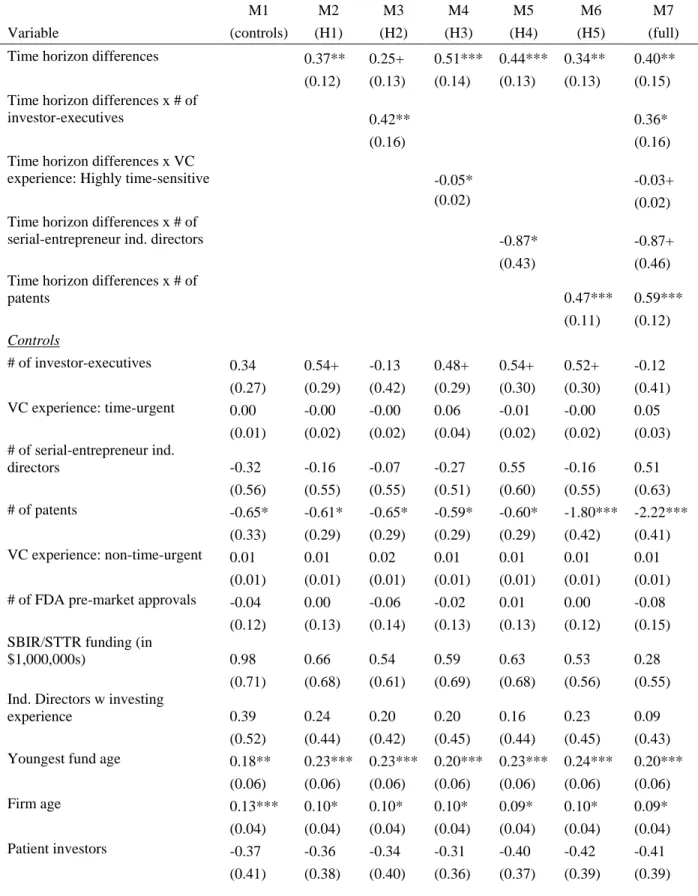
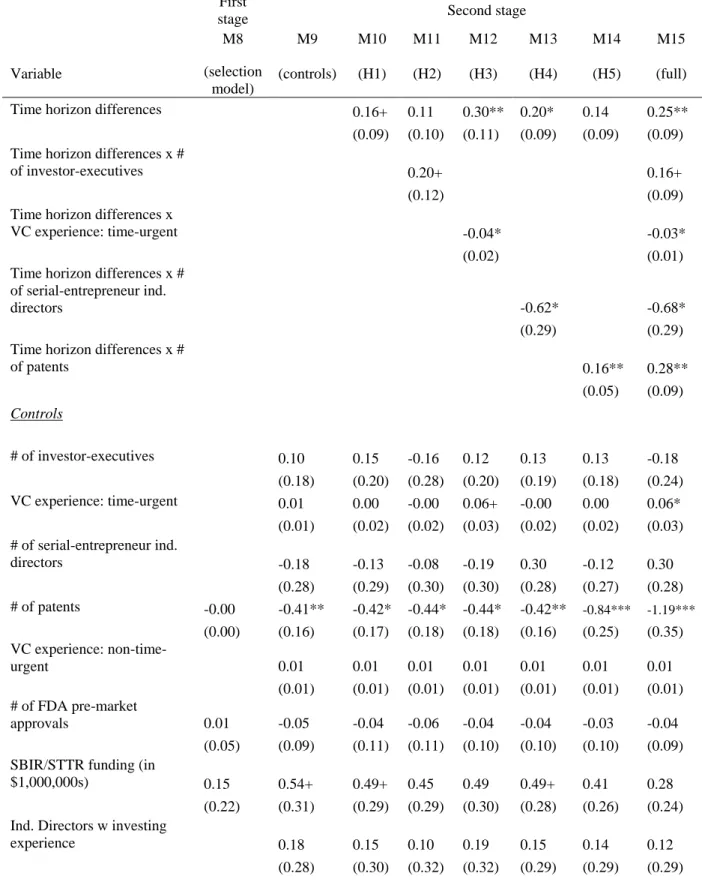
Table 5. Estimated coefficients from competing risk models ... 91
LIST OF FIGURES
Figure 1. Firm stages of VC-backed companies ... 95
Figure 2. VC business model ... 95
Figure 3. Distribution of time horizon differences ... 96
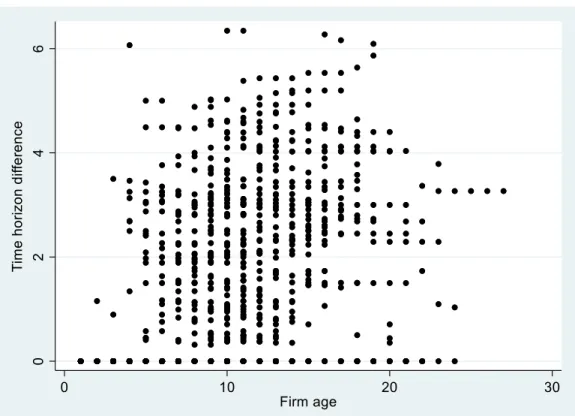
Figure 4. Scatter plot between time horizon differences and firm age ... 96
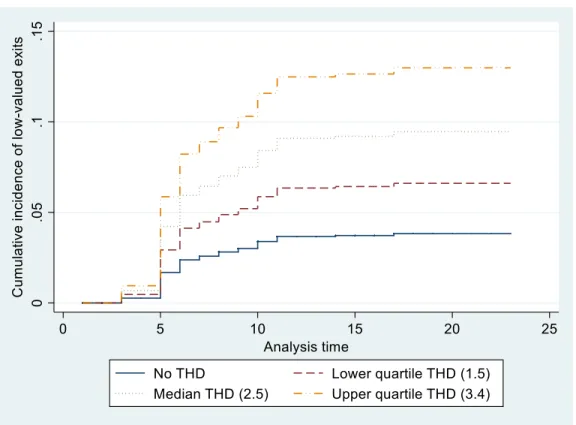
Figure 5. Impact of time horizon differences on low-valued exits across firm age ... 97
Figure 6. Impact of time horizon differences on low-valued exits at median firm age ... 97
Figure 7. Moderating impact of the number of investor-executives ... 98
Figure 8. Moderating impact of the experience of time-urgent VCs ... 98
Figure 9. Moderating impact of the number of serial-entrepreneur independent directors... 99
CHAPTER 1. INTRODUCTION
Venture capital (VC) is a dominant force in the financing of innovative startups. VC-backed companies profoundly influence the U.S. economy as they drive both economic growth and private sector employment (Kortum & Lerner, 2000). Venture capitalists help startups in two ways: they actively assist startup businesses (e.g., financial and marketing advice as well as vital contacts with legal and accounting advisors, investment banks, suppliers, etc.) (e.g., Gompers & Lerner, 2004; Sahlman, 1990; Sapienza, Manigart, & Vermeir, 1996) and they certify a startup’s quality (e.g., Gompers & Lerner, 2004, 2001; Hochberg, Ljungqvist, & Lu, 2007; Hochberg, Serrano, & Ziedonis, 2018). Puri and Zarutskie (2012) find that VC-backed startups are less likely to fail than non-VC-backed startups, mainly due to careful selection by VC firms.
However, Hall and Woodward (2010) find that 75% of VC-backed startups ended with a liquidation value of zero. Intuitively, the high failure rate results from poor startup performance. But many entrepreneurs provide an alternate explanation. Entrepreneurs share stories about “VC insanity.”1 For example, at times venture capitalists push aggressively for the sale of a promising
portfolio startup, and at other times, they prevent sales even though the deal is sufficient to assure high returns for the founder and the investor. Moreover, some entrepreneurs comment that VC-backed startups often fail because they run out of time rather than running out of customers.2
1 Read VC insanity, explained for more detail, available at https://www.danshapiro.com/blog/2010/08/vc-insanity-economics/
The concerns expressed in these comments are fundamentally related to the VC business model and fund structure, and particularly the limited partnership and the fixed lifetime of VC funds.
VC firms raise capital from passive investors (aka limited partners) who do not
participate in a fund’s operational activities. VC funds have a limited lifecycle, generally a
10-year period fixed ex-ante, where the first five 10-years are viewed as an investment period and the second five years as a harvest period. An exit is crucial to VC investing because startups do not pay dividends and the returns are realized at the exit stage. Therefore, exit performance at the end of the fund is an indicator of the VC manager’s skill and determines the chances of raising a new fund (Kaplan & Schoar, 2005). As the funds age, venture capitalists face increasing pressure to exit. Guler (2007) indicated that older funds tend to terminate investment. In a theoretical study, Kandel et al. (2011) examined the impact of VC funds’ finite horizon on continuation decisions and suggested that VC firms are likely to abandon good projects at the end of their fund. These findings indicate that VC funds’ fixed lifetimes may partially contribute to the high failure rate of VC-backed startups. Although we have started to understand the impact of the fixed lifetime of VC funds on investment decisions (Barrot, 2017) and fund liquidation decisions (Masulis & Nahata, 2011), the impact of VC funds’ finite horizon on startups has received little attention in academic research. This deficit in understanding is a crucial shortfall for those types of innovation which require a long-term gestation.
This dissertation aims to better understand the impact of VC funds’ fixed lifetime on
startups by considering the effect in the specific context in which VC firms directly interact with entrepreneurs and affect startup businesses—the board of directors. The work focuses on the key role of the new venture board, as the board balances the dynamic relationship between
capitalists’ behavior, but the emergent impact on startups depends on other decision makers’ behavior. The board is the most influential and powerful group involved with startups. VC firms highly value board seats, and affect startups’ businesses via their board positions (Feld &
Ramsinghani, 2013). The board actively and significantly affects the startup business (Garg & Furr, 2017). The board has almost absolute power to initiate exit (Smith, 2005).
In the board context, how does the finite lifetime of VC funds affect the startup, especially at the end of the fund’s life, and affect the decision that VC firms care most about— exit? At this period, VC board members and other board members may have different
preferences on the timing of an exit and/or the type of exit. VC firms tend to face stronger pressure to exit, pressure that is driven by approaching fund termination. To capture these dynamics, this study focuses on the time period from these differences starting from when the formal board is incubated (its creation) to the period the differences become the most compelling (around the exit). Specifically, I investigate three questions: 1) Why and how often do time horizon differences arise? 2) How do time horizon differences affect exit outcomes? and 3) How can startups effectively manage time horizon differences?
the fund or VC firm level. Also, the research often suffers sample selection bias by including only surviving startups (Da Rin, Hellmann, & Puri, 2011). Additionally, time is still one of the most neglected critical issues in team research (Kozlowski & Bell, 2003). Researchers have identified time and temporal differences in teams as a key agenda for future research (Eisenhardt, 2004; McGrath & Tschan, 2004). Much of the research to date on temporal difference in teams is conceptual and cross-sectional (Mohammed & Harrison, 2013; Mohammed & Nadkarni, 2011). No study has examined the impact of temporal differences on venture board exit decisions, an important topic that significantly affects startups’ growth and survival.
I developed an extensive dataset by hand-collecting data on U.S. VC-backed surgical device startups founded between 1986 and 2014. I tracked each startup from the formal board inception to the first firm exit event (i.e., IPO, M&A, or bankruptcy) through the end of 2017, including such factors as their board composition, director characteristics, financial history, and performance. The sample covers both successful startups and failed startups. The comprehensive dataset enabled me to investigate the impact of changing perspectives across time at the board level, as the new venture entered the period around fund expiration. This study’s goal is to help us better understand venture corporate governance and to explain the changes in a VC firm’s impact on a startup as the fund is close to expiring. I first conducted a field study to assess the validity of issues related to time horizon differences and to understand the impact of time horizon differences on board dynamics.
capital boards’ critical role in the embryonic stage of firm formation. A focus on these inaugural boards offers important insights about the perils of emergence for publicly traded firms.
CHAPTER 2. LITERATURE REVIEW
In this chapter, I review previous findings on corporate governance, paying particular attention to firms at different developmental stages (public, IPO, and VC-backed ventures). I also discuss the research related to time and temporal differences.
Board of Directors
Boards of directors hold the legal authority to monitor firm operations and performance. Publicly traded U.S. corporations are required to form a board of directors. Laws, such as the Sarbanes Oxley Act (SOX) of 2002, provide explicit directions about how boards should act. Despite many decades of study about boards, which led to the design restrictions in Sarbanes-Oxley, little is known about the embryonic stages of board development in newly emerging ventures. Before firms raise equity capital, they create small and informal boards composed of founders and advisors. When these early-stage firms obtain investment from venture capital funds, venture capitalists serve as active monitors and advisors and increase the formality of the board through board meetings (Gabrielsson & Huse, 2002). When a firm grows and
Researchers have examined the impact of boards in different firm stages (Figure 1): public firm boards, transition period boards around an IPO, and venture boards in VC-backed startups3. The priority of the board shifts in the different stages. Most research on boards of directors focuses on public firm boards, or the period just before the venture registers for an IPO. This study will focus on the early stage of board development, specifically, the time between the first venture capitalist gains a board seat and the first firm exit. The next section reviews the primary theories and findings relating to the three firm stages as these theories provide some insight into the initial board formation challenges.
Public firm boards
Corporate governance scholars use multiple theoretical perspectives to explain board behavior and the impact of boards on a company’s strategies and performance. The primary theories include agency theory (Jensen & Meckling, 1976), stewardship theory (Davis, David Schoorman, & Donaldson, 1997), resource dependence theory (Pfeffer & Salancik, 1978), and the behavioral theory of corporate governance (Westphal & Zajac, 2013).
Agency theory emphasizes control and ongoing monitoring. The key assumptions include
managerial self-interest, risk aversion, bounded rationality, and information asymmetry (Eisenhardt, 1989). The agency perspective suggests effective governance can be achieved by monitoring agents, by aligning incentives via contract design, and by signaling. Empirical applications of agency theory suggest that board composition and board leadership structure affect governance outcome (Finkelstein & D’Aveni, 1994; Jensen & Meckling, 1976). Specifically, a higher proportion of outsiders and the separation of CEO and board chairman
3 Early stage boards are advisory-focused with an informal structure, and whose ownership and control are
positions contribute to better governance. Agency theory emphasizes an under-socialized theory of board behavior. The recommendations based on agency theory have been challenged. For example, outsiders and insiders often have close relationships (e.g., Westphal & Bednar, 2005); CEOs, due to their high power and information brokerage positions, can often dominate
outsiders in CEO-only boards (Joseph, Ocasio, & McDonnell, 2014). Even in conditions of “ideal” governance (a high proportion of outsiders), broad adoption of golden parachutes often
occurs (Joshi, 2013).
Stewardship theory emphasizes cooperation and holds assumptions that are opposite to
those found in agency theory. A key assumption is that managers are intrinsically motivated to act in the best interest of the principals (Davis et al., 1997; Donaldson & Davis, 1991).
Therefore, the stewardship perspective recommends a higher proportion of insiders
(Sundaramurthy & Lewis, 2003) and CEO duality (Donaldson & Davis, 1991). Both theories address states of nature that can exist, in that managerial interests and owners’ interests can contrast at some times but not necessarily at all times. An important issue that requires further study is how and when and why boards shift from cooperating and monitoring roles.
Resource dependence theory (RDT) highlights another board role: strategic advisory and
based on the types of resources they bring: business experts, support specialists, and community influentials. RDT predicts that board composition and director characteristics influence
governance outcomes. Specifically, RDT suggests that a larger board (Pfeffer, 1972), interlocking directors (Boyd, 1990; Davis & Greve, 1997), and directors with diverse
backgrounds (Erhardt, Werbel, & Shrader, 2003; Hillman & Dalziel, 2003) are more likely to bring critical resources. However, scholars point out the effects of board composition and director characteristics are contingent on many factors, such as prior financial performance, a firm’s strategy, and the external environment (Pearce & Zahra, 1992).
This research pays little attention to the underlying mechanisms and behavioral dynamics that lead to variances in the link between composition and conduct (Bromiley & Johnson, 2005).
In contrast, the behavioral theory of corporate governance (BTCG) is “a multi-level, mechanism-based theory of governance that is socially informed yet actor-centric” (Westphal & Zajac, 2013:607). BTCG considers the social structural relationships, institutional processes, and social cognition; it addresses both the macro- and micro-level of analysis in an attempt to
understand mechanisms that link the two (Westphal & Zajac, 2013). Researchers propose many mechanisms explaining board dynamics and behavior, such as similarity-attraction, ingratiation, impression management, social learning, norms of reciprocity and social distancing. Specifically, Westphal and Zajac (1995) demonstrated that powerful CEOs favor board candidates who are demographically similar; in turn, this increased demographic similarity can lead to more generous CEO compensation. Westphal and Stern (2007) concluded that ingratiatory behaviors toward peer directors increased the chance of gaining further board appointment, and that, therefore, demographic minorities must engage in a higher level of ingratiatory behavior to get the same appointment. An outcome of the ingratiating behavior is increased management control. Westphal and Graebner (2010) found that negative analyst appraisals prompt impression
which explains how boards maintain the solidarity of corporate elites. In sum, the behavioral perspective investigates how informal structures (i.e., networks, power dynamics, and symbolic management) affect power, politics, behavioral patterns in board decision-making processes as well as the diffusion of strategy and technology across firms (See Westphal & Zajac, 2013 for a thorough review).
Faultline theory (Lau & Murnighan, 1998) is another emerging theory that provides
insights into board dynamics, and that allows simultaneous consideration of multiple director characteristics. Faultlines are defined as “hypothetical dividing lines that may split a group into subgroups based on one or more attributes” (Lau & Murnighan, 1998: 328). Faultlines stimulate
members with dissimilar demographics to differentiate themselves and potentially partition the group into several competing subgroups. Studies have shown that group processes and outcomes are strongly affected by subgroups (Bezrukova, Jehn, Zanutto, & Thatcher, 2009; Carton & Cummings, 2012; Lau & Murnighan, 2005). Subgroup differences may trigger lack of trust, behavioral disintegration, conflicts (including relationship conflicts, task-related conflicts, and process conflicts) and poor team performance (Bezrukova, Thatcher, & Jehn, 2007; Li & Hambrick, 2005). Meanwhile, similarity across members within the same subgroup may strengthen liking, social support, and job satisfaction (Lau & Murnighan, 2005).
boards tend to build on assumptions of management guile and the boards’ monitoring role, rather than the board’s advisory role. In the next section, I review the important findings on the period
of transition to and through an IPO; then I compare and contrast venture boards and public firm boards.
New boards: the transition to IPO
The IPO process is characterized by information asymmetry that reflects an imbalance of knowledge about the emerging firm. The entrepreneurs know more about the firm than potential investors, and this can lead to adverse selection and moral hazard (Ibbotson, Sindelar, & Ritter, 1988). At this stage, board composition signals the new firm’s quality and potential, thus
The IPO process significantly shapes the board composition and structure. In the IPO-seeking firm, a VC firm’s ownership and the executives’ power and ownership affect the selection of non-executive director (e.g., number and background) (Filatotchev, 2006). The IPO process also requires the board to create formal structures (i.e., committees and committee chairs). Garg and his colleagues indicated that if qualified directors are not appointed as
committee chair or board chair, these undervalued directors lead to an unpleasant board climate, thus increasing the likelihood of turnover for outside directors and the CEO (Garg, Li, & Shaw, 2017), as well as increasing the likelihood of adding less qualified directors and having a poor financial performance (Garg, Li, & Shaw, in press).
While an IPO remains an important mark of transition in governance, the number of IPOs in the U.S. have reduced significantly since peaking in 1996 (Doidge, Karolyi, & Stulz, 2017). Many causes have been proposed, such as more regulation on public firms in early-2000s (e.g., SOX), global technological shocks that makes M&As more attractive (Gao, Ritter, & Zhu, 2013), and the deregulation of securities laws in the 1990s that facilitated raising private capital (Doidge et al., 2017; Ewens & Farre-Mensa, 2018). A recent study indicated that the IPO decline is the result of increases in founders’ bargaining power vis-à-vis their investors and the lower cost of being private due to the deregulation of securities laws (Ewens & Farre-Mensa, 2018). Therefore, research focused on public firms and firms that seek an IPO may have limited the application to governance in early stage of board formation for two reasons: 1) the omission of increasing numbers of firms that stay private or seeking alternative exits (M&A and bankruptcy); 2) the significantly different board structure and focus in public firm boards (including IPO-stage boards) and venture boards (venture boards actively engaging in advisory role). While the
look like or do after the firm achieves its public acclimation in the stock markets, little is known about the boards’ formative stages.
New venture boards vs. public firm boards
The genesis of board development occurs in the early stages of a venture's development. While not all new ventures seek external funding, I focus on the boards in VC-backed companies because professionally funded entrepreneurial firms tend to have formal boards, which leads to specific requirements on information disclosure and formal board meetings. New venture boards are significantly different from public firm boards, and deserve direct study as a distinct form or governance challenges.
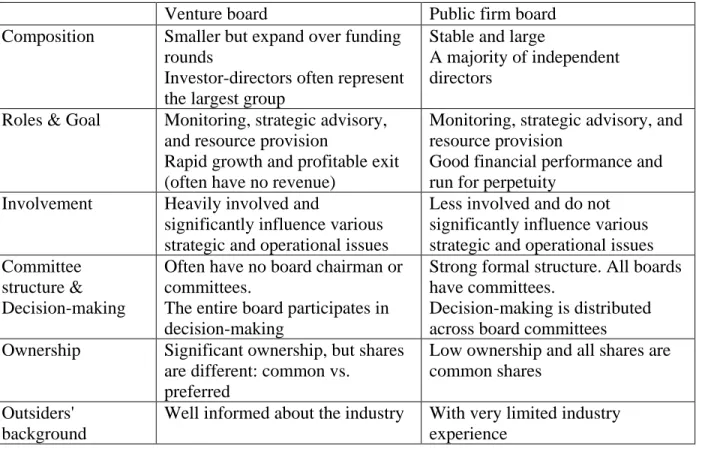
First, venture boards are composed of insiders (founders or other key executives), lead investors, and independent directors (Quinton, 2016). These boards expand in size over funding rounds and tend to be small (typical board size ranges from three to seven) (Feld &
Ramsinghani, 2013; Lerner, 1995). About half of the boards are investor-directors, who represent the largest single category on venture boards (Kaplan & Strömberg, 2003). Public firm boards tend to be large (average board size in S&P 500 companies in 2018 was 11) and stable with a majority of independent directors.
Second, while new venture boards and public firm boards share the same roles
& Ramsinghani, 2013). Public firm boards emphasize monitoring; they target ongoing good financial performance to maximize shareholder value in the long run.
Third, the level of directors’ involvement also differs. Public firm directors are often passive and less involved in operational decision-making (Lorsch & MacIver, 1989), while venture board members are heavily involved and play a critical role in strategic and operational decision-making. For example, board members play key roles in the formulation of startups’ strategies and innovation trajectories (Garg & Eisenhardt, 2017), alliance portfolios (Beckman, Schoonhoven, Rottner, & Kim, 2014), hiring or firing founders and executives (Boeker & Karichalil, 2002; Ewens & Marx, 2018), and exit planning (Pollock, Chen, Jackson, &
Hambrick, 2010). Venture board members interact more frequently with startups. On average, S&P 500 companies met eight times per year in 2018 (EY Center for Board Matters, 2019). Gompers, Gornall, Kaplan, & Strebulaev (2016) found that 85% of VC firms interact at least once per week with their portfolio companies.
Fourth, venture boards lack formal structure (i.e., committees) and often do not appoint a board chairman (Garg, 2014). Board activities involve all board members. SOX and stock exchanges require that public companies form independent board committees and committee chairs (i.e., audit, compensation, and nominating/corporate governance committees). Each committee has specifically defined functions and develops correspondingly specialized expertise (Ellstrand, Daily, Johnson, & Dalton, 1999; Vafeas, 1999). Board responsibilities are commonly delegated to board committees. New venture boards lack this level of formality.
investors often have preferred shares (Kaplan & Strömberg, 2003). Although
entrepreneurs/CEOs are treated as agents in finance literature (Kaplan & Strömberg, 2004), the CEO-board relationship in startups reflects a principal-principal alignment. In public firm boards, directors represent shareholders, but they often own low levels of common stocks.
Lastly, directors in venture boards are well informed about the industry sector, although they may have different functional backgrounds (e.g., entrepreneurs are strong on product and technology, while investors are experts on finance and marketing (Pahnke, Katila, & Eisenhardt, 2015)). Directors on public boards often come from a different industries and have limited focal industry experience or knowledge (Garg & Furr, 2017). Further, unlike public firm boards where all directors represent the same company, venture directors represent different organizations (i.e., both startups and VC firms) and their diverse background may lead to different goals or
incentives. For example, while entrepreneurs may prioritize innovation and enhancing their status in the scientific community, VC firms generally want to improve financial performance and generate revenue by switching emphasis from R&D to marketing and production (Sapienza & De Clercq, 2000).
Table 1 summarizes the key differences between venture boards and public firm boards. The next section reviews the extant literature concerning new venture boards.
New venture boards: only a few survive
interaction dynamics among directors. More importantly, ventures and venture boards face unique challenges (e.g., raising capital and exit) that are not shared by mature firms. Although limited by small sample sizes, conceptual studies, and the primary emphasis on the VC directors, extant literature provides insights into board composition, investor-directors’ involvement, and the impact of the board on innovation and exit.
Specifically, while participation on a board is highly valued, not all VC investors can obtain board seats (Kaplan & Strömberg, 2003). VC investors who make greater investments, invest closer to startup, and have distinctive reputations are more likely to sit on board, although strong venture performance reduces that likelihood (Cumming & Johan, 2008; Cumming, 2008; Lerner, 1995; Park & Steensma, 2014). Further, the level of a VC firm’s involvement is
contingent on multiple factors, for example, firm stage, CEO’s experience, the venture capitalist’s experience, and the completeness of top management teams (Sapienza & Gupta,
1994; Sapienza & Korsgaard, 1996; Sapienza et al., 1996). Not all CEOs value a venture
capitalist’s input. The CEOs’ attitude depends on the CEOs’ background, the level of uncertainty
the venture faces as well as the venture capitalist’s status and experience (Barney, Busenitz, Fiet, & Moesel, 1996; Rosenstein, Bruno, Bygrave, & Taylor, 1993).
commercialization (Hellmann & Puri, 2000), alliance formation with established firms
(Colombo, Grilli, & Piva, 2006; Gans & Stern, 2003), and valuable exits (Ozmel & Guler, 2015). However, VC firms also can negatively affect startups by leaking information to competitive firms (Pahnke, McDonald, Wang, & Hallen, 2015), providing poor advice when facing conflict among portfolio companies (Garg & Eisenhardt, 2017), or pushing for a premature IPO
(Gompers, 1996).
Agency theory highlights the VC firm’s monitoring role, which benefits the company, but may disfavor the entrepreneurs. A VC firm’s oversight is significantly affected by geographical distance (Bernstein, Giroud, & Townsend, 2016; Lerner, 1995). VC firms tend to replace the CEO when misalignment arises (Bruton, Fried, & Hisrich, 1997). However, the assumption that VC principals want to maximize value does not hold in many situations. For example,
inexperienced venture capitalists are motivated to pursue a premature IPO to impress potential investors (Gompers, 1996) or to use underpricing as a device for credibly establishing a reputation (Neus & Walz, 2005). Therefore, Garg and Eisenhardt (2017) suggested that the agency problem may be “flipped” in startups, where CEOs are aligned but investors are not.
Additionally, researchers show that power dynamics rather than the agency framework explain why founders are replaced when startups perform well (Boeker & Karichalil, 2002; Wasserman, 2003). These findings indicate that agency theory may not predict the impact of ownership and control separation in the entrepreneurial business sector.
directors or the impact of the entire board on startups. One exception is the Katila, Thatchenkery, Christensen, and Zenios’ (2017) study of board members who had experience in the use of the venture company’s product. They demonstrated that the presence of user board members (i.e.,
physicians) leads to an inverted U relationship with startup innovation. This study hinted at the importance of further research on the composition of new venture boards to better understand how entrepreneurs, independent directors, and investor-directors affect the development of the new venture board and the range of potential outcomes. Also, although agency theory and RDT provide valuable insights into venture board governance, these theories overemphasize the role of outsiders, especially venture capitalists, while minimizing the impact that the entrepreneur and the board can have on performance outcomes. More research is needed to explain venture board dynamics and how venture boards affect strategy choices and performance at this sensitive emergence stage of the firm and its board.
Time Horizons and Shifting Expectation
A significant difference between new venture boards and established boards emerges due to the active involvement of venture capitalists. VC firms have a finite investment horizon due to the limited lifetime of VC funds. Therefore, VC-backed venture boards’ time horizons become limited, and those limits shape the life expectancy of the new venture and its board in compelling ways. Next, I review the literature related to time.
Nuttin, 1980). Time orientation reflects the psychological time. People have an inherent orientation toward the flow of time (Fraisse, 1964), which may differ among individuals with respect to their interpretation of the relative dominance of the near versus the distant future. The intermediation of these differences is not a trivial problem.
Time orientation is one of the fundamental parameters of individual differences
(Bluedorn & Denhardt, 1988). People with a future time orientation tend to prefer identity over instrumental benefits and are relatively more idealistic (Kivetz & Tyler, 2007). Future time orientation motivates persistent effort for the present activities thereby enhancing performance (de Volder & Lens, 1982; Lasane & Jones, 1999). Researchers also show that future time orientation motivated by intrinsic benefits (e.g., self-development) improves learning,
performance, and persistence, while future time orientation motivated by extrinsic benefits (e.g., financial rewards) can forestall positive outcomes (Deci, Eghrari, Patrick, & Leone, 1994; Reeve, Jang, Hardre, & Omura, 2002; Simons, Vansteenkiste, Lens, & Lacante, 2004).
Das (1987) finds that executives with a distant future time orientation prefer a longer planning horizon, while executives with a near future orientation prefer a shorter planning horizon. West and Meyer (1998) show that future time orientation facilitates strategic change. Time is also a scarce and valuable resource. A shorter time horizon signals a hectic pace of activity and demands additional resource commitment (Eisenhardt, 1989).
Therefore, decision makers’ time orientation affects a specific project’s time horizon, the strategic planning cycle, and the will toward resource commitments (Das, 1987). Time horizon reflects “a boundary which separates the foreseeable from the unforeseeable future” (Das,
explicitly aware of their temporal orientation, even though time orientation is evidently at play in the process of decision-making and negotiation (Waller, Conte, Gibson, & Carpenter, 2001). Das (1991) calls the process “the silent politics of time.” The persistent differences in how managers think about and value time can significantly affect project performance. Despite its importance, unlike other categories of individual characteristics (e.g., gender, ethnicity, personality traits, education, and functional background), time orientation differences/diversity have received limited recognition in the strategy literature.
The extant research on time orientation diversity refers to the theory of time, interaction, and performance (TIP theory) proposed by a social psychologist, Joseph McGrath (1991). Although TIP theory does not explicitly discuss temporal diversity, it suggests that time
orientation differences lead to three generic temporal problems—temporal ambiguity, conflicting interests and requirements, and the scarcity of temporal resources, that create gaps in
coordination and workflows and consequently inhibit team performance. Previous research leaned heavily on “in-sync preference” and the importance of entrainment, namely the harmonious internal temporal coordination (synchronization) of activities which match the demands of the task environment (Ancona & Chong, 1992; Bartel & Milliken, 2004; Blount & Janicik, 2002; Pérez-Nordtvedt, Payne, Short, & Kedia, 2008).
Although temporal diversity can lead to significant misunderstandings, conflict, and lower social integration (Price, Harrison, Gavin, & Florey, 2002), conceptual studies suggest that temporal diversity helps balance multiple team performance requirements (e.g., speed and
Kahwajy, and Bourgeois (1997) studied 12 top management teams and found temporal diversity improved firm performance.
The inconsistent findings motivate researchers to explore the boundary conditions that moderate the impact of temporal diversity. Mohammed and Harrison (2013) pointed out in a conceptual study that task characteristics may moderate the impact of temporal diversity on team performance. Specifically, temporal diversity may enhance performance in an uncertain and dynamic task environment because temporal diversity enables consideration of more valuable information, ensuring the attainment of both proximal and distal goals, as well as a balance between reckless action and indecision. Mohammed and Nadkarni (2011) surveyed 71 teams in a medium-sized Indian firm and identified another moderator: team temporal leadership (defined as “leader behaviors that aid in structuring, coordinating, and managing the pacing of task
accomplishment in a team” (Mohammed & Nadkarni, 2011:492)). They conclude that strong temporal leadership amplifies the benefits and reduces the problems related to temporal diversity, thus maximizing team performance.
For newly funded IPO firms, the concept of time horizon is gaining research attention due to the obvious impact of VC firms. Lungeanu and Zajac (2016) found that the misfit between VC firms’ time horizons and the startups’ time horizons reduces the likelihood of a successful IPO and leads to poor short-term post-IPO performance. Additionally, time horizon differences arise during the IPO process. The strong selling incentive and exit pressure horizon result in VC firms adopting a short-term horizon (Gompers & Lerner, 1998, 1999). Short-term horizons in IPO events are further confirmed by research showing that VC firms significantly affect CEOs’ decision horizon by providing explicit short-term horizon incentives in the compensation contract (e.g., giving option grants before the IPO that vest soon after the IPO) (Cadman & Sunder, 2014). Arthurs, Hoskisson, Busenitz & Johnson (2008), without conducting an explicit test of time horizon differences, suggested that boards of directors play an important role in managing time horizon differences, thus affecting an IPO performance. These studies on the role of time horizon emphasize firms that sought to go public. Due to this emphasis, these studies fail to consider patterns in the emergence of time horizon differences, or in the role of contextual factors in the amelioration or exacerbation of time horizon differences.
Studies of early-stage startups do provide evidence of temporal differences between the VC firm and CEO. In a longitudinal study of one VC-backed startup, Gersick (1994)
investigated time horizon differences using a large sample of early-stage startups. Thus, the impact of time horizon differences is still not well understood in the extant literature.
Some extant research does identify factors which affect the VC firm’s time orientation in early-stage ventures. For example, a VC firm’s time orientation is influenced by the fundraising cycle and fund age. VC funds have pre-determined, finite lifetimes, usually ten years, although extensions of between one and three years are possible (Gompers, 1995; Kandel et al., 2011). VC firms typically raise a new fund every three or four years. VC firms strategically delay writing-off failed investments during fundraising (Chakraborty & Ewens, 2018), which lengthens the investment horizon. VC firms’ time horizons decrease as VC funds age due to their fixed lifetimes. Kandel, Leshchinskii, and Yuklea (2011) demonstrated that although VC firms, in general, are less likely to abandon projects than other types of investors, VC firms with an older fund are much more likely to abandon good projects. Barrot (2017) found that VC firms with an older fund were less likely to invest young and innovative companies.
investment horizon that may make it harder for radical innovation and the development of complex technologies (Ewens et al., 2018). In sum, a VC firm’s time orientation is significantly affected by the investment horizon. A venture capitalist’s time orientation guides their behavior and their willingness to contributing resources, thus affecting startups’ strategy, time horizon,
and survival.
Despite the intensive research on the impact of VC, prior research does not pay attention to the differences of time orientation among the key decision makers (e.g., executives,
independent directors, and other investors on board). Although VC firms are highly influential, venture capitalists and executives have the same impact on the final decision in 60% of startups (Kaplan & Strömberg, 2003). Therefore, independent directors could also play a decisive role. Previous results on how VC firms affect startup strategies and performance may understate the role of other board members due to the sole focus on the VC investment horizon and the exaggeration of venture capitalists’ impact on board.
This dissertation aims to provide insight into the influence of time horizon differences on the new venture board from the board’s inception through an exit event, where the exit event includes IPO, M&A, or bankruptcy. The study will identify the impact of time horizon
CHAPTER 3. CONTEXT
The context of this study is medical device startups that have received venture capital investments in the United States. For the quantitative analysis, the sample focuses on surgical device startups.
The medical device industry is a proper context for four reasons. First, the R&D and commercial processes are costly so that early-stage medical device startups rely heavily on venture capital (Ackerly, Valverde, Diener, Dossary, & Schulman, 2009; Pahnke et al., 2015). For example, data indicates that surgical device firms spend at least $40 million to introduce a new product, and the majority of startups receive some form of venture capital funding (Pahnke et al., 2015).
as a means of affecting startup business strategies in healthcare startups. Therefore, the focus on this industry is appropriate for this study of the formative challenges of governance in an
entrepreneurial company’s embryonic stage.
Third, medical device companies share a similar set of innovation-related milestones. In addition, such a firm’s assets tend to be intangible and transaction-specific. For example, new products require both patent approval and FDA pre-market clearance and approval. Prior research on the surgical device industry provides a solid basis to establish observable signals of quality. The literature has suggested reliable measures of technical innovation (patents) and commercial innovation (FDA clearances and approvals) for the surgical device industry (Pahnke et al., 2015; Pahnke et al., 2015).
Finally, many medical device entrepreneurs have a scientific background. Technically-oriented entrepreneurs often lack financial and commercial experience. This lack of managerial skills gives rise to the possibility for both high value-added benefits from the involvement of a VC firm and significant potential for conflict in entrepreneur-VC collaborations.
I conducted both a field study of VC-backed medical device firms and a systematic quantitative analysis with a particular focus on VC-backed surgical device startups in the U.S. to explore entrepreneurs’ and venture capitalists’ time orientation and its impact on board dynamics
CHAPTER 4. INITIAL INSIGHTS FROM THE FIELD
Study Design
The research target of this study is the venture board that guides new ventures, as such boards directly affect startup operations and growth. Venture boards are composed of managers, investor-directors, and independent directors (Quinton, 2016). Directors are the most powerful group of people in the startup, with the ability to approve or block key transactions (Feld & Ramsinghani, 2013). This research investigates the era from the first formation of a board until the VC-backed company’s exit (IPO, M&A, or bankruptcy). The exit outcome provides an indicator of the financial return for entrepreneurs and investors and is a widely-used venture performance measure (e.g., Cumming & Johan, 2008; Cumming, 2008; Cummings & MacIntosh, 2003). A board’s evaluation of events across this time horizon is a fundamental aspect of strategic decisions made concerning exit (Das, 1987). The exit decision must occur within a specific time horizon for the VC firms because all such firms openly negotiate an expected exit before or around the end of their funds’ lifespan when investing (Schwienbacher, 2008). The VC firm’s time orientation and the strict external fund deadline affect the evaluation process as time passes. When faced with a strict deadline, the external time pressure can change decision makers’ (i.e., the venture capitalists) temporal orientation/proclivity by mandating clear
with the creation of a formal board and the appointment of its first VC director and ending with the first startup exit event, including the impact of time horizon differences on board dynamics and exit outcomes.
To first confirm the face validity of the time horizon construct and its effect on board dynamics and venture exit performance, I conducted extensive reviews of archival sources, including blog posts, books, and podcasts to gain a practitioners’ view of the interaction
dynamics among entrepreneurs, VC firms, and independent directors. I also conducted 15 semi-structured interviews with entrepreneurs and investors, who were likely to have different exit preferences.
The interviewees included entrepreneurs from seven medical device firms and nine investors (seven from VC firms,4 one family office investor, and one evergreen fund manager).
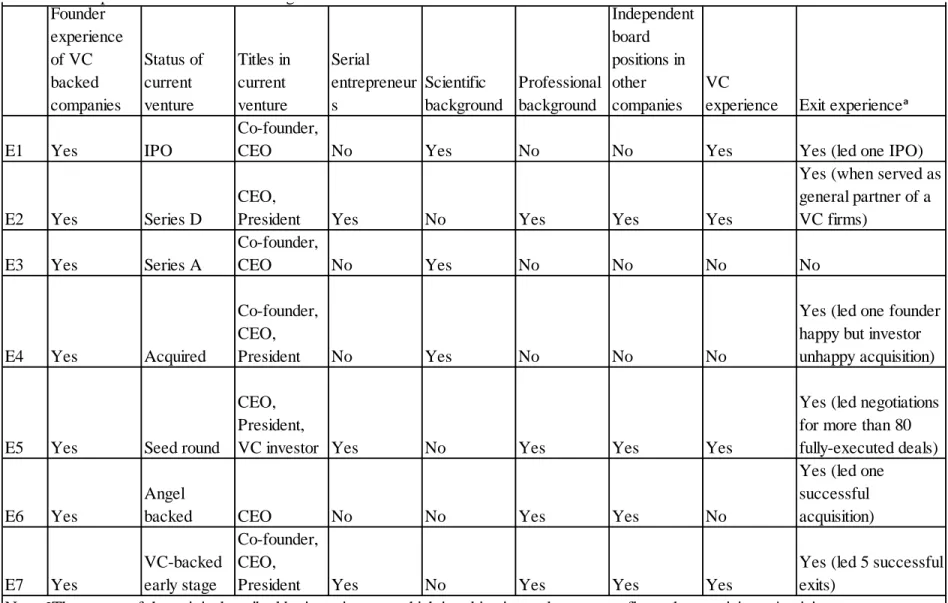
Each interview lasted between 30 and 90 minutes. The interviews took place during August 2017 and February 2018. The entrepreneur interviewees had diverse experience levels (see Table 2 for background details): first-time vs. serial entrepreneurs, scientific vs. business background, and early (e.g., seed round) vs. late stage (series D) VC-backed companies. All the investor
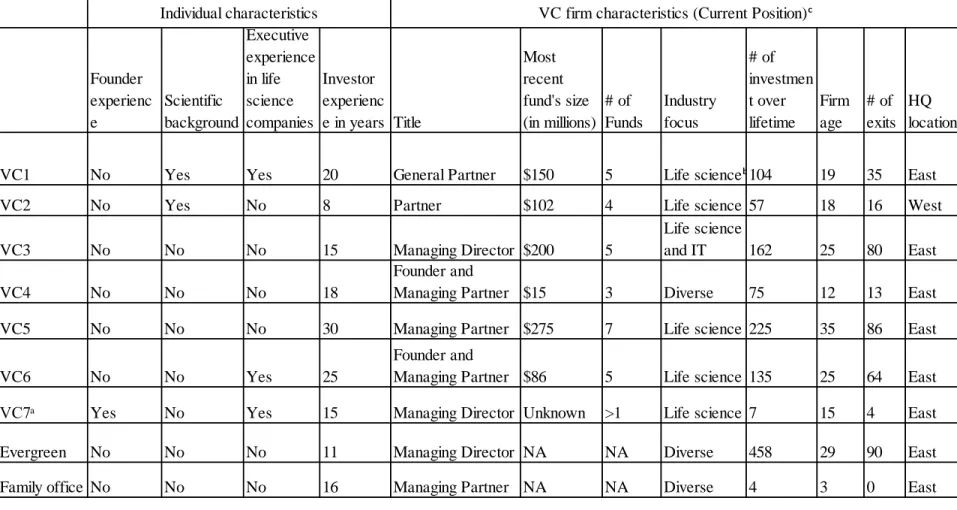
interviewees were highly experienced, and were responsible for all aspects of the venture
process, from deal sourcing and negotiation to management of portfolio investments (see Table 3 for background details). All the investor interviewees served on multiple boards. The investor interviewees represented VC firms with different fund sizes, ranging from $15 million to $275 million, and differences in their firm’s investment focus (life science sector exclusively or
diverse portfolios). The interview questions concerned entrepreneurs’ orientation to time; the VC firm’s concerns about time and how these differences emerged as the VC-backed companies
progressed (or failed to progress) through the stages of early discovery and growth; and how concerns about time emerged on the board and how boards resolved these issues (if they did resolve them).
Results from the Field
Entrepreneurs and their comments on time
Each entrepreneur interviewed had founded one or more medical device startups, which was the first criterion used in selecting interviewees. For each VC-backed company, I
interviewed the incumbent CEO since CEOs are the most senior executives and always hold board seats. Although all medical device companies originate from scientific ideas and tend to have scientific founders as part of the founding team, the scientists may not hold the CEO position, especially when the founding teams have a cofounder with a professional background. Four out of the seven entrepreneur interviewees lacked a scientific background (i.e., a science Ph.D. degree and intensive research experience). Scientists are typical “futurists” (Eisenhardt et
al., 1997), who tend to have a long time horizon. The differences in the CEO backgrounds provided insight into whether the different backgrounds contributed to differences in the perception and evaluation of events across time.
Our goal is to build the best product and identify the market where we can differentiate and bring value…. We improve the product continuously. We want to have a sustainable business. In order to achieve the big goal, we have a few milestones along the way. (E4)
Our goal is to develop an instrument to safely separate tissues…. We look to make a big difference, not a small difference. We set goals aggressively as best as we can, but we always keep an eye open for new opportunities. Four months ago, we wanted to enter the European market first and had no plan for China. Now that has changed. (E3)
Our goal is to have a product that solves the problem and goes along with our mission…. It’s hard to know where you are in technology development. So, we have annual goals and regularly do a landscape analysis: who else is there, what they are doing, what patents they have filed, etc. (E6)
The only exception to this pattern occurred with a CEO who was also an active VC investor in the startup. This interviewee is the startup’s CEO and President, and a general partner of a VC firm. His answer emphasized short-term milestones:
Anytime I start a new company, I look at what milestones we need to hit to raise extra money. This model drives how we set up and reach the goal. For example, what is realistic to successfully complete each year? Is it possible to build partnerships with larger firms? Can we raise more capital or is this a year just to do the work?... We do not set goals for a whole year. Instead, we break it down into smaller segments. Some
milestones can be finished in three to six months. (E5)
These comments were much more specific in terms of the goals and time frames and suggested a strong emphasis on relatively short-term periods.
The interviews indicated that entrepreneurs divided the future into long- and short-term components. The present was loosely guided by future product-oriented goals. The comments implied that, for the majority of entrepreneurs, the long time horizon was somewhat more important than the short term. This longer-term emphasis applied to entrepreneurs with a scientific background and to entrepreneurs who had a professional background. The
entrepreneurs’ long time horizon observed here matched findings reported by Graebner and
rewards or their jobs in the post-acquisition firm. However, in the case of this study’s VC CEOs, when the entrepreneur was also an active VC investor, he/she paid more attention to the present and short-term goals, and, thus, had a shorter time horizon.
Within the sample, four founding entrepreneurs served as independent directors on other startup boards, including the three serial entrepreneurs. Their roles as independent directors provided insights into how independent directors might balance the difference in time horizon between founders and venture capitalists. Will Herman, a serial entrepreneur and experienced startup director, described,
Outside directors [independent directors] can fill a unique role on the board…. Unlike the investors on the board, the outside director has no limited partners to report back to or any other type of investment agenda. Additionally, the outside board member will often be the most operationally experienced board member…. the outside board member becomes the go-to adviser, working on operational issues and opportunities as well as emotional issues when the CEO or team members feel crushed under the day-to-day stress of running the company. Another important role of the outside director is that of the mediator or synthesizer of the parochial opinions of the insiders—those who invested in the company. Often, this means bridging the gap between the management team and the investors in the company. (Feld & Ramsinghani, 2013:36-39)
VC’s time horizons and the rise of VC-led time horizon differences
evergreen fund manager and a family office manager who served as startup directors. Evergreen funds have an indefinite fund life, and family offices do not have a fund structure. This allows both types of managers to pursue risky projects over a longer return cycle. Evergreen funds and family offices provide “more patient” capital when compared to time-bound VC funds.
Venture capitalists are venture capital fund managers who raise capital from limited partners. Limited partners (e.g., pension funds, insurance companies, university endowments, wealthy individuals, etc.) are venture fund owners but do not directly invest in startups. Limited partners commit the money for the life of the fund, typically ten years. Typically, 2% of the fund are paid to VC firms as a management fee and the rest of the fund is invested in startups. By the end of the fund, VC firms need to return capital to their limited partners in a liquid format, either as cash or public company shares. VC firms share a proportion of the profits, typically 20% (aka carried interest). Startup exit (either IPO or M&A) is the primary mechanism for VC firms to return capital to their investors. VC firms can use contractual rights to force an exit (e.g., redemption rights and liquidation rights) to ensure an on time return of money back to limited partners. As a result, an indefinite duration is not an option for VC funds. As Luke Kanies, founder of Puppet, described5,
Any company has four options: Go broke, go public, get bought, or stay private indefinitely. If you take VC money, that last option is off the table.
Another option is buyout investors at the end of the fund to avoid a firm exit. Startups can raise additional capital from new investors to buy out the time-urgent VC firms. Startups can also buyout time-urgent VC funding contracts by themselves. For example, Arkadium used its profits
5 Extracted from If You Take Venture Capital, You’re Forcing Your Company To Exit, available at
https://medium.com/s/understanding-venture-capital/if-you-take-venture-capital-youre-forcing-your-company-to-to buy out their VC firm’s investment in September 2018. Another company, Buffer, bought out its main Series A investors in July 2018. Figure 2 presents the VC business model.
The interviews demonstrated that the fixed fund lifetime significantly limits a VC firm’s orientation to time, which is evident at multiple stages of the firm’s development: deal
negotiation, management of the startup, and active intervention when close to the end of the fund. VC funds share a similar structure, regardless of the VC firm’s location (West or East). VC funds have a fixed lifecycle, typically ten years, although extensions of between one and three years are often allowed (Gompers & Lerner, 1999). The exit stage is a necessary part of the financing process, and the funds must be liquidated at the end (Schwienbacher, 2008). Investors (limited partners) receive proceeds in cash or liquid securities (Smith, 2005). There are five possible exit means: IPO, M&A, company buyback, secondary sale, or write-off/liquidation (Cummings & MacIntosh, 2003). Secondary sales and company buybacks are inferior forms of exits, which are avoided if at all possible (Cummings & MacIntosh, 2003). These rare and inferior exits generate much lower profits upon exit (Cumming, Fleming, & Schwienbacher, 2006; Cummings & MacIntosh, 2003). Hence, VC firms’ exit plans focus on IPOs or M&As. VC firms often preplan the exit before contracting with the entrepreneur, although the preplanned exit strategy is not part of the contract (Cumming & Johan, 2008). Gompers, Gornall, Kaplan, and Strebulaev (2016) surveyed 885 venture capitalists and found that exit considerations were the most important factors in deciding valuation and structuring term sheets.
We talked about exit before making any investment. We don’t make an investment with any company unless we are clear there will be an exit before our fund shuts down. (VC5)
Once VC firms and entrepreneurs sign the investment contract, they become partners. VC firms cooperate with company managers and play a supporting role by contributing valuable resources (Graebner & Eisenhardt, 2004). My interviews described a similar pattern of support. For
example, one venture capitalist said,
Usually, entrepreneurs send us their plan or goal; we take a look at it. Management is in a much better position to outline the next step and the amount of money needed than VCs. We do not try to manage the company. We try to focus on the strategic directions and whether the goals fit with the financial resources available. (VC1)
Note that the VC firms appear patient in the early stages of the fund when the exit pressure is not high. They work with the startups with a tolerance for missed goals and exhibit patience, even though short-term performance may fall below expectation. As one venture capitalist
commented,
It is not uncommon that a company misses its goals. Our relationship with entrepreneurs really doesn’t change in that regard because it is not we made the investment in year one, we learned this problem in year seven. We walked with the company together, and we know that we are updating our own expectations that the original goal may be missed by a year. So, we manage expectations throughout the process and it does not change the dynamic. (VC6)
However, the cooperative relationship faces greater challenges due to stronger exit pressure as the fund nears its expiration date. A clear misalignment in exit preference is often observed among entrepreneurs, venture capitalists, and other types of investors (evergreen and family office). For example,
My fund is eight years old…. I want to sell the company. The CEO is concerned about losing his job, so he is not interested in the acquisition. But from the investor perspective, I don't care. (VC4)
The differences in the preferred exit time among various types of directors is evidence of differences in sensitivity to time pressure across the different types of board members. Similar differences in the level of sensitivity can also arise that result from misalignment among VC investors in the same firm because of the different fund vintages of the respective VC funds. Specifically, as one venture capitalist described,
Thinking about your investment, typically you want to exit at year five or seven. You typically invest for the first four or five years and you want the next four or five years to harvest a good return—you want to exit. If I invest in a company for five years (and the investment happens in my year four) and a new fund comes in, five years have passed and now I am in my year nine. The new fund comes in at year one or two, so clearly there is not an aligned interest. (VC4)
This type of misalignment in the preferred exit time arises when one VC firm’s fund is close to its expiration date. The primary cause is strong exit pressure resulting from the end of the fund. This type of time horizon differences reflects a VC firm’s strong exit incentive and a weak exit incentive for entrepreneurs and other types of investors who pursue a valuable exit without a specific time limitation. I label this difference in time horizon as VC-led time horizon differences.
Differences in thoughts about exit strategies can occur during an earlier period, long before the expiration of a VC’s fund. But in this case, the VC’s longer window may induce a
preference to delay the exit. Dan Shapiro,6 a serial entrepreneur, described this situation:
They [VC firms] don’t let you sell the company, even though it’s enough to make everyone rich.
VC firms reserve money for a startup’s follow-on investment to protect their ownership and their return. The return is calculated based on the amount the firm reserved to invest rather
6 Extracted from VC insanity, explained, which is available at
than what they invested. An early exit can be less attractive than an additional round that
increases a VC firm’s ownership and future return. This type of time horizon difference is called an entrepreneur-led time horizon difference. Entrepreneur-led time horizon differences are likely to happen in the middle stage of a fund when VC firms want to grow the business for a higher return. The extent of the differences decreases as the fund ages. The entrepreneur-led time horizon differences tend to arise and disappear before VC-led time horizon differences as both entrepreneurs and venture capitalists may prefer an exit around the end of the fund. If an exit does not happen at the end of a VC’ firms fund, a mutually acceptable exit is normally not
available, VC-led time horizon differences arise as VC firms’ strong exit motivations make them more likely to accept low-valued deals that entrepreneurs resist. Besides, entrepreneur-led time horizon differences probably may occur less frequently in medical device companies, due to the long cycles of development and approval. In this study, I have focused on VC-led time horizon differences.
These differences in approach to exit timing may vary with the venture investor’s level of
experience. For example, inexperienced and young venture capitalists may push for an exit before their fund ends to signal the VC-backed company’s quality to potential investors in follow-on funds (Gompers, 1996). The quantitative study in the next chapter controls for venture capitalists’ experience.
One purpose of this research is to investigate the incidence of these VC-led time horizon differences and to describe the contexts in which they occur. A second aim is to investigate if the board’s composition plays a role in resolving these conflicts. The interviews hinted at the role the
Differences in time horizon7: what role does the board play in impact and management?
McGrath (1991) described how conflicts about time perception emerge due to temporal ambiguity, conflicting interests and requirements, and the scarcity of temporal resources. These three problems are reflected in the interviews. When I asked how time horizon differences affect startup operations, one VC said,
[Time horizon differences lead to] more conflict. Somebody may sue. In any institution, this misalignment [in time horizon] could mean trouble, and a successful exit could be more difficult. Maybe you [entrepreneurs] can survive it, but you need to put in more effort. When there is a misalignment, one board member tells you one thing, while other members tell you another thing. It becomes very complicated. I have never seen a positive impact that way. (VC3)
Also, one entrepreneur responded:
VCs are quite simple. The first two to three years are the honeymoon. After that, they want to exit…. We have to spend more time on negotiation and conflict resolution. (E2)
The strained relationships between entrepreneurs and VC firms may substantially reduce the probability of success. Time horizon differences have a significant impact on VC-backed startups, As Asheesh Advani, an entrepreneur and investor, stated,8
Most businesses fail because they run out of time, not because they run out of clients…. Venture capital firms are high risk, high return investors, and their limited partners expect high returns quickly. To them, patience is not a virtue.
The management of these time horizon differences becomes crucial to a startup’s survival. When asked about how to address time horizon differences, the interviewees emphasized the prevention of time horizon differences and indicated limited options on the management of time horizon differences if they are not anticipated. For example, one venture capitalist said,
7 In this paper, time horizon differences mean VC-led time horizon differences unless otherwise stated.
This is why it is important to think early on before you invest.... I not only think about whether it is a good company. I also think about who is going to invest in the company next, how many rounds they are going to have. I think about these problems before I put money into the company. I want to prevent misalignment. I cannot try to fix it if it's already there. If the problem comes, I cannot do much about it. The only way to do something about it is to prevent it…. I think about who else will invest with me, that is another reason why fund syndicates with another fund. Because once syndicated,
together we have enough money to last a long time, and we may be OK. If I do it alone, I don’t have the power due to a limited amount of money. When I syndicate, I consider the length of the other funds as well, so that all the co-investors have a similar length. (VC6) Another venture capitalist added,
The only way is to change the board. You try to get rid of that investor [with an expired fund]. (VC2)
A board seat is necessary for affecting the negotiation. One venture capitalist stated,
If you do not force the issue and look for an exit, you will be in a very bad situation. To force the issue, you need to sit on the board…. After raising money, entrepreneurs do not solely control the firm. It is the whole board's decision. It is a lot of people. Who is on the board is very important. You want to have some influence or control about how the decisions are made. (VC3)
Venture capitalists will not leave the board unless they get their money back. A buyout situation for early investors can occur when a firm raises a new round from a big fund. One venture capitalist explained,
Sometimes, a big fund may help. … For example, the company needs $10 million, but the company looks for a fund who is interested in investing $20 million. What the new
investors do is to put $10 million in the company and buy out $10 million early investors. (VC4)
The evergreen fund manager added,
When we face a conflicted time horizon, there is really only limited help we can provide there. We don’t want to damage the startup by letting it go out the door. We also don’t want to poison the relationship with co-investors. So one way we can help is by
introducing that investor to a secondary market where people are going to buy their stake in the company. We definitely know it is very difficult. But we try to persuade them
In sum, the field study explained why VC-led time horizon differences arise and provided preliminary evidence suggesting the significant impact of time horizon differences on a startup business. VC firms influence startups via their board position. Some investors point out that changing board composition by removing investors with an expired fund may solve time horizon differences. The board level analysis in this dissertation will consider how boards anticipate and manage time horizon differences. One path mentioned in these interviews is based on the use of sequential investments, as in the case of a later investor buying out the earlier investor. A second path mentioned in the interviews requires some success in achieving market legitimacy, as a necessary condition for raising more capital.