Alexander J. Chisum. A Content Analysis of Academic Library Gift Policy Statements in the United States. A Master’s Paper for the M.S. in L.S. degree.May, 2020. 52 pages. Advisor: Mary Grace Flaherty
The following study compares and contrasts the content of gift policy statements for R1 university libraries (as defined by the Carnegie Classification system) in the United States. The research provides a “snapshot” of current gift policy-writing practices by randomly sampling the gift policy statements from university library websites, coding the content of those statements, and analyzing the code for significant themes,
commonalities, and divergences. In so doing, the research hopes to provide a much-needed point of reference for librarians and libraries looking to maximize the impact of gifted materials through the use of carefully written policies.
Headings:
Library rules & regulations Library contributions Academic libraries
A CONTENT ANALYSIS OF ACADEMIC LIBRARY GIFT POLICY STATEMENTS IN THE UNITED STATES
by
Alexander J. Chisum
A Master’s paper submitted to the faculty of the School of Information and Library Science of the University of North Carolina at Chapel Hill
in partial fulfillment of the requirements for the degree of Master of Science in
Library Science.
Chapel Hill, North Carolina
April 2020
Approved by
_______________________________________
Table of Contents
Introduction ... 3
Literature Review ... 5
The Question of Value ... 5
The Value of Policy ... 9
Policy in Practice ... 11
Methodology ... 15
Research Questions ... 15
Positionality / Researcher Role ... 16
Sample ... 16
Data Collection Methods ... 17
Data Analysis Methods ... 19
Findings ... 21
Main Code... 24
Physical Gifts Code ... 30
Financial Gifts Code ... 34
Donor Recognition Code ... 37
Discussion ...44
Introduction
In the context of academic libraries, gifts can be a tricky subject. Often, they are
viewed as both a boon and burden. While gifts can help supplement collections, provide alternative streams of revenue, and cement valuable relationships, they can also be costly and time-consuming to process, and, in much of the literature on the subject, their overall
value has been drawn into question. One way to help ensure that gifts maintain their value without becoming too costly is through the use of carefully constructed policies.
But what makes for a good policy? Though there exist a fair number of
recommendations for the types of gift policy statements that libraries supposedly need, little analysis has been done on actual policy-writing practices. In what ways do library
gift policy statements adhere to or diverge from recommendations made by experts in the field, and in what ways can these comparisons inform future policy-writing practices?
In this paper, I hope to fill a void in the current literature by comparing and contrasting the content of gift policy statements for R1 university libraries (as defined by the Carnegie Classification system) in the United States. The research seeks to provide a
“snapshot” of current gift policy-writing practices by randomly sampling the gift policy statements from university library websites, coding the content of those statements, and
libraries looking to maximize the impact of gifted materials through the use of
Literature Review
The Question of Value
The importance of gifts to academic libraries has been well-documented. A
cost-benefit analysis performed by Ballestro and Howze (2005) found that the costs of processing donations to the Southern Illinois University Library were less than the costs
of procuring the items on Amazon. Others have discussed the importance of gifts in supplementing library collections during times of economic hardship (Bostic, 1991; Carrico, Fleming, & Simpson, 2010; Casey & Lorenzen, 2010; Empey, 2018; Fronty et
al., 2019; Leonhardt, 1999; Norris, 2002; Sibley, 2009; Williams, 2014), while White, Morgan & Gordon (1990) have found that “Gifts, by their non-repetitive nature, may be
one way to secure an injection of funds necessary for the implementation of programs and processes that make the library more cost efficient” (p. 54).
In addition to adding value by supplementing collections and funding, gifts can
also be used to generate revenue. Arthur (2009) and Korolev (2002) discuss the ways in which reselling gifts can create new revenue streams for libraries. Additionally,
according to Korolev, gift book sales can be “used for library publicity, outreach and marketing,” which can add additional value (p. 88). This idea is echoed by Carrico et al. (2010), who discuss the use of a virtual bookplate program that was instituted at the
communicates to donors that their endowments are valued and visible to library
users” (p. 422). Indeed, according to Richey (2012), the acceptance of gifts can engender “a sense of goodwill, and can generate future contributions, both monetary and general” (p. 6).
But what are “gifts,” exactly? The term itself is slippery, and often applies more to the method of acquisition than it does to the actual nature of the materials given. In
their own gift policy, the American Library Association (2015) define gifts as “a
voluntary transfer of assets from a person or an organization” (p. 3). Fabbi, Bressler, and Earp (2007) define gifts simply as “items donated to the library” (p. 12), while other
researchers variously define gifts as “donated materials” (Arthur, 2009, p. 513), “materials given outright without expectation of other materials or services in return”
(Sibley, 2009, p. 13), or “money” and “properties” (White et al., 1990, p. 57). “Money” is clear enough. As far as determining what constitutes “assets,” “items,” “materials,” or “properties,” however, the American Library Association further clarifies things by
writing that gifts are “motivated by charitable intent,” “not generally subject to a change of consideration or other contractual duties between [the receiving library] and the
donor,” and “not completed until [the gift] has been accepted by [the receiving library] in accordance with [the library’s gift policy]” (p. 13-14). Therefore, a reasonable definition for gifts in this context might be anything that is given charitably, without contractual
preconditions, and according to rules laid out in a library’s gift policy.
This latter criterion, that gifts not be classified as “gifts” until they comply with a
part, this is due to the fact that handling physical formats (such as books) can be
a complicated process, often involving multiple departments (Badics & Tammany, 1999; Ballestro & Howze, 2006; Cassell, 2005; Empey, 2018; Heath & Merkey, 2011; Kohl, 2019; Williams, 2014). Even before gifts are accepted, libraries are often forced to
expend resources following-up with prospective donors, which can become even more costly when, upon review, the contents of a potential donation are deemed “not as
relevant as anticipated” (Arthur, 2009, p. 514). Additionally, in her review of University of Central Florida Libraries’ policies and processes for handling gifts, Arthur (2009) found that, after receiving a 1,500-volume donation of military history books, the library
only added 102 books to the collection. “That is a lot of work for just 102 books,” Arthur writes, “so those working with gifts need to ask if it is worth the effort” (p. 518).
Indeed, according to Sibley (2009), accepting physical gifts can involve multiple phases, including planning for, processing, preserving, and shelving materials. Arthur (2009) describes the system in even more detail: “Circulation staff have to be trained on the
acceptance policy” in order to appropriately accept or reject gifts; afterwards, gifts
collected by circulation staff need to be “review[ed] by librarians” for whether or not they
are appropriate for the collection; acceptable gifts then need to be “searched in the catalog and OCLC, processed and forwarded on for cataloging or binding” (p. 514-516). When this process is not completed in a timely fashion, unprocessed materials can begin
to pile up. According to Jones (2003), backlog was one of the most consistent problems cited by librarians at the 2001 ARL Conference on Special Collections at Brown
an issue, given the fact that backlogs take up space, and, according to Heaty &
Merkey (2011), “Most institutions have space concerns.”
And things can become more complicated still. Other problems associated with physical gifts can include materials that have “insect infestation and mold,” which can in
turn be “spread to other areas of the collection” (Arthur, 2009, p. 515). Additionally, though she elsewhere addresses the ways in which gifts can help cement relationships
between libraries and their donors, Arthur also writes that gifts can cause fractures: “Even if donors give a collection physically,” she writes, “some emotional strings of ownership [may stay] attached” (p. 91). This can result in power struggles over how a gift is
preserved or presented, or hurt feelings when inappropriate gifts are rejected. For many libraries, rejecting free materials can be difficult (DeWitt, 1988; Heath & Merkey, 2011).
Saying no to an influential donor or alumnus can be harder still.
Finally, as users’ preferences have drifted toward electronic formats, the value of physical gifts has been drawn into question even more. At Colorado State, a decision to
place restrictions on a gift-in-kind program was based in part on the “transition toward electronic information as the user-preferred format” (Bishop, Smith, & Sugnet, 2010, p.
116). Furthermore, research done by Kairis (2000) suggests that, even in an era when users tended to prefer physical formats, gifts were often less-used than purchased
materials, and therefore were less likely to meet users’ needs. Nevertheless, according to
Cevari de Paredes (2006), “even in the 21st century, [gifts] continue to be comprised mainly of books, journals, and other types of traditional library material,” as opposed to
though it seems their value is often overridden by the costs associated with
handling them. Therefore, a balance must be struck. One way to achieve such balance, perhaps, is through policy.
The Value of Policy
In the International Federation of Library Associations and Institutions (IFLAI)’s
revised edition of “Gifts for Collections: Guidelines for Libraries,” Fronty et al. (2019) advise that libraries “develop clear processes for handling and evaluating gift offers” in order to “provide clarity both to library staff and donors, reduce exposure to risk and
potential liabilities and ensure that future opportunities… can be fully exploited” (p. 2). This point about “providing clarity” to staff and donors is emphasized by Bybee (1999),
who states that “Gift policies have two principal dimensions. The first is library internal policy…. The second is a document for public distribution meant to educate donors about the library’s gift acceptance policies and processes” (p. 19). Heath & Merkey (2011)
suggest posting gift policies to library websites as a way of directing the public “to an official policy while reducing the chance of potential problems” (p. 190). In this sense,
crafting gift policies—and making them readily accessible—helps reduce some of the workload associated with appraising gifts, as, according to Kohl (2019), “a potential donor should be able to determine in advance whether his or her donation will be of use
to the library” (p. 30).
As far as what makes an effective policy, Bybee (1999) suggests that policies
technical language and written in a persuasive prose style” (p. 19).
Additionally, after a study of fourteen academic library gift policy statements conducted in the mid-1990s, Bybee produced a template for use by other libraries. This template included ten main areas of focus (p. 19-28):
• Solicitation: rules for who may solicit gifts on the library’s behalf, and by what
methods;
• Gift philosophy statement: a statement outlining “the purpose for seeking gifts
and inform[ing] donors which gifts meet the library’s needs” (p. 21), as well as enumerating the ways in which gifts might be used or disposed of;
• Acceptance/right of refusal: the justifications by which gifts may be rejected;
• Gift type: the types of gifts actively sought by the library;
• Donor category: the types of people who might give;
• Library facts: meant to educate donors about the operations, history, and
wellbeing of the institution, including contact information and collection profiles;
• Acknowledgment: how donors will be thanked and how their generosity will be
commemorated;
• Services provided or not provided by the library: what donors “will or will not
receive in return for their donation,” including information on documentation, taxes, and logistical services related to the physical the transfer of the gift;
• Processing procedure: how gifts will be handled by staff;
• Gift description: what information a library “will need to know… if a gift is to be
It is important to note that, even twenty years after the publication of
Bybee’s template, many of these recommendations are repeated, albeit in different
terminology, in more recent publications, including Fronty et al. (2019), Kohl (2019), and Massey (2005). (One notable deviation from Bybee’s recommendations includes Massey,
Kohl, and Fronty et al.’s suggestions to include clearer information about libraries’ ownership rights after gifts are received.) That recommendations for library gift policies
have remained remarkably consistent over such a length of time suggests one of two things: either the problem of gifts has changed little over the course of the last few decades, or it is well-past time to reconceptualize our policy-writing strategies.
Policy in Practice
To my mind, the first step in reconceptualizing gift policies is to observe current practice. What policies are in use now, and in what ways might they deviate from the recommendations made by Bybee and others? Because my interests veer in the direction
of academic libraries in the United States, I decided to search for content analyses of gift policies American institutions. Unfortunately, the pickings were relatively slim. Of the
relevant resources, most tended to be out-of-date, failed to adequately describe their methods, or didn’t offer enough information about their samples to enable readers to determine what kind of libraries the policies had come from (Briggs, 1968; Bybee, 1999;
Cassell, 2005; Drummond, Hollman, Monroe, & Stephens, 1999). Some, such as Empey (2018), Grgic (2011), and Williams (2014), focused on different populations (Canadian
focus to include all posted library policies, thus occluding the more specific
information about gift policies that I was seeking. Still, taken together, this body of literature reveals a fair amount about current practice as it regards the conceptualization and creation of gift policies.
One of the studies most salient to our purposes was undertaken by Drummond, Hollman, Monroe, & Stephens (1999). Published nearly twenty years ago at the time of
this writing, it seems inadequately prepared to address the shift from physical to
electronic resources mentioned in previous sections of this paper; nevertheless, the study is revealing in its comparison of gift policy statements to actual gift-handling practices in
academic libraries, particularly in its acknowledgement of the sometimes-significant gulf between the two endeavors. It seems important to note here that a statement of policy
may not necessarily coincide with actual practice, and that, at least so far as Drummond et al. have observed, there can exist significant divergence between a library’s stated policy and its actual process of handling gifts. In my opinion, this is an area ripe for
future research.
Another study, by Williams (2014), is illustrative of a certain perspectival
influence that I found common in gift policy research. In its analysis of gift policies of New York state libraries (including academic, public, and special libraries), the research is primarily interested in classifying libraries according to the percentage of unsolicited
gifts allowed by their policies, with each library falling into one of four categories: “Unlimited,” “Selective,” “Minimal,” or “Never” (p. 3-4). While useful as a method of
assessing libraries’ attitudes toward gift acceptance, this method seems to me an
classification onto the policies, Williams produces results that are more
reflective of his own (admittedly important) interests, and less reflective of the policies themselves.
The same can also be said of Empey (2018), though, I’d argue, to a lesser degree.
As her analysis sprung from a need to revise the gift policy for her own library (Geoffrey R. Weller Library at the University of Northern British Columbia), she classified policies
according to a set of questions that fit her library’s needs. Though, as with Williams, I’d argue that Empey’s results are somewhat skewed by the fact that she developed her classification system before the actual analysis of her data, I’d also point out that the
effect is likely blunted because of her more robust classification system, much of which coincides with the recommendations for gift policies made by Bybee (1995) and others.
(The list of elements includes: contact information; whether monetary donations are mentioned; screening processes for donations; examples of “preferred” and
“unacceptable” materials; references to “the total cost” of the donation; information on
who pays for shipping and appraisal; tax receipt processes; transfer of ownership
information; information about unsolicited gifts; separate process for archives or special
library donations; and acknowledgement information (p. 3).) Additionally, Empey’s research comprises some of the most significant content analysis of academic library gift policy statements that is currently available and, in many ways, serves as a model for
future research. The sample covers a selection of all twenty-nine members of the
Canadian Association of Research Libraries, and, in its comparison of the differences and
The Empey study is also important in its singularity. Because it is the
only study of its kind, it highlights a need for future research, particularly the need for a similar kind of analysis of gift policy practices for American academic libraries, if only for the sake of comparison. Additionally, content analyses whose methods of
classification are drawn from the policies themselves—and not from a predetermined set of criteria—would be especially useful, in that they would likely provide a more accurate
Methodology
Research Questions
For my study, I aimed to document the similarities and differences between gift
policy statements currently in use by academic libraries in the United States. In order to achieve this purpose, I planned on answering the following questions:
• What are the characteristics of academic library gift policy statements in
the United States?
• How do these policies differ across institutions?
• What characteristics are shared by all or most institutions?
• In what ways do these characteristics differ from the characteristics noted
by Empey and others?
For the purposes of this study, I defined “academic libraries” as libraries
belonging to academic institutions classified as R1 universities by the Carnegie
Classification of Institutions of Higher Education. “Gift policy statements” were defined
as publicly available statements published on a library’s website regarding the library’s position on the acceptance and handling of gifts.
In order to answer my research questions, I used a qualitative content analysis of
academic library gift policy statements posted online by American universities. This was an appropriate approach for my research, as it allowed me to compare and contrast the
snapshot of current practice for use by future researchers and libraries wishing
to create or rewrite their own policies.
Positionality / Researcher Role
As the sole researcher for this study, I collected the policy statements from libraries’ websites, coded their content to determine major themes, then analyzed the
resultant codes to determine important commonalities and differences between gift policy statements.
As regards my positionality, I currently work in a library at an R1 institution (the
University of North Carolina at Chapel Hill) and have worked as a graduate teaching assistant at another R1 university (the University of Alabama). I have spent time
processing gift materials for libraries at both the University of North Carolina and at the University of Alaska Fairbanks, and I am aware of the expense and difficulty associated with processing gifts. Further, my work in both of these institutions has made me aware
of the necessity of policies, particularly where it concerns accepting materials that will be expensive and time-consuming to process but which will not be particularly valuable
additions to a collection.
Sample
For this research, I studied 30 policy webpages for libraries belonging to universities classified as R1 by the Carnegie Classification system. This sample
comprises 22.9% of the 131 R1 universities, which are defined as “doctoral universities”
Teaching, 2017). Therefore, my sample is comprised of gift policy statements
“pulled” from these webpages.
Data Collection Methods
In order to determine which statements to “pull,” I used a simple random sampling technique. After downloading a list of Carnegie’s R1 universities, I used a
random number generator to select 30 universities, at which point I visited their libraries’ webpages to download their gift policy statements. However, after a first pass, I found that one university (Rice University) did not appear to have an accessible gift policy
statement online, while another (Purdue University – Main Campus) featured a link to a gift policy statement, but the link was dead. After making a note of these findings, I
returned to my list of randomly generated numbers and selected the next two universities (the University of Southern Mississippi, and the University of Wisconsin – Madison), whose websites both included gift policy statements. Another university (Tufts) had a gift
policy statement that seemed to only apply to one library on the campus. As this seemed like a slightly exaggerated example of a fairly common issue (i.e., a number of gift policy
statements are accessed through a university’s main library website, making it difficult to ascertain whether the policy applies only to the main library or to the university’s library system as a whole), I decided to keep it for my sample. Finally, I conducted a quick
readthrough of all of the assembled statements to ensure that none were identical. The list of universities sampled, including Rice and Purdue, is included below as Table 1.
I believe that this sampling technique allowed me to assemble an adequate
free of bias. However, because this method was limited to only R1 universities,
potentially valuable comparisons of R1 university library policies to non-R1 university library policies (and to non-university library policies more generally) was rendered impossible. Additionally, by randomly sampling only 24.4% of the population, I ran the
risk of pulling a non-representative sample. In the context of this study, however, I believe these decisions were justified, given the relatively small scope of my research.
(I.e., There is no real way to ensure a representative sample of R1 libraries except by sampling more—or even all—of the universities.) Further, if I had expanded my scope to include more types of library, I would have diluted the number of policies sampled,
which would have made it more difficult to reach conclusions about major trends or themes.
Another difficulty of this data collection method was that involved a number of tricky decisions regarding what constituted a gift policy and what did not. For a number of institutions, the gift policy seemed to span a number of different webpages and wasn’t
in any centralized location. In these instances, I tried to cobble together as much of the policy as I could. It seems almost certain, however, that, in some cases, some portions of
a library’s policy may have been missed. In other instances, libraries’ gift policies
seemed to be inextricably linked to the broader gift-giving initiatives of their universities. This was particularly common when it came to financial donations. Where these links
were inextricable, I kept the policy as I found it. In areas where I felt more or less confident in determining a divide between the library’s policies and its parent
inconsistent. In these instances, I collected both policies and did my best to
reconcile any differences as best I could.
Data Analysis Methods
My method of data collection resulted in an existing data source for analysis. The benefits of pulling statements from library pages were that the statements could be easily
and affordably obtained. Additionally, the fact of noting whether or not a policy statement is published online is valuable in itself, as an online statement is more accessible to the public and thus helps to discourage gifts of unwanted materials.
However, by ignoring policy statements that aren’t published online, I was unable to determine whether libraries who lacked online statements (such as Rice University and
Purdue University – Main Campus) also lacked statements altogether, or whether unpublished gift statements tended to differ in any substantive way from those that are published online. This was beyond the scope of my research.
After my data was assembled, I used content coding and analysis as my method of interpretation. Coding the gift policy statements for important themes and differences
appearing within the sample provided a cheap and easy way to parse the data. However, because the data was only coded once, by a single researcher, the validity of the code has limitations. This criticism also applies to my analysis of the code. A better option would
have been to use a number of different researchers to code the data, reconcile any differences of the coding, and then work together to arrive at conclusions, as this would
My method of coding followed the approach set forth by Thomas
(2003). First, I read the sampled gift policy statements for understanding, and to
familiarize myself with the policies themselves. Then I read the policies a second time in an attempt to develop a thematic code that was descriptive of the policies’ contents.
Finally, I read each policy a third time while applying and refining my code, highlighting various passages with colors that aligned with specific themes and documenting my
results in an Excel spreadsheet. My code and its results are included below.
Afterwards, I analyzed the code’s application across my sample, looking for patterns and important differences. This involved quantifying the codes into percentages
so as to discern any predominant themes or interesting outliers. I also compared these results with Empey’s findings, as well as to the recommendations made by Bybee and
others. The result was an effective way of seeing how current practice in the U.S. aligns with practice in Canada, and how policy writing aligns with recommendations made by experts in the field. Additionally, because my code was generated from the content of the
policies themselves, it serves as an interesting contrast/supplement to research by Empey (2018) and Williams (2014), which both used prefabricated methods of categorizing gift
Findings
The ultimate result of my process was a sampling of 32 of Carnegie’s 131 R1
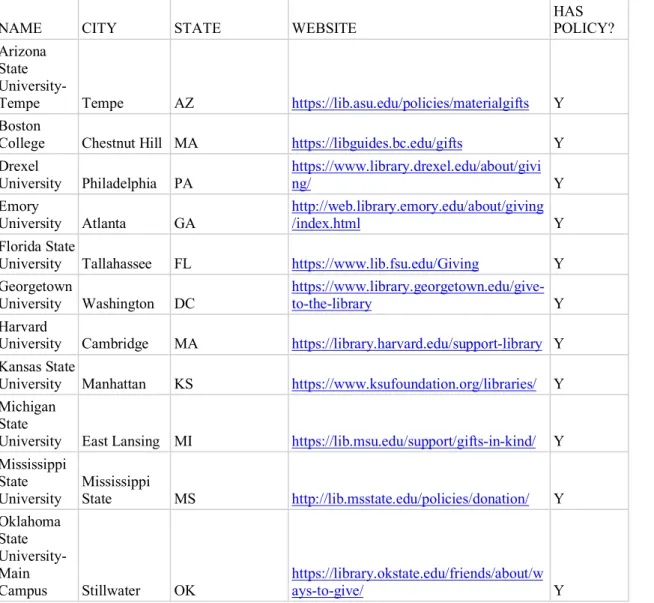
universities (24.4%), accumulating 30 unique gift policy statements (comprising 22.9% of Carnegie’s 131 R1 universities) for analysis. See Table 1.
Table 1. University Sample
NAME CITY STATE WEBSITE HAS POLICY?
Arizona State
University-Tempe Tempe AZ https://lib.asu.edu/policies/materialgifts Y Boston
College Chestnut Hill MA https://libguides.bc.edu/gifts Y Drexel
University Philadelphia PA https://www.library.drexel.edu/about/giving/ Y Emory
University Atlanta GA http://web.library.emory.edu/about/giving/index.html Y Florida State
University Tallahassee FL https://www.lib.fsu.edu/Giving Y Georgetown
University Washington DC https://www.library.georgetown.edu/give-to-the-library Y Harvard
University Cambridge MA https://library.harvard.edu/support-library Y Kansas State
University Manhattan KS https://www.ksufoundation.org/libraries/ Y Michigan
State
University East Lansing MI https://lib.msu.edu/support/gifts-in-kind/ Y Mississippi
State
University Mississippi State MS http://lib.msstate.edu/policies/donation/ Y Oklahoma
State University-Main
Oregon State
University Corvallis OR
https://library.oregonstate.edu/collections/ faculty-donations Y Purdue University-Main Campus West
Lafayette IN https://www.lib.purdue.edu/adv
Y but link is dead Rice
University Houston TX N/A N
Stony Brook
University Stony Brook NY https://library.stonybrook.edu/about-us/giving/ Y Texas Tech
University Lubbock TX http://www.depts.ttu.edu/library/donate/index.php Y The
University of Texas at
Arlington Arlington TX https://library.uta.edu/giving Y The
University of Texas at
Dallas Richardson TX https://www.utdallas.edu/library/support/index.html Y
Tufts
University Medford MA
https://www.library.tufts.edu/tisch/giving/ givingToTisch.html
Y (for a particular library) University of California-Santa
Barbara Santa Barbara CA https://www.library.ucsb.edu/gift-acceptance-policy Y University
of Chicago Chicago IL https://www.lib.uchicago.edu/about/thelibrary/supportus/ Y University
of
Cincinnati-Main
Campus Cincinnati OH https://libraries.uc.edu/about/policies/gift-policy.html Y University
of Georgia Athens GA https://www.libs.uga.edu/development/support Y University
of Hawaii at
Manoa Honolulu HI http://manoa.hawaii.edu/library/about/organization/policy/gift-guidelines/ Y University
of Louisville Louisville KY https://library.louisville.edu/give Y University
of
Massachuset
ts-Amherst Amherst MA https://www.library.umass.edu/giving/ Y University
Minnesota-Twin Cities University of Notre
Dame Notre Dame IN https://library.nd.edu/hesburgh-libraries-gift-policy Y University
of
Oklahoma-Norman
Campus Norman OK https://libraries.ou.edu/content/giving-ou-libraries Y University
of South
Carolina-Columbia Columbia SC https://sc.edu/about/offices_and_divisions/university_libraries/support/index.php Y University
of Southern
Mississippi Hattiesburg MS http://www.lib.usm.edu/about_us/donations/ Y University
of
Wisconsin-Madison Madison WI https://www.library.wisc.edu/giving/ Y
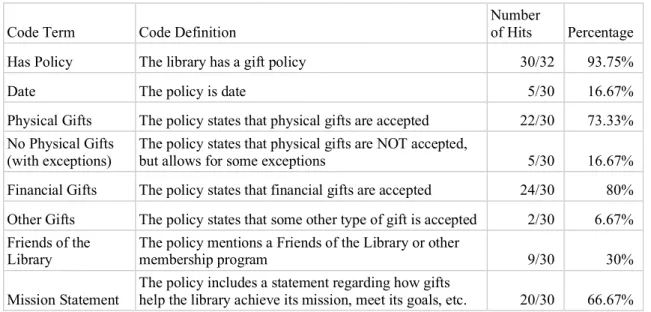
After my initial read-throughs of the policy statements, my finalized code was broken into four sections: Main Code (Table 2), which analyzed the overarching
characteristics of the gift policy statements; Physical Gift Code (Table 3), which analyzed the characteristics of the gift policy statements that pertained to physical gifts; Financial Gifts Code (Table 4), which analyzed the characteristics of the gift policy statements that
pertained to monetary gifts; and Donor Recognition Code (Table 5), which analyzed the characteristics of the gift policy statements that pertained to donor recognition.
Of the 32 universities sampled for this study, 30 had gift policy statements that were easily accessible online (93.75%). Of those 30 gift policy statements, 27 stated, either directly or indirectly, that gifts of physical materials were accepted, either
conditionally or otherwise (90%); 24 directly or indirectly stated that financial gifts were accepted (80%); and 8 directly or indirectly stated how donors would be recognized for
Main Code
The Main Code portion of my analysis consists of 12 terms: Has Policy; Date; Physical Gifts; No Physical Gifts (with Exceptions); Financial Gifts; Other Gifts; Friends
of the Library; Mission Statement; Historical Information; Contact Information;
Tax/Legal Information; and Donor Recognition. It should be noted here that, while there
are code terms for policy statements allowing physical gifts (the “Physical Gifts” term) and for policy statements that do not allow physical gifts except under certain
circumstances (the “No Physical Gifts (with Exceptions)” term), there is no code term for
a library gift policy statement that explicitly forbids gifts of physical material. This is because all policy statements either accepted physical gifts, only accepted physical gifts
under certain conditions, or did not address physical gifts at all. The universities whose library gift policy statements did not address physical gifts were Florida State University, Harvard University, and Kansas State University. See Table 2.
Table 2. Main Code
Code Term Code Definition Number of Hits Percentage
Has Policy The library has a gift policy 30/32 93.75%
Date The policy is date 5/30 16.67%
Physical Gifts The policy states that physical gifts are accepted 22/30 73.33% No Physical Gifts
(with exceptions) The policy states that physical gifts are NOT accepted, but allows for some exceptions 5/30 16.67%
Financial Gifts The policy states that financial gifts are accepted 24/30 80%
Other Gifts The policy states that some other type of gift is accepted 2/30 6.67% Friends of the
Library The policy mentions a Friends of the Library or other membership program 9/30 30%
Historical
Information The policy includes historical information about the library 3/30 10%
Contact Information
The policy includes some sort of contact information (including info on how to make online payments, send
checks, etc.) 27/30 90%
Tax/Legal Info
The policy includes information about taxation as it applies to gifts (including appraisal of gifted material;
does NOT include ownership information) 19/30 63.33%
Donor Recognition The policy includes some method of donor recognition 8/30 26.67%
For the purposes of my coding, I used the “Has Policy” term to indicate that a library website did, in fact, have an easily accessible gift policy statement. As has
previously been stated, this code term applied to 30 of the 32 universities sampled (93.75%).
The “Date” term was used for gift policy statements that were dated. Examples of statements to which the date term was applied include “Updated 3/15/2017” (Arizona State University-Tempe, 2017); “Aug. 1, 2019” (Boston College, 2019); and “Last
Updated: December 21, 2016” (University of California-Santa Barbara, 2016). This term was applied to only 5 of the 30 gift policy statements sampled (16.67%).
The “Physical Gifts” term was used for gift policy statements that stated, either explicitly or implicitly, that a library accepted gifts of physical materials. This did not apply to policies that stated physical gifts were not accepted, except under special
circumstances. Examples of explicit statements to which the “Physical Gifts” term was applied include the University of Madison: “The University of
Wisconsin-Madison’s Library System (GLS) welcomes the donation of materials in support of the University’s programs” (n.d.); and the University of Southern Mississippi: “The Libraries welcome gifts of original materials, books, photographs, reports, maps and other items
statements to which the “Physical Gifts” term was applied include the
University of Notre Dame, whose policy stated, “Limited physical space and human resources for storing, processing, and making materials accessible prevents the Libraries from accepting many items” (2015). The “Physical Gifts” term was applied to 22 of the
30 gift policy statements sampled (73.33%).
The “No Physical Gifts (with Exceptions)” term was used for gift policy
statements indicating that gifts of physical materials were not allowed, unless under certain circumstances. An example of a gift statement to which the “No Physical Gifts (with Exceptions)” term applies is the University of Minnesota-Twin Cities (n.d.), which,
in one portion of the document, stated, “The Libraries do not accept donations of books and other material.” However, under the “Gifts of rare and unique materials” heading, the
authors of the document wrote, “If you feel your potential gift is of critical research interest to the Libraries, please call 612-624-9064.” This statement suggested to me that gifts relevant to critical research interests would be accepted by the library, and thus the
“No Physical Gifts (with Exceptions)” tag was applied to the University of Minnesota-Twin Cities libraries. In all, the “No Physical Gifts (with Exceptions)” term was applied
to 5 of the 30 gift policy statements sampled (16.67%).
The “Financial Gifts” term was used for gift policy statements permitting gifts that are financial in nature, including trusts, fund creation, estates, bequests, naming
opportunities, stocks, real estate, etc. Examples of statements to which the “Financial Gifts” term was applied include the University of Massachusetts-Amherst: “Simply mail
dedicated to the repair of [University of Louisville Libraries] rare materials and
secure their legacy for generations to come” (n.d.). The “Financial Gifts” term was applied to 24 of the 30 gift policy statements sampled (80%). (Because no library gift policy statements indicated that financial gifts are allowed only under special
circumstances, or that financial gifts are not allowed at all, no such code terms were created.)
The “Other Gifts” code term was used to describe statements relating gifts that did not easily fit into the “physical” and “financial” categories. This term applied to only 2 of the 30 gift policy statements sampled (6.67%). These gift policy statements belonged
to Drexel University (n.d.), whose policy allows for “oral histories” and “digital formats,” and Texas Tech University (n.d.), whose policy accepts “gifts of intangible personal
property, such as copyrights, patents, and mineral rights.”
The “Friends of the Library” code term was applied to policy statements that mentioned Friends of the Library or other membership programs. Examples of library gift
policy statements to which the code was applied include the University of Texas at Dallas (n.d.), which includes a “Friends of the Eugene McDermott Library” section in its gift
policy statement, and Oklahoma State University-Main Campus (n.d.), which states that “Gifts to the Friends of the OSU Library come in many forms and can provide you with membership and tax benefits, as provided by law.” The “Friends of the Library” code was
applied to 9 of the 30 gift policy statements sampled (30%).
The “Mission Statement” code term was used for library gift policies containing
Oregon State University (n.d.), whose gift policy solicits financial materials by
asking potential donors to “Help us enhance student success”; and Stony Brook University (n.d.), whose policy states that donations will “play a role in securing the future successes, growth and excellence at Stony Brook University Libraries.” Of the 30
gift policy statements sampled, the “Mission Statement” code was applied to 20 (66.67%).
The “Historical Information” code term was used to describe gift policy statements containing information about the history of their libraries. Examples of statements to which the term was applied include Kansas State University (n.d.), whose
statement included information about a fire that damaged the roof of Hale Library; and Georgetown University (n.d.), whose policy states, “The first collection in the University
Library was a gift of about 100 volumes from Fr. Louis Guillaume Valentin DuBorg, Georgetown University’s third president, in 1796.” This code was applied to 3 of the 30 gift policy statements sampled (10%).
The “Contact Information” code term applied to any contact information
contained within a library’s gift policy statement, including contact information that only
appeared to apply to a section of the policy and not the policy as a whole. Examples of policies to which the “Contact Information” code was applied include Florida State University (n.d.), whose policy provides the contact information for their University
Libraries’ Director of Development; Georgetown University (n.d.), whose policy variously includes email and phone numbers for the Midwest and Mission & Ministry
donors wishing to mail checks. Of the 30 policies sampled, 27 were coded with
the “Contact Information” term (90%).
The “Tax/Legal Information” code term was applied to library gift policy
statements conveying legal information, including information about taxes and appraisal
of gifted material. Note that this term does not apply to information about legal ownership of gifted physical materials, which is covered by the “Legal Ownership
Information” code term in the Physical Gifts Code. Examples of the “Tax/Legal
Information” code include the University of South Carolina-Columbia’s gift policy (n.d.), which states, “By law, we are unable to provide a monetary value for any donated
materials”; and the University of Wisconsin-Madison (n.d.), which refers potential donors to “IRS publications for details related to tax deductions.” Of the 30 policies
sampled, 19 were coded for this term (63.33%).
The “Donor Recognition” code term was applied to gift policy statements containing information about the ways in which libraries would recognize their donors.
Examples of donor recognition statements include Mississippi State University (n.d.), which includes a “Donor Recognition and Identification” section in its policy; and the
University of California-Santa Barbara (2016), whose policies discuss the conditions under which acknowledgement letters, tax donation letters, and donor plates will be provided. Of the 30 library gift policy statements sampled, 8 were coded for “Donor
Physical Gifts Code
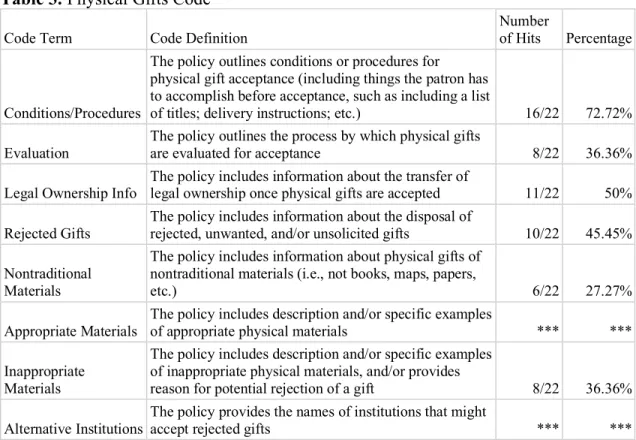
Of the 30 library gift policy statements sampled for this research, 22 indicated that physical materials were largely accepted by their libraries, while 5 others indicated that physical materials might be accepted under certain conditions. This code largely focuses
on the 22 libraries whose statements allow for physical gifts. The code consists of 8 terms: Conditions/Procedures; Evaluation; Legal Ownership Information; Rejected Gifts;
Nontraditional Materials; Appropriate Materials; Inappropriate Materials; and Alternative Institutions. See Table 3.
Table 3. Physical Gifts Code
Code Term Code Definition Number of Hits Percentage
Conditions/Procedures
The policy outlines conditions or procedures for physical gift acceptance (including things the patron has to accomplish before acceptance, such as including a list
of titles; delivery instructions; etc.) 16/22 72.72%
Evaluation
The policy outlines the process by which physical gifts
are evaluated for acceptance 8/22 36.36%
Legal Ownership Info The policy includes information about the transfer of legal ownership once physical gifts are accepted 11/22 50%
Rejected Gifts The policy includes information about the disposal of rejected, unwanted, and/or unsolicited gifts 10/22 45.45%
Nontraditional Materials
The policy includes information about physical gifts of nontraditional materials (i.e., not books, maps, papers,
etc.) 6/22 27.27%
Appropriate Materials
The policy includes description and/or specific examples
of appropriate physical materials *** ***
Inappropriate Materials
The policy includes description and/or specific examples of inappropriate physical materials, and/or provides
reason for potential rejection of a gift 8/22 36.36%
Alternative Institutions The policy provides the names of institutions that might accept rejected gifts *** ***
The “Conditions/Procedures” code term was used for policy statements outlining
University of California-Santa Barbara’s (2016) directive that potential donors
first contact subject librarians or the Head of Collection Development before gifting materials; and the University of Hawaii at Manoa’s (n.d.) condition that potential donors may be asked to “provide a list of publications that includes author, title, edition, and
publication date.” Of the 22 university libraries whose policies allow physical gifts, 16 were coded for the “Conditions/Procedures” term (72.73%). This represents 53.33% of
the total number of gift policy statements sampled.
The “Evaluation” code term was applied to policy statements outlining the processes by which physical materials would be evaluated for inclusion in the library’s
collection. Examples of “Evaluation” statements include the University of Cincinnati-Main Campus (n.d.), which states that donations of physical materials will be accepted
only under the condition that they are evaluated by “Subject Liaisons or [the] Gifts Librarian”; and Tufts University’s Tisch Library (n.d.), which, as “the main library for Arts, Sciences, and Engineering programs… we look for books that meet the research
and teaching needs of students and faculty.” Of the 22 policies allowing for physical gifts, 8 used the “Evaluation” code (36.36%). This represents 26.67% of the total number
of gift policies sampled.
The “Legal Ownership Information” code term was applied to statements
including information about the transfer of legal ownership of gifted materials. Examples
of policy statements to which the “Legal Ownership Information” code was applied include Mississippi State University’s (n.d.) assertion that, “Once accepted by MSU
become the property of UMass Amherst Libraries, which reserve the right to
determine retention, location, cataloging treatment, and use of donated materials.” Of the 22 policies allowing for gifts of physical materials, 11 included statements regarding ownership rights (50%). This comprises 36.67% of the total gift policy statements
sampled.
The “Rejected Gifts” code term pertains to policy statements pertaining to the
disposal of rejected or unwanted gifts. Examples of policy statements coded for the “Rejected Gifts” term include the University of Notre Dame’s (2015) statement,
“Hesburgh Libraries retains the right to dispose of unwanted or unsolicited gift materials
in the manner of its choosing”; and the University of Wisconsin-Madison’s (n.d.) statement, “The GLS reserves the right to exchange, sell, or discard any materials not
added to the Libraries’ collection.” Of the 22 gift policy statements with information regarding gifts of physical materials, 10 included information about disposal of unwanted gifts (45.45%). Of the 30 gift policies sampled, 33.33% were coded for this term.
The “Nontraditional Materials” code term was used for gift policy statements concerning gifts of physical materials not “traditionally” collected by university libraries.
(Examples of “traditional” materials include books, maps, sound recordings, etc.”
Examples of “Nontraditional Materials” statements include the University of Louisville’s solicitation for “paintings” and “sculptures” (n.d.); and the University of
Massachusetts-Amherst request for “other unique materials” besides “rare books, photographs, manuscripts, [and] organizational records” (2018). 6 of the 22 library gift policy
The “Appropriate Materials” term was used for gift policies that listed
or described physical materials that are appropriate for giving. This term was used to code statements such as Georgetown University’s (n.d.) list of materials accepted for its library art collection; and Boston College’s (2019) list of “[s]cholarly monographs,
hardbound or good quality paperback[s], [m]usic CD’s and scores, DVD’s.” Of the 22 libraries accepting of physical gifts, 9 included descriptions of appropriate material
(40.9%). This represents 30% of the gift policy statements sampled. However, it should be noted here one of the 9 universities coded for this term (the University of
Massachusetts-Amherst) only went into such detail for its art library. Appropriate
materials for other campus libraries were not listed.
Similarly, the “Inappropriate Materials” term was used for gift policies that listed
or described physical materials that were inappropriate for giving to the library. These included Drexel University’s (n.d.) instructions for student organizations not to send “[d]uplicate and blank forms; [d]etailed financial records, canceled checks, bank
statements and receipts; [p]laques and trophies”; and Oklahoma State University-Main Campus’s (n.d.) list of “[i]tems not needed by the OSU Library.” Of the 22 gift policy
statements allowing for physical gifts, 8 were coded for “Inappropriate Materials” (36.36%). This figure represents 26.67% of the total number of gift policies sampled.
Finally, the “Alternative Institutions” code term was used for policy statements
listing other institutions or organizations that might be accepting of rejected physical materials. An example of a statement tagged with this code includes the University of
organizations such as better world books” (n.d.) Of the 22 gift policy
statements that allowed for physical gift donations, 6 provided suggestions for alternative institutions for whom potential donors could give rejected materials (27.27%), a figure representing 20% of the total number of gift policy statements sampled. However, this
number is raised when considering the 5 policies that only accept gifts under certain conditions. When these policies are added to the mix, 8 of the 27 policies suggest
alternative institutions (29.62%), a figure representing 26.67% of the total number of gift policy statements sampled. Of the 3 statements that do not address physical materials at all, no library suggests an alternative institution for giving. These 3 statements make up
10% of the total sample.
Financial Gifts Code
Of the 30 library gift policy statements sampled for this research, 24 indicated that financial gifts of some type were accepted by their library, while 6 policies made no
mention of monetary contributions. This code focuses on the 24 gift policies that include information about financial gifts. The code consists of 5 terms: Initiative List; Existing
Fund; Planned/Deferred; Honorariums; and Matching Gifts. See Table 4.
Table 4. Financial Gifts Code
Code Term Code Definition
Number of
Hits Percentage
Initiative List The policy provides a list of specific initiatives to which patrons can contribute financially 15/24 62.50% Immediate
Contribution The policy allows for immediate financial contributions to an existing fund 20/24 83.33%
Planned / Deferred Gifts
The policy allows for planned or deferred gifts (including trusts; fund creation; estates; bequests; securities; stocks;
Honorariums
The policy outlines financial giving opportunities that result in honorariums (including bookplates; naming opportunities;
etc.) 12/24 50%
Matching Gifts The policy mentions potential matching gift programs 6/24 25%
The “Initiative List” code term was used to describe gift policy statements that included a list of specific initiatives to which donors could contribute money. Examples of initiatives include the “Alumni Library Fund,” “Ann McWhorter Memorial Fund,” and
the “William Sidney Rozier Memorial Support Fund” mentioned by the University of Georgia (n.d.). Of the 24 policies to mention financial gifts, 15 included a list of specific
initiatives (62.5%), or 50% of the total sample.
The “Immediate Contribution” code term indicates that a gift policy allows for donors to make an immediate contribution to the library itself, or to an existing fund.
Examples of the “Immediate Contribution” code include Michigan State University’s (n.d.) statement that donors can designate that their gift supports a “specific collection of
the MSU Libraries”; and Oklahoma State University-Main Campus’s (n.d.) section on direct contributions, which allows for “gifts made in the form of cash or checks to the OSU Foundation.” Of the 24 policies that accept financial gifts, 20 were coded with the
“Immediate Contribution” term (83.33%), or 66.67% of the total sample.
The “Planned/Deferred Gifts” code term relates to policy statements regarding
financial gifts requiring planning and coordination, rather than simple, one-time gifts of money. Planned/deferred gifts include trust and fund creation; bequests; gifts of
securities, stocks, annuities; etc. Examples of statements tagged for “Planned/Deferred
Texas Tech’s (n.d.) statement on “Creating a Lasting Legacy”: “Gifts from
wills, trusts and retirement accounts are crucial investments in the future of our
universities.” 17 of the 24 financial gift policies make mention of planned/deferred gifts (70.83%). This figure represents 56.67% of the total sample.
The “Honorariums” code term applies to financial gifts made in someone’s honor, including naming opportunities and book plates. Examples of honorariums include the
University of Texas at Arlington’s digital bookplates statement: “A digital bookplate is a unique and meaningful way to recognize a donor’s gift that supports the growth of the library’s collections”; and the University of South Carolina-Columbia’s “Naming
Opportunities” section. Of the 24 statements that discuss financial gifts, 12 were coded for “Honorariums” (50%), or 40% of the entire sample.
The “Matching Gifts” code term was used to tag statements encouraging donors to consult matching gift programs offered by other organizations (such as the donor’s place of business). Examples of policies tagged with the “Matching Gifts” term include
Stony Brook University’s (n.d.) statement that “You may be able to increase the value of your gift if your company or employer has a matching gift program”; and Harvard’s
(n.d.) similarly phrased, “Find out if your employer will match your gift using our Matching Gift Program Search.” Of the 24 policies that address financial gifts, 6 also mention matching gift programs (25%). This represents 20% of the number of library gift
Donor Recognition Code
Of the 30 library gift policy statements sampled for this research, only 8 indicated any form of donor recognition. This code analyzes the forms of recognition mentioned by those policies. The code was comprised of the following terms: Name Recognition;
Receipts; and Written Letter. See Table 5.
Table 5. Donor Recognition Code
Code Term Code Definition
Number of
Hits Percentage Name
Recognition Donors will be recognized via some form of name recognition (book plates; fields in catalog records, etc.) 4/8 50%
Receipts Donors will be provided with receipts 2/8 25%
Written Letter Donors will receive a written letter 6/8 75%
The “Name Recognition” code term applies to those gift policies that recognize
their donors via some form of name recognition, including bookplates. Examples of “Name Recognition” statements include Mississippi State University’s (n.d.) statement
that “Donors can request that we add bookplates recognizing them or honoring another person to donated materials”; and the University of Georgia’s (n.d.) “Naming
Opportunities” section. Of the 8 policy statements that mention donor recognition, 4 were
coded with the “Name Recognition” tag (50%), or 26.67% of the entire sample.
The “Receipts” code term was used for policy statements indicating that donors
would receive receipts for their donated materials. This tag was used for Mississippi State University’s (n.d.) policy, which states that “Donors receive a receipt indicating the types and numbers of materials they have donated”; and for the University of Cincinnati-Main
also approve the gift.” These were the only two policies to receive this tag,
making up 25% of the 8 policy statements that address donor recognition, or 6.67% of the entire sample.
Finally, the “Written Letter” code term is used for policy statements that
recognize donor gifts by sending written letters. Examples include the University of California-Santa Barbara’s (2016) statement that donors who “provide a name and
address” will receive an “acknowledgement letter”; and Tufts University’s (n.d.)
declaration that, “upon request” donors can receive “a letter acknowledging your gift and indicating the number of titles donated.” Of the 8 policies that make mention of donor
Analysis
In a number of ways, my code aligns well with Bybee’s (1999) ten main areas of
focus for writing library gift policy statements (though it’s important to acknowledge this may be a result of a certain amount of confirmation bias; by employing other coders, and by including coders unfamiliar with Bybee’s schema, I could have better ensured that
similarities were coincidental). Among the similarities are Bybee’s “gift type,” which outlines the types of gifts actively sought by the library and aligns more or less exactly
with my “Appropriate Materials” term. Additionally, his “library facts” matches with my “Historical Information”; and his “acknowledgment” matches my “Donor Recognition.”
Elsewhere, the similarities are present, but not as clean. His “processing
procedure,” “gift description,” and “services provided or not provided by the library” are reflected—though not entirely—in some combination of my terms “Evaluation,”
“Conditions/Procedures,” and “Tax/Legal Information.” Similarly, portions of his “gift philosophy statement” area—which outlines “the purpose for seeking gifts,” informs donors which kinds of gifts are needed, and enumerates the ways in which gifts might be
used or disposed of (p. 21)—seem to align with a combination of my “Mission
Statement” and “Rejected Gifts” terms, though “Rejected Gifts” also seems to align with
peculiarities of my own coding; again, employing more coders would have
helped improve the significance of observations like these).
Perhaps of more interest to this study, however, are the results produced by Empey (2018). However, before beginning my comparison, it’s again important to
acknowledge that I reviewed Empey’s study before beginning my own research, and it’s possible that the Empey’s method of categorizing gift policy statements may have
influenced my own code. Still, I feel that a comparison is worthwhile. In Empey’s study, the author reviewed online gift policy statements for academic libraries in Canada, and, because she was interested in rewriting her own library’s gift policy, she was looking for
characteristics that met her needs. However, despite the differences in approach between Empey’s research and my own, there is considerable overlap in our code—and some
overlap in our results.
For example, Empey’s “Contact Information” term matches perfectly with my own “Contact Information” term, and, while Empey found that all 21 of the library
webpages she surveyed “directed potential donors to an initial contact person” (p. 3), I found that a similarly high number of the policies I sampled contained this kind of
information (90%). Additionally,Empey found that 15 of the 21 library webpages she sampled mentioned monetary donations (71.43%) (p. 4), while my own results were slightly higher, with 80% of my gift policy statements making mention of financial gifts.
Elsewhere, there were similarities in code, but differences in results. While Empey’s “Donation Acknowledgment” term aligns very well with my “Donor
information. Additionally, despite the differences in the number of policies that
included donor recognition information, there was some overlap in the kinds of recognition mentioned by both American and Canadian academic library policies. However, because of differences in our coding technique (I lumped together different
kinds of name recognition, while Empey kept these categories separate) a more precise comparison would require re-coding my results.
Similarly, while there is considerable overlap between Empey’s
“Disposition/Ownership of Items” term and my own “Legal Ownership Information” term, Empey found that 17 of the 21 policies she sampled contained information
regarding ownership of gifted items (80.95%) (p. 8), while I found that only 36.67% of American gift policy statements contained similar information.
In other areas, there is a fair amount of overlap in code terms, though slight differences in the term definitions makes comparison tricky. For example, Empey’s “Examples of Preferred or Unacceptable Materials” term aligns fairly well with my own
“Appropriate Materials” and “Inappropriate materials,” though there is also some overlap with another my terms, “Conditions/Procedures.” Despite these similarities, however,
comparison between Empey’s results and my own is made more difficult by the different ways in which we chose to track information. While Empey tracked the kinds of
materials that were or were not preferred in gift policy statements (for example, she lists
16 policies as rejecting materials that are in “poor condition” (p. 6)), she does not provide the raw number of policy statements that include this kind of information. Though it can
at least 12 provided examples of Preferred Materials, the actual numbers are
impossible to ascertain, and thus comparison to my own results isn’t feasible.
Additionally, there is some similarity between Empey’s “Tax Receipt Processes” term, which tracks the various ways in which libraries provide (or don’t provide) tax
receipts, and my “Tax/Legal Information” term, which tracks tax and legal information more generally, but the differences are significant enough that comparison doesn’t quite
make sense. (Still, the numbers are tempting: Empey found that 66.67% of her policies contained “Tax Receipt Process” information (p. 7-8), while I found that 63.33% of my gift policy statements contained information related to the taxation of gifted items.)
A similar situation is also true for Empey’s “Screening Process” term, which functions as a combination of my “Conditions/Procedures” and “Evaluation” terms.
Because there is no easy way to make our terminology more completely compatible, comparison of our results isn’t possible. The same is also true of other terms, including “Cost of Appraisal” (which overlaps some, but hardly completely, with my “Tax/Legal
Info” term) and “Unsolicited Gift-In-Kind Donations” (which incompletely overlaps with “Rejected Gifts.”)
Lastly, there are terms in Empey’s classification system that have no corollary in my coding. These terms include “Total Cost of Gift-in-Kind Donation,” “Cost of
Shipping,” and “Archives/Special Collection Donations,” which checked for different
contact information or processes related to archival or special collection= donations (p. 9). (This category in particular was something that I noticed but didn’t think to code, and
As far as major trends within these findings, it seems significant that
both Empey and I found that a majority of the library gift policies contained information regarding monetary gifts. If physical gifts are indeed as troublesome as the literature suggests, it would make sense that libraries would attempt to shift giving away from
physical materials and toward financial donations. However, with that in mind, both my findings and Empey’s findings seem to indicate that the prevailing sentiment among
academic libraries is that physical gifts do serve a useful purpose. How else to explain the number of gift policy statements that allow for some kind of physical gifts? Either
libraries are actively soliciting physical materials against their own interests, or, as a
number of researchers have pointed out, gifts can be useful. (The question of how gifts are useful, and under what circumstance, is probably dependent on the individual library,
and is something that could be explored in further research.)
Other important trends include the low number of American policies that mention donor recognition. When compared to Empey’s results, this seems to suggest a significant
difference in practice between American and Canadian university libraries. And, if Korolev’s (2002) assertion is true, that recognition of gift donors can serve as a reliable
Discussion
If there is one overriding takeaway to emerge from this study, it’s that further
study is needed. Though I was able to notice some potentially interesting similarities between my research, Bybee’s (1999) recommendations, and Empey’s (2018) study of Canadian academic libraries, the accuracy of these observations ultimately remains
unverifiable until other researchers have performed similar studies and yielded more results. As I have mentioned multiple times throughout this paper, the addition of more
coders could provide greater insight into the patterns in academic library gift policy writing. Furthermore, by sampling other gift policies, and by using Bybee’s
recommendations and Empey’s classification as the basis for other content analyses, we
would be able to form better, more informed inferences regarding the current state of policy-writing practice. Not only would this give us a better sense of actual practice as it
currently takes place in academic libraries, it would also provide valuable insight into the ways in which gifts are actually perceived by libraries: as a boon, or as a nuisance?
In addition to this research, more study is needed regarding the relationship
between gift policy and gift processing. In the first section of this paper, I asserted that some of the problems associated with processing gifts could likely be assuaged by
happens when a policy is changed? What aspects of the process are improved,
and what becomes more difficult?
Finally, it’s worth acknowledging again the relatively focused nature of this research. By focusing only on R-1 university libraries in the United States, I believe I
provided a more or less useful snapshot of gift policy-writing practices for a narrow segment of the library world. But policy-writing practices at R-1 university libraries in
the United States could likely benefit from studying policy-writing practices in other classifications of American university libraries, or in non-American university libraries, or in non-university libraries. As has already been mentioned here, the best policy for a
particular library is likely going to be dependent on the specific characteristics of that individual library. In order to make the best policy decisions for that individual library,
References
Ahmadianyazdi, F., Chandrashekara, M., & Marjaei, S. (2019). Study of library policies
in universities 1. Library Philosophy and Practice, 1-14. Retrieved from
http://libproxy.lib.unc.edu/login?url=https://search-proquest-com.libproxy.lib.unc.edu/docview/2236126181?accountid=14244
American Library Association (2015). Gift acceptance policy. Retrieved from
http://www.ala.org/aboutala/sites/ala.org.aboutala/files/content/dev/ALA%20Gift
%20Acceptance%20Policy%20%28approved%2002-03-2015%29.pdf
Arthur, M. (2009). Learning to love gifts: how one library has increased efficiency in processing, and realized the benefits of gift materials. Proceedings of the
Charleston Library Conference. http://dx.doi.org/10.5703/1288284314787
Badics, J., & Tammany, R. (1999). The gifts and exchanges program at Eastern Michigan
University. The Acquisitions Librarian, 11(22), 131–142. https://doi.org/10.1300/J101v11n22_11
Ballestro, J., & Howze, P. C. (2006). When a gift is not a gift: collection assessment
using cost-benefit analysis. Collection Management, 30(3), 49–66. https://doi.org/10.1300/J105v30n03_05