COOL COUNTRY: A CONTENT ANALYSIS OF SPONSORED FRAMES IN COUNTRY-POP CROSSOVER PUBLIC RELATIONS
Sarah Elizabeth Davidson-Palmer
A thesis submitted to the faculty at the University of North Carolina at Chapel Hill in partial fulfillment of the requirements for the degree of Master of Arts in Mass Communication in the
School of Journalism and Mass Communication.
Chapel Hill 2014
© 2014
ABSTRACT
Sarah Elizabeth Davidson-Palmer: Cool Country: A Content Analysis of Sponsored Frames in Crossover Country Public Relations
(Under the direction of Dulcie M. Straughan)
A crossover artist has songs and/or albums on charts of two genres at the same time. The goal is to maintain the original audience while also attracting new fans from another genre or audience. Public relations plays an important role in crossover by creating and maintaining an artist’s image as well as promoting their music. Through qualitative content analysis, this study examined the frames sponsored by Shania Twain’s public relations team during her pop
ACKNOWLEDGEMENTS
I would like to thank my advisor, Dulcie Straughan, for her constant support,
understanding, guidance, and encouragement throughout the thesis process. I greatly appreciate your words of wisdom and the moments of laughter that helped me reach the finish line.
TABLE OF CONTENTS
LIST OF TABLES ... viii
LIST OF FIGURES ... x
CHAPTER 1: INTRODUCTION & COUNTRY CROSSOVER BACKGROUND ... 1
Introduction ... 1
Country-Pop Crossover ... 4
CHAPTER 2: LITERATURE REVIEW ... 15
Public Relations ... 15
Framing Theory ... 30
Framing in Public Relations ... 36
Framing and Country Music ... 43
Framing in This Study ... 44
CHAPTER 3: RESEARCH QUESTIONS & METHOD ... 45
Research Questions ... 45
Method ... 45
Performing a Content Analysis ... 48
Determining Consumer Acceptance of Frames ... 62
Limitations ... 63
Reflexivity ... 65
Personal History ... 67
Debut Album: Shania Twain ... 68
Second Album: The Woman In Me ... 70
Third Album: Come On Over ... 76
Fourth Album: Up! ... 81
2004-Present ... 85
CHAPTER 5: FINDINGS ... 87
Shania Twain Frames ... 87
The Woman In Me Frames ... 95
Come On Over Frames ... 110
Up! Frames ... 132
Chart Performance & Album Sales ... 151
CHAPTER 6: DISCUSSION & CONCLUSION ... 158
Discussion ... 158
RQ1: Sponsored Public Relations Frames ... 158
RQ2: Frame Acceptance By Key Publics ... 175
Conclusion ... 191
APPENDICIES ... 197
Appendix 1: Public Relations Materials Analyzed ... 197
Appendix 2: Press Coverage Analyzed ... 199
LIST OF TABLES
Table 1. Print Publications Reviewed in Content Analysis ... 55
Table 2. Print Articles Retrieved From Hall of Fame Archive ... 55
Table 3. Date Ranges of Materials Reviewed For Each Album ... 58
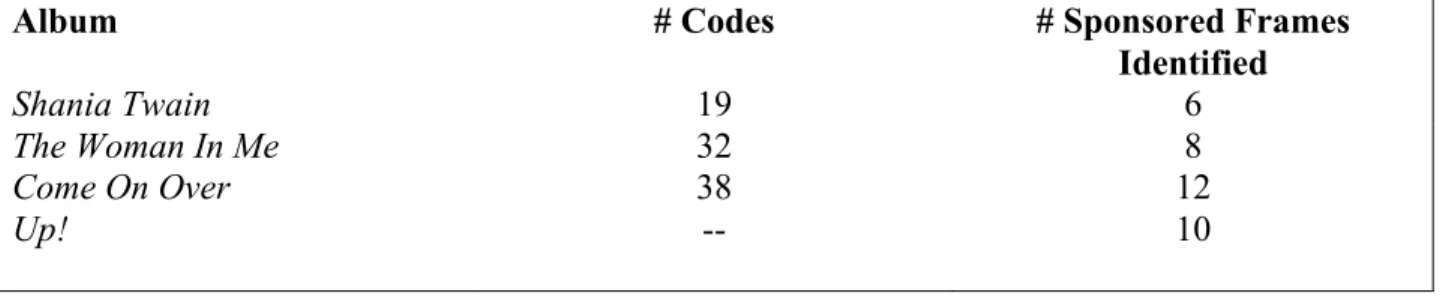
Table 4. # Sponsored Public Relations Codes and Frames Identified For Each Album ... 60
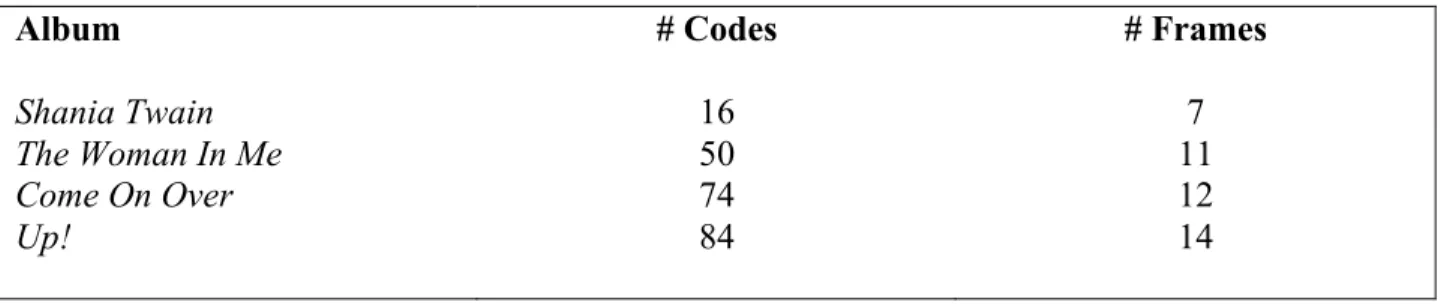
Table 5. # Press Codes and Frames Identified For Each Album ... 61
Table 6. Date Ranges of Materials Reviewed in Content Analysis ... 87
Table 7. Shania Twain: Sponsored Public Relations Frames ... 88
Table 8. Shania Twain Album: Press Coverage Frames ... 92
Table 9. The Woman In Me Album: Sponsored Public Relations Frames ... 96
Table 10. The Woman in Me: Press Frames ... 102
Table 11. Come On Over: Sponsored Public Relations Frames ... 111
Table 12. Come On Over: Press Frames ... 118
Table 13. Up!: Sponsored Public Relations Frames ... 132
Table 14. Up!: Press Frames ... 138
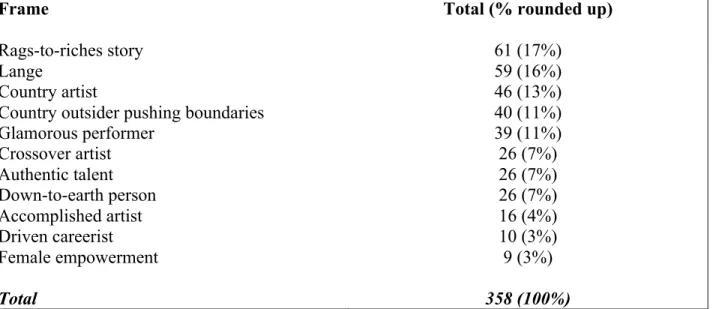
Table 15. Sponsored Public Relations Frames Summary ... 150
Table 16. # Sponsored PR Frames Accepted by Press ... 151
Table 17. Billboard’s Country Albums Chart ... 151
Table 18. Billboard’s Pop Album Chart ... 152
Table 19. Billboard’s Country Singles Chart ... 152
Table 20. Billboard’s Pop Singles Chart ... 154
Table 21. Recording Industry Association of America (RIAA) Sales Data ... 155
Table 23. Shania Twain: Comparison of Public Relations Frames and Press Frames ... 177
Table 24. The Woman In Me: Comparison of Public Relations and Press Frames ... 182
Table 25. Come On Over: Comparison of Public Relations and Press Frames ... 186
LIST OF FIGURES
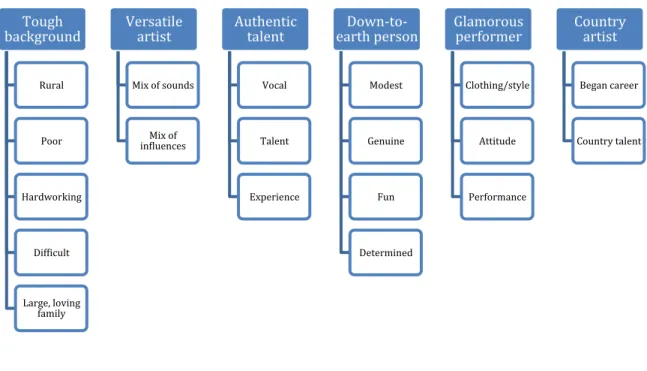
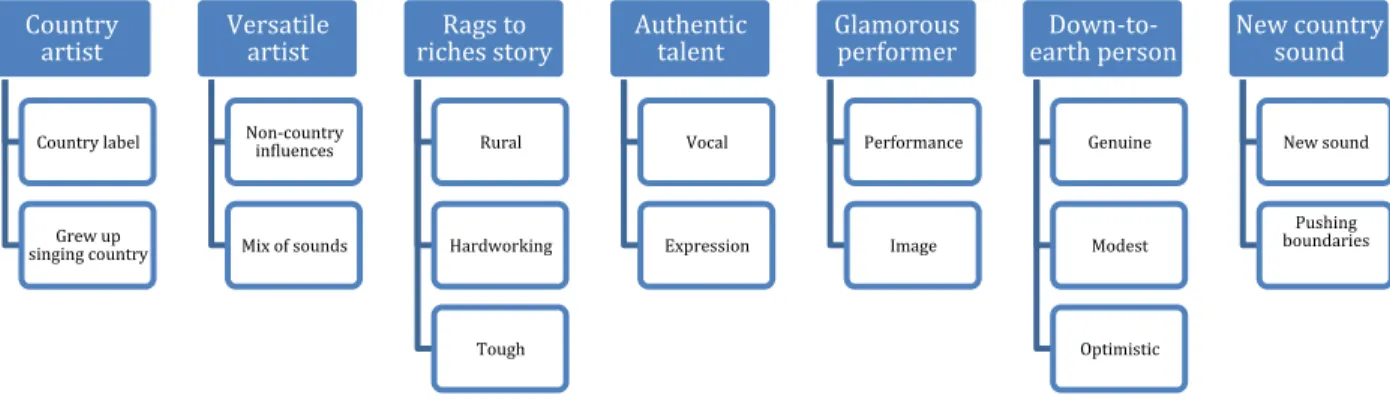
Figure 1. Shania Twain Album: Public Relations Codes ... 88
Figure 2. Shania Twain album: Press Codes ... 92
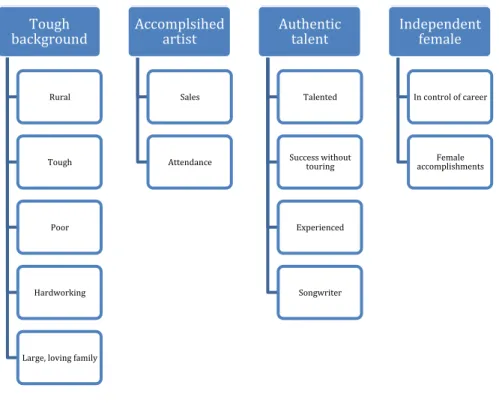
Figure 3. The Woman In Me: Public Relations Codes ... 96
Figure 4. The Woman in Me: Press Codes ... 103
Figure 5. Come On Over: Public Relations Codes ... 112
Figure 6. Come On Over: Press Codes ... 119
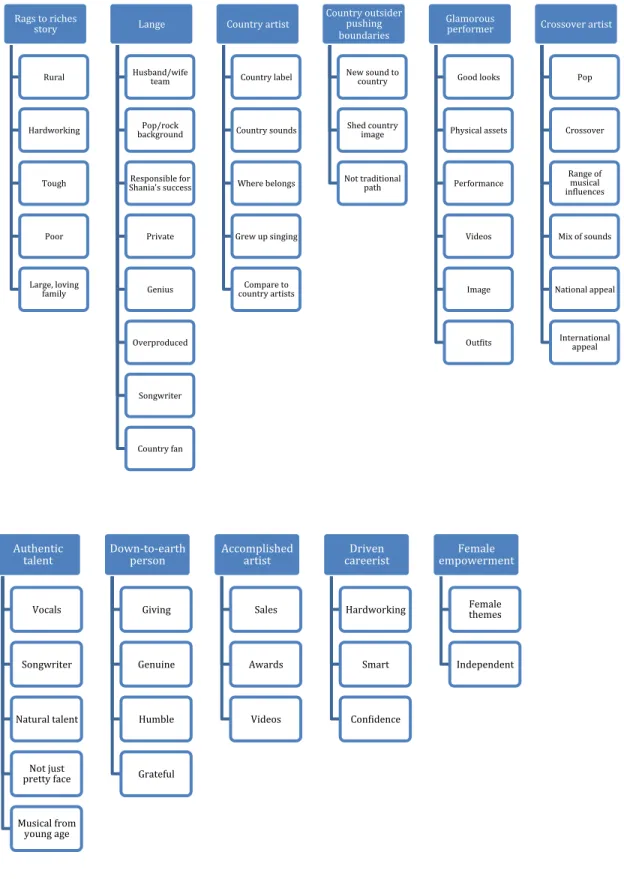
Figure 7. Up!: Press Codes ... 139
CHAPTER 1:
INTRODUCTION & CROSSOVER BACKGROUND
In the middle of an average night in 1973, eight-year-old Eilleen Twain stepped timidly onto the smoky stage of a local bar in Timmins, Ontario to belt out country classics for the drunken audience (Eggar, 2005; Twain, 2011). Little did she know that by 2002, she would have taken the world by storm as the international pop superstar, Shania Twain. One may wonder, how did this shy little girl go from singing traditional country tunes in a small Canadian town to global pop superstardom by the age of thirty-seven? As Friskics-Warren (2002) of Nashville
Scene explains, she “crossed over, redefining country music and proving how durable and elastic
the idiom can be” (para. 7).
Crossover occurs in many music genres when artists move between markets, charts, and audiences (Baskerville, 2001). For decades country artists have been crossing over to other genres, mixing country sounds with outside musical influences and attracting new audiences to their music (Friskics-Warren, 2002). Between the country and pop genres, a “crossover” artist is defined as having simultaneous hits on the pop and country charts (Malone & Neal, 2010, p. 245). Since the 1940s, country artists have been making successful and lucrative transitions from the country genre to the glitzy pop world (Dicaire, 2008).
over the merits and drawbacks to country-pop crossover is called the ‘crossover controversy.’ On far right side of the spectrum are the country traditionalists who argue that pop influences dilute the pure country sound and have no place in their genre. On the far left side of the divide are the crossover proponents who view country-pop crossover as healthy, bringing innovation and much needed change to the country industry. This tension adds to the difficulty of crossing over as artists attempt to enter a new market, attracting outside audiences while maintaining their original fan base (Fenster, 1988).
While any crossover begins with the music itself, public relations play an important role in facilitating the transition (Baskerville, 2001; Greenblatt & Steinberg, 2003). Highly skilled promotional and management teams create, sculpt, and drive artists’ careers (Baskerville, 2001). As an integral part of any artist’s team, public relations professionals are responsible for forming, establishing, and promoting their public image (Baskerville, 2001; Field, 2010; Fink 1996; Greenblatt & Steinberg, 2003; Lathrop & Pettigrew, 2003; Vittek, 2011; Weissman, 2003). Given the heated environment of country-pop crossover, one might wonder how a public
relations practitioner successfully navigates their client through the controversial waters between the country and pop markets. How do they bridge the gap between the two vastly different music cultures? In creating and maintaining an artist’s image, which characteristics are emphasized and which are downplayed in order to reached the desired audience?
frame’ is one endorsed by the framer or message creator. Public relations professionals often sponsor frames in communications such as press releases and interviews (Andsager & Smiley, 1998). The degree to which key audiences accept sponsored frames determines the ‘salience,’ or effectiveness of the message (Entman, 1993).
The following background section will provide an overview of country-pop crossover, particularly its success in the 1990s, when Shania began her career. Then, it will discuss the crossover controversy and the various arguments involved. The second chapter presents a review of relevant literature on public relations functions, its role in the music industry, framing theory, frame sponsorship, framing’s use in public relations, and how it will be applied in this study. The third chapter presents the research questions and explains the methodology of content analysis as it is applied in this study. The fourth chapter includes secondary research on Shania’s career providing a background for the content analysis. The fifth chapter contains the findings of the study. Finally, the sixth chapter presents discussion of the research findings, research
contributions, suggestions for future research, and conclusions of this thesis. Country-Pop Crossover
Country Crossover
in order to keep those fans. As Fenster (1988) explains, the “degree” to which an artist wishes to cross over to another genre is evidenced by how much of the original and new styles are
represented in their music and image (p. 295).
Throughout country music history, country to pop crossover has emerged as a defined style (CMHFM, 2006, 2014; “Country music history,” 2014; Cusic, 2008; Malone & Neal, 2010; Neal, 2013; Oermann, 1999; Peterson, 1997; Tribe, 2006; Wolf & Duane, 2000). From Eddie Arnold in the 1940s, to the Nashville Sound in the 1950s, to Patsy Cline in the 1960s, to Barbara Mandrell and Dolly Parton in the late 1970s and early 1980s, country artists found great success by integrating their music, and sometimes image, with slick pop style, shedding some of the traditional country elements along the way.
1990s Country-Pop Crossover
declaring their independence through their lyrics, revealing outfits, and sexy performances, emulating their pop contemporaries.
Shania Twain
It was during this 90s crossover boom that Shania Twain emerged as a bona fide superstar (Cusic, 2008; Malone & Neal, 2010; Neal, 2013; Oermann, 1999). Recording in the country-pop style, Shania managed to go from country star to international pop star. Malone and Neal (2010) describe how her good looks and sassy performance style “translated into one of the most commercially successful careers ever enjoyed by a woman performer” (p. 433). Thus Shania’s crossover career is a useful example for this study examining how country artists are framed by their public relations team during their crossover to the pop market.
Crossover Controversy
artist to target audiences involves understanding his or her motivations and the fuel to their critics’ fire (Baskerville, 2001). Accordingly, the following section summarizes and provides examples of the basic arguments for and against country-pop crossover.
Overview. As Malone & Neal (2010) explain, today’s country industry “has continued its long-standing tradition of trying to reinvent its present without disowning any of its past” (p. 467). Consequently, the debate between traditionalists and country-pop crossover supporters is as fierce as ever. In fact, one’s opinion about the “health of country music” today can be determined by one’s stance on the crossover debate (p. 467). Flippo (2002) describes the industry’s divide over crossover as part of “the identity crisis that’s been with it since the music began” (para. 1). He describes the two sides of the debate in political terms, using the red and blue divisions typically used to delineate the more conservative Republican Party from the more liberal Democratic Party. “Red country” is supported by “the traditional fan—historically rural—who likes the music straight and simple, maybe with a little pop ‘sophistication’” (para. 1). The “blue country” fan is a “more uptown—often urban—listener who likes purist and retro sounds as well as more experimental fare” (para. 1). In the middle of these two sides is a clear line between supporters of pop crossover and traditionalists who are opposed to such influences. Surrounding that line are those fans whose preferences include both ends of the spectrum. Outside the spectrum are audiences of other genres who, in varying degrees, dip into the country pond.
Arguments in support of crossover. Generally, those who support crossover acts argue that the country artists’ infiltration into the pop market is beneficial for the country genre,
There’s room for everyone. Proponents of pop crossover believe there is room for all types of music styles within the country genre. Flippo (2009a) argues that despite the crossover trend, there is still plenty of room in the industry for traditional country. He chastises the “defensive” nature of the traditionalists who claim that country-pop is pushing all other types of country out of the genre, arguing there’s room for every style under the country umbrella (para. 8). He comments: “Some country stars are sexy, some are trendy, some ignore history, some are students of history, some do sappy songs, some pay close attention to tradition and some do a dozen other things. That’s nothing new” (para. 10). Flippo (2009c) claims that the ability of the genre to accommodate so many opposing styles is actually “a testament to its inherent strength” (para. 9).
Crossover music is authentic. Another argument of crossover supporters asserts that
country-pop is actually authentic music, despite traditionalists’ dismissal of the style as artificial. While traditionalists dismiss today’s crossover stars as talentless, Flippo (2009a) argues that these artists should be respected for their abilities. He uses the example of Taylor Swift who possesses enviable “songwriting skills”, “career smarts”, and “audience appeal” that surely are appreciated by some respectable country icons (para. 4). A country artist making money from pop success does not make their effort less legitimate. Schmitzer (1999) agrees, explaining that a good song is a good song, regardless of genre labels. Yu (2009) even suggests country-pop crossover has become its own genre, with a real interface between artists and their audience:
and unconsciously shape each other, thus creating a subculture that defines country pop as its own genre, for it, too, is an authentic form of music. (p. 53)
She believes that the harsh backlash of traditionalists ironically causes the progression of country-pop as a distinct style that is neither completely enveloped by pop music nor firmly tied to country tradition (p. 50, 53). According to Yu (2009), country-pop crossover is not pop music because it still exhibits some elements of traditional country, such as story-telling lyrics (p. 53). However, country-pop crossover is not country music either since the “negative stigmatism country traditionalists extend towards country pop fans segregates the type of audiences each respective genre appeals to” (Yu, 2009, p. 53). Instead, Yu (2009) suggests that country-pop crossover is its own “distinct” genre consisting of “a unique synthesis of both genres that appeals to its own type of audiences (p. 53). She concludes that “in acknowledging each of these generic markers of the genre, it is plain: country-pop is not artificial, fabricated, or inauthentic” (p. 53).
Change is healthy and natural. Crossover supporters also champion the familiar and
positive nature of change in the country industry. Flippo (2009c) reminds us that “country music does not exist in a vacuum;” it “does not live in a test tube, as a pure and unsullied single-cell creature;” and that “music is an organic being, and it grows and mutates in unpredictable and sometimes uncontrollable way” (para. 1). He points out that many of the great moments in country history would not have occurred without change in the genre. He also advises that it is healthy to “embrace” new acts, and recommends: “it’s a good thing for country to publicly acknowledge, finally, that its artists get old. And die. That’s life” (Flippo, 2008, para. 9). Stark (1997) suggests that crossover acts actually wide the audience of country, increase record sales, and empower the industry as a whole. Price (2005) notes that when crossover artists can
untouched pop fans are exposed to country music through airplay of crossover hits on
mainstream pop stations. Despite the traditionalists’ qualms, crossover is “happening and it’s making a lot of fans happy as well as those big wigs at the table” (para. 2).
Arguments against crossover. As Billboard (“Country crossover,” 2006) explains, “While attitudes have softened, there are still plenty on Music Row who believe that ‘crossover’ is a bad, bad word” (para. 1). Opponents of crossover feel that pop influences have a negative effect on the country genre, diluting its traditional sound, endangering the existence of traditional country, selling ‘imposter country’, and overshadowing the music with commercial ambition (Applebome, 1999; “Country crossover,” 2006; Flippo, 2004, 2005, 2006, 2010a, 2010b; Henkin, 1999; Jessen, 2010; Malone & Neal, 2010; McCloud, 1998; Molanphy, 2009; Stark, 1997; Tuttle, 2009).
Dilutes country music. One of the traditionalists’ main arguments against country-pop
McCloud (1998), describes the country charts as “currently full of hunks and women with bellybutton rings whose recorded output is not even remotely country” (para. 5). Tuttle (2009) agrees, commenting, “country music just ain’t what it used to be,” (para. 3) contending that crossover acts greatly dilute the country genre by “borrow[ing] the vernacular…the genuineness and masculinity of that hard-knock life…[and] turn[ing] it into something that’s barely
recognizable…The rough edges of authenticity have been sanded off” (para. 11). McCloud (1998) illustrates his concerns about the dilution of country through a hypothetical conversation: “Good morning. Please tell me, do you like country music?...No?...What’s the reason?...Oh, OK we’ll get rid of the steel guitars, fiddles, mandolins, nasal vocals,…Now do you like it?...Great, another convert. As a result another million sales” (para. 6). Similarly, Henkin (1999) describes the disgust of traditional country fans when “radio stations insist on playing these ‘pop’ songs and passing them off as ‘country’ on a continual basis, thereby insulting the intelligence of their listenership by passing off a fake product and not giving us fans what we really want” (para. 25).
Endangers country music’s future success. Traditionalists also take issue with the
there that want more real country music yet cannot find it when they turn on so-called country radio stations.
Overly commercial. Billboard (“Country crossover,” 2006) attributes the traditionalists’
dislike of crossover to “Southern culture” and “a certain down-home fear of getting too big for one’s britches” (para. 1). They do not like the overly commercial images of crossover stars. Flippo (2005) describes the overtly sexual image of female crossover artists as “a cattle call,” suggesting they’re seen merely as “meat on the hoof” (para. 7). He criticizes their “overdone makeup, exaggerated hair, [and] pneumatic cleavage,” calling such promotion tactics “course and cheap” (para. 6). In a similar vein, Tuttle (2009) depicts the red carpet of the 2009 Academy of Country Music Awards as a “parade of hot bodies” that could “rival the Miss America
contest,” with female nominees “dressed in skintight, revealing tops, some with long, flowing blond hair and deep golden tans…and that’s just the men” (para. 3-4).
The record labels’ narrow focus on crossover’s commercial success irritates traditionalists. As Malone and Neal (2010) explain, “such openness about the commercial industry runs counter to traditional notions of country music” (p. 471). Crossover artists, such as Taylor Swift, have angered traditionalists by “presenting an unashamedly ambitious, commercial face to the world” (p. 472). McCloud (1998) agrees, stating his disgust for the labels’
“pander[ing] to the simple minds at the radio stations, many of whose presenters had not even heard of country music before 1989” (para. 9). Henkin (1999) agrees, adding, “diehard fans of traditional country music are complaining about being sold out by money-hungry acts who are ignoring their musical roots and crossing over into the arena of mainstream pop” (para. 12).
Fear country genre will disappear. Crossover opponents also worry that the genre they
in convoluted, almost duplicitous relationship with its history…making elaborate bows to the past” and then “skittering wildly after the demographic or musical fashions of the moment” (para. 1). Traditionalists fear this unstable pattern may lead the to ultimate abandonment of traditional country. Flippo (2006) contends that today’s young country fans know nothing about the rich history of the genre, spurring fears about the genre’s future. He worries about where the “heart and soul and the core of country music” is at present (Flippo, 2010b, para. 1). This “heart,” Flippo (2010b) explains, “used to be at the center of the major Nashville record labels” and “at the major recording studios,” but this “core” “eroded” a long time ago (para. 9).
Although Tuttle (2009) admits that the current crossover trend of “spit-polished pop” is not “the end of the world,” ultimately “something gritty and real has been lost” (para. 11) Echoing these fears, Applebome (1999) questions whether the attempt to bring back “real” country sounds “constitutes a revival, a calculated marketing move or a nostalgic bow to the past” (para. 4). Henkin (1999) predicts a continued reliance on crossover for economic gains will lead to a gradual breakdown of Nashville’s music industry. He calls crossover a “limited star system,” (para. 9) claiming that label heads “have no idea of what has gone before,” and only follow “current trends” when producing music (para. 6).
Ultimately, there seems to be no end in sight for the crossover controversy. For the meantime, country-pop crossover is here to stay. Therefore, it is essential for public relations practitioners in the country industry to understand country-pop crossover and the dynamics of the controversy surrounding it. This study will apply this information towards understanding how country artists are framed by their public relations team during their pop crossover
CHAPTER 2: LITERATURE REVIEW
This review of the literature will provide a brief overview of public relations practice, function, and process. It also includes background information on the role and process of public relations in the music industry. Additionally, the review gives an overview of literature on framing theory, its use in public relations, and how it will be applied in this study.
Public Relations Public Relations Practice
Public relations plays an important part in various industries, helping organizations and individuals establish and maintain beneficial relationships with key groups (Broom, 2009; Cutlip, Broom, & Center, 2006; Guth & Marsh, 2011; Wilcox & Cameron, 2010). Wilcox and Cameron (2010) describe the practice as an all-encompassing “process” of “research and analysis, policy formation, programming, communication, and feedback” (p. 5). Cutlip et al.’s (2006) widely accepted definition asserts, “public relations is the management function that establishes and maintains mutually beneficial relationships between an organization and the publics on whom its success or failure depends” (p. 5). The Public Relations Society of
who produce and disseminate messages in multiple media channels” (p. 5). Consequently, successful public relations activity is focused on making public relations part of the management function, whether for an organization or single client, and maintaining positive relationships with important publics.
The targets of any public relations activity are the publics who matter to the client’s success (Cutlip et al., 2006; Guth & Marsh, 2011; Wilcox & Cameron, 2010). A “public” is defined as “any group of people who share common interests or values in a particular situation— especially interests or values they might be willing to act upon” (Guth & Marsh, 2011, p. 88). Traditional categories of publics include employees, investors or stakeholders, customers or consumers, media, government, and the community (p. 90). The type of relationship desired and group of publics targeted can depend on the type of industry in which the public relations activity takes place. These relationships are created and maintained via the public relations functions. Public Relations Functions
Practitioners establish and maintain relationships with their important publics using actions of the overarching public relations function (Bowen, Martin & Rawlins, 2010; Cutlip et al., 2006). Common activities include “counseling, research, media relations, publicity,
employee/member relations, community relations, public affairs, governmental relations, issues management, financial relations, industry relations, development/fundraising, multicultural relations/workplace diversity, special events, and marketing communications” (Wilcox &
Cameron, 2010, pp. 10-11). Such actions are the basic components of a public relations program (Cutlip et al., 2006).
Wilcox & Cameron, 2010). Various models illustrate the assorted approaches. Grunig and Hunt’s (1984) popular model describes the four most common functions of public relations, categorized by how practitioners facilitate communication between an organization and its publics1. Of particular interest to this study is the press agentry/publicity model, which Wilcox and Cameron (2010) describe in the following manner:
A one-way communication, primarily through the mass media, to distribute information that may be exaggerated, distorted, or even incomplete to “hype” a cause, product, or service. Its purpose is advocacy, and little or no research is required…Sports, theatre, music, film, and the classic Hollywood publicist are the main fields of practice today...(p. 53)
This model is useful for the purposes of this study since it focuses on public relations practice in the music industry.
Public Relations Process
The public relations process involves planning, building, and maintaining relationships with key publics (Cutlip et al., 2006). Stacks (2002) lists the four main steps:
1. Define the problem
2. State the program’s objectives
3. Create a campaign or program that meets or surpasses the objectives 4. Evaluate and provide feedback on the campaign. (p. 23)
Popular interpretations of this four-step process include the RACE (research, action,
communication, evaluation) and ROPE (research, objectives, planning, evaluation) models (Guth & Marsh, 2011, p. 13). While other non-linear, cyclical models have been advanced, the
traditional four-step method is heavily used (Cutlip et al., 2006; Guth & Marsh, 2011; Wilcox & Cameron, 2010). The following section will summarize the four steps using the RACE method.
1 The first and second models—press agentry/publicity and public information—involve a one-way communication
Research. During the research phase, practitioners thoroughly gather information to gain a better understanding of their client, the problem or opportunity at hand, and the publics
involved or affected (Cutlip et al., 2006; Guth & Marsh, 2011; Wilcox & Cameron, 2010). This process involves the formulation of a research strategy addressing, “What do I want to know?” and “How will I gather that information?” (Guth & Marsh, 2011, p. 195). The amount and type of research needed varies by client and scenario, so it’s often necessary to ask the client several preliminary questions assessing their current situation (see Wilcox & Cameron, 2010, p. 128). Practitioners then select a suitable research method that will effectively gather the type of information needed, which also varies according to client and situation. Once a sensible plan is in place, research begins. This may involve primary2 or secondary3 sources.
Action (Program Planning). After considering the research gathered, practitioners plan the actions they’ll take to reach key publics regarding their client’s problem or opportunity (Cutlip et al., 2010; Guth & Marsh, 2011; Wilcox & Cameron, 2010). The level of detail involved depends on the situation (Wilcox & Cameron, 2010). Although various methods exist, the basic elements of most public relations plans include: “(1) a goal or goals; (2) objectives; (3) strategies; and (4) tactics or recommended actions” (Guth & Marsh, 2011, p. 237). Once a clear plan is in place, practitioners are ready to execute the strategy.
Communication (Execution). During the communication phase, “practitioners direct messages to specific publics in support of specified goals” (Guth & Marsh, 2011, p. 13; see also Broom, 2009; Cutlip et al, 2006; Wilcox & Cameron, 2010). This involves creating effective
2 Primary research is defined as “original research not derived from the results of an earlier researcher’s efforts”
(Guth & Marsh, 2011, p. 543). This type of research can be formal or informal (see Cutlip et al, 2006, Guth & Marsh, 2011; Stacks, 2002; Wilcox & Cameron, 2010).
3 Guth and Marsh (2011) define “secondary research” as “using information generated by someone else, sometimes
messages and selecting channels that will efficiently deliver those messages to key publics. These choices vary according to campaign goals and characteristics as well as the types of publics targeted.
Evaluation. In the final phase, evaluation, the practitioner must ascertain “how
efficiently and effectively a public relations effort met the [client’s] goals” (Guth & Marsh, 2011, p. 13). Broom (2009) describes evaluation as finding “evidence of program impact” (p. 349). This can be measured by the “inputs,” “outputs,” and “effects” of the program (p. 357). These measurements commonly look at “(1) measurement of production, (2) message exposure, (3) audience awareness, (4) audience attitudes, and (5) audience action” (p. 196). Such assessments of the program allow practitioners to identify which approaches were successful, need
adjustment, or should be abandoned (Wilcox & Cameron, 2010). This information informs and guides future campaigns.
Importance of Process
If researched, planned, executed, and evaluated properly, public relations activity can effectively craft and deliver messages to targeted audiences, accomplishing client objectives in an efficient manner (Broom, 2009; Cutlip et al, 2006; Guth & Marsh, 2011; Wilcox & Cameron, 2010). The next section will explain how this public relations process operates in the music industry.
Public Relations in the Music Industry
the [client], and they believe that the generation of publicity is their primary purpose” (p. 7). Music industry public relations can also incorporate the two-way asymmetric model where communication “is intended to be persuasive, even manipulative, in that feedback from audiences is used to guide the organization in how to get publics to behave as the organization wants them to behave” (Turk, 1986, p. 8; Lathrop & Pettigrew, 2003). This model can be applied to communication between record labels and artists, the mass media, and consumers (Lahtrop & Pettigrew, 2003). Lahtrop and Pettigrew (2003) explain how two-way
communication operates in the music industry:
The importance of the media to the marketer is substantial. The media provides the mass-communication channels through which marketers can publicize their products. The media also provides feedback—via reviews—about how the product is perceived in the marketplace. (The marketer can, if so inclined, use this feedback to suggest changes in future products, such as a different musical or lyrical direction in an artist’s future recordings.) (p. 138)
The record company uses feedback in crafting future music releases and messages to consumers. Starting with the music. Although public relations are a key part of an artist’s success, it is important to remember that it all begins with the music (Baskerville, 2001; Greenblatt & Steinberg, 2003). Greenblatt and Steinberg (2003) explain, “As with everything in the recording industry, marketing begins with the music” with “[t]he music set[ting] the tone for how that music is to be marketed” (p. 70). Baskerville (2001) adds that promotional campaigns must connect “with the nature of the music and the style of performance…” (p. 346). Greenblatt and Steinberg (2003) elaborate on this process:
Thus, once the promotional team has connected with the artist’s music, they will set about crafting the artist’s image and promotional campaign, all centered on the music.
Creating an image. Public relations practitioners in the music industry “are thought to be creators of [artists’] public images blurring the line between success stemming from musical talent versus persona” (Merkl, 1997, p. 2). Merkl (1997) discusses this awesome power of public relations in image creation:
It can be argued that the core of this popular culture phenomenon [of image creation] has the potential to be created and controlled by such professions as public relations…If these personae are actually just crafted images created by publicists, marketers, media relations officers, and the artists, themselves, research must be done on such processes given their potential to become a controlling force in society. (p. 4)
Consequently, the main role of a public relations counselor in the music industry is to establish and maintain “an image for a musical group, artist, product, place, or company” (Field, 2010, p. 114; see also Baskerville, 2001; Fink, 1996; Greenblatt & Steinberg, 2003; Lathrop & Pettigrew, 2003; Phillingane, 2005a; Vittek, 2011; Weissman, 2003). This strategically crafted image then guides all future public relations activity for the artist. Vittek (2011) explains the role of public relations in the music industry:
Public relations, in its simplest form, are just that, your relationship with the public. How you interact with friends, fans, fellow musicians, and citizens of your community is public relations. The desired result of your public relations is to create and build
credibility and integrity. The goal is to shape the opinion and perception of others toward you. It is a long-term effort that needs to be tended to on a regular basis. (p. 11)
Often when creating an artist’s image, the public relations professional will work from
She labels “frames of reference” as an “essential ingredient in the larger concept of persona creation” (p. 27).
Celebrity image. Celebrity images are painstakingly crafted, encompassing not only the public, but private life of the star (McNamara, 2009). Avenarius (1993) suggests, “The
organization (or the person) determines how it/he/she wants to appear and prepares for this appearance meticulously” (pp. 65-66). McNamara (2009) explains, “celebrities’ grooming and behavior at public on-stage events is crucial to the maintenance of their professional and personal image” (p. 13). This image is then “negotiated” by fans that become “an active audience [with] the space to make meaning of their world by accepting or rejecting the social values embodied by a celebrity image” (p. 891; Avenarius, 1993). Meyers (2009) describes the social power of celebrity image, explaining, “it is, in part, the blurring of the boundaries between private and public or the idea of an authentic individual behind the public persona that makes celebrity images particularly potent ideological symbols” (p. 891).
public persona often becomes indistinguishable from the actual humans at its core” (citing James, 1997, p. 12; Klapp, 1964, p. 13; Rich, 1997, p. 21).
PR’s overlap with marketing. Public relations practitioners in the music industry wear many hats and are commonly referred to as publicists or press agents since they tend to focus on the publicity and promotion aspects of the public relations process (Field, 2010; Phillingane, 2005a). As Baskerville (2001) explains, in the music industry there are no clear boundaries between “promotion, marketing, merchandising, publicity, and sales promotion” (p. 346). These activities could each have their own department, be shared by various personnel, or done
individually (Baskerville, 2001; Fink, 1996). However, is important to understand that public relations is the overarching field, while publicity and promotion are tactics used within the public relations process (Heath, 2005; Lyon, 2005; Phillingane, 2004a, 2004b; Vittek, 2011). Both publicity and promotion are achieved by the practitioner supplying planned messages to targeted publics with the goal of advancing the artist’s career and public image. Publicity is aimed at media exposure by giving tailored stories to outlets such as newspapers, television, radio, and the Internet. Promotion, on the other hand, has a more “long-term” effect as it aspires to “gain awareness, increase awareness, and foster positive thoughts and opinions about the organization, product, service, or issue” by “targeting” certain consumers (Heath, 2004, p. 650, 651).
Distinguishing PR from marketing. However, while both perform similar activities, the
maintain that image in publics’ minds (Phillingane, 2004b; Lyon, 2005). As Vittek (2011) explains, publicity and promotion are the tactics that “get you to the top,” while “how you manage your public relations will determine how long you stay there” (p. 11).
Music industry campaigns. Public relations campaigns in the music industry follow the linear RACE model used across disciplines (Baskerville, 2001; Field, 2010; Fink, 1996). In creating, establishing, disseminating, and maintaining an artist’s image, the practitioner will go through the research, action, communication, and evaluation phases (Baskerville, 2001; Fink, 1996). Campaigns could be used to establish a new artist, revive an existing artists bad image, or take their career in a new direction.
Research. During the initial research phase, the public relations counselor will try to
assess who the artist is, what genre they belong to, and the types of audiences they can reach (Baskerville, 2001; Field, 2010; Fink, 1996; Greenblatt & Steinberg, 2003). Important questions addressed at this point are: “(a) Just what kind of performer or act do we have? (b) To what audience does the artist appeal? (c) Can that audience be expanded? And (d) What must we do for the artist to fully exploit all the potential?” (Baskerville, 2001, pp. 186-187).
Choosing a genre. Greenblatt and Steinberg (2003) explain the importance of selecting a
genre before moving forward with a campaign:
Although everyone wants his or her song to be played on as many formats as possible, it is important for the label to hone in on a specific area of music and make a strong promotional push in that area. Trying too many formats and spreading a song too thin can result in no station wanting to play the song. If the song hits in one format, then others may pick it up and add it to their playlists, especially if it’s close enough to their own format. Initially, however, it is more important to choose a limited number of formats and work hard to get acceptance. (p. 72)
recording focused on one market segment that achieves sales in one or more additional markets” (p. 631). Even though an intentional strategy may exist to have an artist’s music cross over to other genres, attracting new audiences, an artist must still establish his or her self in one genre to begin with. Baskerville (2001) describes this strategy:
When categorizing an album, a primary genre is initially assumed, and the music is placed on the corresponding chart. This is done so that radio stations playing that particular type of music can feel ownership of the album. However, if the album gains popularity on stations featuring other genres, the album is then “crossed over” to one or more additional charts. (p. 301)
Answers to the above questions may be obtained through extensive formal market research or an informal approach such as casual interviews with the artist. Baskerville (2001) suggests, “Conscientious [promotional teams] usually start their thinking by listening to the music they are going to try to sell” (p. 346). From the results of this research, the practitioner gleans which elements of the artist’s image will guide the tone and direction of the public relations campaign.
Action (program planning). Next, the public relations team will develop a carefully
artist are the fans (consumers) and the media who deliver the message to fans. In order to reach the media, most public relations counselors keep a running list of media gatekeepers with whom they maintain a relationship (Field, 2010). Finally, campaign materials will be prepared, ready for distribution in the following phase.
Communication (execution). Once the campaign has been planned, it will be put into
action (Baskerville, 2001; Field, 2010; Fink, 1996; Greenblatt & Steinberg, 2003). As Fink (1996) suggests, carrying out the campaign “is complex, and its success often depends on precise timing” (p. 72). There are many options of communication channels and tactics to get the artist’s image and music to the desired publics (Lathrop & Pettigrew, 2003).
Promotion & publicity. Here, the most important tactics are promotion and publicity.
Lathrop and Pettigrew (2003) summarize how the promotion tool works in this phase:
Promotion, in brief, is activity designed to stimulate demand for a product…Promotion starts with the product selling points identified during product development…and translates them into memorable, brandable messages and a marketable image…It then makes use of the entire media system—print, audio, visual, and multimedia—to
communicate the message, project the artist’s image, and broadcast the sound in as many ways, and to as many potential customers, as possible…A complete promotion program makes use of all available tools, techniques, and outlets. (p. 137)
Often considered a subpart of promotion, publicity is another popular tool for public relations in the music industry since it costs nothing compared to expensive advertising. Lathrop and Pettigrew (2003) describe publicity as “the art of attracting attention via the information outlets that consumers routinely use” (p. 138). Thus, practitioners gain publicity by feeding messages to the media, which delivers them to the public. Below are the three main goals of publicity
activity in this third campaign stage:
2. Get coverage in the most appropriate media…focusing on publications and programs that cater directly to the target audience…
3. Attempt to control the content of the coverage…making sure that articles communicate the desired message…. (p. 138)
Media targets. Publicity efforts in this communication phase are targeted at media since
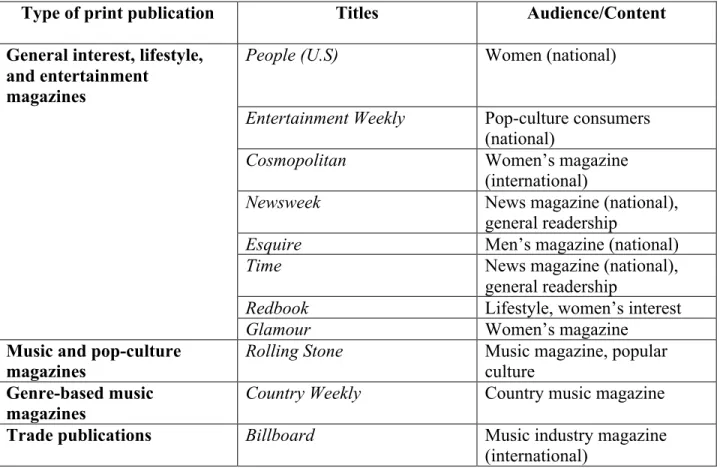
they are the main conduit of information to consumers (Baskerville, 2001; Fink, 1996; Lathrop & Pettigrew, 2003; Rutter, 2011; Weissman, 2003). The type of media outlet depends on campaign goals. However, there are several common channels through which music publicity is fed—print media, Internet, and broadcast media (Lathrop & Pettigrew, 2003). Key print media in the music business include “daily newspapers,” “general interest, lifestyle, and entertainment magazines,” “newsweeklies,” “music and pop-culture magazines,” “genre-based music magazines,”
“promotional magazines,” “magazines for music hobbyists and professionals,” “magazines for record collectors,” and “trade publications” (p. 140). “Web-based music magazines and news sites”, “general interest” web magazines, Internet versions of print sources, and music blogs are important Internet channels (p. 141). Radio and television are the main broadcast outlets.
Publicity tools. Music industry practitioners use several tools to accomplish campaign
goals (Baskerville, 2001; Lathrop & Pettigrew, 2003). The press kit and press release are popular choices.
media outlets, a press kit usually includes, “a cover letter (also called a ‘pitch’ letter); a fact sheet; a bio or product description; publicity photographs, press clips, a CD…[or] DVD of visual performance and interview clips…and additional attention-grabbing items” (Lathrop &
Pettigrew, 2003, pp. 143-144). This information may be in print or digital format. All elements of the press kit are guided by the artist’s crafted image (Baskerville, 2001; Lathrop & Pettigrew, 2003; Weissman, 2003).
Equally important, the press release is a meticulously worded, concise statement of information designed to get interest from targeted media outlets (Field, 2010; Fink, 1996;
Greenblatt & Steinberg, 2003). It is used to inform the media and the public of the artist’s events or news. Greenblatt and Steinberg (2003) explain, “Publicity for each song or CD usually begins by developing a press release which contains the pertinent information regarding the artist and the CD, including release date, producer, content, etc..” (p. 70). It is typically “sent out to both the trade publications…and to consumer publications” (p. 70).
In addition to the press kit and press release, the artist is often scheduled for interviews and live performances to support promotion of their music (Baskerville, 2001; Fink, 1996; Greenblatt & Steinberg, 2003; Lathrop & Pettigrew, 2003; Weissman, 2003).
Evaluation. In the final campaign phase, evaluation, the artist’s public relations team ensures that their publicity tactics have been disseminated extensively and effectively (Fink, 1996). The public relations counselor will continue to seek publicity opportunities to further the public awareness already obtained during the previous communication phase. Such
Importance of the Public Relations Team
As the above information shows, the public relations team is essential to a music artist’s success (Baskerville, 2001; Field, 2010; Fink, 1996; Greenblatt & Steinberg, 2003; King, 2010; Lathrop & Pettigrew, 2003; Merkl, 1997; Phillingane, 2005a). As campaigns are carried out, the image carefully crafted by the public relations team guides the way, shaping each decision and detail. From the early research stages of the campaign, the public relations team considers how to present the artist to appeal effectively to the target publics. Every detail of this image is painstakingly planned, determining the course of the whole campaign:
Publicists hold meetings with the artist and his personal manager to obtain the artist’s biography, photographs, and impression of his personality. From these meetings and other research a formal “bio” is written and an “ideal image” for the artist is developed. Publicity people may work with the artist to prepare him for future interviews. Press releases are worked out using “angles” on the record, the music, the image, and the artist’s career to date. A publicity plan is developed which details, step-by-step, how the execution phase will be carried out. (Fink, 1996, p. 72)
Weissman (2003) argues, “the image of the [artist] is as important as the music” (p. 170). He explains how this image can be so manufactured that it no longer bears resemblance to the artist’s real personality:
The goal is to get the attention of the public, and it really isn’t necessary that the artist be what the public thinks an artist is. Once the attention of the public is captured, an act is on the way toward building an audience. (p. 170)
Components of this image can include “costumes, stage gestures, attitude presented to the media, and the type of photographs that the group uses as promotional pictures” (p. 170).
such a transition. Thus, the following section will discuss the relevant literature on framing theory, its use in public relations practice, and how it will be applied in this study.
Framing Theory What is Framing?
Framing is a powerful theory used widely in social science research and other disciplines (Entman, 1993; Hallahan, 1999; Scheufele, 1999). The theory began with the work of
sociologist, Erving Goffman, who suggested people “use frames in our day-to-day experience to make sense of the world…help[ing] interpret and reconstruct reality” (as cited in Volkmer, 2009, p. 408). Johansson (2007) affirms that Goffman’s ideas on framing are still strongly applicable in communication, especially in the field of public relations. Although there is no universal definition of framing, some commonly accepted explanations exist. Entman’s (1993) popular definition is often cited:
To frame is to select some aspects of a perceived reality and make them more salient in a communicating text, in such a way as to promote a particular problem, causal
interpretation, moral evaluation, and/or treatment recommendation for the item
described. (p. 52)
How Do Frames Work?
Carragee & Roefs (2004) describe how “frames construct particular meanings concerning issues by their patterns of emphasis, interpretation, and exclusion” (p. 217). Hallahan (2005) likens the framing process to “drawing a border around a painting or picture,” where the frame is the border and the message is the painting within (p. 340). By choosing certain information to emphasize inside the frame and ignoring “competing, distracting, or contradictory” information placed outside the frame, message creators are able to determine the focus of a message (p. 340). He explains this process of inclusion and exclusion:
A frame essentially limits or defines a message’s meaning. Both message creators and receivers are involved in the process. Frames reflect judgments made by message creators, who put information in either positive or negative frames, use particular semantic phrases, and tell stories using particular syntactical, thematic, or rhetorical devices. (p. 340)
Likewise, Carroll (2005) defines a “frame” as “a rhetorical label that encapsulates unconnected pieces of information about a subject of interest into a graphic image or coherent story” (p. 338). He also explains framing in terms of a frame around a picture:
The term naturally draws metaphorical value from the function of a cropping frame used with visual images, which limits and focuses the viewer’s gaze, while at once bestowing relevance upon subjects within the position or scope of its borders and irrelevance upon those without. (pp. 338-339)
Carroll notes, although much research has focused on the use of frames in the media, they can also be used in independent communications “within or between individuals, groups, or
Salience
In his foundational study synthesizing the myriad of classic framing research, Entman (1993) describes “selection” and “salience” as the cornerstones of framing theory (p. 52). Selection involves the purposeful inclusion or exclusion of information. Salience deals with whether the audience accepts the message presented. Entman (1993) defines salience as
“making a piece of information more noticeable, meaningful or memorable to audiences” (p. 53). Thus, frames operate to “highlight some bits of information about an item that is the subject of communication, thereby elevating them in salience” (p. 53). Entman (1993) suggests that increased salience is achieved by information “placement or repetition, or by associating them with culturally familiar symbols” (p. 53). By drawing attention to certain information, it becomes more likely that readers will “perceive the information, discern meaning and thus process it, and store it in memory” (p. 53, citing Fiske & Taylor, 1991). Essentially, the message creator chooses which frames to include and exclude, and the message receiver determines how salient the frames are by choosing to accept or reject them.
Through this process of selection and salience, Entman (1993) contends that frames perform four distinct functions: (1) define problems; (2) diagnose causes; (3) make moral judgments; and (4) suggest remedies (p. 52). Frames perform these functions at four points along the communication chain:
1. Communicators make conscious or unconscious framing judgments in deciding what
to say, guided by frames (often called schemata) that organize their belief systems. 2. The text contains frames, which are manifested by the presence or absence of certain
keywords, stock phrases, stereotyped images, sources of information, and sentences that provide thematically reinforcing clusters of facts or judgments.
3. The frames that guide the receiver’s thinking and conclusion may or may not reflect the frames in the text and the framing intention of the communicator.
4. The culture is the stock of commonly invoked frames…the empirically demonstrable
At each point in the communication process, frames serve to “select and highlight” certain information to “construct an argument about problems and their causation, evaluation, and/or solution” (p. 53).
Additionally, Gamson and Modigliani (1989) suggest five “framing devices” that can be used as “shorthand” in applying a consistent frame to a group of messages: “(1) metaphors, (2) exemplars (i.e., historical examples from which lessons are drawn), (3) catchphrases, (4) depictions, (5) and visual images (e.g., icons)” (p. 3, footnote 2). By implementing a framing device, a communicator can present his/her messages efficiently and effectively “as a whole with a deft metaphor, catchphrase, or other symbolic device” and “suggest how to think about the issue” (p. 3, Footnote 2).
Frame Sponsorship
Another important element of framing theory addresses who is responsible for the act of framing (Andsager, 2000; Andsager & Smiley, 1998; Carragee & Roefs, 2004; Entman, 1993; Kleinmann, 2005; Turk, 1986). Carragee and Roefs (2004) contend that recent research has focused too heavily “on news frames” and “the production, reception, and influence of news texts” (p. 214). They argue that such studies ignore the outside sources that provide frames to the media:
Frame sponsors can be any individual, organization, or group who create and disseminate their own messages. A sponsor’s power can be determined by whose frames are included in the news coverage (Carragee & Roefs, 2004; Entman, 1993). Entman (1993) suggests, “the frame in the news is really the imprint of power—it registers the identity of actors or interests that competed to dominate the text” (p. 53). Kleinmann (2005) contends, “Frame sponsorship is an active component of the framing process” (p. v).
Public relations practitioners frequently act as frame sponsors when constructing
messages for clients (Andsager & Smiley, 1998). Andsager and Smiley (1998) explain how “In communicating information through interviews, press conferences, and press releases, public relations practitioners can transmit their [client’s] frames,” allowing them to “impact the public’s frame of reference” (p. 184). Turk (1986) highlights the importance of public relations
practitioners’ role as frame sponsors, describing them as “the junction point for interaction between an organization and the media” (p. 4). In turn, the media become key publics for public relations practitioners sponsored messages “because although an organization also may
communicate directly with key audiences, most of what an organization’s key publics know about it is mass media created and disseminated” (p. 4). Consequently, this thesis will examine frame sponsorship by public relations practitioners in the music industry, particularly those helping a country artist cross over to the pop market. The media’s acceptance of the sponsored frames will be examined, since they are a key public as well as a channel to other publics like consumers.
suggested, “The salience of the frame in the text should reflect the policy actor’s influence on the news coverage” (p. 185). Similarly, my study examines whether the press, as well as consumers accepted the sponsored public relations frames from Shania Twain’s public relations team. Like the study above, the salience of the sponsored frames in the news text should reflect her public relations team’s influence on the press coverage. The salience of sponsored frames with
consumers will be measured by sales and chart performance data, indicating whether consumers accepted the frames and acted on them by buying and playing her records.
This study also keeps in mind Carragee and Roefs’ (2004) point that sponsored frames and news frames evolve over time and change in reaction to one another. They suggest, “Because journalists define issues over time and because sponsors often restructure their issue frames given changing…conditions, frames evolve, and particular frames may gain or lose prominence in the news media…These transformations highlight the construction of meaning over time…” (p. 216; citing Gamson, 1992; Pan & Kosicki, 1993; Snow & Benford, 1988). It will be interesting to see how the sponsored frames from Shania’s team change over time and whether they take cues from press frames. If the press frames reflect changes in the sponsored frames, this will also indicate increased salience of the sponsored frames.
Importance of Framing in Communication
As a result of its power to construct messages and influence audiences, framing is a very powerful tool for any communicator. Entman (1993) explains the ultimate strength of framing:
Thus, this study will examine the use of framing by public relations practitioners in the music industry, specifically those helping country artists cross over to the pop market. Having provided an overview of framing theory, the remainder of this literature review will focus on how framing operates in the practice of public relations.
Framing in Public Relations
Framing’s ability to shape messages and influence how their audiences will receive texts makes the theory an important tool for public relations practitioners. As Hallahan (1999) explains, “Framing is a potentially useful paradigm for examining strategic creation of public relations messages and audience responses” (p. 205). Carroll (2005) agrees, adding that “[a]n awareness of frames helps public relations professionals better understand general trends in society” and “[a] thorough understanding of how frames work may also aid public relations staff members in knowing their role and abilities as professionals” (p. 339). Additionally, Lim and Jones (2010) suggest, “a frame has the utility for theoretical and practical understanding of public relations campaigns” (p. 292).
Importance in Public Relations
As one of the leading scholars on the workings of framing theory within the practice of public relations, Hallahan (1999) contends that framing “provides a potentially useful umbrella for examining what occurs” within the profession (p. 206). Framing’s power lies in its
combination of a rhetorical and conceptual approach. The rhetorical approach concentrates “on how public relations is engaged in the construction of messages and meanings that are intended to influence key publics important to an organization” (p. 205). This approach includes a variety of models such as “argumentation, advocacy and persuasion, corporate communication,
reputation management” (p. 205). On the other hand, framing is also “conceptually connected to the underlying psychological processes that people use to examine information, to make
judgments, and to draw inferences about the world around them” (p. 206). Thus, the core elements of framing—message construction and audience receipt—tie directly to the idea that “public relations work fundamentally involves the construction of social reality” (p. 206).
Hallahan (1999) laments the social confusion about the role of public relations
practitioners who are commonly labeled “imagemakers and spin doctors,” focusing only on their task of message creation (p. 206). Instead he argues, “public relations counseling involves
defining reality for organizations by shaping organizational perspectives about the outside
world…Similarly, outbound public relations communications involve attempts to define
reality…for the many publics on whom the organization depends” (p. 206). Thus, the practice of public relations uses framing to “construct social reality” and “shape the perspectives through which people see the world” (p. 207).
In discussing the “construction of social reality” by public relations practitioners, Hallahan (1999) explains framing in terms of “a window or portrait frame drawn around
information that delimits the subject matter and, thus, focuses attention on key elements within” using the “processes of inclusion and exclusion as well as emphasis” (p. 207). Thus, while building and sustaining “mutually beneficial relationships” with key publics, practitioners can use framing to create “common frames of reference about topics or issues of mutual concern” (p. 207).
Ultimately, Hallahan (1999) concludes that framing plays an invaluable role throughout the various stages of the public relations process:
strategists, who strive to determine how situations, attributes, choices, actions, issues, and responsibility should be posed to achieve favorable outcomes for clients. Framing decisions are perhaps the most important strategic choices made in a public relations effort. It is out of strategic framing that public relations communicators develop specific themes (i.e., key messages or arguments that might be considered by publics in the discussion of topics of mutual concern). Framing also provides the foundation for
choosing images and other framing devices that can be used to dramatize or reinforce key ideas. Finally, framing provides the basis for how people should be asked to evaluate information, make choices, or take action. (p. 224)
Carroll (2005) agrees that framing theory is essential to the practice of public relations, positing that “a general awareness of the power of frames can assist public relations
professionals in managing information so that they can clarify thinking, articulate alternative points of view, or more readily perceive less evident alternative viewpoints” (p. 339). He suggests several benefits framing may lend practitioners in the public relations process:
1. Use frames in research and evaluation efforts to track changes, monitor events, and identify new threats and opportunities in a given environment.
2. May more readily express their needs and objectives with frames preferred by top management in order to accomplish organizational or public objectives.
3. Can work with management groups to identify and avoid fixed perspectives preserved by lasting frames.
4. Policy advocates can enhance their success by shaping information into coherent packages with standardized prevailing values, stories, or myths.
5. Can use framing concepts to adapt organizational interests to the established media frame of “newsworthiness” that news workers use in deciding what counts as news. (p. 339)
Knight (1999) also agrees that framing has immense potential for use in public relations since “[p]ublic relations practitioners occupy positions ideally suited for framing issues in a way likely to advance both public and organizational interests” (p. 384). She adds that “[t]heir traditional roles as media and community liaisons offer opportunities for framing issues of interest, as do their less-recognized roles as lobbyists, negotiators, and environmental scanners” (p. 384). Practitioners should use framing in “organizational communication, external
Use of Framing in Public Relations
Hallahan (1999) describes a frame as the element of a message that “limits or defines the message’s meaning by shaping the inferences that individuals make about the message,” thus “reflecting judgments made by message creators or framers” (p. 207). These frames can take many forms depending on their use and construction. Consequently, the process of framing “bias[es] the cognitive processing of information by individuals” (p. 207). Within this process, two “mechanisms” act to achieve the framing goal—“contextual cues” and “priming” (p. 207). First, “contextual cues” are supplied during the framing process to “guide decision making and inferences drawn by message audiences” (p. 207; citing Kahneman & Tversky, 1979; Hamilton & Zanna, 1972; Pratto & John, 1991; Smith & Petty, 1996; Petty & Cacioppo, 1986;
Maheswaran & Meyers-Levy, 1990). Second, ‘priming’ aims to take advantage of the preprogrammed social and cultural norms in the audience’s mind. Hallahan (1999) suggests, “knowledge is thought to be organized in human memory in cognitive structures or schemas, which operate as constraints on the arrangement and interpretation of situations and events” (p. 208, citing Bartlett, 1932; Fiske & Taylor, 1984; Markus & Zajonc, 1985; Neisser, 1967).
Framing Models for Public Relations
and practitioners to understand the usefulness of the framing concept, to apply it in practice, and to pursue a systematic research agenda about framing as it might be applied to public relations” (p. 209). However, Hallahan (1999) explains the common threads between the models and their importance for public relations practice:
The central idea that links each of these models of framing is contextualization. Framing puts information into a context and establishes frames of reference so people can evaluate information, comprehend meanings, and take action, if appropriate. Indeed, the message must be imbued with sufficient clues so that people can make sense of the message and for it be persuasive (i.e., to have an influence on people’s predispositions or overt behavior). Framing provides those clues. (p. 224)
Framing of attributes. Hallahan’s (1999) “framing of attributes” (attribute framing) is of particular interest to this study since it aims to examine how country artists are framed in public relations materials during their crossover to the pop market. It is defined as “the characterization of objects, events, and people” (p. 210). The model thus operates by highlighting certain “characteristics of objects and people” while disregarding others, “thus biasing processing of information in terms of focal attributes” (p. 210). Hallahan (1999) further explains, “When used in this context, semantic framing is used to focus on particular attributes that might be flattering or derogatory and, thus, be advantageous or disadvantageous to message sponsors in persuasive communications” (pp. 211-212).
This type of framing is commonly used in advertising to create picture captions (picture framing), influence consumer decisions (problem framing), affect how consumers experience the product (advertising framing of product experience), draw on “consumer’s prior experience with a product to bias their future choice (experience-frames-advertising), alternative ways to present product claims/attributes (product claims), and in comparing product attributes versus
offerings and image so they occupy a meaningful and distinctive competitive position in the customer’s mind” (p. 212, citing Kotler, 1995, p. 295). Additionally, framing of attributes has been examined in the context of “media studies,” with scholars claiming that “media are
effective in not only raising the salience of particular topics, issues, or objects but also can create specific knowledge of attributes related to issues and people” (p. 213; citing Ghanem, 1997; McCombs, 1997; McCombs & Ghanem, 1998; McCombs & Shaw, 1973, 1993). Thus, the media can use attribute framing to tell audiences “what to think about—and how to think about it” (p. 213).
Consequently, attribute framing is an important and useful tool in public relations. Hallahan (1999) argues “public relations practitioners routinely engage in framing of attributes by accentuating particular aspects of the causes, candidates, products, or services they represent” and “routinely strive to position clients and their products or services so they will be evaluated favorably and so key publics will respond in a desired way when they buy, invest, donate, work, or vote (p. 225). These aims are achieved by “creating positively valenced associations with beliefs and values, traditions and rituals, or with other cultural artifacts that people cherish” (p. 225).
Other models. Similarly, Lim and Jones (2010) conducted a review of framing research within public relations, organizing the findings into distinct categories. After examining