e383
IVC Filters
What Is an IVC Filter? What Is Its Purpose?
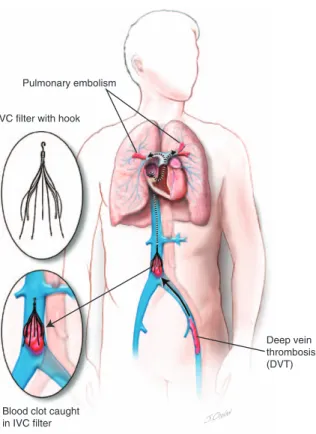
Patients who have a blood clot in their leg, referred to as deep vein thrombosis (DVT), are at risk of the clot breaking off and traveling toward the lung. It gets to the lung via the big vein in the abdomen (Figure 1), called the inferior vena cava (IVC). The traveling clot is called an embolus. Once it reaches the lung (after having passed through the right chambers of the heart) and becomes lodged in the lung, it is called a pulmonary embolism (PE). A filter can be inserted into the IVC (Figure 1) to catch and trap a traveling clot, pre-venting it from reaching the lung. Such filters used to be called Greenfield fil-ters, but a variety of differently shaped filters now exist, so a more generic and better term is IVC filter. Filters can be nonremovable and thus are permanent, or they can be removable and thus can be left in for only a few weeks or months.
How Is an IVC Filter Placed?
Filters are typically placed by a radiolo-gist or vascular surgeon or cardioloradiolo-gist
through a vein in either the neck or the groin and then deployed via a cath-eter into the correct position in the IVC (Figure 1). The placement itself is relatively straightforward and takes only 10 to 15 minutes. Together with preparations, the procedure may take 30 to 45 minutes; it can be done as an outpatient procedure.
What Are Potential Benefits and Downsides?
The potential benefit of a filter is clear: It is meant to catch moderate-sized or large clots and prevent them from trav-eling to the lung. Filters do not prevent new clots—leg or pelvic DVT or clots in and around the filter—from forming. There are potential downsides of hav-ing a filter in place. The most common complication from placing an IVC filter is a hematoma or bleeding at the cath-eter insertion site in the neck or groin. This is typically not a major problem because the hematoma resolves.
Probably the most important potential problem is that a large clot or multiple smaller clots can become trapped in the filter and make it harder for blood to travel from the legs to the
heart. This may lead to further DVTs below the filter, sometimes involving both legs. In addition, a clot can form on the upper side of the filter and still lead to a PE. Thus, PEs can happen despite an IVC filter. Less common complications include small pieces of the metal frame of the filter breaking off; the filter tilting, changing position, and thus obstructing blood flow in the IVC and increasing the risk for DVT; the filter becoming loose and traveling to the heart or lung; and the filter caus-ing a small hole (perforation) in the IVC, leading to internal bleeding.
Who Should Get an IVC Filter?
People who have a new DVT in the large veins of the pelvis or thigh and are not able to safely take blood thin-ners because of current major bleed-ing or a high risk of bleedbleed-ing should have an IVC filter inserted. Once it is safe to start blood thinners, after a few days or weeks, the filter should be removed.
There are a number of situations in which filter placement is sometimes considered by physicians. However, it is less clear whether they really should
(Circulation. 2016;133:e383-e387. DOI: 10.1161/CIRCULATIONAHA.115.019944.) © 2016 American Heart Association, Inc.
Circulation is available at http://circ.ahajournals.org DOI: 10.1161/CIRCULATIONAHA.115.019944
The information contained in this Circulation Cardiology Patient Page is not a substitute for medical advice, and the American Heart Association recommends consultation with your doctor or healthcare professional.
From University of North Carolina School of Medicine, Department of Medicine, Division of Hematology-Oncology, Chapel Hill.
Correspondence to Stephan Moll, MD, University of North Carolina School of Medicine, Department of Medicine, Division of Hematology-Oncology, CB 7035, Chapel Hill, NC 27599-7035. E-mail [email protected]
Inferior Vena Cava Filters, May-Thurner
Syndrome, and Vein Stents
Sarah Carroll, MD; Stephan Moll, MD
be placed in these situations. Because filters by themselves, being foreign bodies in the vascular system, increase the risk for DVT and because they can lead to the complications discussed above, the risk of placing a filter in these situation may be higher than the potential benefit:
• Trauma: People who sustain a trauma, especially if it will require them to be immobilized for long periods of time, are at a higher risk of developing a blood clot. Many of these patients also can-not use blood thinners to prevent blood clots because of a high risk of bleeding or the need for sur-gery. It is unclear whether trauma patients should get an IVC filter if they do not have a new blood clot, but most probably should not. • Orthopedic surgery: People
undergoing orthopedic surgeries (hip or knee replacement; major
pelvic, leg, or back surgeries) have a higher risk of blood clots. Most patients should be on blood thinners after surgery to prevent blood clots from forming. It is unclear whether people at high risk for blood clots should have an IVC filter in addition to using a blood thinner, but most probably should not.
• Pregnancy: Patients who are preg-nant are at increased risk for blood clots as a result of increased estro-gen levels and pressure of the pregnant uterus onto the big veins in the pelvis. It is not clear whether pregnant women at particularly high risk for DVT should get a filter. The pressure of the overly-ing pregnant uterus can potentially damage filters. There are likely few, if any, situations in which a filter is needed and beneficial. • Obesity (bariatric) surgery: People
undergoing obesity surgery are
at increased risk of blood clots because of the surgery and the obesity itself. Small studies show that placing an IVC filter before surgery in a person who does not have a blood clot does not decrease the risk of a PE after surgery.
• Recurrent DVT: Although fil-ters are sometimes considered in patients who have a second (recurrent) DVT despite having been on blood thinners, that is, patients with anticoagulant fail-ure, no data exist that filters in this situation are beneficial. • Severe lung or heart disease: In
patients with severe lung or heart disease, even a small to medium-sized PE can be detrimental. If such patients have a DVT, filters are sometimes considered to pro-tect the lung from clots.
• Clot busters or mechanical DVT removal (thrombectomy): DVTs are sometimes treated with strong clot-dissolving medications, called clot busters or fibrinolytic drugs, or by putting a catheter into the clot and sucking it out, referred to as mechanical throm-bectomy. Because of a concern that parts of the clot may break loose during the procedure, an IVC filter is sometimes placed temporarily.
Existing Guidelines
Several medical groups have cre-ated best-practice guidelines for IVC filters. The American College of Chest Physicians and the Society of Interventional radiology recommend that IVC filters be placed in someone with a known DVT in the pelvis or thigh who cannot be on blood thinners because of bleeding.1,2 The following additional recommendation have been made:
• The American College of Chest Physicians recommends that people do not get an IVC filter if they are able to use blood thinner medications.1
• The Society of Interventional radiology recommends IVC
Deep vein thrombosis (DVT) Pulmonary embolism
IVC filter with hook
Blood clot caught in IVC filter
Figure 1. The main image shows a filter in the big vein in the abdomen, preventing a clot
that breaks off a deep vein thrombosis from reaching the lung. The traveling clot gets caught in the filter, thus protecting the lung. Some filters have a hook at their top (oval inset), allowing them to be removed with a catheter once they are not needed any more; these are called removable or transient inferior vena cava filters.
filters in patients who have a new or worsening clot while on blood thinners, whereas the American College of Chest Physicians does not recommend an IVC filter in this situation.1,2 The Society of Interventional radiology also recommends an IVC filter in people with a large PE who still have evidence of a DVT. In addi-tion, the Society of Interventional radiology recommends an IVC filter in patients with DVT who have severe heart or lung disease. • Recognizing the potential side
effects of IVC filters, the US Food and Drug Administration recommends that IVC filters be considered for removal as soon as protection from PE is no longer needed.3
Do I Need to Stay on
Anticoagulation if I Have an IVC Filter?
Blood thinners should be restarted when the bleeding has resolved even if an IVC filter was placed. It is impor-tant to start anticoagulation as soon as possible because an IVC filter does not prevent the formation of new blood clots. Once a patient is safely on blood thinners, the filter should be removed. The duration of treatment with blood thinners depends on what caused the DVT or PE in the first place. Although people with an IVC filter are at a slightly higher risk for a clot in the future once blood thinners are stopped, most people should not continue taking anticoagulation just because an IVC filter is in place. How long to treat with a blood thinner is an individualized decision that should be discussed with your doctor.
How Is an IVC Filter Removed?
A radiologist or vascular surgeon can remove a filter by inserting a catheter into one of the neck veins, the same way as when the filter was placed. The catheter hooks around a hook at the top of the filter, which can then be pulled out. This is typically an outpa-tient procedure. removing a filter is
most successful if attempted within 3 months of placement. The filter becomes more difficult to remove the longer it has been in because its feet (struts) become embedded in the wall of the IVC. Sometimes, filters cannot be removed, even within the first few months after their placement. Some radiologists or vascular surgeons feel comfortable removing the filter while the patient is on a blood thinner; oth-ers want the patient to discontinue the blood thinner before the removal.
Summary
IVC filters should generally be reserved for patients with a new, acute, fresh blood clot in the pelvis or thigh who cannot safely use blood thin-ner medications. The filter should be removed as soon as possible. How long to keep someone on blood thinners if an IVC filter is not removed depends on a number of factors, mostly the rea-sons why the DVT or PE formed in the first place.
Vein Stents
What Is a Vein Stent? What Is its Purpose?
Vein stents are small mesh tubes (Figure 2, oval inset) that are inserted into large veins when they become nar-rowed. These stents keep the blood ves-sel open so that blood can continue to move from the legs to the heart. They can be placed into the large veins in the abdomen (ie, the IVC) or pelvis.
May-Thurner Syndrome
People can have narrowing of a vein for several reasons. One of them is an anatomic variation called May-Thurner syndrome. In normal anatomy, the artery leading to the right leg (called the right common iliac artery) rests on top of the vein coming from the left leg (the left common iliac vein). In some people, the artery puts increased pres-sure on the vein, causing the vein to be narrowed (Figure 2). People are born with this variant and have it through-out their life. The narrowing can range from mild to severe. Some studies esti-mate that 20% of people have some
degree of narrowing. Severe narrowing is less common. Veins can also become chronically narrowed as a result of scar-ring from previous DVTs or from exter-nal compression (eg, from a cancer). Significant narrowing can lead to blood flow disturbance and can increase the chance of developing a DVT.
What Are the Symptoms of May-Thurner Syndrome?
Most people with May-Thurner syn-drome have no symptoms and will never develop any. Even if the vein is severely narrowed, bypassing veins (collaterals) may open up and drain the leg so that a patient may be without symptoms. However, in some people, the narrowing can lead to chronic leg swelling or can contribute to the forma-tion of a DVT in the left leg.
How Is May-Thurner Syndrome Diagnosed?
A routine Doppler ultrasound of the leg is not likely to see the narrowing because the veins involved are deep in the pelvis, an area that a Doppler ultrasound cannot visualize. A com-puted tomography venogram or mag-netic resonance venogram of the pelvis can show the narrowing of the vein. Another way to see the narrowing is by injecting contrast dye into a vein in the leg, called a contrast venogram. Sometimes, intravenous ultrasound is done with an ultrasound catheter in the vein. This is to determine the degree of narrowing and to measure pres-sures in front of and behind the nar-rowed stretch of vein to determine how severely narrowed the vein is.
Does May-Thurner Increase My Risk for a DVT?
It is unknown how much the vein nar-rowing increases the risk for develop-ing a DVT. DVTs are often attributable to multiple risk factors, not just one. May-Thurner syndrome may contrib-ute to DVT. However, it is important to determine other risk factors (major surgery, major trauma, hospitaliza-tion or other immobility, long-distance travel, birth control pill, patch or ring,
pregnancy, etc) and perhaps to assess for congenital or acquired clotting dis-orders by blood testing before blaming the occurrence of a DVT on the pres-ence of May-Thurner syndrome.
If I Have May-Thurner, Do I Need a Stent?
• Vein stents are not indicated in people who have no symptoms and have not had a DVT.
• People with a DVT in the leg who are found to have significant May-Thurner syndrome can be considered for a stent. However, it is unknown if placing a stent decreases the risk of getting a blood clot in the future.
• A stent can be considered in the patient with May-Thurner syn-drome who has had a DVT and who still has significant leg pain or swelling after a few months of blood thinner treatment. Studies have shown that leg symptoms may improve after stent placement.
How Is a Stent Placed? Does It Stay Open?
A stent is placed with the help of a cath-eter via the large veins in the leg behind
the knee or in the groin, with deploy-ment of the stent in the area of nar-rowing. Most stents are patent for the first 1 to 2 years after being inserted.4 Unfortunately, some become narrowed within 3 to 5 years. When stents become narrowed, leg swelling may increase. A radiologist, vascular surgeon, or inter-ventional cardiologist can put a catheter through the vein in the leg and open up the stent by using a balloon to reinflate the stent or by placing a new stent. This is usually successful.
How Do You Monitor if a Stent Is Still Patent?
If you have a stent and develop more leg swelling, leg pain, or a new DVT, then the radiologist, surgeon, or cardi-ologist should evaluate whether your stent is patent by injecting contrast dye into the veins of the leg. It is not known whether people with stents who are doing well and have no new symptoms need regular routine follow-up monitoring with images (such as a computed tomography venogram).
Do I Need to Stay on Blood Thinners if I Have a Stent?
Once the stent is placed, you will likely stay on blood thinner medications for at
least 3 months to treat your acute DVT. The decision on how long to treat with a blood thinner is based on the circum-stances of the blood clot, your risk of bleeding, and how well you tolerate the blood thinner. If the blood thinner is stopped, we do not know if you should start on an antiplatelet medication (eg, aspirin or clopidogrel) because it is not known whether antiplatelets are benefi-cial in keeping vein stents open.
Existing Guidelines
Many clinical management issues about venous stents are unknown because stents have not been studied much in clinical trials. Therefore, there are very limited guidelines related to venous stents. The Society for Vascular Surgery and the American Venous Forum recommend stents for large veins in the pelvis, but not in the thigh of around behind the knee, if narrow-ing is found after a blood clot has been removed.5 However, it is not known whether stents are really beneficial and decrease the risk for recurrent clots in this situation.
Summary
Vein stents can be successful in decreasing leg symptoms after a leg DVT such as chronic swelling and leg pain caused by narrowing of a pelvic vein. We do not know whether stents prevent blood clots from forming in the future or how long a patient needs to stay on blood thinners or antiplate-let medications after stent placement. Stents are foreign bodies and are not without risk. They may occlude over time and lead to the need for repeated radiological procedures (angioplas-ties) to open them again. Therefore, they should be placed only after the risks and benefits have been carefully weighed.
Acknowledgments
We thank Joe Chovan, medical illustrator, Cincinnati, OH, for the creation of the fig-ures for this article.Disclosures
None.Inferior Vena Cava (IVC)
Aorta
Common iliac vein
Common iliac artery
Stent placement in left common iliac vein Narrowed left iliac common vein by pressure from right common iliac artery
Figure 2. The main image shows the narrowing of the left pelvic vein (blue) as a result of
pressure from the overlying right pelvic artery (red). This is called May-Thurner syndrome and is a risk factor for left leg deep vein thrombosis. After balloon stretching of the vein (called angioplasty), a stent has been placed (oval image) to keep the vein open and to relieve leg pain and swelling.
References
1. Kearon C, Akl EA, Comerota AJ, Prandoni P, Bounameaux H, Goldhaber SZ, Nelson ME, Wells PS, Gould MK, Dentali F, Crowther M, Kahn Sr; American College of Chest Physicians. Antithrombotic therapy for VTE disease: Antithrombotic Therapy and Prevention of Thrombosis, 9th ed: American College of Chest Physicians Evidence-Based Clinical Practice Guidelines. Chest. 2012;141(suppl):e419S–e494S. doi: 10.1378/ chest.11-2301.
2. Caplin DM, Nikolic B, Kalva SP, Ganguli S, Saad WE, Zuckerman DA; Society of
Interventional radiology Standards of Practice Committee. Quality improvement guidelines for the performance of inferior vena cava filter placement for the preven-tion of pulmonary embolism. J Vasc Interv Radiol. 2011;22:1499–1506. doi: 10.1016/j. jvir.2011.07.012.
3. US Food and Drug Administration. removing retrievable Inferior Vena Cava Filters: FDA Safety Communication. May 6, 2014. http://www.fda.gov/MedicalDevices/ Safety/AlertsandNotices/default.htm. Accessed November 11, 2015.
4. Oguzkurt L, Tercan F, Ozkan U, Gulcan O. Iliac vein compression syndrome: outcome
of endovascular treatment with long-term follow-up. Eur J Radiol. 2008;68:487–492. doi: 10.1016/j.ejrad.2007.08.019.
5. Meissner MH, Gloviczki P, Comerota AJ, Dalsing MC, Eklof BG, Gillespie DL, Lohr JM, McLafferty rB, Murad MH, Padberg F, Pappas P, raffetto JD, Wakefield TW; Society for Vascular Surgery; American Venous Forum. Early thrombus removal strategies for acute deep venous thrombosis: clinical practice guidelines of the Society for Vascular Surgery and the American Venous Forum. J Vasc Surg. 2012;55:1449–1462. doi: 10.1016/j.jvs.2011.12.081.