WRITING MAROON CULTURE INTO NATURE: ON THE AGENCY OF COLONIAL REPRESENTATIONS OF BLACK AND GREEN IN SURINAME
Rudo Kemper
A thesis submitted to the faculty at the University of North Carolina at Chapel Hill in partial fulfillment of the requirements for the degree of Masters of Arts in the Department of
Anthropology in the College of Arts and Sciences.
Chapel Hill 2014
iii ABSTRACT
Rudo Kemper: Writing Maroon Culture into Nature: On the Agency of Colonial Representations of Black and Green in Suriname
(Under the direction of Karla Slocum)
iv
TABLE OF CONTENTS
LIST OF FIGURES ... v
CHAPTER 1: INTRODUCTION ... 1
CHAPTER 2: THEORETICAL PREFACE: WHY NATURE CAN’T
PRE-EXIST ITS OWN CONSTRUCTION ... 7
CHAPTER 3: A (VERY) BRIEF HISTORICAL OVERVIEW OF
MARRONAGE IN SURINAME ... 14
CHAPTER 4: ON THE ‘PLACING’ OF MAROONS: TRAVERSING
THROUGH BLACK-AND-GREEN TINTED EPISTEMIC MURK ... 16
CHAPTER 5: MODERNIZATION, DEVELOPMENT, AND WILDNESS: A SHORT MEDITATION ON THE PRESENT-DAY SALIENCE OF
BLACK-IN-GREEN ... 34
CHAPTER 6: CONCLUSION: REPRESENTATIONS IN NETWORKS ... 43
v
LIST OF FIGURES
Figure 1 – Maroon Groups in Suriname ... 15
Figure 2 – Depiction of Surinamese Slaves on the Plantation ... 21
Figure 3 – “March thro’ a swamp or Marsh in Terra Firma” ... 25
Figure 4 – Left: “Bayo inspects an obia leaf.” Right: “A Saramacca
elder, who has Tiger spirit." ... 29
Figure 5 – The colonial rhetorics of ‘wildness’ ... 37
1
CHAPTER 1: INTRODUCTION
“In the interior, various indigenous communities and Maroon tribes live in harmony with each other, but also with nature. Get to know the authentic traditions of these primordial Surinamese. It is up to you to embark on this discovery journey and get to experience this clandestine, almost entirely untouched, world. One who truly wants to understand the secrets of the jungle would do well to make an adventurous tour into the interior of Suriname!" – Pamphlet titled “Suriname: The Beating Heart of the Amazon”, 2012
“THE PEOPLE ARE THE FOREST: The mission of the Amazon Conservation Team Suriname Foundation is to enter into partnerships with indigenous and maroon communities in order to protect and preserve the biodiversity, culture and traditional healthcare within the boundaries of Suriname. The backbone of the rainforest is represented by the people who have always lived there. ACT Suriname’s vision is to preserve our ecosystem and all biological organisms occurring within by validating and integrating traditional knowledge and empower indigenous and maroon communities for the conservation of our rainforest. In our work we are aware that this is a constant process of protecting natural ecosystems and their biodiversity while at the same time supporting human livelihood and traditional culture...ACT Suriname developed its inside out approach to conservation by empowering and sustaining the rainforest’s rightful guardians.” – Mission statement of the Amazon Conservation Team (ACT) Suriname.1
At the head of this paper we find two contemporary statements about the relationship between the Surinamese rainforest, part and parcel of the Guianas shield ecosystem, and the indigenous and maroon communities that live in it. Both are sales pitches, for different audiences but there is a clear sense of overlap and continuity between the sets of representations that are being deployed in them and their broader discursive contexts in which these passages are embedded. The pitches beckon us to imagine a primordial, biodiverse, forgotten, and therefore still pristine rainforest, populated with exotic and endangered creatures like the famed okopipi,
2
the blue dart poison frog, as well as traditional cultures like indigenous and maroon groups who live in sustainable harmony with the natural world around them. Come to Suriname to discover the Amazon in its most pristine, virginal state, and take a photograph of okopipi and the still-primordial maroon (or better yet, come save them!), lest this landscape of clandestine, natural wildness be touched by modernity and tainted once and for all.
The story isn’t unfamiliar. By and large, it’s the same one that is told everywhere across the world where there is a stake in protecting natural spaces considered to be protected, with residents who must somehow be figured into (or out of) these spaces. To be sure, tropes of a forgotten, endlessly fertile wilderness, untouched by civilization are likely to be mobilized in many other tropical “primordial forests” (oerwoud) across the planet.2 But, upon closer
examination, there is a narrative sleight-of-hand that we may discern in these particular stories about this tropical wilderness: they seem to have a particular “buried epistemology.” We might expect to find indigenous Amazonian peoples, subjects of ahistoricality and aborigin par excellence, living in the most natural (and least civilized) manner possible, placed into this natural world. But maroons… aren’t those the escaped slave societies whose stay in the
rainforest has been fleeting at best, whose culture is essentially African (Herskovitz 1934), and whose arrival in the Northeastern Amazon has been determined by a very recent world history of colonialism and slavery? When, and how, did the maroons become naturalized into
oer-Surinamese? What does their seamless “placing” into this most natural of spaces tell us about representations of the Northeastern Amazon and of the maroons (can the two be disentangled)?
2 The Dutch oerwoud, frequently utilized to describe the Surinamese rainforest, is difficult to translate. Oer (like the
3
What kinds of effects has the distribution and sedimentation of these representations produced (for example, by way of intervention)?
While these kinds of questions have not yet been asked before about the tropical
landscape of understudied Suriname, they have been asked about other places. Recent literature in political ecology has paid considerable attention to how the production and representation of ‘nature’ has played a role in the colonization of particular social environments, and how what counts as ‘nature’ in particular places is often informed by colonial representations (and thereby imbricated in colonial power) (Braun 1997, 2002; Kosek 2004; Wainwright 2008). This
approach, and its method of Foucauldian genealogy, shed important light on the structuring power of invisible discursive representations. However, this body of literature has recently been taken to task for reifying a dualism between nature and culture, by putting overmuch emphasis on the cultural construction of nature (Braun 2007). Recent scholars, inspired by philosophers like Gilles Deleuze and Bruno Latour, have sought to overcome this pervasive schism by thinking through the ways in which nature and culture (and the ‘stuff’ understood to belong to either of these two distinct ontological domains) are always-already entangled together. Instead of cultural stuff (like representations) having an influence on natural stuff and vice versa, we are asked to imagine a flat ontology in which relations between human and non-human are
constantly being formed and reformed; hence, multiple natures-cultures. Yet, there seems to be a certain value to asking the kinds of questions about semiotics and representation which I pose above, and to inquiring into their genealogies and effects as per the abovementioned approaches in political ecology. Philosophical ramifications about dualism aside, these approaches seem to get something right about representations. How can we account for the value of this
4
epistemology” of the placement of maroons into the Surinamese rainforest, to make sense of the contemporary power and force of this colonial imaginary of Surinamese maroons?
In this paper, I will argue that we can. Consider the following passage, from Michael Taussig’s influential Shamanism, Colonialism and the Wild Man (1987):
The importance of this colonial work of fabulation extends beyond the nightmarish quality of its contents. Its truly crucial feature lies in the way it creates an uncertain reality out of fiction, giving shape and voice to the formless form of reality in which an unstable interplay of truth and illusion becomes a phantasmic social force. All societies live by fictions taken as real. What distinguishes cultures of terror is that the epistemological, ontological, and otherwise
philosophical problem of representation—reality and illusion, certainty and doubt—becomes infinitely more than a ‘merely’ philosophical problem of epistemology, hermeneutics, and deconstruction. It becomes a high-powered medium of domination, and during the Putomayo rubber boom this medium of epistemic and ontological murk was most keenly figured and thrust into consciousness as the space of death (Taussig 1987: 121).
In this exceptional moment of clarity, Taussig describes how narratives of savagery, wildness, and cannibalism about the indigenous population of the Putomayo region in southern Colombia helped shape the colonial imagination during the rubber boom era. This was a period of time during which brutal acts of torture and murder were enacted by the Peruvian Amazon Company on indigenous peoples, thus opening up what Taussig calls a space of death. To understand the conditions of possibility for the emergence of such a space, Taussig asks us to take seriously the numerous narratives circulating during this period, of which only several may be accessed by us in the present. “These stories and the imagination they sustained,” he writes in the same lucid passage, “were a potent political force without which the work of conquest and of supervising rubber gathering could not have been accomplished. What is crucial to understand is the way these stories functioned to create through magical realism a culture of terror that dominated both whites and Indians” (Ibid., my italics). Taussig’s observation here is of vital importance:
5
conjunctures as terrible as the space described by Taussig in the first part of his book. As he illustrates throughout the text, colonial representations of wildness constitute a major dimension of the imagination of spaces like the Amazon, imaginations which persist into the present day and continue to effect the ways in which its inhabitants are perceived (e.g. as possessing magical powers or not). In this way, Taussig shows us how representations can themselves be
ontological, or even ontologizing.
6
not all-encompassing) role as actants in assemblages and networks in ‘the real world’, which include both human and non-human elements.3
Before getting to my analysis, it will be worthwhile to spend some more time considering what it means to create space for representations in assemblages, theoretically speaking. So, we briefly postpone our voyage by spending some time in a different “epistemic murk”: the murk of academic theory on the relationship between nature and culture, and the agentive role of
representations.
3
7
CHAPTER 2: THEORETICAL PREFACE: WHY NATURE CAN’T PRE-EXIST ITS OWN CONSTRUCTION
In a lucid and provocative essay titled “Nature and Culture: On the Career of a False Problem”, Bruce Braun (2007) tracks how the ostensible relationship between “culture” and “nature” has been explored within a shifting configuration of ideas, institutions and practices. In tracing the career of this dichotomy (and its various related incarnations, like “nature-society” and “human-environment”), Braun identifies four key ‘moments’ or theoretical approaches to the nature-culture problematic: cultural ecology, political ecology, cultural studies of the
environment, and nonmodern ontologies. Although he is keen to argue that these moments should not be understood in either a rigid, non-overlapping or successive temporal sense, it seems clear that they nevertheless correspond to more general theoretical trends in academia; and in fact Braun analyzes and criticizes the first three ‘moments’ from the perspective of the final. As such, Braun’s article implicitly registers the momentum, and tapering, of movements in thought about nature-society relations and their transition from one to the other, and its most recent culmination in the exploration of nonmodern ontologies (and the concurrent
8
seeks to dissolve and dispense with the nature-culture problem altogether; it is the one that has decisively shown that its defining problematic is in fact false. If Braun’s powerful formulation accurately depicts the movements of thought in political ecology scholarship—and I believe it does—we should seriously contend with what these shifts entail, analytically and
methodologically. Of particular interest will be the move from ‘cultural studies of the
environment’ towards ‘nonmodern ontologies.’ Let us consider this move in detail, but start at the end by looking at nonmodern ontologies first.
The moment of nonmodern ontologies is characterized by an interest in assemblages, entanglements, relationality, networks, and more than anything, an enthusiastic dedication to the critique and unsettling of dualism(s) between nature and culture, human and non-human. It is similar to what has recently been described as “the ontological turn” in anthropology and
geography. This body of scholarship, inspired by thinkers like Bruno Latour, Gilles Deleuze, and Donna Haraway and others is cataloged well by Arturo Escobar, who himself may be said to have undergone a theoretical shift from the third towards the fourth moment:
The interest in flat alternatives is a sign of the times. “We are tired of trees,” famously denounced Deleuze and Guattari, two of the prophets of this movement in modern social theory. “We should stop believing in trees, roots, and radicles. They’ve made us suffer too much. All of arborescent culture is founded on them, from biology to linguistics.” What they mean is that researchers need to move away from ways of thinking based on binarisms, totalities, generative structures,
9
This literature is by no means homogeneous (and indeed Escobar’s spin on it veers towards the Deleuzian), but perhaps its most succinct statement of purpose is Bruno Latour’s (1993, 2004) critique of what he calls the modern Constitution. In texts like We Have Never Been Modern and
Politics of Nature, Latour argues that the modern world’s self-understanding rests on an
ontological presupposition of nature and culture as dichotomized and non-overlapping domains. But, despite this modern belief in ontologically distinct domains, he argues, the two have always been tangled together, and it is only (us) moderns who imagine that it is possible to assign things unambiguously to either realm. Latour calls attention to how modernity is constituted by the enterprise of purifying the actual world of hybrids, networks, etc. into these ontological zones; but in reality, we have never been modern because these zones don’t exist in the way that we (moderns) think they do. Modernity does in fact produce unique hybrids, and at a vertiginous pace, by virtue of believing that these realms do exist. But ultimately its dualisms of ‘nature’ and ‘culture’ are fabricated abstractions from the horizontal, flat ontology of relations between humans and non-humans alike that comprises reality. Consequently, if reality consists of flows and connections in which hybrids are constantly formed and reformed, and if the modern
Constitution is only one possible form among others, it follows that other ontologies are possible. Other ‘nature-cultures’ are possible. This implies, then, a politics—for if we adjudicate that the modern Constitution has made us suffer, to paraphrase Deleuze and Guattari, in spite of its great efficacy in the production of new hybrids, then we might move to militate against it and work to usher in a different, more enabling ontology.
10
‘culture,’ with some or other form of relation between them. The most interesting of these retrospective polemics is leveled at the so-called ‘cultural studies of the environment’ moment, which for the sake of brevity is well represented (if erroneously, in the exegetical sense) by Donna Haraway’s famous phrase that “nature cannot preexist its own construction.” This moment encompasses a wide and promiscuous array of theoretical approaches including post-structuralism, postcolonialism, and cultural Marxism. Scholarship filed under this moment tends to investigate how semiotic representations render what counts as ‘nature’ visible or legible, and are thereby imbricated in governmental power. There is no better example of this body of
scholarship than Braun’s own (earlier) work on the intemperate rainforest in Canada, in which he aims to shed light on the “colonizing power inherent in particular ways of rendering landscapes ‘visible’” (Braun 1997: 5), and how environmental discourse “[produces] nature as pristine, or [collapses] cultures into nature to form a premodern harmony that must be protected in its
totality from a threatening modernity” (Braun 2002: 13). In a nutshell, representational practices, which are thoroughly and integrally infused with relations of power, bring ‘nature’ into being. Channeling Foucault, who is a key interlocutor for cultural studies of the environment, we can therefore talk about the “power/knowledge” of the rainforest, and how that power/knowledge culminates in the formation of institutions that seek to intervene in the constitution of subjects who inhabit the rainforest, and how they are governed.
11
nature…is left aside.” (Latour 2004: 33). Cultural studies of the environment, then, implicitly reproduce something like the Kantian distinction between things-in-themselves and
representations, placing all of the emphasis on the latter but thereby leaving the dualism intact, thriving more than ever. Ironically, the ‘postmodern turn’ ends up being hyper-modern after all. We therefore have good reason to be suspicious of this moment, which Braun tags with the suggestive subtitle “challenging essentialisms, deepening dichotomies?” (Braun 2007: 163)
But lest we act hastily and prematurely consign our dog-eared, foxed Foucault and Said readers to the proverbial dustbins of outmoded theory, let us try to think through the conjuncture of the alleged passing from one moment to the other (a rather recent event at that). Upon close examination, we might see that the two are not all that irreconcilable, and might even be complementary. “Every tool is a weapon if you hold it right” Ani DiFranco sang, and Michael Hardt & Antonio Negri parroted in their turn of the century book Empire, in so doing
reterritorializing the lyric as a trope to be used in critical academic studies like this one. A more mainstream trope: let us (who have never been modern etc.) try not to throw the baby out with the (Foucaultian) bathwater.
12
nevertheless, there seems to be something to the prodigious power that humans wield over the production of networks, as Latour’s deference to modernity as a potent hybrid-producing machine effectively acknowledges. If we move to “flatten” our conception of reality and eliminate hierarchical thinking by considering all (quasi-)objects—living and non-living—as simply actants through and through, do we lose the ability to explain why and how humans, or even other complex living creatures, seem to have a greater capacity to give shape to relations and assemblages? Various critics have articulated versions of this argument (see Ingold 2011:89-94 for example), and indeed Braun himself cedes this point as well: “what distinguishes modern human subjects is neither their mastery of, nor their alienation from, ‘things,’ but their
extraordinary success in mobilizing them and their stunning inability to see that they are doing so!” (Braun 2007: 173) Although actor-network theory, along with its philosophical cronies grouped under Braun’s ‘nonmodern ontologies’ moment, deserves all the plaudits for its forceful and important critique of the so-called nature-culture problem, there is still important work to be done in thinking through how ‘culture’ (if I may be permitted to use the term, as Latour does, as a stand-in for human social formations and processes) manages to have such a momentous force in organizing—entangling—nature-culture assemblages.
13
into a theoretical framework wherein the Gordian knot of natures and cultures has been retied? I argue that we may do so by recognizing that representations of nature play an important
(although certainly not all-encompassing) role in the constitution of nature-culture assemblages. Representation is part of the meshwork along which the human lives—to pillage a turn of phrase from Tim Ingold—and any assemblage including humans (there are many) is therefore wont to be affected by human representational practices.4 In sum, I wish to argue that there is something to Donna Haraway’s mantra that “nature cannot preexist its own construction” after all; for as any good student of the Amazon region knows, there are no natural spaces on the planet that have not in some way been touched by humans, and therefore figured into assemblages that include humans, non-humans, machines, politics, and representations. Just as ‘things out there’ are not inert and passive, representations of those ‘things out there’ aren’t either—as actants, they play a crucial, formative role in the emergence of particular historical conjunctures. This is exactly what I will try to demonstrate in what follows, by looking at narrative tropes and
representations of maroons in nature, and how these sedimented representations come to circulate in and effectuate the present.
4
This point was made almost two decades ago by Paul Rabinow, albeit for very different reasons, in
“Representations Are Social Facts,” published in the influential volume Writing Culture: The Poetics and Politics of Ethnnography. Rabinow’s aim in this essay was to show how a Foucaultian framework can shed light on how thought and social processes interconnect, in ways that the fashionable philosophical positions of the day were not able to. Although the context and objective of Rabinow’s piece differ from my own, I concur with Rabinow’s position as stated in the following passage: “As Max Weber, I think, once said, seventeenth-century capitalists were not only economic men who traded and built ships, they also looked at Rembrant’s paintings, drew maps of the world, had marked conceptions of the nature of other peoples, and worried a good deal about their destiny. These representations were strong and effective forces in what they were and how they acted” (Rabinow 1986: 241).
In a sense, what I am doing theoretically is adapting this argument from Rabinow into a ‘nonmodern ontologies’ framework. I am grateful to Peter Redfield for pointing this out to me.
14
CHAPTER 3: A (VERY) BRIEF HISTORICAL OVERVIEW OF MARRONAGE IN SURINAME
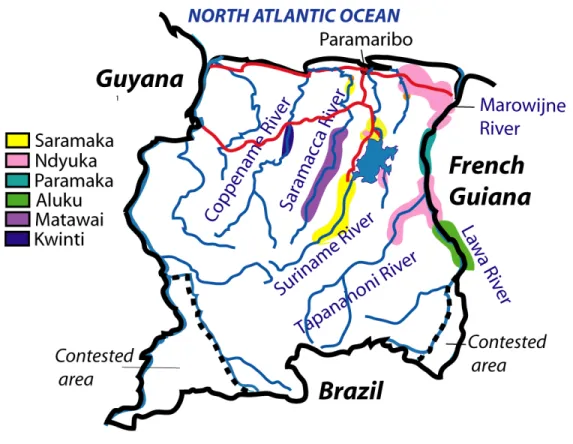
Maroons, formerly known as ‘bushnegroes,’ make up about 10% of the country’s population and are the majority population in the interior.5 The term ‘maroon’ derives from the Spanish Cimarron, which used to refer to cattle that had gone wilds and taken to the bush; for the maroons, it now stands for a heritage of heroism and dignity (Price 1983: 119). The phenomenon of marronage into the interior had been taking place since at least the 1630s, and culminated in an uprising in 1690. The Dutch imposed harsh penalties on escape attempts and offered bounties for capture, resulting in togten (raids) orchestrated both by military personnel and private
militias. Maroons would organize raids on plantations to free slaves and aid fugitives in return. The fighting came to a halt in the 1760s as a result of the Dutch being unable to overcome maroon guerilla tactics in the interior, and resulted in peace treaties with several Maroon groups (notably the Saramakas and N’Djukas/Aukaners) wherein the Dutch recognized the autonomy and territorial rights of maroons. These documents (along with the places where they are they thought to have been signed) bear significant cultural meaning to the maroon groups and are treated by them as legitimate to this day, in spite of the independent Surinamese state’s argument
5 This section is intended to give the reader a rudimentary historical background on maroons in Suriname. For
15
that they are colonial documents and therefore legally obsolete.6 For centuries after the signing of the peace treaty, the maroons pursued their lives relatively free of outside interference. The autonomy of the maroons began to erode when the government began to relax its isolationist policy around the turn of the 20th century, and changed for good when the Surinamese state (stumbling on its way to independence) made its first true incursion since the 18th century into the interior to establish a dam in Saramaka and N’Djuka land, flooding numerous villages. This large-scale development initiative signaled the advent of many future incursions relating to resource extraction, infrastructure building, military combat, ecotourism, and conservation.
Figure 1: Maroon groups in Suriname
From http://www.heemskerk.sr.org/Maroons/Maroons.html, accessed on March 24, 2014
6
16
CHAPTER 4: ON THE ‘PLACING’ OF MAROONS: TRAVERSING THROUGH BLACK-AND-GREEN TINTED EPISTEMIC MURK
17
important to present only a few brief observations that serve to provide a foundation for our topic, just as Ralegh himself provides the foundation for later writings about the Guyanas.
The main thing that Ralegh’s Discoverie yields for our purposes is the image that he paints of the Guyanas as simultaneously consisting of two different things—riches and savagery (Whitehead 2009: 3; 1997: 5). As Hugh Raffles put it, Ralegh gives us a nature that “can be as paradisiacal as it is nightmarish” (Raffles 2002: 104). Ralegh’s narrative is replete with examples of this coupling, but perhaps the most indicative and important instantiation is his depiction of indigenous peoples. Take the following illustrative passage describing an inebriated and chaotic ceremony performed by the supposed inhabitants of Manoa:
…at the times of their solemne feasts when the Emperor carowseth with his Captayns, tributaries, & governours, the manner is thus. All those that pledge with him are first stripped naked, & their bodies annoynted…when they are anointed all over, certain servants of the Emperor having prepared gold made into fine powder blow it thorow hollow canes upon their naked bodies, until they be al shining from the foote to the head, & in this sort they sit drinking by twenties and hundreds & continue in drunkenness sometimes sixe or seven daies togither (Ralegh 1997: 141).
As Candace Slater points out, scenes such as these establish a narrative tradition in which “the natives appeared alternatively as direct extensions of and obstacles to the exploitation of a
fabulously rich land,” which preempts and solicits colonial intervention in the form of conquer or government (Slater 2002: 35, my emphasis). In this way, Ralegh produces a pristine landscape on which the marks of culture are rendered invisible or unproductive (Raffles 2002: 95),
18
This landscape’s “wildness” is the upshot not only of an unfamiliar, hostile materiality of the natural world but also the presence of natives who were as close to natural as could be found.7 As we will see, this representation of the rainforest will be reproduced ad nauseam in later texts, and it is within the boundaries of this European imaginary that the “placing” of maroons takes place.
Indeed, we find this coupling of boundless, budding fertility with savagery and
“wildness” reproduced in one of the first major Dutch narratives, which weaves an imagery of the nascent colony in largely eroticized terms. In the 1718 text Beschryvinge van de
volk-plantinge Zuriname (Descriptions of the colony Suriname),J.D. Herlein describes Suriname as a “wealth of blessedly fertile assets, exceptionally elegant, enticing and lustrous,” and compares the land to Paradise (Herlein 1718: preface).8 Although parts of the text are intended to provide an account of daily life in the Dutch West Indies colonial context, the majority of Herlein’s narrative is dedicated to exposing the Dutch reader (a persistently present interlocutor in Herlein’s narrative) to the extensive fauna, and especially flora, of the colony. In Herlein’s words, “The reader will find in this volume a copious selection of many carefully described crops, carrots, herbs and plants, fruit-bearing and other kinds of tree that make themselves important, as a result of her excellent and nutritious and refreshing fruit, or by any other of her miraculous properties; and at the same designated her virtues, effects, and use” (Ibid.). This passage and many others suggest that in Herlein’s imagination of Suriname, the mythology of gold has completely disappeared in lieu of an endlessly fertile and desirable natural world with
7 It is for this reason that the Guyanas, and indeed also the Amazon were often understood as land without history;
the taking-place of history would do violence to the idea of primordial, unchanging humans that live in nature.
19
boundless prospects for the fatherland—a feminized, vegetal El Dorado passively awaiting colonial penetration.
The shift in interest from minerals to plants taking place from Ralegh to Herlein can be explained in part by taking into consideration the different colonial contexts and reasons behind writing; where Ralegh partook in hyperbole and exaggeration to curry favors at Queen
Elizabeth’s court, Herlein’s narrative is reflective of contemporaneous Dutch buoyancy about Suriname’s prospects of flowering into the leading plantation economy of the New World (Oostindie 2005: 5). However, Herlein’s Beschryving can also be read as registering a broader colonial momentum towards interior exploration and documentation—including the
documentation of the natural world. In Imperial Eyes, Mary Louise Pratt draws our attention to how the incipient mid-eighteenth century interest in classification (spurred by Carl Linnaeus and his students) transformed travel writing about exotic colonized spaces. Rather than being related in appendix form, the cataloguing of nature itself became a significant part of the narrative. For Pratt, this new tendency for travel writers to dedicate themselves to the exhaustive description of nature reveals the constitution of a new (colonial) field of visibility (Pratt 1992: 27-29). With Herlein, the palpable natural richness and fertility of Suriname compelled him to partake in “gentlemanly naturalizing” decades before Linnaeus’ knowledge-building enterprise of the natural world. Through his painstaking attempts to detail the natural world of both the coastline and the bush along with the Dutch colonial infrastructure, his text presents a considerably early case of what Pratt identifies as a new orientation towards exploring and documenting continental interiors (Pratt 1992: 23).
20
colonialism, the capital city of Paramaribo, and especially the lucrative plantation economy. The rest of the book is dedicated to the flora and fauna as abovementioned, but wedged in between these two parts are a chapter on African-descendent slaves and their attempts to escape into the interior, followed by two chapters on Caribs, Arawaks, and their social customs. In other parts of the book, Herlein more explicitly and seamlessly places the colony’s Indian populations, “with their sufficiently friendly and lovely essence,” among the above-mentioned cornucopia of exotic wildlife, and describes the “nature” of the indigenous tribes of the interior using the established racial language of the time (Herlein 1718: preface). However, in spite of the placement of Indians within this paradisiacal natural taxonomy, Herlein later cautions the reader that he will not stray from pointing out that which is “detestable, dishonorable, disgusting and shameful” about the natives (Ibid.); accordingly, a chapter devoted to the Carib people of the interior details their “wild and barbaric” customs.9 Sometimes paradise, sometimes nightmare: to borrow a wonderful phrase from Taussig, tumbling through Herlein’s jungle can be characterized as a “sexualized Dantean topography of going down and into the bosom of solitude, treasure, and wildness” (Taussig 1987: 76).
9
21
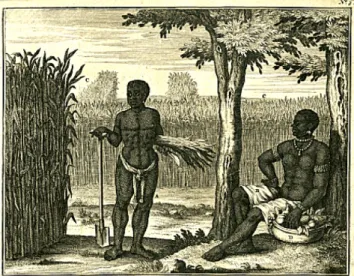
Figure 2: Depiction of Surinamese slaves on the plantation
From J. D. Herlein’s Beschryving… (1718), p. 95.
22
propensity, hateful and stubborn” and devil-worshipping (Herlein 1718: 96, 105) contrary to the meek (yet savage) disposition of the Indians. However, because of the newness of the problem, Herlein does not yet “place” maroons into the natural habitat of the interior as easily as he does the indigenous populations.10 Where Indians are depicted as belonging to the Surinamese rainforest lifeworld, maroons that have escaped into the interior are only described in relation to the plantation11; consigned to neither (Dutch) culture nor (exotic, Othered) nature, the
Surinamese maroon is merely a faulty piece of technology over which the Dutch (still) possess the totalizing right of mastery; but this technology will soon reveal itself as utterly recalcitrant to Dutch attempts to discipline and punish, causing a rupture in the colonial perceptions of
maroons.
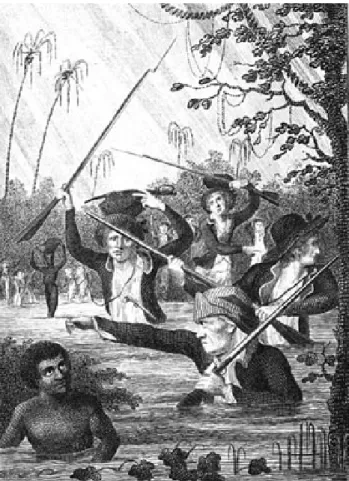
The discourse about the interior’s wildness/savagery would gradually shift into one of imminent and palpable danger in the later 18th century. This was in part because the rainforest gradually became known as a landscape of disease and death (a topic for another paper), but certainly another key factor was the escalating threat posed by marauding maroon bands. In his influential Narrative of a Five Years’ Expedition… (1790/6), John Gabriel Stedman provides an account of the largely incompetent and unprepared expeditions into the interior to hunt for maroons, liberally sprinkling in lascivious and explicit details of “beautiful Negroe Maids” and his sexual relations with them, in particular one slave girl by the name of Joanna. Along the way, Stedman recounts survival tales of the jungle and tremors of tropical fever, and the sheer
10 Marronage had begun several decades earlier, but many of the major raids that Price (1983) documents—which
might have forced the Dutch to reimagine maroons as possessing significant environmental knowledge and cunning—had not yet taken place.
11 An exemplary quotation from the text: “The Surinamers have also suffered major damage to its slavery ventures,
23
European incompetence in abiding such hazards. “Innumerable, indeed,” Stedman writes, “are the many plagues and dangers one is hourly exposed to in the woods of this tropical climate,” before listing a host of them (Stedman 1992: 204).12 Indeed, Stedman himself observes that the sheer necessity of the military campaign is the only reason for entering this unconquerable interior to begin with, for such natural obstacles have made interior exploration virtually impossible for the European observer (Pratt 1992: 92).
The maroons, on the other hand, are understood by Stedman to demonstrate an authentic and natural mastery of the very same tropical bush which the European soldiers are woefully inept in circumnavigating and surmounting. Throughout the narrative, Stedman is effusive of the environmental knowledge mobilized by his maroon adversaries, not only in their guerilla-like tactics used against Dutch raids but also in subsistence: “in a state of tranquility they seemed as they had said to us [to] want for nothing—being plump and fat at least such we found those that had been shop—for instance game and fish they catch in great abundance by artificial traps and springs, and which they preserve by barbecuing, while with rice, cassava, yams, plantains, and so on, theyr fields are ever over stoked…” (Stedman 1992: 409-410; he goes on at length to describe other creative, skilled usages of the land, including for the production of material culture). Where Herlein’s escaping slaves are clumsy and helpless in the rainforest, their ever-temporary residence before recapture, Stedman’s maroons come off as veritable masters of the rainforest. Indeed, this narrative as presented by Stedman is consonant with maroon (or at least,
12 At the same time, Edenic imaginary endures in the narrative: for Stedman, Suriname nevertheless resembled a
24
Saramakan) memories inscribed in first-time knowledge as documented by Richard Price in his
First-Time (1983).13 How does Stedman account for this mastery?
I argue that in addition to the high profile of several key maroon victories, the explanation must be sought in Stedman’s New World ontology of nature. Where Herlein
hesitated from placing the maroon population into the rainforest’s taxonomy of nature, Stedman has no problem doing so nearly eighty years later. In the Narrative, Stedman frequently depicts maroons as Rousseau’s “natural man” or noble savage, not essentially dissimilar from Europeans but without the “mixed blessings of civilization” (Stedman 1992: lviii): “the Africans in a state of nature, are not that wretched people which they are by too many ignorant European wretched represented” (Ibid., 189). In effect, the overall tone of the manuscript conceives of maroons as carefree, state-of-nature forest dwellers.14 Stedman’s inclination to write the maroons into nature can moreover be discerned through his use of several well-known colonial tropes and rhetorics.
13 See, for example, this vignette about the 1749 battle of Bákakúun: “Bákakúun. The whites’ guns were useless
there. They killed those whites like nothing. The big ditch. In order to get up the hill, you had to walk in it. They rolled the tree stumps down there, zálálátje, all the way down to the bottom. So many were killed! (Aseedu 22 July 1978)” (Price 1983: 137).
14
25
Figure 3: “March thro’ a swamp or Marsh in Terra Firma”
By William Blake, depicting a raid into the interior, fromStedman’s Narrative... (1992), p. 211.
26
without culture), but in other ways they are entirely Other, from an Othered landscape of feral humans and monkeys. Palpably, this ontological paradox served simultaneously as a complex source of anxiety and eroticism for Stedman, but it also affirms the point that for Stedman, there is a certain though not fully purified naturalness about the maroons in the Surinamese landscape.
Stedman’s love affair with Joanna is also testament to this tension, in that he clearly bears strong affects for her yet only insofar as she is the exotic, non-civilized human creature from a different world. Upon returning to England, his passionate, lustful memories of his time with Joanna prompts him to write his own account of Edenic life on the wild coast. In grandiloquent and sentimental language, Stedman remembers his passionate days with Joanna in terms reminiscent of Milton’s Paradise Lost:
Not Adam and Even in Paradise could Enjoy a greater Share of felocity, than we now did—free like the roes in the forest and disentangled from every care and fashion, we breathed the purest Ether in our walks, and refresh’d our limbs in the Cooling limpid Streams, health and Vigour were not again my portion, while my Mulatto flourished in youth and beauty, the envy and admiration of all of the River Comewina” (Ibid., 260).
In Imperial Eyes, Pratt provides a lapidary analysis of Stedman’s sexual rhetoric. She reads Stedman’s transracial love plot as a colonial narrative in which European supremacy is
27
In sum, Stedman weaves a conception of an impenetrable, untamable, savage, yet also luscious and virgin jungle (like Ralegh, he compares Suriname to a large and beautiful garden), and infuses this imaginary with a racial geography suggesting that only similarly feral races, like Indians and “Bush-negroes”, may survive and ultimately thrive in this tropical climate and therefore belong to it (Redfield 2000: 193-4). Almost certainly, the difference between Herlein and Stedman can in part be explained by the historical persistence and growing importance of marronage and maroon resistance into the interior, the emergence of ‘maroon’ as an analytical category, and the formation of distinctive maroon societies—Stedman distinguishes between the Saramakas and N’Djukas, two maroon groups that had by this point become settled in different parts of the interior (cf. Figure 1). But in addition to this historical background, I argue that in order to make sense of Stedman’s inclusion of the maroons belonging in the natural world, we need to register the complex assemblage that may have included (among other things) racial geographies and ideologies, colonial desires and eroticisms, and prior imaginings of the Surinamese interior.
28
From somewhere far away, behind the jungle wall, would come the dum-dum-dum-dum-dum, of a tom-tom calling back forgotten gods, sounding the old rhythms that open for the negro just a crack, the heavy door of forest mysteries. The beating of a tom-tom is a strange sound. When a white man hears it he either curses and with nervous fingers lights a cigarette, or grows quiet and wonders at the unfamiliar pressure on his heart He cannot understand. The black slaves heard and did understand. The tom-tom sound crystallized their longings, brought back with undiminished passion the rich memories time had faded. It recalled earth-scented clearings near old Congo, cool impassioned nights high upon the great Mandingo plateau in West Africa. The drums relighted in fancy the red fires before the headmen's houses when the leopards barked far away, hyenas laughed, witch-men danced in carven masks, and women with shining breasts crooned to babes who would live to hunt the elephant. (Vandercook 1926: 8-9)
This long diatribe about Africa is followed by countless instances throughout the text in which the author painstakingly seeks to connect maroon social and cultural customs to an African origin. Interestingly, as Price & Price (2003) point out, Vandercook’s writing coincides with an emerging American academic fetishism of the Surinamese maroons, and in particular the Saramaka who had become “a sort of anthropological metonym…providing the exemplary arena in which to argue out certain anthropological claims about a discursive domain called Afro-America” (3).15 In the late 1920s, two important academic texts were being written about the maroons: Morton Kahn’s Djuka: The Bush Negroes of Dutch Guiana (1931) and Melville Herskovits’s Rebel Destiny: Among the Bush Negroes of Dutch Guiana (1934). Kahn was a physician who had conducted epidemiological studies among the Saramaka, and he accompanied Herskovits—an anthropologist trained by Franz Boas—and his wife in 1928 and 1929 on
ethnographic expeditions.16 These expeditions, and their resultant texts, turned out to be pivotal in the development of Afro-American studies in American academia (Price & Price 2003: 2), as
15
This quotation is actually approvingly cited by Price & Price as being written by a “recent critic”, but they do not name or cite them. Interestingly, the critic is David Scott and the essay is “That Event, This Memory: Notes on the Anthropology of African Diasporas in the New World” (1991). In this piece, Scott takes Richard Price to task for assuming that the history and culture of African diasporas like the Saramakas has to be “anthropologically argued out in terms of a notion of an authentic past,” which for Price is the event of slavery and the subsequent maroon struggle for autonomy (Scott 1991: 278). For a rebuttal, see Price 2006.
29
both of these authors sought to position the maroons as the most authentically African culture in the Americas (Ibid., 15; Scott 1991: 275-277). Indeed, such sentiments were widespread: Allen Counter, a well-known biologist, and David Evans, an “anthropology-oriented Harvard
administrator” (van Velzen 2004: 35) proclaimed in a Newsweek article that the ‘Djukas’ are a lost tribe that had successfully preserved its African heritage and wrote in 1974 that “the defiant Djukas, who won the right to choose their life-style, have existed in the deep interior virtually unchanged for three centuries” (Ibid.).
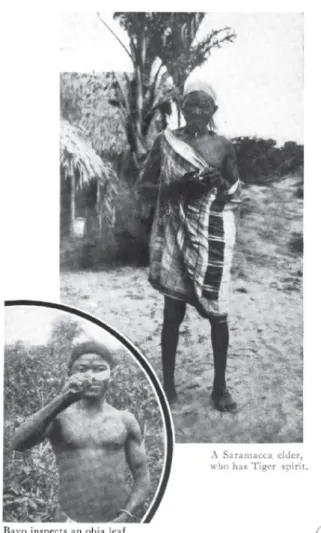
Figure 4. Left: “Bayo inspects an obia leaf.” Right: “A Saramacca elder, who has Tiger spirit.”
30
Let us briefly examine one of these academic texts to pull out a few themes characteristic of this body of texts, before returning to Vandercook. Morton Kahn, who writes in order to admonish and praise the maroons for their adaptation to a new environment (Kahn 1931: xix), tells us that the “wild Bush Negroes still maintain in South America the ancient customs and venerable economy of the jungle dwellers of West Africa” (Ibid.: xvii). Indeed, the similarities of the African and Surinamese jungles (in which the white man is weak and dependent (Ibid.: 5)) played a pivotal role—maroons were enabled in their flight from the plantation by “the wild and inaccessible jungle, the ancient abode of their ancestors…Their way is the way of the jungle; they cannot do otherwise and survive” (Ibid.). Because many of the maroons were first generation, they were readily able to duplicate the manners and habits of their West African birthplace in the Guiana bush, which was “much like the African bush” (Ibid.: 183). Herskovits’s ethnohistory is more nuanced and careful, but the same desire to discover Africa underlies much of the text, which is equally infused with fear and anxiety about the rainforest and the terrifying dangers that it harbors. What I wish to draw out of this discussion is the prevailing perception that the African-derivative “maroon culture” lends itself to a wild jungle existence in a natural way, whereas “white culture” does not.
31
world. But it their own,” (Ibid.: xv) and the attempts of white colonists to domesticate the jungle fall impossibly short, for “when a year has gone the forest has taken back its own so thoroughly white men find it is hopeless to dispute any longer. The land has returned forever to the jungle and to the black men who are masters of the jungle” (Ibid.: 27).
As with Kahn, the African heritage of the maroons is pivotal for understanding their mastery, for it is their “ways of life, remembered from Africa” that taught them to comprehend the jungle (Ibid.: 49). Whereas Kahn and Herskovits are more careful to register the fact that maroons were greatly assisted by the indigenous populations in learning about and adapting to the new environment, Vandercook draws our attention to the vast similarities between the
Central African and Surinamese jungles which are “the same as they have always been…literally the oldest thing on earth” (Ibid.: 119). For Vandercook, adapting to the jungle is the only
historical fact of the black race (Ibid.), and so the transition from one jungle to another was both seamless and natural for the maroons. The underlying claim being made here is that the ontology of these two natural landscapes is the same, and therefore we may expect the inhabitants of one to easily be placed into the other. The maroons’ temporary capture and bondage was but a brief interruption of their otherwise non-changing state of existing in eternal equilibrium with the jungle, and should have left no impression on their quintessentially African culture.17 Hence, Vandercook has no trouble declaring, with a poetic flourish: “the bushnegroes are part of the jungle. In the eternal forest they, too, enjoy a perpetual summer of the soul. They never die” (Ibid.: 139).
17 Obviously, Vandercook never spent any time at cock’s crow listening to First-Time stories. Perhaps Price had an
32
One of the most telling passages in the text concerns the use and possession of magical abilities. The Dutch and English planters, Vandercook explains, marveled at the maroons’ ability to thrive in the forest in spite of the perilous conditions and the lack of supplies (and again, this is vis-à-vis their own powerlessness in the rainforest). Aside from their jungle habitus, they had to have some other skill or power over the jungle, which “converted the unseen enmity of the jungle into friendship” (Ibid.: 28).18 At this point in the text, Vandercook makes reference to the indigenous populations of Suriname, which he only does twice throughout the entire book. Vandercook retells a story of a powerful black witch-man, who the Dutch tried to kill on
numerous occasions. They fired shots from their muskets at his heart, but he would just laugh at them. They enlisted a Carib chieftain and his son to assist, and they fired a rain of poisoned arrows which also failed miserably. Then the chieftain, who was also a magician, took two magic arrows that he had saved for some worthy occasion, and fired them at his eyes. The maroon magician collapsed “and his spirit fled among the trees” (Ibid., 29-30). The story is supposed to have been authenticated by numerous accounts, says Vandercook, before noting that
“explanations seem strangely superfluous in all talk of things that transpire within the farther jungles” (Ibid., 30-31).
In this story, it is only another kind of “bush-dweller”, another primitive, another “wild man” who is able to challenge the maroon’s obia and successfully defeat him. As Taussig points out, “Indianness” or “wildness” in the Putomayo region is closely tied with magical
empowerment (Taussig 1987: 99, 152, 171). As he puts it, “it is not just that Indians and blacks have been identified with evil in the depths of a class structure mediated by whites ascending to
18
33
the godhead, but that from those depths spring power” (Ibid.: 169). The further away that Indians and blacks get from their primordial condition of wildness, the less magical power they are imputed to possess (hence, the lowland Indians of the Putomayo region, who are less
“creolized”, are understood to be the most powerful). By placing the maroon magician on equal grounds with the Carib chieftain, we see that Herlein’s hierarchy of jungle races has shifted dramatically. With this gesture towards the maroon’s possession of jungle magic, the writing of maroons into the Surinamese rainforest is complete. In the colonizers’ eyes, because of the similarities in jungle landscapes in the Amazon and Western Africa, the ‘placement’ of Africans
in the Amazon is both natural and seamless. “The negro mind differs from ours in just the same way as a tract of equatorial woods is unlike a New England meadowland” (Vandercook 1926: 113). Vandercook’s conceptualization of the jungle black man would go on to have a strong influence on the public perception of maroons; Price & Price 2013 describe a Brazilian
34
CHAPTER 5: MODERNIZATION, DEVELOPMENT, AND WILDNESS: A SHORT MEDITATION ON THE PRESENT-DAY SALIENCE OF BLACK-IN-GREEN
“Out of all that I have told you, all has not yet come true,” he replied enigmatically. “But there must be one thing plain to you, that there is radium here, whether I have found it or not. And it must be plain, even to you, that there is gold that has not been dug, and electrical power in the greater waterfalls of the rivers that has not been harnessed, and great forests of magnificent woods that have not been explored, and mineral deposits of vast value that they have not mined. Those stupid Dutch burghers in Paramaribo, with their narrow views—what do they know of colonization, what do they know of development? They think only of the present. They sleep with their black sluts, they beget themselves half-breed children to help them in their impotent
governing. They are blind! Waste, waste, waste! – Bush Master: The Jungles of Dutch Guiana, Nicol Smith (1943, p. 220)
My argument throughout the preceding section has been that we can utilize travelogues and travel narratives to index how maroons, from the period of slavery into the early 20th century, were gradually imagined as being part of the natural landscape of the Surinamese rainforest. In this section, I would like to show concretely how these representations of maroons were conscripted in a series of development interventions that began in the middle of the 20th century. To do so, we will need to trudge through two more travel narratives, in order to understand how the above tropes came to be redeployed in this assemblage of modernity and development, which so far has not been discussed at length. We are traveling sixty years back in time from where Vandercook left us, to a historical juncture during which the practice of
35
William Gifford Palgrave, a renowned English traveler whose curriculum vitae includes an expedition into the terra incognita of the Arabian peninsula, published a volume about his travels and observations in Dutch Guiana in 1876, and dedicates a good portion of the text to conferring discreet advice from an English perspective. In this work, Palgrave also attests to the verdure of the Surinamese natural world, while also taking due pause to comment on the
grueling, savage tropical climate and its adverse effects on European salubrity (Palgrave 1876: 206). However, Palgrave is far less interested in indulging in erotic poetics of the bush, or in the pursuit of discovering Africa in the Americas; as a sober-minded servant of the British Foreign Office steeped in liberal economics, he is exclusively interested in what Suriname has to offer in terms of resource extraction. In an illustrative passage, Palgrave suggests that
there is no tropical field-growth but finds, or might find, a home in Dutch Guiana; no valuable timber but forms part of her boundless forests; no costly spice is a stranger to her soil; no useful extract alien from the list of her resources. Suriname is the triumph of vegetable life: the triumph of human industry alone is waiting to subjugate and complete (Palgrave 1876: 248)
In other words, Suriname holds an untapped profusion of natural wealth that the Dutch have simply failed to capitalize upon. The suggestion made throughout the text is that the wilderness
36
What can a treatise like Palgrave’s tell us about representations of maroons in Suriname? Aside from the absence of knowledge about the hinterland, Palgrave argues that the central deficiency of Suriname is the dearth of population—particularly an able population capable of laboring and working the land properly for cultivation and extraction (Palgrave 1876: 254). Like Vandercook, Palgrave trades in on the racial-geographical tropes of the time to argue that the maroons living in the interior present a “copious and, as yet, unemployed reserve force of labor” (Palgrave 1876: 173), in contrast to the “coolies” (or Asian laborers) whose natural physical constitution was understood to be deficient for work in the harsh tropical climate (cf. Redfield 2000: 194). Indeed, in a chapter dedicated to “bush negroes,” Palgrave even argues that the maroons’ climactic aptitude is unrivaled by “Indian aborigines,” who have “wasted away and disappeared, unable not merely to compete but even to co-exist with their African…neighbors” (Palgrave 1876: 142). Palgrave opines that the Bush negroes “hold a good position among men; better, certainly, by far, than that occupied by most of the aboriginal races of the South American continent” (Ibid., 164). Positively estimating their overall resilience, fortitude and
industriousness in agriculture and woodcutting (though delineating a gradient from “best to worst” among maroon groups as has been cliché since Stedman onward), for Palgrave the maroons are the most naturally and climactically apposite bodies available to live, thrive, and most important of all, labor in the brutal rainforest landscape.
37
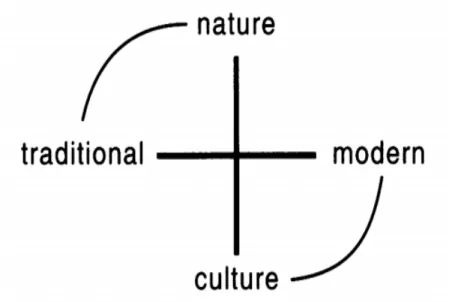
civilization and ultimately put to use towards the colony’s development. In Palgrave’s racial ontology, maroons bear natural attributes of physical strength and industriousness, but the possible riches that may be harvested by means of these attributes are unattainable so long as they remain in a perpetual state of savagery (in nature). In a number of ways, we see the maroons subjected to a version of what Bruce Braun has called the colonial rhetorics of ‘wilderness’ (figure 5), in which the maroons are conflated with nature only if they remain ‘traditional.’
Figure 5. “The colonial rhetorics of ‘wilderness.’
By mapping these dualisms onto each other (culture-nature, modern-traditional) native peoples are conflated with nature and areas are seen to remain natural only
if the cultures that live there remain ‘traditional.” From Braun’s “Buried Epistemologies…” (1997), p. 22.
With Palgrave, Ralegh’s tropes resurface yet again, although their meaning is somewhat ruptured as a result of their recalibration towards Palgrave’s late nineteenth century universe of
38
that were becoming prevalent at the time of writing. Nevertheless, a unique trajectory of representations can be discerned from Herlein to Palgrave: the maroons are gradually written into a rainforest already saturated with colonial imaginations, but then with Palgrave, this enduring discursive representation of maroons-in-nature ends up soliciting their development (Wainwright 2008). This is, of course, a closely related assemblage of representations as the one traced in the previous section, but it is nevertheless unique in its prescriptions and mobilization.
Importantly, this assemblage of representations does not vanish with Palgrave’s sober-minded British outlook at the end of the 19th century. In the years which follow, the maroon landscapes came to be highly coveted from the perspective of an exponentially intensifying colonial gaze of the forgotten colony’s interior. This valuation of the maroon-inhabited rainforest figured its way into travelogues of this period as well, such as Jungle Gold: Dad Pedrick’s Story
(1930) and Bush Master: Into the Jungles of Dutch Guiana (1943), both American in nature and published through the Bobbs-Merrill company. Jungle Gold is an account of the early days working on gold extraction in the Surinamese interior, and Bush Master is a fictional narrative based off the author (Nicol Smith)’s own travails in the country. The latter text inundates the reader with a number of passionate, polemical rants about the underdevelopment of the country’s interior through the voice of his protagonists. A number of them sound very similar to Palgrave about the need to develop the interior, as seen in the invective passage which opens this section as well as the following quotation, given as an answer to a question about why Holland has neglected this “black daughter of hers”:
39
nothing at all but a few scattered villages near the coast—and all the rest is virtually unexplored jungle! Do you wonder that I say the possibilities of the country have been neglected? (Smith 1943: 36).
As the reader of the previous section of this paper might suspect, this trope of plentitude is not left alone without its cousin danger, and indeed, one of the characters tells us that “‘ten miles in there is nothing but sickness and death, murder and Black Magic” (Ibid., 42). Smith tells us relatively little about the maroons of Suriname, but he channels Vandercook in a number of places in relation to the possibility of “voodoo” and magical practices: “Here at the edge of the great jungle we see only the outer wall of the forest. It seems just as it has always been. But who knows what has been going on behind that green wall? For all we know, the men who live in the bush may have been developing a knowledge of the mysterious forces of nature which have been denied to the men in the laboratories of civilization” (Ibid., 56). But in spite of this amplified feeling of anxiety about the threat posed by the rainforest to white colonizers, the characters in
40
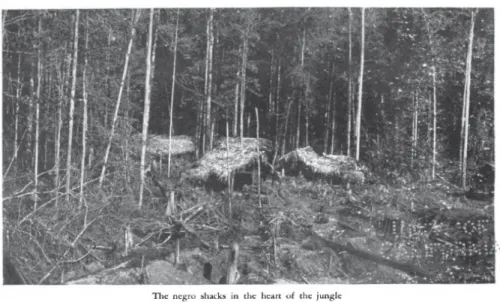
Figure 6. “The negro shacks in the heart of the jungle.”
From Pedrick’s Jungle Gold: Dad Pedrick’s Story (1930), p. 112.
This discourse about the need to develop the rainforest, in particularly the mineral-rich landscape occupied by maroon groups like the Saramaka and N’Djuka, became absolutely central during Suriname’s development era from the mid-1960s onward. During this time, the economic development regime of the Netherlands increasingly began to target the development of the maroons as part of this strategy. According to a Dutch historian, the maroons were
perceived as having “no productive value to the colony...All this would have to be changed, also for the sake of their own advantage. Material benefit for the colony, it was hoped, would accrue from the gain of labour and the heightened productivity” (de Groot: 2009: 164). This meant putting effort into civilizing maroons into becoming ‘useful members of the community’ through education, evangelization, and tighter administrative control but also through increasing
41
then Prime Minister Josef Pengel, who is one of the two most important figures in Suriname’s stride towards independence,
there is a shortage of educated [maroon] laborers, but bush-negroes are finally becoming empowered [ingeschakeld; literally, plugged in, or activated]. They were not yet part of the economic process. It will take months to reach the villages, but now already there are 26 airplanes in the interior” (Hasen & de Wagt 100-101).
The Afobaka dam served as the first occasion for the territorialization of maroon lands in the interior. As Richard Price points out, from the perspective of the Dutch government this large-scale development initiative seemed like a natural stride into modernity, but for the maroons it represented the first true incursion into maroon territory since the 18th century raids described by Stedman (Price 2011: 33, 38). Many would follow, particularly in the form of resource extraction of bauxite, lumber, and gold. For many Surinamers today, maroons are understood as remnants of the stone age who need to be ‘developed’ or brought into the modern era (Kambel 2007), and the apparent disjunction between development and preservation of traditional cultures is often mobilized by politicians to argue in favor of the former (because not
developing is, by default, an impossibility) (Price 2011: 199). The feeling of danger has
gradually eroded as incursions and infrastructure-building in the interior escalated, although the 1980s war of the interior lead by maroon militant Ronnie Brunswijk momentarily resuscitated old feelings and anxieties about the dark threat lurking in the bushlands.
From Palgrave’s text to the Afobaka dam, we see how the sedimented tropics of maroons explored earlier came to entangle with liberal ideas about national development, resource
42
some very real, material consequences, most of all for the maroons themselves. The
43
CHAPTER 6: CONCLUSION: REPRESENTATIONS IN NETWORKS
“Come discover Suriname - Friendly, Pristine and Welcoming. Suriname is a land of enormous cultural diversity and one of the few spots in the world where the tropical rainforest [is] still completely virginal. The country's unusual blend of African (including the Bushnegro cultures of the interior), Asian, European and native Amerindian culture elements contribute to Suriname's tourism appeal,” an ecotourism website serenades to me, before attempting to sell me on a tour that will allow the more daring spirits among us to strap on our expensive adventurer’s gear and trek deep into the interior to “learn more about the culture of the Saramaccans, in their natural habitat, the Amazon rainforest.”19 Virtually all ecotourist firms in Suriname croon the same sales pitch, although some use more subtle melodies than others. Ecotourism in Suriname
always entails finding both okopipi, the naturally blue poison dart frog doing natural stuff in nature, and the traditional maroon doing traditional stuff in the traditional village (which, of course, is itself located in nature as well). Something about the song sounds familiar… It’s really not the same melody that Ralegh whistled to try to win Queenne Elizabeth’s Favours, nor does it quite incorporate “sexy jungle rhythms” as Stedman did (do I hear it in the background though?). The lyrics have certainly changed; in place of the epic Olde English refrains about Guyana missing her “Maydenhead, never sack’t,” we get (similarly epic) verses about biodiversity, world heritage, and authentic cultural experiences. Déjà vu; where have I heard this before? Did I just hear a clever play on words about fertility and savagery, or am I just making things up?
19
44
Back to the atonal, mostly undanceable language of academia for a moment: the by-now familiar representational tropes of the tropical rainforest—fertility and erotics, wildness and savagery, primordial and undomesticated, unknown and untapped—that we’ve explored in travelogues continue to be at play in contemporary imaginations of the jungle. And the maroons are still represented as belonging in this forgotten natural paradise. Which is not to say that it is the only set of representations that circulate; after all, the ensemble of discourses, practices, and institutions relating to conservation and ecotourism are politically positioned over and against the ever-encroaching threat of resource extractivism, which comes with its own sets of
representations perhaps hearkening back to the historical assemblages of which Palgrave and Smith were a part. Another competing set of representations that I have not discussed at all are those of the maroons themselves20; is their reality accurately depicted by the “them” in Bruno Latour’s “them and us” chart in We Have Never Been Modern (p. 102)— characterized by endless relations between quasi-objects that defy being fitted into sui generis domains of nature and culture—or are we (moderns) speaking for “them” by saying so? What kinds of
representations of the rainforest shape and color their meshwork, their ontology—is it
‘nonmodern’? Or has the genealogy of representations going back to Herlein’s semiotics of the “blessedly fertile” managed to be active in the constitution of their reality also?21 Especially after the incursions into maroon territory from the 1960s onwards, how has the exigent need to enact a politics of land and nature shaped the agency of their representations? Questions that have gone unanswered in this essay, but which certainly merit their own investigation. I index them here
20 One could consult Price 1983 and 1990 as a start; however, the maroon representations contained within these
texts were selected/curated by Price and partial in kind, as Price himself might acknowledge.
21
45
only to register the fact that the colonial representations in which this study is mired are not necessarily totalizing—slippages certainly occur and “worlds and knowledges otherwise” (Escobar 2008) do remain a possibility, or reality. The objection can be made that there is a kind of epistemic violence that comes out of choosing to narrate only these colonial representations and their politics as being agentive in the “writing of maroon culture,” and I certainly do grant that “the text” as such is incomplete without the inclusion of such other accounts. 22 However, my point has been to emphasize that these colonial representations have a certain deep-rooted, obstinate hegemony, and therefore must be grappled with as a major force in the writing and ontologizing of maroons in nature.
What I hope to have done in this paper are several things. First, to demonstrate that representations matter and have an effect in the “real world.” Second, to show that ‘cultural studies of the environment’ can be deployed and rendered useful in the framework of the ‘nonmodern ontologies’ moment, as per Braun’s typology. Third, to say something about the genealogy of specific imaginations of the Surinamese rainforest as a particular kind of natural-cultural space. And lastly—although I have not been explicit on this point—to show that clean epochal distinctions between ‘colonial’ and ‘post-colonial’ are ambiguous and messy at best: supposedly long-forgotten colonial pasts continue to organize experience in the present. In places like Suriname, I argue, colonial representations are very much part and parcel of the complex machines that are composing or conducting the overtures of the rainforest and its inhabitants.