School of K-pop: Teaching a Nation Through Idol Survival Programs
Grace Kweon
A thesis submitted to the faculty at the University of North Carolina at Chapel Hill in partial fulfillment of the requirements for the degree of Master of Arts in the Department of Music.
Chapel Hill 2018
© 2018 Grace Kweon ALL RIGHTS RESERVED
ABSTRACT
Grace Kweon: School of K-pop: Teaching a Nation Through Idol Survival Programs (Under the direction of David Garcia)
Notes on Romanization and Translation
TABLE OF CONTENTS
LIST OF FIGURES . . . vi
CHAPTER ONE: INTRODUCTION . . . 1
Produce 101: A National Guide to K-pop Production . . . 3
Methodology . . . .9
Literature Review. . . 11
Thesis Outline . . . .16
CHAPTER TWO: UNPACKING THE K-POP CLASSROOM . . . .. . . .18
The School Scene as a Symbol of Korean Modernity . . . 20
“F”-Level Trainee Kim So-Hye . . . 23
The School Scene as a Site of Youth Oppression . . . .26
Learning and Teaching “Pick Me” . . . .28
CHAPTER THREE: HARNESSING K-POP’S GIRL POWER . . . .35
Policing the Girl Body . . . 36
Policing Girl Behavior . . . 41
Policing Musical Girlhood . . . 45
Girl Powered Idol Republic . . . 49
CHAPTER FOUR: CONCLUSION . . . 52
LIST OF FIGURES
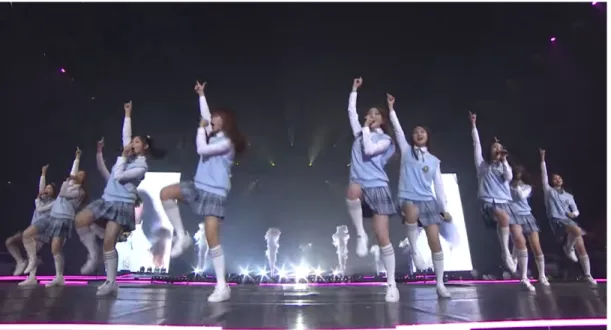
Figure 1 - I.O.I performs "Pick Me" at KCON France 2016. . . 2
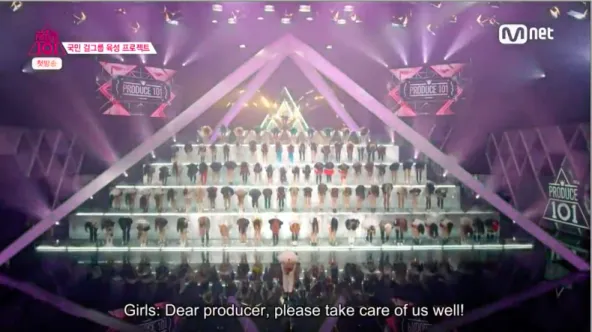
Figure 2 - Trainees of Produce 101 bow to the viewers . . . 4
Figure 3 - Idol survival program trends . . . .8
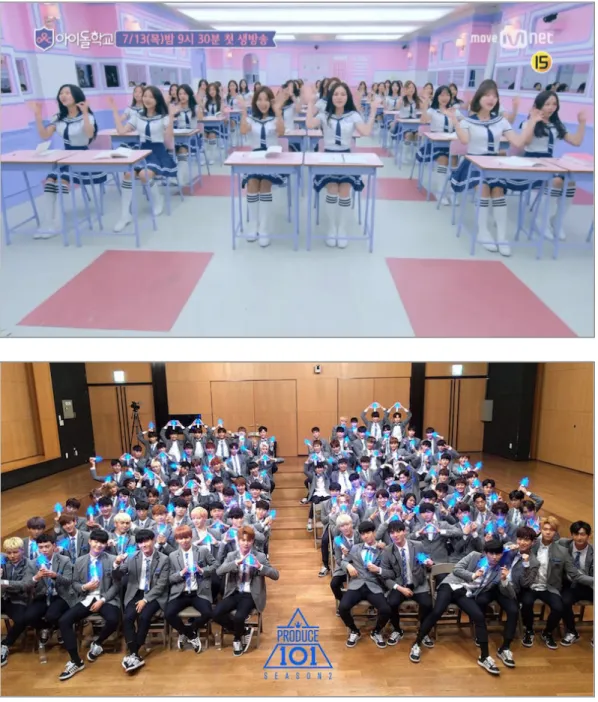
Figure 4 - Classroom environment in idol survival programs . . . .19
Figure 5 - Kim So-Hye singled out for criticism during rehearsals . . . 23
Figure 6 - Kim So-Hye and Kim Se-Jeong rehearse together . . . 24
Figure 7 - Coach Bae Yoon-Jung sheds tears after Kim So-Hye’s routine . . . 25
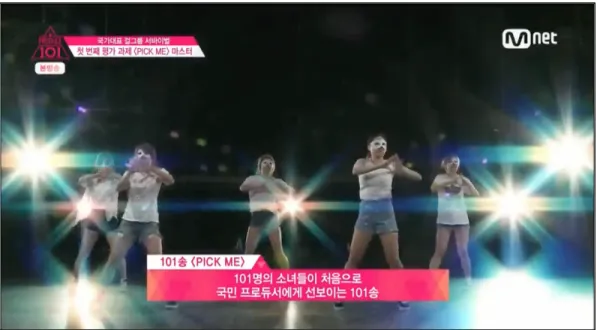
Figure 8 - Training video of dancers performing “Pick Me”. . . 29
Figure 9 - First group performance of “Pick Me” . . . 31
Figure 10 - A fictional map titled “Hell Joseon: An Infernal Hellfire Peninsula” . . . .34
Figure 11 - Comments about Kang Mi-Na’s body displayed on the screen. . . 38
Figure 12 - Kim Se-Jeong during the “Loyalty Test” . . . .44
Figure 13 - Jessi confronts the other contestants of Unpretty Rapstar with a diss rap . . . .46
Figure 14 - Jeon So-Mi reenacts Jessi’s diss rap . . . 48
Figure 15 - Apink’s Son Na-Eun holds a phone case that reads “Girls Can Do Anything” . . . . .50
CHAPTER ONE INTRODUCTION
In Paris of 2016, eleven girls in school uniforms performed at KCON, the largest K-pop festival in the world. These girls were members of the popular girl group I.O.I. In attendance were the then South Korean president Park Geun-Hye and some French diplomats, watching alongside twelve thousand screaming K-pop fans. Weaving through the popular music and political spheres, these idols of the industry have become the face of Korean culture as K-pop expands into international communities. This is a part of hallyu, also known as the Korean Wave, which refers to the sudden global popularity boom of Korean cultural products. The ongoing phenomenon of hallyu began in the late 1990s with the success of Korean TV dramas in Asian countries. A decade later, K-pop overtook the TV programs as hallyu’s main driving force. Music entertainment agencies have recognized that K-pop stars have incredible potential as cultural ambassadors. They recruit en mass young aspiring stars, or “trainees.” Once
contractually bound to these agencies, the trainees undergo rigorous physical, social, and moral training for years until their debut as idols. Upon achieving some success, the idols are
Figure 1: I.O.I performs "Pick Me" at KCON France 20161
Since the start of hallyu, successive Korean governments have also played their part in idol manipulation.2 They eagerly allocate resources and create policies to support the idols’ activities abroad to promote the national culture industry. The nation-state frames the idols’ international fame as a national success in the global soft power competition.3 For decades, the people within Korea have kept an eye on such developments with interest, but increasingly, everyday K-pop consumers and bystanders are looking to take part in these nationalist projects. They found one such opportunity for K-pop participation in the TV shows featuring trainees— specifically, reality competition shows labeled as “idol survival programs” (아이돌서바이벌
1 Image captured from video by Mnet K-POP, “[KCON 2016 France×M COUNTDOWN] I.O.I_Pick Me M
COUNTDOWN 160614 EP.478,” YouTube, 14 June 2016, www.youtube.com/watch?v=R8pdS-fqiA8.
2 For an overarching summary of policies through the decades, see Yong-Jin Won, “Hallyu: Numerous Discourses,
One Perspective,” in The Korean Wave: Evolution, Fandom, and Transnationality, ed. Tae-Jin Yoon and Dal-Yong Jin (Lanham, MD: Lexington Books, 2017), 37-38.
3 Jocelyn Yi-Hsuan Lai, “East Asian Stars, Public Space, and Star Studies,” in Routledge Handbook of East Asian
프로그램). The label itself is helpful in understanding the format of the show. “Idol” indicates the ultimate goal, which is to turn the competing trainees into full-fledged idols by the end of the season. “Survival” refers to the fact that viewers get to evaluate and eliminate contestants
regularly through votes. The trainees that “survive” through the end win the competition, at which point they debut together as a new K-pop group. And finally, “program” is the operative word in the label, at least for the purposes of this thesis. Program can refer to the nature of television broadcasts, but it can also refer to an educational program—a set system that prepares the trainees to enter the industry officially. Successful groups like I.O.I debuted by winning these training competitions. As I will explain, these shows emphasize crucial moments of learning rather than moments of musical performance.
Produce 101: A National Guide to K-pop Production
Televised singing competitions are not new to Korean television. Korean programs such as Superstar K (2009-16), K-pop Star (2011-17), and The Voice of Korea (2012-14) presented and eliminated contestants based on celebrity judges’ and audience’s votes, in a similar manner to that of popular music competition franchises such as the Idol series and The X Factor. However, these imported formats gave way to the rise of a new type of reality competition shows, adapted for the particularities of the K-pop industry. Large-scale shifts in Korean music reality shows first drew my attention in 2016 with the success of Produce 101, a show that set the standard for subsequent idol survival programs. As the title suggests, Produce 101 claims to be a beginner-friendly how-to guide for producing K-pop groups. The new format of the
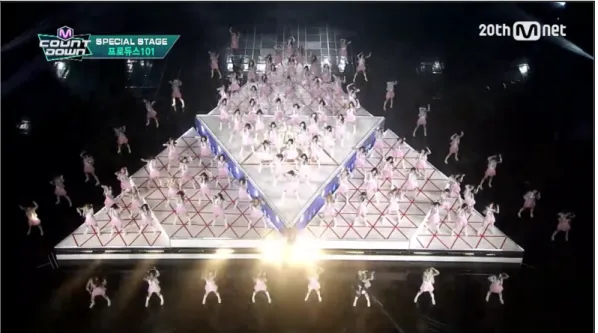
These girls have been preparing anywhere from a couple of months to over ten years, not on a stage, but in small practice rooms . . . We are going to make a national girl group ourselves . . . Produce 101 does not have any judges . . . One hundred percent of the decisions rely on you! Only eleven of these girls are going to represent the girl group of Asia. Are you just going to watch? Vote for your girl now!4
With the monologue concluded, the host Jang moves aside. Behind him, one hundred and one female trainees bow deeply from the waist and shout in unison: “Dear producer, please take care of us well!” (Figure 2). Through the opening spectacle, these young girls have placed themselves at the mercy of the viewers.
Figure 2. Trainees of Produce 101 bow to the viewers5
The premise, as the host explained, is that the national viewers become K-pop group producers, and by extension the nation becomes the agency. For the following four months, these young girls live together and complete challenges. The situation resembles the rigorous training
4 “Episode 1,” Produce 101, directed by Joon-Young An, translated by me (January 22, 2016; Seoul: Mnet),
Television.
5 All images from Produce 101 are captured from an unofficial streaming site, Kshow123.net. The translations for
provided within K-pop entertainment agencies. The show provides “coaches” of varying specialties to comment on the trainees’ progress. The coaches are either famous K-pop stars or K-pop trainers who have helped to create famous groups. Because they have already surpassed the K-pop training system, they can frame their commentary as authoritative instruction from seniors of the industry. But as promised, the final decision each week is up to the voters, who can choose either to vote for the trainees praised by the coaches, or to disregard the coaches’
opinions. Through this structure, Produce 101 invites viewers to reimagine their participation as running a national K-pop agency. The showrunners recruit trainees, and the K-pop professionals coach them. Then, the head of the agency—the viewers—determine which of them are ready for debut. Commentary in Produce 101 is intentionally steeped in nationalist rhetoric. The viewers are pressured to take their role as producers seriously, to remember that their choices are of national consequence. Despite the heavy-handed appeal to nationalist sentiments, Produce 101 more or less conveys the stakes of K-pop production in the real world.
Most of the time, Produce 101 viewers see the trainees in small rehearsal spaces rather than on a performance stage. The contestants are filmed living together in a dormitory-like setting and preparing for the weekly evaluations. Like the CEO of a K-pop agency, the viewers drop in once a week on the practicing trainees to monitor their progress. (This is similar in format to the Star Academy franchise, which also films contestants in a school-like setting.) Because there are one hundred and one contestants, regular individual evaluations are unfeasible within the one-hour episodes. Instead, the coaches divide the contestants into groups and
evaluate each group as a unit. As the girls of Produce 101 struggle to work together, their
at times, the coaches function as the real stars of the show. Due to time constraints, the viewers have few opportunities to learn about the background story of each contestant. Instead, they see more of the contestants’ interactions with their teachers and with each other. With individual stories and performances minimized, the contestants must rely on group rehearsals to appeal to their voters. Therefore, the gateway to global stardom is governed by efforts to control this rehearsal space: the trainees use their own rehearsal behaviors; the industry executives use onscreen commentary; and the viewers use votes.
Produce 101’s success in 2016 led to a new wave of idol survival programs. Though the shows varied in style, the core tenets of Produce 101 remained—national participation and youth education. In figure 3, I have compiled a list of notable idol survival programs and their
characteristics to illustrate a distinct shift in 2016. First, the number of contestants jumped from a little over ten to now hundreds of contestants per season. The increased size meant that unlike before Produce 101, entertainment agencies all across the industry were sending trainees to participate in the shows. I also pointed out the gradual introduction of an official host figure. Previous reality programs involving trainees were small in scope and limited to a single agency, so usually the CEO of that agency would MC the show. With growing numbers of participating agencies, however, the idol survival programs needed a neutral third party to moderate the proceedings. And with growing numbers of viewers, the host began to fill the role of a
professional entertainer to keep audiences interested and invested. I interpret these changes as evidence of a coordinated, industry-wide effort to involve a wider Korean public.
H os t N o hos t (CE O H w ang S e-Jun) N o hos t (CE O Y ang H yun -S uk) N o hos t (a pa ne l of a rt is ts ) N o hos t (CE O Y ang H yun -S uk) N o hos t (CE O P ark J in -Y oung) K im Il -J oong Ja ng G eun -S uk O h Y eon -Seo
BoA Kim
H ee -Chul Ra in N oh H ong -Chul L ee S eung -Gi F igu re 3. Idol s urvi va l progra m tre nds D eb u t G rou p N ame V IX X W IN N E R M ons ta X
iKON TW
ICE M om ol and I.O .I IN 2IT W anna O ne from is _9 U N I.T (gi rl s) a nd (U N B (boys ) N ot ye t de but ed N ot ye t de but ed Wi nne rs
6 boys 5 boys 7 boys 7 boys 9 gi
rl s 7 gi rl s 11 gi rl s
8 boys 11 boys 9 gi
rl
s
9 gi
rl
s, 9 boys
9 boys Not
ye t de te rm ine d C on te stan ts
10 boys 11 boys 12
boys
9 boys 16 gi
rl s 10 gi rl s 101 gi rl s
49 boys 101 boys 42 gi
rl s 126 gi rl s a nd boys 400 gi rl s a nd boys 96 gi rl s Id ol S u rvi val P rogr am My D O L (2012)
WIN: Who Is
Ne xt (2013) No.Me rc y (2014) Mi x & Mat ch (2014) Si xt ee n (2015) F indi ng Mom ol and (2016) P roduc e 101 (2016) B oy s24 (2016) P roduc
e 101 Se
Methodology
Reality TV, to borrow the words of Marwan Kraidy, is a “laboratory where various versions of modernity are elaborated and contested, a courtroom of sorts that hosts modernity’s endless trial.”6 I understand the idol survival program as a localized reality TV format that elaborates and contests versions of a Korean modernity, within the boundaries of K-pop. Three groups participate in this endeavor: the trainees, the showrunners, and the viewers. Given the complex power relations between these groups, they adopt differing strategies to manage their own representation on TV. Accordingly, I examine the show using three separate approaches.
My primary research material is the televised footage of Produce 101. For each case study in this project, I begin with a close reading of key scenes. In my critical listening and viewing, I attend to performance decisions—from vocal style and choreography to attire and facial expressions—enacted by trainees both on stage and in rehearsal rooms. Without readily available commentary from the contestants themselves, I make sense of the trainees’ musical performance through my own analysis. My interpretation is informed by existing scholarship on hallyu and other musical reality TV programs.
I pivot from the trainees to the showrunners, a designation that includes both the coaches and the production team working on Produce 101. My main interest here is how meaning is packaged into the episodes, a process termed “encoding” by Stuart Hall.7 I evaluate the coaches’ televised commentary about the trainees’ rehearsal and stage performances. Furthermore, I look and listen to the footage editing as additional commentary from the production side. On the
6 Marwan M. Kraidy, Reality Television and Arab Politics: Contention in Public Life (New York: Cambridge
University Press, 2010), 18.
7 Stuart Hall, “Encoding and Decoding in the Television Discourse” (paper, Birmingham Centre for Contemporary
whole, the Produce 101 coaches and production staff are senior members active in the K-pop industry; therefore, I consider the showrunners’ interventions to be a reflection of the broader industry’s interests. Building on my findings, I construct an overarching narrative staged throughout the idol survival program.
To gauge the audience response, I turn to critical discourse in Korean online periodicals and Internet literature associated with the show, including interviews and episode reviews. The audience of Produce 101 includes those who vote online regularly and those who simply watched the episodes. I presume that the viewing public is largely Korean or at least Korean language speakers, given that the show did not provide official subtitles in other languages at the time of its airing. I am also mindful of the vote distribution in each elimination round, as the tallied votes are meant to represent a public consensus. Here, I am interested in broad trends in audience opinion each week, as well as specific commentary responding to the trainees and showrunners.
In working through these three approaches, I engage in the topic as a long time K-pop consumer and as a native member of the Korean diaspora. This study began as an exercise in understanding my own positionality as a Korean immigrant in an American musicological institution. I identify as part of the Korean audience that participated in these idol survival programs to create the K-pop groups; simultaneously, I identify as part of the K-pop consumers abroad for whom the K-pop products are tailored.
hearing the coaches’ comments. Contestants, viewers, and producers alternatingly clash in a power struggle and collaborate in perfect synchrony. My thesis is a close reading of these musical entanglements as an ongoing conversation—about Korean modernity and identity.
Literature Review
In my consideration of modern Korean identity and popular culture, I lean on recent hallyu scholarship from media and communication studies. The Korean Wave: Evolution, Fandom, and Transnationality (2017) is the latest and most comprehensive volume of essays, edited by Tae-Jin Yoon and Dal-Yong Jin. The collection not only provides a historical account of hallyu’s past two decades, but also suggests several theoretical frameworks for understanding hallyu’s cultural products. Yong-Jin Won’s contribution to the volume, an essay titled “Hallyu: Numerous Discourses, One Perspective,” was particularly useful to my inquiries. The author outlines policies of each Korean administration since the mid–1990s, arguing that the
government and entertainment agencies worked symbiotically to promote cultural nationalism. Won found that local coverage of hallyu pushed one of four narratives, all of which were nationalistic:
[F]irst, Korea had finally been recognized by the world; second, Korea had occupied the forefront of the world’s attention; third, the economic success of K-pop in foreign countries was derived from the excellence of Korean culture and sensibility; and fourth, increased effort should be made to develop this phenomenon further.8
He argues that because Korean governments have broadcasted hallyu success stories for decades, “[penetrating] everyday lives of Koreans, it has become almost impossible to ask difficult
8 Yong-Jin Won, “Hallyu: Numerous Discourses, One Perspective,” in The Korean Wave: Evolution, Fandom, and
questions or raise criticisms regarding hallyu.”9 My thesis is in part a response to Won’s call-to-action, questioning the idol manufacturing processes that fuel hallyu.
While the vast body of hallyu scholarship and my personal diasporic experiences inform my research, my analysis has clear limitations. Because I approach the televised footage as my primary text, my project is decidedly not an ethnographic study. My interpretations are not based on personal communication with participants in the K-pop sphere. Michael Fuhr’s excellent monograph on K-pop, Globalization and Popular Music in South Korea: Sounding Out K-Pop (2016) serves as an effective counterbalance, as his work draws on his lengthy interviews with heads of K-pop agencies, composers, and trainees located in Korea.
This thesis participates in the contemporary efforts to theorize reality TV and national identity more broadly. Marwan Kraidy considers several reality TV shows in the Middle East in his wide-ranging book, Reality Television and Arab Politics: Contention in Public Life (2010). He argues that the reality TV shows’ success in the Arab world triggered a “period of collective soul searching during which Arabs have debated norms governing their public life and grappled with shifting identities and changing values.”10 His case studies tackle elements of Westernness or foreignness that linger as reality TV formats are imported from the United Kingdom and the United States.
The Korean citizens find themselves in the midst of the Korean Wave, in which the small peninsular nation commands worldwide attention and soft power through its cultural exports. This has created a rise in “cosmopolitan strivings,” efforts from Koreans to participate in a
9 Ibid., 37-38.
10 Marwan M. Kraidy, Reality Television and Arab Politics: Contention in Public Life (New York: Cambridge
globalized world to elevate their social status and sense of self-worth.11 Korean citizens,
governing bodies, media, and institutions all keep a watchful eye on the K-pop industry, with the understanding that the status of K-pop is a reflection of their own status in the world. In the context of idol survival programs, such cosmopolitan strivings mean that the viewers use voting as a strategy to control how their nation represented on the international stage. Andrea Bohlman and Alexander Rehding identified a similar voting strategy being used in countries that
participate in the Eurovision Song Contest each year, a strategy they call the “European two-step.”12 They posit that the voters from each European country elect an artist that will likely appeal to both the domestic and the wider European audiences. Viewers of Produce 101 and other idol survival programs are participating in a Korean two-step, choosing participants that simultaneously embody the Korean ideals of identities and resonate with an international fandom.
Throughout this thesis I rely heavily on research of Western TV shows because the Korean music reality shows themselves were modeled after their Western counterparts. For example, in the book, Idolized: Music, Media, and Identity in American Idol, Katherine Meizel reasons that commercial music and the music industry are not simply forces to be criticized or resisted, but are themselves critical sites for redefining American culture. Following her lead, I also look to the televised K-pop products as a productive site of cultural analysis. These TV shows simultaneously reveal and redefine national understandings of identity. Meizel posits that reality TV competitions like American Idol shrink the gap between consumers and the industry producers, which causes debates about national identity and culture to rise anew:
11 Ho, “Fuel for South Korea’s ‘Global Dreams Factory’: The Desires of Parents Whose Children Dream of
Becoming K-pop Stars,” Korea Observer 43, no. 3 (Autumn 2012): 478.
The barriers have slipped that formerly held apart production and consumption, performer and audience, public and private, reified musical genres, even politics and entertainment . . . But it also contributes to the equation of identity with brand, and to the imagination of the U.S. itself at a historical moment when Americans are struggling with identity on multiple levels—being American in an ever more identity-conscious nation, and being America in a global context with its own blurring borders, that increasingly relies upon transnational economic, political, social, and cultural structures.13
Discussion of identity becomes a discussion of national brand, given the show’s designation as an American endeavor. Similarly, the Korean idol survival programs close gaps between the production and consumption sides and demand that they both grapple with the Brand Korea. In her own analysis of the American brand, Meizel maintains that the American identities and values depicted within American Idol help to imagine the nation first and foremost as a diverse one. She concludes that American diversity is carefully highlighted and coached into a viable commodity by judges, with contestants packaged into familiar portraits of American identities. What, then, are the portraits of Korean identities, as packaged by the new idol survival
programs? My reading is that the episodes of Produce 101 are structured to praise group coordination and collaboration, rather than to emphasize diversity or individuality. These qualities are instilled within the trainees as ideal Korean traits they need in order to properly represent the nation. To gauge the national consensus of ideal Korean traits, I look at which behaviors are commended or criticized by online voters and the coaches.
William Cheng writes about the relationship between reality TV competitions and
national ideals in the North American context. In the article, “Staging Overcoming: Narratives of Disability and Meritocracy in Reality Singing Competitions,” he exposes the ways in which disabled auditionees are exploited to appeal to the ideals of the American Dream—to tell a narrative of overcoming.
13 Katherine Meizel, Idolized: Music, Media, and Identity in American Idol (Bloomington, IN: Indiana University
On a show such as American Idol . . . the American Dream is the star, promising every contestant a shot at fame . . . . [S]ing proficiently enough, on your own merits, and maybe the world will listen.14
But it is difficult to tell a story of overcoming personal adversity in a show such as Produce 101, in the absence of individual performances and screen time. So what overarching narrative is a K-pop idol survival program meant to tell? The idol survival programs promise contestants fame, not based on their preexisting merits, but on their ability to become proficient as determined by the industry standards. The shows are meant to do work onto its contestants; therefore, they tell a narrative of learning and adapting.
Cheng points to the slippage between voice and body to explain why music shows have such narrative capabilities:
Whereas matters of disability are liable to leave audiences at a loss for words . . . , people may feel relatively at ease using safe, standard vocabularies to pass technical judgment on voice alone, on music as music.15
Musical voice serves as a vehicle for viewers to speak about the contestants’ bodies, and this holds true for idol survival programs. Following Cheng’s approach, I examine the way the bodies of youth, especially bodies of young girls, are publicly policed under the guise of musical
education and evaluation. I take care to center music in this process of mass policing because I consider it my main contribution to hallyu scholarship. The music is an essential component of the K-pop industry’s inner workings and of shifting identity formations in Korea. Research on hallyu-era nationalism tends to “register the occurrence of change, [but] they do not specify the mechanisms of change.”16 Building on works that register such occurrences of changing Korean
14 William Cheng, “Staging Overcoming: Narratives of Disability and Meritocracy in Reality Singing
Competitions,” Journal of the Society for American Music 11, no. 2 (2017): 190.
15 Ibid.
16 See Emma Campbell, “The End of Ethnic Nationalism? Changing Conceptions of National Identity and
identities in hallyu, my thesis aims to reveal the mechanism of this change, a mechanism in which Koreanness is taught and negotiated through musical participation.
As I work through these larger questions, I also want to examine the role of musicality— especially vocalization—in discourses about national identity and personhood. In thinking about the concept of the human voice in contemporary Korean contexts, I draw on the work of
anthropologist Nicholas Harkness, author of Songs of Seoul: An Ethnography of Voice and Voicing in Christian South Korea (2016). According to Harkness, Korean Christians aim to exhibit certain idealized qualities of modern Christian personhood by cultivating a “clean” voice, a voice that emulates European-style classical singing. The act of voicing in Seoul functions as an act of narrating, proclaiming one’s status as a citizen of a progressive society: “The voice becomes an emblem of progress . . . , a communicative medium spanning bodily manipulation and sonic entailment to exhibit the idealized qualities of larger-scale social change in Korea.”17 Building on Harkness’s research, I look to the commentary about the contestants’ voices on the idol survival programs to see how the K-pop industry, too, is being positioned as an emblem of progress, cultivating “clean” voices and personhoods.
Thesis Outline
The first chapter traces the efforts to portray the trainees as students. They are placed within televised competition settings that masquerade as a classroom environment. I illustrate the symbolic importance of the classroom in Korean culture and history. Schools have been a central site of national modernization and youth oppression, and now the K-pop industry is modeling its “Ethnography of Politics: Foundations, Applications, Prospects,” in Political Ethnography: What Immersion
Contributes to the Study of Power, ed. Edward Schatz (Chicago: University of Chicago Press, 2009), 33.
17 Nicholas Harkness, Songs of Seoul: An Ethnography of Voice and Voicing in Christian South Korea (Berkeley
operations after them. On the one hand, it is clear that idol survival programs provide a rare and valuable insight into the innerworkings inside the K-pop factory. Everyday Koreans can shape the idols’ global careers with their own hands and therefore take part in the nation’s
CHAPTER TWO
Unpacking the K-pop Classroom
Recent idol survival programs index the classroom as a concept in many ways. Many shows require the contestants to wear school uniforms for the duration of the program. As seen in figure 4, the set of the shows places the trainees inside rooms that visually resemble a classroom or a school auditorium. Like most Korean secondary schools, the idol survival programs are generally not co-educational, meaning that boys and girls do not train together on camera. When coaches evaluate the trainees, the results are organized within a grading system and announced, much like the student academic rankings posted publicly in Korean classrooms. These grades have immediate effects on the contestants. For example, in the show SIXTEEN, the girls who scored poorly were put in dirtier dormitories and had limited access to rehearsal rooms. The bulk of the content is about the trainees’ learning experiences under the tutelage of K-pop coaches. Some shows, such as Idol School, explicitly label the participants as students, the host as the principal, and the coaches as teachers.
issues with the supposedly wholesome image of the educational system. I argue that the K-pop industry’s rebranding is an intentional but problematic strategic move to win over national support.
Figure 4. Classroom environment in idol survival programs (top: Idol School18; bottom: Produce 101 Season 219)
18 Screen captured from “Idol School 아이돌학교입학생최초공개 ‘예쁘니까’ 7/13 (목) 밤9:30 첫방송 170701
The School Scene as a Symbol of Korean Modernity
In 2015, U.S. President Barack Obama spoke at an Oklahoman high school about the Korean school system: “Obviously, as President you travel around a lot, and you go to countries like South Korea where…they pay their teachers the way they pay their doctors, and they consider education to be at the highest rung of the professions.”20 In another speech, he again emphasized the Korean educational policies as being more progressive than the American counterparts. “We can no longer afford an academic calendar designed for when America was a nation of farmers who needed their children at home plowing the land at the end of each day. That calendar may have once made sense, but today it puts us at a competitive disadvantage. Our children—listen to this—our children spend over a month less in school than children in South Korea—every year. That's no way to prepare them for a 21st century economy.”21 Such attention from a global world leader received much press and elicited many reactions within Korea. “Why is Obama so Envious of South Korean Education?” asked one newspaper columnist;22 another wrote about “Obama’s one-sided love for Korean educational system.”23 The comparison to American farmers portrayed Koreans as modernized citizens and validated the country as a developed nation worthy of envy.
19 Photo from article by Harmony4377, “‘Produce 101’ Season 2 Surpasses Season One's Ratings,” Allkpop, June
17, 2017, https://www.allkpop.com/article/2017/06/produce-101-season-2-surpasses-season-ones-ratings.
20 Barack Obama, “Remarks by the President on Launch of ConnectHome Initiative,” The White House, July 15,
2015, https://obamawhitehouse.archives.gov/the-press-office/2015/07/15/remarks-president-launch-connecthome-initiative.
21 Barack Obama, “Remarks of the President to the United States Hispanic Chamber of Commerce,” The White
House, March 10, 2009, https://obamawhitehouse.archives.gov/the-press-office/remarks-president-united-states-hispanic-chamber-commerce.
22 Bum Lee, “Why is Obama Envious of Korean Education?” Hankyoreh, June 1, 2009,
http://www.hani.co.kr/arti/opinion/column/358108.html (in Korean).
23 Yong-Yoo Yang, “Obama’s One-Sided Love for the Korean Educational System,” JoongAng Ilbo, March 14,
There are no signs of diminishing status so far. Global rankings still list South Korea as the world leader in education, literacy, high school and college graduation rates, and various standardized tests.24 The country’s educational system is a source of national pride and functions as a symbol of Korea’s modernity on the global stage. But the educational enterprise takes top priority on the local level as well. On the day of the national college entrance exam, the workday and stock markets open later to avoid traffic jams that might hinder students’ travel to testing centers. The planes are also grounded so their noise does not disturb the students during the exam. There are many teachers who achieve celebrity status for maintaining high success rates when it comes to getting their students into prestigious schools. Like the factories and their mega-conglomerates, the country’s educational institutions are also given credit for the rapid postcolonial advancement since the 1950s.
Having achieved global recognition as a modern nation, Koreans strive to maintain their status with a sense of urgency. This is because of the enduring belief that their colonial
experience occurred primarily because Japan modernized first, allowing it to occupy Korea under the pretext of helping a country that has fallen behind.25 Education is seen as the key to this modern status. It is widely acknowledged that the transition from pre-modern to a modern Korea was powered by high educational zeal. But the focus on education is rooted in traditional Confucian values, as educational theorist Duck-Joo Kwak explains:
[N]eo-Confucianism, has occupied a unique place in the formation of Korean modernity,
24 In one such evaluation, at least six ranking systems were consulted, including rankings from the Organisation for
Economic Co-operation and Development (OECD), Programme for International Student Assessment (PISA), the United Nation’s Economic and Social Council (UNESOC), The Economist Intelligence Unit (EIU), the Trends in International Mathematics and Science Study (TIMSS) and Progress in International Reading Study (PIRLS). For compiled scores, see Human Rights Advocate, “South Korea’s Education System Outperforms 208 Nations,” World Top 20 Project, January 16, 2017, https://worldtop20.org/south-koreas-education-system-outperforms-208-nations.
25 Jini Kim Watson,“Imperial Mimicry, Modernisation Theory and the Contradictions of Postcolonial South Korea,”
as a source of moral psyche deep in the minds of Korean people against both Japanese colonialism and western individualism.26
Korean modernity, then, hinges on a neo-Confucian combination of anti-individualism and educational zeal. And as Kwak stated, the push for modernity—and therefore for education— comes from moral belief. There is a fervent belief in that the only way to survive is through a good education system, to the extent that many Korean parents willingly drive themselves into debt while paying for their children’s private education.
The K-pop industry has capitalized on these anxious beliefs by offering its services as an educational program. Recent ethnographic studies have found that a growing number of families send children into K-pop agencies “to give legitimation to their own personal desires to
reposition themselves favorably in an increasingly competitive and globalized capitalistic economy so that they would not be left behind.”27 With the national attention focused on this educational modern identity, the idol survival programs’ gravitation towards a school-like image produces obvious advantages. In a stage set that appears to be a classroom, the young trainees represent the nation’s youth onscreen, while the industry plays the celebrated role of educator. This teacher-student relationship is established in a number of ways throughout the recent idol survival programs, programs that are enthusiastically supported by K-pop entertainment agencies looking to rebrand. I will highlight one such narrative, about the transformative powers of the K-pop educational system as seen in Produce 101.
26 Duck-Joo Kwak, “Encounter of East Asian Educational Tradition with Western Modernity: The Korean Case,”
Educational Philosophy and Theory (January, 2018): 2. Emphasis in the original text.
27 Swee-Lin Ho, “Fuel for South Korea’s ‘Global Dreams Factory’: The Desires of Parents Whose Children Dream
“F”-Level Trainee Kim So-Hye
In the first episode of Produce 101, the viewers are introduced to a 16-year-old contestant named Kim So-Hye. She drew attention early on in the season because she had accidentally applied to the competition thinking it to be an acting audition. So-Hye was trained as an actress, and consequently had no training in musical performance. When time came for the first round of evaluations, she quickly received the lowest letter grade of “F” for her dancing and singing abilities. During practice sessions, she wore a large “F” on her shirt, grouped together with other trainees that had scored poorly. (Figure 5) She became the frequent target of criticisms from the coaches, especially from the dance coach Bae Yoon-Jung, known for her sharp tongue.
Figure 5. Episode 2: Kim So-Hye (bottom right) singled out for criticism during rehearsals
down her teacher and teammates. The challenge for the week was to perform a rendition of a 2008 song “So Hot” by the K-pop group Wonder Girls. The trainees were expected to have a level of familiarity with the song because it was a staple in the K-pop repertoire. But naturally, So-Hye who received no prior music lessons had to master the performance routine from scratch. When the experienced contestant Kim Se-Jeong saw that So-Hye was struggling, she approached and offered to coach her. Se-Jeong had been ranked as an “A”-level contestant for her lyrical singing and charming onstage presence. Moreover, Se-Jeong had garnered more audience votes than the hundred other contestants on the show. The episode featured a montage of clips showing the viewers that the two girls rehearsed overnight in front of the mirror. (Figure 6)
Figure 6. Episode 4: Kim So-Hye (left) and Kim Se-Jeong (right) rehearse together
to remark that So-Hye stayed up all night to practice. The two girls and their teammates embraced while the coach applauded their teamwork.
Figure 7. Episode 4: Coach Bae Yoon-Jung sheds tears after Kim So-Hye’s routine
After Kim So-Hye, the worst performing student, won the approval of her teacher, the viewers of Produce 101 responded with their own approval. The voting tally after episode 4 shifted dramatically in favor of Kim So-Hye. She was rescued from certain obscurity among the hundred and one girls to become one of the most popular contestants. Even the media outlets reported on Kim Se-Jeong’s private practice sessions with Kim So-Hye, chronicling the tale of the “A”-level trainee helping an “F”-level participant to succeed together.28 Both girls
maintained their popularity with voters from that point on and eventually debuted as the girl group I.O.I. During the final episode, when So-Hye found out that she was one of the eleven winners, she gave a speech thanking the creators of the program, her teachers, and the national
28 In fact, at the time of airing, episode 4 of Produce 101 was the most viewed episode of the show according to the
Nielsen ratings. The press cited Kim Se-Jeong’s chemistry with Kim So-Hye as the reason for such high viewership. For an example of such coverage, see “Produce 101’s Kim Se-Jeong and Kim So-Hye ‘Private Teaching’ Scene Hits Number 1 Viewership Rating,” Chosun Ilbo, February 13, 2016,
producers. As grateful tears streamed down So-Hye’s face, the host Jang Geun-Suk likened her story to a “coming-of-age drama.”
Indeed, the trainees—as well as the hosts, coaches, and viewers—are meant to enact a drama onstage, a coming-of-age story within the industry. The adolescent trainees are raised to musical maturity in front of the audience. I describe the story of So-Hye to convey just how much of the idol survival programs are dedicated to moments of learning and teacher-student relationships. Such emphasis causes the rehearsal spaces of the show to turn into classrooms in which students and their teacher thrive together. Coaches like Bae Yoon-Jung are included to represent K-pop executives in general, executives who approach the young trainees as harsh yet emotionally invested and effective teachers. As such, the perceived teaching role of the industry makers likens the entertainment agencies with the nation’s other educational institutions. Once again, the K-pop industry can be seen as the face of Korean modernity, aligned with the much-acclaimed Korean educational system. Additionally, this new image of the industry justifies its control over the young trainees within the show and within the agencies, because like the classroom spaces, the K-pop practice rooms can be seen as sites in which Korean youths are turned into well-educated and globally admired students.
The School Scene as a Site of Youth Oppression
But as the industry emulates the benefits school systems, it also reifies their problems. Korean schools may be objects of national pride and global envy, but they produce their impressive statistics at a cost. Some argue that Korea’s educational zeal is actually an
determining factor of a successful future, ranging from job prospects to a healthy marriage, creating an academic attainment-oriented society.29
The feverish state is apparent in the lives of Korean students. A typical student in Korea begins the weekday by attending a full day of instruction at a public school, followed by hours of extracurricular activities and supplemental studies at a private educational agency called hagwon (sometimes known as “cram schools”). Though they vary in scope, the general purpose of
hagwons is to prepare their students for entry into a top-ranked high school or university. Hagwons specialize in subjects such as mathematics, foreign languages, sciences, as well as sports, arts, and music. They often operate until midnight, contributing to a nationwide epidemic of sleep deprivation and stress. Additionally, the hagwon attendees are getting younger every year. One study published in 2017 shows that more than 83 percent of 5-year-olds and 36 percent of 2-year-olds in Korea receive private education at hagwons.30
Structurally, the hagwons’ long hours and frequent evaluations are similar to that of K-pop agencies. The adolescent trainees commit themselves to the agency during their afterschool hours, with the promise that one day, the trainees will be ready to debut. One trainee spoke in an interview about her daily schedule while trying to juggle school and training at S.M.
Entertainment, the country’s largest K-pop agency:
I had to go to middle school, and when school finished, I went to the training center right away, still wearing the school uniform. It took 1.5 hours to the training center in
Apgujeong where I practiced from 5:00 p.m. until 10:30 p.m. Then I got back home around midnight. That was during the week. At the weekend or during vacation when I didn’t have to go to school, I left home around 9:30 a.m., and practiced from 11 a.m. to
29 Jeong-Kyu Lee, “Educational Fever and South Korean Higher Education,” Revista Elctrónica de Investigación
Educativa 8, No. 1 (2006), https://redie.uabc.mx/redie/article/view/118/1065.
30 Se-Hwan Bak, “83 Percent of Five-Year-Olds in Korea go to Hagwon,” The Korean Herald, January 9, 2017,
10:30 p.m., almost 12 hours.31
Given such pressures on students and trainees alike, perhaps it is little surprise that Korean students are notoriously unhappy. On top of the demanding schedule and high pressure, there is a culture of rampant violence within school settings. Bullying and gang activities have plagued middle and high schools. Furthermore, teachers’ use of corporal punishment was banned in Seoul only in 2010, and the criminalization continues to be a source of debate because Korean teachers and parents support the idea that students learn better when struck or physically punished. And most devastatingly, South Korea has the highest suicide rate in the world for adolescents between ages 10 to 19.32 Consequently, I wish to draw attention to the potential dangers in K-pop industry’s alignment with the national educational system, both of which have been accused with abusive management of young Koreans. In particular, I point to the multiple appearances of the song “Pick Me” in order to raise issues with the K-pop “educational” process.
Learning and Teaching “Pick Me”
Produce 101, like other idol survival programs, introduced its contestants and viewers to its “logo song,” a musical number that represents the show. The logo song was titled “Pick Me,” composed by the veteran K-pop composer Kim Chang-Hwan (also known as Midas-T). In the second episode, Jang Geun-Suk gathered the girls and showed them a video in which several performers in masks performed the newly composed “Pick Me.” Figure 8 shows a scene from the training video. Five unidentified dancers demonstrated the choreography while an unidentified
31 Interview with ex-trainee Kim Sujin, quoted from personal communication with Michael Fuhr. For more, see
Michael Fuhr, Globalization and Popular Music in South Korea: Sounding Out K-pop (New York: Routledge, 2016), 79.
32 World Health Organization, “World Health Statistics 2017: Monitoring Health for the SDGs” (Geneva: World
female voice sang the melody. After the video concluded, he announced that the coaches would evaluate the girls in three days, based solely on their ability to master the song and dance routine as depicted in the video.
Figure 8. Episode 2: Training video of dancers performing “Pick Me”
I want to take a moment to unpack the underlying premise of this training video and the evaluation assignment. The anonymity of the performers on stage is a crucial component of the teaching process. With performers’ faces covered, the trainees watching the video could more easily envision themselves as these unidentified performers. The trainees were meant to compete for the right to become one of the performing bodies—to replace the masks with their own faces. The video already contained “the song itself”—the precise musical product that the coaches want to see and hear. Essentially, the girls’ assignment was to give a rendition as close as they could to the original product, to satisfy the vision of the K-pop executives and composers who created the video version of “Pick Me.”
education in Korea, Nicholas Harkness discovered that students are taught to conform to the aesthetic stylistics of their vocal coaches as a display of obedience: “At school . . . singers are expected to be disciples whose vocalization should always be performed in emulation of and deference to their professors . . . . [At] school, they emulate the voices of their teachers as a kind of filial servitude.”33 Likewise, the trainees emulate the vocal performance chosen by their coaches in deference to them and to the training system that they represent. The human voice is a tool used to express one’s concept of self to the world; to adapt one’s voice is to adapt one’s personhood. And this is precisely the learning outcome of this evaluation exercise. Using the musical evaluations, the idol survival programs tell a success story, but only for the young trainees who changed their musical identity to fit the standards of the K-pop industry. The whole practice certainly resembles the aforementioned Korean educational institutions that decide the future of their students based on a single standardized test.
Once the evaluations were completed and each trainee was assigned a letter grade between A and F, Jang Geun-Suk explained the next step of the program. The trainees were to perform “Pick Me” together for the first time on television. After this performance aired, the viewers would be allowed to cast their first round of votes for their favorite trainee. Those who did not secure enough votes would be eliminated from the competition, raising the stakes of the performance to new heights.
The creators of Produce 101 also designed the actual stage itself to reward the trainees who had been evaluated favorably. The stage consisted of four moving triangles (figure 9), each carrying trainees of the same letter group. The letter grades determined the length and position of exposure on camera. The “Pick Me” performance began with only the “A” ranked trainees. They
33 Nicholas Harkness, Songs of Seoul: An Ethnography of Voice and Voicing in Christian South Korea (Berkeley
were allowed to perform at the center, and they also sang the first verse alone. Then a second triangle carrying the “B” ranked trainees shifted into view, followed later by the third and fourth triangles. The trainees who received an “F” only entered for the final dance break at the end of the song. These contestants were positioned on the floor and off of the actual stage, with no microphones to capture their voices. Wearing school uniforms, the trainees acted the part of dutiful students on television, putting on display the lessons they have learned through the idol survival program.
Figure 9. Episode 3: First group performance of “Pick Me”
While the EDM (electronic dance music) genre-influenced beats blare loudly, the girls are given only one melodic line throughout the song. Consequently, the overall sound resembles that of a hundred-person sing-along. The lyrics of the chorus convey a single, pleading message:
Pick me, pick me, pick me up Pick me, pick me, pick me up Pick me, pick me, pick me, pick me Pick me, pick me, pick me up Pick me, pick me, pick me up Pick me, pick me, pick me up Pick me, pick me, pick me, pick me I want you, pick me up
The trainees were taught not only to sing and dance in perfect unison, but also to subordinate themselves to the national viewers. And herein lies the danger of the K-pop system. The young trainees are taught to change themselves and lose the sense of individualism to create a suitable national K-pop group. But the system is harsh on those who do not fall in line. During the “Pick Me” evaluation process, three trainees voluntarily dropped out of the competition after receiving poor grades from the coaches. Enraged, the host read aloud the names of the three trainees and their respective entertainment agencies, publicly shaming them for leaving the show. “There are many who wanted to be a part of the program but did not get selected . . . If you have no
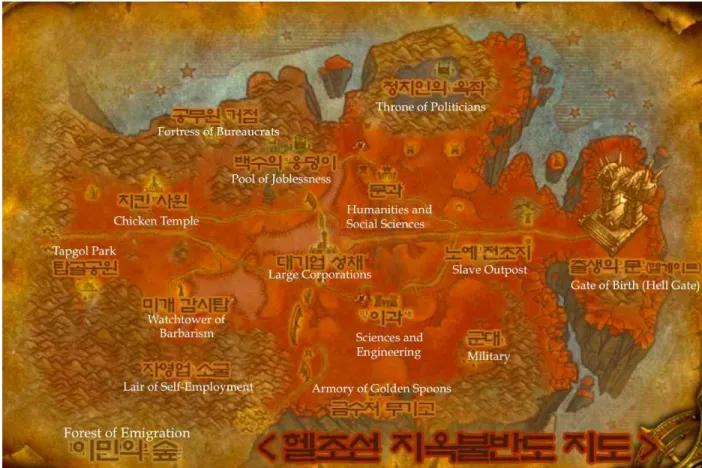
The entire process of teaching, evaluating, and finally performing “Pick Me” is dedicated to bending the youth to the will of the industry and of the nation. When the viewers around the country participate with their votes, they become part of the K-pop education system. I draw attention to the idol survival programs because I perceive them as part of a larger problem. As the projects of industry and nation branding demand more from the youth, frustrations are mounting. For example, young Koreans in their twenties have started to refer to Korea as “Hell Joseon,” a pejorative term that compares current Korean societal structure to the class-based Joseon dynasty of 19th century Korea.34 It serves as a counter narrative to the tales of national prowess and global success. Hell Joseon discourse maintains that things are worse than ever for the young people of Korea despite the bright and wholesome image of the nation pushed through hallyu. A Korean twitter user created a map of Hell Joseon, half in jest, but the message of the map resonated with many and quickly spread online. (Figure 10) Journalist Se-Woong Koo provided an analysis of the graphic:
According to this map, being born in South Korea is tantamount to entering hell, where one is immediately enslaved by a highly regulated system that dictates an entire course of life. Onerous education and service in the abusive military are the norm, and the only goal for the young is to become servants of the mighty corporations that rule the realm from its heart.35
Onerous education, servants to corporations, and a highly regulated system are all parts of the K-pop production line, as seen in the idol survival programs. The young generation uses Hell Joseon discourse in anger, to thrash against the overpowering forces that control the Korean youth. A growing group of frustrated young people is rejecting the conventional paradigm of
34 Youngmi Kim, “Hell Joseon: Polarization and Social Contention in a Neo-liberal Age,” in Korea’s Quest for
Economic Democratization: Globalization, Polarization, and Contention, ed. Youngmi Kim (Edinburgh, UK: Palgrave Macmillan, 2017), 1.
35 Se-Woong Koo, “Korea, Thy Name is Hell Joseon,” Korea Exposé, September 22, 2015,
development through nationalism and economic growth.36 Hell Joseon discourse is an attempt to speak out against nationalistic modernization projects pushed by corporation-backed industries, and against a culture suffering from excessive educational fever. But if the narrative in the idol survival programs remains uncontested, then the new Brand Korea may silence the voices of those suffering in the rebranding project.
Figure 10. A fictional map titled “Hell Joseon: An Infernal Hellfire Peninsula”37
36 Johan Cornelis Schoonhoven, “Hell Joseon: Tales from a South Korean Youth Trapped Between Past and
Present” (master’s thesis, Lund University, 2017), 2.
37 This image is an adaptation of a map used in the popular online game, World of Warcraft. Original image created
CHAPTER THREE Harnessing K-Pop’s Girl Power
The success of the film series Whispering Corridors (Yeogo Geodam, 1998-2009)
brought about a revival in the stagnating Korean domestic horror film industry. Set in an all-girls high school, these films explore the gruesome consequences of authoritarianism and conformity within the Korean educational system. The series antagonizes educational fever and its violent manifestation inside the classrooms, in the form of corporal punishment, suicides, and murders. Clearly, the tales of youth oppression resonate with the public, judging from the films’
commercial success and positive reception. All-female institutions are naturally suited for psychological horror stories of Korean society, as Jinhee Choi explains:
Narrative conflicts set in boys’ high schools are often resolved by recourse to physical violence . . . In a girls’ high school, by contrast, students may be more likely to be forced to endure or internalize conflicts with their teachers and peers, rather than confronting them or resolving them in physical terms.38
These situations are common since many Korean secondary schools are still segregated by gender, founded on the Confucian ideology that distinctive social and gender norms need to be taught to boys and girls.39 Girls therefore face a specific set of expectations within school spaces. The films give a strong warning against institutional attempts to govern girlhood: any heroine’s coming-of-age story can turn tragic inside the Korean classroom.
38 Jinhee Choi, “A Cinema of Girlhood: Sonyeo Sensibility and the Decorative Impulse in the Korean Horror
Cinema,” in Horror to the Extreme: Changing Boundaries in Asian Cinema, ed. Jinhee Choi and Mitsuyo Wada-Marciano (Hong Kong: Hong Kong University Press, 2009), 44.
The warning applies to the K-pop industry, which is in the middle of rebranding itself as an educational system. In many ways, the all-girls’ classrooms resemble the training spaces for female trainees and idols. The young girls who sign with entertainment agencies are almost always segregated by gender inside the facilities; furthermore, they are often contractually forbidden from public interactions with adolescents of the opposite gender unless specifically given permission. K-pop institutions seem to be operating on a similar premise that girls need to be trained in a fundamentally different way than boys. In this chapter, I zoom in on the specific strategies of training enforced on female trainees, as seen in the idol survival programs. Because K-pop is the face of hallyu, the industry can justify its strict control of the girls as a necessary part of national image making. I raise alarm at the relative ease with which the idol survival programs recruit their viewers in the act of policing girlhood. The nationalistic rhetoric and premise of the shows like Produce 101 perpetuate the notion that Korean feminist struggle for freer expression is incompatible with nationalistic activities—that when it comes to the global stage, representation of girls need to be confined and controlled. And as such, the case studies presented in this chapter point out training strategies largely exclusive to female trainees.
Policing the Girl Body
healthy living style to the viewers. The health trainer then led a group yoga session, instructing the girls to hold a physically challenging pose while singing the logo song “Pick Me” in unison. The entire episode was a confusing mixture of musical and physical training. One thing was made clear: the overemphasis of the word “health” was meant to portray the program as a protector of these girls and of the nation’s youth.
media outlets and was met with very positive reception; most of the articles included images like figure 10 to celebrate the effect that Produce 101 had on the trainee’s body. Many online users added comments about their own determination to follow Mi-Na’s dieting strategies.40
Figure 11. Episode 5: Comments about Kang Mi-Na’s body displayed on the screen
And thus, the narrative arc of Kang Mi-Na became an inspirational story for Korean viewers, a story in which the national audience improved upon a young girl through the mechanism of K-pop educational systems. But such attempts to portray body policing as harmless belie the dangerous reality. Female idols go to extreme lengths in order to meet the industry’s body standards, often at the recommendations of “health trainers” hired by
entertainment agencies. In addition to questionable weight loss practices, cosmetic surgery for women is popular both within and outside of the K-pop sphere, to the extent that Seoul has
40 For instance, see Ji-Young Choi, “I.O.I’s Kang Mi-Na Halved Arm Thickness After Rapid Dieting,” Insight, July
30, 2017, http://www.insight.co.kr/newsRead.php?ArtNo=114584 (in Korean), and Hee-Joo Lee, “The Appearance of Gugudan’s Kang Mi-Na After Her Perfect Diet Success,” JoongAng Ilbo, February 24, 2017,
earned the nickname “the plastic surgery capital of the world.”41 The wholesome approach to body policing on idol survival programs normalizes the practice of altering girls’ appearances off the set as well. K-pop consumers become complicit participants in the body controlling practices through these shows, practices that were established by the almost exclusively male executives of the industry.
During the celebration of Kang Mi-Na’s victory in the final episode, the host announced proudly that she had secured a large following from samchon-fans, or uncle-fans. Samchon is the Korean word for uncle, and samchon-fans refer to middle-aged men who take interest in young girl idols. Under the identity of uncle, the male adult fans liken their fan activities to that of uncles caring for their young nieces. In this way, they can avoid accusations of pedophilia; the samchon-fan designation “allows male adults to safely and intimately indulge in the girl bodies.”42 The all-female idol survival programs thrive on the male gaze, especially that of samchon-fans. While working on a second season of Produce 101 with all-male trainees, the show’s creator Han Dong-Chul reflected on his vision for the original all-girls show:
[T]he reason why I first created the female version is because I wanted to make healthy pornography for guys. Even though the contestants just seem like a younger sister or niece, aren't they adorable? I wanted to create a type of porn that gives you that feeling . . .43
41 Elise Hu, “In Seoul, A Plastic Surgery Capital, Residents Frown On Ads For Cosmetic Procedure,” NPR Morning
Edition, February 5, 2018, https://www.npr.org/sections/parallels/2018/02/05/581765974/in-seoul-a-plastic-surgery-capital-residents-frown-on-ads-for-cosmetic-procedure.
42 Yeran Kim, “Idol Republic: The Global Emergence of Girl Industries and the Commercialization of Girl Bodies,”
Journal of Gender Studies 20, no. 4 (2011): 340.
43 Interview with Han Dong-Chul translated into English by Yckim124, “‘Produce 101’ PD Criticized for Saying the
Show Was Intended to be Healthy Pornography,” Allkpop, July 21, 2016,
His statement was a stark reminder that the idol survival programs are meant to please the male viewers, first and foremost. Produce 101 creates a spectacle of girls’ bodies on stage, a
pornographic depiction of niece-like girls to captivate the self-proclaimed uncles. But the integration of voting and supposed nationalistic aims of the show cause the whole process to appear collaborative, between the industry and the citizens. The body of the young Kang Mi-Na was altered publicly, approved by adult male fans, and eventually envied by the general online community. Through narrative arcs such as Mi-Na’s, the industry executives can claim that their training methods have national support. When girls’ bodies are regulated under the protection of cultural nationalism, the consumers seem to tolerate—and even willingly participate—in their governance.
The nationwide governance of girl bodies in K-pop gives rise to what Kim Ye-Ran has termed “Lolita nationalism,” a process in which girl bodies are marked as national property in celebratory tones for the conquering of the global cultural market and exhibition of national power.44 Kim argues that managing girl idols is key to national identity formations, and her analysis is worth quoting at length:
[G]irls are shifting in their social position from sexual objects of patriarchal desire into agents of patriotic nationalism, capable of bringing the nation a victory in the global cultural war. All of these images are intertwined in the building of, according to media and popular colloquial, the idol republic. Girl power is not the mere image reflexive of male fantasy in a patriarchal structure of representation but, more significantly, girl power is the actual force that has the effect of bonding various individuals and groups across different genders and generations, projecting a nation’s dream of cultural pride in the construction of an imagined community known as the idol republic.45
44 Yeran Kim, “Idol Republic: The Global Emergence of Girl Industries and the Commercialization of Girl Bodies,”
Journal of Gender Studies 20, no. 4 (2011): 343.
As Kim states, Koreans who engage with female K-pop idols (and trainees) can view their participation as a national community-making process. Moreover, their participation is an act of national belonging, a way of self-identifying as a citizen in a republic of beautiful idols. As the idol girls become increasingly visible in musical, economic, and political spheres, the nation attempts to control the image of girlhood in order to control its own image presented to the global world. The shaping and cutting of girl bodies become part of a national collaborative project, coordinated by the K-pop industry.
Policing Girl Behavior
The body expectations for idols extend beyond appearance. Young idols, especially girls, must project an image of chastity and appear wholly devoted to their fans. To maintain this image, agencies forbid their idols from dating or direct public encounters with the opposite gender, barring a few exceptions. Granted, the performance of purity is practically part of the job description for K-pop girl idols, whose songs are largely about chaste, adolescent love. However, the girls are expected to continue this performance of sexual purity off the stage. And the
trainees learn this expectation of body maintenance early on, through the industry-prescribed training regiment. For instance, during the eleventh episode of Produce 101, the popular
loud cheer. The interviewer then turned to the trainee next to Se-Jeong, a shy trainee named Kim Chung-Ha, and exclaimed, “I heard that you have been single all your life! Have you ever kissed anyone before?” Chung-Ha corrected this abrupt statement: “Once. I did have one boyfriend before.” Again, the male fans did not react warmly to her answer, and the interviewer repeated her question, “But have you really had your first kiss?” Like Se-Jeong, Chung-Ha seemed to gauge the audience reaction and hesitantly shook her head no. Eagerly, the interviewer declared to the audience, “Wow, she has no experience in kissing!” The male fans on camera seemed thrilled with this conclusion.
Through a series of small moments like these, the trainees are taught that their every utterance and movement must appeal to the audience. In the girl idol-fueled hallyu wave, the girls must remain vigilant and only embody the image of girlhood deemed appropriate by their national supporters. “Visibility is a trap,” as Michel Foucault famously declared, and the hyper-visible girls are trapped in the name of national advancement.46 K-pop entertainment agencies have always monitored the trainees’ bodies and behaviors, but now the idol survival programs are recruiting K-pop consumers to participate in idol surveillance.
Produce 101 in particular allotted a long segment for examining the girls’ behaviors, inviting the voters to make their opinions known once again. This segment featured three “tests” in rooms with hidden cameras in order to determine which trainees are truly well behaved, even when they believe no one is watching. Older K-pop idols were brought in specially to watch the footage from a separate room, verbally reacting to the trainees’ actions. The first test, titled the “Consideration Test,” featured a production staff member who walked by various trainees while
46 Michel Foucault, Discipline and Punish, trans. Alan Sheridan (New York: Vintage Books, 1995), 200. For further
struggling to carry two heavy water bottles. The idol-commentators roundly criticized the girls who took no notice of the staff member and praised the trainees who offered help. In the second test, the “Initiative Test,” the girls were sent to practice in rooms with secret cameras. To the side of the room was a large pool of spilled Coke. Similar to the first test, the segment highlighted some trainees who took initiative to clean up the spill, and those who chose to ignore it.
The third test, labeled as the “Loyalty Test,” was more elaborate and somewhat cruel. Each trainee was pulled aside in a private room to do one of the usual interviews. While a
camerawoman was setting up, she knocked over an expensive looking camera, which broke upon impact. The camerawoman then begged the trainee to take the blame, pleading that otherwise she would be fired for breaking the valuable equipment. When the director of the show walked in the room and appeared angry at the situation, some trainees refused to lie about the damage while others, such as the popular contestant Kim Se-Jeong, readily covered for the panicked
Figure 12. Episode 5: Kim Se-Jeong during the “Loyalty Test”
For a reality music competition, the tests of consideration, initiative, and loyalty seem out of place. But as in the case of body policing, the scenes of behavioral tests are also mixed in with scenes of musical evaluations. The jumble creates a larger narrative that body, behavior, and musical performance are intertwined, that they are equal parts of the criteria for producing the ideal K-pop girl. For comparison, the second season of Produce 101 with all-male trainees also included a “hidden camera” segment. But rather than a series of tests, the boys simply