pages
Autism and autism narratives are present in the University of North Carolina in a variety of forms and aimed at a variety of target audiences, and so I used a test to examine the types of autistic representation present in the libraries at the university. I visited three libraries - the Manning Library, Davis Library, and the Undergraduate Library - and ran a selection on the books they had available on autism, allowing both fiction and
nonfiction in my selection. I also tested for whether the books were aimed at autistic students themselves, neurotypical peers, parents, or teachers, since I theorized that books directly aimed at autistic teens and young adults would be in a minority. This is because the general social atmosphere around autism focuses more on children with the disorder rather than teenagers and adults, even though autism will be present with a child for its entire life and has implications for adult tasks like college application and job hunting.
My theory of what I would find in the library was correct, since fiction books centered around autistic characters were in a minority compared to books dealing with autistic side characters. Pop psychology works and especially autism memoirs dominated the library shelves in the Undergraduate Library and Davis. The majority of the autism memoirs were by parents of children and teens with a small minority written by autistic teens and adults. However, the library was also heavily science-focused and didn’t give any time to conspiracy theories surrounding vaccines, which is a strong positive.
Headings: Library Autism
OF CHAPEL HILL
By:
Mariel MacGowan
A Master’s paper submitted to the faculty of the School of Information
and Library Science of the University of North Carolina at Chapel Hill in partial fulfillment of The requirements for the degree of
Master of Science in Library Science.
Chapel Hill, North Carolina April 2019
Approved by:
Introduction
Autism and autism narratives are present in the University of at Chapel Hill’s libraries – Davis Library (the graduate library), the Undergraduate Library, and the School of Information Science Library (SILS) - about autism, maps out what is available and how accessible it is, and compares the books’ target demographics to get a sense of which books target autistic people, families of autistic people, and teachers and employers of autistic people. Books will also be divided by whether they target children, teens, or adults, and finally by whether the authors of the books are autistic. I will make some suggestions about how UNC can improve its autism resources to appeal to all the demographics who need them.
apparent to others”. Autism is one of these, as are conditions like attention-deficit hyperactivity disorder (ADHD), post-traumatic stress disorder (PTSD) and tinnitus.
Autism is a complicated family of disorders which vary in symptoms and severity, and manifests differently in different individuals. Some forms manifest in inability to recognize social skills and a person’s trouble with physical spaces. Others manifest in
more overtly visible and severe ways, such as many autistic people being unable to vocalize. Many of these people rely on alternate methods of communication, such as computers or sign language, and there should be ways to accommodate these alternate techniques, if possible, to give them an easier time of accessing library resources.
Autism-Centered Books
With Autism Grow Up, Child Mind Institute), and while it is often diagnosed in childhood a person with autism will deal with its lifelong consequences. This affects their job prospects, ability to drive, getting from place to place, and other things that a book discussing autism from the perspective of an unaffected individual cannot get across as effectively as an autistic individual.
This research includes a representation survey of UNC’s collection in respect to autism,
how autism is represented, and how diverse UNC’s collection of autism-related
literature is. This research reports on how many books dealing with autism are available at UNC’s three main libraries, compares the individual library’s resources, and
examines books by intended audience and target demographic, and when possible categorizes by whether a book is written by an autistic author. Fiction books are also included in the survey, and autobiographies, as experiences of people with autism, are included.
Literature Review
Services that assist autistic patrons may also be helpful to others. In general, libraries’
accessibility and how disabilities can interfere with that ability to access them, as well as how the situation can be remedied, are a heavily understudied area of the field that require more examination in the future to make libraries a more comfortable and safe place for disabled individuals to work, access, and enjoy. It is important that they be addressed so that the UNC Library becomes a welcoming place to all patrons regardless of special needs, and that these special needs are taken into account as part of the process. The literature review discusses particular disabilities, their impact on library use, how they affect the way consumers use library access and information with
disabilities, and how these disabilities can be counteracted to make libraries more open places to their patrons. Some of them deal with potential solutions and studies held in other countries that, nevertheless, are relevant to solving the issue of accessibility in the United States.
Visual Impairment in Libraries
The first disability that will be discussed involves sight impairments, the most obvious of which is blindness. There are many impacts that blindness will have on an individual’s
that make library use easier for blind individuals and others suffering from vision impairments. The importance of having a layout that isn’t cluttered or hard to use is emphasized as a mistake many designers make, and one that’s beneficial to all site users
(Wachiaya, 2016). Audiobooks and books with larger print than usual are the primary options available for these individuals, and while they are a start they are also not enough. A study by Eldridge in 1982 indicates that blind people and people with vision impairments do not feel as if libraries take them and their needs into consideration when designing the accessibility of a library, and that library students both recognize that this lack of interest for the blind is a problem and have potential ideas to help solve it. It’s important, for instance, to have major genres and authors represented as
audiobooks for vision-impaired visitors to use, although the audiobook section will, by necessity, not represent every book in the library in audiobook form, although that would be the ideal. Instead, books would need to be selected based on a variety of factors, such as the significance of the novel, importance to relevant fields, and how highly requested it is. It would be a good idea to allow visitors to make audiobook requests, since blind readers find audiobooks a useful way to access books that they are physically unable to read.
very difficult for disabled users to tolerate. For example, many autistic library users would benefit from having a “quiet zone” in the library for them to use without
distractions from noise, other visitors, or outside sources, or a “quiet time” where a lack
of outside interference is provided (Hadeer Abd-El-Razak Barakat, 2019). This is a global problem –according to a study by Phukubje and Ngoepe (2016), “students with disabilities are often marginalised by library policies in terms of library services, only a small fraction of books are transcribed into alternative formats that are accessible to students with print impairments, academic books or prescribed materials are not available in appropriate formats, and to produce them in house takes a very long time”
(Phukubje & Ngoepe, 2016, 181). This study took place in South Africa, and the authors report that despite efforts to help students with disabilities adjust to library settings they have little government support or assistance in doing so, or even access to the resources and funding they need to progress further on the issue. Mutanga (2017) reports that “In most instances when disability is mentioned in policy documents, either
Hearing Disabilities in Libraries
Auditory issues are another disability that can interfere with library use for disabled populations, since they can interfere with a student or employee’s ability to
communicate with other library users. Nadene Eisner (2012) predicts in “Engaging Deaf and Hard of Hearing Students” that over seventy percent of deaf or otherwise hard of
hearing students will attend a public school setting with their abled peers, as well as other students with hearing problems. Without being able to hear or even talk in some cases, a deaf individual may have trouble using the Internet. While sign language is helpful, people who were born deaf have a more difficult time learning words, although of course not impossible. Studies indicate that inclusion of employees with knowledge of sign may be helpful for deaf library visitors. Deafness and partial deafness are more common than blindness and caused by a variety of conditions, ranging from childhood illness, genetics, exposure to loud noise on a regular basis, and ear infections. It comes in a variety of severities, where some people may have difficulty hearing, need special equipment in order to hear, or not be able to hear at all. There are other hearing
disorders that do not involve deafness which may need to be considered. Tinnitus is one of the most common of these hearing disorders, an irritating condition which causes a constant ringing, throbbing, or buzzing in the ear that does not go away over time, is loud and persistent enough to be distressing or distracting to the sufferer, and is largely untreatable. While associated with the elderly, it’s an illness that can affect anyone at
restful places where their condition won’t interfere as much with their ability to read, or
where they will have an easier time focusing on homework or their jobs. However, they will still be able to access and use the majority of library services without issue, which may make their situation less pressing than visitors and employees dealing with deafness or partial deafness, whose condition runs a higher risk of rendering them unable to use library resources and services.
Autism
Autism in particular is a complicated issue to handle, since there are so many different types of autism with different requirements. As a result, libraries have an especially difficult time handling autism, and a sample study by Ghuloum and Alyacoub in 2016 revealed that two-thirds of a sample population of autistic individuals in Kuwait simply didn’t use their local library. However, other autistic people enjoyed visiting libraries, and many libraries employ openly autistic librarians, volunteers, and other employees (Lund, 2018). These people may require changes in the library organization to work to their full potential. Organizations such as the Autistic Self Advocacy Network engage directly with the stigmatization of the disorder, as numerous stereotypes exist
surrounding autism and autistic people that make it more difficult for people with these disabilities to be open about them and their needs. Also, because there’s such a
diversity of autism-related conditions that have to be kept in mind when designing or updating a library to be more accessible, it’s difficult to make the library space open to
its categorizing of the disability) autism may be completely unhelpful to a student who has “high-functioning” autism, Asperger’s, or Nonverbal Learning Disorder, which are less visible by their nature as spectrum disorders which are closer to the “higher -functioning” area of the scale.
Another issue with autism involves the disconnect between autistic visitors and
whether or not they feel that their needs have been met by the libraries they visit. Many autistic people enjoy visiting the library, but many more are discouraged because they don’t feel that the library meets their needs. In a study in 2016, Amelia MacLay
Anderson took a study of users of WrongPlanet, a forum created as an online meeting place for autistic individuals across the spectrum. What she discovered is that, while autistic students use the library with similar goals to neurotypical students, there are other reasons they choose to visit that are relevant to library and information studies: “However, students with ASD especially describe using the library as an escape from
sensory overload…Students with ASD use the library as an auditory escape, yet many still find the library to be too loud or chaotic to suit their needs.” (Anderson, 2016, p. 9). Anderson also highlights the relative lack of research in the field of autism and how it affects autistic individuals’ use of the library. A recurring theme in research around disabilities in library settings is how there is a severe lack of research in the field,
is a modern day problem despite researchers’ best efforts, and there is a lot more work to do in this field both to understand autism as a disorder, the requirements people with disabilities have in library settings, and how best to help individuals with autism adapt to an unfortunately often unaccommodating larger society. Something that’s emphasized, as it is on Wrong Planet, is input from autistics themselves.
Autistic Input
Something which disability groups have been criticized for in the past is treating autism and related disorders like illnesses or defects that need to be cured, and for emphasizing the narratives of parents, teachers, and supervisors over the narratives of individuals with ASD themselves. Amelia Anderson (2016), in “Autism and the Academic Mind: A
Study of Communication”, notes that “There is little research about the college experiences of students with ASD themselves, instead focusing on the experiences or impressions of parents, teachers, or administration” (p. 647). Autism Speaks, probably
the most well-known and well-funded autism charity, has faced severe criticism from autistic individuals and their allies for the use of autism as an illness or threat, its pledge to “cure” autism, and a lack of autistic individuals in its staff that was only highlighted
when Elder St. Robinson, a member of the organization’s board of directors, resigned from his position due to concerns that leadership wasn’t listening to him (Robinson,
by placing autistic people in the organization’s membership, in control of determining policy, and giving them a national voice as representatives of their own demographic. For marketing reasons, autism is frequently associated with children, which doesn’t
mesh with the actual demographics – autistic children grow into autistic teenagers and adults, who will deal with difficulties throughout their lives due to their autism.
The implications of this are significant, especially given my hypothesis before starting research that many books in the UNC library that deal with autism are targeted at adult readers, and generally neurotypical ones that place emphasis on the study and
understanding of autism and related disorders as disabilities. Many disabilities have an issue with representation and who receives what kind of help, how that help is
provided, and especially who speaks for disabled populations. While advocacy is important, it’s also important to give people with disabilities a voice in their
Methods
Studying autism resources in a library setting included several different steps, each of which work towards a larger picture of Chapel Hill’s current accessibility status. The primary focus is on a book overview of the autism selection at the three UNC libraries - the Davis library, the Undergraduate Library, and the SILS Library. My overall goal in checking the book selection is to grade UNC’s current selection on how it deals with autism – for example, are books about autism aimed at a particular demographic, and if so which one? This is important, for example, because many books and websites that deal with autism tend to be medical books describing young to teenage patients or books that are aimed at children. As discussed above, autism marketing is often focused around young people with the disorder and their parents, and while providing a good school environment for autistic children is important it downplays the presence and needs of autistic adults, many of whom would like a greater voice in how their condition is discussed and engaged with by the educational and medical community. Books were overviewed, if possible, to see how many of them are authored by individuals on the spectrum, such as St. Elder Robinson and Temple Grandin. While individual experiences don’t reflect the wide range of experiences of people diagnosed with autism, they are
important because they return the autistic narrative to autistic individuals themselves. Since not all texts divulge whether or not the author is on the spectrum, especially in the case of medical journals where the author’s status isn’t so relevant, I also counted texts
I suspect that inclusiveness has trended upwards with time as access to people with disabilities became a more important issue and America in general became more sensitive to physical and mental disorders, although the former became accepted before the latter, and issues involving people with mental disabilities being bullied and otherwise abused in places where they are supposed to be given care (most recently the Judge Rosenberg Center, which is infamous among mentally disabled people and their allies for their use of involuntary and violent shock therapy) are present (NPR). The next part of my survey focused on books, specifically books about autism. This survey was intentionally narrower and more specific than my general survey, and books used were determined by several factors. Autobiographies and memoirs by autistic authors or authors on the autism spectrum were permitted, as well as works of fiction. My survey at the three libraries took a selection of at most fifty books, using “autism”, “noverbal
learning disorder” and “Asperger's Syndrome” as search terms in the book catalog. Fifty
exists, and if one did I counted the translated copy instead of the original. If not, I counted the English copy as the representative of the text in the general tally.
Books in my selection were evaluated under several different criteria. First, I was interested in the target demographic of the books selected, primarily age, gender, and whether or not it is directed at autistic people themselves. I was also curious if particular authors who discuss autism appear more than once, particularly in medical contexts, since some seemed to focus on autism and related topics more than others. Target demographics, as well as the phenotypes of the group being studied, are relevant because they’re used to determine whether or not autistic people themselves are the people primarily targeted by books on autism in the UNC libraries. I was curious about how many studies of media are aimed at or use children as compared to adults. Autism is especially affected by this, especially when the study of autistic children and teens overshadow research connected to adults.
Once books were identified, my second piece of analysis involved taking a sample of each library’s books using search terms to emphasize the books that focus specifically on autism, and sorting them by target audience, target demographic, whether the book Is academic, autobiographical, or explanatory in nature, and whether or not the author of the book is autistic. Scholarly texts were judged by whether or not the author dealt directly with autistic people, for example through surveys or interviews, and this information was used as part of judging the texts.
The SILS Library
There were differences between the libraries’ collections. At a total of sixteen books, the SILS library had a larger selection of fiction books on autism represented than the others, which is not especially surprising given that the library houses an extensive collection of children’s books. Autism was not the main subject of these books, but it was represented in the presence of characters, all children, with autism. The absence of autistic adults is at least in part likely due to the age demographic of the books’ target audience. It would be easier for a child, both neurotypical or autistic, to relate to an autistic child over an autistic adult. Nevertheless, this ties into my observation earlier that autism is frequently associated with children even though it’s a lifelong condition
president of Autism Speaks, caused it some controversy, as Autism Speaks only had two autistic individuals on its board at the time of publishing (ASAD, 2017).
There were four guides targeted at students with autism spectrum disorders to help them cope in a classroom setting, with two books aimed at the peers of these students, explaining what autism looks like to them and emphasizing that autistic people should not be bullied, but treated with respect. There was one book aimed at caregivers
specifically. Since there aren’t really books aimed at adults at the SILS library, there were
fewer books with an adult target audience of teachers with an autistic student in their class or parents of a child with autism. While an neurotypical audience is necessary, since it’s helpful if students know what to expect if they have an autistic classmate to
prevent bullying or miscommunication, it was good that there were books targeted at autistic people themselves. These guides, counting guides for both autistic and
neurotypical students, were the most frequently occurring of the nonfiction books, but were still overall represented much less than the fiction books.
The Undergraduate Library
The Undergraduate Library had thirty-three books relevant to autism, with nonfiction much more heavily represented than it was in SILS. However, no one genre was
overwhelmingly present the way there was a majority of fiction books in the children’s library. Nonfiction is a much more divided genre, split into many different subgenres: pop psychology, thesis papers, autobiographies, and memoirs. There were three
of view of parents who had an autistic child. The other things I noticed involved recurring themes, such as the history of vaccinations, the alleged connection between autism and vaccinations, and the history and misunderstandings behind that myth. The vast majority of the books took the side of vaccines and didn’t treat the speculation that
vaccines caused autism seriously, which I think is a good sign of the library’s science
literacy. Some of the books’ ties to autism issues were fairly loose, such as a book about the X-Men and a book exploring pet cognition, which while interesting have little to do with autism.
Davis Library
would be a major target audience at a large university with a considerable student population of 29911
Social skills guides in general were very scarce, in favor of fictional works dealing with autism and pop science books that handle the subject. There was only one book that dealt with vaccines, and it was only tangentially related to autism because of the
pervasive myth that vaccines cause autism or increase autism risk. In general, it seemed to be a mixture of the other two libraries’ contents in that it was largely a hybrid of
nonfiction with a focus on pop science, memoirs usually but not always written by parents, and a handful of guides targeted at teachers and students. The scientific disciplines represented at Davis were largely psychology and biology, the two most directly relevant to autism, its identification, and its study, though there was also one general history of autism.
Discussion
I noticed that overall the genres most represented in the library were the fiction books and pop science, followed closely by the autism memoirs. These three were, overall, more aimed at neurotypical than autistic audiences - for example, the two most prominent fiction books with autistic narrators - Piggy and The Curious Incident of the Dog in the Night-Time - were both by neurotypical narrators and their lead characters
are multidimensional but stereotypical, if in relatable situations. The autistic narrator of Piggy gets mixed up with an especially vicious school bully who pressures her into
tries to solve the murder of a dog in his neighborhood while struggling with problems in his family. While The Curious Incident of the Dog in the Night-Time was praised at the time of its release for representing a sympathetic and multi-dimensional autistic character, it later has been criticized within the disability community (Bartmess, 2015) for relying on stereotypes and tropes regarding autism and autistic people as a whole, such as the narrator’s general lack of empathy and his belief that people who are unlike
himself are less intelligent and not worth paying attention to. The book is a good example of how a work that’s considered inclusive when it’s first written may not hold up to closer scrutiny in the future.
As for the nonfiction I studied, I also wasn’t surprised that it had a consistent presence or that the majority of nonfiction works represented were memoirs and pop psychology. The autism memoir is a popular form, especially in its manifestation as the autism-parent narrative in which a autism-parent reflects on the experience, positive and negative, of raising an autistic child. There were a couple of memoirs that were written by autistic authors, but they are still heavily underrepresented in favor of narratives for and by neurotypical people, which was disappointing but what I expected. On the other hand, the absence of conspiracy narratives around vaccines and the presence of several books that directly debunk the alleged autism-vaccine connection. This means that the
libraries’ scientific literacy is solid, and I appreciated that those works, which promote dangerous misinformation and have contributed to multiple public health crises.
While books on autism have a substantial presence in the library system at the University of North Carolina, there are several issues that can be improved on in the future. Autistic narratives, as written by autistic people, are in a distinct minority, overshadowed by popular science books and autism memoirs. The fiction selection is promising, if problematic in that autism fiction is reliant on stereotypes, such as mentioned above with The Curious Incident of the Dog in the Night-Time. To improve the selections available in the library, I would strive to include a greater diversity of viewpoints - teachers and parents one, siblings and peers another, and autistic people themselves represent an internal perspective which forms an important piece of the whole picture. While the perspectives of parents and teachers should be represented and are important, since they help drive policy that affects people with autism and other disabilities, it’s also important for the people who are most directly affected by a condition to be one of the loudest voices in addressing it and engaging with the larger world about it.
Sources Cited
Anderson, A. M. (2016). Wrong planet, right library: College students with autism spectrum disorder and the academic library
Anderson, Amelia (2018). Autism and the Academic Library: A Study of Online Communications. College & Research Libraries. Vol. 79, No. 5.
Axelsson A, & Ringdahl, A. Tinnitus--a study of its prevalence and characteristics. Br J Audiol. 1989.
Autistic Self-Advocacy Network. Before You Donate To Autism Speaks… 2017.
https://autisticadvocacy.org/wp-content/uploads/2019/03/AutismSpeaksFlyer2019.pdf
Bartmess, Elizabeth. Review: The Curious Incident of the Dog in the Night-Time by Mark Haddon. 2015. Disability in Kid Lit.
Baskin, Barbara H. and Karen H. Harris. The Mainstreamed Library: Issues, Ideas, Innovations. Chicago: American Library Association, 1982.
Center for Disease Control. https://www.cdc.gov/ncbddd/autism/data.html November 15, 2018.
Chaputula, Aubrey & Mapulanga, Patrick. (2017). Provision of library services to people with disabilities in Malawi. South African Journal of Libraries and Information Science. 82. 10.7553/82-2-1619.
Carlos, Deborah J. Instruction in Disability Services and Adaptive Technology in Schools of Library and Information Science: A Survey of the Curriculum. A Master’s Paper for the M.S. in L.S. degree. April, 2005.
Ghuloum, H. F., & Alyacoub, W. M. (2017). Activating the role of the public library towards Autism Spectrum Disorder (ASD) in Kuwait. Information Development, 33(4), 406–417.
Eldridge, L. (ed.) 1982. Speaking out: personal and professional views on library service for blind and physically handicapped individuals. Washington: National Library Service for the Blind and Physically Handicapped.
Hadeer Abd-El-Razak Barakat, Ali Bakr, Zeyad El-Sayad. Nature as a healer for autistic children. Alexandria Engineering Journal. Volume 58, Issue 1. 2019. Pages 353-366. ISSN 1110-0168.
“Library services for people with disabilities: results of a survey”. Bulletin of the Medical Library Association vol. 84,3 (1996): 397-401.
Brady D. Lund (2018) Redefining Opportunity for the Library Employee with Autism: A Model of Positive Behavioral Support for Library Management, Journal of Library Administration, 58:5, 434-448, DOI: 10.1080/01930826.2018.1468192
Mutanga, O (2017). STUDENTS WITH DISABILITIES’ EXPERIENCE IN SOUTH AFRICAN HIGHER EDUCATION – A SYNTHESIS OF LITERATURE. Mutanga Institute of Health and Society Faculty of Medicine, University of Oslo
National Public Radio. School Shocks Students With Disabilities. The FDA Is Moving To Ban The Practice. 2019.
Phukubje, J., & Ngoepe, M. (2017). Convenience and accessibility of library services to students with disabilities at the University of Limpopo in South Africa. Journal of Librarianship and Information Science, 49(2), 180–190.
Rayini, Junaid. June 2017. Library and Information Aid to the Visually Impaired Persons. University of Lucknow.
Reynolds Brooks, Danielle C.. Serving Students with Disabilities in the School Library. A Master’s Project for the M.S. in L.S degree. April, 2013.
Roberts, Larry E et al. “Ringing ears: the neuroscience of tinnitus”Journal of neuroscience : the official journal of the Society for Neuroscience. 2010.
Robinson, Elder St. “I resign my roles at AutismSpeaks”.
http://jerobison.blogspot.com/2013/11/i-resign-my-roles-at-autism-speaks.html November 13, 2013.
Rozema, Robert. “The Problem of Autism in Young Adult Fiction”. Language Arts Journal of Michigan. Volume 30, Issue 1.
University of Massachusetts. “InvisibleDisabilities”.
https://www.umass.edu/studentlife/sites/default/files/documents/pdf/Invisible%20Dis abilities%20List%20%26%20Information.pdf
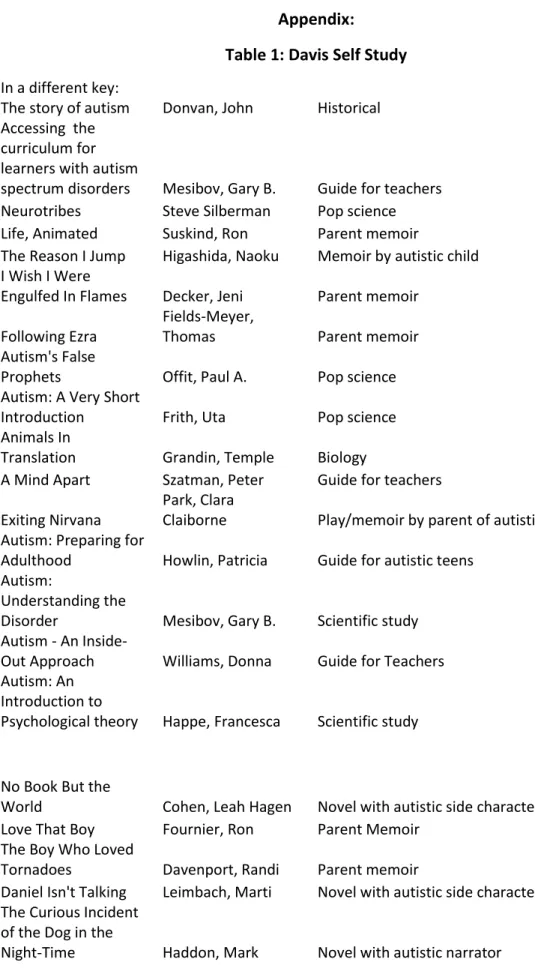
Appendix: Table 1: Davis Self Study In a different key:
The story of autism Donvan, John Historical Accessing the
curriculum for learners with autism
spectrum disorders Mesibov, Gary B. Guide for teachers Neurotribes Steve Silberman Pop science Life, Animated Suskind, Ron Parent memoir
The Reason I Jump Higashida, Naoku Memoir by autistic child I Wish I Were
Engulfed In Flames Decker, Jeni Parent memoir Following Ezra
Fields-Meyer,
Thomas Parent memoir
Autism's False
Prophets Offit, Paul A. Pop science Autism: A Very Short
Introduction Frith, Uta Pop science Animals In
Translation Grandin, Temple Biology
A Mind Apart Szatman, Peter Guide for teachers Exiting Nirvana
Park, Clara
Claiborne Play/memoir by parent of autistic adult Autism: Preparing for
Adulthood Howlin, Patricia Guide for autistic teens Autism:
Understanding the
Disorder Mesibov, Gary B. Scientific study Autism - An
Inside-Out Approach Williams, Donna Guide for Teachers Autism: An
Introduction to
Psychological theory Happe, Francesca Scientific study
No Book But the
World Cohen, Leah Hagen Novel with autistic side character Love That Boy Fournier, Ron Parent Memoir
The Boy Who Loved
Tornadoes Davenport, Randi Parent memoir
Daniel Isn't Talking Leimbach, Marti Novel with autistic side character The Curious Incident
of the Dog in the
Autistic Children: A Guide for Parents
and Professionals Wing, Lorna Guide for parents and teachers Switched On Robison, John Elder Memoir by autistic author Brain Maker Permutter, David Pop science
Diagnostic and statistical manual of mental disorders : DSM-5.
American Psychiactric
Association Reference Book Do You Believe In
Magic? Offit, Paul A. Pop science
Brain On Fire Calahan, Susannah Memoir The Tell-Tale Brain Ramachandran, V. S Pop science Look Me In the Eye Robison, John Elder Memoir Vaccine Allen, Arthur Pop science
Table 2: SILS Library Temple Grandin: How the
girl who loved cows embraced autism and
changed the world Sy Montgomery Biography Waiting for Benjamin Alexandra Altman Fiction
I am Utterly Unique Elaine Marie Elson Children's Nonfiction Tacos, Anyone? Marvie Ellis Guide for caregivers My Friend With Autism Beverly Bishop Guide for neurotypical kids All About My Brother Sarah Peralta Biographical Children's Fiction
Taking Autism to School Andreanna Edwards Guide for caregivers and neurotypicals An exploration of the
relationships of characters with autism spectrum disorders in young adult and upper elementary level
literature Mary S. Randolph Thesis
AUTISM SPECTRUM DISORDER
REPRESENTATION IN YOUNG ADULT
LITERATURE: A CONTENT
ANALYSIS Marli Johnston Thesis
PUBLIC LIBRARIES: SERVING CHILDREN WITH
DISORDER AND THEIR FAMILIES
EVALUATING THE PRESENCE OF THE AUTISM SOCIETY IN THE AMERICAN SOUTH USING DIRECT CONTENT
ANALYSIS Hillary Fox Thesis
On the Edge of Gone Corrine Duvyis Fiction - book with autistic character Al Capone Does My
Homework Genniver Choldenko Fiction - book with autistic character A Certain October Angela Johnson Fiction - book with autistic character Marcelo in the Real
World Francisco X. Stork Fiction - book with autistic character Anything But Typical Nora Raleigh Baskin Fiction - book with autistic character Adult interactive style
intervention and participatory research designs in autism : bridging the gap between academic research and
practice Lila Kossyvaki Scientific Study
Al Capone Shines My
Shoes Genniver Choldenko Fiction - book with autistic character Piggy Mireille Geus Fiction - book with autistic character Friends Learn About
Tobin Diane Murrell Fiction
When my worries get too big! : a relaxation book for children who live with
anxiety Kari Dunn Boron Guide for autistic students
Rules Cynthia Lord Fiction - book with autistic character The boy who ate stars Kochka Fiction - book with autistic character Keisha's Doors Marvie Ellis Fiction and Guide
The Heart's Language Lois-Ann Yamanaka Fiction - book with autistic character Looking After Louis Lesley Ely Fiction - book with autistic character Al Capone Does My Shirts Genniver Choldenko Fiction - book with autistic character This is Asperger
Syndrome
Elsa Gagnone and Brenda
Smith Miles Guide for neurotypical kids Andy and his yellow
frisbee Mary Thompson Fiction - book with autistic character The Devil Hole Eleanor Spence Fiction - book with autistic character Please don't say hello Phyllis-Terri Gold Fiction - book with autistic character Disability in comic books
Answers to the health questions people ask in
libraries Laura Townsend Kane Reference Guide Universal usability Jonathan Lazar Reference Guide
Table 3: Undergraduate Library
Characterizing Early Development and NREM Sleep in Infants
and Toddlers and Risk for Autism Spectrum Disorder Page, Jessica Thesis Early Life Exposure to Air Pollution and Autism Spectrum
Disorder: Susceptible Time Windows and Populations McGuinn, Laura Thesis
In a Different Key Donvan, John Historical Study
The Reason I Jump
Higashida, Naoki
Memoir by an autistic teen Neurotribes
Silberman,
Steve Historical Study I wish I were engulfed in flames : my insane life raising two
boys with autism Decker, Paula
Memoir by parent with autistic child Following Ezra
Fields-Meyer, Thomas
Memoir by parent with autistic child Autism : a very short introduction Frith, Uta Study
Autism : understanding the disorder
Mesibov, Gary
B. Study
Ginny Moon
Ludwig, Benjamin
Novel with autistic character
Lake Success
Shteyngart, Gary
Novel with autistic minor character
The Disordered mind Kandel, Eric R. Study
Innate
Mitchell, Kevin
J. Study
The Age of Perpetual Light Weil, Josh
Short story with autistic minor character
Facts and fictions in mental health Arkowitz, Hal Psychological study Pets on the couch
Dodman,
Nicolas H. Animal psychology The human superorganism
Dietert, Rodney
R. Pop biology
Andy Warhol was a hoarder Kalb, Claudia
Pop psychological study
Parenting and theory of mind Miller, Scott A.
Study of autistic parents
The brain's way of healing Doidge,Norma Study
Great myths of the brain
Jarrett,
Christian Pop biology The man who wasn't there
Ananthaswamy,
Infection madness
Washington,
Harriet A. Psychology The Home Front
Vanderburg, Margaret
Novel with autistic minor character
Child psychopathology Mash, Eric et al. Psychology
The Ages of the X-Men
Darowsk,
Joseph Pop culture study
We are our brains Swaab, D. F. Psychology text
Child and adolescent psychopathology Hoboken, N.J Psychology
The Panic Virus Mnookin, Seth Study of anti-vaxxers
Disability Affecting Learning Wilson, Mike Pro/Con book
Aesthetic nervousness Qyayson, Ato Psychology
The speed of dark
Moon, Elizabeth
Novel with autistic character