September 14, 2018
The role of environment and gas temperature in the formation of
multiple protostellar systems: molecular tracers
N. M. Murillo
1, E. F. van Dishoeck
1,2, J. J. Tobin
3, J. C. Mottram
4, and A. Karska
51 Leiden Observatory, Leiden University, P.O. Box 9513, 2300 RA, Leiden, the Netherlands e-mail:[email protected]
2 Max-Planck-Institut für extraterrestrische Physik, Giessenbachstraße 1, 85748, Garching bei München, Germany
3 Homer L. Dodge Department of Physics and Astronomy, University of Oklahoma, 440 W. Brooks Street, Norman, Oklahoma 73019, USA
4 Max Planck Institute for Astronomy, Königstuhl 17, 69117, Heidelberg, Germany
5 Centre for Astronomy, Nicolaus Copernicus University, Faculty of Physics, Astronomy and Informatics, Grudziadzka 5, 87100, Torun, Poland
September 14, 2018
ABSTRACT
Context.Simulations suggest that gas heating due to radiative feedback is a key factor in whether or not multiple protostellar systems will form. Chemistry is a good tracer of the physical structure of a protostellar system, since it depends on the temperature structure. Aims.To study the relationship between envelope gas temperature and protostellar multiplicity.
Methods.Single dish observations of various molecules that trace the cold, warm and UV-irradiated gas are used to probe the tem-perature structure of multiple and single protostellar systems on 7000 AU scales.
Results.Single, close binary and wide multiples present similar current envelope gas temperatures, as estimated from H2CO and DCO+line ratios. The temperature of the outflow cavity, traced by c−C3H2, on the other hand, shows a relation with bolometric luminosity and an anti-correlation with envelope mass. Although the envelope gas temperatures are similar for all objects surveyed, wide multiples tend to exhibit a more massive reservoir of cold gas compared to close binary and single protostars.
Conclusions.Although the sample of protostellar systems is small, the results suggest that gas temperature may not have a strong impact on fragmentation. We propose that mass, and density, may instead be key factors in fragmentation.
Key words. astrochemistry - stars: formation - stars: low-mass - ISM: molecules - methods: observational
1. Introduction
Multiple protostellar systems are widely thought to be formed through fragmentation of the cloud core and/or disk within which they form. This process is expected to either be induced by turbulence (e.g., Offner et al. 2010) or through instabilities in the disk that can lead to fragmentation of the disk material (e.g., Stamatellos & Whitworth 2009; Kratter et al. 2010). Each mech-anism is proposed to produce multiple protostellar systems, but since they operate on different spatial scales (disks:∼100 AU, vs. cloud core: ∼1000 AU) they result in different separations between the sources. Turbulent fragmentation predicts the ini-tial formation of wide companions, whereas disk fragmentation can produce close companions, on scales of the disk radius. The time when these processes occur, upon initial collapse or after one source has formed, can also alter the resulting multiple pro-tostellar system and its evolution. Observational studies of mas-sive star formation provide conflicting evidence regarding the role of turbulence in core fragmentation (e.g., Wang et al. 2014; Palau et al. 2015; Beuther et al. 2018). Another potentially rel-evant factor in regulating fragmentation may be magnetic sup-port. This mechanism suggests that magnetic fields reduce the number of fragments formed in a cloud core (Commerçon et al. 2010; Hennebelle et al. 2011). Observations of fragmentation in massive dense cloud cores (Tan et al. 2013; Fontani et al. 2018), where both high- and low-mass protostars can form, suggest that
magnetic fields can shape the fragment mass and distribution. The role that magnetic support plays in low-mass multiple star formation is not yet entirely understood.
The factors that enhance fragmentation of cloud cores need to be studied in order to understand how multiple protostellar systems form. Radiative feedback and gas heating have been raised as key factors in the fragmentation of protostellar cores (e.g., Krumholz 2006; Bate 2012; Krumholz et al. 2014). Sim-ulations and models show that fragmentation is suppressed by heated gas due to the increase in the thermal Jeans mass needed for collapse. An accreting protostar heats up its surrounding gas, even as early as the first collapse of the core (Boss et al. 2000; Whitehouse & Bate 2006). Thus it is expected that fragmenta-tion can be considerably suppressed even as the protostellar ob-ject forms. Numerical simulations show that as stars begin to form they can heat surrounding gas out to a few thousand AU, with the gas being continuously heated out to larger expanses as more objects form (Bate 2012). This is expected to consid-erably reduce fragmentation, and consequently the formation of multiple protostellar systems on envelope scales (few thousand AU). Models considering the effect of accretion luminosity on the temperature structure of cloud cores suggest that cores can be heated above 100 K out to a few hundred AU, and 30 K out to a few thousand AU (Krumholz et al. 2014). This is thought to significantly hinder cloud core fragmentation and the consequent formation of multiple stellar systems (Krumholz 2006).
Observations of young low-mass embedded protostellar sys-tems, however, seem to show a different picture. Construction of the SEDs of all known embedded protostellar systems in the Perseus star forming region (d ∼ 235 pc, Hirota et al. 2011) found, for separations larger than 700, that higher order multiples have a tendency for one of the sources to be at a different evolu-tionary stage than the rest, i.e. non-coeval systems (Murillo et al. 2016). For these non-coeval systems to occur, one of the sources was most likely formed after the other protostars were formed. During the star formation process, episodic accretion bursts pro-duce quiescent phases, lasting on the order of 103−4yr (Scholz et al. 2013; Visser et al. 2015), which allow enough time for the envelope to cool and thus be more conducive to fragmentation and collapse. However, objects undergoing episodic accretion do not always show multiplicity (e.g., very low luminosity objects, VeLLOs; Hsieh et al. 2018), and not all multiples present signa-tures of accretion bursts (e.g., Frimann et al. 2017). Furthermore, the recently fragmented circumbinary disk of the deeply embed-ded protostellar system L1448 N (Tobin et al. 2016a) suggests that instabilities could overcome heating-suppressed fragmenta-tion, since this disk is most certainly heated by both the central binary and through accretion.
Observational evidence for gas and dust heating on scales of a few thousand AU by UV radiation escaping through outflow cavities comes from several lines of evidence. Multi-wavelength observations of dust emission around low-mass protostars sug-gest indeed elevated temperatures out to such distances (e.g., Hatchell et al. 2013; Sicilia-Aguilar et al. 2013). More relevant are measurements of the gas temperature, since at low cloud den-sities (104 cm−3) gas and dust temperatures may be decoupled (Evans et al. 2001; Galli et al. 2002), and it is the gas temperature that enters the formulation for suppressing fragmentation (Offner et al. 2010). The best diagnostics are the13CO mid-J lines, espe-cially 13CO J=6–5, first demonstrated by Spaans et al. (1995) and modeled in detail by Visser et al. (2012). The use of 13CO 6–5 as a temperature probe on extended scales has been quan-tified observationally by van Kempen et al. (2009) and Yıldız et al. (2013, 2015), showing temperatures of 30-50 K on scales of a few thousand AU.
Relating the temperature structure and multiplicity of a pro-tostellar system can provide constraints on the temperature-fragmentation relation. Simulations including radiative feedback (e.g., Krumholz 2006; Bate 2012) would lead us to expect that non-coeval multiple protostellar systems may form in much colder cloud cores than single and coeval binary protostellar systems, in order to have further fragmentation. Thus, the tem-perature structure of protostellar systems needs to be charac-terized in order to test these models. Because heating is time-dependent and we cannot observe the temporal history of pro-tostellar envelope heating, propro-tostellar objects at different evolu-tionary stages and having recently undergone processes such as accretion bursts and fragmentation need to be studied and com-pared.
Molecular excitation and chemistry provide an excellent tool to probe the temperature structure of a protostellar system. Us-ing selected molecules that trace the cold and warm envelope gas (e.g., Murillo et al. 2015, 2018), it can be established how the gas heating is being distributed throughout the cloud core. In addition, we use new13CO 6–5 data combined with existing 13CO 3–2 spectra (Mottram et al. 2017) and 13CO 10–9 spectra
from the WILL survey (Mottram et al. 2017), observed with the James Clerk Maxwell Telescope (JCMT) and Herschel Space Observatory(Pilbratt et al. 2010), respectively. Relating this to
the multiplicity and coevality1can then provide information on how temperature affects fragmentation.
This work presents single-dish observations of embedded multiple and single protostellar systems aiming to address the relation between temperature and fragmentation at the envelope scale (∼7000 AU). The sample selection criteria for the proto-stellar systems studied in this work are described in Section 2. Section 3 describes the Atacama Pathfinder EXperiment (APEX; Güsten et al. 2006) observations. Results and analysis of the data obtained from the observations are given in Sections 4 and 5, re-spectively. Comparison between single and multiple protostellar systems is made in Section 6, considering evolutionary stage and whether they are located in a crowded or isolated environment. The conclusions of this work are given in Section 7, along with the resulting insight on the temperature-fragmentation relation.
2. System sample
The Perseus molecular cloud (d = 235 pc) large-scale struc-ture has been well studied in continuum (e.g. Hatchell et al. 2005; Enoch et al. 2006; Chen et al. 2016; Pokhrel et al. 2018) and molecular line emission (e.g. Arce et al. 2010; Curtis et al. 2010a,b; Curtis & Richer 2011; Walker-Smith et al. 2014; Hacar et al. 2017). The small scale structure of the region has been studied through the characterization of individual systems (e.g. Kwon et al. 2006; Enoch et al. 2009; Mottram et al. 2013; Hirano & Liu 2014; Ching et al. 2016). The evolutionary classification of the protostars in the region has been carefully studied through molecular line and continuum observations (Enoch et al. 2009; Carney et al. 2016; Mottram et al. 2017). Recently, Tobin et al. (2016b) conducted an unbiased 8 mm survey of all protostars in Perseus down to 15 AU separation with the Karl G. Jansky Very Large Array (VLA), thus characterizing the multiplicity of the star forming region.
The evolutionary stages of each source in embedded wide multiple protostellar systems in Perseus have been characterized through the construction of spectral energy distributions (SEDs) and the parameters derived from the SEDs includingHerschel
Space Observatory PACS maps (Murillo et al. 2016). This pro-vides information on the coevality of wide multiple protostel-lar systems and can help to understand how these systems are formed (Murillo et al. 2016). Further examination of coevality, core structure and protostar distribution was done by Sadavoy & Stahler (2017), studying possible formation mechanisms. Dust emission observed with the VLA toward several disk-candidate embedded protostellar systems was examined by Segura-Cox et al. (2016), and the dust continuum was found to present disk-shaped structures. In addition, envelopes and outflows driven by protostars in Perseus have been studied both at scales larger than 4000 AU (Davis et al. 2008; Curtis et al. 2010a,b; Arce et al. 2010; Mottram et al. 2013; Karska et al. 2014; Yıldız et al. 2015; Mottram et al. 2017) and below 2000 AU (Persson et al. 2012; Plunkett et al. 2013; Maret et al. 2014; Lee et al. 2016). To-gether, previous work provides an extensive database of infor-mation about the protostars in the Perseus molecular cloud.
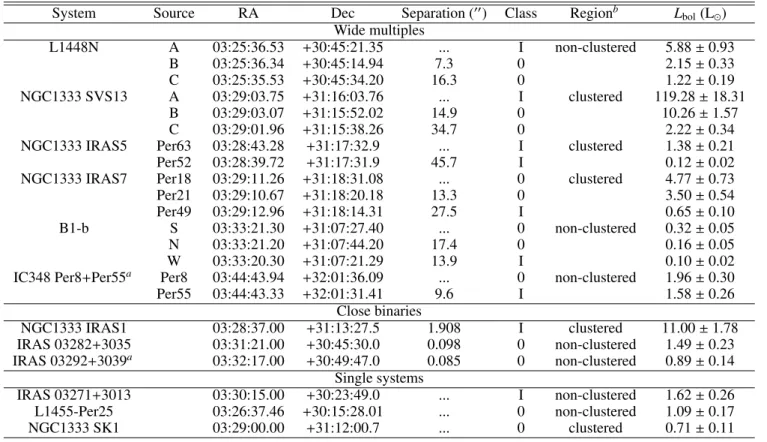
For this study, a sample of 12 low-mass protostellar systems in Perseus were selected from the work of Tobin et al. (2016b) and Murillo et al. (2016). The sample is listed in Table 1, along with coordinates, source separations, type of region where they are located and the bolometric luminosity Lbol calculated from
Table 1.Sample of protostellar systems
System Source RA Dec Separation (00) Class Regionb L
bol(L) Wide multiples
L1448N A 03:25:36.53 +30:45:21.35 ... I non-clustered 5.88±0.93
B 03:25:36.34 +30:45:14.94 7.3 0 2.15±0.33
C 03:25:35.53 +30:45:34.20 16.3 0 1.22±0.19
NGC1333 SVS13 A 03:29:03.75 +31:16:03.76 ... I clustered 119.28±18.31
B 03:29:03.07 +31:15:52.02 14.9 0 10.26±1.57
C 03:29:01.96 +31:15:38.26 34.7 0 2.22±0.34
NGC1333 IRAS5 Per63 03:28:43.28 +31:17:32.9 ... I clustered 1.38±0.21
Per52 03:28:39.72 +31:17:31.9 45.7 I 0.12±0.02
NGC1333 IRAS7 Per18 03:29:11.26 +31:18:31.08 ... 0 clustered 4.77±0.73
Per21 03:29:10.67 +31:18:20.18 13.3 0 3.50±0.54
Per49 03:29:12.96 +31:18:14.31 27.5 I 0.65±0.10
B1-b S 03:33:21.30 +31:07:27.40 ... 0 non-clustered 0.32±0.05
N 03:33:21.20 +31:07:44.20 17.4 0 0.16±0.05
W 03:33:20.30 +31:07:21.29 13.9 I 0.10±0.02
IC348 Per8+Per55a Per8 03:44:43.94 +32:01:36.09 ... 0 non-clustered 1.96±0.30
Per55 03:44:43.33 +32:01:31.41 9.6 I 1.58±0.26
Close binaries
NGC1333 IRAS1 03:28:37.00 +31:13:27.5 1.908 I clustered 11.00±1.78
IRAS 03282+3035 03:31:21.00 +30:45:30.0 0.098 0 non-clustered 1.49±0.23
IRAS 03292+3039a 03:32:17.00 +30:49:47.0 0.085 0 non-clustered 0.89±0.14
Single systems
IRAS 03271+3013 03:30:15.00 +30:23:49.0 ... I non-clustered 1.62±0.26
L1455-Per25 03:26:37.46 +30:15:28.01 ... 0 non-clustered 1.09±0.17
NGC1333 SK1 03:29:00.00 +31:12:00.7 ... 0 clustered 0.71±0.11
Notes. (a) Only observed in 13 CO with APEX.(b) Clustered regions are defined to have 34 YSO pc−1, while non-clustered regions present 6 YSO pc−1, (Plunkett et al. 2013).
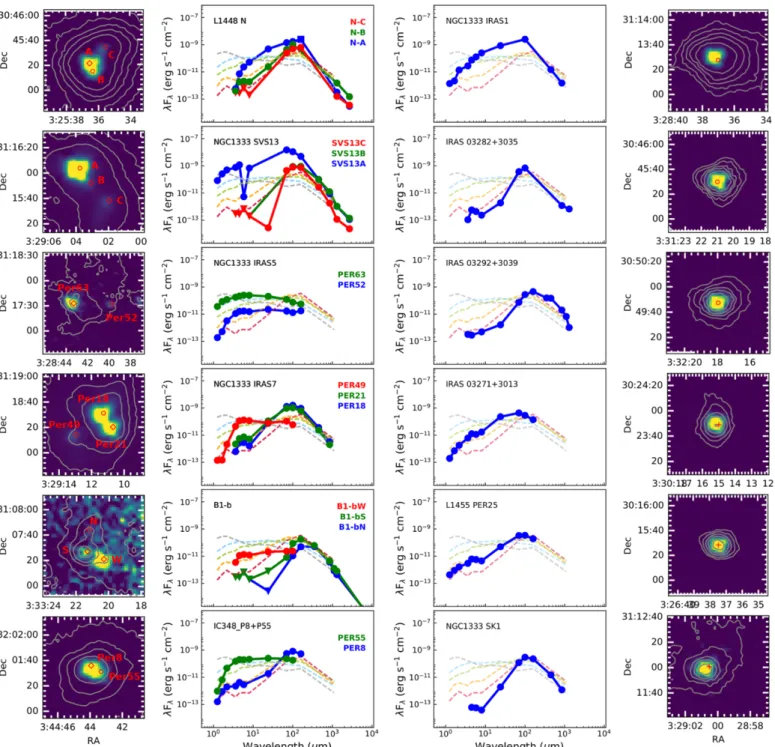
the SEDs. Figure 1 shows HersechelPACS thermal continuum mini-maps of the sample obtained from the Gould Belt Sur-vey (André et al. 2010), along with the constructed SEDs from Murillo et al. (2016). The selected systems are young embedded protostars in the Class 0 and I evolutionary stages. Both single and multiple (i.e., binary and higher order multiples) protostellar systems are included, with the multiple systems spanning a range of separations from ∼0.100 to 4600 (∼23.5 AU to 11000 AU). Thus, both close and wide multiple protostellar systems are con-sidered in this study. Finally, the systems are located in both clus-tered (NGC1333) and non-clusclus-tered regions (L1448, L1455 and B1). Selecting systems from both clustered and non-clustered regions (34 and 6 YSO pc−2, respectively; Plunkett et al. 2013) allows the impact of external heating on the measured gas tem-peratures to be assessed.
This sample then allows the evolutionary stage, multiplicity, and region to be compared with temperature, both from the UV-heated gas and the envelope gas temperature. Since the timescale for protostellar evolution (of order a few×105 yrs, Evans et al. 2009; Mottram et al. 2011; Heiderman & Evans 2015; Carney et al. 2016) is considerably longer than can be observed in hu-man lifespan, the evolution of the protostellar temperature struc-ture cannot be directly observed. Hence, systems in the Class 0 and I evolutionary stages need to be compared, as well as single and multiple protostellar systems. Evolutionary classes are deter-mined based on the shape of the SED, derived parameters such as bolometric temperatureTbol, and the structure of the system (e.g. envelope, outflow opening angle). Thus, the temperature-multiplicity-age relation can be studied, which can in turn pro-vide constraints for hydrodynamical models with radiative feed-back.
3. Observations
3.1. Single pointing
APEX observations of 10 out of 12 systems in our sample were carried out with the Swedish Heterodyne Facility Instrument (SHeFI; Nyström et al. 2009) in position switching mode. The APEX-1 band was used for observations on 1 December 2016 with a precipitable water vapor (PWV) ∼ 1.6 mm (O-098.F-9320B.2016, NL GTO time) using one spectral setting with the central frequency set to 217.11258 GHz and a bandwidth of 4 GHz. This setting targeted the molecules DCO+, DCN, c−C3H2 and H2CO. In addition, transitions of SO and CH3OH were de-tected. Typical noise levels for the observations ranged between 15 to 70 mK for a channel width of 0.4 km s−1and a HPBW of 28.700. The beam efficiencyηmb for observations at 230 GHz is 0.75.
APEX-2 band observations were carried out from 7 to 12 July 2017 with PWV between 0.37 and 1.5 mm (M-099.F-9516C-2017) using two spectral settings with central frequencies of 350.33746 and 361.16978 GHz, and bandwidth of 4 GHz. The molecules targeted were C2H, DCO+, DCN and H2CO. HNC was also detected. Typical noise levels range from 20 to 100 mK for a channel width of 0.4 km s−1, a HPBW of 1800 andη
mb =
Fig. 1.HerschelPACS maps of the systems sampled in this work together with their respective SEDs. The 70 and 160µm emission are shown in color-scale and contours, respectively. Each stamp spans a region of 8000×
8000
and is centered on the position of the OTF maps, except for NGC1333 IRAS5 whose sources have a separation of 45.700
. Red symbols represent the sources of a system and the positions of the APEX single-pointing observations. Circles denote systems with additional unresolved multiplicity. Diamonds indicate single sources within multiple protostellar systems. Crosses indicate single protostars. The SEDs are overlaid on the average SEDs from Enoch et al. (2009) for reference (dashed lines), with early Class 0 (red), late Class 0, early Class I, late Class I, and Class II (gray).
3.2. OTF maps
On-the-fly (OTF) maps of all 12 systems were obtained with two instruments: CHAMP+(Kasemann et al. 2006), and SEPIA B9 (Baryshev et al. 2015; Belitsky et al. 2018), in order to observe 13CO 6–5.13CO 6–5 is a particularly useful tracer of UV heated
gas, in contrast to 12CO 6–5 (Yıldız et al. 2012; van Kempen et al. 2010).
CHAMP+ was used to observe three systems: NGC1333 IRAS7, IC348 Per8+Per55 and IRAS 03292+3029, with a
spec-tral set-up targeting13CO 6–5 (661.06728 GHz) and a beam of 9.400(HPBW). Maps of 4500 ×4500were centered on the target system in the case of IC348 Per8+Per55 and IRAS 03292+3029. In the case of NGC1333 IRAS7, the maps were centered at a po-sition equidistant from all sources. Observations took place in two epochs, from 26 August to 19 September 2014 (M-094.F-0006.2014), and 2 to 13 of August 2015 (M-095.F-0023.2014).
Table 2.Molecular species in this work
Molecule Transition Frequency Eup log10Aij
GHz K
Single pointing
SO 55–44 215.22065 44.10 -3.92
DCO+ 3–2 216.11258 20.74 -2.62
c−C3H2 33,0–22,1 216.27876 19.47 -3.33
DCN 3–2 217.23863 20.85 -4.24
c−C3H2a 6–5 217.82215 38.61 -3.23
c−C3H2 51,4–42,3 217.94005 35.42 -3.35
p−H2CO 30,3–20,2 218.22219 20.96 -3.55
CH3OH 42,2–31,2 218.44005 45.45 -4.33
p−H2CO 32,2–22,1 218.47563 68.09 -3.80
p−H2CO 32,1–22,0 218.76007 68.11 -3.80
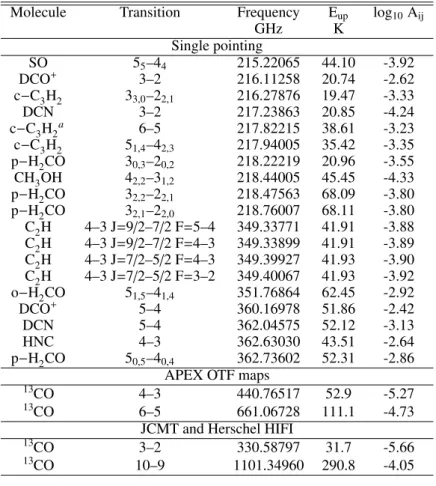
C2H 4–3 J=9/2–7/2 F=5–4 349.33771 41.91 -3.88 C2H 4–3 J=9/2–7/2 F=4–3 349.33899 41.91 -3.89 C2H 4–3 J=7/2–5/2 F=4–3 349.39927 41.93 -3.90 C2H 4–3 J=7/2–5/2 F=3–2 349.40067 41.93 -3.92
o−H2CO 51,5–41,4 351.76864 62.45 -2.92
DCO+ 5–4 360.16978 51.86 -2.42
DCN 5–4 362.04575 52.12 -3.13
HNC 4–3 362.63030 43.51 -2.64
p−H2CO 50,5–40,4 362.73602 52.31 -2.86
APEX OTF maps
13CO 4–3 440.76517 52.9 -5.27
13CO 6–5 661.06728 111.1 -4.73
JCMT and Herschel HIFI
13CO 3–2 330.58797 31.7 -5.66
13CO 10–9 1101.34960 290.8 -4.05
Notes.(a)Contains both ortho- and para forms.
References.All rest frequencies were taken from the Cologne Database for Molecular Spectroscopy (CDMS; Endres et al. 2016). The SO entry is based on Clark & De Lucia (1976). The DCO+entries are based on Caselli & Dore (2005). The c−C3H2entry was based on Bogey et al. (1987) with transition frequencies important for our survey from Bogey et al. (1986) and from Spezzano et al. (2012). The DCN entries are based on Okabayashi & Tanimoto (1993) and Brünken et al. (2004). The entry for CH3OH is based on the line list from Xu & Lovas (1997). The H2CO entries are based on experimental data from Bocquet et al. (1996). The C2H entry is based on Padovani et al. (2009) with additional important data from Müller et al. (2000) and Sastry et al. (1981). and on Cazzoli et al. (2012), respectively. The entry for HNC is based on Okabayashi & Tanimoto (1993). The13CO entries are based on Klapper et al. (2000).
Two maps were made for each of the systems NGC1333 SVS13 and NGC1333 IRAS5, given the separation between the sources. For NGC1333 SVS13, the maps were centered on the A and C sources. Observations took place from 13 August to 25 Novem-ber 2016 (O-098.F-9320A.2016), with an additional science verification observation of B1-B on 29 July 2016 (E-097.F-9810A.2016).
The systems IRAS 03282+3035 and IRAS 03292+3029 were further observed using FLASH (Heyminck et al. 2006) with a spectral set-up targeting13CO 4–3 (440.76517 GHz), since ob-servations of13CO 3–2 were not available with JCMT for these two systems. Observations were carried out on 26 August 2014 (M-094.F-0006.2014).
In order to compare the observations from FLASH, CHAMP+ and SEPIA B9 with the Herschel HIFI 13CO 10–9 observations (RMS noise: 0.03 K; Mottram et al. 2017), the data were averaged within a box of approximately 19.300, the HPBW of the HIFI observations, centered on the position of the HIFI ob-servations. The FLASH observations provide RMS noise of 0.44 and 0.75 K for IRAS 03292+3029 and IRAS 03282+3035, re-spectively, for a channel width of 0.4 km s−1. For the CHAMP+ observations, typical RMS noise is between 0.03 to 0.08 K for a channel width of 0.4 km s−1. For the SEPIA B9 observations the
typical RMS noise level is between 0.1 to 0.2 K for a channel width of 0.4 km s−1. The main beam efficienciesηmbbeing used are 0.60 for 440 GHz, and 0.56 for 660 GHz. Typical calibration uncertainties are about 10 to 20%.
4. Results
4.1. Cold and warm gas
0
1
2
3
DCO
+
3-2
DCO
+5-4 (x3)
DCN 3-2 (x3)
DCN 5-4 (x3)
SO (x3)
CH
3OH (x3)
L1448 N
HNC
0
1
2
3
SVS13
0
1
2
3
IRAS5
Per52
Per63
0
1
2
3
IRAS7
0
1
2
3
B1-B
0
1
2
3
IRAS1
0
1
2
3
IRAS03282
0
1
2
3
IRAS03271
0
1
2
3
Per25
2 4 6 8 1012
Velocity (km s
1)
0
1
2
3
T
mb(K
)
2 4 6 8 1012 2 4 6 8 1012 2 4 6 8 1012 2 4 6 8 1012 2 4 6 8 1012 2 4 6 8 1012
SK1
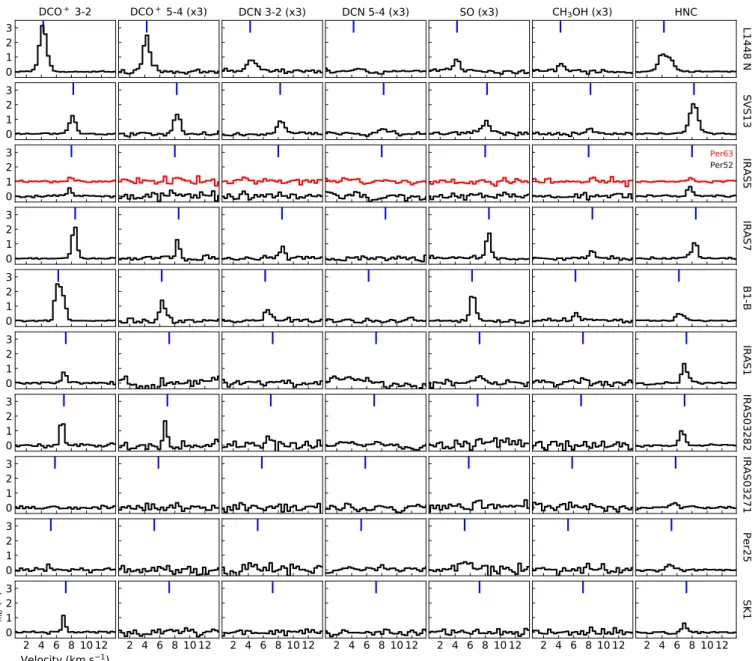
Fig. 2.APEX single pointing observations of DCO+, DCN, SO, CH3OH and HNC. Except for DCO+3–2 and HNC, the spectra are multiplied by a factor of 3 to make the features more prominent. The spectra for the wide multiple systems are averaged for all the sources, except for NGC1333 IRAS5. The vertical blue line marks the systemic velocity.
noise, line widths and integrated fluxes are listed in Tables B.1 to B.6.
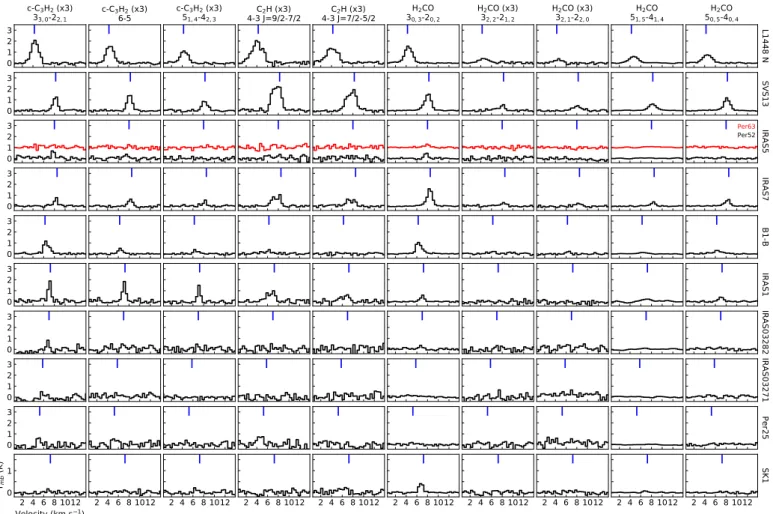
HNC was detected toward all the systems in the sample, however, the other observed molecules were not detected in the envelope of every system. Three out of the five wide multiple protostellar systems show detections with signal-to-noise (S/N) above 3 in 0.4 km s−1channels for all targeted molecular lines. B1-b, also a wide multiple system, shows above 3σdetections in all lines except H2CO 32,2–21,2, DCN 5–4 and C2H 4–3 J=7/2– 5/2. SO and methanol (CH3OH) were detected toward four wide multiple systems. IRAS5 Per63 has detections above 3σonly in DCO+3–2, H2CO 30,3–20,2 and H2CO 50,5–40,4. In contrast, IRAS5 Per52 presents detections in DCO+3–2, c−C3H23–2 and 6–5, and H2CO 30,3–20,2.
The close binary system NGC1333 IRAS 1 presents emis-sion with S/N>3 in SO, DCO+3–2, all transitions of the warm molecules c−C3H2and C2H, as well as H2CO 30,3–20,2. In
con-trast, IRAS 03282+3035 presents emission only in both transi-tions of DCO+, DCN 3–2 and H2CO 30,3–20,2.
The single protostellar systems show little to no emission. NGC1333 SK1 presents emission above 3σ in DCO+ 3–2, H2CO 30,3–20,2 and H2CO 50,5–40,4; while L1455-Per25 shows only DCO+3–2 and HNC emission. The other single protostar, IRAS 03271+3013, presented no detection beyond HNC. This might be due to the protostar being a Class I protostar, how-ever, NGC1333 IRAS 1 and both sources of NGC1333 IRAS5 are also Class I objects but show more line detections than IRAS 03271+3013. In summary, wide multiple systems gen-erally present more line emission than single protostars, most likely related to the higher envelope mass, and hence larger molecular column density.
0 1 2 3
c-C33H2 (x3)
3, 0-22, 1 c-C3H6-52 (x3) c-C51, 43H-42 (x3)2, 3 4-3 J=9/2-7/2C2H (x3) 4-3 J=7/2-5/2C2H (x3) 3H0, 32-2CO0, 2 H322, 2CO (x3)-21, 2 H322, 1CO (x3)-22, 0 51, 5H2CO-41, 4 50, 5H2-4CO0, 4 L1448 N
0 1 2
3 SVS13
0 1 2
3 IRAS5
Per52
Per63
0 1 2
3 IRAS7
0 1 2
3 B1-B
0 1 2
3 IRAS1
0 1 2
3 IRAS03282
0 1 2
3 IRAS03271
0 1 2
3 Per25
2 4 6 8 1012 Velocity (km s1)
0 1 Tmb
(K
)
2 4 6 8 1012 2 4 6 8 1012 2 4 6 8 1012 2 4 6 8 1012 2 4 6 8 1012 2 4 6 8 1012 2 4 6 8 1012 2 4 6 8 1012 2 4 6 8 1012
SK1
Fig. 3.Same as Fig. 2 but for c−C3H2, C2H and H2CO.
gas (Jørgensen et al. 2005; Mathews et al. 2013; Murillo et al. 2015). It should be noted, however, that CO freezes out onto the dust grains at densities above 104∼105cm−3(e.g., Caselli et al. 1999; Bergin et al. 2002; Jørgensen et al. 2005), thus at these densities DCO+may be dependent on density as well as temper-ature. The low-lying transition of H2CO 30,3–20,2is the strongest among the five transitions, with peaks a factor of∼10 higher than the higher-lying H2CO transitions. The peaks of the H2CO 5–4 transitions appear stronger than the higher-lying 3–2 transitions, this is due to the smaller HPBW of the APEX-2 observations (1800). DCN is a warm gas tracer, which can be formed and frac-tionated through a higher temperature route starting with CH2D+ (e.g., Favre et al. 2015). Similarly to DCN, the higher-lying tran-sitions of H2CO also trace warm gas. The weak emission of DCN and the higher-lying transitions of H2CO would suggest that the envelope gas is relatively cold and currently not being strongly heated. The molecules c−C3H2and C2H trace the warm UV-irradiated gas (e.g., Nagy et al. 2015; Guzmán et al. 2015), most likely located along the outflow cavity (e.g., Fontani et al. 2012; Jørgensen et al. 2013; Murillo et al. 2018). The peak inten-sities of c−C3H2vary by less than a factor of 3 among all three observed transitions. C2H is detected in both spin doubling tran-sitions with each transition showing a characteristic double hy-perfine structure pattern. Methanol (CH3OH) and SO are mainly formed on grain surfaces, and either are sputtered offthe grains by shocks (e.g., Buckle & Fuller 2002; Burkhardt et al. 2016) or sublimated into the gas phase in hot, dense regions of the outflow (e.g., van der Tak et al. 2000; Palau et al. 2017).
The different systemic velocities of each region within Perseus are reflected in the observed spectra (Fig. 2 and 3). For the systems located in NGC1333, there is also a slight diff er-ence in the systemic velocity between the systems located closer to the cluster center (NGC1333 SVS13, NGC1333 IRAS7 and NGC1333 IRAS5;vLSR =8.0–8.5 km s−1) and those located in the outer part of the cluster (NGC1333 IRAS1 and NGC1333 SK1;vLSR ∼7.3 km s−1).
4.2.13CO maps
The results from the 13CO maps are described in this section. The spectra extracted from the maps are shown in Fig. B.1, along with the spectra from JCMT andHerschelHIFI observations, for comparison. Spectra from the JCMT and APEX observations are smoothed to the beam of the HIFI observations. Observed line peak temperatures, RMS noise, line widths and integrated fluxes are listed in Table B.7.
13CO 4–3 was observed toward the close binary systems
IRAS 03282+3035 and IRAS 03292+3039, with emission be-ing detected only toward IRAS 03292+3039 (S/N∼7σ). IRAS 03282+3035 does not show emission at the natural resolution of the FLASH observations (σ ∼0.5 K), nor smoothed to the Her-schelHIFI observations HPBW =19.2500(σ∼1 K).
13CO 6–5 was mainly detected toward the wide multiple
(S/N = 24σ) is located between Per18 and Per21, with little emission toward Per49, while IC348 Per8+Per55 shows cen-trally concentrated emission with S/N=42σ. IRAS 02393+3039 did not show any significant line emission in the CHAMP+ ob-servations with a noise of 0.12 K.
Observations with SEPIA B9 detected 13CO 6–5 toward L1448N, NGC1333 SVS13 and NGC1333 IRAS1. From these systems, NGC1333 SVS13 presents the strongest emission, peaking at∼4.7 K (average of the central position of the maps centered on sources A and C). L1448N presents weak emission, despite presenting relatively strong line detections in all the other molecules observed with APEX-1 and APEX-2 (Fig. 2 and 3). However, the weak 13CO 6–5 emission is consistent with the observations of 13CO using the JCMT and HerschelHIFI (Ta-ble B.7 and Fig. B.1).
The SEPIA B9 observations show considerably more noise by a factor of 3 higher than those of the CHAMP+observations. Considering the signal-to-noise ratio of the detected emission, however, the non-detections are not due to the higher noise level of the SEPIA B9 observations, but most likely from the compact 13CO 6–5 emission toward these systems, which is diluted in the
larger beam.
5. Analysis
5.1. Line emission and system parameters
The observed molecular line emission is compared to system lu-minosity and envelope mass in this section. Bolometric luminos-ityLbolis obtained from the SEDs of the observed systems, with
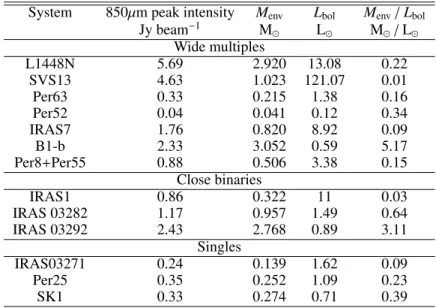
Lbol for the wide multiple systems derived from the combined SEDs (Murillo et al. 2016). Envelope mass Menv, listed in Ta-ble 3, is calculated from the 850µm peak intensityS850µm,Lbol and distanced using the formula from Jørgensen et al. (2009) expressed as:
Menv=0.44M
Lbol 1L
!−0.36
S850µm
1 Jy beam−1 !1.2
d
125 pc !1.2
(1)
which takes into account that more luminous systems have some-what higher dust temperatures. The relation assumes optically thin emission and typical dust-to-gas ratio of 1:100, and is de-rived from the power-law relations that arise between enve-lope mass obtained from radiative transfer models, and the ob-served peak flux, and luminosity. The power-law relations are
Menv∝S8501.2 andMenv/S850∝L0bol.36.
The 850µm peak intensity used in this work is measured from the COMPLETE survey map of Perseus taken with SCUBA on the JCMT (Kirk et al. 2006), which has a beam of 1500. The peak intensity was measured in a circular region of 28.700 (HPBW of the APEX-1 observations) centered on each system. For the wide multiple systems, the total flux of all sources is used. In addition, the observed line emission is com-pared to the ratio of envelope mass to bolometric luminosity, (Menv/Lbol), listed in Table 3. This ratio gives insight into the amount of mass heated by the luminosity of the protostellar sources within each system. Because younger systems are pected to have more mass in their envelopes, higher ratios are ex-pected to correspond to younger sources (Bontemps et al. 1996). This holds true for the close binary and single systems in our sample. But it is more difficult to disentangle for the wide mul-tiple systems, since the individual sources present different evo-lutionary stages (Fig. 1 and Table 1).
System type (wide multiple, close binary and single proto-star) is indicated in the plots with different symbols in order
to determine if there is any relation with respect to line emis-sion or system parameters. For systems with molecular line non-detections, the upper limits in the plots are placed at 3σ. A linear fit to the data is used to identify trends between the observed line emission peaks and system parameters in cases where there is a significant correlation. Further statistical analysis is treated in Sec. 5.3.
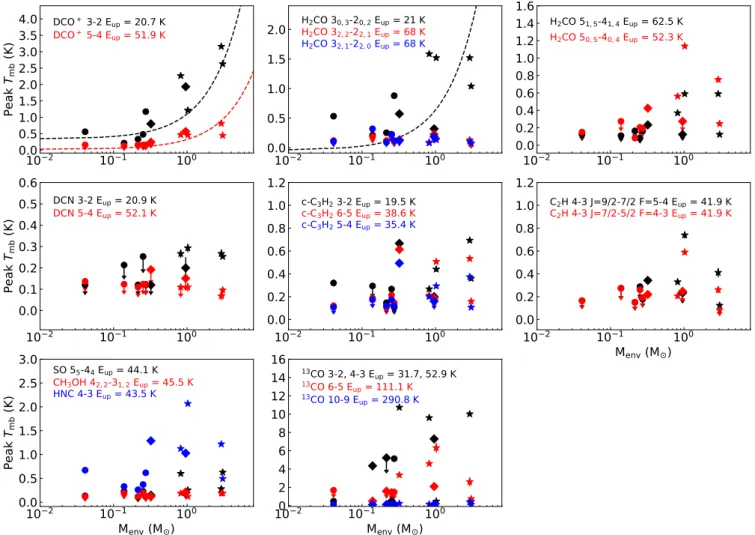
Peak antenna temperatures are compared with the envelope mass in Fig. 4. The peak intensities of H2CO 30,3–20,2, and DCO+3–2 increase with envelope mass. Wide multiple systems have larger envelope masses than the close binaries and single protostars, with the exception of NGC1333 IRAS5, where Per63 and Per52 have envelope masses comparable to single protostars. This can be interpreted as wide multiple systems having more massive reservoirs of cold gas compared to close binaries and single protostellar systems. On the other hand, the warm gas be-ing traced by DCN and the two higher-lybe-ing transitions of H2CO 3–2 do not show a dependency on the envelope mass, degree of multiplicity or region type. Instead the line peaks are practically constant with envelope mass. Methanol, SO and the three transi-tions of c−C3H2do not show particular dependency on envelope mass either. For 13CO 3–2, there appears to be a slight correla-tion between envelope mass and peak antenna temperature, but there are not enough data points to be certain. The 6–5 and 10–9 transitions also do not show a correlation to envelope mass.
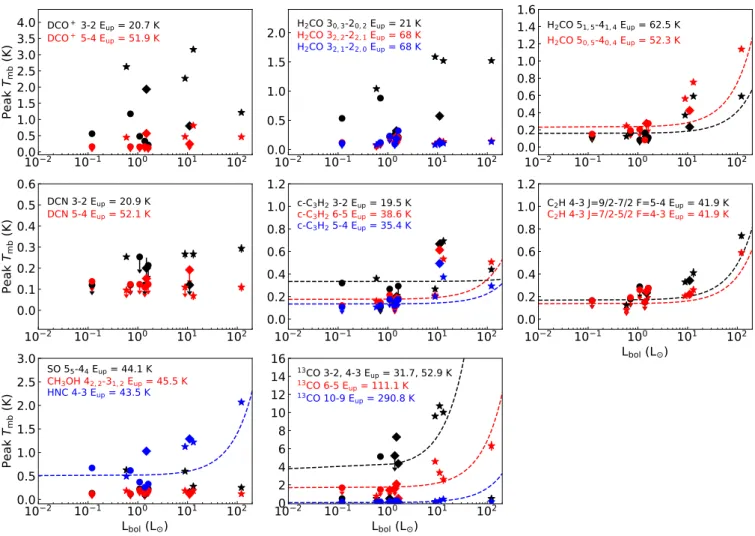
Figure 5 shows the observed line peak antenna temperatures compared withLbol. The warm molecule C2H appears to be asso-ciated withLbol, as well as the c−C3H26–5 and 5–4 transitions. Since these molecules are generally formed in irradiated regions (Fontani et al. 2012; Jørgensen et al. 2013; Nagy et al. 2015; Guzmán et al. 2015), the correlation between C2H and c−C3H2, andLbolcan be explained by the outflow cavity being irradiated by the central protostar, as was also found for O[I] and H2O (e.g. Mottram et al. 2017). Thus, the more luminous the central protostar, the deeper the outflow cavity is irradiated and more c−C3H2and C2H is produced. The two transitions of H2CO 5–4 show a correlation to bolometric luminosity, whereas the higher lying transitions of H2CO 3–2 do not, despite the similar upper energy levels (Eup =52–68 K). The reason for this discrepancy could be the difference in beam size from the observations. The H2CO 3–2 transition was observed with a beam of 28.700, com-pared to 1800for the 5–4 transition. This suggests that the H2CO 5–4 transition is picking up emission from material at smaller scales, closer to the protostellar source(s), and thus related to the luminosity of the protostellar source(s). HNC, and all three tran-sitions of13CO also show relation toLbol, as previously found for a larger sample by e.g., San José-García et al. (2013) and Yıldız et al. (2013). The other molecules do not present any correlation to bolometric luminosity, not even SO and CH3OH which are expected to trace shocks, or the higher transitions of H2CO 3–2 which trace warmer gas. The lack of correlation could be due to the low number of detections, and are further explored through statistical analysis in Section 5.3.
The peak antenna temperatures compared withMenv/Lbolare presented in Fig. B.2. There appears to be no relation between any of the observed molecular line peaks andMenv/Lbol. This in-dicates that when the amount of mass being illuminated, and thus heated, by the central protostellar system is taken into account, the observed protostellar systems present similar peak antenna temperatures.
transi-Table 3.Source parameters
System 850µm peak intensity Menv Lbol Menv/Lbol
Jy beam−1 M L M/L
Wide multiples
L1448N 5.69 2.920 13.08 0.22
SVS13 4.63 1.023 121.07 0.01
Per63 0.33 0.215 1.38 0.16
Per52 0.04 0.041 0.12 0.34
IRAS7 1.76 0.820 8.92 0.09
B1-b 2.33 3.052 0.59 5.17
Per8+Per55 0.88 0.506 3.38 0.15
Close binaries
IRAS1 0.86 0.322 11 0.03
IRAS 03282 1.17 0.957 1.49 0.64
IRAS 03292 2.43 2.768 0.89 3.11
Singles
IRAS03271 0.24 0.139 1.62 0.09
Per25 0.35 0.252 1.09 0.23
SK1 0.33 0.274 0.71 0.39
tions of H2CO. c−C3H2and C2H trace the warm irradiated out-flow cavity, rather than envelope material.
5.2. Line ratios and implied physical conditions
The gas temperature structure can be probed with the several transitions of c−C3H2, H2CO and DCO+that were observed. In addition, the ratio of DCN/DCO+ can be used to compare the warm (DCN) and cold gas (DCO+) from the envelope. Since the two transitions of DCO+ were observed with a different beam (3–2: 28.700; 5–4: 1800), a beam dilution correction factor of 0.39 is applied to the 5–4 transition. Not considering the different beam sizes of the observations, would result in the DCO+ ra-tio being overestimated by a factor of 2 to 3. The line rara-tios of c−C3H2, H2CO, DCO+ and DCN/DCO+ are listed in Table 4. While two transitions of DCN were observed, ratios can only be obtained for half the systems due to low detection rates, of which three are upper limits. These ratios are thus also listed for each system where both lines were detected in Table 4 but not discussed further.
High-JCO lines (Ju>3) can be used as diagnostics of tem-perature and density, as well as UV photon-heated gas (e.g., Yıldız et al. 2012, 2015). Hence the 13CO 4–3 and 6–5 ob-servations presented in this work are compared with peak an-tenna temperatures from the JCMT andHerschelHIFI observa-tions. For this purpose, the spectra from the JCMT and APEX data were smoothed to the beam of theHerschelHIFI observa-tions (19.2500). Only part of our sample has data from the JCMT and/orHerschelHIFI (Table B.7). Thus, only those systems are considered for13CO ratios (Table 5).
Using RADEX (van der Tak et al. 2007), non-LTE excita-tion and radiative transfer calculaexcita-tions were performed to study the variation of the c−C3H2, H2CO, DCO+and13CO ratios with H2density and temperature (Fig. 6). The molecular data files for the RADEX calculations were obtained from the Leiden Atomic and Molecular Database (LAMDA; Schöier et al. 2005). The collisional rate coefficients for DCO+ are based on the results of Botschwina et al. (1993) and Flower (1999). For c−C3H2, H2CO and 13CO, the collisional rate coefficients are based on Chandra & Kegel (2000), Wiesenfeld & Faure (2013) and Yang et al. (2010), respectively.
Ratios are not calculated for the systems with non-detections in both transitions used in the ratio (Tables B.1, B.3, B.5 and B.7) and are thus not considered in the following analysis (Table 4 and 5). Upper limits are given when one of the transitions is a non-detection (Table 4), and are not considered for the linear fits but are shown in the figures for reference.
Kinetic gas temperatures are derived from the c−C3H2, H2CO, DCO+and13CO ratios by averaging over a range of H2 densities, and are listed in Table 6. An H2densitynH2range be-tween 105 to 106 cm−3, typical in the envelopes of embedded protostellar objects on the scales of the beam, is assumed for the c−C3H2, H2CO, and DCO+calculations. A column density of 1012cm−2is adopted for the DCO+, c−C3H2 and H2CO line ratio calculations, ensuring that the lines are optically thin. For 13CO, a column density of 1016cm−2is adopted for a line width
of 2 km s−1, which produces optically thin emission. Yıldız et al. (2012) found a column density of 1017 cm−2 for a line width of 10 km s−1 toward NGC1333 IRAS4A and IRAS4B. Thus our adopted13CO column density is reasonable. Adopting a column density of 1017cm−2for a line width of 2 km s−1would provide optically thick emission.
Figure 7 compares the calculated ratios with envelope mass
Menv, bolometric luminosityLbol, andMenv/Lbol. Since molecu-lar line ratios are related to gas temperature (Fig. 6), the com-parison serves to determine relations between temperature and system parameters.
10
210
110
00.0
0.5
1.0
1.5
2.0
2.5
3.0
3.5
4.0
Pe
ak
T
mb(K
)
DCO+ 3-2 Eup = 20.7 K
DCO+ 5-4 Eup = 51.9 K
10
210
110
00.0
0.5
1.0
1.5
2.0
H2CO 30, 3-20, 2 Eup = 21 KH2CO 32, 2-22, 1 Eup = 68 K
H2CO 32, 1-22, 0 Eup = 68 K
10
210
110
00.0
0.2
0.4
0.6
0.8
1.0
1.2
1.4
1.6
H2CO 51, 5-41, 4 Eup = 62.5 K
H2CO 50, 5-40, 4 Eup = 52.3 K
10
210
110
00.0
0.1
0.2
0.3
0.4
0.5
0.6
Pe
ak
T
mb(K
)
DCN 3-2 EDCN 5-4 Eupup = 20.9 K = 52.1 K10
210
110
00.0
0.2
0.4
0.6
0.8
1.0
1.2
c-C3H2 3-2 Eup = 19.5 K
c-C3H2 6-5 Eup = 38.6 K
c-C3H2 5-4 Eup = 35.4 K
10
210
110
0M
env(M )
0.0
0.2
0.4
0.6
0.8
1.0
1.2
C2H 4-3 J=9/2-7/2 F=5-4 Eup = 41.9 K
C2H 4-3 J=7/2-5/2 F=4-3 Eup = 41.9 K
10
210
110
0M
env(M )
0.0
0.5
1.0
1.5
2.0
2.5
3.0
Pe
ak
T
mb(K
)
SO 55-44 Eup = 44.1 K
CH3OH 42, 2-31, 2 Eup = 45.5 K
HNC 4-3 Eup = 43.5 K
10
210
110
0M
env(M )
0
2
4
6
8
10
12
14
16
13CO 3-2, 4-3 Eup = 31.7, 52.9 K
13CO 6-5 Eup = 111.1 K 13CO 10-9 Eup = 290.8 K
Fig. 4.Peak intensities of the observed molecular lines compared to the envelope mass (M) of each systems. The dashed lines are linear fits to the data for the cases where a correlation is found. Circles, diamonds and stars show single, close binary and wide multiple protostellar systems, respectively. Note that the more massive envelopes show an increase in the peak intensities of DCO+and the low-lying transition of H2CO, which trace cold gas in the envelope. Molecules tracing warm gas have similar peak intensities regardless of envelope mass.
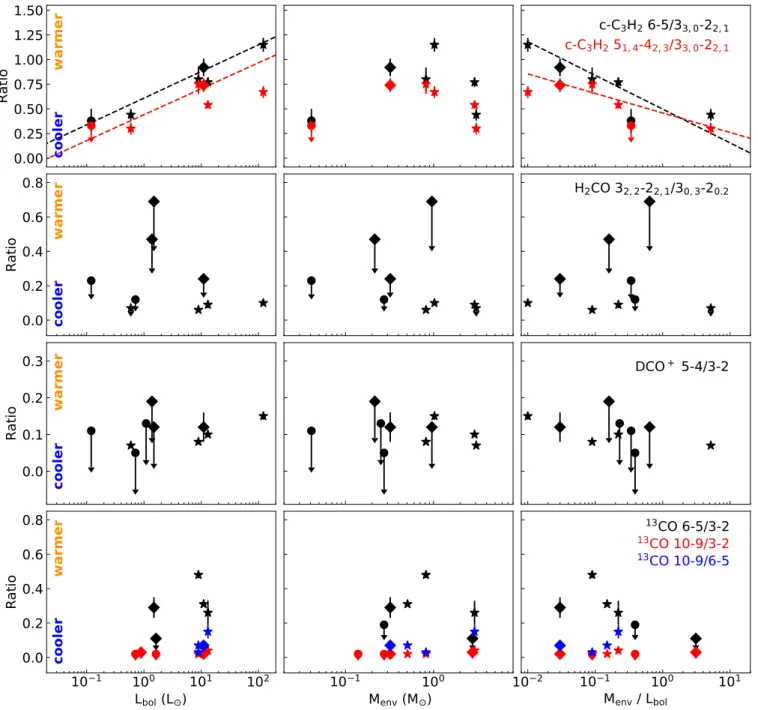
from Class 0 to I (e.g., Nisini et al. 2015; Mottram et al. 2017), the results of c−C3H2toward our sample may indicate an evolu-tionary effect. The separation of the sources in multiple systems or their coevality does not show any effect on the temperature traced by the c−C3H2ratio (Fig. 7). While there is no difference in temperature between close binaries and wide multiples, the effect of multiplicity, on the other hand, cannot be fully deter-mined, since none of the single protostars in our sample present c−C3H2detections.
The ratios of H2CO, DCO+and13CO are quite constant in relation to all system parameters, and suggest overall cooler tem-peratures. System type, region and evolutionary stage do not present any correlation either. The ratios of H2CO and DCO+ indicate temperature between 10 and 60 K. Considering higher
nH2, alters the temperature by only a few degrees, otherwise the temperatures stay mainly constant. Thus, all embedded proto-stars appear to have envelope gas with similar, and relatively cold, temperatures regardless of their multiplicity (Fig. 7).
The ratios obtained from13CO vary little among the systems, regardless of system parameters, multiplicity and evolutionary stage. The low ratios suggest temperatures typically below 60 K, with only L1448 N showing temperatures closer to 100 K atnH2 of a few 105 cm−3. This is consistent with the work of Yıldız et al. (2015), which found typical gas temperatures of 30 to 50 K
toward protostellar systems. Given that high-J13CO lines trace UV photon-heated gas, the low ratios and derived temperatures would indicate that the envelope is not being heated out to large radii. Furthermore, the lack of line detection toward some of the systems would suggest that13CO emission is concentrated closer to the source of heating, and thus is being diluted in the APEX beam, and even more so when smoothed to theHerschelHIFI beam.
10
210
110
010
110
20.0
0.5
1.0
1.5
2.0
2.5
3.0
3.5
4.0
Pe
ak
T
mb(K
)
DCO+ 3-2 Eup = 20.7 K
DCO+ 5-4 Eup = 51.9 K
10
210
110
010
110
20.0
0.5
1.0
1.5
2.0
H2CO 30, 3-20, 2 Eup = 21 KH2CO 32, 2-22, 1 Eup = 68 K
H2CO 32, 1-22, 0 Eup = 68 K
10
210
110
010
110
20.0
0.2
0.4
0.6
0.8
1.0
1.2
1.4
1.6
H2CO 51, 5-41, 4 Eup = 62.5 K
H2CO 50, 5-40, 4 Eup = 52.3 K
10
210
110
010
110
20.0
0.1
0.2
0.3
0.4
0.5
0.6
Pe
ak
T
mb(K
)
DCN 3-2 EDCN 5-4 Eupup = 20.9 K = 52.1 K10
210
110
010
110
20.0
0.2
0.4
0.6
0.8
1.0
1.2
c-C3H2 3-2 Eup = 19.5 K
c-C3H2 6-5 Eup = 38.6 K
c-C3H2 5-4 Eup = 35.4 K
10
210
110
010
110
2L
bol(L )
0.0
0.2
0.4
0.6
0.8
1.0
1.2
C2H 4-3 J=9/2-7/2 F=5-4 Eup = 41.9 K
C2H 4-3 J=7/2-5/2 F=4-3 Eup = 41.9 K
10
210
110
010
110
2L
bol(L )
0.0
0.5
1.0
1.5
2.0
2.5
3.0
Pe
ak
T
mb(K
)
SO 55-44 Eup = 44.1 K
CH3OH 42, 2-31, 2 Eup = 45.5 K
HNC 4-3 Eup = 43.5 K
10
210
110
010
110
2L
bol(L )
0
2
4
6
8
10
12
14
16
13CO 3-2, 4-3 Eup = 31.7, 52.9 K
13CO 6-5 Eup = 111.1 K 13CO 10-9 Eup = 290.8 K
Fig. 5.Peak intensities of the observed molecular lines compared to the bolometric luminosityLbol(L) of each system. The dashed lines are linear fits to the data for the cases where a correlation is found. Circles, diamonds and stars show single, close binary and wide multiple protostellar systems, respectively. C2H and c−C3H2show somewhat higher peak intensities in systems with relatively higher luminosities.
upper limits would decrease the mean ratio for the13CO 10–9/3– 2 and 10–9/6–5 ratios, but not so much for the 6–5/3–2 ratio.
In summary, the cool envelope temperatures found in this work are not from particularly cold protostellar systems, nor is the Perseus molecular cloud producing uncommon protostars. It would seem, instead, that the central protostar does not exten-sively heat the envelope to high temperatures, and that single protostars do not heat the envelope differently than multiple pro-tostellar systems.
5.3. Statistical analysis
In order to determine quantitatively if there is a relation between the observed line peaks and derived quantities, and the system parameters, the Generalized Kendall’s rank correlation is used (Isobe et al. 1986). This method measures the degree of asso-ciation between two quantities which contain upper limits (cen-sored data), with the null hypothesis being that the values are uncorrelated. Thus, if the significance level p >0.05, the prob-ability of the values being correlated is less than 3σ, while p<
0.05 indicates a correlation at better than 3σ significance. The standard normal scorezand the significance levelpof the Gen-eralized Kendall’s rank correlation are listed in Table C.1, with values indicating a correlation highlighted in bold text. The sig-nificance level is calculated from the standard normal scorezby
the relation
p=1−0.5∗(1+er f √|z|
2 !
), (2)
whereer f(x) is the error function.
The results confirm the correlations seen by eye (Sec. 5.1). The peak antenna temperatures of the molecules tracing cold gas, namely DCO+ and H2CO are associated with system en-velope mass, but not with luminosity. On the other hand, the peak antenna temperatures of c−C3H2 and C2H, both tracers of warm gas, are correlated with luminosity but not system en-velope mass. The three transitions of 13CO present correlation with luminosity, while the 6–5 transition also presents a correla-tion with the mass to luminosity ratio. The 6–5/33,0–22,1ratio of c−C3H2 shows correlations with luminosity and the mass to luminosity ratio, but not envelope mass. The DCN/DCO+ and 13CO 10–9/3–2 ratios present correlation with envelope mass,
but not the other system parameters.
6. Discussion
6.1. Observed line detections
20
40
60
80
100
T
kin(K
)
0.4 0.6
0.8 1.0 1.4
1.8 2.0
c-C
3H
26-5/3-2
0.4
0.6
0.8 1.0
1.4 1.8 2.0
c-C
3H
25-4/3-2
0.25
0.2 0.17 0.130.1 0.08
p-H
2CO 3
2, 2-2
2, 1/3
0, 3-2
0, 220
40
60
80
100
T
kin(K
)
0.1
0.2
0.4 0.6
0.8 1.0 1.2 1.4 1.6 1.8 2.0
DCO
+5-4/3-2
0.2 0.4 0.6 0.8 1.0 1.4
13
CO 6-5/3-2
0.2 0.4 0.6 0.8 1.0 1.4
13
CO 6-5/4-3
10
510
610
7Density n(H
2) (cm
3)
20
40
60
80
100
T
kin(K
)
0.02
0.2 0.4 0.6 0.8
13
CO 10-9/3-2
10
510
610
7Density n(H
2) (cm
3)
0.02
0.2 0.4 0.6
13
CO 10-9/4-3
10
510
610
7Density n(H
2) (cm
3)
0.02 0.04
0.2 0.4
13
CO 10-9/6-5
Fig. 6.Calculated line ratios for c−C3H2, H2CO, DCO+and 13
CO. The black lines show the modelled ratios assuming a column density of 1012 cm−2for c−C
3H2, H2CO and DCO+, and 1016cm
−2for13
CO. For the13CO 6–5/3–2 and 6–5/4–3 panels, the two lower lines show the 0.02 and 0.04 ratios. The shaded areas show the results for the gas temperature calculations and adopted H2density range for individual systems: L1448N (cyan), NGC1333 SVS13 (blue), NGC1333 IRAS7 (light blue), NGC1333 IRAS1 or IRAS 03292+3039 (gray) and NGC1333 IRAS5 Per52 or NGC1333 SK1 (red).
Table 4.Peak main beam temperature line ratios
System c−C3H2 c−C3H2 H2CO DCO+ DCN DCN/DCO+
6–5/33,0–22,1 51,4–42,3/33,0–22,1 32,2–22,1/30,3–20,2 5–4/3–2 5–4/3–2 3–2 Wide multiples
L1448N 0.77±0.05 0.54±0.04 0.09±0.02 0.1±0.01 0.26±0.09 0.08±0.01
SVS13 1.15±0.07 0.67±0.06 0.1±0.01 0.15±0.03 0.35±0.10 0.24±0.02
Per63 . . . <0.47 <0.19 . . . <0.36
Per52 0.38±0.12 <0.33 <0.23 <0.11 . . . <0.21
IRAS7 0.8±0.12 0.75±0.1 0.06±0.01 0.08±0.01 <0.41 0.12±0.01
B1-b 0.44±0.06 0.3±0.06 <0.07 0.07±0.01 <0.35 0.1±0.01
Close binaries
IRAS1 0.92±0.09 0.74±0.07 <0.24 0.12±0.1 . . . <0.15
IRAS 03282 . . . <0.69 <0.12 <0.76 0.1±0.03
Singles
IRAS 03271 . . . .
Per25 . . . <0.13 . . . <0.52
0.00
0.25
0.50
0.75
1.00
1.25
1.50
Ratio
cooler
warmer
c-C
3H
26-5/3
3, 0-2
2, 1c-C
3H
25
1, 4-4
2, 3/3
3, 0-2
2, 10.0
0.2
0.4
0.6
0.8
Ratio
cooler
warmer
H
2CO 3
2, 2-2
2, 1/3
0, 3-2
0.20.0
0.1
0.2
0.3
Ratio
cooler
warmer
DCO
+5-4/3-2
10
110
010
110
2L
bol(L )
0.0
0.2
0.4
0.6
0.8
Ratio
cooler
warmer
10
110
0M
env(M )
10
2
10
110
010
1M
env/ L
bol13
CO 6-5/3-2
13
CO 10-9/3-2
13
CO 10-9/6-5
Fig. 7.Calculated molecular line ratios of c−C3H2 (top row), H2CO (second row), DCO+(third row) and 13
CO (bottom row) compared to the system parameters bolometric luminosityLbol(left column), envelope massMenv(middle column) and the mass to luminosity ratioMenv/Lbol(right column). The black and red dashed lines in the top row are linear fits to the data for the 6-5/33,0-22,1 and 51,4-42,3/33,0-22,1 ratios, respectively. Circles, diamonds and stars show single, close binary and wide multiple protostellar systems, respectively. The c−C3H2 ratios appear to be somewhat related to luminosity, whereas the ratios from H2CO and DCO+are constant regardless of system parameter.
line detections with strong peak intensities than close binaries (Fig. 9). In contrast, single protostars present very weak molecu-lar line emission. There seems to be a relation, however, between the envelope mass and the number of molecular line detections. As noted in Sect. 5.1, the ratioMenv/Lbolcorrelates with evolu-tionary stage for the close binary and single systems. However, the ratio, and thus the evolutionary stage, does not seem to have relation to the number of line detections (Fig. 9d). These rela-tions appear to not be affected by clustering either. However, the envelope mass is larger for wide multiple protostellar systems in contrast to that of close binary and single protostars. Core mass would then be more related to formation of non-coeval wide multiple protostellar systems. There is no apparent
0
2
4
6
8
10
Counts
cooler
13CO 6-5/3-2
warmer
cooler
13CO 10-9/3-2
warmer
cooler
warmer
Yildiz et al. 2013
13
CO 10-9/6-5
0.0
0.5
1.0
1.5
Ratio
0
2
4
6
8
10
Counts
0.00
0.05
0.10
0.15
0.20
0.25
Ratio
0.00
0.05
0.10
Ratio
0.15
0.20
0.25
This work
Fig. 8.13CO ratio stacked histogram including JCMT andHerscheldata from Yıldız et al. (2013) (top row) and this work (bottom row). Upper limits are shown in gray. Ratios from Yıldız et al. (2013) are for the systems in the Water In Star-forming regions withHerschel(WISH) key project (van Dishoeck et al. 2011), which do not overlap with the sample studied in this work. The black dashed line shows a Gaussian distribution fit to the total sample of13CO ratios.
Table 5.13CO peak main beam temperature line ratios
System 6–5/3–2 6–5/4–3 10–9/3–2 10–9/4–3 10–9/6–5
Wide multiples
L1448N 0.26±0.07 0.04±0.004 0.15±0.04
IRAS7a 0.48±0.02 0.02±0.004 0.03±0.01
PER8+PER55 0.31±0.01 0.02±0.003 0.07±0.01
Close binaries
IRAS1 0.29±0.06 0.02±0.01 0.07±0.02
IRAS 03282 ... ... ...
IRAS 03292 <0.11 <0.03 ...
Singles
IRAS 03271 ... <0.02 ...
Per25 ...
SK1 <0.19 <0.02 ...
Notes.(a)Includes only Per18 and Per21.
more protostellar systems would be needed to determine if the trends found in this work are real or product of the small sample size.
6.2. Envelope gas temperature and multiplicity
The H2CO and DCO+ratios point to cool envelopes (Tgas <60 K at scales of 7000 AU) for all the systems in our sample, re-gardless of multiplicity, clustering and evolutionary stage. Only c−C3H2 presents a correlation with bolometric luminosity and an anti-correlation with Menv/Lbol. Since a formation path of c−C3H2is through the breakdown of large hydrocarbons by UV photons, these correlations could be related to the amount of ma-terial that is irradiated by the central protostar, with more lumi-nous protostars irradiating more material. Alternatively, it could be an evolutionary effect where the jet becomes hotter while the envelope and outflow cavity mass decreases, resulting in more material being irradiated by UV photons (e.g., Nisini et al. 2015; Mottram et al. 2017). The low13CO ratios, and derived temper-ature (Tgas <100 K at scales of∼4500 AU), suggest that the
envelope and outflow cavity are not being UV photon-heated out to large extents.
Table 6.DerivedTkinfrom line ratios averaged over H2density range
System c−C3H2a c−C3H2a H2COa DCO+a 13COa 13COa 13COa
6–5/33,0–22,1 51,4–42,3/33,0–22,1 32,2–22,1/30,3–20,2 5–4/3–2 6–5/3–2 10–9/3–2 10–9/6–5
Tkin(K) Tkin(K) Tkin(K) Tkin(K) Tkin(K) Tkin(K) Tkin(K)
Wide multiples
L1448N 18±2 20±3 30±2 19±3 30±3 58±7 86±16
SVS13 30±6 22±4 31±1 26±8 ... ... ...
Per63 . . . <180 <29 ... ... ...
Per52 11±1 <10 <61 <21 ... ... ...
IRAS7 18±2 54±30 24±1 17±3 42±3 51±6 51±7
B1-b 11±1 10±7 <25 21±5 ... ... ...
Per8+Per55 ... ... ... ... 33±2 50±6 66±10
Close binaries
IRAS1 22±3 81±49 <64 25±8 33±3 50±6 65±10
IRAS 03282 . . . <180 <26 ... ... ...
IRAS 03292 ... ... ... ... <20b <57b ...
Singles
IRAS 03271 . . . ... ... <51 ...
Per25 . . . <23 ... ... ...
SK1 . . . <35 <13 <27 <51 ...
Notes.(a)Assuming a H
2density range of 105to 106cm
−3 (b)Kinetic temperatures are for the 6–5/4–3 and 10–9/4–3 ratios.
with the findings of Yıldız et al. (2012), with the gas tempera-ture droping to 40 K at a distance of∼5000 AU. These results thus indicate that while the embedded protostar can heat up the surrounding gas to temperatures of 50 to 100 K, it can only do so out to about 1000 AU or along low density structures such as the outflow cavity. In contrast wide multiple protostellar systems are observed to have much larger separations (Table 1), with sources not likely to be located within the outflow cavity.
Non-detection within the APEX beam of molecules such as c−C3H2and H2CO, which trace the outflow cavity and envelope gas, respectively, would point to cooler envelopes and outflow cavities at scales of 7000 AU. In addition, DCO+, a cold gas tracer, is detected toward all but one system (IRAS 03271+3013, single). Non-detections of warm gas tracers in addition to the presence of DCO+ toward single and close binary protostellar systems could be explained by these systems being somewhat cooler than wide multiple protostellar systems. Another possi-bility could be the evolutionary dispersal of envelope material which would cause the warm gas to be located closer to the pro-tostellar source(s) and thus diluted in the observing beam. Inter-estingly enough, H2CO 30,3–20,2and DCO+ appear to increase with an increase in envelope mass. In other words, H2CO 30,3– 20,2and DCO+present stronger emission in wide multiple pro-tostars. This could indicate the presence of massive reservoirs of cold gas in these systems.
External heating does not seem to play a significant role, as evidenced by a lack of difference in all aspects between sys-tems in clustered and non-clustered regions. However it is not clear why close binaries present less molecular line emission than wide multiple protostars, given that some sources of the latter are often close binaries themselves (Fig. 1). A possible ex-planation would be the sensitivity and beam filling factor of the observations. However, this would not explain why NGC1333 IRAS1 has more line detections than NGC1333 IRAS5 Per63 when both have sensitivities of∼30 mK. The results presented in this work indicate that there is no significant difference in en-velope temperature between single, close binary and wide mul-tiple protostellar systems. The only difference temperature-wise
arises from c−C3H2, which traces the outflow cavity. This is con-sistent with previous studies that find the heating by protostellar source(s) is mainly channeled through the outflow cavity (Yıldız et al. 2012, 2015).
The envelope gas temperatures measured in our sample co-incide well with the temperature expectations from Krumholz (2006), 30 K at a few thousand AU, while the results from Koumpia et al. (2016) and Maret et al. (2004) are consistent with the inner regions closer to the source being heated to 100 K. However, no extensive heating of the envelope out to thousand AU scales (Bate 2012) is found in our sample, with gas temper-atures above 30 K occurring only in the outflow cavities. Based on the work presented here, the prediction that heating of the envelope should hinder fragmentation is not consistent with the results and analysis of the sample. Wide multiple systems tend to be non-coeval and are thus produced by continued fragmen-tation of the cloud core (Murillo et al. 2016; Sadavoy & Stahler 2017), but they do not show colder envelope gas temperatures with respect to coeval binary and single protostellar systems. Thus, if the envelope gas temperature is similar for all surveyed systems, then it is not clear why only some cores have contin-ued fragmentation. Cloud core mass could provide a possible explanation, since wide multiple systems present higher enve-lope masses than coeval binary and single protostellar systems, however this would require further studies.
10
210
110
010
110
2L
bol(L
)
Wide Multiples
binaries
Close
Singles
(c)
0
5
10
15
20
25
Detections S/N > 3
(a)
10
210
110
0M
env(M
)
(b)
L1448 N
SVS13
IRAS7
B1-b
IRAS1
IRAS03282
IRAS03271
Per25
SK1
IRAS5-Per63
IRAS5-Per52
10
210
110
010
1M
env/
L
bol(d)
Fig. 9.Number of line detections (a), envelope massMenv(b), bolomet-ric luminosityLbol(c), and envelope mass to luminosity ratioMenv/Lbol (d) of each system in our sample compared to the region, clustered (cir-cles) or non-clustered (diamonds), and system type. NGC1333 IRAS5 is considered here as two single protostellar systems, Per63 and Per52.
6.3. Accretion bursts
Accretion of material onto the protostar is not a continuous pro-cess, but has been found from observations to be episodic (e.g., Visser et al. 2015; Safron et al. 2015; Frimann et al. 2017; Hsieh et al. 2018). An accretion burst causes an increase in luminos-ity, and consequently heating of the envelope gas. The chemical composition of the envelope gas is altered, since cold chemistry molecules (e.g. DCO+) move further out and molecules such as CO are evaporated off the grains. While the luminosity of the central protostar will decrease after the accretion burst has passed, it takes about 104 years for the gas to refreeze onto the dust grains (Johnstone et al. 2013; Jørgensen et al. 2015).
Frimann et al. (2017) studied the presence of accretion bursts toward embedded protostars in Perseus. Their sample includes four of the systems studied in this work (L1448 N, NGC1333 SVS13, NGC1333 IRAS1 and IRAS 03282), as well as two sources of NGC1333 IRAS7, Per18 and Per21. Half of these sys-tems (Per21, IRAS1 and IRAS 03282) present indications of past accretion burst activity, while the others (L1448 N, SVS13 and Per18) do not. The results presented here do not show any diff er-ence among the systems that have evider-ence of having undergone an accretion burst, and those that have not. NGC1333 IRAS1 and
IRAS 03282, both close binary protostars, are suggested to have undergone an accretion burst. The difference found in this work is mainly that IRAS1 presents emission from warm molecules, while IRAS 03282 only shows emission in cold molecules. For L1448N and SVS13, both wide multiple protostars, there is also no significant difference, since both systems present the same number of line detections, with similar peak intensities except for DCO+ which is stronger in L1448N. Analyzing NGC1333 IRAS7 Per18 and Per21 (Appendix A) separately also points to a lack of significant difference among both sources. However, it must be noted that given their separation of 1300, the spectra of each source is contaminated by emission from the other.
7. Conclusions
Single-dish observations of a sample of 12 embedded proto-stellar systems in Perseus are presented here. The observations targeted molecular line emission that trace the cold, warm and UV-heated gas of the observed protostellar systems. The sam-ple included wide multisam-ple protostellar systems (separation ≥
700, or ≥1600 AU), close binary protostars (separation<200, or
<470 AU) and single protostars, located in clustered and non-clustered environments, spanning Class 0 and I objects, and con-taining coeval and non-coeval systems. The results presented in this work examine the relationship between fragmentation and temperature, since heated gas is expected to suppress fragmen-tation based on simulations including radiative feedback.
Although the sample presented here is small and there are several upper limits, the envelope gas temperature is found to be similar among multiple and single protostars, regardless of evolutionary stage, coevality or clustering. These results suggest that gas temperature may not have as strong a role in suppress-ing fragmentation as expected from models, a result that was also stated in Offner et al. (2010), who found that temperature does not suppress turbulent fragmentation. Instead, wide multi-ple protostellar systems present larger envelope masses and mas-sive cold gas reservoirs in comparison to close binary and single protostars. It seems, then, that mass, along with other factors such as turbulence, density profile and magnetic fields, rather than envelope gas temperature plays a fundamental role in frag-mentation. Larger, more massive cores could then lead to further fragmentation that forms non-coeval wide multiple systems.
Further interferometric observations of the sample used in this work using the same molecular lines treated here would lend insight into the spatial distribution of the cold, warm and UV heated gas. The gas density and temperature distribution can then be compared to the multiplicity of the protostellar system. An additional topic of further research would then be to determine what causes some cores to become more massive than others.
Acknowledgements. Astrochemistry in Leiden is supported by the European
Union A-ERC grant 291141 CHEMPLAN, by the Netherlands Research School for Astronomy (NOVA), by a Royal Netherlands Academy of Arts and Sciences (KNAW) professor prize. JCM acknowledges support from the European Re-search Council under the European Community’s Horizon 2020 framework pro-gram (2014-2020) via the ERC Consolidator grant ‘From Cloud to Star Forma-tion (CSF)’ (project number 648505). AK acknowledges support from the Polish National Science Center grant nr 2016/21/D/ST9/01098. We are grateful to the APEX stafffor support with these observations. Observing time for the APEX data was obtained via Max Planck Institute for Radio Astronomy, Onsala Space Observatory and European Southern Observatory.
References