RISKS OF GRANULES AND TREATED SEEDS TO BIRDS ON
ARABLE FIELDS
Supplemental research for the risk-assessment scheme for birds
Joop de Leeuw Marieke Gorree Geert R. de Snoo Wil L.M. Tamis Rob J. van der Poll Robert Luttik
Centre of Environmental Science Leiden University
P.O. Box 9518 2300 RA Leiden The Netherlands
National Institute of and the Environment P.O. Box l
3720 BA Bilthoven The Netherlands
Public Health
CML report 118 - Section Ecosystems & Environmental Quality
Copies can be ordered as follows: - by telephone: (+31)71-277485
- by writing to: CML Library, P.O. Box 9518, 2300 RA Leiden, The Netherlands. Please indicate clearly report number, and name and address to whom the report is to be sent.
- by fax: (+31)71-277434
CIP-DATA KONINKLIJKE BIBLIOTHEEK, THE HAGUE Leeuw, Joop de
Risks of granules and treated seeds to birds on arable fields : supplemental research for the risk-assessment scheme for birds / J. de Leeuw ... [et al.].
- Leiden : Centre of Environmental Science, Leiden University. - (CML report, ISSN 1381-1703 ; 118)
With réf.
ISBN 90-5191-095-9
Subject headings: seeds / pesticides ; risk-assessment.
PREFACE
In the course of this study we have received assistance from many sides. The field trials could not have been conducted without the cooperation and participation of a large number of Dutch farmers and employees of the Ministry of Transport, Public Works and Watermanagement, Direction Flevoland. The authors are therefore very grateful to the following people for their cooperation: Messrs. Ph. Blom, M. Bostelaar, J. van der Brink, R.W. Bronkhorst, J. Buitenhuis, J.W. Bus, E. de Groot, M.T.S.D. de Groot, J. Ham, H.A. Hiddink, O. de Kok, A. Maat, M. Maat, H.W. ter Meulen, D.W. Molenaar, D. Monsma, G.J. van Nieuwenhuis, gebr. Nieuwenhuis, C. van Nieuwenhuyzen, J.C. Pétrie, C.W. Rademaker, TJ. Ritsema, K. Roodenburg, A.J. Rus, G.A. van Schie, D.J.G. Slootweg, W. Sol, J. Straathof, K. van der Veldt, gebr. Verbeek, P.C. Verschure, J.J. Weel, M. van Weringh, J. Willemse and M. Zijlstra.
The birds examined in grit part of the study were supplied by Messrs. H.F.M. de Beer, H.W. van der Berg, J. Bouman, L.F.M. Bouten, W.F. Café, J.M. Driessen, M.R. van Eerden, J.H.G.M. Erkens, P.J.H. Haeghs, J.T. Hendriksma, F. Kruizinga, L. van Ree, K.S. van der Rol, P. Staffeleu, P. Suurd, P.F. Toorenburg and R.D. Wassenaar.
In addition, various contributions were made to the study by Messrs. H. Berkhoudt (Leiden University), L.B. Best (Department of Animal Ecology, Iowa State Univer-sity, USA), A.J. Binsbergen (Ministry of Agriculture, Nature Management and Fisheries), A. Ester (Research Station for Arable Farming and Field Production of Vegetables), P. Mineau (National Wildlife Research Centre, Canadian Wildlife Service, Canada), M. Noordeloos (State Herbarium, Leiden), J. Pinowski (Institute of Ecology, Polish Academy of Sciences, Poland), D. Schoonderbeek (Winand Staring Centre) and Messrs. J.A. Hoenderken, B. Meuldijk, P. Sterrenburg, P. van Velde of the National Reference Centre for Nature Management.
We extend our particular thanks to the members of the advisory committee of the project: Messrs. R.W.R.J. Dekker (National Museum of Natural History, Leiden), A.J. Remmelswaal (Ministry of Transport, Public Works and Watermanagement, Direction Flevoland) and B.A. ten Hag (Research Station for Arable Farming and Field Production of Vegetables).
Furthermore, we would like to thank J.B.H.J. Linders (National Institute of Public Health and Environmental Protection) for his comments on the manuscript and N. Harle for correcting the English.
Finally, we extend our special thanks to Frank Mertens (student trainee) for his considerable efforts on the bird grit and Ann Rahme (visiting scientist) for her contribution to the field work and to the assessment of risk associated with submerg-ence of seeds.
The authors Leiden, June 1995
TABLE OF CONTENTS
Preface v Table of contents vii Summary ix Samenvatting xi
General Introduction xiii
1 The risk-assessment scheme xiii 2 Risk of treated seeds, granules, and pellets xv 3 Aim and outline of the research xvii 4 References . xviii
Part A: Resemblance between grit and granules/pelleted seeds
1 Introduction 5 2 Materials and methods 11 3 Results 17 4 Hazards to birds 27 5 Discussion 31 References 39 Appendices 45
Part B: Availability of treated seeds resembling natural food
1 Introduction 79 2 Study area and methods 85 3 Results field study 93 4 Discussion 101 5 Consequences for the risk-assessment scheme 107 References 123 Appendices 127
SUMMARY
Before a pesticide is approved for use in the Dutch market, an assessment must be made of the risk of its use to non-target organisms. This study considers the extent to which use of pesticides, in the form of granules or seed-treatment agents, constitutes a potential risk to birds. If treated seeds or granules remain on the field surface during drilling, they may be picked up by birds for two reasons: seeds may be taken for food, or granules and pelleted seeds may be taken for potential grit (small stones used by birds to grind down their food). There are presently a number of gaps in the knowledge required to assess the risk of using such granules and seed-treatment agents. First of all, nothing is known about the grit consumption of farmland birds in the Netherlands. In addition, it is unknown what proportion of seeds remains on the surface after drilling. This study therefore has a twofold aim:
1. to describe the grit particles consumed by farmland birds, establish their resemblance to granules and pelleted seeds, and assess the resulting risk to these birds, and
2. to estimate the number of treated seeds remaining available to birds at the soil surface after drilling various crops, establish factors of influence and incorporate these in a risk assessment procedure.
Part 1: Resemblance between grit and granules/pelleted seeds
In order to describe the grit in bird gizzards, the gizzard content of some 200 birds of varying size and diet (e.g. granivores and non-granivores) was examined. The grit particles in the gizzards were counted and the size, shape and colour of those particles larger than 0.5 mm were determined. The results show that the grit particles recovered from granivores differ in size from those recovered from all other groups. This group of birds have comparatively more grit particles in their gizzards. Small granivores such as sparrows and finches mainly consume particles somewhat larger than 1 mm. Large granivores such as woodpigeons and pheasants have particles of 2-3 mm in their gizzards. In the non-granivores large numbers of very small particles (< 0.5 mm) were found. Particles this size cannot possibly have been picked up individually. The shape of the grit particles was virtually the same for all bird groups: about 1.4 times longer than wide. No correlation was found between the colour (chroma) of the grit and the bird groups. However, large granivores were found to pick up lighter particles than the other bird groups. This may indicate selectivity in the case of these birds, or, alternatively, a correlation between grit size and the nature of the parent material.
The size, shape and colour of the grit found in bird's gizzards were compared with a
number of granules and pelleted seeds in common use in the Netherlands. It was found that, in terms of size, small granules show a strong resemblance to the grit consumed by non-granivores and small granivores. The larger granules (pellets used to control slugs) show a stronger resemblance in size to the grit picked up by large granivores. The pelleted seeds investigated show only a slight overlap in size with the grit used by large granivores.
On the basis of the resemblance between bird grit on the one hand and granules and pelleted seeds on the other, an estimate has been made of the potential risk to birds foraging on drilled fields. In doing so, the following factors were also given due consideration: dose and toxicity of the pesticides employed, availability of granules and pelleted seeds, number of particles consumed daily and foraging strategy employed. It was found that small granivores run the greatest risk. Of the pesticides, the small granules (approx. 1 mm) appear to be pose the greatest risk to small granivores, and the larger granules (slug pellets) to large granivores. The pelleted seeds also appear to pose a risk to large granivores, although to a lesser degree.
Part 2: Availability of treated seeds resembling natural food
Field research to establish the number of seeds remaining on the field surface was undertaken in nine arable crops in various districts of the Netherlands. These crops were drilled using various techniques (standard and precision) and the seeds were of various size. Sampling to establish the number of surface seeds post-drilling was performed at field centres and on headlands. Depending on the crop, counts were carried out in the spring or autumn. At a number of sites it was also investigated how long the seeds remain on the surface post-drilling.
SAMENVATTING
Voordat een bestrijdingsmiddel op de Nederlandse markt wordt toegelaten, wordt onderzocht in hoeverre het gebruik van de stof risico's kan opleveren voor niet-doelwit organismen. In dit onderzoek is nagegaan in hoeverre het gebruik van bestrijdingsmide-len, in de vorm van granulaten of zaaizaadbehandelingsmiddebestrijdingsmide-len, mogelijke risico's met zich meebrengt voor vogels. Als bij toepassing behandelde zaden of granulaten aan het oppervlak van een akker blijven liggen, kunnen ze om twee redenen door vogels worden opgepikt: zaden kunnen worden gezien als voedsel of granulaten en gepilleerde zaden kunnen worden gezien als potentieel grit (maalsteentjes die helpen bij de voedselverte-ring). Voor het bepalen van de risico's van het gebruik van granulaten en zaaizaadbehan-delsmiddelen bestaan bij de risico-evaluatie een aantal kennislacunes. Allereerst is niet bekend wat het gritgebruik is van akkervogels in Nederland en daarnaast is onbekend hoeveel zaden na het zaaien aan het oppervlak blijven liggen. Het doel van dit onderzoek is dan ook tweeledig:
1. het beschrijven van grit bij akkervogels en het vaststellen van de gelijkenis van grit met granulaten en gepilleerde zaden, en een schatting van het hieruit resulte-rende risico en
2. het verkrijgen van een beeld van het aantal zaden dat achterblijft aan het oppervlak na zaaien van verschillende gewassen, factoren die dit aantal beïnvloeden en de verwerking hiervan in een risicoschatting.
Deel 1: Overeenkomt tussen grit en granulaten/gepilleerde zaden.
Voor de beschrijving van het grit in vogelmagen is de maaginhoud van ca. 200 vogels van diverse grootte en met verschillende dieeten (zoals zaadeters, niet-zaadeters) onder-zocht. De steentjes in de vogelmagen zijn geteld en van de steenjes groter dan 0.5 mm is de grootte, vorm en kleur bepaald. Uit de resultaten blijkt dat de grootte van gritdeeltjes bij zaadetende vogels zich onderscheid van alle andere vogels. Deze vogelgroep heeft naar verhouding veel meer grote steentjes in de maag. Kleine zaadeters zoals mussen en vinken verzamelen hoofdzakelijk steentjes van ruim l mm. Grote zaadeters zoals houtduiven en fazanten hebben steentjes van ca 2-3 mm in hun maag. Bij de niet-zaadeters zijn grote hoeveelheden zeer kleine deeltjes (<0.5 mm) aangetroffen. Dergelij-ke deeltjes kunnen onmogelijk afzonderlijk opgepikt worden. De vorm van de gritdeeltjes blijkt voor alle vogelgroepen nagenoeg hetzelfde te zijn: ca 1,4 maal zo lang als breed. Er is geen verband gevonden tussen de kleur (chroma) van het grit en de vogelgroepen. Bij grote zaadeters zijn de grit deeltjes evenwel lichter van aard dan bij de andere vogelgroe-pen. Dit kan duiden op eventuele selectiviteit van deze vogels, maar ook op een correlatie tussen de grootte van steentjes en de aard van het moedermateriaal.
De grootte, vorm en kleur van grit in de vogelmagen is vergeleken met een aantal in Nederland veel gebruikte granulaten en gepilleerde zaden. Het blijkt dat kleine granulaten voor wat betreft hun grootte sterk overeenkomen met het grit van niet-zaadeters en kleine zaadeters. De grotere granulaten (slakkenkorrels) vertonen qua grootte meer overeen-komst met het grit van grote zaadeters. De onderzochte gepilleerde zaden vertonen alleen een (geringe) overlap met het grit van grote zaadeters voor wat betreft hun grootte. Op basis van de overeenkomst tussen het vogelgrit enerzijds en granulaten en gepilleerde zaden anderzijds is een schatting gemaakt van de potentiële risico's voor vogels die op de akker fourageren. Hierbij is tevens de dosering en toxiciteit van de gebruikte bestrij-dingsmiddelen, de beschikbaarheid van granulaten en gepilleerde zaden, het aantal deeltjes dat dagelijks wordt opgepikt en de manier waarop deze worden verzameld, beschouwd. Hieruit volgt dat zaadeters de meeste risico's lijken te lopen. Van de bestrijdingsmiddelen lijken de kleine granulaten (ca. l mm) vooral riskant voor kleine zaadeters en de grotere granulaten (slakkenkorrels) voor grote zaadeters. De gepilleerde zaden lijken in mindere mate ook voor grote zaadeters risico's te kunnen opleveren.
Deel 2: Beschikbaarheid van op bruikbaar voedsel gelijkende, behandelde zaden.
Het veldonderzoek naar het aantal bovenliggende zaden op akkers is verricht in negen akkerbouwgewassen in verschillende gebieden in Nederland. Deze gewassen worden met verschillende zaaitechnieken gezaaid (standaard en precisie) en de zaden zijn van verschillende grootte. De bemonstering van het aantal bovenliggende zaden na het zaaien heeft plaatsgevonden in het centrum van de percelen en op de wendakkers. De tellingen zijn afhankelijk van het gewas in het voor- en najaar verricht. Op een aantal locaties is tevens nagegaan hoelang de zaden na het zaaien aan het oppervlak blijven liggen.
De resultaten van het onderzoek tonen aan dat in het gewas wintertarwe (inzaai in het najaar) het grootste aantal zaden bovengronds blijft liggen. Ook na correctie voor de zaaidichtheid blijven in dit gewas relatief de meeste zaden bovengronds liggen. De belangrijkste factoren die van invloed zijn op het aantal bovenliggende zaden zijn de zaaitechniek, de bodemconditie (kwaliteit van het zaaibed) en de plaats op het veld: wendakker of centrum van het perceel. Bij standaard gezaaide percelen zijn gemiddeld 4 maal zoveel bovenliggende zaden gevonden als bij precisie gezaaide percelen. In het najaar zijn bij granen gemiddeld 13 keer zoveel zaden aangetroffen als in het voorjaar, waarschijnlijk als gevolg van verschil in bodemconditie. Op wendakkers tenslotte zijn gemiddeld 4 keer zoveel zaden gevonden als op de centra van de velden. In het onderzoek is ook gekeken in hoeverre op de akker spilplaatsen van zaden aanwezig zijn, bijvoor-beeld op plaatsen waar de zaaimachines worden gevuld. Het blijkt dat op sommige velden het totaal aantal zaden op de spilplekken vergelijkbaar is met het aantal zaden dat bij het zaaien boven blijft liggen. In de periode na het zaaien neemt het aantal bovenliggende zaden op de akker af. In het najaar van 1994 bleek 50% van de bovenliggende zaden na ca. 6 dagen te zijn verdwenen (wintertarwe). In het najaar van 1993 duurde deze periode echter meer dan 14 dagen. De resultaten van het veldonderzoek zijn verwerkt in een risicoschatting voor enkele stoffen, gewassen en vogelssoorten. Hierbij is ook de optimal foraging theory beschouwd.
GENERAL INTRODUCTION
1 The risk-assessment scheme
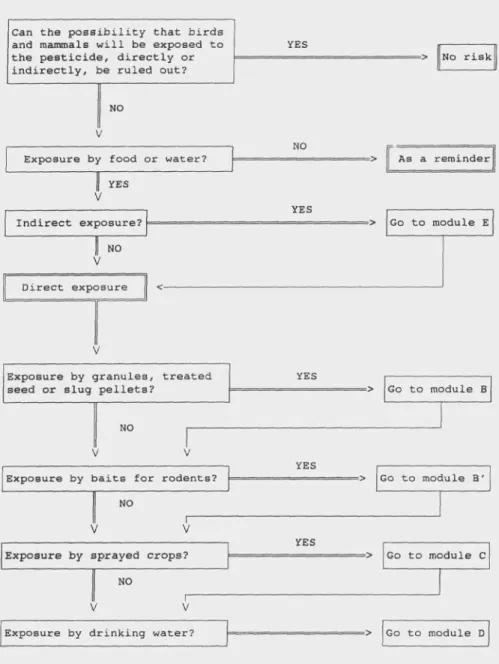
An enormous variety of pesticides are used in agriculture today, and every year many new agents are developed. Before these new 'pesticides are approved for use in the Netherlands, their behaviour and effects must be evaluated. One of the aspects of this evaluation procedure is an assessment of adverse side-effects. In the Netherlands a stepwise assessment procedure has been developed to assess the hazards of pesticides to birds and mammals in the field (Luttik, 1992). This procedure is based on a risk-assessment scheme that can be used for pesticides used as a spray, for seed treatment or as granules. The general structure of this risk-assessment scheme is shown in Figure 1. The scheme helps to decide which module should be used for the mode of use of a particular pesticide. Luttik (1992): "In the risk-assessment scheme 3 different types of boxes and two different types of arrows are used:
boxes with a single line are steps in the scheme where a choice has to be made; boxes with a double line are boxes where a statement is made or a reference to another module is given;
boxes with a double vertical line and a single horizontal line are boxes with conclusions about the degree of risk,
double lined arrows are indicating the route which has to be followed in the scheme,
single lined arrows are indicating that one has to go back to the general module to look for other exposure possibilities. "
Can the possibility that birds and mammals will be exposed to the pesticide, directly or indirectly, be ruled out?
YES
> No risk
NO
Exposure by food or water?
YES
NO
> As a reminder
Indirect exposure?
YES
NO
Direct exposure <•
Exposure by granules, treated seed or slug pellets?
NO
Exposure by baits for rodents?
NO
Exposure by sprayed crops? NO
Exposure by drinking water?
YES
YES
YES
Figure 1. The general module of the risk-assessment scheme
The general scheme is referred to as module A. There are 4 modules dealing with possible exposure routes for birds or mammals:
module B: exposure by granules, treated seed and pellets module B': exposure by baits for rodents;
module C: exposure by pesticides used for spraying crops; module D: exposure by drinking water;
module E: exposure by secondary poisoning.
2 Risks of treated seeds, granules and pellets
This report is focused on module B, dealing with exposure to granules, treated seed and pellets. These pesticide applications may pose a risk to birds and small mammals. These applications and their possible risks to wildlife are described below.
Seed treatment involves the direct addition of pesticides and other substances such as nutrients and beneficial microorganisms to the seed. Seed can be treated in different ways:
Conventional treatment: the pesticides are added to the seed by mixing the seed with a powder, liquid or slurry formulation (Jeffs & Tuppen, 1986).
Film-coating: the seed is coated with a film containing pesticides. This is achieved by adding film-forming binders to the liquids used in conventional seed treatment or in a more sophisticated way, e.g. by spraying relatively large volumes of pesticide and polymer binders on the seeds, with simultaneous drying. Film-coating results in a film around the seed that is usually coloured. The differences with the conventionally treated seed are: absence of dust, uniform coverage between and on individual seeds, and improved flow through the drill (Jeffs & Tuppen, 1986; Halmer, 1994).
pelleted seeds: Small or irregular seeds are built up into spherical capsules so they can be sown with the required precision. Pesticides are added to the capsule coatings (Jeffs & Tuppen, 1986).
Seed treatment is used in many crops, e.g. sugar beet (pelleted), cereals, onion and pea (Mandersloot, 1993). By adding the pesticide directly to the seed instead of spraying after sowing, less pesticide can be used. Seed treatment is therefore generally considered to be relatively environmentally friendly.
Granules are small inert carriers (length: aprox. 1 mm) to which the pesticide is added. These granules are lightly incorporated into the soil and then slowly release the pesticide to the soil. A variety of carriers are used, including silica, clay, corncob, gypsum or cellulose (Best & Gionfriddo, 1994). They are used to control insects, nematodes and molluscs ((Mandersloot, 1993). Pellets are particles larger than granules (length: between 3 and 6 mm) that are used for controlling slugs. They are incorporated in the soil in the same way as granules. In this report they are treated as (large) granules.
1.
2.
LD50(species of concern) / A < l
YES
* High risk
NO
PEC(food) « DPI / LD50(species of concern) < 0.001
NO
ÏES
> Low risk
3.
Treated seed (coating), baits for rodents or particles resembling natural food?
YES
NO
LD50{i
Risk f "Real' corapar
the gr of the
4a.
4b.
Granules, pelleted seed or particles regemb. grit
LD50(species of concern) / A < 20
YES NO
Low risk
"Real" risk must be assessed by comparing the characteristics of the grit with the characteristics
K / (LD50(species of concern) / A) s 0.1
YES
> Low risk
NO
K / (LD50(species of concern) / A) > 10
YES
=> High risk
NO
> Intermediate risk
Figure 2. Module B: exposure by granules, treated seed and pellets. A: Amount of pesticide on one panicle, K: number of panicles available on the soil surface per rrf, DPI: Daily Food Intake, PECtfood): Predicted Environmental Concentration of pesticide on food.
Both granules and treated seeds may pose a risk to birds. The treated seeds can be picked up as food, while granules can be picked up by birds mistaking them for stones that can be used as grit (i.e. stones in a bird's stomach; see Part A of this report). Pelleted seeds may likewise be picked up as grit because pelleting changes the appearance of the seeds and birds can mistake the pelleted seed for stones. Even though the most hazardous pesticides have now been banned, there are still pesticide applications allowed that have been associated with poisoning incidents: lindane, chlorfenvinphos, methiocarb and fonofos for seed treatment and carbofuran for granules (Hart & Clock, 1994; Cooke, 1988).
The risk to birds of granules and treated seeds is assessed in module B. This module is shown in Figure 2. The risk assessment in this module is based on the LD50 of the species concerned. The LD50 is the dose at which 50% of the individuals of a species die. In the first step (1 in Fig. 1) the amount of pesticide on one granule or seed is compared with the LD50 of the species concerned. In the second step (2 in Fig. 1) the amount of pesticide ingested if the daily food intake consists completely of the particles containing the pesticide is compared with the LD50. In the third step (3 in Fig. 1) it is decided if the particles resemble food or grit. The risk assessment for particles resembling grit is still to be elaborated. The risk assessment for particles resembling food is based on the amount of pesticide (on the particles) per surface area. In this last step (4a and 4b in Fig. 1) the amount of pesticide available per m2 is compared to the LD50.
However, the risk assessment using module B is hampered by a lack of information at two points. The first is step three of the risk-assessment scheme. This step requires characterization of the appearance of grit used by birds. Moreover, the method to assess the degree of risk for particles resembling grit has yet to be developed. The second point where the risk-assessment scheme is hampered is step four. To calculate the amount of pesticide per surface area, it is necessary to know the number of particles available on the soil surface. In addition, the risk measure used in step four has to be evaluated from the point of view of optimal foraging theories.
3 Aim of the research
Information on the above-mentioned subjects is necessary for further development of the risk-assessment scheme. Therefore the aim of the research described in this report was to gather information on the following subjects:
A. The appearance and number of grit particles consumed by bird species in the Netherlands, their resemblance to granules and pelleted seeds and the resulting risk to these birds.
B. The number of treated seeds available to birds at the soil surface and the risk of
these seeds to birds.
The two subject were studied separately and are therefore described in two separate parts of the report; Part A describes the research focused on grit and its resemblance to granules and pelleted seeds, while Part B focuses on the availability of treated seeds resembling natural food and on the evaluation of the risk assessment of these treated seeds, based on optimal foraging theories. The research focused on birds, but most of the results can also be used for the assessment of the hazards posed to small mammals.
4 References
Best, L.B. & J.P. Gionfriddo (1994). Effects of surface texture and shape on grit selection by House Sparrows and Northern Bobwhite. Wilson Bull. 106(4): 689-695. Cooke, S (1988). Poisoning of Woodpigeons on Woodwalton Fen. BCPC Mono. 40: Field methods for the study of environmental effects of pesticides.
Halmer, P. (1994). The development of quality seed treatments in commercial practice -objectives and achievements. In: T. Martin (ed.). Seed treatment: progress and prospects. BCPC monograph No. 57: 363-374.
Hart A.D.M. & M.A. Clook (1994). Research based improvements in the regulation of hazards to wildlife from pesticide seed treatments. BCPC Mono. 57: Seed treatment: Progress and prospects.
Jeffs, K.A. & R.J. Tuppen (1986). Application of pesticides to seeds, Part I: Require-ments for efficient treatment of seeds. In: K.A. Jeffs (ed.). Seed treatment, BCPC publications, Surrey: 17-45.
Luttik, R. (1992). Environmental hazard/risk assessment of pesticides used in agriculture for birds and mammals. The Dutch concept. Part 1. Introduction and synopsis of the decision scheme. RIVM report no. 679101006.
Mandersloot, H.J. (1993). Gewasbeschermingsgids. Handboek voor de bestrijding van ziekten, plagen en onkruiden en de toepassing van groeiregulatoren in de akkerbouw, veehouderij, tuinbouw en het openbaar groen. 13th Revised Edition. Informatie en Kennis Centrum Akker- en Tuinbouw, Plantenziektekundige Dienst, Wageningen.
l
Part A:
PART A: CONTENTS
1 Introduction 5
1.1 Granules, pelleted seeds, and the risk to birds 5 1.2 Mechanisms of exposure 6 1.3 Grit use and characteristics of grit 7 1.3.1 Grit use 7 1.3.2 Characteristics of grit 7 1.4 Research questions 9
2 Materials and methods 11
2.1 Sampling of grit, granules, and pelleted seeds 11 2.1.1 Sampling of grit 11 2.1.2 Sampling of granules and pelleted seeds 13 2.2 Analysis of grit, granules and pelleted seeds 14
3 Results 17
3.1 Grit 17 3.2 Granules and pelleted seeds 24
4 Hazards to birds 27
4.1 Introduction 27 4.2 Grit compared to granules and pelleted seeds 27 4.3 Amount and size of grit 29 4.4 Other characteristics 32 4.5 Conclusions 32
5 Discussion 33
5.1 Introduction 33 5.2 Results compared with literature 33 5.3 The hazard assessment 35 5.4 Recommendations . 36
References 39
Appendix Al: Scientific and popular name of birds 45 Appendix A2: List of collected birds 46 Appendix A3: Grit size in numbers 48 Appendix A4: Size histograms of the bird species 56 Appendix A5: Grit colours 62 Appendix A6: Shape-index of grit 65 Appendix A7: Size distributions of granules and pelleted seeds 66 Appendix A8: Trade names and manufacturers of granules 72 Appendix A9: Toxicity of granules and pelleted seeds to birds 73 Appendix A10: Hazard to birds 74
CHAPTER 1:
INTRODUCTION
1.1 Granules, pelleted seeds and the risk to birds
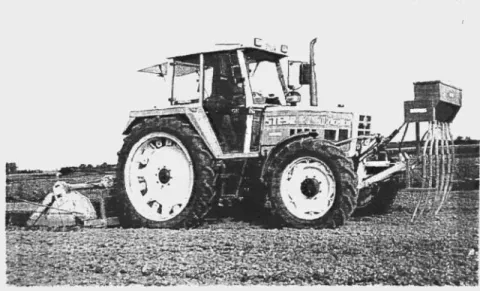
Many bird species ingest small stones (grit) in order to grind their food (Farner & King, 1972) and to obtain minerals, especially calcium in the egg-laying period (Vance, 1971; Moksness, 1988; Sadler, 1960). For most of the European species, however, it is unknown how much and what kind of grit they have in their gizzards. Many pesticides used in arable fields are formulated as granules, or are added to pelleted seeds. Fig. 1.1 shows a granule applicator used in the Netherlands. When granules or pelleted seeds are left on the surface of the soil, they may look like normal grit to birds, which may therefore pick them up intentionally (see step 4 in the decision scheme on p. xvii). Gra-nular pesticides can be extremely hazardous to birds this way. In a laboratory experiment Balcomb et al. (1984) found that of the 16 granular insecticides tested, 6 resulted in mortality in House sparrows or Red-winged blackbirds when these birds were given a single particle (for the scientific name of the species mentioned, see Appendix 1). Most avian mortality incidents reported in the field as a result of granule ingestion are caused by carbofuran. Mineau (1988) mentions kills of large numbers of waterfowl and granivorous songbirds. Greig-Smith (1987) lists 30 incidents with pellets (large granules used for controlling slugs) and granules in England and Wales in the period 1980-87. Most incidents mentioned here involved the pesticides metaldehyde and carbofuran. Balcomb et al. (1984) systematically searched 195 ha of corn fields on which granular carbofuran was applied and found 7 poisoned songbirds. Although pelleted seeds are applied in much lower densities than granules, they may also look like grit to birds and thus constitute an avian hazard.
Reported kills highly underestimate the true mortality rate. Balcomb et al. (1984) point out that few people search for wildlife on agricultural land. Mineau (1988) has doubts about the willingness of fanners to report kills to the authorities. He also concludes that the carcass search efficiency is often in the 50% range, that many birds die outside the treated fields, and that the majority of fresh carcasses can be removed in one night by scavengers.
The aim of this research is to describe the grit that birds use on arable fields in the Netherlands, and to establish the resemblance of this grit to some widely used granules and pelleted seeds. Secondly, the study assesses the resultant hazards to these birds.
Figure 1.1 A granule applicator used in the Netherlands.
1.2 Mechanisms of exposure
In this study we concentrate on two potential mechanisms of avian exposure to granules mentioned by Best & Fisher (1992), and the same reasoning is applied here to pelleted seeds.
1. Granules or pelleted seeds may be picked up intentionally as a source of grit to birds. According to Farner & King (1972), one of the functions of the muscular stomach or gizzard is grinding food. Many species also make use of small stones (grit), especially graminivores, herbivores and some omnivores. The theory of the grinding ability of grit has been made acceptable by Norris et al, 1975; Porkert & Höglund, 1984; Lifjeld, 1984; Norman & Mumford, 1985; Alonso, 1985; Högland & Porkert, 1983; Moksnes,
1988; Soler et al., 1993; Norman & Brown, 1985; Hogstad, 1988. Grit is also mentioned as a source of minerals, especially calcium (Walton, 1984; Sadler, 1960).
2. Birds may also pick up granules or pelleted seeds inadvertently as they forage on the ground. This can happen if they probe the soil for seeds or seedlings, or if granules adhere to selected food items like earthworms. In addition, we mention the possibility of birds ingesting small heaps of soil that function as grit without selection of separate particles. In such cases, birds may ingest granules along with small soil particles.
1.3 Grit use and characteristics of grit
1.3.1 Grit use
Whether selectively or randomly picked up, the number of particles ingested is very important in assessing the hazards to birds, and so are the factors that influence this number. From the literature on this subject, two factors seem to play an important role:
Diet: Best and Gionfriddo (1991a) found that all individuals of granivorous species like
Pheasants and House sparrows have grit in their gizzards, whereas less than 50% of the examined Starlings, omnivores, appear to have grit in their gizzards. Also, Walton (1984) found that only 33% of adult Meadow pipits, which are mainly insectivorous, use grit. Only the juveniles (78%) use grit to a large extent. Norman & Brown (1985) examined ten species of Australian waterfowl and found that carnivorous species had less grit in their gizzard than herbivores. Soler et al. (1993) reported that Ravens normally eat carrion and small invertebrates, and grit use is almost never recorded in this species. In contrast, they found that Ravens in their agricultural research area are mainly granivorous and use large quantities of grit. Alonso (1985), Porkert et al. (1984), Mathiasson (1972), Morris et al. (1975) and Hogstad (1988) have shown that the number of grit stones also varies in relation to seasonal changes in diet.
Bird size: Lifjeld (1984) examined five species of waders and found that the amount of
grit is positively correlated with the body size of the waders.
1.3.2 Characteristics of grit
If birds ingest stones selectively, one might expect them to ingest stones with features best suited to performing both the functions (grinding and mineral source) mentioned in paragraph 1.2. However, how birds select their grit is still largely unknown. A number of characteristics mentioned in literature will de discussed below.
Högland & Porkert (1983) found that among the stones they offered to Capercaillie, Black grouse and Willow grouse, only those with certain dimensions were ingested. Norris et
al. (1975) found that Willow grouse, when offered stones of various sizes, rarely
consumed stones smaller than 2 mm. Trost (1981) concludes that grit consumption in captive Mallards is also affected by the size of the particles offered. Spanish sparrows ingest larger numbers of small particles in winter, when their diet consists mainly of small seeds, than in summer, when the birds ingest larger food items (Alonso, 1985). Lifjeld (1984) records that the size of grit particles in the gizzards of five species of waders is positively correlated with the body size of the birds. Best & Gionfriddo (199la) characterized the grit use by 22 bird species with all kind of dietary habits in a cornfield area. According to the authors all kinds of stones were available in this area, but of all the characteristics examined, the birds differed most in the size of the grit they used. They found that grit size increases with the body mass of the examined species, including less selective birds. Resuming, the size of the particles appears to play an important role in grit uptake, and the size of the ingested particles seems related to body size (mass) and diet.
Grit colour
Colour has proven to be an important factor in the search for food by birds. Pank (1976) proposed using this fact by colouring seeds of the Douglas fir (Pseudotsuga menziesii) black or green, colours that proved to have a negative effect on the acceptance of the seeds. When granules based on crushed corncob as a carrier were coloured black, Pheasants were found to reduce their intake by 80-90% compared to their intake of uncol-oured, yellowish white granules (Spittier, 1978). Best & Gionfriddo (1993), referring to unpublished data, have found an avoidance of black grit by House sparrows, too. In the grit of wild cornfield birds a variety of grit colours can be observed: from colourless to opaque. Most grit is opaque, and predominant hues are whites, grays and light browns. Blues and greens are rare (Best, 1992). It seems likely that birds select grit colours, and they seem to demonstrate an aversion to black and green and a preference for light colours. However, the dominance of opaque grit found by Best (1992) in wild birds suggests that availability might be equally important.
Shape of grit
'Shape' is defined here as the ratio of particle width to length. Unfortunately, there is very little information on possible selectiveness regarding this characteristic. Best & Gionfriddo (1991a) examined the shape of the grit of cornfield birds in the U.S., and they also investigated the preferences of two granivorous bird species in captivity with respect to these characteristics (Best & Gionfriddo, 1994). They found that shape does affect grit selection.
Grit composition
Soils in the Netherlands consist mainly of sediment (clay and sand). Clay particles are much too small to serve as grit for birds. Sand (quartz) would be more suitable. It is probably difficult to erode in the gizzard. Best & Gionfriddo (1991b) show that silica particles remain the same size after 72 hours in the House sparrow gizzard. Therefore,
the reduction of grit size found by Vance (1971) after passage through the intestine-colon is probably due to the high percentage of calcareous grit in the examined Pheasants. Walton (1984) and Moksnes (1988) report a predominance of quartz in the gizzard of birds, and they presume that the most calcareous particles are not recorded because they dissolve very quickly in the acid environment of the stomach. The amount of calcium fragments ingested by birds is unknown. Sadler (1961) mentions that cereal grains are almost devoid of calcium, and he shows that Pheasants are able to compensate this deficiency by selecting calcareous grit. Kopischke (1965) and Harper (1964) have shown that hen Pheasants increase their intake of calcareous grit in the egg-laying period. Females of Ringed plovers and Temminck's stints have more calcareous grit in their stomachs than the males (Moksnes, 1988). Trost (1981) showed the same in captive Mallards. Soler et al. (1993) found, in 5 corvid species, that ingestion of calcareous grit increased during the egg-forming period. Composition is clearly an important factor in the selection of grit by birds, especially for females in the reproduction phase.
Birds are well capable of tasting (Duncan, 1960). The effect of repellency that some ingredients, like methiocarb, have on birds has been investigated as a means of reducing bird damage to various crops (Yusufu et al., 1992; Conover, 1989; Duncan, 1963; Greig-Smith & Rowney, 1987). However, it is unknown whether birds refuse or accept soil particles as grit on the basis of their sense of taste.
1.4 Research questions
From the above we conclude that the size and diet of birds influence the number and size of ingested grit particles, and that their diet and sex affect the portion of calcareous grit. As a result, the birds considered in this study will be investigated according to their size and diet. The factor sex will be excluded, because the portion of calcareous grit will probably be severely underestimated when examining the contents of gizzards. Further-more, our research is not designed to draw any conclusions about taste as a factor determining avian selection of grit. Consequently, grit, granules and pelleted seeds will be described on the basis of 1. size, 2. colour and 3. shape.
The following questions are thus investigated in this study:
What is the amount and appearance in terms of size, colour and shape of grit used by avian species of varying size and dietary habit, and which forage on arable fields?
How does this grit resemble the granules and pelleted seeds that are frequently applied on arable fields, and how can this resemblance be applied in assessing the resultant hazard to birds?
CHAPTER 2:
MATERIALS AND METHODS
2.1 Sampling of grit, granules and pelleted seeds
2.1.1 Sampling of grit
The main factor determining our selection of bird species is their occurrence on arable fields in the Netherlands. We searched for birds that forage on these fields at least part of the year. The species sampled varied in their dietary habits and size. Most birds obtained were from game hunters, taxidermists or from the National Natural History Museum in Leiden. Their cause of death varied and remnants of granules or pelleted seeds were never found in their gizzards. Birds that probably died as a result of poor health (weakened thorax muscles, dirt around the anus) were excluded. In order to obtain representative samples of the bird species in question, the birds were collected throughout the year and at different locations. In Appendix 1 the scientific names of the birds investigated are listed along with their English names. The complete list of birds and the cause, place and time of death are presented in Appendix 2. The list comprises 12 granivorous species (n=100) and 15 species with other diets (i.e. fructivores and insec-tivores; n=98). The birds are divided into 3 groups according to their diet: granivores and granivores. Anatidae (ducks and geese) are considered separately from the non-granivores because of their 'sieving' mode of foraging (Kooloos, 1986). The non-granivores and non-granivores are subdivided into small and large species. Most results below are presented at the level of these species groups, allowing for more ready extrapolation of the results to species that are not investigated here but that fit into a given species group. Table 2.1 presents the groups with the numbers of individuals collected.
Tobte 2.1. Birds examined, n = number of birds. See Appendix 1 for scientific names.
size diet/taxon/weight size diet/taxon/weight
la:
Ib:
granivores, 10-50 g Skylark House sparrow Tree sparrow B rambling Chaffinch Greenfinch Linnet Twite Goldfinch granivores, 350-1500 g
Pheasant Grey partridge Woodpigeon
39 6 11 1 1 8 g 2 1 1 61 16 25 20
Ha: non-granivores, 15-100 g Starling
White wagtail Meadow pipit Reed bunting Blackbird Song thrush lib: non-granivores, 200-500 g
Carrion crow Jackdaw Magpie Black-headed gull Lapwing
45 10 3 9 3 10 10 35 13 1 11 8 2
III: ducks and geese, 1000-3500 g 18 Bean goose 1 White-fronted goose 1 Greylag goose 5 Mallard 11
In selecting the bird species various literature sources were used. De Snoo & Canters (1990) list a number of breeding birds in the Netherlands that regularly forage on arable fields. Breeding birds not mentioned by De Snoo & Canters (1990) as foragers on arable land are: Greenfinch, Reed bunting, Greylag goose and Mallard. These species have been included here because the literature shows that they forage on arable fields at least part of the time (Watson, 1992; Hanisch & Gemmeke, 1992; SOVON, 1987). Bramblings, Twites, Bean geese and White-fronted geese are mainly migratory species in the Nether-lands, but are also regularly seen on arable fields (SOVON, 1987). Bird weights have been derived from Cramp et al. (1977-1993), Glutz von Blotzheim et al. (1971-1991), and our own data.
The gizzards of the birds were removed, sliced open and the contents flushed into a jar. The contents were then transferred into a test tube. This tube was centrifuged 2-3 times for 30 seconds and each time the (light) organic matter was poured out of the tube until there were only non-organic particles left. The particles and remaining water were poured back into the jar. The method was found to be very reliable: the organic matter was checked 3 times for the presence of non-organic particles and it was found that no more than 1% of the particles were lost in this way. The jar was then kept at a temperature of 80 °C for about 12 hours until the particles were completely dry.
It was found that many birds had huge numbers of very small particles in their gizzard. These particles were smaller than 0.5 mm and were presumably swallowed by accident
along with food items, because it seems very unlikely that such small particles are actively selected by birds. Particles smaller than 0.5 mm were excluded by screening. In our study the size of the particles was measured in terms of their length. However, if particles are screened the particles remaining on the screen will have been selected by their smallest diameter, i.e. their width. This means that if particles are to be described on the basis of their length, and if a screen is to be used to obtain a minimum size, a certain percentage of the particles falling through the screen will have lengths exceeding this minimum. We assumed that this effect will become stronger as the particles oecome more oblong. We quantified this effect by counting all particles with a diameter (i.e. length) exceeding 0.5 mm in the 0.25 - 0.5 mm screen fraction from one representative of the omnivorous birds and one of the granivorous birds. The results are summarized in Table 2.2. The derived average percentage of particles that were out of place in the screen fraction has been used to correct the size distributions of all examined species. The number of particles smaller than 0.5 mm was estimated as follows. The samples were screened with screens with a mesh of 0.25 mm and 0.50 mm. Approximately 50 particles from both size classes (0 - 0.25 mm and 0.25 - 0.5 mm) were taken, and these subsamples weighed. In addition, whole samples of the two size classes were weighed. The number of particles in these classes was determined by extrapolation.
Table 2.2. The portion of grit longer than 0.5 mm found in the 0.25 -0.5 mm screen fraction of a Magpie and a Grey partridge.
Partridge Magpie average
grit length between 0.5 - 0.75 mm 15.8 % 12.8 % 14.3 % grit length between 0.75 - 1 mm 0.6 % 1.3 % 0.95 %
The gizzards of geese and mallards contain huge numbers of particles larger than 0.5 mm. Therefore, only a subsample of several hundred particles was examined. The total number of grit particles was estimated by counting and weighing this subsample and extrapolating.
2.1.2 Sampling of granules and pelleted seeds
All the granules investigated in this study are used regularly on Dutch arable fields. For their full names, see Appendix 8. Vydate, Mocap and Temik are the granules most frequently used (pers. comm. Van Velde, Informatie en Kennis Centrum). Pelleted seeds of three widely grown crops were collected: sugar beet, carrot and onion. The granules and pelleted seeds examined are summarized in Table 2.3.
Table 2.3. Granules and pelleted seeds examined. A. I. = active ingredient, n = number of particles analyzed, pot = potatoes, beet = sugar beet, rape s = rape seed, cult = cultivation, veg = veg-etables. The active ingredients mentioned for sugar beet are potentially used, i.e. not all at once.
trade name
Granules Mocap 20GS Vydate 10G Cu rater granules Tcmik 10G Gypsum Ncmacur 10G Dursban pellets Mesurol pellets Asci' Slakkcndood Luxan pellets Pelleted seeds Sugar beet Carrot Onion A.I. ethoprofos oxamyl carbofuran aldicarh f en am i tb s chloorpyrifos methiocarb metaldehyde metaldehyde benfuracarb furathiocarb teftuthrin thiram hymcxazool chlorfenvinphos furathiocarb perc. A.I. 20% 10% 5% 10% 10% 2% 4% 6% 6.4% 1.6% 2.2% 0.4% 0.2% 0.9% 0.1% 0.5% n 199 123 108 158 263 100 113 119 126 70 98 91 application
pot.veg.tree cult .flowers pot.bcct.tree cull.vcg, flowers rape s, , maizc,beet,onion,veg,tree cult veg, pot, flowers, tree cult
pot, flowers veg, flowers, tree cult all crops all crops all crops
effect:
n c m at ic idc , in sect ic i de insecticide.acaricide insecticide nematicide. Insecticide ne mat icide insecticide
mo 1 1 use LC id e , in sec ticide mollusc icide mollusc icide insecticide insecticide insecticide fungicide fungicide insecticide insecticide
2.2 Analysis of grit, granules and pelleted seeds
-*11 grit, granules and pelleted seeds were laid in squares on a drawing-table and photo-graphed. Small particles were laid in a square measuring 2.5 by 2.5 cm, larger particles in a square 5.5 by 5.5 cm. The particles were spread regularly in these squares and did not touch one another. They were illuminated from beneath and thus contrasted strongly against the white background. Some particles appeared transparent and later had to be filled in with a black pen on the photographs. On the photographs small particles are enlarged 3.6 times and large particles 1.7 times. The photographs were then taken to a Quantimet 570 image analyzer, consisting of a camera that scans images (usually photographs) and a computer that analyses the resulting (digital) information. Images are divided into 512 by 512 pixels and the resolution of an image is thus determined by the size of one pixel, i.e. the size of the image divided by 512. Consequently, the resolution of a photograph of large particles is about 0.1 mm, and of a photograph of small particles 0.05 mm. The computer determines the diameter of each particle in 64 directions. The largest diameter is defined to be the length and the smallest diameter the width of a particle. In this study the length is chosen to represent the size of the particles, and the length of a particle divided by its width is called the shape index.
The colours of the particles > 0.5 mm were determined for 6 bird species. We selected 3 species, with 5 individuals each, as representatives of the small and large granivores (small: House Sparrow, Chaffinch and Greenfinch; large: Woodpigeon, Partridge and Pheasant). In addition, particle colours were also analyzed for 2 non-granivorous species (Carrion crow and Black-headed gull, represented by 5 and 4 individuals, respectively). From each individual about 30 particles > 0.5 mm were aselectively taken for examin-ation. As a result, a total of 1128 grit particles were classified. In addition, 10 samples of granules and 3 samples of pelleted seeds, all of different manufacture, were classified according to the Munsell soil colour system (Munsell, 1988). The Munsell system describes colours by three attributes: hue, representing the dominant spectral wavelength; value, representing the brightness of colour; and chroma, representing the strength of the colour. Each grit particle from the aforementioned birds was compared with colour chips on charts. The codes were then translated to colour names. A number of grit particles appeared to have no colour at all and were classified as transparent. Some particles (6.1 %) had very bright colours, and their values exceeded the range of soil colours in the Munsell system. Of these particles, 5.9% had yellow hues according to the Munsell system and were therefore called yellow, but perhaps should have been called white instead because of their high values. Consequently, about one third of the so-called yellow grit particles is classified with uncertainty. The granules caused more problems: the translation from Munsell codes to Munsell soil colour names was found to be impossible because the colours of 10 granules were far beyond the range of soil colour names. As a result, we had to name these colours ourselves on the basis of their Munsell codes.
Colour classes were established on the basis of the last colour mentioned in the Munsell soil colour name (e.g. yellow in 'olive yellow'). This gave 5 colour classes: yellow, red, olive, brown, grey (including white and black), and transparent. The classes were subdivided into light and dark colours, on the basis of the Munsell values. Colours with a value higher than 6 were called light, the others dark, except for yellows, which always have values higher than 6.
All differences in the above characteristics between species groups were statistically, non-parametrically tested at the species level, except for grit colours, which were tested at the level of individuals. In all cases the Mann-Whitney U-test for the comparison of two independent samples was used.
CHAPTER 3:
RESULTS
3.1. Grit
Separation of grit from 'soil'
The total number of particles found in the 198 birds examined was estimated to be 3.31 million. The vast majority of these particles was smaller than 0.5 mm (93%), and were found mainly in non-granivores and ducks and geese (91% of the total number of particles). The numbers of particles smaller than 0.5 mm found in the average non-granivore and average duck or goose species are thus enormous: 9,268 and 128,286 particles, respectively. With so many particles that small, it would seem impossible for birds to pick them up individually. It therefore seems likely that these birds ingest most particles in heaps, or that they are ingested along with food items. Moreover, these particles are out of the size range of granules and pelleted seeds, and from the viewpoint of assessing the hazard of granules and pelleted seeds on the basis of their appearance they are therefore irrelevant. We name particles smaller than 0.5 mm 'soil particles' and larger particles 'grit'. Examination of the birds clearly indicated that non-granivores and ducks and geese also ingest relatively few grit particles, compared to the amount of soil in their gizzards. Table 3.1 summarizes the ratio of soil to grit particles for the various species groups. This ratio reflects the difference in grit ingestion behaviour between the granivores and the non-granivores, including ducks and geese.
From Table 3.1 we conclude that granivores use relatively more grit than non-granivores, with the ducks and geese occupying an intermediate position. In the rest of this section, we ignore soil particles (<0.5 mm) and focus only on grit particles (>0.5 mm). The number, size, colour and shape of the grit particles are presented for each species group; the results for individual species can be found in the appendices.
Table 3.1. Quotient of number of panicles < 0.5 mm ('soil') and particles > 0.5 mm ('grit'), determined at species level and averaged per species group. The subgroups of small and large birds are combined here. Test: Mann-Whitney U-test, two-tailed. * = P<0.05, ** = P<0.01, *** = P < 0.001. n = number of species examined, sd = standard deviation.
species group
a: granivores b: non-granivores c: ducks & geese
n
12 11 4
ratio
(soil/grit) ± sd
1.9 ± 2.7 32.9 ±21.4 12.9 ± 3.1
Differences between groups: a-b:
a-c: b-c:
+**
#*
Number of grit particles
The total number of grit particles (>0.5 mm) retrieved from the sampled birds was 245,788. Table 3.3 shows that all the granivores, ducks and geese examined had grit in their gizzards. Grit use is less frequent in granivores, especially the small non-granivores like Starlings and Meadow pipits (in both species, 22% of the individuals examined had grit). It was found, furthermore, that 80% of the grit is found in less than
10% of the birds: the ducks and geese.
In Table 3.2 the mean number of grit particles found in the gizzard is listed per species group (species averaged, individuals with no grit excluded).
Table 3.2. Percentage of individuals per species group in which grit was found, and mean number of grit particles per group (species averaged, individuals with no grit excluded), n = number of species, sd = standard deviation.
species group
small granivores large granivores small non-granivores large non-granivores ducks & geese
n 9 3 6 5 4
perc. with grit
100% 100%
46% 86%
100%
mean
120.5 365.7 146.2 495.6 11041.5
± sd
± 60.7 ± 268.5 ± 232.4 ± 530.2 ± 7377.8
The average duck or goose uses more grit than the average granivore (P=0.004, n=16) or non-granivore (,P=0.005, n=15, both Mann-Whitney U-test). There is no difference in
the amount of gizzard grit between an average granivore and an average non-granivore (P=0.78, Mann-Whitney U-test, n=23).
Fig. 3.1 shows that the body weight of the birds is positively correlated with the number of grit particles found in the gizzard.
100000
10000=
o
<= 1 000:
m
c CB
eu 100=
10;
r=0.82 p=0.000
n*
d
10 100 1000
Mean weignt
10000
small gran •*• »mall non-gran * large non-gran. large gran X ducks & geese
Figure 3.1. Average body weight of birds vs. number of grit panicles per gizzard.
Size of grit particles
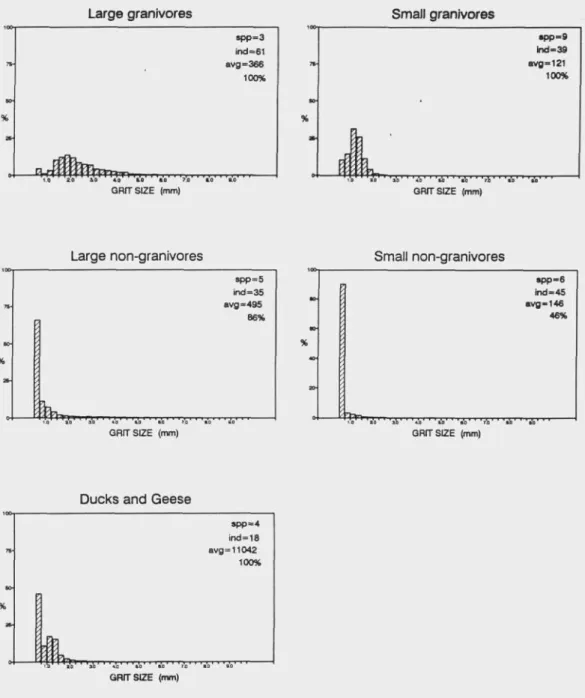
The average size of grit particles found in the various species groups is listed in Table 3.3. It can be concluded that non-granivores have smaller grit particles than granivores, with ducks and geese occupying an intermediate position. Also, small birds have smaller grit particles than large birds. The differences in grit size between the species groups are all significant (see Table 3.3), which supports the formation of such groups. Histograms of the relative frequencies of grit size in each species are presented in Appendix 4. Fig. 3.2 shows the histograms of the species groups.
3: Results 19
Table 3.3. Average grit number and size for the various species groups. The frequencies shown in Fig. 3.2 were analyzed with the Mann-Whitney U-test, two-tailed. * = P<0.05, ** = P<0.01, *** = P<0.001.
species group
a: small granivores b: large granivores c: small non-granivores d: large non-granivores e: ducks & geese
no. of species
9 3 6
5 4
average no. of grit particles
121
366 146 496
11042
average size of grit particles (mm) ± sd
1.2 ± 0.3 2.4 ± 1.1 0.7 ± 0.2
1.0 ± 0.7
1.0 ± 0.5
Differences in grit size between groups: a-b *** b-c **+ a-c *** b-d *** a-d *** b-e ***
c-e d-e
*+*
**
a-e c-d **+
Colour of grit
Fig. 3.3 presents pie charts of the grit colours. The top two pie charts show the relative occurrence of 10 colour classes in the small and large granivores, respectively. The bottom pie chart, for the large, probably less selective non-granivores, 'might' represent the composition of soil colours. Differences between the pie charts for the granivores and for the non-granivores indicate a possible preference of the former group. The pie charts for individual species are presented in Appendix 5; it is found that the proportions of many colours are very variable, and do not appear to depend of the species group in question, except for the proportions of white/light grey and black/dark grey in the large granivores. Table 3.4 shows the test results of the differences between the three groups in terms of the proportions of light and dark coloured grit, and the proportion of the remaining, transparent particles.
Large granivores
»pp=3 ind=61 avg=366
100%
QRITSIZE (mm)
Small granivores
QRITSIZE (mm)
ind = 39
avg=121
100%
Large non-granivores Small non-granivores
spp=5 ind=35 avg=495 86%
•pp~6
M-4S
«V8-146 46%
GRFTSIZE (mm) GRTTSIZE (mm)
Ducks and Geese
spp=4 ind=18 avg=11042
100%
GRIT SIZE (mm)
Figure 3.2. Grit size distributions in species groups, ind. = no. of individuals, spp. = no. of species, avg - average number of grit particles, percentage = percentage of birds with grit in their gizzard.
small granivores
yellow 18.0%
nspareiM: 6-3%
light olive 0 9%
light brown: 1.6% light red 5 4%
dark olive 3 5 %
black/da* gray: 11.0%
dark red: 16.6%
dark brown: 10.0%
large granivores
white/light gray 6 6 2 %
transparent: 1.1% black/dark gray 3 6 %
dark red; 1.1%
dark brown 47%
dark olive: 1.6% light red. 1.1% light brown 1 1% light olrve: 1.1%
white/light gray 300%
non-granivores
light olive: 1.2% light brown: 3.2%
bght rad 0.8% dart ortvH: 0.4%
transparent 10.4%
black/dark gray 22.0%
dark red -6.8%
Figure 3.3. Proportions of grit colours in three species groups. White and light shading represent light colours (excluding transparent), heavy shading and black dark colours.
Table 3.4. Mean proportions of transparent, dark and light coloured grit in small granivores, large granivores and non-granivores. Differences analyzed with Mann-Whitney U-test, two-tailed, ns = not significant. * = P<0.05, ** = P<0.01, *** = P<0.001. n = number of individuals.
transparent light dark
a: Small granivores (n = 15) b: Large granivores (n = 15) c: Non-granivores (n =9)
6.0% 1.1% 12.6%
52.7% 87.8% 49.6%
41.3% 11.1% 37.8%
Differences in proportion of light-coloured grit between groups: a-c ns
b-c *** a-b ***
From Table 3.4 the large proportion of light-coloured grit in large granivores compared to non-granivores and small granivores is clearly evident. Two conclusions are possible: 1. large granivores use large grit, which is light coloured because large sand particles generally contain relatively pure silica, which is hard to erode (Pannekoek, 1976), or 2. large granivores prefer light coloured grit and avoid transparent and dark coloured grit. Shape index of grit particles
The mean shape index of the grit found in each species examined is presented in Appendix 6. These indices range from 1.3 to 1.4, with very little variation. Table 3.5 presents the mean shape indices of the various species groups.
Table 3.5. Average grit shape index (s.i., = length/breadth) of species in three species groups. Test: Mann-Whitney U-test, n=23, two-tailed, ns = not significant. * = P<0.05. sd - standard deviation.
mean ± sd
a: Granivores 1.37 ± 0.03 b: Non-granivores 1.37 ± 0.03 c: Ducks & Geese 1.34 ± 0.02
Differences between species groups: a-b: ns
a-c: ns b-c: *
The ducks and geese had somewhat more spherical grit than the non-granivores. This could be due to the 'sieving' mode of ingestion of the ducks and geese. Since there is no
difference in grit shape between the granivores and the presumably selective non-granivores, it seems unlikely that shape is used by these birds to select grit.
3.2 Granules and pelleted seeds
Size
The size distributions of the granules and pelleted seeds are shown in Appendix 7. The granules are found to form two groups in terms of size: the insecticides/nematicides Mocap, Curater, Temik and Nemacur are small granules measuring about 1 mm with small ( ± 1 mm) ranges, while the granules (pellets) used as molluscicides are consider-ably larger (median: 3.5 - 5.5 mm) with large ranges (4.25 - 7.75 mm); the insecticide Vydate has an intermediate size (1.5 mm) and range (2 mm). The median size of pelleted seeds is between 3.5 - 4.75 mm with a range of 1.25 - 2.25 mm.
Table 3.6 presents the colours of the granules and the pelleted seeds. Seven types of granules and pelleted seeds have light colours. The colours of most types of granules and pelleted seeds are strong, and cannot be assigned to one of the 11 colour classes used to determine the grit colours.
Shape
The grit shape index is also presented in Table 3.6. The small granules generally have mean shape indices ranging from 1.3 to 1.4, with only the Temik granules being somewhat more spherical. The larger granules (pellets) are more oblong: they are 1.5 - 2 times longer than wide. Pelleted seeds are designed for accurate sowing, and are found to be almost spherical, as expected.
_
Table 3.6. Colours and shapes of granules and pelleted seeds. For sugar beet 5 different pellet colours were examined.
granules Mocap 20GS Vydate 10G Curater granules Temik 10G Gypsum Nemacur 10G Dursban pellets Mesurol pellets Asef Slakkendood Luxan pellets pelleted seeds Sugar beet no. 1 Sugar beet no. 2 Sugar beet no. 3 Sugar beet no. 4 Sugar beet no. 5 Carrot
Onion
colour
reddish violet green greyish blue strong black white
yellowish green blue/violet blue blue
blue
red
strong brown yellow green strong blue yellow
red
light/dark
light light dark dark light light dark dark dark
dark dark light light dark light dark
shape index mean ± sd
1.31 ± 0.19 1.41 ± 0.24 1.27 ± 0.12 1.23 ± 0.16 1.32 ± 0.15 1.38 ± 0.25 1.47 ± 0.17 2.08 ± 0.35 2.13 ± 0.55
1.14 ± 0.07
1.18 ± 0.05 1.20 ± 0.21
CHAPTER 4:
HAZARDS TO BIRDS
.
4.1 Introduction
In this chapter we attempt to assess the hazard to birds, based on the resemblance between grit and granules or pelleted seeds, the difference in grit consumption between granivores and non-granivores, the availability of granules and pelleted seeds, and the consumption rate of birds.
4.2 Grit compared to granules and pelleted seeds
Below, grit is compared to granules and pelleted seeds in terms of size, colour (light/dark) and shape index.
Size
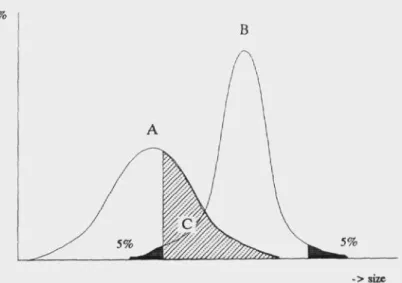
In order to establish the resemblance in size between grit and granules or pelleted seeds, histograms were compared, as follows: the 90% range of the size histograms of granules and pelleted seeds (5 % subtracted at both tails) was placed over the grit histograms of the species groups, and the portion of grit within this size range was termed the 'overlap' between the grit of a certain bird species or group and a certain granule or pelleted seed. Thus, the overlap can be considered as the percentage of grit having the same size as granules.
This means that the shape of the size distribution of granules or pelleted seeds was not taken into account, only the size range of 90% of these particles. The reason for this is that 90% of granules and pelleted seeds are assumed to be present in unlimited quantities to birds. The value of 90% was chosen to eliminate the effect of small, isolated bars on the range of the size histograms of granules and pelleted seeds (see Appendix 7). In contrast, the shape of the grit size histograms is relevant for determining the size overlap, because the number of grit particles is limited by the intake of the birds. In Fig. 4.1 this is visualized. The shaded area in this figure shows the fraction of grit particles that can potentially be granules or pelleted seeds.
B
-> size
Figure 4.1. Determination of 'overlap ' in size between grit of a given species (group) and certain granules or pelleted seeds. A = size distribution of grit. B = size distribution of granules or pelleted seeds. C = 'overlap '.
Table 4.1 shows the portion of grit of the various species groups within 90% of the size range of the granules and pelleted seeds. The small granules (Mocap, Vydate, Curater, Temik and Nemacur) are found to show the greatest resemblance to the grit of granivores (small and large), large non-granivores and ducks and geese. The very small Mocap granules also match the grit of small non-granivores. The large granules or pellets (Dursban, Asef, Mesurol, Luxan) most resemble the grit of large granivores, and the pelleted seeds show some resemblance to the grit of large granivores.
Colour
Since the hue of grit colours is very variable, and no preference was found among the birds examined, a comparison of grit to granules or pelleted seeds appears to have little point. Light colours (value > 6, see Chapter 2) might be preferred by large granivores, and these are found in the small granules of Nemacur, Mocap and Vydate, the pellets of Dursban, the pelleted carrot seeds, and 2 out of 5 kinds of pelleted sugar beet seeds.
Table 4.1. Percentage size overlap between grit and granules or pelleted seeds. For explanation of overlap determination, see text. gr. = granivores.
granules Mocap 20GS Vydate 10G Curater granules Temik 10G Gypsum Nemacur 10G Dursban pellets Mesurol pellets Asef Slakkendood Luxan pellets pelleted seeds Sugar beet Carrot Onion 90% range(mm) 0.50-1.50 1.00-1.25 0.75-1.50 1.00-1.75 0.75-1.50 2.50-5.00 2.75-5.00 2.75-5.50 3.25-8.25 4.25-5.75 3.75-4.50 3.25-4.25 small gr-86.7 65.7 75.1 61.8 75.1 0.4 0.2 0.2 0.1 0.0 0.0 0.1 large gr. 18.6 50.7 14.8 25.3 14.3 32.9 25.7 26.8 17.3 5.6 6.5 10.8 small non-gr. 97.7 5.7 7.3 4.8 7.3 0.4 0.3 0.3 0.1 0.0 0.0 0.1 large non-gr. 88.2 16.0 22.4 13.3 22.4 5.3 4.5 4.9 3.9 1.6 1.3 1.9 ducks & geese 89.0 40.8 43.1 37.2 43.1 1.9 1.0 1.0 0.6 0.1 0.1 0.5 Shape index
There was no preference found in terms of shape index. The mean shape index of grit is between 1.3 - 1.4. All the granules have shape indices that are comparable with those of grit, except for the pellets of Mesurol, Luxan and Asef, which are more oblong. The small Temik granules and pelleted seeds are more spherical than grit.
4.3 Amount and size of grit
The resemblance of granules or pelleted seeds to grit was demonstrated in the previous chapter. However, equal percentage size overlaps in granivores and non-granivores (see Table 4.1) do not necessarily lead to equal hazards. Granivores are likely to search for particles of a certain size (or colour, shape index) and if large numbers of granule particles or pelleted seeds are exposed that look very similar to the grit they prefer, these particles might also be expected in large numbers in the gizzards of these birds. In contrast, if there is a strong resemblance between the grit of non-granivores and granules,
this does not necessarily result in a large number of granules in their gizzard. It is assumed that the number of granules or pelleted seeds in the gizzards of these (non-selective) birds reflects, within a certain size range, their number among soil particles. Granules may be present in large quantities on the soil surface after sowing: Erbach & Tollefson (1983) tested three brands of planters used on com fields in the US, and found that 14.7% of the granules were left exposed. Mineau (1988) combined this result with the recommended rate of application in Canada, and estimated that on com fields in Ontario (Canada) at least 5 to 17 granules per row centimetre are probably left exposed. Maze et al. (1991) evaluated the soil incorporation of rapeseed, combined with a substitute for Furadan granules, sown by four types of seeding equipment in Canada, and found that 2.18% of the granules remained on the surface. The number of pelleted seeds on the surface may be high if spillage occurs (see Part B of this report). We consequently assume that granules and pelleted seeds are available to birds ad libitum.
On the basis of the information on grit use and the toxicity of granules and pelleted seeds, the hazard of the latter to birds can be assessed. Because of a number of uncertainties about the foraging behaviour of birds in the field and the retention rate of grit in gizzards, the assessment should be regarded as a first approximation.
Hazard assessment:
Given the concentration of a certain active ingredient in one granule or pelleted seed, we can determine the number of granules or pelleted seeds that will add up to the LD50 dose for birds. This is presented in Appendix 9. The number of granules or pelleted seeds that would cause lethal effects in 50% of the average birds of the species groups is listed in parentheses for each type of granule or pelleted seed and each species group in Appen-dix 10. For example, when a number of individuals of the average small granivore ingest 4.97 Curater granules, 50% will die.
On the basis of the amount of grit in a bird's gizzard and the retention rate, we also can estimate the number of grit particles ingested daily. We term this number 'E' (expected). Fig. 3.2 shows the average number of grit particles found in the species groups. For a small granivore the number is 121. How many particles it has to ingest to maintain this number, in other words the retention time of grit, is largely unknown. Mathiasson (1972) has shown that Woodpigeons excrete half their grit in 2 days. From this, we derive that a bird substitutes a quarter of its gizzard grit each day. In our example this means that a small granivore consumes 30.3 grit particles per day.
We now propose that:
1. x% of the grit ingested by granivores will consist of granules or pelleted seeds.
2. y% of the grit ingested by non-granivores and Anatidae will consist of granules or pelleted seeds.