Maternal Malaria and Malnutrition
(M3) initiative, a pooled birth cohort of
13 pregnancy studies in Africa and the
Western Paci
fi
c
Holger W Unger,1,2Jordan E Cates,3Julie Gutman,4Valerie Briand,5,6
Nadine Fievet,5,6Innocent Valea,7,8Halidou Tinto,7,8Umberto d’Alessandro,9,10,11 Sarah H Landis,12Seth Adu-Afarwuah,13Kathryn G Dewey,14Feiko Ter Kuile,15 Stephanie Dellicour,15Peter Ouma,16Laurence Slutsker,4Dianne J Terlouw,17 Simon Kariuki,16John Ayisi,16Bernard Nahlen,18Meghna Desai,4
Mwayi Madanitsa,19Linda Kalilani-Phiri,15,19Per Ashorn,20,21Kenneth Maleta,19 Ivo Mueller,22Danielle Stanisic,23Christentze Schmiegelow,24John Lusingu,24,25 Daniel Westreich,3Anna Maria van Eijk,15Steven Meshnick,3Stephen Rogerson2
To cite:Unger HW, Cates JE, Gutman J,et al. Maternal Malaria and Malnutrition (M3) initiative, a pooled birth cohort of 13 pregnancy studies in Africa and the Western Pacific.BMJ Open 2016;6:e012697.
doi:10.1136/bmjopen-2016-012697
▸ Prepublication history for this paper is available online. To view these files please visit the journal online (http://dx.doi.org/10.1136/ bmjopen-2016-012697).
Received 17 May 2016 Accepted 8 November 2016
For numbered affiliations see end of article.
Correspondence to Professor Stephen Rogerson; [email protected]
ABSTRACT
Purpose:The Maternal Malaria and Malnutrition (M3) initiative has pooled together 13 studies with the hope of improving understanding of malaria–nutrition interactions during pregnancy and to foster
collaboration between nutritionists and malariologists. Participants:Data were pooled on 14 635 singleton, live birth pregnancies from women who had
participated in 1 of 13 pregnancy studies. The 13 studies cover 8 countries in Africa and Papua New Guinea in the Western Pacific conducted from 1996 to 2015.
Findings to date:Data are available at the time of antenatal enrolment of women into their respective parent study and at delivery. The data set comprises essential data such as malaria infection status, anthropometric assessments of maternal nutritional status, presence of anaemia and birth weight, as well as additional variables such gestational age at delivery for a subset of women. Participating studies are described in detail with regard to setting and primary outcome measures, and summarised data are available from each contributing cohort.
Future plans:This pooled birth cohort is the largest pregnancy data set to date to permit a more definite evaluation of the impact of plausible interactions between poor nutritional status and malaria infection in pregnant women on fetal growth and gestational length. Given the current comparative lack of large pregnancy cohorts in malaria-endemic settings, compilation of suitable pregnancy cohorts is likely to provide adequate statistical power to assess malaria– nutrition interactions, and could point towards settings where such interactions are most relevant. The M3 cohort may thus help to identify pregnant women at high risk of adverse outcomes who may benefit from tailored intensive antenatal care including nutritional supplements and alternative or intensified malaria
prevention regimens, and the settings in which these interventions would be most effective.
INTRODUCTION
It is estimated that each year over 125 million pregnant women residing in low-income and middle-income countries (LMICs) are at risk of infection with Plasmodium falciparum and P. vivax.1 Malaria contributes to the high burden of maternal morbidity and mortality in these settings and may affect placental development and fetal growth.2 Sequestration of P. falciparumparasites in the placenta has been associated with fetal growth restriction (FGR) and low birth weight (LBW, <2500 g), thus contributing to
Strengths and limitations of this study
▪ This cohort pools data from 14 635 singleton, live birth pregnancies in women who participated in 1 of 13 pregnancy studies in areas with high burdens of malaria and undernutrition.
▪ The Maternal Malaria and Malnutrition (M3) pooled data set uses data collected at first ante-natal attendance and at time of delivery.
▪ The data set comprises essential information on malaria infection status, maternal anthropometric indicators of undernutrition, presence of mater-nal anaemia, neonatal anthropometrics and ges-tational age at delivery, among others.
tion is also common among pregnant women in these settings,6–8 and undernourished women are more likely to have growth-restricted fetuses and babies with reduced birth weight.9 To date, it remains unclear whether the susceptibility to, and the impact of, malarial infection are affected by maternal nutritional status. A small number of studies suggest that macronutrient nutritional status modifies the effects of malaria in preg-nancy, specifically the impact of P. falciparum parasit-aemia on fetal growth and birth weight.10–12 Although largely overlooked, this may not be surprising given that both macronutrient and micronutrient nutritional status affect immune function more broadly.13 14 As such, there may be scope to design interventions that prevent adverse pregnancy outcomes by protecting women and their offspring from the deleterious consequences of malaria and undernutrition. This aligns with the 2015 Global Strategy for Women’s, Children’s and Adolescents’ Health recommendations to reduce the risk of LBW and maternal anaemia through the preven-tion and treatment of malaria and through adequate nutrition during pregnancy.15 16
The Malaria in Pregnancy Consortium (MiPc), which receives funding from the Bill & Melinda Gates Foundation, brings together scientists whose aim is to reduce the burden and impact of malaria in pregnancy in LMICs.17 18 At the 2014 MiPc meeting in New Orleans, Louisiana, USA, Consortium members identi-fied the need to study the relationship between macro-nutrient nutritional status and malaria in pregnancy, given the high prevalence of undernutrition in malaria-endemic countries. The MiPc and other malaria researchers have conducted a number of malaria in pregnancy studies (observational studies and randomised controlled trials (RCTs) of malaria preven-tion strategies) and many had collected maternal anthropometrics and data on anaemia. Similarly, some recent trials of nutritional supplementation during preg-nancy collected malariometric indices. Drawing on these data, there is a unique opportunity to study the interaction between undernutrition and malaria, together with other risk factors such as maternal anaemia.
The Maternal Malaria and Malnutrition (M3) initiative has pooled data from 13 studies with the hope of improving the understanding of malaria–nutrition inter-actions and to foster collaboration between nutritionists and malariologists. Reduction of LBW and anaemia were two of the six global nutrition targets for 2025 agreed on at the 2012 World Health Assembly.15As of 2014, the
malaria risk and nutritional status during pregnancy; and the study of the role of anaemia in relation to adverse pregnancy outcomes.
POOLED COHORT DESCRIPTION Study populations
The M3 initiative comprises 13 studies (7 RCTs and 6 cohort studies) conducted among pregnant women in malaria-endemic countries from 1996 to 2015.10 20–32 Studies were selected based on the availability of a pre-determined set of essential variables for each woman, adequate ethical clearance and willingness of collaborators to share data. Essential variables included the assessment of malariometric indices (light micros-copy (LM), quantitative PCR (qPCR) and/or rapid diag-nostic tests (RDTs)) at enrolment/first antenatal care visit (ANC), assessment of anthropometric indicators at enrolment (mid-upper arm circumference (MUAC) and/or body mass index (BMI)), gravidity, type of malaria prevention used and maternal age. Essential delivery outcomes included birth weight and newborn sex. With birth weight being the primary focus, we restricted inclusion to women who delivered live single-ton infants without congenital abnormalities, as previ-ously recommended.33
We included 14 635 singleton, live birth pregnancies from women who had participated in 1 of 13 pregnancy studies (table 1) conducted in seven countries in Africa and one in the Western Pacific (figure 1, table 1). Of the seven RCTs, four assessed the effectiveness of differ-ent pharmacological malaria prevdiffer-ention regimens,27–30 one additionally evaluated nutritional supplementa-tion,21one was designed solely to assess the effectiveness of nutritional supplementation22 and one measured the impact of insecticide-treated bed nets (ITNs) on birth weight.25 The six prospective cohort studies were all designed to assess risk factors and consequences of malaria infection and/or antimalarial treatment during pregnancy in different locations and among different study populations.10 20 23 26 31 32
Table 1 Characteristics of the 13 individual studies included in the M3 initiative
Countries Study name Design Period Median GA (IQR)* Malaria prevention†
Nutritional
intervention N‡ n§
Benin STOPPAM I20 Cohort 2008–2010 17 (14–20) IPT-SP None 1037 791
BF FSP/MISAME21 34 RCT 2006–2008 16 (11–21) IPT-SP(2), IPT-SP(3) MMS, FFS 1296 1020
DRC ECHO10 Cohort 2005–2006 19 (17–21) IPT-SP None 182 164
Ghana iLiNS-DYAD22 RCT 2009–2012 17 (15–20) IPT-SP LNS, MMN, IFA 1320 1068
Kenya EMEP and IPTp-MON23 24 Cohort ¶ 2011–2013 23 (16–30) IPTp-SP None 1453 473¶
Kenya ITN25 RCT 1996–1999 24 (20–30) IPT-SP started during study None 911 711
Kenya Kisumu cohort26 Cohort 1996–2001 36 (34–37) IPT-SP started during study None 3155 3388**
Kenya STOPMIP27 RCT 2012–2015 23 (20–26) IPT-SP, IPT-DHA-PQ, IST-DHA-PQ None 1546 1203
Malawi ISTp28 RCT 2011–2013 21 (19–23) IPT-SP, IST-DP None 1873 1602
Malawi LAIS29 RCT 2003–2006 20 (18–23) IPT-SP(2), IPT-SP(4) IPT-SPAZ None 1320 1190
PNG IPTp study30 RCT 2009–2013 22 (19–25) IPT-SPAZ; Single dose SP and CQ None 2793 1943
PNG Sek cohort31 Cohort 2005–2007 25 (22–28) Single dose SP and weekly CQ None 470 293
Tanzania STOPPAM II32 Cohort 2008–2010 19 (15–21) IPT-SP None 995 789
*Median (IQR): gestational age at enrolment assessed by fetal biometry, or symphysis-pubis fundal height when ultrasound unavailable. †If RCT, describes the intervention, if cohort, describes the national policy during the study period.
‡N, enrolled in parent study.
§n,live birth pregnancies that met inclusion criteria for M3.
¶The EMEP study was a prospective cohort study with some overlapping enrolment with the cross-sectional study IPTp-MON. One hundred and eleven pregnancies were enrolled in EMEP and IPTp-MON; information on malaria infection at delivery was obtained for the subset of women in IPTp-MON.
**Includes additional women from a substudy not included in the parent study which otherwise met inclusion criteria for the pooled data.
BF, Burkina Faso; CQ, chloroquine; DHA-PQ, dihydroartemisinin-piperaquine; DRC, Democratic Republic of the Congo; FFS, fortified food supplementation; IFA, iron and folic acid supplementation; IPTp, intermittent preventive treatment in pregnancy; IST, intermittent screening for malaria infection; ISTp, intermittent screening for malaria infection in pregnancy; ITN, insecticide-treated bed net; LNS, lipid-based nutrient supplementation; M3, Maternal Malnutrition and Malaria; MMS, multiple micronutrients supplementation; PNG, Papua New Guinea; RCT, randomised controlled trial; SP, sulphadoxine-pyrimethamine; SPAZ, SP and azithromycin; STOPPAM, Strategies To Prevent Pregnancy Associated Malaria.
HW
,
et
al
.
BMJ
Open
2016;
6
:e012697.
doi:10.1
136/bmjopen-2016-0126
97
Open
HIV-infected pregnant women,22 27 28 three studies did not assess HIV status21 30 31 and the remaining seven studies included both HIV-infected and HIV-negative pregnant women.10 20 23 25 26 29 32
The predominant malaria species observed in all studies was P. falciparum. The two studies in Papua New Guinea (PNG) also reported P. vivax infections.30 31 Some studies detected P. ovaleand P. malariaeinfections but prevalence was very low (<1%). Studies not differen-tiating between species (n=4) were conducted in areas where P. falciparum is the principal malaria species, and P. vivax is thought to be largely absent.20–22 25 Eleven studies reported high and perennial malaria transmis-sion, while two studies reported medium-to-high peren-nial malaria transmission.22 30
Measurements
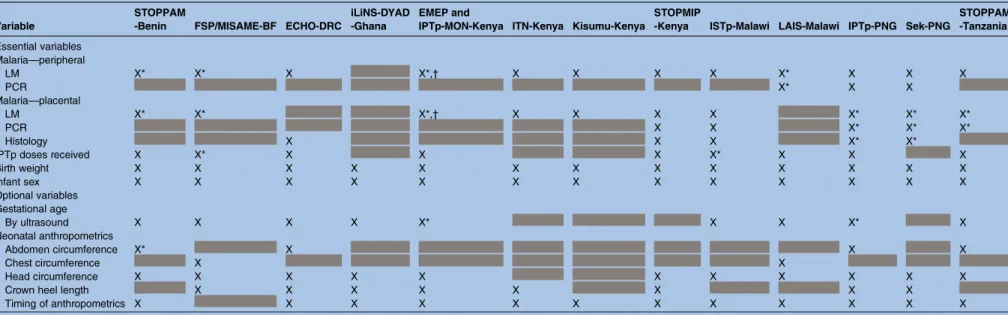
Women in all studies had at least two study visits, at enrol-ment and delivery, but the frequency and timing of follow-up visits during pregnancy varied by study. Given logistical and computational intensity required in pooling longitudinal measures and substantial heterogeneity in fre-quency and timing of measurements, only data at enrol-ment and at delivery were pooled from every study.Tables 2
and3show available enrolment and delivery measurements for each included cohort. Measurements included both those variables deemed essential for the main analyses on malaria, anaemia and malnutrition, and those variables deemed optional but informative. A few measurements, specifically malaria infection diagnostics, malnutrition anthropometrics and anaemia diagnostics warrant further discussion.
Malaria infection at enrolment
At enrolment, malaria infection was diagnosed by exam-ination of peripheral blood.35 Parasitaemia was assessed
enrolment was routinely diagnosed by LM. In the FSP/ MISAME study in Burkina Faso, LM was only performed if a woman presented with symptoms consistent with malaria, that is, fever or history of fever.21 In the iLiNS-DYAD Ghana study, malaria was only diagnosed using an RDT.22 RDTs detect circulating target malaria antigens and are increasingly used in malaria-endemic areas when microscopy is not readily available.35 36 However, persistence of circulating target antigens after parasite clearance can lead to false-positive test results.35 Sensitivity of qPCR is much higher than LM and RDTs, but the role of submicroscopic infections detected by qPCR alone in causing adverse outcomes has not been clearly determined.37 38
Malaria infection at delivery
In addition to peripheral blood diagnostics at delivery, some studies also assessed placental malaria infection at delivery (table 3). Placental malaria was diagnosed by LM of a placental blood smear, qPCR and/or placental histology.39 Three criteria are used to classify placental malaria by histology: presence of infected erythrocytes; haemozoin in monocytes/macrophages and haemozoin infibrin deposits.40Placental histology is considered the diagnostic reference standard for placental infection.
MUAC and BMI
Table 2 Key measures at enrolment across the 13 studies included in the M3 initiative
Variable STOPPAM-Benin FSP/
MISAME-BF ECHO-DRC iLiNS-DYAD-Ghana
EMEP and
IPTp-MON-Kenya ITN-Kenya
Kisumu-Kenya STOPMIP-Kenya ISTp-Malawi LAIS-Malawi IPTp-PNG Sek-PNG STOPPAM-Tanzania
Essential variables Malaria
LM X X* X X X X X X X X X X
PCR X X X X
RDT X† X‡ X§ X§ X†
Anthropometrics
MUAC X* X X X X* X¶ X X X X
Weight X X X X X X X X X X X X X
Height X X X X X X X X X X X X
Gravidity X X X X X X X X X X X X X
Anaemia**
Haemoglobin X X X X X X X X X X X X
Haematocrit X
Optional variables Gestational age
Ultrasound X X X X X* X X X* X
Fundal height X X* X X X* X X X X X X X X
Age X X X X X X X X X X X X X
Smoking (Y/N) X X X X X X X
HIV X X X X X* X X X X X
Residence (rural/urban)
X X X X X X X X X X X X
Bed net ownership X X X X X X X X X*
Available information indicated with X, missing data >10% indicated by *, and systematically missing data indicated with grey highlighting.
†The STOPPAM Benin and Tanzania studies primarily used the Parascreen RDT (Zephyr Biomedical Systems, Goa, India), which detectsPlasmodium falciparumHRP-2 and pLDH. ‡The iLiNS-DYAD-Ghana study used the Clearview Malaria Combo RDT (British Biocell International, Dundee, UK), which detects HRP-2 and plasmodium aldolase.
§Women randomised to the ISTp arms of the STOPMIP-Kenya and ISTp-Malawi studies were tested with a First Response Malaria Ag. (pLDH/HRP2) Combo RDT (Premier Medical Corporation, India).
¶Maternal MUAC measured at delivery.
**Nine studies measured haemoglobin using a HemoCue haemoglobinometer (Hemocue, Angelholm, Sweden),20–22 26–31one study relied on haemoglobin measures from a local laboratory (unknown make),23one study used Sysmex hematological analyser (Kobe, Japan)32and one study collected capillary blood (finger stick) specimens for determination of haematocrit or haemoglobin levels using a standardised chart.10In the ITN-Kenya study, haemoglobin was measured using a HemoCue haemoglobinometer (Hemocue, Angelholm, Sweden) before 1997, and from 1997 onwards capillary blood (finger stick) specimens were collected for determination of haematocrit levels, which were divided by a factor of three and presented as haemoglobin values for consistency with the 1996 data. BF, Burkina Faso; DRC, Democratic Republic of the Congo; HRP-2, histidine protein-2; IPTp, intermittent preventive treatment in pregnancy; ISTp, intermittent screening for malaria infection in pregnancy; ITN, insecticide-treated bed nets; LM, light microscopy; M3, Maternal Malnutrition and Malaria; MUAC, mid-upper arm circumference; N, no; pLDH,Plasmodiumlactate dehydrogenase; PNG, Papua New Guinea; RDT, rapid diagnostic test; STOPPAM, Strategies To Prevent Pregnancy Associated Malaria; Y, yes.
HW
,
et
al
.
BMJ
Open
2016;
6
:e012697.
doi:10.1
136/bmjopen-2016-0126
97
Open
Table 3 Key measures at delivery across the 13 studies included in the M3 Initiative
Variable
STOPPAM
-Benin FSP/MISAME-BF ECHO-DRC
iLiNS-DYAD -Ghana
EMEP and
IPTp-MON-Kenya ITN-Kenya Kisumu-Kenya
STOPMIP
-Kenya ISTp-Malawi LAIS-Malawi IPTp-PNG Sek-PNG
STOPPAM -Tanzania
Essential variables Malaria—peripheral
LM X* X* X X*,† X X X X X* X X X
PCR X* X X
Malaria—placental
LM X* X* X*,† X X X X X* X* X*
PCR X X X* X* X*
Histology X X X X* X*
IPTp doses received X X* X X X X* X X X
Birth weight X X X X X X X X X X X X X
Infant sex X X X X X X X X X X X X X
Optional variables Gestational age
By ultrasound X X X X X* X X X* X
Neonatal anthropometrics
Abdomen circumference X* X X X
Chest circumference X X
Head circumference X X X X X X X X X X X
Crown heel length X X X X X X X X
Timing of anthropometrics X X X X X X X X X X X X
Available information indicated with X, missing data >10% indicated by *, and systematically missing data indicated with grey highlighting. †For the EMEP/IPTp-MON study, only women co-enrolled in the IPTp-MON study (n=111) had malaria diagnostics at delivery.
BF, Burkina Faso; DRC, Democratic Republic of the Congo; IPTp, intermittent preventive treatment in pregnancy; ISTp, intermittent screening for malaria infection in pregnancy; ITN, insecticide-treated bed nets; LM, light microscopy; M3, Maternal Malnutrition and Malaria; PNG, Papua New Guinea; STOPPAM, Strategies To Prevent Pregnancy Associated Malaria.
Unger
HW
,
et
al
.
BMJ
Open
2016;
6
:e012697.
doi:10.1136/
and BMI are easy and low-cost nutritional assessments that can be undertaken in low-resource settings, and are clinically relevant.42
Anaemia at enrolment
Most women had haemoglobin measurements per-formed at first ANC, and most received routine iron/ folate supplements, although information on their use was not routinely collected. The dosage of folate supple-mentation (0.4–5 mg) varied by study site.
FINDINGS TO DATE
Findings from each individual study emphasise how pooling these data has the potential to generate import-ant information on malaria–nutrition interactions in pregnancy.
The ECHO study in the Democratic Republic of the Congo (DRC) was thefirst study to report an interaction between malaria and malnutrition on the risk of FGR.10 In this study, the risk of FGR was 2–8 times higher among women with evidence of malnutrition. In this study, the magnitude of the difference in effect sizes depended on the measurement for malnutrition (BMI vs MUAC vs short stature vs weight gain) and the meas-urement for malaria (cross-sectional vs cumulative); however, with all measurements of malnutrition and malaria, the pattern and directionality of the modifi ca-tion was consistent. This study, together with a small number of follow-up studies, provided the necessary pre-liminary data for the M3 initiative.7 12
Two participating studies provided evidence regarding nutritional interventions during pregnancy. The FSP/ MISAME in Burkina Faso study concluded that multiple micronutrient-fortified food supplementation increased mean birth weight, and that this effect was most pro-nounced among women who were anaemic or under-nourished early in their pregnancy.34 The iLiNS-DYAD trial in Ghana found modest overall increases in birth weight with the provision of lipid-based nutrient supple-ments compared with iron and folic acid supplementa-tion, but showed that the intervention may be most effective when given to primiparous women.22 While nutritional assessment was not the primary aim of the remaining studies, the IPTp RCT in PNG and the Strategies To Prevent Pregnancy Associated Malaria (STOPPAM) cohort study in Benin reported associations between low maternal anthropometrics and birth weight.20 43
Other studies largely focused on malaria prevention. In the late 90s, the Kisumu cohort study found that implementation of two doses of IPT-sulphadoxine-pyrimethamine (SP) halved the prevalence of placental malaria infection. In another study conducted concur-rently in Kenya (Asembo Bay study) use of ITNs was associated with a marked reduction in placental malaria and LBW, but (as expected) with no apparent impact on nutritional status.25 The LAIS study, conducted in
Malawi from 2003 to 2006, found that adding azithromy-cin to two courses of monthly SP (SPAZ) was better at reducing malaria at delivery, LBW and preterm birth than monthly SP or two doses of SP.29 44 45 SPAZ was also superior when compared with the standard malaria prevention regimen used in PNG (SP plus chloro-quine),30 where placental infection is an important risk factor for LBW.31 The EMEP cohort study found that use of artemisinin combination treatments during the first trimester was not associated with increased risk of miscarriage.23 The IPTp-MON study found that with increasing resistance, the efficacy of IPTp-SP in clearing existing infections or preventing new ones is compro-mised; however, where the sextuple mutant is rare, it remains associated with improvements in birth weight and maternal haemoglobin.24
The STOPPAM cohort studies conducted in Benin and Tanzania provided observational data on the effects and potential limitations of two-dose IPTp-SP. Specifically, the STOPPAM-Benin study found that a sub-stantial proportion of women acquired malaria infec-tions late in pregnancy, sometimes after the second IPTp dose had been given.20 The STOPPAM-Tanzania study also found that malaria infections in the first or second trimester were associated with altered fetal growth that might not be detectable until the third tri-mester.32Trial data from the FSP/MISAME study further corroborated these observational studies; the FSP/ MISAME study found that malaria infection during the first trimester was associated with higher risk of LBW and that additional doses of IPTp might be more
effect-ive.21 46 These studies, along with others, have
high-lighted the importance of early and frequent malaria prevention to improve birth outcomes, and IPT-SP is now routinely given monthly until delivery.47 48
The intermittent screening for malaria infection (ISTp) Malawi study assessed another malaria preven-tion strategy by comparing IPTp-SP with ISTp at ANC visits using RDTs and treating infected women with dihydroartemisinin-piperaquine (DHA-PQ).28 The STOPMIP Kenya study also assessed ISTp with DHA-PQ, comparing it to IPTp with DHA-PQ as well as IPTp-SP. Analyses from both studies suggest that ISTp-DHA-PQ is not superior to the existing strategy of IPTp-SP, although IPTp-DHA-PQ was more effective than both ISTp-DP and IPTp-SP.27
FUTURE PLANS
of anaemia on LBW; the interaction between anaemia and malaria with regard to increasing the risk of LBW; the mediation of the effect of malaria through anaemia on LBW; and the usefulness and agreement of MUAC versus BMI to predict adverse birth outcomes. Short maternal stature, potentially indicative of stunting and reduced adolescent catch-up growth (chronic undernu-trition), has also been associated with increased risks of adverse birth outcomes and will be explored using this pooled data set.52 Finally, we will assess aforementioned relationships and effects among pregnant women with HIV, a patient cohort known to be at increased risk of adverse outcomes due to malaria and malnutrition.53
STRENGTHS AND LIMITATIONS
This pooled birth cohort holds promise as the largest preg-nancy data set to date to address questions regarding malaria and nutrition that are of great importance to maternal and infant health. Prior research on this topic has been limited by insufficient statistical power to examine the interaction between malaria and malnutri-tion. The pooled M3 offers the opportunity to overcome this limitation by increasing statistical power and precision, which is particularly valuable for conducting subgroup ana-lyses and investigating interactions. The substantial size of the pooled data set also facilitates the application of rigor-ous methodological approaches for systematically missing data, such as multiple imputation by chained equations, standardisation, latent variable methods or transformation of measurements to create commensurate measures.54 55 Availability of individual-level data, rather than aggregate data from each study, allows definitions of exposures and outcomes to be harmonised. Individual-level information on malaria and malnutrition further enables implementa-tion of complex modelling to assess targeted antimalarial and nutritional interventions during pregnancy. The diver-sity of study populations included in the M3 cohort, for example, with respect to location, ethnicity, malaria trans-mission intensity, malaria and nutrition interventions, health infrastructure and HIV prevalence, could provide important data with regard to generalisability of ourfi nd-ings. Specifically, this level of population diversity, coupled with availability of data on multiple risk factors for LBW and greater statistical power to assess subgroup effects, may allow the identification of high-risk women who could benefit most from more intensive antenatal care, nutri-tional supplements and alternative malaria prevention regi-mens, and of the settings in which these interventions would be most effective.
(table 3), but should allow for meaningful subanalyses. Second, exclusion of miscarriages and stillbirths may cause selection bias (left truncation) for some analyses, given the possibility of differential rates of early preg-nancy losses in relation to infection and nutritional status.56 We will assess this potential bias using data on miscarriages and stillbirths extracted from a subset of studies.21 23 27 28 Third, potential confounders such as concomitant helminth infection and micronutrient defi -ciencies were not measured in participant studies.57 58 Fourth, while MUAC only modestly changes throughout pregnancy, BMI tends to increase with gestational age: gestational age-adjusted BMI may be one approach to address this problem. Fifth, while we have information on HIV status for a majority of studies, information on use of antiretroviral therapy (ART) was not extracted, and secular changes over time regarding use and effi -cacy of ARTs could influence the comparability of results across studies that enrolled HIV-infected women. Finally, since the intention was to concentrate on areas of moderate-to-high P. falciparum transmission, we did not include any studies representing other malaria-affected regions such as Central/South America and India.
COLLABORATION
The investigators welcome collaboration for future pro-jects and invite proposals for additional analyses. Further details can be obtained by contacting SR ([email protected]) and HWU (hwunger@doctors. org.uk).
Author affiliations
1Department of Obstetrics and Gynaecology, Edinburgh Royal Infirmary,
Edinburgh, UK
2Department of Medicine at the Doherty Institute, The University of
Melbourne, Parkville, Victoria, Australia
3Department of Epidemiology, UNC-Chapel Hill, Chapel Hill, North Carolina,
USA
4Malaria Branch, Division of Parasitic Diseases and Malaria, Center for Global
Health, Centers for Disease Control and Prevention, Atlanta, Georgia, USA 5Institut de Recherche pour le Développement (IRD), Mère et enfant face aux
infections tropicales (UMR216), Paris, France
6COMUE Sorbonne Paris Cité, Faculté de Pharmacie, Université Paris
Descartes, Paris, France
7Unite de Recherche Clinique de Nanoro, Institut de Recherche en Sciences
de la Santé-DRO, Bobo-Dioulasso, Burkina Faso
8Departement de Recherche Clinique, Centre Muraz, Bobo-Dioulasso, Burkina
Faso
9Medical Research Council Unit, The Gambia 10London School of Hygiene and Tropical Medicine, UK 11Institute of Tropical Medicine, Antwerp, Belgium 12Worldwide Epidemiology, GlaxoSmithKline, Uxbridge, UK
13Department of Nutrition and Food Science, University of Ghana, Legon,
16Kenya Medical Research Institute (KEMRI)/Center for Global Health
Research, Kisumu, Kenya
17Malawi-Liverpool-Wellcome Trust Clinical Research Programme Liverpool
School of Tropical Medicine, Liverpool, UK 18President’s Malaria Initiative, Washington DC, USA
19School of Public Health and Family Medicine, College of Medicine,
University of Malawi, Blantyre, Malawi
20Tampere Center for Child Health Research, Tampere, Finland
21Department for Pediatrics, University of Tampere and Tampere University
Hospital, Tampere, Finland
22Walter and Eliza Hall Institute, Parkville, Victoria, Australia
23Institute for Glycomics, Griffith University, Gold Coast, Queensland, Australia 24Faculty of Health Science, Department of Immunology and Microbiology,
Centre for Medical Parasitology, University of Copenhagen, Copenhagen, Denmark
25National Institute for Medical Research, Tanga Centre, Tanga, Tanzania
Contributors HWU and SR were involved in the conception of this study. HWU, JG, VB, NF, IV, HT, Ud’A, SHL, SA-A, KGD, FTK, SD, PO, LS, DJT, SK, JA, BN, MD, MM, LK-P, PA, KM, IM, DS, CS, JL, AMvE, SM and SR were involved in design and supervision of data collection of the parent studies. JEC and HWU drafted the work. All the authors critically revised this article and approved the final manuscript as submitted.
Funding The STOPPAM project,‘Strategies To Prevent Pregnancy Associated Malaria’was supported by the European Union’s Seventh Framework Programme (EU FP7); STOPPAM contract number: 200889. STOPPAM I (Benin) and STOPPAM II (Tanzania). The FSP/MISAME study (Burkina Faso) was funded by Nutrition Third World, The Belgium Ministry of Development, Flemish Interuniversity Council, and French Ministry of Development. The ECHO study (Democratic Republic of the Congo) was funded by the Department of Epidemiology, University of North Carolina Chapel Hill, UNC Gillings School of Global Public Health. The iLiNS-DYAD (Ghana) trial was funded by a grant to the University of California, Davis from the Bill & Melinda Gates Foundation. EMEP was partly supported by the Malaria in Pregnancy (MiP) Consortium, which is funded through a grant from the Bill & Melinda Gates Foundation to the Liverpool School of Tropical Medicine, UK (46099) and partly by the US Centers for Disease Control and Prevention (CDC), Division of Parasitic Diseases and Malaria through a cooperative agreement with Kenya Medical Research Institute (KEMRI), Center for Global Health Research (CGHR), Kisumu, Kenya. The IPTp-MON study (Kenya) was supported by the CDC. The ITN project (Kenya) was funded by the US Agency for International Development. The Special Health Support Fund from the Royal Netherlands Embassy (Nairobi, Kenya) provided additional support for the study of the impact of ITN in pregnancy. The Kisumu study (Kenya) was funded by US Agency for International Development (grant numbers AOT0483-PH1-2171 and HRN-A-00-04-00010-02) and the Netherlands Foundation for the Advancement of Tropical Research. The STOPMIP study (Kenya) was funded by the Malaria in Pregnancy (MiP) Consortium, which is funded through a grant from the Bill & Melinda Gates Foundation to the Liverpool School of Tropical Medicine, UK. The ISTp study (Malawi) was funded by the European and Developing Countries Clinical Trials Partnership (EDCTP). The LAIS study was supported by grants from the Academy of Finland (grant numbers 79787 and 207010), the Foundation for Pediatric Research in Finland, and the Medical Research Fund of Tampere University Hospital. Azithromycin and its placebo were provided free of charge by Pfizer (New York, New York, USA), which also provided funding for the PCR testing of the sexually transmitted infections. The IPTp study (Papua New Guinea (PNG)) was funded by the MiP Consortium, through a grant from the Bill & Melinda Gates Foundation (46099); the Pregvax Consortium, through a grant from the EU FP7-2007-HEALTH (PREGVAX 201588) and the Spanish Government (EUROSALUD 2008 Programme); and Pfizer, through an investigator-initiated research grant (WS394663). The Sek study (PNG) was supported by AusAID (grant to PNG Institute of Medical Research (IMR)), the National Health and Medical Research Council of Australia; Australian Research Council; Wellcome Trust; and Veterans Affairs Research Service. The Walter and Eliza Hall Institute is supported by the NHMRC Infrastructure for Research Institutes Support Scheme and Victorian State Government Operational Infrastructure Support. JEC was funded by the National Institute of Allergy and Infectious Diseases at the National Institutes of Health
(Pre-doctoral Training in Infectious Disease Epidemiology grant #5 T32 AI070114).
Competing interests None declared.
Provenance and peer review Not commissioned; externally peer reviewed. Data sharing statement Researchers can request data use by contacting SR ([email protected]) and HWU ([email protected]).
Open Access This is an Open Access article distributed in accordance with the terms of the Creative Commons Attribution (CC BY 4.0) license, which permits others to distribute, remix, adapt and build upon this work, for commercial use, provided the original work is properly cited. See: http:// creativecommons.org/licenses/by/4.0/
REFERENCES
1. Dellicour S, Tatem AJ, Guerra CA,et al. Quantifying the number of pregnancies at risk of Malaria in 2007: a demographic study.PLoS Med2010;7:e1000221.
2. Umbers AJ, Aitken EH, Rogerson SJ. Malaria in pregnancy: small babies, big problem.Trends Parasitol2011;27:168–75.
3. Bardají A, Sigauque B, Sanz S,et al. Impact of malaria at the end of pregnancy on infant mortality and morbidity.J Infect Dis
2011;203:691–9.
4. Barker DJ, Gluckman PD, Godfrey KM,et al. Fetal nutrition and cardiovascular disease in adult life.Lancet1993;341:938–41. 5. Nosten F, McGready R, Simpson JA,et al. Effects of Plasmodium
vivax malaria in pregnancy.Lancet Lond Engl1999;354:546–9. 6. Burki TK. Malaria and malnutrition: Niger’s twin crises.Lancet
2013;382:587–8.
7. Unger HW, Ome-Kaius M, Karl S,et al. Factors associated with ultrasound-aided detection of suboptimal fetal growth in a malaria-endemic area in Papua New Guinea.BMC Pregnancy Childbirth2015;15:83.
8. Hanson MA, Bardsley A, De-Regil LM,et al. The International Federation of Gynecology and Obstetrics (FIGO) recommendations on adolescent, preconception, and maternal nutrition:“Think Nutrition First”.Int J Gynaecol Obstet Off Organ Int Fed Gynaecol Obstet2015;131(Suppl 4):S213–53.
9. Black RE, Victora CG, Walker SP,et al. Maternal and child undernutrition and overweight in low-income and middle-income countries.Lancet2013;382:427–51.
10. Landis SH, Lokomba V, Ananth CV,et al. Impact of maternal malaria and under-nutrition on intrauterine growth restriction: a prospective ultrasound study in Democratic Republic of Congo.Epidemiol Infect
2009;137:294–304.
11. Griffin JB, Lokomba V, Landis SH,et al. Plasmodium falciparum parasitaemia in the first half of pregnancy, uterine and umbilical artery blood flow, and foetal growth: a longitudinal Doppler ultrasound study.Malar J2012;11:319.
12. McClure EM, Meshnick SR, Lazebnik N,et al. A cohort study of Plasmodium falciparum malaria in pregnancy and associations with uteroplacental blood flow and fetal anthropometrics in Kenya.Int J Gynaecol Obstet2014;126:78–82.
13. Rytter MJH, Kolte L, Briend A,et al. The immune system in children with malnutrition—a systematic review.PLoS ONE2014;9:e105017. 14. Shankar AH. Nutritional modulation of malaria morbidity and
mortality.J Infect Dis2000;182(Suppl 1):S37–53.
15. Branca F, Piwoz E, Schultink W,et al. Nutrition and health in women, children, and adolescent girls.BMJ2015;351:h4173. 16. WHO. WHO | Global Strategy for Women’s, Children’s and
Adolescents’Health, 2016–2030. (cited 2015 Sep 28). http://www. who.int/entity/life-course/partners/global-strategy/
global-strategy-2016-2030/en/index.html
17. The Lancet Infectious Diseases. Putting malaria in pregnancy firmly on the agenda.Lancet Infect Dis2007;7:79.
18. Malaria in pregnancy consortium. http://www.mip-consortium.org/ 19. International Food Policy Research Institute. Global nutrition report
2014: actions and accountability to accelerate the world’s progress on nutrition. 2014. http://cdm15738.contentdm.oclc.org/utils/getfile/ collection/p15738coll2/id/128484/filename/128695.pdf
20. Huynh B-T, Fievet N, Gbaguidi G,et al. Influence of the timing of malaria infection during pregnancy on birth weight and on maternal anemia in Benin.Am J Trop Med Hyg2011;85:214–20.
21. Valea I, Tinto H, Drabo MK,et al. An analysis of timing and frequency of malaria infection during pregnancy in relation to the risk of low birth weight, anaemia and perinatal mortality in Burkina Faso.
24. Desai M, Gutman J, Taylor SM,et al. Impact of
sulfadoxine-pyrimethamine resistance on effectiveness of intermittent preventive therapy for malaria in pregnancy at clearing infections and preventing low birth weight.Clin Infect Dis
2016;62:323–33.
25. ter Kuile FO, Terlouw DJ, Phillips-Howard PA,et al. Reduction of malaria during pregnancy by permethrin-treated bed nets in an area of intense perennial malaria transmission in Western Kenya.Am J Trop Med Hyg2003;68:50–60.
26. van Eijk AM, Ayisi JG, Slutsker L,et al. Effect of haematinic supplementation and malaria prevention on maternal anaemia and malaria in western Kenya.Trop Med Int Health2007;12:342–52. 27. Desai M, Gutman J, L’lanziva A,et al. Intermittent screening and
treatment or intermittent preventive treatment with
dihydroartemisinin-piperaquine versus intermittent preventive treatment with sulfadoxine-pyrimethamine for the control of malaria during pregnancy in western Kenya: an open-label, three-group, randomised controlled superiority trial.Lancet2015;386:2507–19. 28. Madanitsa, Mwayiwawo, Linda Kalilani, Victor Mwapasa, Anna M.
van Eijk, Carole Khairallah, Doreen Ali, Cheryl Pace,et al.
“Scheduled Intermittent Screening with Rapid Diagnostic Tests and Treatment with Dihydroartemisinin-Piperaquine versus Intermittent Preventive Therapy with Sulfadoxine-Pyrimethamine for Malaria in Pregnancy in Malawi: An Open-Label Randomized Controlled Trial.”
PLoS Medicine13, no. 9 (Sep 2016): e1002124. doi:10.1371/ journal.pmed.1002124
29. Luntamo M, Kulmala T, Mbewe B,et al. Effect of repeated treatment of pregnant women with sulfadoxine-pyrimethamine and
azithromycin on preterm delivery in Malawi: a randomized controlled trial.Am J Trop Med Hyg2010;83:1212–20.
30. Unger HW, Ome-Kaius M, Wangnapi RA,et al.
Sulphadoxine-pyrimethamine plus azithromycin for the prevention of low birthweight in Papua New Guinea: a randomised controlled trial.
BMC Med2015;13:9.
31. Stanisic DI, Moore KA, Baiwog F,et al. Risk factors for malaria and adverse birth outcomes in a prospective cohort of pregnant women resident in a high malaria transmission area of Papua New Guinea.
Trans R Soc Trop Med Hyg2015;109:313–24.
32. Schmiegelow C, Minja D, Oesterholt M,et al. Malaria and fetal growth alterations in the 3rd trimester of pregnancy: a longitudinal ultrasound study.PLoS ONE2013;8:e53794. http://www.ncbi.nlm. nih.gov/pmc/articles/PMC3543265/
33. Rijken MJ, Rijken JA, Papageorghiou AT,et al. Malaria in pregnancy: the difficulties in measuring birthweight.BJOG Int J Obstet Gynaecol2011;118:671–8.
34. Huybregts L, Roberfroid D, Lanou H,et al. Prenatal food
supplementation fortified with multiple micronutrients increases birth length: a randomized controlled trial in rural Burkina Faso.Am J Clin Nutr2009;90:1593–600.
35. Wongsrichanalai C, Barcus MJ, Muth S,et al. A review of malaria diagnostic tools: microscopy and rapid diagnostic test (RDT).Am J Trop Med Hyg2007;77:119–27.
36. WHO. WHO | Information note on recommended selection criteria for procurement of malaria rapid diagnostic tests (RDTs). (cited 2015 Aug 6). http://www.who.int/malaria/publications/atoz/rdt_selection_ criteria/en/
37. Rantala AM, Taylor SM, Trottman PA,et al. Comparison of real-time PCR and microscopy for malaria parasite detection in Malawian pregnant women.Malar J2010;9:269.
38. Cottrell G, Moussiliou A, Luty AJF,et al. Submicroscopic plasmodium falciparum infections are associated with maternal anemia, premature births, and low birth weight.Clin Infect Dis
2015;60:1481–8.
39. Anchang-Kimbi JK, Achidi EA, Nkegoum B,et al. Diagnostic comparison of malaria infection in peripheral blood, placental blood
health related outcomes in adolescents and adults: a systematic review. Washington DC: FHI 360/FANTA, 2013.
42. Ververs MT, Antierens A, Sackl A,et al. Which anthropometric indicators identify a pregnant woman as acutely malnourished and predict adverse birth outcomes in the humanitarian context?PLoS Curr2013;5:ecurrents. http://www.ncbi.nlm.nih.gov/pmc/articles/ PMC3682760/
43. Unger HW, Wangnapi RA, Ome-Kaius M,et al.
Azithromycin-containing intermittent preventive treatment in pregnancy affects gestational weight gain, an important predictor of birthweight in Papua New Guinea—an exploratory analysis.Matern Child Nutr2016;12:699–712.
44. Luntamo M, Rantala A-M, Meshnick SR,et al. The effect of monthly sulfadoxine-pyrimethamine, alone or with azithromycin, on PCR-diagnosed malaria at delivery: a randomized controlled trial.
PLoS ONE2012;7:e41123.
45. Luntamo M, Kulmala T, Cheung YB,et al. The effect of antenatal monthly sulphadoxine-pyrimethamine, alone or with azithromycin, on foetal and neonatal growth faltering in Malawi: a randomised controlled trial.Trop Med Int Health2013;18:386–97.
46. Valea I, Tinto H, Drabo MK,et al. Intermittent preventive treatment of malaria with sulphadoxine-pyrimethamine during pregnancy in Burkina Faso: effect of adding a third dose to the standard two-dose regimen on low birth weight, anaemia and pregnancy outcomes.
Malar J2010;9:324.
47. Kayentao K, Garner P, van Eijk AM,et al. Intermittent preventive therapy for malaria during pregnancy using 2 vs 3 or more doses of sulfadoxine-pyrimethamine and risk of low birth weight in Africa: systematic review and meta-analysis.JAMA2013;309:
594–604.
48. Huynh BT, Cottrell G, Cot M,et al. Burden of malaria in early pregnancy: a neglected problem?Clin Infect Dis Off Publ Infect Dis Soc Am2015;60:598–604.
49. Westreich D. From exposures to population interventions: pregnancy and response to HIV therapy.Am J Epidemiol
2014;179:797–806.
50. Ahern J, Hubbard A, Galea S. Estimating the effects of potential public health interventions on population disease burden: a step-by-step illustration of causal inference methods.
Am J Epidemiol2009;169:1140–7.
51. Taubman SL, Robins JM, Mittleman MA,et al. Intervening on risk factors for coronary heart disease: an application of the parametric g-formula.Int J Epidemiol2009;38:1599–611.
52. Kozuki N, Katz J, Lee AC,et al. Short maternal stature increases risk of small-for-gestational-age and preterm births in low- and middle-income countries: individual participant data meta-analysis and population attributable fraction.J Nutr2015;145:2542–50. 53. González R, Ataíde R, Naniche D,et al. HIV and malaria
interactions: where do we stand?Expert Rev Anti Infect Ther
2012;10:153–65.
54. Siddique J, Reiter JP, Brincks A,et al. Multiple imputation for harmonizing longitudinal non-commensurate measures in individual participant data meta-analysis.Stat Med2015;34:3399–414. 55. Resche-Rigon M, White IR, Bartlett JW,et al. PROG-IMT Study
Group. Multiple imputation for handling systematically missing confounders in meta-analysis of individual participant data.Stat Med
2013;32:4890–905.
56. Lisonkova S, Joseph KS. Left truncation bias as a potential explanation for the protective effect of smoking on preeclampsia.
Epidemiol Camb Mass2015;26:436–40.
57. Kapil U. Multiple micronutrient supplements will not reduce incidence of low birthweight.Indian J Community Med2009;34:85–6. 58. Andersen LT, Thilsted SH, Nielsen BB,et al. Food and nutrient
intakes among pregnant women in rural Tamil Nadu, South India.