ARE YEAR-ROUND SCHOOLS A VIABLE OPTION FOR IMPROVING STUDENT ACHIEVEMENT, COMBATING SUMMER LEARNING LOSS IN DISADVANTAGED YOUTH,
CONTROLLING EXPENSES, AND REDUCING TEACHER BURNOUT?
Adrienne Smith
A dissertation submitted to the faculty of the University of North Carolina at Chapel Hill in partial fulfillment of the requirements for the degree of Doctor of Philosophy in the School of Education.
Chapel Hill 2011
Approved by:
iii
ABSTRACT
ADRIENNE SMITH: Are Year-Round Schools a Viable Option for Improving Student Achievement, Combating Summer Learning Loss in Disadvantaged Youth, Controlling Expenses, and Reducing
Teacher Burnout?
(Under the direction of Gary T. Henry)
v
ACKNOWLEDGEMENTS
Upon completion of this work I must credit the individuals who have been instrumental in its development. Special thanks to Dr. Henry for his expertise, Dr. Cizek for his guidance in this process, and to all of my committee members, Dr. Brown, Dr. Cooper, and Dr. Ware, for their valuable input.
TABLE OF CONTENTS
LIST OF TABLES ... viii
LIST OF FIGURES ... x
Chapter I. INTRODUCTION ... 1
II. THEORETICAL LITERATURE REVIEW ... 7
Memory and Spacing ... 7
Time on Task ... 16
Connection to Calendar Reform ... 21
III. POLICY RATIONALE FOR CALENDAR REFORM ... 25
Summer Learning Loss ... 25
Summer School Interventions ... 29
Modified Year-Round Schools ... 31
Weaknesses in the Current Year-Round Research ... 36
In Summary ... 39
Next Steps ... 39
IV. METHODOLOGY ... 40
Design ... 40
Research Questions... 48
Participants ... 49
Measures ... 49
vii
Data Analysis ... 61
Models ... 64
Limitations ... 70
V. RESULTS ... 71
Propensity Score Matching ... 72
Descriptive Statistics ... 80
Inferential Statistics ... 82
Summary and Conclusion ... 91
VI. DISCUSSION ... 93
Summary of Findings ... 95
Interpretation and Implications ... 96
Limitations ... 102
Suggestions for Future Research ... 104
Conclusion ... 106
APPENDICES ... 107
LIST OF TABLES
Table
1. List of Variables ... 59
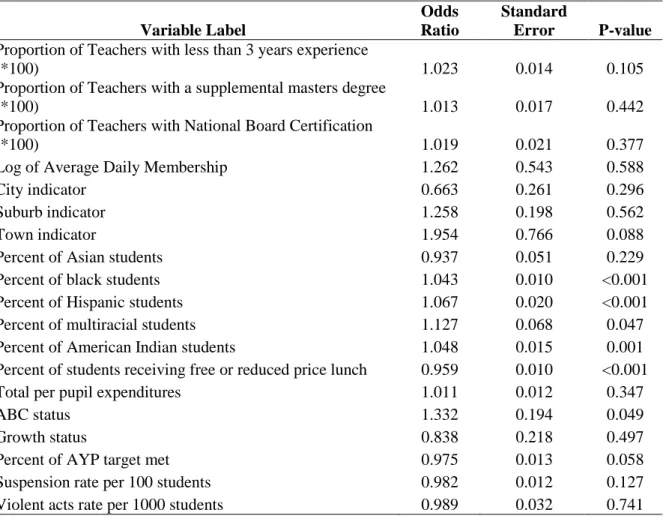
2. Logistic Regression for Propensity Score Matching: Growth Curve Analysis ... 73
3. Comparison of Matched and Full Traditional Calendar Samples to Modified Year-Round Schools ... 75
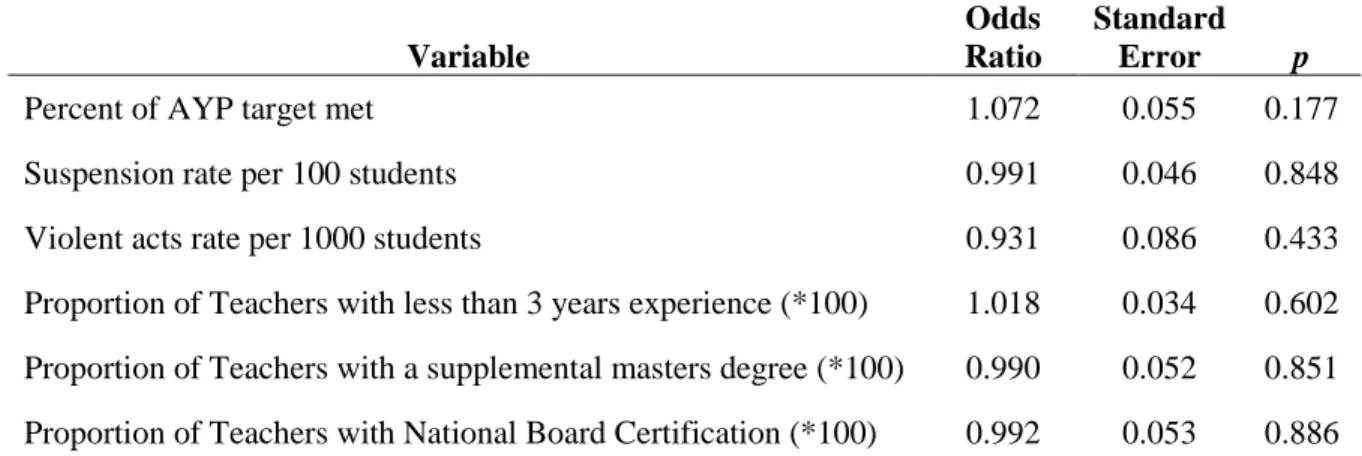
4. Logistic Regression for Propensity Score Matching: Difference-in- Differences Analysis ... 76
5. Comparison of Matched and Full Traditional Calendar Samples to Modified Year-Round Schools ... 78
6. Falsification Tests Results ... 80
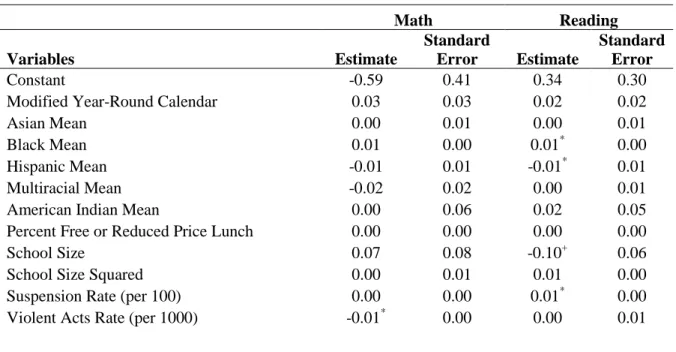
7. Student Fixed Effects Results for Math and Reading Achievement ... 82
8. Growth Curve Model Results for Math and Reading Achievement ... 84
9. Student Fixed Effects Results for Student Absenteeism ... 86
10. Growth Curve Interactions Results for Student Achievement ... 87
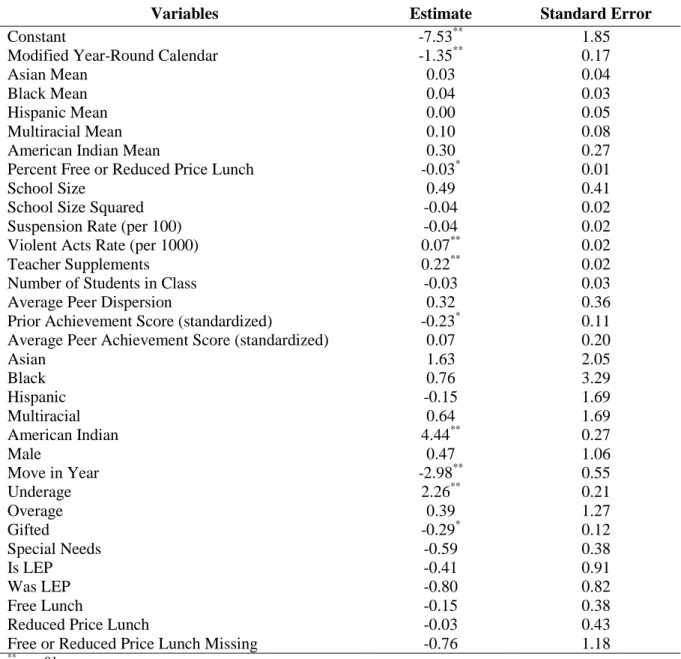
11. Difference-in-differences Results for Teacher Retention ... 89
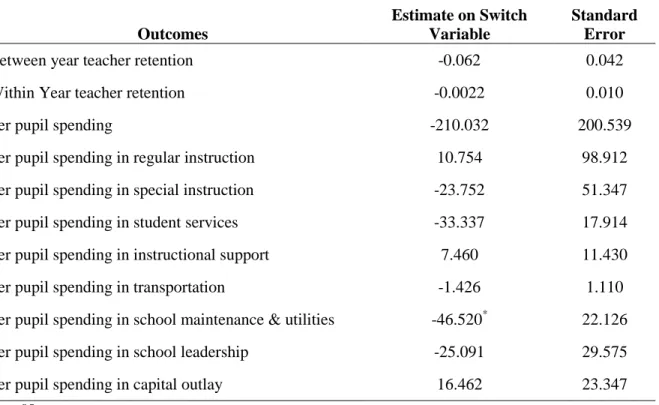
12. Difference-in-differences Results for Expenditures ... 90
B.1. Reliability of End of Grade Math Tests (2006). Gender and Ethnicity ... 109
B.2. Reliability of End of Grade Math Tests (2006). Disability Status, Limited English Proficiency ... 109
B.3. Reliability of End of Grade Reading Tests (2004) ... 109
B.4. Linkages between Research Questions and Specific Analyses ... 110
B.5. Year-Round schools in North Carolina ... 110
B.6. Description of Growth Curve Sample for Math Achievement Outcome ... 110
ix
B.8. Weighted Description of Student Fixed Effects Sample for Math
Achievement Outcome ... 113 B.9. Weighted Description of Student Fixed Effects Sample for Reading
Achievement Outcome ... 115 B.10. Weighted Description of Student Fixed Effects Sample for
LIST OF FIGURES
Figure
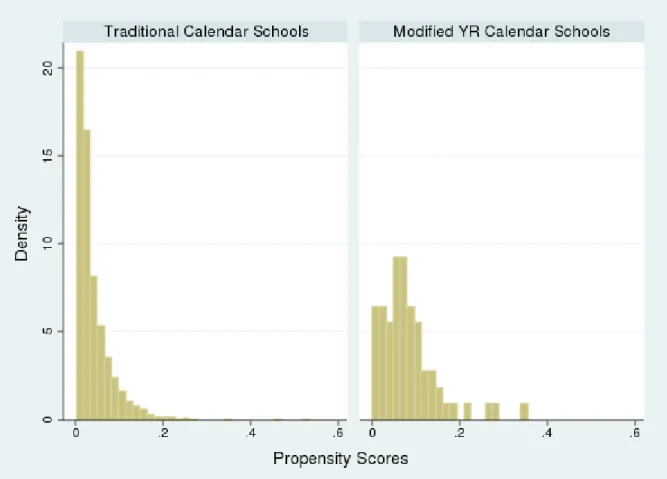
1. Density of Propensity Scores in Traditional Calendar Schools and
Modified Year-round Schools ... 74 2. Density of Propensity Scores in Traditional Calendar Wake County
Schools and Wake County Schools that Switch to the Modified
CHAPTER 1
INTRODUCTION
The number of modified calendar year-round schools has been steadily increasing since the 1980s. According to the latest figures just over two million children in America are enrolled in modified year-round schools (National Association for Year-Round Education, 2007). There were 3,000 modified calendar year-round schools (including schools from kindergarten to twelfth grade) during the 2006-2007 school year. Students enrolled in a modified calendar year-round school is up 11% from the 2000-2001 school year and up 39% from ten years ago. Modified calendars in
particular are adopted more readily by elementary schools, as opposed to high schools, because of the scheduling conflicts that arise with after-school activities, especially athletics (St. Gerard, 2007). States with the highest number of modified year-round schools are California, Hawaii, Arizona, Nevada, and Texas; which are also states experiencing high rates of population growth (Cooper, Valentine, Charlton, & Melson, 2003).
Modified year-round schooling calendars are commonly arranged by nine weeks of schooling followed by a three week break. The modified year-round calendar eliminates the long summer break. If the time-learning relationship is not only affected by the amount of schooling time, but also the length of time between schooling periods, the modified calendar may have an advantage over the traditional calendar. Indeed, research has quantified the summer learning loss phenomenon, which is even more striking for economically disadvantaged students (Alexander, Entwistle, & Olsen, 2001; Heyns, 1978). Eliminating the long summer break may also be beneficial for other sensitive subgroups unexamined by previous research, such as English Language Learners and students in special education.
Several literature strands may inform calendar directives in multiple ways:
3
2. From Carroll‟s work springs another line of research focusing on unpacking time into separate components including student motivation and innate ability, commonly labeled “time on task” (Carroll, 1989).
Memory studies and the time-on-task literature give insight into the effective use and placement of schooling and non-schooling time periods. In other words, both theoretical frameworks speak to calendar reform.
Yet, improving student achievement is not the only factor in the decision to initiate calendar reform. Calendar reform can be economical. Interestingly, financial concerns motivated the adoption of a particular kind of modified calendar, referred to as a multi-track year-round calendar, in growing regions. To handle an influx of students and the lack of time and money for building new schools, policymakers have turned their attention toward multi-track modified year-round schools as a feasible cost-savings option. Multi-track schools contain several groups of students who follow different schedules. Multi-track schools have a group of students on break at any given time. Each track has its own schedule. For example, a school on a multi-track modified calendar has 4 classrooms designated for third graders. There are 5 classes of third graders that rotate through the four classrooms. Every week one class is on a break (referred to as “tracked-out”) while the other four classes are in session. Once a track resumes instruction, they occupy the classroom where previous students who are now “tracked out” once resided. Thus the school needs fewer classrooms and fewer resources (books, desks, chairs, storage cabinets, etc.) to serve more students. Few studies have quantified the effects of multi-track modified calendar schools relative to the traditional calendar (Daneshvary & Clauretie, 2001).
critical component for garnering support for any school reform. Distinct patterns of teacher turnover can reveal a great deal about personnel satisfaction. Higher levels of teacher turnover can indicate less satisfaction with a reform, in this case, modified school calendars. On the other hand, more frequent breaks in the modified year-round calendar could prevent teacher burnout and lead to a higher rate of teacher retention. To date, no evidence exists to support or reject the idea that teacher turnover may be lower in modified year-round calendar schools compared to traditional calendar schools.
The main focus of the proposed study is to investigate whether the modified year-round calendar improves student achievement outcomes, including the outcomes of groups of disadvantaged students, above and beyond achievement outcomes associated with a traditional calendar. Additional investigations of the school calendar‟s effect on school finance and teacher retention will also render evidence as to the potential viability of the modified year-round calendar reform. I hypothesize that, on average, students in modified year-round calendars will outperform students on a traditional calendar, and that the differences will be greater for students of low socioeconomic status, English Language Learners, and students in special education. Also, I predict that schools operating under a modified year-round calendar will spend less per pupil than schools under a traditional calendar. Finally, I hypothesize that the modified year-round calendar will reduce teacher burnout, resulting in lower teacher turnover rates compared to schools with a traditional calendar.
To study the effects of modified year-round schools will require three separateapproaches. First a comparison of modified year-round and similar traditional schools over a three year period will yield information on the growth curves of students from contrasting calendar arrangements. The lack of methodological and statistical rigor in the literature on modified year-round schooling is only beginning to be addressed by newer studies rooted in Ruben‟s causal framework; capitalizing on multi-level modeling strategies that enable researchers to test between school effects while
5
and speaks to the different trajectories that may be observed in the various subgroups (i.e. students with differing levels of socioeconomic status).
Yet, the growth curve approach still suffers from bias, namely selection bias. If students who attend a modified year-round school are systematically different from students who are enrolled in a traditional calendar school in ways that are not measured by control variables such as prior test scores, race/ethnicity, or poverty status then these unobserved differences would confound the
calendar effect. For example, perhaps parental motivation regarding their children‟s success in school influences the decision to reside in a high growth suburban community with high performing schools, which increases the chance their children will enroll in a year-round school. Differences in student achievement may be due to parental factors (when they are uncontrolled for in a study) instead of school calendar arrangement. Conveniently, a natural experiment in North Carolina allows for a second exploration to estimate the effect of the modified year-round calendar with little chance of selection bias. In the 2007-08 school year, Wake County Public Schools switched 23 elementary and middle schools from a traditional calendar to a modified year-round calendar just before the school year began, leaving parents with little opportunity to move their children to a school with a traditional calendar. Using a fixed effects design, students serve as their own controls, and statistical tests contrast the effect of traditional and modified school calendars on individual students. However, to consider the impact estimates unbiased, we have to assume that year-to-year growth is constant over from grade to grade.
Teacher morale, measured by differences in turnover, will be addressed using schools in Wake County with a difference-in-differences design. The difference-in-differences design will allow a comparison of teacher turnover rates prior to switch to a modified year-round calendar, adjusting for the differences due to the passage of time.
instructional support, school maintenance and utilities, school leadership, and capital outlay. Note that multi-track modified schools will be the focus of this analysis. Using difference-in-differences, the effect of calendar arrangement on operational expenditures can be measured. Differences in per pupil spending in various expenditure categories related to calendar type will inform policymakers as to whether calendar reform is an efficient or lower cost alternative.
CHAPTER 2
THEORETICAL LITERATURE REVIEW
Calendar reform restructures schooling and non-schooling time. Depending on the reform, calendar changes may increase the effectiveness of schooling time because of qualitative differences in schooling that occur based on the specific spacing of learning sessions. Both memory and time-on-task theories provide a context for understanding how patterns of schooling and non-schooling intervals impact student learning. Next is a description of the literature in mass versus distributed theory and theories based on the time-on-task conceptual framework.
Memory and Spacing
The central difference between the modified year-round calendar and the traditional calendar is the distribution of school and out-of-school time. The traditional calendar lumps together in-school time while the modified year-round calendar creates chunks of in-in-school time (on average, nine weeks) separated by out-of-school time (on average, three weeks). The effect of the dispersion of in-school learning time in each calendar arrangement may be examined through the mass versus distributive practice theoretical frame. The traditional calendar can be compared to the mass condition, where learning time is massed together in one period, while the modified year-round calendar is likened to the spaced condition, where learning time is divided into multiple periods. Next, is a literature review of the spacing effect including a summary of various theories attempting to account for the phenomena and landmark studies within the field.
Early Learning Theory
retention compared to learning trials packed closely together (aka “the spacing effect”).
Ebbinghaus‟s groundwork spurred a number of studies on the spacing effect in the early twentieth century (Dempster, 1989). Although methodological procedures were far less advanced, many of the studies confirmed the presence of the spacing effect.
Within the context of early learning theory, the two main facets of learning are: changes in resistance to forgetting and changes in lag time between a question and an answer (Estes, 1955). According to Estes, both facets, combating forgetting and reflex response, are in line with Skinner‟s work on the use of reinforcement schedules that increase or decrease the likelihood of eliciting a specific behavior (Skinner, 1938). Labeled “habit strength” and “response strength,” Estes quantifies both facets through a series of probability curves. Using this approach he finds that the number and spacing of conditioning episodes is related to habit strength, meaning that forgetting can be
manipulated by changing the number of learning occasions and the amount of time between learning occasions. Increasing the time interval between conditioning episodes results in greater retention. Response strength (how quickly a participant answers a question) appears greater with very short intervals between conditioning episodes at first, but over time spaced conditioning episodes tend to produce faster recall (Estes, 1955). Grounded in behaviorism, Estes reasons that improved retention is a direct function of the number of similar elements between conditioning episodes and recall trials. This approach is later fleshed out by component level theorists (Glenberg, 1979).
Defining the Spacing Effect
9
participants in spaced versus massed conditions, favoring spaced conditions with remarkable regularity (Hintzman, 1974; Melton, 1970).
Dempster‟s (1989) review of spacing effect research summarizes several important features of the spacing effect that have been highlighted repeatedly in the literature. First, the overall size of the spacing effect is pronounced, especially compared to other learning variables which have
comparably weaker effects. Second, the size of the retention interval (the amount of time between the last learning episode and the test) is also related to the size of the spacing effect with longer retention intervals favoring more spaced learning trials. Contemporary research has focused on this aspect of the spacing effect and is detailed later in the review. Third, it appears that the spacing effect has some boundaries, specifically in terms of material and context. Massed reading passage trials were just as effective as spaced reading passage trials (Austin, 1921). Recalling nonsense syllables may be less influenced by the spacing effect phenomenon than the acquisition of more meaningful information (Underwood, 1961). However, even though some material may be less amenable to the spacing effect, the spacing effect has been evidenced in virtually all traditional learning tasks (see Dempster, 1989 for full review).
There may also be a developmental component to the spacing effect. Toppin and DiGeorge (1984) postulated that the neural mechanisms associated with the spacing effect mature in time. Using evidence from similar experiments performed with preschoolers and first graders, the spacing effect was present for first graders, but not for preschoolers. However, other researchers have reported effects in young children (Cornell, 1980; Rea & Modigliani, 1987). By and large, the spacing effect is extremely robust over different subject matter, interval spacing, and throughout a long research history.
Encoding Variability Theory
does the number of pathways for retrieval. The explanation for recall differences between
participants in massed versus distributed conditions is due to partial versus full processing. In massed conditions, repeated trials spaced closely together require less processing because simple retrieval of the previous encoding is so accessible. The spaced condition requires deeper processing upon each trial because the prior encoding happened longer ago. Using deeper processing for successive trials is what encoding variability researchers believe accounts for the higher long-term retention of
participants in a spaced versus massed learning condition. Addressing the need for further
explanation of the role of context within the encoding variability theory, Glenberg (1979) provides a more explicit account in his component levels theory.
Component Levels Theory
In an effort to explain the spacing effect, Glenberg (1979) describes the component-levels theory which outlines three types of components in relation to the retrieval process. In component-levels theory various stimuli are encoded by the individual either voluntarily or involuntarily resulting in the formation of a complex episodic trace. Multiple components make up the episodic trace; contextual components, structural components, and descriptive components. Contextual components include all stimuli related to the individual‟s environment, including the physical setting, time of day, and the individual‟s mental and emotional state. Contextual components are encoded automatically. When information is encoded in different contexts, the amount of contextual components increases. With more contextual components to aid in retrieval of the episodic trace, an individual is more likely to recall information. Unlike contextual components, structural components are encoded based on an individual‟s voluntary processes to manage new information. The ways in which an individual organizes or chunks information together is the structural components part of the episodic trace. Lastly, descriptive components relate new information with prior experiences. By linking the
semantic memory to the input of new information, the descriptive components are formed on a deeper level of processing. Glenberg (1979) reasons that spaced learning conditions allow for greater
11
and descriptive components to create a more elaborate memory trace resulting in higher rates of retention.
Component-levels theory goes one step further by attributing the encoding feasibility to different features of the trial process that create an “episodic trace.” Surface structures, seemingly superficial features of a learning trial, can aid in the creation of an episodic trace. Component-levels theorists argue that variations in learning trials create more episodic traces which lead to easier retrieval in later tests. Dellarosa and Bourne (1985) set out to test this facet of component-levels theory by changing the surface structure of learning sessions. The researchers manipulate surface structure by allowing free recall versus verbatim responses and substituting different speakers during learning trials. Indeed, the results supported the component-levels theory because in both
manipulations students in the massed condition performed just as well as the students in the spacing condition.
Recall that Glenberg‟s components level theory offered three elements that lead to the creation of a rich episodic trace; contextual, structural, and descriptive. Dellarosa and Bourne (1985) point out that their manipulation of speaker voice and use of free recall instead of requiring simple recognition may have altered one or many of these three elements. Precisely which elements are altered by the study manipulations and understanding which element is the most consequential is still in debate. Dellarosa‟s research team suggests that perhaps differential weights should be assigned to the three elements, the weakest to contextual elements. Additional experiments in the 1980s did not support encoding variability theory or related theories, and it is no longer a preferred interpretation for the spacing effect (Dempster, 1987; Postman & Knects, 1983).
Deficient Processing Theory
deficient processing theory, four explanations for differential processing have come forward: (a) consolidation, (b) habituation, (c) rehearsal, and (d) attention (Dempster, 1989). The first two
contend with involuntary processing; that is, processing that occurs without effort from the individual. The latter two represent techniques a person actively uses in order to increase retention.
Proponents of the consolidation mechanism say that information must be converted from just-learned memory to long term memory storage (Dempster, 1989; Landauer, 1969). Since the
conversion requires time, distributed presentations allow time for consolidation, and therefore result in greater long-term retention. While the consolidation theory has been set forth as an explanation for the spacing effect, little research has been conducted to test the theory explicitly.
According to habitation theory, after the first presentation of new material the brain shuts down. If a second presentation occurs soon after the first it cannot receive full processing treatment. Additional presentations are further limited in processing. Interestingly, the habituation explanation has also been neglected by researchers.
Switching to voluntary behaviors that flesh out the deficient processing theory, the rehearsal hypothesis suggests that spaced presentations allow more time for rehearsal. The increased rehearsal is what cements learning. Research on the rehearsal hypothesis has been limited, however the finding of the spacing effect in young children, who are not old enough to engage in regular rehearsal of new information, does not support the rehearsal mechanism (Cornell, 1980).
13
attention, is related to time between presentations (Magliero, 1983). Following up on the voluntary nature of participants‟ attention levels, researchers isolated several reasons why an individual may choose to pay less attention under massed conditions. First, a false sense of confidence after the initial presentation may prompt individuals to believe they have mastered material at a higher rate than has actually been retained. Zechmeister and Shaughnessy (1980) found that college students were more confident about the amount of material they believed they had remembered in massed condition versus the spaced condition. In actuality, individuals in the spaced condition outperformed those in the massed condition on memory tests. Second, individuals may find massed repetitions boring and redundant, resulting in the choice to pay less attention. Elmes, Dye, and Herdelin (1983) had participants rate the “pleasantness” of spaced versus massed word presentations and found that the spaced words were rated as more pleasant.
However, the persistence of the spaced effect lends itself more to an involuntary process. Memory researchers tweaked the attention hypothesis in proposing a less voluntary mechanism, sometimes known as the reconstruction or accessibility hypothesis (Dempster, 1989). In a massed condition, the first encoding is easily accessible during the second presentation. The ease of
remembering the first encoding requires less attention from the individual. Spaced conditions require more effort during the second presentation because the encoding from the first presentation is not as readily available, resulting in more effort in processing during the second presentation. Studies that restructure repeated presentations in order to seem less similar resulted in similar retention levels for individuals in massed and spaced presentation conditions (Dellarosa & Bourne, 1985).
Assumptions and Expansions of the Spacing Effect Literature
out that restricting memory research to the laboratory has limited the type of information used for experimentation to material that can be easily mastered within relatively few, short trials and oftentimes restricts the retention interval as well. By adopting this mode of operation, memory researchers have effectively assumed that no fundamental difference exists between the acquisition and retention of simple information compared with more complex cognitive learning. Bahrick explained that differences in mass versus distributive practice are related to differences in the memory process, more specifically, to two distinct phases; the acquisition phase and the maintenance phase. He cautioned researchers to pay particular attention to which phase of memory is being manipulated.
15
Recent Research
Following from the reconstruction or accessibility theory and borrowing ideas from Bahrick‟s (1979) body of work, a line of research developed on spaced testing. Honing in on the relationship between the intersession interval (time between learning presentations) and the retention interval (time between the last presentation and test), Roher and Pashler (2007) modeled the optimal interval lengths for the highest rates of retention. According to these scholars, increasing the retention interval leads to lower rates of retention regardless of the intersession interval. Retention is improved when the length of time between final study session and final test is similar to the length of time between study sessions. The model suggests that longer intersession intervals are best when long term retention is the goal.
In order to tap into the variability of intersession gaps and test delays (aka retention interval), Cepeda and colleagues (2009) tested different spacing and testing intervals to see which combination yielded the greatest retention rate. Using various study material such as Swahili-English word pairs and unfamiliar visually presented objects, the experimenters found that increases in test delay led to increases in the optimal intersession gap. For example, in one experiment, a ten day test delay led to optimal results with a 1 day intersession gap. In a second experiment a six month test delay produced high retention rates when paired with 28 day gaps between learning sessions. The research team recommends the use of repeated cumulative tests to practitioners aiming for long term retention.
Participants, whether under the massed or spaced condition, believed that persons in the massed condition had a greater command of the material than participants in the spaced condition. Based on prior research, Kornell speculated that participants mistakenly equated the relative ease of retrieval in the short-term with long-term learning (Benjamin, Bjork, & Schwartz, 1998; Kelley & Lindsay, 1993).
Karpicke and Roediger (2010) also manipulated the intersession gap, but instead of using constant intervals between study sessions, they expanded the learning session intervals over time. The researchers found no difference on memory tests based upon whether participants experienced equal or expanding intervals between learning sessions. Next, is an examination of the time on task literature, which also highlights a relationship between learning time and achievement.
Time on Task
Shifts in the school calendar reorganize time spent in school, but time is not the only pre-requisite for learning. Established in the literature as “time on task,” a line of research outlines the importance of time engaged in meaningful learning activities as a central tenet for increasing student achievement. A modified year-round calendar may impact time on task.
Carroll‟s (1963) classic paper presented a model of school learning, a product of years of research on the processes of learning a foreign language. According to the model, five variables accounted for student performance: aptitude, opportunity to learn, perseverance, quality of
instruction, and ability to understand instruction. The first three variables were said to be affected by time. Aptitude was defined as the quantity of time required for a particular student to master a task. Opportunity to learn was simply being given the time necessary to learn. Perseverance was thought of as the student‟s motivation to learn. The basic outline for the time-on-task model influenced other bright scholars in the field of education research as well as spurring a number of school policy changes as well (Karweit, 1984).
17
(1981) organized the field of time-on-task literature into the following categories: ecological psychology, learning for mastery, survival skills, studies of beginning teachers, and a large scale evaluation.
The Ecological Psychology Approach
The ecological psychology approach originated from Kansas in the 1960s and outlined the concept of behavior patterns. According to ecological psychologists, certain classroom practices (e.g. reading circles) elicit specific behavior patterns regardless of the particular natures of the individuals themselves. Gump (1967) found that structures of the classroom such as whole-class versus small group instruction yielded differences in students‟ time-on-task. Specifically, students were more engaged during small group instruction and externally-paced activities (Gump, 1967). Kounin, another ecological psychologist, looked at how specific teacher behaviors influenced student time-on-task. Interestingly, Kounin (1970) found that the relationship between teacher behaviors and student time-on-task was moderated by the classroom setting. For example, variety in task was highly correlated to student time-on-task in seatwork settings, but not in whole-class instruction settings. Kounin, through collaborations with Gump and Doyle, fleshed out a new concept to explain their research findings coined “continuity of signal systems” (Kounin & Doyle, 1975; Kounin & Gump, 1974). Grounded in the idea of the importance of classroom settings, characterized by the information presented, the presentation style, the materials used, and the nature of the specific behavior setting contribute to the signal system which ultimately elicits certain behaviors from students. When continuous and aligned signals are communicated, students are more apt to experience high rate of time-on-task.
expand Carroll‟s model. Synthesizing prior research on teaching, Walberg (1986) used past studies to draw support for the additional components he and colleagues had added to the model.
Learning for Mastery
One such scholar whom was profoundly influenced by Carroll is Benjamin Bloom, who used the time-on-task framework to ground his concept of mastery learning (Carroll, 1989). With mastery learning, Bloom asserted that every individual is capable of grasping specific material and the goal of educators is to either increase the amount of time spent on learning the material or to use teaching strategies that lessen the amount of time needed to master the task (Bloom, 1968). Preferring to focus on the “alterable” variables of Carroll‟s model, Bloom‟s work called educators to action by creating a direct link between classroom practices and student achievement (Anderson, 1981).
Bloom‟s learning for mastery approach includes several fundamental components including specific objectives communicated clearly to students, small chunks of information, short
well-developed tests for the purpose of assessing whether an individual has understood a specific objective (also known as formative assessment), remediation when necessary and monitoring of remediation using assessments until all students have performed well (Bloom, 1968).
Several researchers have used Bloom‟s lens to examine time-on-task. For example, one series of studies gauges the influence of teacher practices on students‟ time-on-task dependent upon the nature of the students. Students with high initial ability experienced higher rates of time-on-task during lecture orientated classes than students with lower initial ability (Anderson & Scot, 1978).
19
theory, researchers reason that teachers must also monitor and discipline students, and divide allocated time into allocated exposure time and useable time (Wiley & Harnischfeger, 1974).
Survival Skills
In the survival skills line of thought, time-on-task is operationalized as four skills: attending, effort, volunteering, and obedience (Cobb, 1972). A set of experimental studies revealed a positive relationship between teachers‟ reinforcement of the four survival skills and students‟ time on task. Further experiments established an additional link between variations in students‟ time on task and student achievement. Higher performance was consistently related to higher rates of time-on-task (Cobb & Hops, 1973; Hops & Cobb, 1974; Walker & Hops, 1976).
Beginning Teacher Evaluation Study
In a three-part effort to better understand the effect time has on student learning, the Beginning Teacher Evaluation study (BTES), divided time into three types: (a) allocated time, (b) engaged time, and (c) academic learning time. Allocated time, the most literal meaning of time, was the time assigned for a particular task. Engaged time is synonymous with time-on-task. Lastly, academic learning time is the time students spend successfully completing tasks. In terms of engaged time, researchers found that interacting with teachers, teacher monitoring, and teacher-led group work corresponded with high time-on-task. Other classroom methods such as multiple activities occurring within the classroom and long stretches of independent work corresponded with low time-on-task. The findings suggested that communication of directions and expectations could be the driving force behind engaging students (Fisher et al., 1978; MacDonald & Elias, 1976).
Follow-Through
Proponents of the follow through approach use student achievement rather than time-on-task as the dependent variable. Connecting the amount of time engaged in certain classroom activities and a student‟s achievement, researchers isolated certain activities that may lead to higher student
are evidenced in this line of research. Continuous instruction, clear goals, teacher monitoring, immediate feedback, use of praise, and sufficient allocated time were all associated with higher student achievement in the Follow Through observational study (Stallings, 1980).
The various approaches outlined differ only slightly in their conceptualization of time-on-task, most retaining the fundamental components outlined by Carroll. Yet even small differences in defining the concept has led to very different conclusions (Karweit & Slavin, 1982). Trying to operationalize time-on-task in order to measure and study variation in time-on-task is another daunting task for this research vein. Researchers have measured time-on-task in a variety of ways, from counting the number of rehearsals to questionnaires (Bloom, 1984; Naus, Ornstein, & Aivano, 1977). Yet, the literature on time-on-task is vast and established in educational research as a well supported phenomenon (Hawley & Rosenholtz, 1984).
The Economics Approach
Another model expressing the relationship between time and student achievement is grounded on Carroll‟s work (Levin, 1986). The model of instructional time views student
achievement as the function of four components; capacity, effort, time, and learning resources (Levin, 1986). Capacity refers to intellectual capacity to process information as well as the current physical and mental state of an individual. Effort is related to task perseverance and time is defined in terms of the duration of a learning activity. Learning resources concern the quality and the quantity of items that assist in the acquisition of knowledge. Interestingly, Levin acknowledges the role of fatigue in defining the effort component. While largely tied to student motivation, a student‟s ability to attend to a task over a large quantity of time is relevant, and ultimately impacts student
21
Connection to Calendar Reform
The purpose of the dissertation is the estimate the unbiased effects of modified year-round schools on student achievement, student absenteeism, teacher retention, and school expenditures. Therefore it is important to understand how the modified year-round calendar could be related to the theoretical foundations of prior educational research. Next is an exploration of how educational theory may explain the possible link between the modified year-round calendar and schooling outcomes.
Calendar reform has theoretical foundations within the cognitive memory processing and time-on-task literatures. Time is the central component in research on both the spacing effect and the effect of time-on-task. Calendar reform requires the reallocation of schooling time. In particular, the use of a modified year-round calendar manipulates the pattern of schooling and non-schooling time periods. Both memory and time-on-task literatures suggest that manipulations of time should impact student learning as described in greater detail below.
Memory research presents a number of mechanisms that can explain how the modified year-round calendar may influence student performance. First, the act of creating spaced learning sessions (versus a single massed learning session) may facilitate greater academic success. Spacing effect research confirmed that individuals tend to perform better on tests when learning trials were spread out over time, as opposed to learning trials conducted back-to-back. Although theorists point to different specific explanations for why spaced trials enhance learning, a common theme shared among researchers is the value of the time in-between learning trials. The distinguishing
an encoding strategy that favors long-term memory. For students in the modified year-round calendar, information must be reviewed several times throughout the year when students return from each break. Each break gives students time to process newly learned information and each return from break allows students to test encoding strategies to assess their durability. By the time students confront end of grade examinations they have experienced multiple opportunities to recall learned information and are thus better prepared than traditional calendar students whose recollection techniques may be less sophisticated.
Second, the benefits of the modified year-round calendar may be underestimated by the end of grade (EOG) tests. As recent research suggests, the strength of the spacing effect is related to the time between the last learning trial and the retention test. The value of the spacing effect is
underestimated by an EOG test given soon after the final learning presentation. If the goal of schooling is to increase retention beyond the end of grade examination, students in the year-round calendar have a distinct advantage since they are more likely to retain information long after the final information presentation. Comparing student performance after a single year may minimize the advantage accrued by students in the modified year-round school calendar if the effects are cumulative over time. Ultimately the effect may be more evident after a few years of exposure to year round schools. Cumulative returns, due to the spacing effect, imply a steeper slope in children‟s learning trajectories when educated under a modified year-round calendar as opposed to a traditional calendar.
Time-on-task research is also a lens through which to examine the possible benefits of a modified year-round calendar. For ecological theorists, frequent breaks may impact multiple
variables in a student‟s environment, such as the mood of teachers or the behavior of peers. Teachers, a critical part of a student‟s environment, select classroom practices based on a host of factors,
23
individual student is subsequently impacted. Frequent breaks may also stave off teacher burnout. Modified year-round calendars give more breaks during the academic year than traditional calendars. If teachers feel less stressed after each break, they may make different instructional choices which benefit students. Additionally, teachers may feel more rejuvenated resulting in lower rates of teacher turnover. Or, if students feel refreshed after breaks and come back to the classroom eager to learn, a collection of motivated students can directly impact the learning environment for each individual student in the classroom (Wentzel, 1998). Ultimately the time-on task literature supports a possible link between the modified year-round calendar and higher student achievement and between the modified year-round calendar and greater teacher retention.
Several explanatory models rooted in the time-on-task literature contain an effort component. Drawing on the associations among student effort, engagement, and ultimately performance,
individuals on a year-round calendar may be uniquely positioned for greater success. For example, students under a modified year-round calendar receive multiple opportunities throughout the academic year to rest. More rest means students are less likely to experience high levels of fatigue; fatigue that decreases student effort, which leads to lower engagement, and ultimately results in poorer academic achievement. Students on a modified year-round calendar have also experienced a more recent break close to the final test compared to traditional calendar students. The recent break may help to alleviate stress due to the ramp up of activity that usually occurs during the final weeks of preparation for end of grade examinations. Again the links between student effort, student
engagement, and student performance are at play.
lead to student fatigue and decrease student effort. Frequent non-schooling breaks might reduce student fatigue and raise student awareness during in-school learning sessions leading to more
CHAPTER 3
POLICY RATIONALE FOR CALENDAR REFORM
Calendar reform, specifically the adoption of a modified year-round calendar arrangement, may save taxpayers money and increase student achievement. Whereas the traditional calendar consists of 9 months of schooling followed by a three month summer break, the modified year-round calendar distributes schooling time throughout the year, substituting the long summer break with more frequent breaks dispersed throughout the year. Students, especially disadvantaged students, suffer from summer learning loss during the traditional three-month summer break. Extending learning time by adding summer school interventions does not consistently counter summer learning losses. Instead, eliminating the summer break by rearranging the school calendar could reduce learning loss during out-of-school periods. Additionally, the modified year-round calendar allows for multiple cohorts of students to rotate in and out of classrooms, leading to higher capacity schools using fewer resources. Shorter more frequent breaks may affect teacher retention, if teachers prefer more frequent shorter breaks to one long summer break. The literature review outlines three main areas of research: summer learning loss, summer school interventions, and the impact of modified year-round calendar reform including cost-saving multi-tracking and teacher retention.
Summer Learning Loss
The most compelling argument from educational researchers for year-round schooling is explained through a phenomenon called summer learning loss. All students are susceptible to summer learning loss if their current educational experiences cannot be equaled during the summer break. Certain populations are especially vulnerable because of the need for consistency in
developing similar routines during the break these children are more likely to relapse into old maladaptive behavior patterns. Children who are learning English as a second language often live in homes where English is not spoken. The absence of listening to English and having opportunities to converse in English during a long break can hinder the language development process. Poorer students may not experience enrichment activities such as visiting museums or public libraries that wealthier families are able to provide for their children over the summer break. Teachers must take additional instructional time at the beginning of the school year to review information that students have forgotten over the course of the summer. Modified year-round schooling may be thought of as a way to combat the summer learning loss experienced by students, especially populations who
traditionally have lower levels of achievement. Policy strategies that target struggling populations may result in reductions of the achievement gap. The next part of this section will focus on the literature surrounding summer learning loss and its implications for student achievement.
Early studies found summer loss effects for speed, but not accuracy in math computation (Cooper, Nye, Charlton, Lindsay, & Greathouse, 1996). In the early 1900s, a study revealed less summer learning loss for children engaged in work over the summer months. Here were the first clues that the activities a child engages in during the summer may impact achievement levels. Researchers in the 1920s began differentiating between different types of students, observing a greater loss for students with lower IQ scores (Brueckner & Distad, 1924; Patterson & Rensselaer, 1925). Summer loss lost momentum in research circles and relatively few studies were produced in the 1930s and 1940s and virtually no studies in the 1950s. The 1960s saw a rise of studies examining summer learning loss. A meta-analysis of 26 studies implemented prior to 1975 reveals some
27
Reading also showed mixed results, but in 11 comparisons of spelling, there was a negative change in spelling skills over the summer.
Studies between 1975 and 1996 gave more support to the notion that, at least in some areas, summer learning loss does occur. Using students in both public and private schools, Pelavin and David (1977) examined summer learning rates in students identified as at-risk for cognitive impairment or low educational achievement. In five separate evaluations with highly consistent results, Pelavin and David found that in-school learning could not be sustained over the long summer break. In response to Pelavin and David (1977), the National Institute of Education (1978) issued a report to Congress. The report took issue with Pelavin and David‟s conclusions that students in compensatory education (CE) programs, who may show large gains over the school year, cannot sustain achievement over the summer. Separate calculations by the NIE showed that changes in reading and math scores over the summer did favor non-CE programs, but that changes in achievement levels were not as extreme as those reported by Pelavin and David.
A breakthrough came in 1987 when Heyns observed a natural experiment on the effects of schooling existed because of the traditional calendar. During the school year students were influenced by schooling practices and the outside environment. However, during the summer, students were influenced by all of the same environmental factors except schooling.
Methodologically, summer could serve as a control for all of the influences of family background and cognitive ability. Therefore differences in learning rates during a summer month compared to a month in school could reveal the true effect of school. Using middle-schoolers in Atlanta, Heyns explored schooling effects and found that learning rates over the summer were different from learning rates during the school year. On average students learn less over the summer. Upon further
exploration, she found that minority students and students of a lower socioeconomic status experience even slower learning rates over the summer.
greater deterioration over the summer than reading skills, and poorer and black students tended to fare worse in summer loss. The topic, however, remained controversial as a large study known as the Sustained Effects Study gave way to different modes of analysis and interpretation.
The sentinel piece in the literature on summer learning loss was published in 2001 by Alexander et al. Taking a seasonal perspective, Alexander and colleagues looked at learning growth rates during the school year as well as during the summer and aggregated their results by
socioeconomic status (SES). Using the latest methodology for clustered data, hierarchical linear modeling (HLM) these researchers examined growth rates using a within-person design. They note that differences in preschool achievement could be explained by out of school factors. The SES variable is a strong predictor of student achievement at the beginning of first grade (Entwisle, Alexander, & Olsen, 1997). Believing that SES does not just affect achievement prior to schooling, but also throughout the school years, Entwisle, Alexander, and Olsen sought to examine how time in school (versus time out of school) moderates the SES effect. Using longitudinal data that spanned 5 years and contained fall and spring data, the researchers were able to examine seasonal differences in individual achievement. Participants were selected from the Baltimore area and were tested
29
learning over the summer months. Upper SES students started off the new school year ahead of their spring achievement. Plotting the HLM analysis showed that African American youths‟ growth rate is slower than Whites and that boys‟ lagged behind girls, in addition to confirming that lower SES students showed slower growth rates than higher SES students. When adding level 2 predictors to see if the SES, race, and gender effect operates similarly in the summer and the school year, the
researchers found that only the SES effect disappeared. Conceptualized as the “faucet theory”, the school provides learning opportunities during the school year, but during the summer the water is “turned off” and students are not regularly receiving educational resources. Middle and upper class parents react by supplementing learning opportunities during the summer, while students with lower SES are unable to receive similar opportunities. Thus, the achievement gap is stable throughout the school year, but grows over the summer when students with high SES continue to grow academically (albeit at a slower rate than the school year) while students with low SES do not grow or even regress.
Summer School Interventions
noteworthy differences between treatment and control groups. Yet other randomized experiments have not shown significant differences in achievement scores for children who have participated in summer programs and those who do not, even when high fidelity to the treatment is reported (Kim, 2007). In response to Alexander and colleagues‟s study, Borman and Dowling (2006) evaluated the longitudinal achievement effects of multiyear summer school. They found that treatment and control groups were not significantly different in achievement, until they examined attendance rate. Dividing up the participants in the summer programs into compliers and non-compliers and reanalyzing the data based on this distinction showed that compliers achieved 40-50% of one grade level higher than the control group counterparts. Roderick, Jacob, and Bryk (2004) investigated the effectiveness of the Summer Bridge Program, targeted towards students who fail to pass minimum competency requirements, in Chicago. Although they were able to isolate program effects on reading and math achievement, there was considerable variance across schools, surprising researchers since the Summer Bridge Program is a highly centralized and closely supervised program. Transportation issues are also important in order to ensure lower SES students can receive summer schooling.
31
learning, (c) recruit middle class as opposed to disadvantaged students, (d) contain a small number of participants, and (e) deliver small-group instruction are most successful in impacting student
achievement. Yet, the particular components that yield consistent summer school effects across schools and student subgroups remain elusive. The next section will review the literature on the effectiveness of year-round schooling to date.
Modified Year-Round Schools
Instead of adding learning time with interventions such as summer school, calendar reformers argue that redistributing schooling time is another alternative to eliminating summer learning loss. Since the growth of modified calendar schools in the 1980s and 1990s, researchers have examined the potential benefit of calendar reform on student achievement, as well as other outcomes, such as teacher satisfaction, that impact the school context. Meta-analyses of modified calendars yield mixed results, but overall there is a small effect in favor of modified calendars (Cooper et al., 2003; Kneese, 1996, 2000). Kneese (1996) report that the type of track—single versus multi-track—influences student achievement. The effect size of modified year-round schooling ranges from .12 to .15, favoring single-year tracks. Other syntheses of year-round schools in the 1980s and 90s showed weak support for modified calendars, concluding that year-round schools certainly did no harm (Zykowski, Mitchell, Hough, & Gavin, 1991). In an update of Kneese‟s (2000) review, modified calendars again received modest support with 67.8% of comparisons between modified and traditional calendars favoring year-round schooling. In an effort to improve upon the selection criteria and statistical analysis of past analyses, Cooper and colleagues (2003) conducted a new meta-analysis to assess the effects of year-round schooling. In addition, the researchers gathered
consistent with their criteria and could estimate an effect size. These studies were conducted between 1973 and 2000. Cooper and colleagues note that none of the studies comparing traditional and modified calendars were part of a randomized trial and less than half used statistical controls to make sure the initial populations were equivalent on important dimensions (such as achievement). This is an important point because inferences made from randomized experiments would be much more beneficial to the study of whether year-round schooling truly is a better alternative. Cautiously, the results of the meta-analysis revealed very small positive effects of year-round schooling (d = .01-.09). Students who had been on a modified calendar for more than one year showed positive effects (d = +.07), but when they had been on a modified calendar for more than two years, the students achievement went down (d = -.11). In regards to potential moderating effects of the calendar— achievement relationship, the students socioeconomic status did have an effect. Poorer students on the modified calendar school year performed on average .2 standard deviations higher than students on a traditional calendar. Thus, Cooper and colleagues surmise that year-round schooling may be considered as a policy solution for achieving equity with respect to socioeconomic status. Students in elementary school also show more positive effects of year-round schooling (d = +.09) than high school students (d = .00). With respect to attitudes, people were more positive about year-round schooling after experiencing a modified calendar than they were prior to its implementation. Yet these estimates should be interpreted cautiously, because the research literature on year round schooling leaves much to be desired. Error-prone techniques and a lack of research contribute to distrust of modified calendar effect estimates. There are a number of methodological issues plaguing the year-round calendar literature.
33
following a year-round calendar than a student following a traditional schooling calendar. Besides the inherent strengths, such as the use of multilevel modeling to study a school level variable and the large sample size which maximizes the power to detect a statistical difference, there are several methodological flaws.
McMillen controlled for student-level variables of previous score, gender, minority/majority, and parental education. However, he does not control for student grade level. Prior studies suggest that the year-round calendar is more effective in the earlier grades (Alexander, Entwisle, & Olsen, 2007) for many possible reasons such as lower student attention spans which benefit from more frequent breaks, and smaller variance in achievement scores because achievement disparities grow over time due to differential summer learning loss. Also, the author does not control for other individual factors which may contribute to achievement differences such as whether the student is enrolled in special education, is an English Language Learner, or the student‟s socioeconomic status. If a variable that is unspecified in the model is responsible for the treatment effect then the model suffers from omitted variable bias. A more thorough list of individual covariates would make omitted variable bias less likely. Interestingly, no other school composition controls were included at level 2 of the model, besides the treatment variable. Peer effects and teacher effects were ignored. While McMillen‟s study takes advantage of a extensive detailed multilevel database, the study suffers from several methodological flaws and does not take full advantage of the available data.
Another facet of year-round modified calendar research is the ability to increase the number of students a school can serve by multi-tracking. Modified year-round calendars can be categorized as single-track of multi-track. Single track schools contain students who are all on an identical schedule, while multi-track schools contain several groups of students who follow different
year-round schools are thought of as a fiscally sound alternative to dealing with growing school-age populations and limited resources. One of the most comprehensive studies on the financial savings of year-round schooling was conducted by Daneshvary and Clauretie (2001). Using an economic model, Daneshvary and Clauretie compared costs between traditional calendar elementary schools and elementary schools operating on a year-round calendar. They found that the total cost per student drops by 7.5% for year-round schools, which is equivalent to about $400 per pupil (controlling for test performance and daily attendance). Operational costs dropped 12.3% per pupil for year-round schools. Year-round schools were most advantageous in the real estate savings, with a reduction of 31% per student. Many multi-track schools are located in high-poverty areas (Orellana & Thorne, 1998). While single-track calendar change is motivated by community concerns, parents‟ voices regarding multi-track modified calendar change are often not solicited in calendar shift decisions, adding to the controversy of calendar change.
Perhaps the biggest organizational issue for administrators of multi-track year-round schools is student assignment. A study by Burns and Mason (1995) claims that multi-track systems in year-round schools limit the principal‟s flexibility in student assignment, changing the compositional nature of classrooms, with homogenous grouping of students in classes resulting in heterogeneity among classrooms. A troubling study by Mitchell and Mitchell (2005) revealed the startling
implications of multi-tracking: de facto segregation. In their comprehensive study of California year-round schools, Mitchell and Mitchell found that specific demographic characteristics were associated with students in the four different tracks. They note that assignment to tracks for year-round
35
Students in the traditional-like track tend to be white, wealthier, and English-speaking. This most popular track also has a higher mean achievement score than the least popular track, by the equivalent of 1½ years of schooling. Children in the least popular track start off with lower achievement and progress more slowly. This track has a high concentration of English Language Learners, is 2½ times more likely to contain poorer students compared to student composition in the most popular track, and twice as likely to be non-white. Mitchell and Mitchell find that program differentiation creates these demographic differences between the tracks. However, teacher sorting may explain the
differences in learning rates. They find that teachers of students of the track with significantly poorer students have less years of experience and are 4 times more likely to have teachers with alternative credentials (such as lateral entry) than teachers in the traditional-like track. Mitchell and Mitchell‟s (2005) study challenges the notion that year-round schools can create more equity between students of various economic backgrounds. Clearly, year-round schools must respond to the scheduling challenges of a multi-track system without contributing to segregation in America‟s schools.
Weaknesses in the Current Year-Round Research
There is not much empirical research on calendar change. Part of the reason may lie in the social forces that constrain calendar change and result in few year-round schools. Or the reason may lie in application researchers‟ reservation to study and suggest such an emotionally-charged
contentious intervention such as adopting a novel school calendar. Whatever the reason, Kneese, Cooper, and colleagues agree that few studies of the relationship between calendar change and student achievement exist. Next, is a detailed look at the problems in design, sample, outcome measures, and analysis in the modified year-round calendar effectiveness literature.
Problems in Design
In the small number of studies that address calendar change, few are longitudinal. Longitudinal studies would establish whether the magnitude of the effect varies over time. Most studies do not report the number of years a modified calendar has been in place (Kneese, 1996). If the current literature samples modified calendars during their initial year or years of implementation, it is very difficult to determine whether the modified calendar‟s advantage is due to its novelty (aka the Hawthorne effect) or whether it truly promotes greater student learning. A recent study by Alexander, Entwisle, and Olsen (2007) where the ninth-grade achievement gap is partially explained by the widening gap over elementary summer breaks, suggests that the modified calendar could have cumulative effects, but without specific modified-calendar longitudinal studies, this remains
speculation.
Problems in Sample Size
37
Problems in Outcome Measures
Rigorous testing of the year-round modified calendar effect requires reliable outcome
measures. Due to regulations from No Child Left Behind legislation (2001), well-developed tests that correspond with school curriculum are largely available in the subjects of reading and math and are only required of students in third grade and above. Reliance on end of grade student performance outcomes limits generalizablity in terms of subject matter and student age.
Many studies of year-round modified calendars rely on self report questionnaires, cognitive tests that are not directly tied to the school curriculum, and observational reports that have less discernible criteria for measuring effectiveness (Gandara & Fish, 1994, Orellana & Thorne, 1998). Also developing is a new line of research that seeks to identify what activities are taking place during schooling breaks that contribute to differential learning rates. Unfortunately some of the most intuitive hypotheses such as increased parental interest and increased attention to activities such as reading or attending cultural events (such as visiting a museum) have not explained much of the variation between students in differing strata of SES (Borman et al., 2005; Burkham et al., 2004). However, most of the information on parents and students‟ activities over break is gleaned from self reports, which can be biased. While education researchers may be interested in the mechanisms behind differential learning rates, policy makers are less concerned with underlying mechanism and more concerned with results. Apart from a randomized trial, sound methodological studies that utilize the latest techniques for minimizing bias is the best manner for examining the school calendar—student performance relationship across subgroups.
Problems in Analysis
student achievement (Cooper et al., 2003). If parents were involved in the calendar change decisions, the effectiveness of the modified calendar may improve. Orellana and Thorne (1998) found that when parents were informed about intersessions and incorporated into the change process it led to greater satisfaction with the year-round calendar. Teachers may like a modified calendar to prevent burnout, but administrators or specialists may not like it as much because they are often changing from a 10-month to a 12-month calendar. Community support in terms of providing options in child care or flexibility for high-schoolers in job sharing seems important for calendar change success. Considering possible moderators, such as parental input or teacher satisfaction would enhance understanding of how modified calendars benefit students.
Another factor that could be minimizing the effect size of the modified calendar is
achievement differences between the students on different tracks at multi-track calendar schools. The assignment of students to tracks could result in different schooling inputs for different tracks. For example, placing all the English Language Learners on the same track may lead to differential average achievement by track (Mitchell & Mitchell, 2005). If the schooling experience changes as a result of track placement, this could confound the year round treatment effect.
Another issue that must be confronted in studies comparing traditional and modified
calendars is the presence of summer school or intersessions. Controlling for the additional instruction is necessary in order to obtain a clean estimate. Controlling for additional instruction will assess whether it is the time dispersion or the extra instruction (in which case quality summer school could substitute) that benefits students. Additionally, intersession and summer school quality varies (Gandara & Fish, 1994). Therefore the quality of the intersessions should be assessed by answering questions such as: Who is targeted? What subjects are addressed? What is the class size? Is the focus on remediation or enrichment?
year-39
round schools with at least one year of implementation that include a control or comparison group and has student achievement as a dependent variable. However, the lack of methodological and statistical strength is beginning to be addressed by newer studies that are taking advantage of the multi-level modeling framework and utilizing statistical packages where researchers can look at between school effects while controlling for individual differences.
In Summary
Interest in year-round schooling is partially based on prior research findings and efforts by policymakers to find viable policy avenues for improving achievement and reducing costs. Prior research on effectiveness of year-round schools finds modest support for a modified year-round calendar, but much of the research is weak. While there is some evidence that the learning losses from summer breaks are greatest for students of low socio-economic status, there are few inquiries into the effects of year-round modified calendar schooling on these students, or other critical subgroups such as English Language Learners and students in special education. Equally important in terms of policy ramifications, is to probe whether assumptions about cost efficiency in year-round schools are accurate. Additionally, the effect of a policy change on other important parties, such as teachers, is essential in garnering public buy-in. Probing whether teacher retention is influenced by calendar change is one way to understand how the schooling calendar impacts teacher satisfaction. To justify a recommendation to switch schools to a year-round modified calendar requires careful attention to multiple facets of the school context. Whether students benefit, whether achievement gaps shrink, what teachers prefer, and the financial impact are all essential components to evaluate in order to advise policymakers who control school calendar arrangements.
Next Steps