
Mineralogy, provenance, and diagenesis of a potassic
basaltic sandstone on Mars: CheMin X-ray diffraction
of the Windjana sample (Kimberley area, Gale Crater)
Allan H. Treiman1, David L. Bish2, David T. Vaniman3, Steve J. Chipera4, David F. Blake5,
Doug W. Ming6, Richard V. Morris6, Thomas F. Bristow5, Shaunna M. Morrison7, Michael B. Baker8, Elizabeth B. Rampe6, Robert T. Downs7, Justin Filiberto9, Allen F. Glazner10, Ralf Gellert11,
Lucy M. Thompson12, Mariek E. Schmidt13, Laetitia Le Deit14, Roger C. Wiens15, Amy C. McAdam16, Cherie N. Achilles2, Kenneth S. Edgett17, Jack D. Farmer18, Kim V. Fendrich7, John P. Grotzinger8, Sanjeev Gupta19, John Michael Morookian20, Megan E. Newcombe8, Melissa S. Rice21, John G. Spray12, Edward M. Stolper8, Dawn Y. Sumner22, Ashwin R. Vasavada20, and Albert S. Yen20
1
Lunar and Planetary Institute, Houston, Texas, USA,2Department of Geological Sciences, Indiana University, Bloomington, Indiana, USA,3Planetary Science Institute, Tucson, Arizona, USA,4Chesapeake Energy Corporation, Oklahoma City, Oklahoma, USA,5NASA
Ames Research Center, Moffett Field, California, USA,6Astromaterials Research and Exploration Science Division, NASA Johnson Space Center, Houston, Texas, USA,7Department of Geosciences, University of Arizona, Tucson, Arizona, USA,8Division of Geologic and
Planetary Sciences, California Institute of Technology, Pasadena, California, USA,9Department of Geology, Southern Illinois University, Carbondale, Illinois, USA,10Department of Geological Sciences, University of North Carolina, Chapel Hill, North Carolina, USA, 11
Department of Physics, University of Guelf, Guelph, Ontario, Canada,12Department of Earth Sciences, University of New Brunswick, Fredericton, New Brunswick, Canada,13Department of Earth Sciences, Brock University, St. Catharines, Ontario, Canada,14Laboratoire
Planétologie et Géodynamique de Nantes, LPGN/CNRS UMR6112, and Université de Nantes, Nantes, France,15Space Remote Sensing, Los Alamos National Laboratory, Los Alamos, New Mexico, USA,16NASA Goddard Space Flight Center, Greenbelt, Maryland, USA, 17
Malin Space Science Systems, Inc., San Diego, California, USA,18School of Earth and Space Exploration, Arizona State University, Tempe, Arizona, USA,19Department of Earth Science and Engineering, Imperial College, London, UK,20Jet Propulsion Laboratory,
California Institute of Technology, Pasadena, California, USA,21Department of Earth Sciences, Western Washington University, Bellingham, Washington, USA,22Department of Earth and Planetary Sciences, University of California, Davis, California, USA
Abstract
The Windjana drill sample, a sandstone of the Dillinger member (Kimberley formation, Gale Crater, Mars), was analyzed by CheMin X-ray diffraction (XRD) in the MSL Curiosity rover. From Rietveld refinements of its XRD pattern, Windjana contains the following: sanidine (21% weight, ~Or95); augite (20%); magnetite (12%); pigeonite; olivine; plagioclase; amorphous and smectitic material (~25%); and percent levels of others including ilmenite,fluorapatite, and bassanite. From mass balance on the Alpha Proton X-ray Spectrometer (APXS) chemical analysis, the amorphous material is Fe rich with nearly no other cations—like ferrihydrite. The Windjana sample shows little alteration and was likely cemented by its magnetite and ferrihydrite. From ChemCam Laser-Induced Breakdown Spectrometer (LIBS) chemical analyses, Windjana is representative of the Dillinger and Mount Remarkable members of the Kimberley formation. LIBS data suggest that the Kimberley sediments include at least three chemical components. The most K-rich targets have 5.6% K2O, ~1.8 times that of Windjana, implying a sediment component with>40% sanidine, e.g., a trachyte. Asecond component is rich in mafic minerals, with little feldspar (like a shergottite). A third component is richer in plagioclase and in Na2O, and is likely to be basaltic. The K-rich sediment component is consistent with APXS and ChemCam observations of K-rich rocks elsewhere in Gale Crater. The source of this sediment component was likely volcanic. The presence of sediment from many igneous sources, in concert with Curiosity’s identifications of other igneous materials (e.g., mugearite), implies that the northern rim of Gale Crater exposes a diverse igneous complex, at least as diverse as that found in similar-age terranes on Earth.
1. Introduction
The Mars Science Laboratory spacecraft mission, through its rover Curiosity, has been exploring and investigating in Gale Crater, Mars, since its successful landing in August 2012. Curiosity’s suite of sampling and analysis instruments was designed to investigate solid materials, their constituents (i.e., minerals), and the physical environment to characterize Mars’past environments in terms of potential habitability for life [Grotzinger et al., 2012, 2014, 2015a, 2015b]. Among Curiosity’s instruments is the CheMin X-ray diffractometer [Blake et al., 2012],
Journal of Geophysical Research: Planets
RESEARCH ARTICLE
10.1002/2015JE004932
Special Section:
The Mars Science Laboratory Rover Mission (Curiosity) at The Kimberley, Gale Crater, Mars
Key Points:
•First mineralogical analysis of sandstone on Mars
•Windjana sandstone very rich in sanidine, implying a trachyte source rock
•The source of Gale Crater sediments is an incredibly diverse igneous terrane
Supporting Information: •Captions for Texts S1 and S2 •Texts S1 and S2
•Data Set S1 •Data Set S2
Correspondence to:
A. H. Treiman, [email protected]
Citation:
Treiman, A. H., et al. (2016), Mineralogy, provenance, and diagenesis of a potassic basaltic sandstone on Mars: CheMin X-ray diffraction of the Windjana sample (Kimberley area, Gale Crater),J. Geophys. Res. Planets,121, 75–106, doi:10.1002/2015JE004932.
Received 31 AUG 2015 Accepted 21 DEC 2015
Accepted article online 27 DEC 2015 Published online 29 JAN 2016
©2015. The Authors.
This is an open access article under the terms of the Creative Commons Attribution-NonCommercial-NoDerivs License, which permits use and distri-bution in any medium, provided the original work is properly cited, the use is
non-commercial and no modifications
which has determined the mineral contents, proportions, and compositions of several materials in Gale Crater [Bish et al., 2013;Vaniman et al., 2014]. CheMin results have shown that the windblown soil in Gale Crater has the mineralogy of a basalt, with no detectable crystalline water-bearing minerals [Bish et al., 2013] and that the mudstones of the Yellowknife Bay area (Figure 1a) contain ferromagnesian smectite clays that formed in situ by aqueous alteration of olivine [Bristow et al., 2015;Vaniman et al., 2014].
After leaving the Yellowknife Bay area, Curiosity has traveled across thefloor of Gale Crater (i.e., Aeolus Palus) toward its ultimate mission goal of investigating the stratigraphy of the central sedimentary mound in the Crater [Grotzinger et al., 2012]. On this trek, Curiosity traversed across sedimentary rocks of the Bradbury group (Figure 2a) and investigated these rocks (by imaging, ChemCam Laser-Induced Breakdown Spectrometer (LIBS), and Alpha Proton X-ray Spectrometer (APXS)), at the Darwin and Cooperstown outcrops [Grotzinger et al., 2015b;McLennan et al., 2014]. These localities were not investigated in detail, because the MSL science team agreed to defer investigations until Curiosity reached the more extensive outcrops of these units in the Kimberley area [Grotzinger et al., 2015b] (Figures 1 and 3).
Along its path, Curiosity encountered a wide range of clastic sedimentary rocks and clasts within or from those sediments [Sautter et al., 2014;Schmidt et al., 2014b; L. Le Deit et al., The potassic sedimentary rocks in Gale crater, Mars as seen by ChemCam onboard Curiosity, submitted toJournal of Geophysical Research Planets, 2015] but did not stop to drill and obtain CheMin analyses of the mineralogies of these materials. Of particular interest along Curiosity’s traverse have been the abundance and variety of sediments and rocks rich in the alkali elements (Na and K) and particularly those rich in potassium [Sautter et al., 2014;Stolper et al., 2013;Thompson et al., 2014; L. Le Deit et al., submitted manuscript, 2015]. The mineralogy of these sediments and rocks had been a matter of specula-tion. It was fortuitous that rocks in the Kimberley area, already targeted for detailed investigation, turned out to be among the most potassium rich analyzed in Gale Crater.
So on sol 609 (‘sol’= Martian solar day since landing) of Curiosity’s mission, a sandstone of the Kimberley area was drilled and delivered to CheMin for X-ray diffraction analysis of its mineralogy. Here we present the results of those analyses, in terms of mineralogy (mineral identities and cell parameters), elemental chemistry (in relation to APXS and ChemCam elemental analyses of rocks in the area), and regional geology for the Windjana area and the sources of its sediments from the far northern wall of Gale Crater.
1.1. Geological Setting for Kimberley and Windjana
Gale Crater is located onfluvially dissected highland crust, along Mars’highlands-lowlands“dichotomy”boundary [Anderson and Bell, 2010]. Crater counts on Gale’s ejecta blanket and the underlying highland crust indicate that the Crater formed at ~3.7–3.6 Ga [Le Deit et al., 2013;Thomson et al., 2011]. The interior plains of Gale Crater (Aeolis Palus), Figure 1, containfluvial valleys, eroded alluvial fan deposits, and sedimentary deposits that form a central mound (Aeolis Mons, informally Mount Sharp) cored by a possible central peak exposed on the south side of the mound [Le Deit et al., 2013;Palucis et al., 2014;Schwenzer et al., 2012;Thomson et al., 2011]. Sedimentary rocks in Gale Crater have been dated to 4.21 ± 0.35 Ga, on Mars, by K-Ar systematics using data from the APXS and Sample Analysis at Mars (SAM) instruments on Curiosity [Farley et al., 2014].
Prior to landing, the bedrock and surficial materials of Aeolis Palus in the vicinity of Curiosity’s landing ellipse were mapped and subdivided into several units based on geomorphic, textural, and physical properties observed from orbit [Grotzinger et al., 2014]. Following landing and thefirst two years of rover operations, these geomorphic/textural units were recognized to coincide with a succession of sedimentary rocks, approximately 75 m thick, that was designated the Bradbury group, Figure 2a [Grotzinger et al., 2015b]. These rocks are interpreted to pass laterally into the Murray formation, a lacustrine mudstone that forms the basal unit of Mount Sharp [Grotzinger et al., 2015b].
The Bradbury group is composed largely offluvial clastic sediments (conglomerates through mudstones), with interstratified eolian sandstones and siltstones (Figures 2a and 2b) [Grotzinger et al., 2015b]. Fluvial deposits were derived from the Gale Crater northern wall and rim based on southerly directed paleocurrent direction [Grotzinger et al., 2015b]. Eolian deposits show variable transport directions that suggest reworking of underlying fluvial sands. The Bradbury group is largely undivided with the exception of the basal Yellowknife Bay formation and the Kimberley formation in the middle of the group.
formation is described byGrotzinger et al. [2015a],Grotzinger et al. [2015b], andStack et al. [2015], and its chemostratigraphy is described byLe Deit et al. [2015], and L. Le Deit et al. (submitted manuscript, 2015). Facies similar to those of the Kimberley formation have been observed in the same stratigraphic sequence at several locations near the Kimberley area; Curiosity studied these rock types previously along its traverse through Moonlight Valley and Violet Valley (sols 500–552), and again at the Kylie location (sols 552–559) [Edgar et al., 2014;Grotzinger et al., 2015a].
The Kimberley formation includes several distinct subdivisions, here designated as members, each of which is a few tens of centimeters to a few meters thick (Figures 2a and 2b). The basal Point Coulomb and Liga members are interpreted asfluvial conglomerates. Overlying the Liga is the Square Top member, which is interpreted as deltaic sandstones and pebbly sandstones. In turn, the Dillinger member of uncertain depositional origin, overlies the Square Top member. The poorly exposed Mount Remarkable member tops the succession along with remnants of a capping sandstone unit, the Beagle member. Outcrops of the Liga and Dillinger members are marked by linear ridges of material that is relatively resistant to erosion. Several such ridges are near the Windjana drill location (Figure 3a), and the one investigated in detail (named Stephen) is strongly enriched in manganese [Lanza et al., 2014].
The Dillinger member of the Kimberley formation was sampled for CheMin and SAM analyses during drilling of a target named“Windjana.”There, the Dillinger is composed offine-grained sandstone to siltstone. The Dillinger member is marked by low-angle cross stratifications that dip generally northward, whereas the regional paleo-depositional dip offluvial facies of the Kimberley formation is toward the south; this difference may suggest that the Dillinger member is eolian (J. Grotzinger, personal communication, 2015). The Dillinger and the subjacent Square Top and Liga members (fluvial sandstones) all have anomalously high K2O abundances compared to most other rocks encountered in Gale Crater [Grotzinger et al., 2014; L. Le Deit et al., submitted manuscript, 2015].
2. Samples and Methods
2.1. Sample and AcquisitionOn sol 580 of the mission, Curiosity arrived at the northernmost outcrops of Kimberley area and investigated the rocks of the Square Top and Liga members (Figure 1). Curiosity approached the Windjana drill site on sol 608, tested it with a minidrill on sol 615 for rock properties and stability, and acquired a drilled sample on sol
Figure 3.Local views of the Windjana outcrop and sample. Images care of NASA, JPL, and Malin Space Science Systems. (a) MastCam mosaic of the Windjana drill target and surroundings (NASA image PIA 18087). Large arrow indicates the drill site for the Windjana sample; small arrow shows Mn-rich platy veinlets or alterations (target Stephen, [Lanza et al., 2014]). (b) The Windjana drill target, after brushing with the MSL DRT tool (NASA image PIA 18088; MAHLI
image 0612MH0003880010203325C00). The brushed area is darker than the rusty colored dust. Inset to bottom right shows detail (location at heavy black arrow). White arrow denotes a clump of dust produced during brushing, ~100μm across. Black arrow denotes a pair of dark sediment grains, each ~80μm across, with sand grains averaging ~100μm across. From MAHLI image 0612MH0003860010203339C00. (c) Windjana sample area after drilling and analyses.“CCAM 1×9” and CCAM 3×3”are locations of ChemCam rasters of Windjana bulk and Windjana drillfines respectively.“S”are marks from drill stabilizers. Inset shows detail of drill cuttings, with no distinct grains>100μm (3 pixels). Mosaic of MAHLI images 0627MH0001900010203476C00, 0627MH0001900010203478C00,
621 (Figure 3) [Anderson et al., 2012, 2015a]. The drilled sample was sieved on sol 622 to<150μm in the CHIMRA sample processing system and delivered then to CheMin into an unused Mylar cell (# 13A) for CheMin diffraction analysis and also to SAM for evolved gas analyses. The Curiosity rover departed from Windjana and the Kimberley area on sol 630 en route to its next detailed investigations at Pahrump Hills (Figure 1a) and to Mount Sharp, the central mound of Gale Crater. During this traverse, a second aliquot of Windjana sieved material was delivered on sol 640 to a Mylar cell (#12B) that had been used previously and dumped.
2.2. Methods and Data
All data used here have been released to the public and are available through the Planetary Data System (https://pds.nasa.gov) and other sources.
2.2.1. CheMin
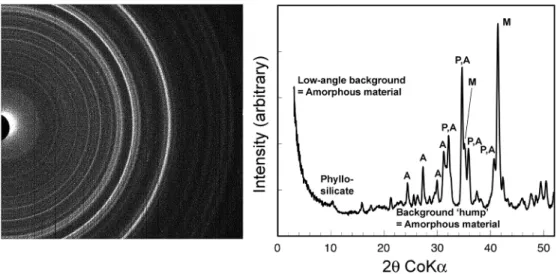
Diffraction patterns for the Windjana powder, as two-dimensional images from the CheMin CCD [Blake et al., 2012], were acquired for a total of 23 h over sols 623–632. There were no systematic differences among the individual images (i.e., in overall intensity or in relative strengths of diffraction peaks), so all were summed to yield a single two-dimensional diffraction pattern (Figure 4a). The second aliquot, delivered on sol 640 to a used and dumped Mylar cell (#12B), was analyzed for 22 h over sols 640–656. Results for Windjana material in this cell are qualitatively identical to those for the pristine cell but show evidence that some material remained in the cell from the previous analysis of Cumberland, a mudstone from an earlier location; these data are not considered further.
The two-dimensional CCD diffraction images were corrected on the spacecraft for DC offset and some hot pixels (pixels on the CCD which register high values in the absence of light or X-ray hits), summed and manually corrected for other hot pixels on the ground, and converted to a conventional one-dimensional X-ray diffraction pattern (Figure 4b) using the computer code“GSE_ADA©for NASA”, beta version 1.09 [Dera et al., 2013], see supporting information. The GSE_ADA code sums diffraction events circumferen-tially around the two-dimensional diffraction image, given the following parameters: the distance from sample to CCD, the location of the X-ray beam center, the shape of the beam, and the tilt of the CCD surface with respect to the X-ray beam. The values of these parameters were obtained by analysis of beryl in an onboard CheMin standard, using its cell dimensions determined with laboratory X-ray diffract-ometers on Earth
Procedures for processing and interpreting the Windjana X-ray diffraction pattern are as described earlier for CheMin [Bish et al., 2013;Blake et al., 2012, 2013;Vaniman et al., 2014]. The Windjana diffraction data were first evaluated by comparisons and searches of the International Centre for Diffraction Data®
Powder Diffraction File using the software packages Jade® (Materials Data Incorporated, Livermore, California) and Topas® (Bruker AXS). CheMin’s relatively low 2θresolution (~0.3° 2θfull width at half maximum at 25° 2θ) limits its capability to identify and determine abundances of minor crystalline phases (<3 wt %). The 1-D XRD patterns were analyzed with Rietveld methods, using Topas® and JADE®. In the Rietveld method, one constructs a model for the diffraction pattern from the crystal structures and compositions of its com-ponent phases, and the difference between the measured and model patterns is minimized by varying parameters in the model, including scale factors (related to phase abundance), unit cell parameters, crystallite size, and strain broadening. Atomic positions and site occupancies were not varied, except for proportions of octahedrally coordinated cations (Fe, Mg, Ca) in olivine and pyroxenes, and Na-Ca in plagioclase (Tables 1 and 2).
The CheMin team produced six independent Rietveld refinements using MDI Jade® and Bruker AXS Topas®, and the results here are the average or consensus of those refinements (Tables 1 and 2). Individual refinements can differ because of choices of input parameters (e.g., unit cell parameters and crystal structures for each given mineral), choices of constraints on the extent of variation permitted (e.g., limiting unit cell parameters to be within a given range), and choices of minerals to include in the model. In addition, several of the input minerals have similar diffraction patterns (e.g., pigeonite, enstatite, and augite), which can proxy for each other in refinement, particularly when they are present in small amounts. For example, the six independent refinements all yielded approximately the same proportions of total pyroxene, but they differed somewhat as to proportions of individual pyroxenes. Results of the individual refinements are given in the supporting information.
Proportions of amorphous and poorly crystalline phases in the Windjana sample (Table 2) were calculated from the diffraction pattern using computer code FULLPAT [Chipera and Bish, 2002]. FULLPAT creates models of the target diffraction pattern as sums of library patterns (including those on amorphous and poorly crystal-line minerals) and minimizes the difference between the model and target patterns. The calculated propor-tions of amorphous and poorly crystalline phases are uncertain, in great part because their chemical compositions (and thus X-ray scattering strengths) are not known. We estimate, for Windjana, that the pro-portions are uncertain to 1σof 20% of the amounts present.
2.2.2. Chemical Compositions
The chemical composition of the Windjana sample, on which much of this analysis relies, comes from the APXS instrument on the rover arm [Campbell et al., 2012;Thompson et al., 2014]. Additional detail is available inGellert et al. [2014a, 2014b]. The APXS acquired several chemical compositions of the Windjana rock and drill powders (Table 3); of those, we rely on the analysis of the Windjana dump sample, which was the sieved powder remaining in the CHIMRA delivery system after aliquots had been delivered to SAM and CheMin. This is the best available analog for what was delivered to CheMin and SAM.
Table 1. Refined Unit Cell Parameters of Well-Crystalline Minerals in the Windjana Sandstonea
Mineral a(Å) b(Å) c(Å) α(deg) β(deg) γ(deg)
Sanidine 8.596(12) 13.047(11) 7.183(5) - 115.97(7)
-Plagioclaseb 8.166(90) 12.87(10) 7.126(110) 93.5(20) 116.5(7) 90.0(9)
Olivine 4.790(7) 10.298(9) 6.031(7) - -
-Augite 9.761(6) 8.94(1) 5.28(1) - 106.3(2)
-Pigeonite 9.67(1) 8.905(13) 5.215(5) - 108.7(1)
-Enstatite 18.4(2) 8.9(1) 5.19(1) - -
-Magnetite 8.3856(11) - - - -
-Ilmenite 5.081(7) - 14.04(4) - -
-Hematite 5.02(2) - 13.87(14) - -
-Pyrrhotite 6.85(4) - 16.99(8) - -
-Akaganeite 10.61(3) 3.1(1) 10.5(3) - 90.4(16)
-Apatite 9.428(16) - 6.87(3) - -
-Anhydrite 6.98(3) 7.01(3) 6.20(2)
-Bassanite 11.9(2) 6.97(4) 12.70(8) - 86(7)
-aNumbers in parentheses are 1σuncertainties on the cell parameters, applied to their last digits. Italics indicate that
the mineral is near its detection limit, and so has uncertain unit cell parameters.
bFor plagioclase, cell parameters are the averages from the three most similar refinements, and the uncertainties are
It is possible that the sieved powder delivered to CheMin does not have the composition of the bulk rock because of grain separation and fractionation during drilling and sieving. A suggestion to this effect can be seen in Table 3 by comparing the drillfines (sol 662) with the sieve dump (sol 704); the latter is poorer in K2O, and richer in Na2O and SO3than the former. However, the drillfines are from a different range of depths within the rock than the sample ingested into CHIMRA, and that difference may account for the range in bulk compositions (Table 3). In either case, we assume that the sieved sample analyzed by CheMin is repre-sentative of the bulk Windjana rock.
Information on the volatile constituents in rocks of the Kimberley comes from the EGA (evolved gas) instrument in the SAM instrument suite [Mahaffy et al., 2012]. SAM EGA analysis can provide constraints on the identity, abundance, and isotope ratios of volatile constituents, like carbonate and nitrate, that decompose or devolatilize below ~ 900°C. Data on the Windjana sample are fromMcAdam et al. [2015] andStern et al. [2015b].
To understand the local context of the chemistry of the Windjana sample, we rely on data from the ChemCam LIBS instrument [Wiens et al., 2012], which can probe the chemistry of rocks up to a few meters from the rover. We use the June 2015 recalibration of the LIBS results (available from the NASA Planetary Data System); comprehensive views of chemostratigraphy in the Kimberley area are given in a companion paper (L. Le Deit et al., submitted manuscript, 2015).. We do not compare chemical analyses by APXS and LIBS directly because of known offsets between these two methods.
2.2.3. Other Data
Images of the Windjana sample area and the Kimberley area are from the Mars Hand Lens Imager (MAHLI) and MastCam imagers on the Curiosity Rover. Spectral reflectance constraints on the iron-bearing minerals of the Windjana sample come from “passive spectra” in visible light from the ChemCam instrument [Johnson et al., 2015a, 2015b;Wiens et al., 2012].
Table 2. Mass Proportions of Phases in the Windjana Sandstone and Other Gale Crater Samplesa
Windjana
Mineral Mass % Crystalline Mass % Total
John Klein Mass % Total
Cumberland Mass % Total
Rocknest Mass % Total
Sanidine 28(4) 21(3) 1.2 1.6 0.9
Oligoclase 1.0(16) 0.8(1.2) - -
-Andesine 2(2) 2(2) - -
-Plagioclase total 3(3) 3(3) 22.4 22.2 29.8
Olivine 6.0(14) 4.7(10) 2.8 0.9 16.4
Augite 26(3) 20(3) 3.8 4.1 10.7
Pigeonite 15(3) 11(2) 5.6 8.0 10.1
Enstatite det? det? 3.0 4.1
-Magnetite 16(3) 12(2) 3.8 4.4 1.5
Ilmenite 1.1(7) 0.8(5) - 0.5 0.7
Hematite 0.7(5) 0.6(4) 0.6 0.7 0.8
Pyrrhotite 0.4(4) 0.3(3) 1.0 1.0
-Akaganeite 0.3(3) 0.2(2) 1.1 1.7
-Anhydrite 0.6(4) 0.4(3) 2.6 0.8 1.1
Bassanite 0.7(5) 0.5(4) 1.0 0.7
-Jarosite det? det?
Fluorapatite 1.1(10) 0.8(8)
Quartz - - 0.4 0.1
-Halite - - 0.1 0.1
-Pyrite - - 0.3 -
-Kaolinite det? det? - -
-Smectite/Illite - 10(2) 22 18
-Amorphous - 15(3) 28 31 27
aWeight % in crystalline mass includes all well-crystalline materials and excludes phyllosilicates and amorphous
3. Results
3.1. Rock Classification
The Windjana sample is clearly of a clastic sedimentary rock, because its source rock contains discrete grains (Figure 3b) and is within a stratigraphic sequence of other clastic rocks. The MAHLI images of the Windjana outcrop with the greatest spatial resolution show rare grains up to ~400μm across, and most of the detect-able grains are ~80μm across (with a limit of detection of three pixels, i.e., 48μm). These images suggest that the dominant grain size is<125μm, which (in the standard classification of sedimentary rocks) would make the Windjana sample a veryfine sandstone or a siltstone or a mudstone. For simplicity, we refer to the Windjana rock as a sandstone.
3.2. Minerals and Compositions 3.2.1. Alkali Feldspar
The most distinctive mineralogical feature of the Windjana sandstone is its abundance of alkali feldspar, 28% by mass of the crystalline material (Table 2) and 21% by mass of the whole rock (including amorphous and poorly crystalline components). This abundance of alkali feldspar is reflected also in the significant abun-dance of K2O in the bulk composition (Table 3); both will be crucial facts for understanding the sources
and genesis of the Windjana sandstone.
Alkali feldspars have a range of compositions and crystal structures. Compositional variability is mostly from the substitution of Na+for K+, although other substitutions can be significant, including: B3+for Al3+, Fe3+for Al3+, NH4+and/or Rb+for K+, and Ba2++ Al3+for K++ Si4+[Cerny and Chapman, 1986]. Structural variability
comes from the ordering (or distribution) of the tetrahedral Al3+among the four (potentially) distinct tetra-hedral sites in the structure [Kroll and Ribbe, 1983]. Depending on whether the Al3+is completely ordered, partially ordered, or completely disordered, the KAlSi3O8mineral would be identified as microcline,
ortho-clase, or sanidine, respectively (Figure 5). Although the name“sanidine”can connote an igneous origin, its use here is in its strict mineralogical sense, as K-rich feldspar with extensive Al-Si disorder.
Fortunately, thebandccrystal unit cell parameters of alkali feldspars vary in a monotonic and distinctive fashion with Na/K ratio and Al-Si ordering [Blasi, 1977; Kroll and Ribbe, 1983, 1987; Wright and Stewart, 1968], and the CheMin determinations for the Windjana alkali feldspar (Table 1) are sufficient for its classifi ca-tion. Figure 5 shows thebandccell parameters of the Windjana alkali feldspar compared to those of other alkali feldspars, based on the extensive experiments and literature compilations ofKroll and Ribbe[1983]. The Windjana alkali feldspar plots are within uncertainty of being pure KAlSi3O8, although theb-cplot is not sensitive to Na
Table 3. APXS Chemical Analyses of the Windjana Sandstone, and Calculated Compositions of Its Crystalline and Amorphous + Poorly Crystalline Materials
Sol (wt %) 612 Pre-DRT 612 Post-DRT 622 DrillFinesa 704 DumpPile ±2σ Crystalline Component ±2σb Amorphous + Poorly Crystalline ±2σb
SiO2 39.84 40.47 39.30 37.38 0.86 43.5 7.8 14.2 19.5
TiO2 1.02 1.03 1.15 1.07 0.06 0.6 0.7 2.6 2.6
Al2O3 6.83 5.62 5.69 5.62 0.38 5.8 2.0 4.7 5.6
Cr2O3 0.41 0.42 0.44 0.49 0.02 0.0 0.0 2.0 1
Fe2O3 - - - 12.1 4.9 -
-FeO 23.38 24.51 26.50 27.90 0.66 14.2 3.8 33.8 21.6
MnO 0.65 0.67 0.56 0.53 0.02 0.28 0.08 1.3 0.5
MgO 9.18 10.87 12.67 12.29 0.50 9.1 2.3 21.6 9.6
CaO 5.50 5.01 4.91 5.26 0.12 6.5 2.1 0.9 7.3
Na2O 2.09 1.21 0.40 0.96 0.14 0.34 0.36 2.9 1.8
K2O 1.71 3.01 3.65 3.09 0.20 4.45 2.6 1.6 4.8
P2O5 0.90 0.81 0.73 0.64 0.10 0.6 0.8 0.8 3.0
SO3 6.42 3.95 2.58 3.57 0.10 1.0 1.0 11.8 6.2
Cl 1.33 1.65 0.80 0.57 0.02 0.0 0.0 2.4 1.2
Total 99.26 99.23 99.4 99.37 98.3 15.2 97.3 5.8
Ni ppm 410 383 383 516 30
Zn ppm 3584 3981 4347 4775 145
Br ppm 1819 1979 348 123 5
aDrillFines is Raster Point 3, which was the longest duration analysis with the lowest uncertainties. b
content of very K-rich feldspars [Kroll and Ribbe, 1983]. Given this insensitivity, we infer that the composition of the Windjana alkali feldspar is approximately Or95±2Ab5±2(1σuncertainty). Structurally,
the Windjana alkali feldspar is sanidine (i. e., high K spar) and within uncertainty of having its Al3+ fully disordered among the possible sites [Kroll and Ribbe, 1987]. Figure 5b compares this composition (Or95Ab5) to feldspars that have been
analyzed from the SNC meteorites [Papike et al., 2009] and from the polymict breccia NWA 7034/7475 [Santos et al., 2015;Wittmann et al., 2015].
With CheMin data, we cannot evaluate other chemical substitutions in the Windjana sanidine (e.g., B3+, Fe3+, NH4+, Ba2+); given the close match between its b and c parameters and those of nominal pure sanidine, none of them are likely to be significant. Feldspars with significant NH4+, the buddingtonite component, are known on Earth in some high-temperature metasomatic deposits and in some sedimentary phosphate deposits; the cell parameters for bud-dingtonite fall slightly outside the quad-rilateral of Figure 5 (b= 13.032 Å,c= 7. 187 Å) but near the sanidine and ortho-clase end-members. It seems doubtful that CheMin data alone could distin-guish buddingtonite from pure sanidine, but the high abundance of K in the bulk rock analysis (Table 3) and the lack of sig-nificant high-temperature evolution of N species during SAM EGA analysis of Windjana [Stern et al., 2015a, 2015b] suggest that its alkali feldspar contains little if any NH4+.
Other substituents have cell para-meters that fall far from the quadrilat-eral on Figure 5. The B3+ feldspar, reedmergnerite, occurs in authigenic deposits in B-rich saline environments [Martin, 1971]; its cell parameters areb= 12.373 Å andc= 6.808 Å. Sanidine rich in Fe3+is known from extrusive alkaline igneous rocks [Taroev et al., 2008]; the cell parameter for pure KFe3+Si3O8areb= 13.13 Å andc= 7.347 Å.
Theb-ccell parameters of the Windjana alkali feldspar could be replicated by mixtures of these nominally minor components (e.g., both B3+and Fe3+) [Cerny and Chapman, 1986], but the simplest explanation is that the Windjana alkali feldspar contains neither B3+nor Fe3+and is nearly pure KAlSi3O8. This is consistent with
ChemCam analyses at Windjana (and elsewhere in Gale Crater) that show concentrations of boron essentially at the detection limit (several hundred parts per million; R. C. Wiens, personal communication, 2015). There is
Figure 5.Alkali feldspar in Windjana. (a) Unit cellb-cplot for alkali feldspars afterWright and Stewart[1968] andCerny and Chapman[1986]. Circle shows the 1σuncertainty ellipse in theb-ccell parameters of the Windjana alkali feldspar (Table 1). Dot“bd”shows cell parameters for buddingtonite, (NH4)
AlSi3O8; arrows show vectors for substitutions, into high sandine, of B3+
(reedmergnerite component, NaBSi3O8) and Fe3+(NaFe3+Si3O8
compo-nent). (b) Compositions of the Windjana alkali feldspar and plagioclase compared to feldspars of the SNC Martian meteorites and the NWA 7034 Martian meteorite (and pairs); data from the literature, full reference list on request. Chemical components are as follows: Or, KAlSi3O8, Ab, NaAlSi3O8;
and An, CaAl2Si2O8. Windjana sanidine and andesine are plotted as 0% An
no published evidence for significant proportions of any of these substituents in alkali feldspars in the Martian meteorites [Papike et al., 2009;Santos et al., 2015;Wittmann et al., 2015].
3.2.2. Plagioclase Feldspar
The Windjana sandstone contains little plagioclase, only ~3% of the crystalline mass (Table 2) compared to ~40% of the Rocknest soil drift [Blake et al., 2013] and ~30% of the mudstones of Yellowknife Bay [Vaniman et al., 2014]. Because the abundance of plagioclase is low and most of its diffraction peaks overlap with those of more abundant phases, its cell parameters and inferred composition are relatively uncertain. Three independent Rietveld refinements yielded essentially the same cell parameters, and their average is in Table 2. Other refinements yielded a wide range of parameters, which is reflected in the cell parameters’ large uncertainties, which are given as 1 standard deviation on all of the refined cell parameters (Table 2). The unit cell parameters of natural plagioclases, at least those between albite (An0-10) and labradorite (~An60), are simple monotonic functions of chemical composition [Ribbe, 1975]. The most definitive of the cell parameters are the c cell length and the angle γ, which range from 7.160 Å and 87.7° for albite (NaAlSi3O8) to 7.105 Å and 90.1° for andesine/labradorite (Ca0.5Na0.5Al1.5Si2.5O8); an individual refinement’s
uncertainty oncandγare ~0.05 Å and 0.3°, which allows some rough specificity of plagioclase composition. The three similar refinements of cell parameters are consistent with a plagioclase composition of ~An40, with
a standard deviation of the mean of 5 An number (i.e., An35–An45). If one takes the more conservative
uncertainties on individual refinements or on the mean of all refinements, uncertainties in the composition are larger. This plagioclase composition is also plotted on Figure 5b—it falls within the range of compositions found in SNC meteorites [Papike et al., 2009] and in NWA 7034/7475 [Santos et al., 2015;Wittmann et al., 2015].
3.2.3. Mafic Silicates
Augite is the most abundant mafic silicate in Windjana, accounting for ~26% of its crystalline material (Table 2). The unit cell parameters of augite are strongly dependent on its chemistry, at least its ratios of“pyroxene quadrilateral” cations Mg, Fe, and Ca [Morrison et al., 2015]. Using those calibrations, the Windjana augite (Table 1) is consistent with a subcalcic augite of composition ~Wo37En42Fs21, (Figure 6a), with uncertainties of ~05 in each of
the components and Mg# = 0.68. With CheMin data alone, there is no way to determine abundances of
“nonquadrilateral“cations (e.g., Al, Ti, Na, Cr) in the Windjana augite.
Pigeonite is moderately abundant in Windjana, ~15% of the crystalline material (Table 2). Its composition is approximately Wo05En63Fs32, Mg# = 0.66 (Table 1 and Figure 6a) [Morrison et al., 2015], again with uncertainties
of ~05 in the En and Fs components. The CheMin data provide no constraints on minor element abundances in the pigeonite. Figure 6 shows that the Gale Crater pyroxene compositions are consistent, in terms of their Ca, Mg, and Fe values, with pyroxenes in the Martian meteorites.
The Windjana sample contains ~6% olivine (by mass) in its crystalline component (Table 2), much less than the 21% in the Rocknest soil drift [Blake et al., 2013] but significantly more than the 2–4% in the Yellowknife Bay mudstones [Vaniman et al., 2014]. From its unit cell volume (Table 1), the Windjana olivine is Fe-forsterite, ~Fo59±06with 1σuncertainties [Morrison et al., 2015]; this composition (Figure 6a) is more magnesian than those inferred for olivine in the Rocknest and Yellowknife Bay materials in Gale Crater [Bish et al., 2013;Vaniman et al., 2014], comparable to that inferred for a Gusev Crater basalt [Filiberto et al., 2008;Morris et al., 2004], and within the very broad range found in the Martian meteorites (Figure 6a) [see
Filiberto and Dasgupta, 2011;Papike et al., 2009;Shearer et al., 2008].
The chemical compositions of Windjana’s augite, pigeonite, and olivine are consistent with chemical equilibrium at high temperature (Figure 6b), at least with respect to Fe/Mg. This concordance is consistent with the minerals all coming from the same protolith, although a single protolith is not required. This igneous protolith is most likely to be basaltic.
Enstatite (orthopyroxene) is not definitively detected in the Windjana sample. Of the six independent Rietveld refinements, one derived ~3% enstatite in the crystalline mass, while the others refined its abundance to zero (Table 2). If enstatite is present, it is at or below the CheMin detection limit.
3.2.4. Iron Oxide Spinel
spinel’s diffraction peaks. Thus, CheMin data alone cannot retrieve the complex composition of a real spinel, e.g., which could contain significant Ti, Cr, Al, and Mg in addition to Fe [Gattacceca et al., 2014]; however, CheMin data can place significant limits on the range of possible spinel compositions. Beyond that, consideration of other data from the Curiosity rover restricts the spinel to being magnetite proper, with very little excess Fe3+ accommo-dated by site vacancies (maghemite component) and/or Ti (ulvöspinel component), and some small propor-tion of Al and/or Mg (hercynite and magnesioferrite components).
3.2.4.1. Constraints From Unit Cell Parameter
Theacell parameter for the Windjana spinel isa= 8.389 ± 0.006 Å (Table 1), the mean value and 1 standard devia-tion of the Rietveld refinements. The uncertainty on the precision of each
individual refinement is ~0.002 Å, which is consistent with the uncertainty on the mean value. As noted above, the accuracy of cell parameters may be worse than this because of uncertainty in the distance between analysis cell and X-ray detector. Thisavalue is smaller than that of pure stoichiometric magnetite, Fe3O4, which hasa= 8.3961 ± 0.0007 Å [Okeruda, 1997;Wechsler et al., 1984], and that difference can be
inter-preted in terms of the spinel’s chemical composition. Many substituents into Fe3O4can reduce its unit cell dimension to that observed in the Windjana sandstone. The most likely in reasonable geological settings include chromium, ferric iron, magnesium, and aluminum, which can be represented as solid solutions toward the spinel end-members: chromite (FeCr2O4), a= 8.3765 Å; maghemite (γ-Fe2O3), a= 8.34 Å;
magnesioferrite (MgFe2O4), a= 8.38–8.340 Å, depending on ordering state; and hercynite (FeAl2O4),
a= 8.152 Å [Antao et al., 2005; Golla-Schindler et al., 2005; Gorski and Scherer, 2010; Hamecher et al., 2013;O’Neill et al., 1992]. The Windjana spinel is likely a complex solid solution of these (and other) com-ponents or end-members, but CheMin data cannot distinguish among them. So we consider here only binary solid solution series.
First, it would be reasonable for the Windjana magnetite to be a solid solution toward chromite (or be a physical mixture of magnetite proper and chromite), because chromite and chrome spinel are common accessory phases in basalts. If the only substituent were chromium, theacell parameter (and uncertainty) would be consistent with composition ranges of Mt80Chr20to Mt62Chr38or ~Mt10Chr90[Kurepin, 2005;Levinstein et al., 1972]. There are two
possible ranges here because theacell parameter is a highly nonlinear function of composition along the magnetite-chromite join (the former being an inverse spinel and the latter a normal spinel).
It would also be reasonable for the magnetite in Windjana to have been produced diagenetically by oxidation of olivine (as proposed for the Yellowknife Bay mudstones [Bristow et al., 2015;Vaniman et al., 2014]). In that case, one might expect it to contain significant additional Fe3+as maghemite component (i.e., cation-deficient magnetite), but not Cr. In that case the Windjana magnetite would be consistent with a composition between Fe2+/Fe3+= 0.35
–0.45, i.e., Mt70Mh30to Mt90Mh10[Gorski and Scherer, 2010;Lilova et al., 2012;Schmidbauer and Keller, 2006]. Aluminum is a common minor substituent in magnetite-rich spinels and can be represented by the hercynite component, FeAl2O4. Between magnetite and hercynite, the unit cell parameteravaries nearly linearly with
composition [Golla-Schindler et al., 2005]. From that data, if the Windjana magnetite were solely a solid solution between magnetite and hercynite, its composition would be approximately Mt95Hc05.
Magnesium is also a common minor substituent in magnetite-rich spinels, as the magnesioferrite component, MgFe2O4. Theacell parameter for pure MgFe2O4can vary significantly depending on its ordering state, with
values near that of the Windjana spinel at the greatest order state (i.e., low-formation temperature,<600°C) [Antao et al., 2005;O’Neill et al., 1992]. So if the Windjana magnetite were solely a solid solution between magnetite and magnesioferrite, it would be very rich in magnesioferrite, in the vicinity of Mt25Mf75. In crustal
settings (on Earth), such magnesioferrite-rich spinels are uncommon and found only in highly oxidized, extreme-temperature settings (e.g., impact spherules, meteorite fusion crusts) and in rare carbonatites and igneous rocks [Shi et al., 2009].
Titanium substitution, as in titanomagnetite and the ülvospinel component, increases theacell parameter [Bosi et al., 2009;Wechsler et al., 1984] and is thus unlikely to be significant in the Windjana magnetite. However, Ti substitution charge balanced by vacancies (as in titanomaghemite) could yield a magnetite with a reasonableacell parameter; i.e., a fully oxidized titanomaghemite hasa= 8.358 Å [Allan et al., 1989].
3.2.4.2. Constraints From Diffraction Peak Heights
Although spinel (being cubic) has few diffraction peaks, the relative intensities of those peaks carry some information on the composition and cation distribution of the spinel. From the Windjana pattern, one can readily extract relative intensities of three spinel diffraction peaks: 400 (d≈2.099 Å); 113 (d≈2.53 Å); and 111 (d≈4.85 Å), see Figure 4b. Two other peaks are buried among diffraction from other phases: 222 (d≈2.43 Å) and 220 (d≈2.97 Å).
Figure 4b, which is calculated for a noncation-deficient magnetite. There is no significant difference between the observed andfitted patterns over the 111 peak position, implying that the 111/113 intensity ratio in the Windjana spinel is like that of pure magnetite. Thus, the peak ratio would be inconsistent with large proportions of chromite, maghemite, titanomaghemite, and hercynite in the Windjana spinel.
3.2.4.3. Other Constraints and Summary
With CheMin data only, it is not possible to define the composition of the Windjana magnetite, but some compositional ranges are quite unlikely. As described above, CheMin data imply that the Windjana spinel is close to pure magnetite and likely contains little substitutions of Ti or Fe3+, the ulvöspinel and maghemite components. The paucity of maghemite component is supported by passive reflectance spectra from the ChemCam instrument on MSL, which are more consistent with a“pure”magnetite [Johnson et al., 2015b]. From CheMin data, the Windjana spinel could contain a moderate to large proportion of the chromite component (Mt80Chr20to Mt10Chr90), but the bulk rock chemical composition excludes even a moderate
con-stituent of the spinel. A spinel with a composition of Mt80Chr20contains ~13.2 wt % Cr2O3. Given that spinel
comprises ~12.4% of the Windjana sandstone, such a spinel composition would contribute ~1.6 wt % Cr2O3 to the bulk rock composition—more than three times the Cr2O3 content of the Windjana Dump Pile
(Table 1). Thus, while we cannot rule out the presence of some chromite as a solid solution component in the spinel, if it is present, its abundance must be quite small, especially since some fraction of the bulk rock Cr2O3will be present in the pyroxenes (augites in NWA 7034/7475 and in the SNCs can contain up to ~1 wt % Cr2O3; [Papike et al., 2009;Santos et al., 2015;Wittmann et al., 2015].
Discounting significant Mg substitution (as magnesioferrite component) as geologically unreasonable, we are left to infer that the Windjana spinel is most likely to be magnetite with a small proportion of Al substitution (~5% molar of hercynite component). This inference is not unique, as we lack data to define or detect small proportions of other substitutions or of complex solid solutions that might mimic this simple result (e.g., a spinel rich in both Ti and Al)—note that most spinels in basaltic igneous rocks contain multiple end-member components [Barnes and Roeder, 2001] and that spinels formed under diagenetic conditions (e.g., ~25°C) can contain significant Al [Schwertmann and Murad, 1990]).
3.2.5. Other Minerals
Ilmenite (FeTiO3) is present in the Windjana sandstone but only at ~1.1% weight, near the CheMin detection limit (Table 2). Hematite is also present in the Windjana sandstone and also near the CheMin detection limit at ~0.7% mass (Table 2).
Pyrrhotite is the only sulfide mineral detected in the Windjana sandstone; it was detected in three of the six refinements and is near the detection limit of ~0.4% by mass of the crystalline material (Table 2). It is not possible to determine which polytype is present—characteristic minor diffractions (as for superstructures) are not visible above the background, and the unit cell parameters of the pyrrhotite are not characteristic of a specific polytype. Akaganeite [β-FeO(OH,Cl)] is present in the Windjana sandstone at the detection limit of ~0.3% by mass (Table 2). Its unit cell parameters are distinctive for the mineral but not particularly informative about its composition, notably its proportion of Cl. The unit cell parameters (Table 1) are perhaps more consistent with Cl-rich akaganeite rather than OH rich [Takagi et al., 2010]. However, little more can be said in the absence of more precise cell parameters for the Windjana akaganeite and additional laboratory data.
Fluorapatite [Ca5(PO4)3F] is almost certainly present in the Windjana sandstone, although its detection by
CheMin is not entirely definitive. Four of the six Rietveld refinements detectedfluorapatite (2.5, 1.0, 0.5, and 1.1% mass), and the abundance of P2O5in the APXS chemical analysis of the sandstone (Table 3) is
consistent with ~1% apatite. Fluorine has been detected in the Windjana sandstone by ChemCam LIBS [Forni et al., 2015], lending further credence to the presence offluorapatite.
Anhydrite (CaSO4) is present in the Windjana sandstone, although essentially at detection limit (Table 2); its refined
cell parameters are distinctive for the phase but not otherwise informative. Bassanite (CaSO4•0.5H2O) is not defi
3.2.6. Not Detected
Many minerals that are characteristic of specific geochemical processes are definitely not present in the Windjana sandstone at the CheMin detection limits. In particular, no products of hydrothermal alteration have been detected, such as might have been produced in an impact-induced hydrothermal system [Schwenzer et al., 2012;Schwenzer and Kring, 2013]. Nor has CheMin detected (at the percent mass level) soluble salts such as sulfates, halides, and perchlorates [Chipera and Vaniman, 2007;Farrand et al., 2014;
Forni et al., 2015;Johnson et al., 2015b]. CheMin’s nondetection of carbonate minerals is consistent with the results of SAM evolved gas analysis. Some of the CO2detected during SAM EGA likely derives from
oxidation of organic material (e.g., from the SAM background) by O2released from oxychlorine phases in
the sample, based on its near-coincidence with a peak in release of O2[McAdam et al., 2015]. Part of the CO2detected could also derive from thermal decomposition of Fe carbonates [Sutter et al., 2015], but the
abundance of carbonate implied by this CO2would be below CheMin detection limits.
3.3. Poorly Crystalline Components
Approximately 25% of the Windjana sandstone is poorly crystalline or amorphous, which appears in X-ray diffraction as broad“peaks”or humps. From the shapes and locations of those features, three of the contributions can be assigned to phyllosilicates and two contributions to amorphous materials.
3.3.1. Phyllosilicates
The Windjana diffraction pattern shows two features consistent with 001 diffractions from 2:1 phyllosilicate minerals: a moderately sharp peak at 10.1° 2θ and low broad peak or band from ~7° 2θ to ~12° 2θ (Figure 4b). The sharper peak gives adspacing of ~10.2 Å, which is consistent with the 001 diffractions of illite, collapsed nontronite, or a collapsed ferromagnesian smectite. However, the 001 diffraction of the inferred collapsed smectite of the John Klein drill sample (Yellowknife Bay) is much broader than that in the Windjana sample [Bristow et al., 2015;Vaniman et al., 2014], and the Griffith Park ferromagnesian smectite used as an analog to the clays at Yellowknife Bay collapses only to 001 of 11.8 Å [Treiman et al., 2014]. The broad low peak or band is very similar to the smectite diffraction“hump”in the John Klein drill sample from Yellowknife Bay [Bristow et al., 2015;Vaniman et al., 2014], which is interpreted to represent a collapsed (dehydrated) ferromagnesian smectite, possibly with chloritic interstratifications. For the Windjana sample, we lack diffraction data on treated samples that would normally be used to distinguish among illite, nontronite, and smectite. By analogy with other Gale Crater samples, we infer that the phyllosilicates are dominantly collapsed smectites [Vaniman et al., 2014]. The presence of illite or illitic interstratifications cannot be disproven, but (as shown later) the chemical composition of the amorphous and clay material includes very little Al or K, and thus little illite component. The mass abundance of the phyllosilicates (sharp peak and broad band) was determined by FULLPAT analysis (Table 2) [Chipera and Bish, 2002].
The Windjana X-ray diffraction pattern shows a low broad peak at ~14° 2θ(Figure 4b), which suggests a small proportion of ~7 Å 1:1 phyllosilicate mineral. This peak refined to adspacing of ~7.15 Å, which is consistent with kaolinite and less so with the serpentine minerals (which have 001dspacings at ~7.25 Å). This phase is present at the CheMin detection limit—the peak area refines to ~1% by mass of the total sample during Rietveld analysis with the well-crystalline phases (Table 2). No other peaks assignable to kaolinite are above background and distinct from interferences from other minerals’ diffractions. Kaolinite is a reasonable identification for this diffraction peak, as it is a common product of low-temperature hydrous alteration of alkali feldspar.
3.3.2. Amorphous
4. Interpretation and Discussion
4.1. Poorly Crystalline and Amorphous Material
Amorphous and poorly crystalline components comprise significant fractions of the materials analyzed by CheMin in Gale Crater [Bish et al., 2013;Blake et al., 2013;Vaniman et al., 2014], and the Windjana sandstone is no exception (Table 2). One can calculate the chemical composition of the amorphous and poorly crystalline material from the bulk composition of the rock and the proportions and compositions of the crystalline phases (Tables 1 and 2, see text above). However, the CheMin data do not provide sufficient constraints to uniquely determine the natures and compositions of these poorly crystalline constituents. Here we propose a model of the amorphous and poorly crystalline components that is generally consistent with Windjana’s elemental composition, CheMin data, and geochemical setting; this model is not unique. The elemental composition of the Windjana sandstone was analyzed by the APXS instrument [Gellert et al., 2014a, 2014b]; analytical targets included: the unbrushed rock surface, the surface brushed clear of dust by the DRT (Dust Removal Tool), tailings from the main drill hole, and sieved drill powder dumped from CHIMRA (Table 3). The dumped material is the remainder of the sieved sample, after aliquots were portioned and delivered to the CheMin and SAM instruments. The unbrushed surface of the Windjana sandstone is clearly distinct from the brushed and internal samples (Table 3), being richer in elements characteristic of Mars’windblown dust like S and Cl [Ming et al., 2008;Yen et al., 2005]. The brushed surface still contains more S and Cl than the drilled (interior) samples, suggesting that some dust remains on the surface. The drilled samples (the tailings and the CHIMRA dump) are not identical, which likely represents real variability of the Windjana sandstone composition. The tailings samples include more material from near the rock’s surface than its interior, suggesting that the surface of Windjana is enriched in K and Cl, and depleted in Ca, Fe, and S compared to its interior (Table 3). In any case, we assume that the CHIMRA dump sample represents the material analyzed by CheMin.
4.1.1. Chemical Composition of“Amorphous”Material
To calculate the composition of the poorly crystalline and amorphous material in the Windjana sandstone, we subtract the material of the CheMin-determined crystalline fraction (mineral proportions and compositions) from the APXS composition of the dump sample. Uncertainties on all analyses are carried through the calculation, which is done using a Monte Carlo method; see the supporting information for details and a spreadsheet of the calculation. The calculated composition of the Windjana amorphous and poorly crystalline material (amorphous + phyllosilicates) is given in Table 3. That composition is notable for its high abundances of Fe and Mg, correspondingly low abundance of SiO2, and high abundances of SO3and Cl.
It is significant that the calculated composition of the amorphous and poorly crystalline material shows, within uncertainties, no negative oxide abundances and near-zero abundances of K2O, P2O5, and CaO.
These observations imply that the CheMin results for mineral proportions and compositions are consistent with the APXS chemical analyses. Further, it appears that all the K2O in Windjana is contained in its sanidine, that all the P2O5is in apatite, and that CheMin has missed no Ca-bearing phases. The nominal K2O abundance
in the amorphous and poorly crystalline material is negative, although within uncertainty of zero; the nominal abundance of K2O would be zero if Windjana contained ~19% of Or95alkali feldspar, which is within uncertainty of the nominal CheMin abundance of 21 ± 3% 1σ (Table 2). All of the P2O5 in the Windjana
APXS analysis would be explained by 1.7%fluorapatite, compared to the nominal CheMin abundance of 1.1 ± 1.0% 1σ(Table 2). We take these concordances as evidence that the CheMin and APXS analyses are consistent with each other and are of the same material (Table 3) and that the CheMin refinements represent accurately the mineral proportions of the Windjana sample.
4.1.2. A Model
Collectively, the amorphous and poorly crystalline materials in Windjana produce four distinct contributions to the CheMin XRD pattern: a broad and a sharp diffraction peak both centered at ~10° 2θ, strong intensity at low 2θ, and a broad hump between 15 and 45° 2θ(Figure 4b). One would like to constrain the chemical compositions of these components, but the calculation is severely underdetermined. Here we propose a model for the natures and compositions of these components, informed by geological constraints from the rock itself and what is known from other rocks at Gale Crater.
the“amorphous + poorly crystalline”compositions, abundances of several elements must be overestimates because of our limited constraints on the true compositions of the crystalline phases. The calculated TiO2
and Cr2O3contents of the amorphous + poorly crystalline components are certainly overestimates, because (1) TiO2and Cr2O3in Martian pyroxenes can be as high as ~2 and 1 wt %, respectively [Papike et al., 2009;
Santos et al., 2015;Wittmann et al., 2015], and our calculation assumed 0 wt % for both; and (2) we assumed (as discussed above) that the spinel phase is essentially pure magnetite, although it could reasonably contain small proportions of Ti and Cr. Similarly, the calculated Al2O3and Na2O contents of the amorphous + poorly
crystalline components are certainly overestimates, because Al2O3 and Na2O can be as high as 6–7 and
~0.6 wt %, respectively, in Martian pyroxenes, and our calculation assumes 0 wt % for both.
Then, we assign elements in the amorphous + poorly crystalline material to likely chemical components. First, approximately a third of this material should be clay minerals (Table 2). Those clay minerals can include little illite because all the K2O in the Windjana whole rock is accounted for by its alkali feldspar; so we assume that the clay is all smectite/saponite as with the Yellowknife Bay rocks [Bristow et al., 2015;Vaniman et al., 2014]. We can assign Na to Cl (chloride, chlorate, or perchlorate) and MgO and the little remaining CaO to SO3, assuming charge
balance and that these components are present as poorly crystalline sulfate materials. The remaining amor-phous + poorly crystalline material has molar (Mg + Fe + Mn)/(Si + Al) far in excess of that for smectite, so we assign all the Si and Al (what little there is) and a proportional amount of the Mg and Mn to the clay mineral. This subtraction leaves a significant proportion of Fe and Mg unassigned to silicate or ionic components. We can suggest two possible hosts for the excess Mg: the amorphous material contains a component of Mg(OH)2,
brucite; or the smectite is partially chloritized. These explanations are chemically equivalent, as chlorite minerals consist of smectite-like layers alternating with brucite layers [Bailey, 1988]. Brucite is potentially reasonable, as it can be formed during aqueous alteration of olivine [O’Hanley, 1996]; partially chloritized smectite has been invoked to explain the XRD properties of clays in the Yellowknife Bay area of Gale Crater [Bristow et al., 2015]. Allophane and/or hisingerite have been proposed as phases in the Windjana sandstone (and other materials of Gale Crater) to account for the sharp rise in diffracted intensities at 2θ<10° [Bish et al., 2013;Rampe et al., 2012]. However, the calculated bulk composition of the amorphous material in Windjana is not consistent with these inferences. Allophane is “a poorly-crystalline, hydrous aluminosilicate … with short-range crystallographic order and molar Si/Al ratios ranging from ~0.5 to 1”[Bish et al., 2013;Rampe et al., 2012], but it cannot be abundant in the Windjana sandstone because the amorphous and poorly crystalline components contain little Al (Table 3) [Morris et al., 2013]. Hisingerite is a ferric iron analog to allophane, again with molar Si/Fe ratios of ~0.5 to 1; it has a nominal composition between Fe3+2 SiO5·2H2O and Fe3+2 Si2O5(OH) 4·2H2O [Dehouck et al., 2014;McAdam et al., 2014]. The amorphous and poorly crystalline materials contain
abundant iron but not enough silica left over after allocation to smectite to allow a significant proportion of hisingerite.
Iron accounts for the bulk of remaining unassigned elements in Windjana’s amorphous material, and it must be assigned to iron oxides and/or hydroxides [seeMorris et al., 2013]. Some of the sulfur could have been assigned to a jarosite mineral or component in the amorphous material (jarosite was detected in one of the Rietveld refinements). Presence of a sulfate component in the amorphous material is confirmed by SAM evolved gas analysis, which yielded more SO2than can be attributed to the pyrrhotite and possible
jarosite detected by CheMin (the Ca sulfates detected by CheMin are not expected to decompose in the SAM temperature range) [McAdam et al., 2015]. The bulk of the so-far unassigned iron could be present as nanophase (poorly diffracting) hematite and/or magnetite, ferrihydrite (approximately Fe3+2 O3·0.5H2O), or
the ferric-ferrous iron substances like“green rust.”The latter are double-layer hydroxide phases, like Fe3+2 (Fe2+, Mg)6(OH)18·4H2O, some of which contain anions besides OH , e.g., fougerite, Fe2+4 Fe3+2 (OH)12CO3·3H2O, and
Fe2+4 Fe3+2 (OH)12SO4·3H2O. Of these, some ferrihydrite samples show strong diffraction intensity at low 2θvalues [e.g.,Parfitt et al. 1992;Schwertmann et al. 1999] and also are consistent with the amorphous hump peaking around 30° 2θ(Figure 4b). The inference of hydrous poorly ordered iron-rich components is consistent with SAM evolved gas results for Windjana; the observed broad water release from ~100 to 450°C is consistent with laboratory SAM-like EGA analyses of such phases [McAdam et al., 2015]. Thus, we infer the presence of ferrihydrite or similar iron-rich phase from the CheMin XRD and APXS bulk composition of Windjana.
magnesia can be assigned to a magnesian smectite; the remaining magnesia is paired with the sulfur as a MgSO4·nH2O component in the amorphous material. Most of the Fe must be present as poorly diffracting
oxide and/or hydroxides, like ferrihydrite. There can be little allophane or hisingerite present, and there is no evidence for Mn-rich phases [Le Deit et al., 2015]. Similarly, there is no evidence that the amorphous component of Windjana contains a significant proportion of igneous or impact glasses. The chemical composition of the amorphous material in Windjana is distinctly different from the estimates ofDehouck et al. [2014] for the amorphous components in the Rocknest, Cumberland, and John Klein samples.Dehouck et al. [2014] found that those amorphous materials were far richer in SiO2and poorer in MgO and FeO than for Windjana (Table 3); it is
not clear how these various amorphous components could be related.
4.2. Diagenesis and Cement
The Windjana sandstone experienced some diagenetic alteration, which is expressed in its mineralogy and was obviously cemented in that it is a solid rock (and not loose sand grains). Away from the Windjana site itself, the Dillinger member shows clear evidence of diagenesis by the presence of Mn-rich fracturefillings or surfaces [Lanza et al., 2014] and diagenetic concretions [Grotzinger et al., 2015b]. However, diagenesis (beyond this cementation) of the Windjana sample was limited because it still contains significant proportions of easily altered minerals, notably olivine, plagioclase feldspar, and pyrrhotite.
4.2.1. Iron Oxide Cement
Most of the sedimentary rocks examined by Curiosity are rich in iron; many contain ~20% FeO (by APXS), and the extreme (before the Windjana analysis) was the Et_Then rock with 26.3% FeO equivalent (all Fe calculated as FeO) [Schmidt et al., 2014b]. The Windjana sample is even richer in iron with 27.6% FeO equivalent (Table 3)
—the iron is present both as magnetite (Fe3O4) and as poorly diffracting oxides/hydroxides in the amorphous
material (see above).
These high FeO abundances are far greater than those expected from sediments and sedimentary rocks of basaltic parentage [Blake et al., 2013;Vaniman et al., 2014] and so have been ascribed to iron-rich cements [Anderson et al., 2015b;Blaney et al., 2014;Grotzinger et al., 2014;Schmidt et al., 2014a;Wiens and Maurice, 2015]. The Windjana sample, being Fe-rich like the other sedimentary rocks of Gale Crater, provides an opportunity to test the hypothesis of iron-rich cements. In the Windjana sample, potential iron-rich cement materials are its magnetite (12% by mass, Table 3) and its amorphous material (~15%), which as discussed above is likely to be Fe-O-(H) material like ferrihydrite or“green rust.”Lesser proportions of the iron are in augite, pigeonite, and olivine; and still smaller proportions in ilmenite, hematite, akaganeite, and pyrrhotite.
It seems reasonable that the Windjana rock is cemented by its magnetite and Fe-rich amorphous material. First, the mass proportions of these phases together, ~27%, represents a volume proportion of ~30–35%, which is reasonable for the porosity of silt or sand sediment [Freeze and Cherry, 1979]. Second, the magnetite is most likely to be nearly pure Fe3O4, possibly with some Al substitution (see above), which is inconsistent
with an igneous origin (i.e., no evidence of Cr or Ti substitutions) but is consistent with formation at Mars ambient temperatures [Schwertmann and Murad, 1990]. Third, diagenetic, amorphous Fe-O-(H) material is known as a cement in basaltic and in pedogenic systems on Earth. And, fourth, decomposition products of Fe-O-(H) material, including a magnetite-like spinel phase, are present in the matrix of the NWA 7034 Martian meteorite [Muttik et al., 2014]. Thus, we infer that the Windjana sample was cemented by its magnetite and Fe-O-(H) amorphous material; it seems reasonable to extrapolate this inference to the other Fe-rich rocks in Gale Crater, and this can be tested with combined CheMin and chemical analyses.
4.2.2. Phyllosilicate
The Windjana sample contains a significant proportion of phyllosilicates, interpreted as smectites and possibly a small proportion of kaolinite (Table 2); there is no evidence for a significant proportion of illite. CheMin data by itself cannot show whether the Windjana phyllosilicates are diagenetic or detrital, but a diagenetic origin seems reasonable in light of a similar inference about smectite in the Yellowknife Bay mudstones [Bristow et al., 2015;
Although we cannot definitively say that Windjana contains smectite, it would be a reasonable product of aqueous alteration of olivine as hypothesized for the Yellowknife Bay rocks [Bristow et al., 2015;Vaniman et al., 2014] and demonstrated for the Griffith Park saponite [Treiman et al., 2014]. If all the smectite in Windjana formed this way, the original sediment would have contained ~15% olivine rather than the observed 6% (Table 2).
The small proportion of kaolinite in Windjana could reasonably be a diagenetic alteration product of its plagioclase or its alkali feldspar [Garrels and Christ, 1990]. If so the proportions of feldspar in the original sediment would have been slightly greater than presently observed (Table 2). The presence of kaolinite also suggests that a portion of clay mineral material could be illite, as it is an intermediate alteration product between plagioclase and kaolinite [Garrels and Christ, 1990]. CheMin data cannot distinguish illite from smectite, but the calculated bulk composition of the amorphous and poorly crystalline materials has nearly no Al and thus permits little illite.
4.2.3. Other Materials
Akaganéite is present near detection limit in the Windjana sample (Table 2). Akaganéite typically forms on Earth in mildly acidic environments, at low temperatures, from solutions rich in Cl and Fe [e.g.,Bibi et al. 2011;Cai et al. 2001; Holm et al. 1983]. Akaganéite is a common alteration product of sulfide minerals, including pyrrhotite [Harries et al., 2013;McLennan et al., 2014]. The pyrrhotite observed in Windjana could be the precursor for its akaganeite, but the fact that pyrrhotite is still present suggests again that diagenesis was relatively minor. Akaganéite has been detected on the Martian surface from orbit [Bishop et al., 2015;
Carter et al., 2015], but the small proportion in Windjana would not be detectable with current technology. The Windjana sample contains small proportions (near detection limits) of the calcium sulfates anhydrite and bassanite. These phases are likely related to the common veins of Ca sulfate in the Windjana area, like those observed all along Curiosity’s path from landing to Kimberley and beyond [e.g.,Kronyak et al., 2015;Nachon et al., 2014]. Light-toned veins occur in the Liga, Square Top, and Dillinger members of the Kimberley formation [Grotzinger et al., 2015b] and are observed in the vicinity of Windjana, although no veins are seen within the drill hole.
4.2.4. Diagenetic Feldspar
Diagenetic effects on terrestrial sediments can include replacement/precipitation of significant proportions of alkali feldspars and plagioclase [Fedo et al., 1995;Montanari, 1991;Walker et al., 1978], which are typically ascribed to actions of alkali-rich solutions on preexisting feldspars and clay minerals. Such a diagenetic origin for the feldspars in the Windjana sample seems unlikely for several reasons. The high proportion of feldspars seems inconsistent with a diagenetic origin, although it is possible for low-temperature metasomatism action to produce rocks so rich in alkali feldspar (see below, e.g.,Glazner[1988]). The presence of olivine, pyrrhotite, and amorphous materials in the Windjana sample argues against extensive diagenesis and thus formation of so much feldspar by diagenesis.
Below, we consider the possibility that the alkali feldspar in Windjana originated through diagenetic or metasomatic processes not within the Windjana sandstone but in the source area for the sediment.
4.3. Provenance of the Windjana Mineral Grains
Among the challenges presented by the Windjana sample is to understand the sources of mineral grains, most importantly its alkali feldspar, and thus its abundant potassium. Felsic rocks on Mars appear to be rare based on orbital spectroscopy, and the few identifications of feldspars made by the Compact Reconnaissance Imaging Spectrometer for Mars are most consistent with anorthositic compositions [Carter and Poulet, 2013;
Wray et al., 2013]; to date, no alkali feldspars have been confirmed from orbit. However, alkali-rich igneous rocks have been analyzed in several places in Gale Crater [Sautter et al., 2014, 2015;Schmidt et al., 2014b;
[Nekvasil et al., 2004;Sautter et al., 2015]. Because the Windjana sample is the only potassic alkali-rich rock on Mars to be analyzed for mineralogy (the mugearite rock Jake Matijevic [Sautter et al., 2014;Stolper et al., 2013] was not analyzed by CheMin), it may provide crucial clues to the origins of these rocks in general and to the igneous geology of the Gale Crater region. Here we explore what can be inferred from the Windjana sample alone and later place it into local and regional geological contexts.
Extrapolation from sedimentary rocks to the bedrock that sourced the sediment can be ambiguous, because chemical weathering and physical sorting may have intervened and can cause profound mineralogical and chemical differences between source rock and derived sediment particles. For the Windjana sample, we can infer that there was little effect from chemical weathering or alteration but have little control on determining the effects of physical sorting processes. The Windjana sample likely experienced only limited chemical weathering or alteration because most of its sediment particles are smaller than 100 μm (Figure 3b inset; detection limit with the MAHLI camera) and include easily altered minerals like olivine, sanidine, pyrrhotite, and plagioclase.
It is difficult to know if the Windjana sample is a product of significant mechanical sorting, either hydrologic or eolian. We have little evidence about the source terrains for the sediments, except that they are likely from the northern and northwest rim of Gale Crater. Because the Bradbury Group sediments were transported initially byflowing water, we can assume that some hydraulic sorting occurred by grain size and density [Siebach et al., 2015]. Sediment grains of similar densities and physical properties would not be typically separated hydraulically, i.e., that plagioclase grains would not be sorted from those of sanidine nor augite from pigeonite. However, it is possible that olivine grains could be sorted from pyroxenes, and pyroxenes from feldspars. It is more likely that magnetite would be sorted from all other minerals because of its higher density, but hydraulic sorting would not explain variations in abundance ratios of minerals with similar densities. The Windjana sandstone is interpreted as an eolian reworking and redeposition of thesefluvial sediments, which represents an additional physical fractionation process. Even with these complicating factors, mineral abundance ratios and chemical compositions enable several constraints to be placed on the sources of sedimentary particles in the Windjana sandstone.
First, the minerals present in (and absent from) the Windjana sample imply that its sources cannot include most types of metamorphic or hydrothermally altered terrains, either regional or local [McSween et al., 2015;
Schwenzer and Kring, 2013]. Windjana consists only of typical igneous minerals and their low-temperature alteration products (see above); it does not contain detectable proportions of minerals that are characteristic of metamorphism or hydrothermal alteration. Nor does it contain minerals that are characteristic of most che-mical sediments (e.g., carbonates or silica) except iron formations (e.g., iron oxyhydroxides).




![Figure 5b compares this composition (Or 95 Ab 5 ) to feldspars that have been analyzed from the SNC meteorites [Papike et al., 2009] and from the polymict breccia NWA 7034/7475 [Santos et al., 2015; Wittmann et al., 2015].](https://thumb-us.123doks.com/thumbv2/123dok_us/8294634.2196586/10.918.265.622.138.765/figure-compares-composition-feldspars-analyzed-meteorites-polymict-wittmann.webp)


