From Destructive to Constructive Thinking: Techniques of Self-Therapy for Adults with ADD
Sharon R. Eisner
A thesis submitted to the faculty of the University of North Carolina at Chapel Hill partial fulfillment of the requirements for the degree of
Master of Arts in the Department of Communication Studies.
Chapel Hill 2007
Approved By: Dr. Julia T. Wood Dr. Lawrence Rosenfeld
ii ABSTRACT
Sharon R. Eisner
From Destructive to Constructive Thinking: Techniques of Self-Therapy for Adults with ADD
(under the direction of Dr. Julia T. Wood)
According to Dr. Albert Ellis’ Rational Emotive Behavioral Therapy (REBT), our thought patterns and self-talk directly influence our behavior and functioning. It is the contention of this thesis that adults with Attention Deficit Disorder may benefit from using some of the techniques of REBT in order to change habitually unproductive
iii
TABLE OF CONTENTS
CHAPTER ONE: Diagnosed with ADD ...1
CHAPTER TWO: Trying A New Approach ...4
CHAPTER THREE: Our Beliefs: Are They Rational Or Irrational? ...7
CHAPTER FOUR: How Do I Do REBT?...10
Step 1: Summarize a specific situation that disturbs you. ...10
Step 2: Write a list of irrational beliefs about the statement...11
Step 3: List the consequences of your irrational beliefs. ...12
Step 4: Dispute your irrational beliefs. ...12
Step 5: Replace the irrational beliefs with rational beliefs. ...13
Step 6: Write out the effects of your rational beliefs. ...14
CHAPTER FIVE: Simplify the Process ...15
iv
LIST OF FIGURES
CHAPTER ONE: Diagnosed with ADD
Until one is committed, there is hesitancy, the chance to draw back, always ineffectiveness—the moment one commits oneself, the providence moves, too. All sorts of things occur to help one that would otherwise never have happened. A whole stream of events issues from the decision, raising in one’s favor all manner of unforeseen incidents and meetings a material assistance, which no man could have dreamed would come his way.
− Goethe
If you are an adult with Attention Deficit Disorder who has not yet figured out how to manage it, you are probably emotionally black and blue from beating yourself up every day for all the things you didn’t do that you “should” have done. I know the feeling well. I was diagnosed with ADD six years ago, and remember feeling initially euphoric. “Now that I know what is wrong with me,” I thought, “I can fix it!” If only it were that easy.
The euphoria was followed by depression and low self-esteem: I fell into the trap of believing myself to be different from “normal” people. I believed that I was suffering from a “disorder” that would stop me from succeeding. It took several years for me to realize that although the challenges represented by ADD may seem more fundamentally disabling than the challenges faced by “average” individuals, they are by no means insurmountable. I have learned from my own experience as well as from my research that not only is it counterproductive to fall into the trap of using ADD as an excuse for
2
Over the course of the past six years, I’ve tried pretty much everything that was recommended to me: medication, therapy, coaching, books and audio-tapes, even courses both on-line and off. My experiences were mostly positive, but I still felt like I was constantly chasing my own tail. The prescribed medication, which has changed the lives of so many children, proved to be wonderful for me in terms of short-term productivity. It did not, however, help me address the larger or more underlying issues which faced me on a daily basis. I felt like it was a tool for moving through crises and getting things done in a crunch, but did not help me to prevent the next crisis. The coaching and classes taught me useful techniques, and helped me to feel on top of my ADD at moments. I was left wondering, however, if I could maintain these techniques without a cheering section; I wanted and needed to know that I could function on my own. And therapy certainly never hurts, except for becoming a significant financial burden which I did not want to picture myself carrying forever.
Even with these tools in my repertoire, there were still many times when I felt overwhelmed and less capable than those around me. It’s true that I was often able to pull myself together to meet a deadline or fulfill a task, but the effort felt Herculean,
especially as I saw others around me completing similar tasks seemingly (and I realize this was not always true!) without blinking. I started thinking about what I could do for myself that would allow me to take advantage of the techniques advocated by therapists and coaches on my own terms, and in the privacy of my own home. I focused my reading and research and tried to come up with a plan that would address the deepest issues of my ADD at their core level. This is the plan I would like to suggest to you.
3
CHAPTER TWO: Trying A New Approach
The approach I am recommending is Albert Ellis’s Rational Emotive Behavioral Therapy (REBT). I firmly believe that anyone with ADD can benefit from using this technique for just ten minutes each day. Let us begin to assess whether this method will help you by asking three questions:
1. Do you frequently experience unhealthy or self-defeating emotions such as unwarranted depression, self-deprecation, or sustained anxiety?
2. Do you experience so much inner conflict around even small tasks that it makes you feel paralyzed or unable to bring anything to completion? 3. Do you frequently feel as though you are sabotaging your own
success, which makes you feel frustrated or angry with yourself?
5
How can this technique tackle the huge issues covered in our three questions, namely unhealthy emotions, self-esteem and self-sabotage? REBT is a method of psychotherapy developed by Dr. Albert Ellis, an eminent psychologist and one of the founders of modern Cognitive Behavior Therapy. It has been used over the course of the last fifty years to address core psychological issues such as anger, neurosis, sexual deviancy, procrastination and depression, and has become part of the fabric of standard psychotherapy in working through the problems of childhood and adulthood. The purpose of REBT is to help us become aware of and change our underlying irrational and
destructive beliefs about ourselves to rational and constructive ones. Dr. Ellis explains the premise behind REBT in his A Guide to Rational Living (1997):
Whatever your emotional upsets are, REBT shows you how to find the thoughts that underlie them—and thereby succeed in deciphering the “unconscious” messages you transmit to yourself. Once you begin to see, understand, and begin to Dispute the Irrational Beliefs that go with your unhealthy feelings, you make yourself aware of your “unconscious” thoughts and greatly enhance your power to change them and reduce your disturbances.1
Let us define self-therapy as a daily ritual in which we check in with ourselves at a deep psychological level, articulate a situation which causes us to feel low self-esteem, and go through the steps of examining existing Irrational Beliefs and changing them to Rational ones. I have found that spending ten minutes each day tackling the debilitating, self-sabotaging series of beliefs around one issue and re-framing them as more honest, realistic, productive statements that we can then act upon can provide a daily, noticeable increase in our self-esteem and ability to function. The burden of ADD with which we are so familiar might become less paralyzing and more manageable, and the overwhelming
1
Ellis, A. and Harper, R. A. (1997). A guide to rational living. Chatsworth, CA: Wilshire Book
6
CHAPTER THREE: Our Beliefs: Are They Rational Or Irrational?
In his book, How to Control Your Anger Before It Controls You (1998), Ellis
describes a situation in which a client’s friend promised to move in with him, and then changed his mind just before the move-in date. Natural, unthinking reactions might include blame and anger based on the following Irrational Beliefs: “My friend is an awful person who does not care about me”; “This is the type of horrible situation that always happens to me”; “I cannot deal with this situation.” Dr. Ellis teaches his readers how to deconstruct these irrational, self-defeating thoughts and turn them into more honest, realistic and productive statements, such as “I am disappointed that my friend did not follow through on his promise this time” (allowing for the fact that the friend is still a friend, and is only human), or “I am frustrated that I relied on someone who did not come through for me, and now I need to take care of it myself” (addressing the feeling of frustration rather than helplessness, and the reality that one can take care of oneself).
What makes some of our beliefs irrational and unproductive? Ellis claims that beliefs that are based on expressed or hidden absolutes or “musts” are the ones that lead to unhealthy conclusions. He describes four categories of irrational beliefs:2
1. Awfulizing: “It is awful that I’m doing so badly (when I absolutely
should do better)!
2 Ellis, A. (1997).
How to control your anger before it controls you. New York: Kensington Publishing
8
2. Can’t-stand-it-itis: “When conditions are really bad for me (as they
absolutely must not be), I can’t tolerate them!”
3. Damnation: “When I act very stupidly and incompetently (as I
absolutely should not), I am a worthless, thoroughly inadequate
person!”
4. Overgeneralization: “If I fail a few times at an important goal (which I
absolutely must not), I’ll always fail, never succeed, and will prove
that I am no good!”
It is clear that our tendency to fall into the trap of using absolute, inflexible language to articulate our thoughts can be self-defeating, and can result in anger, anxiety and depression. Ellis says that if we re-state our thoughts more realistically, our
reconfigured thoughts will lead to reconfigured emotions, behavior, and possibilities. REBT is based on the very reasonable idea that thoughts lead to emotions which then lead to actions. If we can change the original thoughts or beliefs, we can, therefore, change the resulting emotions and behavior.
What are some common irrational thoughts and beliefs that an adult with ADD might have, and might suffer with on a daily basis? Sari Solden in Women with Attention
Deficit Disorder: Embrace Your Differences and Transform Your Life (2005) speaks of
many, including:
1. I am a failure because I cannot accomplish a certain goal. 2. I am incapable of organizing my life.
9
4. I am incompetent, irresponsible, and/or immature; I do not learn from past mistakes and I cannot be depended upon.
5. I am ashamed that my life is such a mess, and feel that my situation is hopeless because I have failed so many times in the past.
Do these statements seem extreme? They may look harsh and extreme written down, but according to the existing research many adults with ADD experience these and other debilitating thoughts frequently in personal, social, academic and professional settings. I know that I do, but over time I have learned to catch myself, and use such sweeping statements far less than I used to. People with ADD tend to compare
CHAPTER FOUR: How Do I Do REBT?
There are six separate steps to using REBT, allowing us to move through the process of changing each individual negative thought and emotion to a more positive, constructive one. It is important to write the exercises down, so that we actually see the words; thinking through the process does not accomplish the same goal, nor does it allow us to witness our progress in the same way.
1. Summarize a specific situation that disturbs you in one statement. 2. Write a list of Irrational Beliefs about the statement.
3. List the Consequences of your Irrational Beliefs. 4. Dispute your Irrational Beliefs.
5. Replace each Irrational Belief with a corresponding Rational Belief. 6. Write out the effects of the Rational Beliefs.
Let us move through the process together, explaining the steps as we go. Use a pen and paper to write down your own example and follow it through each of the steps.
Step 1: Summarize a specific situation that disturbs you.
11
statement of how I feel, but it does not DESCRIBE the situation. In searching for a sample statement, it is a good idea to start by writing down how you feel, and then strive to articulate a clear visual image of the specific issue at hand which makes you feel that way. Ask yourself: What would a camera see? It would certainly see a messy room or a disorganized home. Therefore a focused, specific statement to work with might be: My home is disorganized.
It is important to note that this statement may reflect an internal or external, real or imagined situation, and may be an event in the past, present or future. So, for example, valid statements might include: My friend criticized me unfairly, I am not doing a good job at work, or I felt ashamed as a child that my mother dressed me in old clothes. The “camera” can see more than just what is physically present.
Step 2: Write a list of Irrational Beliefs about the statement.
To identify our underlying irrational beliefs, we need to write out our strong, uncensored feelings in four extreme categories:
• DOGMATIC DEMANDS (musts, absolutes, shoulds).
Example: I should have an organized house; I must organize my home immediately.
• AWFULIZING (It’s awful, terrible, horrible).
Example: It is terrible that my home is so messy.
• LOW FRUSTRATION TOLERANCE (I can’t stand it).
12
• SELF OR OTHER RATING (I’m/he/she is bad, worthless).
Example: I am a horrible wife/mother/person because I can’t keep things clean and organized.
When listing and identifying irrational beliefs, it is important to refrain from censoring ourselves. Of course, you and I may recognize on some level that the last statement, for example, is not true, but for the purpose of the exercise it is critical to allow ourselves to express deep, murky, never-said-aloud feelings, in order to see the words on paper and examine the emotions involved.
Step 3: List the Consequences of your Irrational Beliefs.
Re-read your list of irrational beliefs, and write two categories of consequences: 1. Major unhealthy negative emotions, and
2. Major self-defeating behaviors. Examples:
1. I feel unworthy because my home does not look like I want it to look; 2. I don’t invite people over because I am embarrassed.
Unhealthy negative emotions might include anxiety, depression, rage, shame, hurt, jealousy or guilt. It is worth trying to identify as many unhealthy negative emotions and behaviors around each statement as possible, to have a full picture of the impact on our psyches and our lives.
Step 4: Dispute your Irrational Beliefs.
Subject each of the Irrational Beliefs that you have written down to one
13
Is it helpful or self-defeating? Where is the evidence to support this belief? Is it consistent with reality? Is this belief logical? Is this really as bad as it could be? Am I truly unable to stand it? After writing at least one question for each belief, write an answer to each question.
Example: “It is terrible that my home is so messy.” In the scheme of things, is it truly “terrible” to have a messy home? Given the choice of other terrible things that occur in life, is it really that bad? Can I truly not stand it? Answer: It’s not THAT awful to have a messy or disorganized home. I wish it were neater, but in the scheme of things, it is not the worst thing I can imagine. I can stand it, I just don’t like it.
Step 5: Replace the Irrational Beliefs with Rational Beliefs.
In order to approach this sensitive subject in a more reasonable, rational manner, strive for at least one belief for each of the following categories:
• NON-DOGMATIC PREFERENCES (wishes, wants, desires):
Example: I wish my house was more organized. • EVALUATING BADNESS (it’s bad, unfortunate):
Example: It is unfortunate that I don’t like to put things away.
• HIGH FRUSTRATION TOLERANCE (I don’t like it, but I can stand it).
Example: I don’t like always having to look for things, but I can stand it. • NOT GLOBALLY RATING SELF OR OTHERS
(I—and others—are fallible human beings).
14
Step 6: Write out the effects of your Rational Beliefs.
Use two categories to list effects of your new Rational Beliefs: 1. New healthy negative emotions, and
2. New constructive behaviors. Examples:
1. I am frustrated that I am not good at organizing my home. 2. I can ask for help about how to organize.
CHAPTER FIVE: Simplify the Process
I realize that I have given you a lot of information, and it may seem
overwhelming. In fact, I have found that once the process is begun, the steps flow easily, and within a few days you will probably not need to refer to the explanations as much. It is also true when one first begins using this method, it generally takes more than ten minutes to get through all six steps for a single statement. I suggest setting the oven timer for ten minutes, getting as far as you can in that time, and continuing the following day. When the process becomes a comfortable routine, much more will fit into your ten minute slot. The reason I do not suggest finishing the process no matter how long it takes is that this could lead to burn-out and reluctance to set aside the time.
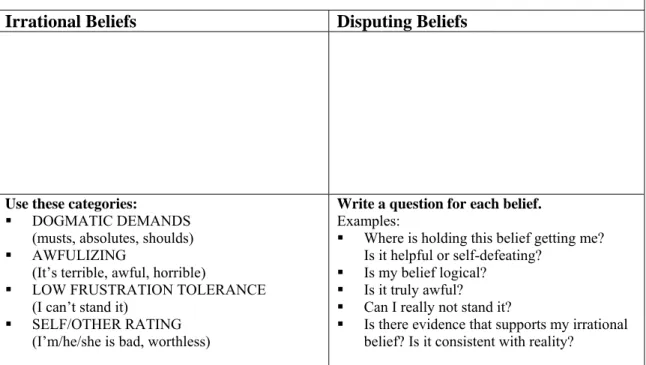
In order to help you simplify the process, I have provided a one-page worksheet based on the one designed by Ellis in How to Control Your Anger Before It Controls You
(Figure 1). You have the option of photocopying it or simply using it as a reference when you write out each category. Use a folder to save each page as you complete it, and from time to time look back and remind yourself which issues have already begun to articulate themselves and which have not. I encourage you to express your deepest, most
16
inadequacy and emotional misery and begin to function to the true reaches of your potential.
As an example of the way that this process can change a life, I would like to share with you that when I began this process of self-growth I broke down the self-defeating statement “I am a failure” into fourteen different focused statements. After two years of work, I can look back on each one…and each one is objectively no longer true. The changes and growth within my internal world have not only significantly lessened my anxiety and depression, but have allowed me to achieve things I once thought impossible.
17
Statement: Summarize the situation you are concerned about. Reminder: What would a camera see?
Irrational Beliefs Disputing Beliefs
Use these categories:
DOGMATIC DEMANDS
(musts, absolutes, shoulds)
AWFULIZING
(It’s terrible, awful, horrible)
LOW FRUSTRATION TOLERANCE
(I can’t stand it)
SELF/OTHER RATING
(I’m/he/she is bad, worthless)
Write a question for each belief.
Examples:
Where is holding this belief getting me? Is it helpful or self-defeating?
Is my belief logical?
Is it truly awful?
Can I really not stand it?
Is there evidence that supports my irrational belief? Is it consistent with reality?
Consequences:
Major unhealthy emotions: Major self-defeating behaviors:
Unhealthy negative emotions include: Anxiety, depression, rage, shame/embarrassment, hurt,
jealousy, guilt, low frustration tolerance
Rational Beliefs: New Effects:
Strive for:
NON-DOGMATIC PREFERENCES
(wishes, wants, desires)
EVALUATING BADNESS
(it’s bad, unfortunate)
HIGH FRUSTRATION TOLERANCE
(I don’t like it, but I can stand it)
NOT GLOBALLY RATING SELF OR
OTHERS
(I—and others—are fallible human beings)
Healthy negative emotions include:
Disappointment Concern Annoyance Sadness Regret Frustration
18
WORKS CITED / RECOMMENDED READING
Ellis, A. (1988). How to stubbornly refuse to make yourself miserable about anything: Yes anything! New York: Kensington Publishing Corp.
Ellis, A. (2004). The road to tolerance: The philosophy of rational emotive behavior therapy. New York: Prometheus Books.
Ellis, A. (1997). How to control your anger before it controls you. New York:
Kensington Publishing Corp.
Ellis, A. and Harper, R. A. (1997). A guide to rational living. Chatsworth, CA: Wilshire
Book Company.
Hallowell, E. M. and Ratey, J. J. (2005). Delivered from distraction: Getting the most out of life with attention deficit disorder. New York: Ballantine Books.
Hallowell, E. M. and Ratey, J. J. (1994). Driven to distraction. New York: Pantheon
Books.
Hartmann, T. (1998). Healing ADD: Simple exercises that will change your daily life.
Grass Valley, CA: Underwood Books.
Howard, P. J. (2006). The owner’s manual for the brain: Every day applications from mind-brain research (3rd ed.). Austin, TX: Bard Press.
Kelly, K. & Ramundo, P. (1997). The added dimension: Celebrating the opportunities, rewards and challenges of the ADD experience. New York: Simon and Schuster.
Kelly, K. & Ramundo, P. (1993). You mean I’m not lazy, stupid or crazy?! A self-help book for adults with attention deficit disorder. New York: Scribner.
Simon, S. (1988). Getting unstuck: Breaking through your barriers to change. New
York: Warner Books.