Received
February 10, 2016; accepted
April 22, 2016
Correspondence to Saira Z. Sheikh, MD Assistant Professor of Medicine, Rheumatol-ogy, Allergy & Immunol-ogy, University of North Carolina at Chapel Hill, Thurston Arthritis Research Center, 3300 Thurston Building, CB 7280, Chapel Hill, NC 27599-7280, USA [email protected]. edu
Key words
belimumab – autoinjec-tor – usability – reliability – pharmacokinetics
GSK, Potomak, MD, GSK, Philadelphia, PA, and PAREXEL International, Research Triangle Park, NC, USA
Abstract. Objective: To study self-ad-ministration and pharmacokinetics (PK) of subcutaneous (SC) belimumab in patients with systemic lupus erythematosus (SLE). Methods: Patients previously treated with be-limumab self-administered bebe-limumab 200 mg SC weekly for 8 weeks using an autoinjector. The primary endpoint was the proportion of
patients able to self-administer their first and
second dose (weeks 1 and 2) in the clinic. The proportion able to self-administer at weeks 4 and 8 (clinic) and weeks 3, 5, 6, and 7 (home) were secondary endpoints. Belimumab PK, safety, and injection-site pain were assessed. Results: 91/95 patients completed the study (withdrawals: adverse events (AEs): 3; lost to follow-up: 1). 93% were female, and mean (SD) age was 44.8 (12.50) years. The majority (99%, 89/90; no attempt, n = 5) successfully self-administered belimumab SC at weeks 1 and 2 (5 had clinic staff assistance), and 98% (85/87) successfully self-administered at weeks 4 and 8. Home-administration success rates were high (93%, (81/87) at weeks 3, 5, 6, and 7). Week 8 median trough concentration
was 113 µg/mL. For patients with a ≤ 1.5-week
interval between IV SC administration, week-1 concentrations were higher vs. week 8 (+ 51% median) but within a range observed with IV
dosing; those with a ≥ 2.5-week interval had
median differences close to 0. AEs and serious AEs were low, with no deaths; pain levels were low and decreased with subsequent injections. Conclusion: Patients with SLE successfully self-administered belimumab SC using a novel
autoinjector; the PK profile was stable follow -ing a switch from IV with acceptable AE and pain levels. The recommended dosing interval between IV to SC dosing is 1 – 4 weeks.
Introduction
Systemic lupus erythematosus (SLE) is
a chronic, autoimmune, inflammatory dis
-ease that causes considerable burden to pa-tients and society [1]. Belimumab is a human, monoclonal antibody that binds to and inhib-its the biological activity of B-lymphocyte
stimulator (BLyS) [2]. The efficacy and safety
of intravenous (IV) belimumab were demon-strated in two large, randomized, multicenter, placebo-controlled trials, BLISS 52, and BLISS 76 [3, 4]. Subsequently, belimumab 10 mg/kg IV was approved for use in adults with active, autoantibody-positive SLE, as an add-on to standard SLE therapy [5]. The dosing regimen for belimumab IV requires administration in an infusion center every 4 weeks. Devices for subcutaneous (SC) deliv-ery of belimumab, which are safe and easy
to self-administer, would be a significant ad -vance for patients with active disease.
Several SC treatments are available to treat rheumatoid arthritis (RA) [6, 7, 8, 9]. SC treat-ment enabled patients with RA to continue their everyday routine and reduced the need to travel to an infusion center, a factor that resulted in more patients choosing a SC treatment [10]. There is a high level of patient acceptance with autoinjector devices in RA, including patients with severe hand disability [11]. Musculoskel-etal and mucocutaneous manifestations, such as fatigue, joint pain, and swelling, are com-mon in patients with active SLE, particularly
reliability, and safety following self-adminis-tration [15]. Four weekly doses of belimumab 200 mg SC were well tolerated in healthy vol-unteers, and it was predicted that weekly ad-ministration would achieve exposures compa-rable to the approved IV dosing regimen [16]. As patients currently treated with belimumab IV may choose to switch to the SC formulation following regulatory approval, the
pharmaco-kinetic (PK) profile across the IV-to-SC switch
should be examined to determine the optimum dosing interval.
The aims of this study were to assess the suitability of a novel autoinjector for self-ad-ministration of belimumab by patients with active SLE under real-life conditions, change in PK trough concentrations when switching from IV to SC administration, and safety and tolerability of belimumab administered via the autoinjector.
Methods
Study design and treatment
This was an open-label, single-arm, multi-dose study in patients with SLE (GSK protocol 200339; NCT02124798). The study was conducted in accordance with the Dec-laration of Helsinki 2008 [17] and approved by an Institutional Review Board. All pa-tients provided written, informed consent prior to study enrollment. Adult patients (> 18 years) with active, autoantibody-pos-itive SLE (American College of Rheuma-tology criteria [18]) receiving belimumab treatment were included. Patients were eli-gible to switch from belimumab IV or
beli-mumab SC (prefilled syringe) to belibeli-mumab
SC (autoinjector) and could continue their other SLE treatments (Figure 1). Patients who switched from belimumab IV to belim-umab SC (autoinjector) must have received belimumab IV every 4 weeks for at least three 4-week cycles or have completed the open-label phase of a phase-3 belimumab
SC study (prefilled syringe) (GSK protocol
BEL112341; NCT01484496) and initiated
treatment with belimumab IV. Day 0 (first
dose belimumab SC) was targeted to be 1 – 4 weeks (~ 2 weeks) after the last dose of beli-mumab IV. Patients who completed the prior belimumab SC study, but who did not then initiate treatment with belimumab IV, could also participate. For this switch from
belim-umab SC (prefilled syringe) to belimbelim-umab SC (autoinjector), the first dose administered
Figure 1. Study design. AE = adverse events; clinic = self-administration of belimumab SC at the clinic; home = self-administration of belimumab SC at home; IV = intravenous; PK = blood sample taken for pharmacokinetic analysis prior to belimumab administration; SC = subcutaneous.
using the autoinjector was scheduled up to 16 weeks (target 1 week) after the last dose
of belimumab SC by prefilled syringe.
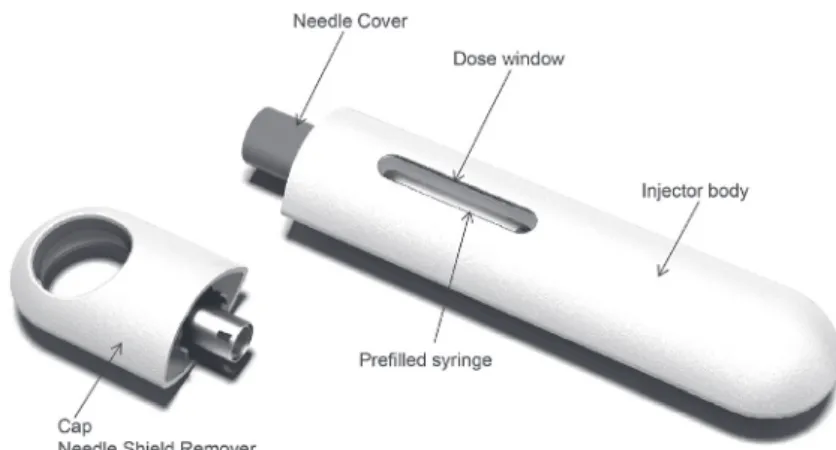
Patients self-administered belimumab 200 mg SC (1 mL) using the autoinjector device (Figure 2) for 8 weekly doses, alter-nating between thigh and abdomen injection sites. Patients received training on the use of the autoinjector at screening and prior to their
first injection (week 1). Training consisted of
reviewing the instructions for use and per-forming a supervised practice injection using a foam pad. Injections at weeks 1, 2, 4, and 8 were performed in the clinic, and injections at weeks 3, 5, 6, and 7 were performed outside the clinic (home). Patients were supervised
during the first injection and could receive
support from site staff at all visits. Patients
attended an exit visit 4 weeks after the final
injection. At study completion, patients could resume or initiate treatment with belimumab IV (10 mg/kg every 4 weeks) 2 – 3 weeks after the last belimumab SC dose; IV loading doses were not required. The recommended time intervals between last IV dose and the
first SC dose, and between last SC dose and
restarting IV administration, were chosen such that the new SC or resumed IV regimens started close to their predicted steady-state trough concentrations [16].
Endpoints and assessments
The primary endpoint was the proportion of patients successfully able to
self-admin-tive to attempted self-administered injections was assessed. Patients used diaries to record injection details (e.g., time, date, injection site), assess the completeness of the injec-tion, and document their experience with the autoinjector. Clinic injections were assessed by site staff. An injection was considered successful if the correct injection site (ab-domen or thigh) was used, if the device was correctly actuated while placed on the injec-tion site, and if the device was held in place until the full dose was delivered. Patients were permitted a second attempt; if the sec-ond attempt was successful, this was deemed an overall successful injection. Percent com-pliance was calculated as 100 X ([number of injections prescribed – number of injections missed]/ number of injections prescribed).
Blood samples for PK analyses were tak-en at weeks 1, 2, 4, and 8 prior to SC dosing and belimumab trough concentrations (Cmin)
were assessed. According to the prespecified
analysis plan, the difference between week-8 and week-0 concentrations was analyzed rel-ative to the case report form (CRF)-recorded
time interval between the last IV and the first
SC dose and according to body mass index (BMI) categories (underweight: < 18.5, nor-mal: 18.5 to < 25, overweight: 25 to < 30 and
obese: ≥ 30 kg/m2). Several patients received
their first SC dose more than the targeted 4
weeks after their last IV dose; these patients were not excluded from the analysis. After database lock and generation of Figure 6 and the associated statistical summary, 3 of the 95 patients in the PK population were deter-mined to have shorter time intervals between
the last IV and first SC dose than recorded in
the CRF (1 vs. 6 weeks, 7.3 vs. 7.6 weeks, 3
vs. 7 weeks, confirmed by site vs. recorded in
the database, respectively).
Safety was assessed using adverse events (AEs) and serious adverse events (SAEs),
re-corded from the first injection through
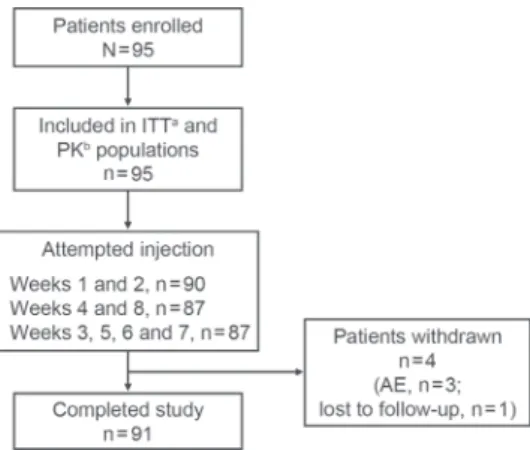
week-Figure 3. Patient disposition. aReceived ≥1 dose
belimumab; bpatients included in the ITT
popula-tion for whom ≥1 post belimumab treatment PK
12 exit visit, and changes in laboratory val-ues. Pain was assessed using a visual analog scale (VAS; 0 – 100 mm) immediately after an injection and 1 and 24 hours post injec-tion, a rating of 0 represented no pain, and 100 worst possible pain.
Statistical analysis
No formal sample size calculation was conducted. The intent-to-treat (ITT) popula-tion included all patients who received at least 1 SC dose. For the primary and secondary endpoints, only patients who attempted self-administration of the injection at all relevant time points were included. Patients who had at least 1 post-belimumab serum sample ana-lyzed were included in the PK population. Continuous variables were summarized with the mean, median, standard deviation (SD), 25th and 75th percentiles, minimum and
maxi-mum. Categorical variables were summarized with frequency counts and percentages.
Results
Patient population
95 patients enrolled, and 91 completed the study; 3 withdrew due to AEs, and 1 was lost to follow-up (Figure 3). The ma-jority was female (n = 88), white (n = 69), and mean (SD) age was 44.8 (12.50) years (range: 24 – 74 years). Mean (SD) weight was 85.9 (24.70) kg, and mean (SD) BMI was 31.4 (8.68) kg/m2. The majority of
pa-tients switched directly from belimumab IV
(n = 93), and 2 patients switched directly
from belimumab SC by prefilled syringe.
Following the study, 90 patients resumed treatment with belimumab IV.
Median exposure was 56 days (range: 14 – 60 days), and 91 patients (96%) at-tempted 7 or 8 injections. Mean (SD) com-pliance was 98% (5.15).
Successful self-administration
At weeks 1 and 2, 99% (89/90) of patients who attempted an injection successfully ad-ministered belimumab using the autoinjector (Figure 4). At week 2, 5/95 patients (ITT) did not attempt an injection and so were ex-cluded from primary endpoint analysis. At week 1, clinical staff assisted with the injec-tion for 5 patients, and these were included as successful injections. At weeks 4 and 8, 98% (85/87) of patients who attempted an injection successfully self-administered belimumab. Patients reported success in similar propor-tions at home and in the clinic; at home, 93% (81/87) of patients who attempted an injection successfully self-administered belimumab (weeks 3, 5, 6, and 7). Overall, 5 patients
failed a first attempt but completed a second
successful injection (1 each at weeks 1, 3, and 5, and 2 at week 7).
Pharmacokinetics
Median serum belimumab trough con-centration at week 8 was 113 µg/mL (range: Figure 4. Percentage of successful injections at
each week. Data missing for 5 patients at weeks 1 and 2, and for 8 patients at weeks 3 – 8. Data la-bels represent number of patients.
Figure 5. Median belimumab serum concentra-tion by week (PK populaconcentra-tion). Minimum and maxi-mum values: week 1 (0, 504.29 µg/mL), week 2 (17.47, 467.86 µg/mL), week 4 (34.41, 278.27 µg/ mL), week 8 (30.19, 296.47 µg/mL). Dashed line:
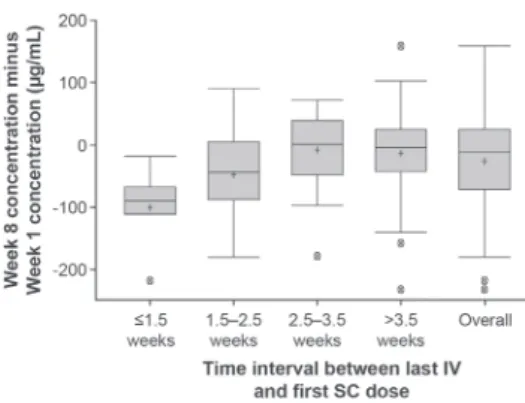
30 – 296 µg/mL) (Figure 5). Following the switch from IV to SC, steady-state trough belimumab levels were attained on average by week 2 (Figure 5). When switching from IV to SC administration, median percentage changes in belimumab concentration be-tween week 8 and week 1 were –51%, –23%, 1%, and –3% for patients with intervals of
≤ 1.5 weeks, 1.5 – 2.5 weeks, 2.5 – 3.5 weeks,
and > 3.5 weeks, respectively (Figure 6).
The difference between week 8 and week 1 belimumab concentrations was greater for patients with a normal BMI (BMI 18.5 to < 25; + 14% median) compared with patients
ful injections, 12 were associated with use errors only, 2 were associated with device errors only, and 2 were initially recorded as both a use error and device error, but after follow-up with the clinical site, they were at-tributed to use errors only (Table 1). Four of the use errors were attributed to one patient and none of the other patients repeated a use error. There were 2 reported device malfunc-tions, 1 of which was substantiated as an ac-tual device error.
Patient diaries
Across 8 weeks, 4 patients required as-sistance or further training to complete their injection successfully; this was in addition to the 5 patients who required assistance at week 1, as noted above. The percentage of patients who used the provided instructions generally decreased over time from 94% (89/95 patients) at week 1 to 71% (65/91 patients) at week 8. Use of injection site lo-cations (left thigh, right thigh, left abdomen, right abdomen) was balanced. The majority of patients agreed that the autoinjector was Figure 6. Effect of the IV-to-SC interval on week-8
to week-1 concentration difference (PK populationa). aExcludes two patients who received belimumab SC
via prefilled syringe at study entry. Boxes represent
the median, 25th and 75th percentiles. Ends of
whis-kers represent the maximum observation below the upper fence (75th percentile + 1.5 × interquartile
range) and the minimum observation above the lower fence (25th percentile – 1.5 × interquartile
range). Crosses (+) represent the mean. Circles with a cross (X) represent outliers. IV = intravenous; PK = pharmacokinetic; SC = subcutaneous.
Table 1. Summary of administration errors.
Wk 1
(n = 96)a (n = 90)Wk 2 a (n = 94)Wk 3 a (n = 88)Wk 4 a (n = 91)Wk 5 a (n = 93)Wk 6 a (n = 92)Wk 7 a (n = 92)Wk 8 a
Use errors, n (%)
Any use error 1 (1) 1 (1) 2 (2) 1 (1) 1 (1) 3 (3) 4 (4) 1 (1)
Autoinjector not properly activated on injection site 1 (1)b 0 0 0 0 0 0 0
Autoinjector pulled away before end of injection 0 1 (1) 1 (1)b 0 1 (1) 1 (1) 1 (1)b 1 (1)
Medication observed at the injection site 0 0 1 (1) 1 (1) 0 2 (2) 3 (3) 0
Device error, n (%)
Any device error 0 0 0 0 1 (1) 1 (1) 2 (2) 0
Delivery stopped before end of injection 0 0 0 0 1 (1)b 0 0 0
Autoinjector did not activate 0 0 0 0 0 0 1 (1)b 0
Autoinjector leaked 0 0 0 0 0 1 (1)c 1 (1)c 0
aNumber of injection attempts. In 5 cases, a patient had 2 attempts to administer their dose; bthe first attempt at injection was unsuccess
-ful, the second attempt was successful; c1 patient reported unsuccessful injections at week 6 and 7, which were initially attributed to both
comfortable to hold (≥ 98%) and that injec
-tion time was acceptable (≥ 97%).
Safety
Overall, 39 (41%) patients reported at least 1 treatment-emergent AE, and 15 (16%)
were considered drug-related (Table 2). Four (4%) patients reported 7 SAEs; 4 occurred in 1 patient (anemia, neutropenia, pneumonia, pyrexia), and there was 1 case each of post-operative abscess (drug withdrawn), pulmo-nary embolism, and deep vein thrombosis. Three (3%) patients reported 5 AEs leading to discontinuation (nausea, vomiting, and pyrexia in 1 patient, and 1 case each of her-pes zoster and postoperative abscess). Two nonopportunistic infections (herpes zoster) were reported, and 4 postinjection nonseri-ous systemic reactions via broad customized medical dictionary for regulatory activi-ties query (CMQ; cough, pruritus, rash, and swelling). Two severe AEs were reported (1 case each of postoperative abscess and deep vein thrombosis). No deaths occurred.
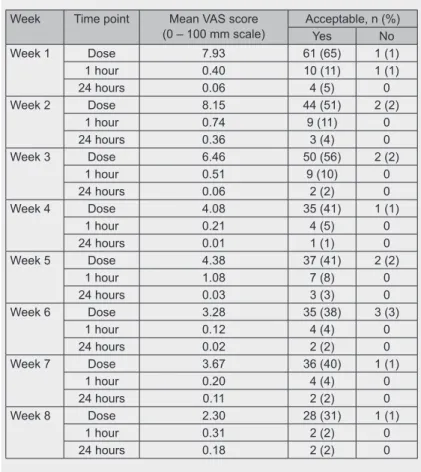
Injection site reaction AEs were reported by 4 (4%) patients; none were serious or re-sulted in study discontinuation. Mean injec-tion site pain (according to the 0 – 100 mm VAS) at dosing was highest with the second injection (8.15 mm) and reduced with re-peated administrations (2.30 mm at week 8). Pain levels reduced 1 hour after dosing and ranged from 0.12 to 1.08 (Table 3). Most pa-tients rated their injection pain as acceptable. Sharp stinging pain was reported most fre-quently, followed by burning pain (data not shown).
Discussion
This was the first study conducted in
patients with SLE to assess use of a novel autoinjector for self-administration of belim-umab SC. PK of the switch from belimbelim-umab IV to belimumab SC were examined.
The majority of patients was able to suc-cessfully self-administer belimumab using the autoinjector, both at home and in the clin-ic. A small number of patients had assistance
during their first injection in the clinic or
required a second attempt. This is not unex-pected in patients who may be
self-adminis-tering an injection for the first time, as initial
anxiety with self-injection has been reported previously in patients with RA [19]. In clini-cal practice, patients would likely receive support from their healthcare practitioner for
first administrations, and therefore the study
represents real-world clinical practice. Table 2. Summary of adverse events.
AEs, n Patients, n (%) N = 95
Any AEa 105 39 (41)
Infections and infestations 27 18 (19)
Musculoskeletal and connective tissue disorders 20 12 (13) General disorders and administration-site conditions 17 10 (11)
Drug-related AEb 25 15 (16)
General disorders and administration site conditions 10 6 (6)
Infections and infestations 9 6 (6)
Serious AE 7 4 (4)
Severe AE 2 2 (2)
AEs leading to discontinuation 5 3 (3)
Fatal AE 0 0
aThose occurring in > 10% are listed; bthose occurring in > 5% are listed (listed
as system organ class). AE = adverse event; SAE = serious adverse event.
Table 3. Injection site pain.
Week Time point Mean VAS score
(0 – 100 mm scale) Acceptable, n (%)Yes No
Week 1 Dose 7.93 61 (65) 1 (1)
1 hour 0.40 10 (11) 1 (1)
24 hours 0.06 4 (5) 0
Week 2 Dose 8.15 44 (51) 2 (2)
1 hour 0.74 9 (11) 0
24 hours 0.36 3 (4) 0
Week 3 Dose 6.46 50 (56) 2 (2)
1 hour 0.51 9 (10) 0
24 hours 0.06 2 (2) 0
Week 4 Dose 4.08 35 (41) 1 (1)
1 hour 0.21 4 (5) 0
24 hours 0.01 1 (1) 0
Week 5 Dose 4.38 37 (41) 2 (2)
1 hour 1.08 7 (8) 0
24 hours 0.03 3 (3) 0
Week 6 Dose 3.28 35 (38) 3 (3)
1 hour 0.12 4 (4) 0
24 hours 0.02 2 (2) 0
Week 7 Dose 3.67 36 (40) 1 (1)
1 hour 0.20 4 (4) 0
24 hours 0.11 2 (2) 0
Week 8 Dose 2.30 28 (31) 1 (1)
1 hour 0.31 2 (2) 0
24 hours 0.18 2 (2) 0
concentration. This is not a safety concern as
the median concentration before the first SC
dose in the present study, where a minimum switching interval of 1 week was imposed, was substantially lower than the maximal belimumab concentration that is typically observed immediately after the last IV dose (313 µg/mL) [5]. Therefore, the PK results from this study support a 1 – 4-week inter-val for switching between belimumab IV and belimumab SC. In addition, the stable transition from IV to SC dosing
demonstrat-ed here supports the use of the prefilldemonstrat-ed sy -ringe for administration of belimumab SC as bioequivalent exposures have been demon-strated for belimumab SC administration
us-ing the autoinjector and the prefilled syrus-inge
[15]. The 200-mg dose was selected based on previous analyses that showed that weekly belimumab 200 mg SC would achieve simi-lar steady-state belimumab exposures to that of monthly belimumab 10 mg/kg IV [16]. The present results support this dose selec-tion; the median concentration of 113 µg/ mL is consistent with the simulated steady-state concentrations for weekly belimumab 200 mg (104 µg/mL) and monthly belimum-ab 10 mg/kg IV (110 µg/mL) [20]. Weekly SC dosing may be advantageous in terms of
PK as fluctuations in steady-state concentra -tions are reduced compared with monthly IV administration due to more frequent dosing and slow SC absorption [20].
Patients with active SLE demonstrated a good level of usability and reliability with
the autoinjector, confirming results of a pre -vious study conducted in healthy subjects [15]. The majority of injection failures was
due to user error, which were rectified with
additional training and slight adjustments in user instructions. It was important that
pa-tients were comfortable and confident with
the device, and when choosing between an SC or IV regimen (assuming comparable
ef-duced costs, when clinic costs, travel expens-es, and missing days from work or childcare are considered. In a claims database study in RA, patients who initiated treatment with
SC biologics were significantly more likely
to meet the criteria for high adherence com-pared with those who initiated treatment with IV biologics [22]. Costs were also lower for SC biologics, although it should be noted that these were not direct comparisons using the same biologic. Such comparisons of ad-herence and costs are not currently available in SLE.
The safety data reported here are
con-sistent with the known safety profile of be -limumab IV, and there was a low incidence of SAEs. These safety data from 95 patients also support a switch from IV to SC admin-istration. Injection-site pain must be con-sidered when using SC medications, as this affects the patient’s overall experience [23] and willingness to continue. Here, in patients with SLE, pain levels were low, short-lived, and declined with repeated administration, as patients gained experience with the device and procedure.
Our study objectives and patient popula-tion warranted an open-label design, which, along with the relatively short treatment du-ration, may be considered a limitation. Simi-larly, there may be some variability across the population and in the self-reported results from patient diaries, which assessed home use. However, the good level of usability and reliability demonstrated, directly assessed by the clinic site staff, is consistent with the
self-reported home data. Efficacy was not exam
-ined, and biomarker data were not collected;
efficacy of belimumab SC will be reported in
a phase-3 randomized trial [24].
toler-ated. PK data strongly support a time interval of 1 – 4 weeks, when switching between the IV and SC administration.
Acknowledgments
Medical writing assistance was provided by Louisa Pettinger, PhD, of Fishawack Indi-cia Ltd, and was funded by GSK.
Conflict of interest
This study was funded by GSK. SZS was an investigator in this study. NLF, JG, AEH, DR, and DG are full-time employees of GSK and hold stock options. HS is an employee of PAREXEL International contracted to GSK and holds stock in GSK.
References
[1] LauCS, MakA. The socioeconomic burden of SLE. Nat Rev Rheumatol. 2009; 5: 400-404. CrossRef PubMed
[2] BakerKP,EdwardsBM,MainSH,ChoiGH, Wa-gerRE,HalpernWG,LappinPB,RiccobeneT, Abramian D, Sekut L, Sturm B, Poortman C, MinterRR,DobsonCL,WilliamsE,CarmenS, SmithR,RoschkeV,HilbertDM,VaughanTJ,et al. Generation and characterization of Lympho-Stat-B, a human monoclonal antibody that antag-onizes the bioactivities of B lymphocyte stimula-tor. Arthritis Rheum. 2003; 48: 3253-3265. CrossRef PubMed
[3] FurieR,PetriM,ZamaniO,CerveraR,Wallace DJ,TegzováD,Sanchez-GuerreroJ,Schwarting A,MerrillJT,ChathamWW,StohlW,GinzlerEM, HoughDR,ZhongZJ,FreimuthW,van Vollen-hovenRF; BLISS-76 Study Group. A phase III, randomized, placebo-controlled study of belim-umab, a monoclonal antibody that inhibits B lym-phocyte stimulator, in patients with systemic lu-pus erythematosus. Arthritis Rheum. 2011; 63:
3918-3930. CrossRef PubMed
[4] NavarraSV,GuzmánRM,GallacherAE,HallS, LevyRA,JimenezRE,LiEK,ThomasM,KimHY, LeónMG,TanasescuC,NasonovE,LanJL, Pine-daL,ZhongZJ,FreimuthW,PetriMA; BLISS-52 Study Group. Efficacy and safety of belimumab in patients with active systemic lupus erythemato-sus: a randomised, placebo-controlled, phase 3 trial. Lancet. 2011; 377: 721-731. CrossRef PubMed
[5] GlaxoSmithKline. Benlysta (belimumab) Pre-scribing Information. 2014. p. 1-24. Available from: http://www.accessdata.fda.gov/drugsatfda_ docs/label/2012/125370s016lbl.pdf
[6] KivitzA,CohenS,DowdJE,EdwardsW,Thakker S,WellborneFR,RenzCL,SeguradoOG. Clinical
assessment of pain, tolerability, and preference of an autoinjection pen versus a prefilled syringe for patient self-administration of the fully human, monoclonal antibody adalimumab: the TOUCH trial. Clin Ther. 2006; 28: 1619-1629. CrossRef PubMed
[7] SchiffM,JaffeJ,FreundlichB,MadsenP. New autoinjector technology for the delivery of subcu-taneous methotrexate in the treatment of rheuma-toid arthritis. Expert Rev Med Devices. 2014; 11:
447-455. CrossRef PubMed
[8] Schulze-Koops H, Giacomelli R, Samborski W, RednicS,HeroldM,YaoR,GovoniM, Vastesae-gerN,WengHH. Factors influencing the patient evaluation of injection experience with the Smart-Ject autoinjector in rheumatoid arthritis. Clin Exp Rheumatol. 2015; 33: 201-208. PubMed [9] AltenR,KaineJ,KeystoneE,NashP,DelaetI,
GenoveseMC. Long-term safety of subcutaneous abatacept in rheumatoid arthritis: integrated anal-ysis of clinical trial data representing more than four years of treatment. Arthritis Rheumatol. 2014; 66: 1987-1997. CrossRef PubMed [10] ChiltonF,CollettRA. Treatment choices,
prefer-ences and decision-making by patients with rheu-matoid arthritis. Musculoskelet Care. 2008; 6:
1-14. CrossRef PubMed
[11] SchwarzenbachF,Dao TrongM,GrangeL, Lau-rentPE,AbryH,CottenJ,GrangerC. Results of a human factors experiment of the usability and patient acceptance of a new autoinjector in pa-tients with rheumatoid arthritis. Patient Prefer Ad-herence. 2014; 8: 199-209. CrossRef PubMed [12] HollowayL, HumphreyL,Heron L,PillingC,
Kitchen H, HøjbjerreL, Strandberg-LarsenM, HansenBB. Patient-reported outcome measures for systemic lupus erythematosus clinical trials: a review of content validity, face validity and psy-chometric performance. Health Qual Life Out-comes. 2014; 12: 116. CrossRef PubMed [13] PetterssonS,LövgrenM,ErikssonLE,MobergC,
SvenungssonE,GunnarssonI,Welin Henriksson E. An exploration of patient-reported symptoms in systemic lupus erythematosus and the relation-ship to health-related quality of life. Scand J Rheumatol. 2012; 41: 383-390. CrossRef PubMed [14] TenchCM,McCurdieI,WhitePD,D’CruzDP.
The prevalence and associations of fatigue in sys-temic lupus erythematosus. Rheumatology (Ox-ford). 2000; 39: 1249-1254. CrossRef PubMed [15] Struemper H,Murtaugh T,Gilbert J,Barton ME,
Fire J,Groark J, Fox NL,Roth D,Gordon D. Relative bioavailability of a single dose of belim-umab administered subcutaneously by prefilled syringe or autoinjector in healthy subjects. Clin Pharmacol Drug Dev. 2016:5: 205-215. PubMed [16] CaiWW,FiscellaM,ChenC,ZhongZJ,Freimuth
WW,SubichDC. Bioavailability, Pharmacokinet-ics, and Safety of Belimumab Administered Sub-cutaneously in Healthy Subjects. ClinPharmacol Drug Dev. 2013; 2: 349-357. CrossRef
[17] World Medical Association. WMA Declaration of Helsinki - ethical principles for medical research in-volving human subjects. (2008); Available from. http://www.wma.net/en/30publications/10policies/ b3/index.html.
belimumab systemic lupus erythematosus Phase 3 program. Lupus. 2016; epub ahead of print. PubMed
[21] JinJF,ZhuLL,ChenM,XuHM,WangHF,Feng XQ,ZhuXP,ZhouQ. The optimal choice of med-ication administration route regarding intrave-nous, intramuscular, and subcutaneous injection. Patient Prefer Adherence. 2015; 9: 923-942. PubMed
[22] CurtisJR,ChastekB,BeckerL,QuachC, Harri-sonDJ,YunH,JosephGJ,CollierDH. Cost and effectiveness of biologics for rheumatoid arthritis in a commercially insured population. J Manag Care Spec Pharm. 2015; 21: 318-329. CrossRef PubMed
[23] CurtisJR,HobarC,HansbroughK. Injection-site burning and stinging in patients with rheumatoid arthritis using injectable biologics. Curr Med Res Opin. 2011; 27: 71-78. CrossRef PubMed [24] WStohl,ASchwarting,MOkada,MScheinberg,A