THE IMPACT OF A PROFESSIONAL LEARNING COMMUNITY ON STUDENT ACHIEVEMENT GAINS: A CASE STUDY
Janice Croasmun
A dissertation submitted to the faculty of the University of North Carolina at Chapel Hill in partial fulfillment of the requirements for the degree of Doctorate of
Education in the School of Education
Chapel Hill 2007
Approved By:
Advisor: Dr. William Malloy
Reader: Dr. Frank Brown
© 2007
ABSTRACT
JANICE CROASMUN: THE IMPACT OF A PROFESSIONAL LEARNING COMMUNITY ON STUDENT ACHIEVEMENT GAINS: A CASE STUDY
(Under the direction of Dr. William Malloy)
Throughout the United States, public schools are looking for ways to raise student achievement levels in order to meet the accountability standards required by the No Child Left Behind legislation and other federal, state, and local accountability. This is a case study of one elementary school in North Carolina that raised its student achievement level from 56% to 84% over a five year period, and credited this increase to the creation of a professional learning community at the school. The purpose of this study was to verify the existence of a professional learning community at the school and to investigate its impact on the increase in student achievement.
Results of this study indicated that a professional learning community exists at the school site, and that this professional learning community did positively impact student achievement. Findings also suggest that a combination of factors contributed to the increase in student achievement, with some components of the professional learning community making more of an impact than others.
CONTENTS
LIST OF TABLES………viii
Chapter I INTRODUCTION……….……….1
A. Introduction to the Chapter………1
B. Background of the Study………2
C. Problem Statement………...………...3
D. Research Design……….………4
E. Professional Significance of the Study ……….………..4
F. Limitations of the Study………..6
G. Definition of Terms……….7
II REVIEW OF RELATED LITERATURE………...………9
A. Introduction to the Chapter……….9
B. Businesses as Learning Organizations………9
C. Learning Organizations: Transition from Business to Schools……….10
D. Learning Organizations in Schools………11
E. Accountability for Student Achievement………...16
F. Accountability in the United States………16
G. Accountability in North Carolina………...18
III. METHODOLOGY……….25
A. Introduction to the Chapter………25
B. Type of Research………25
C. Site Selection………..27
D. Data Collection………...29
E. Data Analysis………..31
IV. RESULTS………33
A. Survey……….34
B. Interviews………34
C. Observations……..………..36
D. Documents………...37
E. School Professional Staff as Learning Community Questionnaire Results………...38
F. Supportive and Shared Leadership………...…41
G. Shared Values and Vision………....46
H. Collective Creativity………49
I. Shared Practice………...56
J. Supportive Conditions………...…58
K. Summary………...………...60
V. SUMMARY ………...………..62
A. Statement of Problem………..………...………...62
B. Review of Methodology………...………...…62
D. Summary of Results: Observations, Interviews,
and Document Review………...64
a. Supportive and Shared Leadership………64
b. Shared Values and Vision………...…………..65
c. Collective Creativity………..65
d. Shared Practice………..66
e. Supportive Conditions………...…...……….……66
E. Discussion of the Results and Impact on Student Achievement………..………..67
F. Summary of Impact on Student Achievement……….………72
G. Implications for Practice………....……….….74
H. Suggestions for Further Research………....….…………...75
APPENDICES...………77
Appendix A: Interview Questions……….77
Appendix B: Observation Protocol………78
Appendix C: Questionnaire Results by Item………...79
Appendix D: Consent Letter………..80
Appendix E: Questionnaire………83
LIST OF TABLES
Table
2.1 Comparison of PLC definitions……….13
2.2 Comparing Traditional Schools to PLCs………...14
3.1 Composite performance proficiency based on NC Accountability Model………..29
4.1 Certified Staff Teaching Assignments at Riley Elementary………..38
4.2 Respondents’ years of teaching experience………...39
4.3 Respondents’ years teaching at Riley Elementary School….………39
4.4 Respondents’ type of teaching certification……….………..39
4.5 Results of the School Professional Staff as Learning Community Questionnaire – by component……….…..40
I. INTRODUCTION
Introduction
The concept of a “professional learning community” has become increasingly popular among educators in recent years. The term has several definitions and can take different forms; however, researchers have identified particular components that must be in place for an organization to function as a learning community (Hord, 1997; Lambert, 1997; DuFour, 2004). This study uses the five dimensions of professional learning communities developed by Hord (1997) to examine the effect of a professional learning community on student achievement. These five dimensions are supportive and shared leadership, collective creativity, shared values and vision, supportive conditions, and shared personal practice.
Accountability for student achievement has also made its way to the forefront of education. Accountability standards are in place in all 50 states, and the passage of No Child Left Behind in 2001 further defined national expectations for student achievement.
as a professional learning community. Data were collected and analyzed in order to verify the existence of a professional learning community in this school and whether its
existence influenced the gains in student achievement.
Background of the Study
The publication of A Nation at Risk: The Imperative for Educational Reform in 1983 was a wake-up call for our country. Our schools, often thought to be the best in the world, were not measuring up to those in other countries. The call for change came from both the American public and from politicians. Since the late 1980s, there has been a focus on changing teaching practices, organization and management in public schools (Elmore, 1990).
The publication of Peter Senge’s The Fifth Discipline in 1990 was a pivotal milestone for corporate America, and, eventually, for America’s educational system. Senge envisioned a learning organization – a place where individuals would actively seek knowledge and begin to look at their work environments in different ways (Senge, 1990).
continued to study and develop the creation of professional learning communities in schools.
While the publication of A Nation at Risk brought cries for change and school reform, it also ignited a push for schools to be accountable for student achievement. The passage of the No Child Left Behind Act of 2001 outlined specific guidelines for
accountability, and all 50 states now have standards and measurements in place to assess student progress. North Carolina’s accountability program, the ABCs of Education, was first implemented in the 1996-97 school year. The ABCs measures student proficiency on state tests and tracks annual academic growth.
Statement of the Problem
While many schools purport to be professional learning communities, they are often self-titled. It is possible, therefore, that some schools that claim to be operating as a professional learning community may not meet the criteria for this classification. It is imperative for this research that the existence of a professional learning community be confirmed. An instrument now exists (Hord, 1997) to verify the existence of a
Research Design
This research is a case study of one school with marked improvement in student achievement in recent years, and labels itself as a learning community. This elementary school has experienced a significant increase in student achievement over the past five years (NC Public Schools, 2006). This study explores possible connections between professional learning community activities and the increase in student achievement. Merriam (1998) stated that when a researcher wants to understand the details of a particular phenomenon, it makes sense to use a case study approach that allows for in-depth investigation.
The research design yielded both quantitative and qualitative data. Using a survey developed by Hord (1997), data were collected from teachers, staff and administrators at the school to assess the existence of a functioning learning community at the site. The survey was followed by interviews of teachers employed at the school since 2001, the year the school began to focus on becoming a professional learning community. Based on teacher interviews, as well as observation and review of documentation, the researcher investigated whether the gain in student achievement was influenced by the professional learning community at the school. The research question asked in this study was: What impact does a professional learning community have on student achievement?
Significance of the study
studies regarding student achievement and the factors that contribute to it. Most of these focus on the behaviors of individual teachers and classroom practices.
The phrase “it takes a village to raise a child” was popularized by Hillary Clinton in the 1994 presidential election. This notion has also been applied to schools recently with the evolution of professional learning communities, where an entire school staff comes together to work toward a single outcome: increasing the academic achievement of all students. Toward this end, educational researchers continually study ways to improve student achievement.
While the literature shows that professional learning communities have had many positive effects in schools, there is very little research in the literature regarding the impact that they may have on student achievement. According to Hall & Hord (2006), “the ultimate and most important question for continued study is: How does the culture of a professional learning community affect student learning results?” (p.34) This study hopes to further define this relationship. Also, few studies have identified factors related to sustainability of high academic performance by a once low performing school. This study may provide some best practice insight into this issue.
Limitations of the study Research design
The study focuses on one North Carolina elementary school. All schools have distinct qualities, individuals and cultures working together to create a unique
communities. According to Stake (1995, p. 85), “single cases are not as strong a base for generalizing to other populations as other research designs...but people can learn much that is general from single cases”. It is the hope of the researcher that this study will provide information about professional learning communities and student achievement in elementary schools.
Theoretical framework
There are several theoretical frameworks in the literature about professional learning communities. In choosing Hord’s (1997) framework, other frameworks were rejected that may have offered additional components or attributes useful for the purposes of this study.
Additional causal factors
This study focuses on one variable and its affect on student achievement. While the focus is on professional learning communities, other factors not addressed in this study may have affected student achievement at this site.
Self-reporting
The use of surveys and interviews require the researcher to rely on the teachers’ self-reports regarding any personal or collective changes in knowledge or teaching practices, as well as their perceptions of the professional learning community.
Purposeful sampling
experiences of this select group of teachers may not represent those of the entire school staff.
Definition of Terms
Professional Learning Community: The researcher used Hord’s (1997) definition, which encompasses five descriptors of a professional learning community:
1. Supportive and shared leadership: The facilitative participation of the principal, sharing decision-making and encouraging leadership roles among the staff.
2. Shared values and vision: An outcome statement created by the staff, working together to identify and articulate common values and goals.
3. Collective creativity: Staff learning together and applying that learning to address students’ needs.
4. Shared practice: Visitation and review of teaching by peers, providing feedback leading to improvement.
5. Supportive conditions: Physical and human conditions, such as time and space to meet, communication structures, trust and respect, that support the staff in developing and sustaining a professional learning community.
proficiency), School of Excellence (>90% student proficiency and meets growth standard), No Recognition (>50% student proficiency and does not meet growth standard), and Low Performing (<50% student proficiency and does not meet growth standard).
II. REVIEW OF THE LITERATURE
Introduction to the Chapter
Professional learning communities are becoming more common in our schools. However, the idea is not a new one. This chapter reviews the origins of learning organizations in the business world, and follows the concept as it crosses over into the education arena. The chapter then progresses into a look at the history of accountability for student achievement, both nationally and locally in North Carolina. Finally,
severalconceptual frameworks are discussed, including the one chosen for this study.
Businesses as Learning Organizations
Herrick and Macoby (1975) put forth the idea that giving employees greater control of their work, as well as participatory decision making opportunities, would lead to
improved attitude and increased productivity. The Office of the American Workplace of the U.S. Department of Labor (1994) said this about successful organizations: “They change in fundamental ways their approach to worker learning. They switch from
training for specific jobs to emphasizing skills that equip workers with the ability to solve problems and interact with…other workers and other departments. Training is viewed as continuous, with a commitment to lifelong learning” (p.2).
Learning Organizations: Transition from Business to Schools
Concurrent with these new ways of looking at workers and learning came the publication of Peter Senge’s The Fifth Discipline in 1990. His work popularized the term “learning organization”, which he defined as “organizations where people continually expand the capacity to create the results they truly desire, where new and expansive patterns of thinking are nurtured, where collective aspiration is set free, and where people are continually learning how to learn together” (Senge, 1990. p.3).
Senge (1990) outlined five components, or “disciplines” that are necessary in learning organizations: systems thinking, personal mastery, mental models, building shared vision, and team learning. He believes it is vital that the disciplines develop together, and calls systems thinking the fifth discipline because it facilitates the
organization is a shift of mind – from seeing ourselves as separate from the world to connected to the world, from seeing problems as caused by someone ‘out there’ to seeing how our own actions create the problems we experience. A learning organization is a place where people are continually discovering how they create their reality. And how they can change it” (p.12).
During this same period, the school reform movement was underway and educators were searching for ways to improve and restructure the nation’s schools and began to apply Senge’s principles to schools, and the term learning organizations became learning communities (Hord, 2004). Rosenholtz (1989) explored the effect of the school workplace on quality of learning, maintaining that when teachers feel supported in their own continuous learning, via teacher networks, cooperation among colleagues and an expanded professional role, they show increased efficacy for meeting student needs. McLaughlin and Talbert (1993) also found that when teachers were given opportunities for collaborative inquiry and learning, they had a greater body of collective wisdom about teaching practices and student learning.
Learning Organizations in Schools
developed five core propositions that they consider to be exemplary teaching practices for teachers:
1. Teachers are committed to students and learning.
2. Teachers have knowledge of subject matter for which they are responsible and how to share this knowledge with students.
3. Teachers are able to plan, monitor and assess student learning.
4. Teachers think systematically about their teaching, reflect upon their practice and make adjustments based upon their reflection.
5. Teachers are members of learning communities.
The National Board Certification process for teachers, which allows teachers in 30 fields to receive national certification in their area of expertise, is based upon these propositions, and every teacher seeking National Board Certification will be assessed upon their proficiency in these areas (NBPTS, 2006).
Marks (1996) describe a professional learning community as a cultural climate that enhances professional development, collective inquiry, and risk taking among teachers.
Lambert (1998) described “places in which teachers participate in decision making, have a shared sense of purpose, engage in collaborative work, and accept joint responsibility for the outcomes of their work” (p.11). Most recently, DuFour (2004) defined a professional learning community as an organization that shares common goals, decision-making and collaboration, and utilizes available data to guide its work.
All of these definitions, while worded somewhat differently, describe ongoing, participatory learning occurring within a school community.
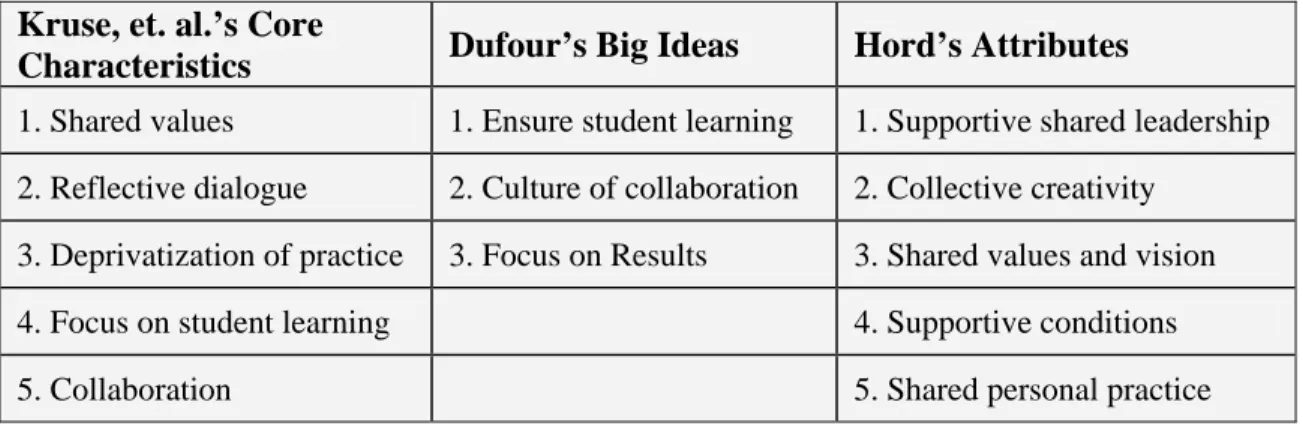
Table 2.1 Comparison of PLC definitions Kruse, et. al.’s Core
Characteristics Dufour’s Big Ideas Hord’s Attributes
1. Shared values 1. Ensure student learning 1. Supportive shared leadership
2. Reflective dialogue 2. Culture of collaboration 2. Collective creativity
3. Deprivatization of practice 3. Focus on Results 3. Shared values and vision
4. Focus on student learning 4. Supportive conditions
5. Collaboration 5. Shared personal practice
Pacific Resources for Education and Learning (2002) defines a professional learning community as a group having “shared vision, challenging curriculum aligned to instruction and assessment measures, a culture of continuous learning and improvement, parents and community as partners in the learning process, and supportive school
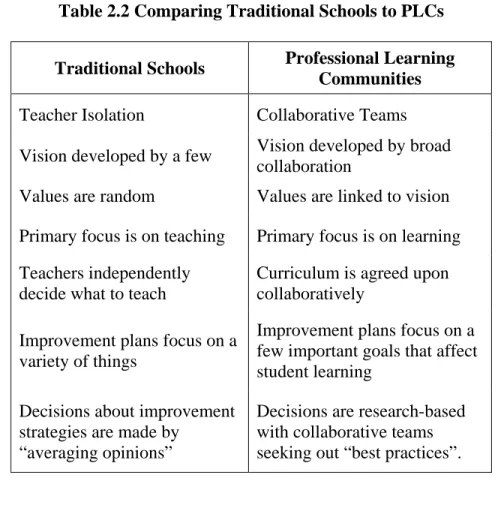
Eaker (2002) outlines comparisons between traditional schools and professional learning communities (Table 2.2). The characteristics Eaker attributes to professional learning communities are closely aligned with those outlined above in Table 2.1: collaboration, shared vision and values, collective creativity in determining teaching practices and desired outcomes, and a focus on student learning.
Collaboration is embedded into the culture of a learning community, with collaborative teams working to achieve common goals. A common vision is continually reflected in the work of the professional learning community, and the staff collectively seeks to learn and apply their knowledge to address student needs (Hord, 2004).
Table 2.2 Comparing Traditional Schools to PLCs
Traditional Schools Professional Learning Communities Teacher Isolation Collaborative Teams Vision developed by a few Vision developed by broad
collaboration
Values are random Values are linked to vision Primary focus is on teaching Primary focus is on learning Teachers independently
decide what to teach
Curriculum is agreed upon collaboratively
Improvement plans focus on a variety of things
Improvement plans focus on a few important goals that affect student learning
Decisions about improvement strategies are made by
“averaging opinions”
In a true professional learning community, all members of a school staff reflect on their practices and the outcomes of these practices on student learning. They assess whether their practices are having the desired effect on student learning, and identify what they need to change in order for all students to be successful learners (Hall & Hord, 2006). While professional learning committees in schools consist of all staff members, transforming a school into a professional learning community, and sustaining the transformation, can be done only with the endorsement and nurturing of the principal. The principal is not only a fellow learner, but encourages staff input into all aspects of decision making. According to Hord (2004), principals must participate and learn side by side with teachers, “questioning, investigating, and seeking solutions for school
improvement and increased student achievement” (p.8).
collaboration regarding teaching and learning, and discussion of effective instructional strategies resulted in positive academic growth.
Accountability for student achievement
This section reviews the history of accountability in education in the United States, beginning with the development and use of standardized tests and progressing through the national No Child Left Behind legislation and its impact on accountability. Next, the focus will turn to the accountability movement in North Carolina and its impact on education in the state.
Accountability in the United States
As corporate profits began to fall in the 70’s and 80’s, Americans also became concerned about the educational system.
In the 1950’s, the Scholastic Achievement Test (SAT) was developed and soon became widely used by universities and colleges as a tool for identifying potentially successful degree candidates. From 1967 to 1982, scores on the SAT declined
significantly, as did performance on the National Assessment of Educational Progress (NAEP) (Peterson, 2003). Prior to this decline, Americans in general regarded the U.S. schools as superior to schools of other nations. According to Peterson, “the United states was the first country to achieve universal elementary education, the leader in the
Finally, in 1983, the National Commission for Excellence in Education released A Nation at Risk. This report outlined reforms that were designed to reverse the decline in student achievement. The commission recommended that students be taught a more rigorous curriculum, and that schools have higher expectations for student achievement (NCEE, 1983). The report received widespread attention, and was the first in a succession of initiatives designed to increase accountability and student achievement. In 1989, President George H. W. Bush brought together 50 governors at the Education Summit. They agreed on six goals, two of which directly addressed student achievement and the development of standards. In 1990, the Secretary’s Commission on Achieving Necessary Skills (SCANS) was appointed by the U.S. Secretary of Labor to define skills necessary for students to be successful in the workplace. The Goals 2000: Educate America Act was passed under President Clinton, which provided funding for state and national efforts to implement challenging academic standards and develop ways to measure student achievement growth. Also, in 1994, congress passed the Improving America’s Schools Act (IASA), requiring states to implement content and performance standards and accountability measures for student performance (Haertel and Herman, 2005). By 2001, when the No Child Left Behind Act was enacted, 49 of the 50 states had implemented accountability standards and assessments (Linn, 2005).
students are making adequate yearly progress (AYP), on average, in both subjects. Test scores are also disaggregated into subgroups, and each of these subgroups that is of statistically significant size, must also make adequate yearly progress toward the goal of full proficiency. Subgroups include ethnicity groups, students with disabilities, students with limited English proficiency, and economically disadvantaged students. Schools that do not make AYP in all subgroups will be defined as needing improvement, and students must be given the option of transferring to another school in the district. In each
successive year that the school fails to make AYP, sanctions become more severe, with state takeover possible after five unsuccessful years (Peterson, 2003).
Accountability in North Carolina
Following the SCANS report and the passage of Goals 2000, North Carolina began to gain national attention for its accountability efforts. NAEP results showed that test scores were rising faster in North Carolina and Texas than in any other state. (Grissmer, 2000) The General Assembly of North Carolina directed the State Board of Education to develop a school restructuring plan, leading to the unveiling of the School Based Management and Accountability Procedures plan (ABCs of Public Education) in May of 1995. According to the School Based Management and Accountability
measured on two standards: the percentage of students deemed proficient in reading and mathematics, and the amount of academic growth students made from one year to the next. Schools are recognized for meeting or exceeding the standards for proficiency and growth, while schools failing to meet the standards are labeled as low performing
schools. For schools that meet certain proficiency and growth standards, the instructional staff receives financial bonuses (Public Schools of North Carolina, 2001).
In the years following its initial implementation, the ABCs plan has undergone several changes, including the addition of performance expectations in written
composition. However, the basic premise remains the same: schools not meeting certain growth and proficiency standards are labeled as low performing and are subject to state intervention, while schools exceeding these standards are given labels such as School of Distinction or School of Excellence and may receive monetary awards for staff members. During the 2003-2004 school year, a new recognition category was added for Schools of Excellence that also meet federal AYP goals; they are called Honor Schools of
Excellence (Public Schools of North Carolina, 2006).
The state has seen mixed results regarding student achievement as measured by the ABCs accountability model. In 1999-2000, 69.8% of the schools in NC made expected or high achievement growth, compared with 69.2% in 2004-05. During this same period of time, 27.6% of schools were designated Schools of Distinction or Schools of Excellence in 1999-2000, compared with 28.9% in 2004-05 (North Carolina
and school officials and administrators continue to explore ways to increase student achievement.
As a result of the ever-increasing federal and state standards for accountability, schools are striving to maximize learning for all students. Many schools are looking at the concept of Professional Learning Communities to help them meet this goal.
Theoretical Framework
An examination of the literature on professional learning communities led this researcher to investigate three possible conceptual frameworks through which to conduct the research. The first framework considered was Kruse, Louis & Bryk’s five core
characteristics of professional learning communities. They identified these characteristics as shared values, reflective dialogue, deprivatization of practice, focus on student
learning, and collaboration. Kruse, Louis and Bryk also identified six structural conditions and five social and human resources necessary to facilitate development of and to sustain professional learning communities (Louis, Kruse & Associates, 1997). The necessary supporting conditions included: time to meet and talk, physical proximity, interdependent teaching roles, communication structures, and teacher empowerment and school autonomy. Social and human resources were openness to improvement, trust and respect, access to expertise, supportive leadership, and socialization. This framework, while quite detailed, was too complex for the scope of this research, a case study of one particular school.
of the three, ensuring that students learn, highlights the concept of learning rather than teaching and puts the focus on the students. He surmised that the answer to the question “How will we respond when a student experiences difficulty in learning?” separates professional learning communities from traditional schools (DuFour, 2005, p.33). The second big idea, a culture of collaboration, emphasizes systematic, rather than informal, collaboration. Big idea number three is a focus on results. DuFour’s professional learning community judges its effectiveness by the results of student achievement. Teams
continually identify current levels of achievement, and then set a goal for improving that level. While this researcher likes the emphasis of this model on student achievement, this researcher does not believe it is well defined enough to provide meaningful results for this study.
The third framework considered is Hord’s attributes of professional learning communities (Hord, 1997). She identified the five attributes as: 1. supportive and shared leadership, 2. collective creativity, 3. shared values and vision, 4. supportive physical and human conditions, and 5. shared personal practice. These attributes are somewhat similar to those identified by other researchers. However, this researcher found Hord’s
framework to be more defined and detailed than DuFour’s, yet less complex than Lambert’s framework. In addition, Hord developed a likert scale survey that
complements her conceptual framework, and this survey instrument will be used as a part of the research in this study.
Supportive and Shared Leadership
According to Hord (1997), the support of the principal or school leader is imperative in creating a professional learning community in a school. Kleine-Kracht (1993) suggests that principals must learn alongside the teachers, dissolving the traditional hierarchical notion of the principal as being wiser and more powerful. This coming together of administrators and teachers lends itself to a team-oriented atmosphere of shared leadership and working together toward a common goal of creating a better school (Hoerr, 1996). Senge (2000) envisions a school where “all people in the system are seen as learners and act as learners” (p.417). Supportive and shared leadership implies that all constituencies are supported in and involved in making decisions that affect the school community. According to The National Commission on Teaching and America’s Future (2003), shared leadership is a vital component in building professional learning communities.
Shared Values and Vision
Shared vision requires bringing together individual expectations and aspirations into alignment to create a common image of the future of their organization, and
collectively defining goals to guide them on the journey. A vision must maintain focus on student learning and their potential achievement; this will lead to collective staff support for behaviors that work toward the common vision.
Collective Creativity
increasing capacity through dialogue among all members of the school communities, collaborating to discuss issues related to teaching and learning. Senge (2000) envisions collective creativity occurring through alignment, which he defines as “arranging a group of scattered elements so they function as a whole, by orienting them all to a common awareness of each other, their purpose, and their current reality” (p. 74). Fullan (2005) looked at capacity building as “the daily habit of working together….by doing it and getting better at it on purpose” (p. 69).
Shared Personal Practice
Teachers learn best from their colleagues, and benefit from the opportunity and conditions to “teach each other the art of teaching” (DuFour 2004, p. 141). In a 2001 study, Huffman et. al. found that shared personal practice was the most rarely evident characteristic of a professional learning community. According to Hord (1997), one type of shared practice involves visiting colleagues’ classrooms and discussing these
observations. Dialogue about best practices is another way for teachers to share their craft with others. Such practices are “based on the desire for individual and community
improvement and is enabled by the mutual respect and trustworthiness of staff members” (Hord, 1997).
Supportive Conditions
around the willingness of the individual to function as a member of a professional learning community, including the ability to provide and receive meaningful feedback.
Louis and Kruse (1995) identified the following human factors as needing to be present in order to have productive learning communities: trust and respect among colleagues, skills and knowledge related to effective teaching, administrative support and concentrated socialization efforts. Teachers become more willing to be involved in leadership at the school when they are empowered to share decision making and facilitate change within the school (Louis, Kruse, & Raywid, 1996).
As previously stated, Hord’s professional learning community model was chosen as the framework for this research because it provides detailed descriptors of the
III. METHODOLOGY
Introduction to the Chapter
This study investigated whether a professional learning community influences student achievement. The basic question guiding this research was: “What impact does a professional learning community have on student achievement?” This chapter outlines the type of research used in the study, followed by a description of the site selection. The methods for data collection and analysis are then explained and discussed.
Type of Research
This study used primarily qualitative methodology to provide an in-depth study of a professional learning community and the impact of that community on student
achievement. Many factors have been attributed to gains in student achievement. Many schools also identify themselves as professional learning communities and cite many benefits that this status has brought to their staff members, students, and school communities. This study confirmed one elementary school’s status as a professional learning community and then explored the view of school administrators and staff members and their interpretations of the impact of this professional learning community on student achievement in their own setting.
identify schools that operate as professional learning communities. It is useful for schools that operate as professional learning communities as an ongoing assessment of their work (Hord, et. al., 1999). Usability, reliability and validity test have been completed on this instrument, which is designed to assess the maturity of a schools staff as a professional learning community. The confirmation of the existence of a learning community allows the researcher to link its existence to possible impact on student achievement.
Langenbach, Vaughn and Aargard (1994) state that “case studies provide information that focuses on a single issue, individual, or organizational behavior or outcome within a narrow context containing limited variables…the researcher must relate his or her findings to theory in order for the work to be considered research”. Qualitative research should show interest in descriptive data, emphasis on interactions and processes, focus on individual experiences and outcomes, and uncertainty about the importance or effect of individual variables (Patton, 1987). It is important to listen to and study the voices of those involved in the school setting during the recent gains in student achievement and concurrent development of a professional learning community. Therefore, a qualitative study was used.
Qualitative methodology allows the researcher to understand the “thoughts, feelings, beliefs” (Marshall and Rossman, 1999, p. 57) of the school staff regarding their professional learning community, the recent gains in student achievement, and the possible linkage between the two phenomena.
from the survey to the qualitative data to determine whether the findings support or contradict each other.
Site selection
This study used a purposeful sample. Patton (1990) describes purposeful sampling as selection of a site because its “information rich” case suits the purposes of the study. Purposeful sampling is not designed to represent a defined population, but to achieve an in-depth understanding of a particular case. When a researcher is selecting a case in order to develop or test a theory, then the findings can be generalized to the theory, not to a defined population (Yin, 1989). This complements Patton’s (1990) description of purposeful sampling. Patton identified 15 types of purposeful sampling used in qualitative research, each serving a different purpose. The strategy for this study is considered to be “critical case sampling”, used to study educational programs and related phenomena. The particular site was selected because it purports to operate as a learning community, as many schools do; however, during the time the school has been operating as a learning community, student achievement has risen dramatically.
commute daily to work in larger cities in North Carolina or Virginia. Despite its rather small size, the population is relatively stable, and families whose ancestors settled in the area generations ago continue to make Riley home. Riley County’s school district serves approximately 2500 students at four schools. Two of these are elementary schools, one serving kindergarten through second grade, and the other serving third through fifth grade. There is one middle school and one high school. Prior to the late 1990’s, there were two K-5 elementary schools; one located inside the town limits, and the other located outside city limits. When it was time to build a school, the district decided to combine the elementary students, building a “double school” on one large plot of land on the outskirts of town. The new building, opened in 2000, consists of two separate school sites, joined in the center by a common hallway. Fowler Elementary serves the K-2 students and Riley Elementary serves the 3-5 students. The schools have totally separate facilities and staffs, sharing only a bus circle and school buses.
This study focuses on Riley Elementary School, which serves 540 students in grades 3-5. Because over 60% of its students live in poverty, Riley is classified as a Title 1 school. The ethnic makeup of the population is 48% African-American, 49%
Caucasian, and 3% other (multiracial, Hispanic and Asian). In the year 2000 the school was given a designation of “no recognition” under the ABCs of Education accountability model, with only 56% of its students achieving at grade level.
proficiency has climbed steadily, from 56.4% in the 1999-2000 school year, to 83.6 % in 2004-2005 (see Fig. 3.1).
Table 3.1 Composite performance proficiency based on NC Accountability Model
1999-2000 2000-2001 2001-2002 2002-2003 2003-2004 2004-2005
56.4% 62.3% 73.5% 81.2% 82.8% 83.6%
Source: NC Public Schools (2006)
Data Collection
Four methods of data collection were used for this research: 1. survey, 2. direct observation, 3. personal interviews, and 4. document review and analysis.
The researcher asked all certified staff members to complete the School Professional Staff as a Learning Community instrument. The Cronbach’s Alpha reliability for this instrument is .94. A value of .75 or greater indicates appropriate internal consistency of an instrument (Hord, 1999). Results of this survey were used to verify the existence of a learning community at Riley Elementary School. Following administration of the survey, the researcher spent four full days on site at the school, over a period of several weeks, observing, conducting interviews, and reviewing documents. Observation, interviews, and document review and analysis all have strengths as means of gathering qualitative data (Gall et. al. 1996).
1996). Observations include horizontal learning team meetings, vertical learning team meetings, staff meeting, and informal gatherings and conversations. Horizontal learning teams consist of seven to ten teachers who teach the same grade level. Each vertical learning team has members representing each grade level, as well as other teacher groups, such as cultural arts teachers, special education teachers, counselors, and other
specialists. Detailed and highly descriptive notes were taken, with awareness in regards to the researcher’s possible impact on the participants being observed. An observation protocol was used to look for evidence of the five components of professional learning communities and references or connections to student achievement (Appendix C).
given the option of not having the interviews recorded, but none of the interviewees objected to the use of a tape recorder during the interview.
Lincoln and Guba (1985) identified two types of written communications: documents and records. They define documents as written communications prepared for personal reasons, and records as formal, official written communication. The researcher had the opportunity to review and/or copy numerous records and documents collected by the school and the principal during the years 2000-2005.
Data Analysis
Marshall and Rossman (1999) defined the data analysis process as consisting of five parts: organizing the data, generating categories and patterns, using the data to test the emergent hypothesis, searching for alternative explanations of the data, and reporting the results. Data reduction and interpretation should be part of each phase of the analysis as the researcher brings meaning to the information collected. Brogdan and Biklen (1992) outline a similar process of data analysis.
The data gathered from the survey was tabulated to yield six averaged scores, one for each of the five component areas and one overall score. The likert scale on the survey ranges from 1-5. For the purpose of this research, an overall result of 3.8 or more will indicate the presence of a professional learning community at the school, and a result greater than 4.0 in any of the component areas will indicate a strong presence of that particular descriptor.
student achievement, and teaching practices resulting from the professional learning community work and their possible connection to increased student achievement. To increase the validity of the data, the researcher used member checking, having the participants review the summaries of the interviews. This purpose of this was to reveal error – either factual errors that can be corrected or discrepancies which require
IV: RESULTS
This case study used Hord’s (1997) five components of a professional learning community to investigate the impact of professional learning communities on student achievement. Hord’s five components of a professional learning community are: 1) supportive and shared leadership, 2) collective creativity, 3) shared values and vision, 4) supportive conditions, and 5) shared personal practice.
To explore the existence of a learning community at the school and its impact on student achievement, the researcher used the following sources of data: the results from Hord’s (1996) School Professional Staff as Learning Community Questionnaire, which explored the existence and maturity of a professional learning community at the school site; interview data from one-on-one interviews with the principal and six teachers, and one focus group of six teachers; observations of professional learning team meetings, both horizontal grade-level meetings and vertical planning teams consisting of a cross grouping of teachers; and school documents such as improvement plans, minutes from team meetings, internal and district surveys, and staff development information.
This chapter contains the analysis of the data collected from the sources listed above. The chapter begins with a brief description of each type of data used for this research: survey, interviews, observations, and documentation. The next section will discuss the results of the School Professional Staff as Learning Community
from interviews, observations and documents and will be presented in five sections, with each representing one component of Hord’s professional learning community model.
Survey
The School Professional Staff as Learning Community questionnaire contains seventeen items and is divided into five sections, with each section corresponding to one of Hord’s (1997) five components of a professional learning community. On the
questionnaire, participants are asked to respond to a particular statement with regards to their perception of its existence at their particular school, using a likert-scale ranging from 1 to 5. Responses for each of the seventeen items were averaged to come up with a score for each item. Then the seventeen item scores were averaged, resulting in one overall score which was used to determine the existence of a professional learning community. For the purposes of this study, a comprehensive overall result of 3.8 or more will confirm the existence of a professional learning community at the site. According to Hord (1999), higher scores indicate greater maturity of the learning community. The researcher decided to use 3.8 to ensure a strong indication that a professional learning community and its components are present at the school site.
Interviews
years. It was important to select teachers who were at the school prior to 2001 because those teachers were part of the school when student proficiency was low, and had experienced the steady increase in student achievement in subsequent years. After the principal identified the teachers who had been at the school prior to 2001, the researcher randomly selected two teachers from each grade level to participate in individual
interviews. The remaining names were then combined and six were selected at random to participate in the focus group. Focus group participants included two cultural arts
teachers, a third grade teacher, a fourth grade teacher, a fifth grade teacher and a resource teacher. Each interview lasted approximately 45 minutes.
Despite having taught at Riley Elementary School for the past five years or more, the twelve interviewees had varied experiences and backgrounds. Two of the
interviewees had retired after thirty years of teaching in the Riley School District, and decided to return to the classroom again. Two of the teachers spent several years teaching in New England before relocating to North Carolina to continue their teaching careers. Two of the interviewees taught in neighboring counties prior to coming to Riley, and the remaining six teachers have spent their entire teaching careers in Riley School District. Of the twelve interviewees, there were: two male and ten female, four African-American and eight Caucasian. These interviewees comprised the following teaching assignments: three third grade teachers, three fourth grade teachers, three fifth grade teachers, two cultural arts teachers, and one resource teacher.
Observations
The researcher spent about 15 hours observing the professional learning
community at Riley Elementary School. Observations included vertical learning teams, horizontal grade level teams, informal staff interactions with each other in small and large groups, and staff interactions with children. In addition, the researcher spent time in the school office, halls, classrooms, teachers’ lounge, and cafeteria.
While the observations were valuable in gleaning information about the
professional learning community at the school, the majority of the observation time was spent in learning team meetings. Riley Elementary has two main types of learning
Documents
The researcher had access to a vast amount of electronic and paper
documentation. The principal of Riley Elementary School keeps notebooks containing minutes of all committee meetings both at the school and district level, as well as any handouts distributed at the meetings. There are also staff development notebooks that contain lists of staff development attended by the principal and/or the staff and copies of any information distributed at the meetings. Planning notebooks contain all
documentation produced by the school and district planning team, including annual team goals, schedules, program and curriculum changes, and other school improvement information. Data notebooks contain results of state and local tests, benchmark tests, and parent, student, and staff survey results.
The principal also keeps copies of all electronically produced documents and emails on her computer. The computer contains folders for each vertical team and each horizontal team, and all electronic documentation pertaining to each group is placed in that folder. There are folders for each school committee and each district committee, as well as folders containing teacher evaluations, program evaluations, and even one for personal reflections and future plans.
School Professional Staff as Learning Community Questionnaire Results There are 36 certified teachers at Riley Elementary School. Their teaching assignments are shown in Figure 4.1.
Table 4.1 Certified Staff Teaching Assignments at Riley Elementary Teaching
Assignment
3rd grade 4th grade 5th grade Resource Cultural Arts Number of
Teachers
10 10 7 4 5
The principal gathered the staff together after school for a short meeting in which the researcher discussed participation in the study. Thirty of the staff’s certified teachers attended the meeting, and all thirty completed and returned the questionnaire. A separate meeting was held at a later time for the teachers who were unable to attend the initial meeting. Three teachers attended the second meeting, and all three completed the questionnaire. In total, 33 of the 36 certified teachers returned the survey, resulting in a response rate of 91.6%. Figures 4.2, 4.3 and 4.4 provide demographic information for the 33 respondents.
Table 4.2 Respondents’ years of teaching experience
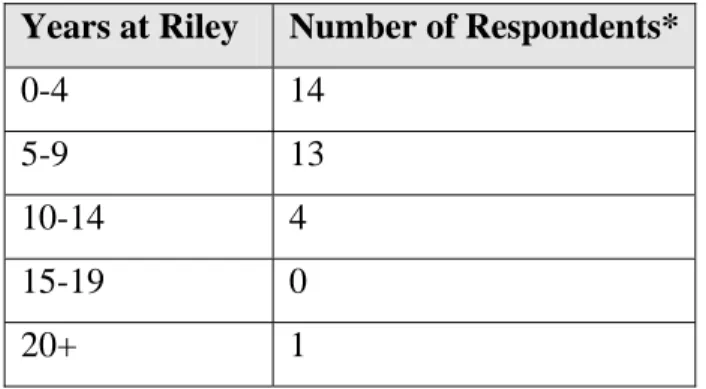
Table 4.3 Respondents’ years teaching at Riley Elementary School Years at Riley Number of Respondents*
0-4 14 5-9 13 10-14 4 15-19 0 20+ 1 *one respondent did not answer this question
Table 4.4 Respondents’ type of teaching certification NC Provisional (not tenured
in North Carolina)
NC Regular (tenured) National Board Certification
9 15 9
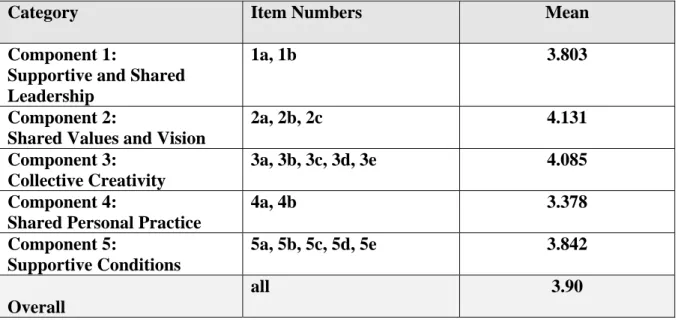
As mentioned previously, the survey contains seventeen items divided into five categories, with each category representing one of the components of a professional learning community. A score was obtained for each of these five components by averaging the item scores of the items corresponding to each component. Averages for each of the five components will provide additional information regarding the existence and strength of each component area at the school. Prior to the study, the researcher set the criteria for the existence of a professional learning community as being an overall mean of 3.8 or greater on the five point likert-scale School Staff as Professional Learning Community survey. Figure 4.5 shows the overall composite mean of the School
Table 4.5 Results of the School Professional Staff as Learning Community questionnaire – by component
Category Item Numbers Mean
Component 1:
Supportive and Shared Leadership
1a, 1b 3.803
Component 2:
Shared Values and Vision
2a, 2b, 2c 4.131
Component 3: Collective Creativity
3a, 3b, 3c, 3d, 3e 4.085
Component 4:
Shared Personal Practice
4a, 4b 3.378
Component 5:
Supportive Conditions
5a, 5b, 5c, 5d, 5e 3.842
Overall
all 3.90
In order to study the impact of a professional learning community on student achievement at Riley Elementary, the researcher first had to determine whether a learning community actually exists at the site. With a composite mean of 3.9, it was determined that a professional learning community does exist at Riley Elementary School.
Supportive and Shared Leadership
The current decision making process is much different than it was in 2001. One interviewee reported that, “Before Sharon came; we were told…now we are asked.” Another teacher said “Decisions used to be haphazard. (Former principal) would change something and we’d get the memo later.”
It is clear that the principal’s leadership plays a key role in the PLC at Riley Elementary School. When asked to identify leaders in their school, interviewees
mentioned several different names, although the principal was named consistently by all of them.
Documents show that teachers have many opportunities to give input and share in the decision-making at the school. Leadership is shared among many committees and learning teams, and committee chairs change frequently. The committee structure of the school, symbolized by an umbrella, consists of one main committee called the planning team. According to an organizational chart created at the beginning of the school year, the planning team includes members from administration, all grade levels, resource teachers, cultural arts teachers, and classified staff. The committee helps to set overall goals and charts a course for how to accomplish them. Subcommittees, characterized as the spokes of the umbrella, include staff development, curriculum, communication and climate. Again, each subcommittee includes members from all curricular groups in the school.
1. Investigate and implement reassignment or hiring of staff to provide at least five teacher planning periods weekly.
2. Analyze and improve dismissal procedures for bus students.
3. Review and update Riley Elementary School’s mission statement, involving all stakeholders, including students.
4. Establish, implement, and communicate a fair, consistent discipline policy. In looking at the list of planning team responsibilities over the past four years, it appears that these responsibilities change slightly each year but always provide the planning team and its subcommittees with similar latitude to decide upon and implement changes. The principal corroborated this finding, stating that, “we have a school structure that works, but we continually look for ways to tweak things and improve them when we can.”
In addition to the committees, teachers also serve on two learning teams, one horizontal team consisting of others with similar teaching assignments, and one vertical team comprised of members from all grade levels and other certified and classified groups. The school schedule shows that horizontal team meetings last all day on Thursdays, and vertical team meetings are held all day on Fridays. There are six horizontal teams and four vertical teams.
engaged and contributing. When necessary, efforts were made by the facilitator to encourage participation. The principal was in and out of the room, answering questions and occasionally contributing to the discussion, but she was definitely in a background role. When questions came up regarding scheduling, materials, or other needs, the
principal appeared eager to help the group get what they needed. When one teacher called the office to say that she could not meet with her learning team because her teacher assistant had gone home sick, the principal responded, “I’ll be right there to take your class for you. It is important for you to be able to join your team.”
Decisions made by learning teams included pacing of the literacy units, purchase of materials for classroom libraries, sequencing of science units, and identifying field trips to support the upcoming social studies unit. Many of the decisions made in team meetings were relatively small ones, but they were taken seriously by the teachers, and team members did a good job of making sure that everyone’s viewpoints were heard and considered.
Several interviewees stated that the principal encourages the staff to come to her if they have problems or concerns. She also asks that they come with possible solutions to the problem. The researcher observed at least three occasions where individuals did come to speak with the principal, and the principal was positive and affirming in her
principal responded, “I can see why you might be frustrated. What have you tried already? I can help you explore some options.”
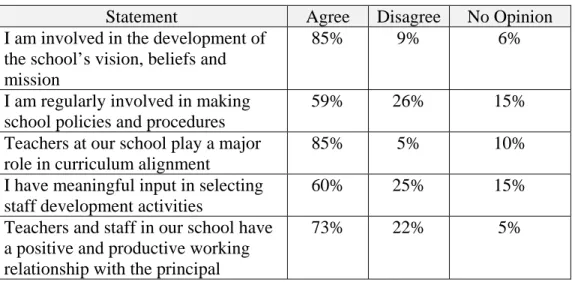
According to a survey given to all Riley Elementary School staff members in 2005, most staff members feel like they are able to share in decision-making at the school, and that they have a positive and productive working relationship with the principal. See Figure 4.6. (A total of 72 staff members took part in the survey; 40 certified teachers and 32 non-certified staff members.)
Table 4.6 Results of 2005 Riley Elementary School Staff Survey
Statement Agree Disagree No Opinion
I am involved in the development of the school’s vision, beliefs and mission
85% 9% 6%
I am regularly involved in making school policies and procedures
59% 26% 15%
Teachers at our school play a major role in curriculum alignment
85% 5% 10%
I have meaningful input in selecting staff development activities
60% 25% 15%
Teachers and staff in our school have a positive and productive working relationship with the principal
73% 22% 5%
While the level of agreement varied among the statements, in each case the majority of the staff agrees that they are involved and able to give input into decisions made at the school. It is interesting, however, that only 59% of the staff feels like they are involved in making school policies and procedures, as the documents show that
more understandable, as the principal and some teachers indicated that much of the staff development is determined for the entire district at the district level. Individual and small groups of teachers, however, may occasionally attend workshops of their choice offered in nearby cities.
Both teachers and the principal indicate that shared leadership is not without its drawbacks. While teachers have many opportunities to provide input and overall they feel that their opinions are heard and valued and that they truly have a hand in what goes on at the school, some see this as a mixed blessing. With the increased responsibility for
decision-making and leadership comes additional work. Some interviewees mentioned feeling overwhelmed by the number of meetings and emails that are often required in order for people to be involved and give input. One interviewee said, “When we were working on the vision, we had meeting after meeting after meeting. In the end we had a great outcome, but it took forever!” Participatory decision-making takes more time and effort. The overall feeling, though, is that the pluses of shared leadership outweigh the minuses. As one teacher put it, “We used to have less work, but there was more unhappiness.”
into practice in a school has to be a deliberate.” It was a philosophy that she brought with her to Riley Elementary and she believes that teacher involvement has reaped its rewards in increased student achievement. “The teachers are putting themselves out there…they put a lot of thought into these decisions and they want to see them succeed.”
The principal has represented her district as Principal of the Year twice during her five year tenure at Riley Elementary. She is a leader with a vision, and she makes it happen each day. She has worked hard to change the climate at the school, from one of authoritative, top-down management to one where everyone is involved in both the process and the outcome, and the changes are obvious. During one of the researcher’s visits, a central office administrator summed it up by saying, “This school was in big trouble. Now the kids are learning, really learning, because of what she has created here.”
Shared Values and Vision
One thing strongly agreed upon by the teachers interviewed and by the principal, and which remained a common thread across all data collected, is the degree of
commitment of the staff to the students’ learning and well-being. When asked what the staff values at the school, responses consistently referred to student achievement and citizenship. The teachers believe that students are respected and cared for by all the adults at the school, and that everyone is committed to academic success for all students. “We are a close community. We are all different people, but every adult in this school is here for the kids. We teach them, but we also love them,” said one interviewee.
opinions regarding how to get there, but it appears the staff as a whole is working toward the same end. A few of the interviewees told the story of the forming of the school vision. According to one interviewee, “We had meetings, meetings, lots of meetings.” There was a lot of discussion during the meetings about the wording of the vision to ensure that it was something everyone believed, and that the wording would be easily understood by anyone, including parents and students. When asked to “tell me about the vision of this school,” however, none of the interviewees actually stated the mission statement. One described the vision as “what you feel when you come here,” going on to say that the vision was visible in the efforts put forth by all the staff and that walking into any
classroom “you would see first that we’re here for the kids.” Another teacher felt that the staff as a whole values children and education and that the children are so well-behaved, for the most part, because they are reflecting the way they are treated at Riley – with mutual respect – and everyone “knows we care about them here.”
According to interviewees, each day over the intercom, the principal reminds students to “be honest, be respectful, be responsible” and shares details about how to “live” various character traits. The researcher observed that character traits are posted throughout the school, in every classroom, and on the large school sign located along the road next to the entrance of the school. In addition, the school mission is posted in the entry hall and in the classroom, and is printed in the student planners.
organized learning environment that showcases their pride in their school and their students’ learning.
Learning is valued for adults as well. During learning team meetings, the
researcher observed that every team was on-task and focused throughout the time allotted for their meeting. Minutes from past meetings show that this is usually the case; the vast majority of team meeting time is devoted to issues that are directly related to instruction, leading the researcher to believe that overall the staff values respect for each other and commitment to improved teaching, and that these values are shared across the board among the adults at the school.
Collective Creativity
Collective learning is abundant at Riley Elementary School. Every teacher interviewed attributed time spent learning together as a major factor in the improvement of student achievement at the school. Prior to 2001, teachers had the opportunity to attend workshops, but the information was beneficial only to the person attending the workshop because there was no format for sharing learning with others. Group learning did not seem to be valued by the administration, and any collective learning that did occur was more by chance than by design. This is certainly not the case today.
A copy of the school schedule shows that each week, two complete days out of five are devoted to collective learning and shared practice in learning teams. In addition, Monday afternoons are set aside for faculty meetings, committee meetings, and staff development opportunities after school, resulting in more than 40% of the week formally devoted to collective learning.
The principal explained the two types of learning teams at Riley Elementary – vertical and horizontal. Each vertical team consists of members from every grade level and teacher group. Horizontal teams are essentially grade level teams, with all teachers on the team having the same type of teaching assignment. Vertical teams meet weekly for one hour, and horizontal teams meet weekly for ninety minutes. Each group has a
I have enough for everyone to open one with your class.” Another teacher thanked her and said, “I created two literacy center activities to use during rocks. They are in my shared folder (on the computer) under November.” When asked about collective
learning, every interviewee mentioned learning teams as the most valuable and consistent way that the staff learns together.
The researcher observed that nearly all of the learning team time was spent discussing the craft of teaching and how to best increase student achievement and meet the individual and collective needs of the students. In each team, there was a high degree of participation from all members, and the atmosphere was helpful and collegial. Both the teachers and the principal believe that time spent discussing teaching and learning in team meetings has had a major impact on the increase in student achievement at the school.
The school conference room is set up to facilitate team meetings. Tables and shelves are lined with multiple titles of resource books for teachers to use in group study on topics such as differentiation of instruction, guided reading, integrating science and mathematics, and interactive writing. There are also video collections designed to showcase particular teaching methods or subjects and provide staff development to teachers wanting to learn more about these methods. A projector and a computer with internet access are available for teachers to use to take notes and look up any information they may need during the meeting.
focus on working with words in literacy instruction and looked around the room at the available resources. They decided to use a video series about incorporating word work into the classroom literacy program. This suggestion came from a team member said, “Let’s look at the “Ways With Words” video. Carol said her team used it at the beginning of the year and they got some great ideas. What do y’all think?”
The facilitator noted that the entire video lasted approximately one hour, and a team member suggested watching fifteen minutes of the video for each of the next four weeks, then taking some time after each viewing to discuss what they saw and ways that it could be used in their classrooms. While the team watched the first segment of the video, the facilitator took notes on the computer (which was projected onto the board) regarding key points of the segment. Following the video, a discussion ensued about different ways to incorporate word work. One teacher mentioned that she “liked how the person in the video used different colors to show different chunks of the words,” starting a discussion of how this could be used to enhance mastery of spelling words. Another teacher then noted that “the love of words from the teacher on the video was obvious,” and discussion turned to teacher enthusiasm for subject matter and its effect on students.
encourage children to choose increasingly difficult books as their reading levels increase. At the end of her presentation, a teammate remarked, “Thank you so much. I’ve had that resource box for two years and never knew exactly how to use the stuff effectively.”
A third vertical team was also ready to begin a new topic of study. The facilitator led the group in reviewing the list of learning goals that was given to them at the
beginning of the year. One member expressed an interest in learning more about effective ways to help students understand math concepts. Another member referred to a standards integration article that the principal had distributed to all teachers earlier in the year, and expressed an interest in learning more about applying this to classroom practice. “Sharon wanted us to read this article, and it was good, but I need to figure out how to apply it in my classroom and help my kids learn.”
Because vertical teams are comprised of teachers from a variety of teaching assignments, discussion included each topic along a continuum of grade levels and subject areas. Rather than individual activities and specific application of the teachers’ learning, these teams spoke more about the overall value and benefit of using the practice at Riley Elementary, as well as what it could look like at different grade levels and how it could be integrated into other settings.