Clinical Infectious Diseases
M A J O R A R T I C L E
HIV/AIDS
Crowdsourcing HIV Test Promotion Videos: A
Noninferiority Randomized Controlled Trial in China
Weiming Tang,1,2,3,6,aLarry Han,1,2,4,aJohn Best,1,3,5,aYe Zhang,1,2,3Katie Mollan,4Julie Kim,3Fengying Liu,2,3Michael Hudgens,4Barry Bayus,7 Fern Terris-Prestholt,8Sam Galler,1,9Ligang Yang,2Rosanna Peeling,3,8Paul Volberding,5Baoli Ma,10Huifang Xu,11Bin Yang,2,3Shujie Huang,2,3 Kevin Fenton,12Chongyi Wei,5and Joseph D. Tucker1,2,3,61
University of North Carolina Project–China,2Guangdong Provincial Center for Skin Diseases and STI Control, and3Social Entrepreneurship for Sexual Health (SESH) Global, Guangzhou, China;
4
Department of Biostatistics, University of North Carolina at Chapel Hill;5
School of Medicine, University of California, San Francisco;6
School of Medicine, and7
Business School, University of North Carolina at Chapel Hill;8
Department of Global Health and Development, London School of Hygiene and Tropical Medicine, and9
University of Oxford, United Kingdom;10
Danlan, Beijing, and
11
Department of HIV/AIDS Prevention and Control, Guangzhou Center for Disease Control and Prevention, Baiyun, China; and12
Public Health England, London, United Kingdom
(See the Major Article by Mi et al on pages 1443–7, and Editorial Commentary by Shen et al on pages 1448–9.)
Background. Crowdsourcing, the process of shifting individual tasks to a large group, may enhance human immunodeficiency virus (HIV) testing interventions. We conducted a noninferiority, randomized controlled trial to comparefirst-time HIV testing rates among men who have sex with men (MSM) and transgender individuals who received a crowdsourced or a health marketing HIV test promotion video.
Methods. Seven hundred twenty-one MSM and transgender participants (≥16 years old, never before tested for HIV) were recruit-ed through 3 Chinese MSM Web portals and randomly assignrecruit-ed to 1 of 2 videos. The crowdsourcrecruit-ed video was developrecruit-ed using an open contest and formal transparent judging while the evidence-based health marketing video was designed by experts. Study objectives were to measure HIV test uptake within 3 weeks of watching either HIV test promotion video and cost per new HIV test and diagnosis.
Results. Overall, 624 of 721 (87%) participants from 31 provinces in 217 Chinese cities completed the study. HIV test uptake was similar between the crowdsourced arm (37% [114/307]) and the health marketing arm (35% [111/317]). The estimated difference be-tween the interventions was 2.1% (95% confidence interval,−5.4% to 9.7%). Among those tested, 31% (69/225) reported a new HIV diagnosis. The crowdsourced intervention cost substantially less than the health marketing intervention perfirst-time HIV test (US$131 vs US$238 per person) and per new HIV diagnosis (US$415 vs US$799 per person).
Conclusions. Our nationwide study demonstrates that crowdsourcing may be an effective tool for improving HIV testing messaging campaigns and could increase community engagement in health campaigns.
Clinical Trials Registration. NCT02248558.
Keywords. crowdsourcing; HIV; testing; men who have sex with men; China.
At a 1906 county fair in England, a group of individuals was asked to guess the weight of an ox. The median estimate of the crowd was accurate to within 1% of the actual weight and better than any estimate from agricultural experts. This shows the wis-dom of crowds or communities in specific contexts [1]. Crowd-sourcing is the process of shifting individual tasks to a large group. It often involves open contests and is enabled through multisectoral partnerships [2,3]. Crowdsourcing has been used extensively in the private sector [2] and has been champi-oned by the National Institutes of Health in the United States as an effective tool to solicit new ideas in health research [4].
Crowdsourcing may overcome 3 common problems en-countered in designing and implementing new human immuno-deficiency virus (HIV) testing interventions. First, when designing interventions, researchers tend to gravitate toward ideas that re-semble previous work, resulting in less creative ideas [5,6]. Sec-ond, when community-based HIV testing interventions are implemented, the input of key affected populations is often rela-tively limited [7,8]. Third, aside from HIV testing programs aris-ing from community-based participatory research [9], many HIV testing campaigns result from a top-down, expert-driven process [10]. In contrast, crowdsourcing draws on the collective knowl-edge of the community instead of experts, empowering commu-nities to develop novel and creative solutions.
The World Health Organization has recognized community engagement as a key social enabler for scaling up HIV testing services and eliminating new HIV infections [8], and HIV com-munity engagement has been associated with increased HIV test uptake [11], effective task-shifting [12], and expansion of HIV treatment services [12–14]. Community engagement is in-creasingly important as key populations bear a greater burden
Received 3 October 2015; accepted 4 December 2015; published online 29 April 2016.
a
W. T., L. H., and J. B. contributed equally to this work.
Correspondence: J. D. Tucker, University of North Carolina Chapel Hill Project–China, No. 2 Lujing Road, Guangzhou 510095, China ([email protected]).
Clinical Infectious Diseases®
2016;62(11):1436–42
of the HIV epidemic, now accounting for more than half of all new HIV infections in many countries [8]. Crowdsourcing could be a powerful tool to enhance HIV testing campaigns by harnessing the power of community engagement to generate creative, new ideas to promote HIV testing.
Our research group organized a creative contributory contest [15] to solicit videos promoting HIV testing. The contest includ-ed an open call to the public, transparent judging, and a showcase of top videos. To compare the effectiveness of a crowdsourced in-tervention vs a health marketing inin-tervention to promotefi rst-time HIV testing among men who have sex with men (MSM) and transgender individuals in China, we conducted a noninfer-iority pragmatic randomized controlled trial (RCT).
METHODS
Intervention Development
The crowdsourced intervention has been described in detail elsewhere [15]. Development of the intervention for this trial included the following steps. First, we posted a public call for videos promoting HIV testing and hosted a call to increase awareness of the contest. Second, a group of multisectoral judg-es, including researchers, community health leaders, public health and marketing experts, and business leaders, evaluated each of the video entries with a score of 1 (worst) to 10 (best). The judges identified a single contest winner based on the ca-pacity to reach untested individuals, generating excitement, and community responsiveness. Finally, the winning video was in-cluded in the intervention arm of this trial (Supplementary Data A). The 1-minute video showed 2 Chinese men falling in love and getting tested for HIV together. The health market-ing video intervention was developed independently from the contest by a small marketing company with the guidance of a municipal public health bureau (Supplementary Data B). The 1-minute health marketing video included a cartoon providing HIV education and promoting HIV testing.
Study Design and Participants
We chose a noninferiority design without a control group for 2 reasons. First, there is already substantial evidence demonstrat-ing the effect of brief marketdemonstrat-ing interventions on HIV testdemonstrat-ing described in 2 Cochrane systematic reviews [10,16]. Second, given the need to expand HIV testing among MSM in China [17], there would be ethical concerns associated with withhold-ing an evidence-based intervention from untested MSM [18].
We recruited participants from Chinese MSM Web portals [19]. An MSM Web portal is an online entry point for social net-working,finding sex partners, exchanging news, and banner ad-vertising. We selected 1 MSM Web portal each in the northern, southern, and eastern regions of China. These 3 portals collec-tively have an estimated 90 000 unique users each day. We piloted an online survey to evaluate the effectiveness of the crowdsourced vs the health marketing video among 150 MSM and transgender
individuals. Extensive formative work, including interviews with MSM and input from survey design experts and anthropologists, informed the development of the online survey tool (Qualtrics) [20]. We followed standard guidelines for reporting online sur-veys and RCTs (Supplementary Data C) [21–23].
Participants were recruited through a banner link on the MSM Web portal home pages and an announcement about the study was sent to registered users of the portals. Participants who clicked on the link were directed to eligibility screening and consent [19]. Inclusion criteria were being born biologically male, having had anal sex with a man at least once, at least 16 years of age, never tested for HIV, and able to provide a cell phone number for follow-up. Biologically born males who cur-rently identified as female or transgender were included. Partic-ipants who entered the same telephone number more than once to join the survey were excluded.
Randomization and Follow-up
After individuals were screened for eligibility, enrolled, and com-pleted the survey, each study participant was randomly assigned to either watch the crowdsourced video or the health marketing video [24]. Participants, Web portal administrators, and re-searchers were all masked to group assignment. A text message was sent to participants 3 weeks after survey completion asking about HIV test uptake and test result. An identical second follow-up text message was sent to nonresponders in the fourth week.
Measures
The primary outcome of this study was self-reportedfirst-time HIV testing. We prespecified a self-reported HIV testing outcome because HIV testing in China is largely anonymous [25], HIV self-testing is common [26], and using facility-based capture of testing outcomes would fail to reach the substantial portion of MSM in China who do not seek facility-based services. Secondary out-comes were cost perfirst-time HIV test and per new HIV diagno-sis and change in likelihood of HIV testing (Likert scale rating).
Sociodemographic characteristics collected in the baseline questionnaire included age, education, income, marital status, and sexual orientation disclosure. Participants were asked whether they had engaged in anal intercourse in the last 6 months, and if so, whether they had used a condom during their most recent instance of anal sex. Participants were also asked if they had ever used a gay mobile application tofind a sex partner. We collected data on likelihood of HIV testing be-fore and after the participants watched the respective videos (very unlikely, unlikely, likely, and very likely).
platforms for our study. Costs included all resources in addition to those resources donated by community-based organizations for all submitted videos, equipment and facilities for both arms (crowdsourced video and health marketing video), and volunteer personnel costs, including judging. Data collected also included costs for the above organizations to coordinate, generate, evalu-ate, and disseminate videos.
Statistical Analysis
We examined the hypothesis that the crowdsourced video was not inferior to the health marketing video to promote HIV testing. The primary endpoint was difference in proportions having self-reported HIV testing, with a noninferiority margin of−3%. The lower limit of a Wald 2-sided 95% confidence interval (CI) was used to evaluate noninferiority. Effect modification was assessed using a linear probability model [27] based on 3 prespecified sub-groups: video watching (first-time vs multitime), Web portal viewed (northern Web portal compared to the other 2 Web por-tals), and risk behavior (recent condomless anal sex, defined by use of condom during last anal sex), all measured at baseline.
Demographics and sexual behaviors were compared between participants who replied to the postsurvey text message and those who did not. According to the prespecified statistical anal-ysis plan, the primary analanal-ysis included individuals who replied to a text message (ie, a complete case analysis). As a sensitivity anal-ysis, multiple imputation was used to impute the missing respons-es at follow-up. Predictors in the imputation model were age, highest education, province from which the individual accessed
the study, study arm, prior exposure to the intervention video (crowdsourced or health marketing), and the Web portal through which an individual accessed the study.
In addition, to test the effectiveness of crowdsourcing vs health marketing video on the change in the likelihood of HIV testing by participants, a Cochran-Armitage trend test was conducted. All individuals were asked how likely they were to test for HIV immediately before and after watching the video. Likelihood of HIV testing was measured on a 4-point nu-merical Likert scale (very unlikely, somewhat unlikely, some-what likely, and very likely). For all comparisons, a 2-sided Pvalue <.05 was considered a statistically significant difference. Statistical analyses were conducted using SAS version 10.3 soft-ware (SAS Institute, Cary, North Carolina).
For cost data collected, we estimated the total and incremen-tal unit costs of introducing a crowdsourced and a health mar-keting video to promote HIV testing perfirst-time HIV tester and per new HIV diagnosis [28]. Wefirst calculated the total cost for each arm (crowdsourced video and health marketing video), then divided these costs by the number of participants newly tested and the number of newly identified HIV cases in each arm to obtain the incremental unit costs. In addition, the ratios and cost savings between the 2 arms were calculated using the health marketing group as the reference group.
Ethical Statement
The study protocol was approved by the institutional review boards of the Guangdong Provincial Centre for Skin Diseases and Sexually
Transmitted Infection Control, the University of North Carolina at Chapel Hill, and the University of California, San Francisco ( Sup-plementary Data D). The study was registered with ClinicalTrials. gov [19] (identifier NCT02248558), prior to trial enrollment. A data monitoring and safety board was not established because there were minimal risks associated with the intervention.
RESULTS
Study Participants
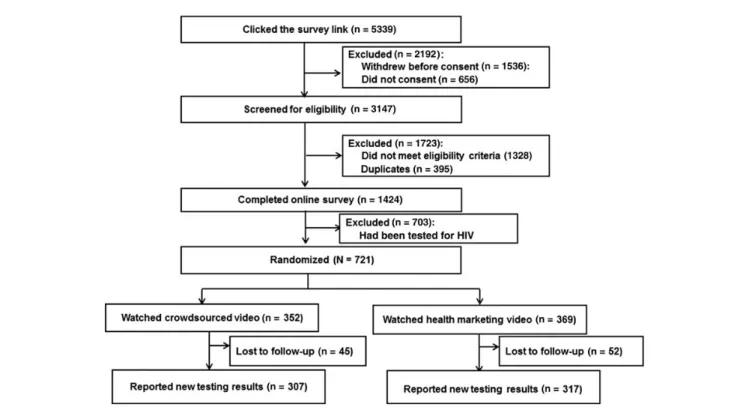
Overall, the study link was clicked 5339 times. Of these, 1536 withdrew from the survey prior to reading the consent form
and 656 were excluded for not signing the consent form. Among the remaining 3147 clicks, 1328 did not meet eligibility requirements, and 395 duplicates were excluded (by checking recorded phone numbers). A total of 1424 persons completed the online survey, including 721 (51%) participants who had never been tested for HIV. Of these 721 individuals, 352 were randomly assigned to the crowdsourced intervention and 369 to the health marketing intervention (Figure1).
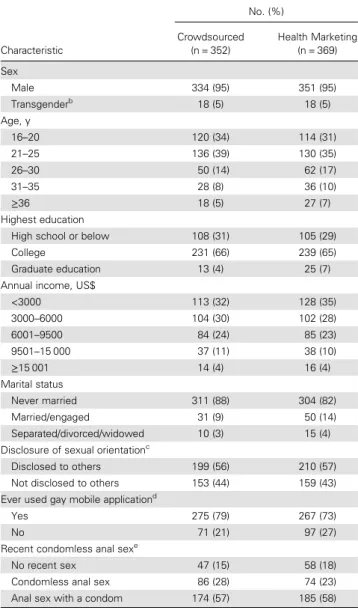
Participants accessed the video evaluation survey from 31 provinces in 217 cities (Supplementary Data E). A majority of participants were between 16 and 25 years old (69%), had dis-closed their sexual orientation (57%), had a college degree or higher (70%), were never married (85%), and used gay mobile applications tofind sex partners (76%). Almost all participants (95%) identified as men and the rest identified as women or transgender. Nearly a third of participants (31%) who had sex in the previous 6 months reported condomless anal sex with their most recent partner. Demographics and behaviors were similar between the 2 randomly assigned study arms (Table1).
Primary HIV Testing Outcome
Of the 721 participants, 624 (87%) replied to the text message. Response rates were similar between the 2 study arms (crowd-sourcing, 87% [307/352]; health marketing, 86% [317/369]). Of the 624 total respondents, 225 (36%) reported having tested for HIV within 4 weeks after watching their assigned HIV test pro-motion video. In the crowdsourced intervention arm, 114 of 307 (37%) reported testing for HIV compared with 111 of 317 (35%) in the health marketing arm. For the complete case analysis, the estimated difference in proportions between arms was 2.1% (95% CI,−5.4% to 9.7%). Using multiple imputation, the esti-mated difference in proportions was 3.1% (95% CI,−4.5% to 10.7%) (Table 2). In both analyses, the CI included values below the prespecified noninferiority margin of−3%, so nonin-feriority was not demonstrated. Of those who tested for HIV, 30.6% reported a positive test.
We assessed the differences in proportions tested between the crowdsourced and health marketing arms using effect Table 1. Baseline Characteristics of Study Participants Recruited Into
the Randomized Controlled Trial in China, 2014 (N = 721)a
No. (%)
Characteristic
Crowdsourced (n = 352)
Health Marketing (n = 369)
Sex
Male 334 (95) 351 (95)
Transgenderb
18 (5) 18 (5)
Age, y
16–20 120 (34) 114 (31)
21–25 136 (39) 130 (35)
26–30 50 (14) 62 (17)
31–35 28 (8) 36 (10)
≥36 18 (5) 27 (7)
Highest education
High school or below 108 (31) 105 (29)
College 231 (66) 239 (65)
Graduate education 13 (4) 25 (7)
Annual income, US$
<3000 113 (32) 128 (35)
3000–6000 104 (30) 102 (28)
6001–9500 84 (24) 85 (23)
9501–15 000 37 (11) 38 (10)
≥15 001 14 (4) 16 (4)
Marital status
Never married 311 (88) 304 (82)
Married/engaged 31 (9) 50 (14)
Separated/divorced/widowed 10 (3) 15 (4)
Disclosure of sexual orientationc
Disclosed to others 199 (56) 210 (57)
Not disclosed to others 153 (44) 159 (43)
Ever used gay mobile applicationd
Yes 275 (79) 267 (73)
No 71 (21) 97 (27)
Recent condomless anal sexe
No recent sex 47 (15) 58 (18)
Condomless anal sex 86 (28) 74 (23)
Anal sex with a condom 174 (57) 185 (58)
a
The baseline characteristics are shown for individuals who had never tested for human immunodeficiency virus and were thus eligible for the randomized video intervention.
b
Born biologically male and now identify as female or transgender.
c
Has told anyone besides sexual partner about their sexual orientation or sexual behaviors.
d
Eleven participants were missing data for ever used gay mobile application.
e
Only for those who reported condomless anal sex with most recent partner in previous 3 months.
Table 2. Noninferiority Analysis of Randomized Controlled Trial in China, 2014 (N = 721)a
Video Tested, No. (%)
Difference in
Proportions, % 95% CI, %
Complete-record analysis (n = 624)
Crowdsourced 114/307 (37.1) 2.1 (−5.4 to 9.7)
Health marketing 111/317 (35.0)
Multiple imputation analysis (n = 721)b
Crowdsourced 132/352 (37.5) 3.1 (−4.5 to 10.7)
Health marketing 127/369 (34.4)
Abbreviation: CI, confidence interval.
a
Noninferiority analysis assessed the difference in proportions of human immunodeficiency virus testing between crowdsourced and health marketing interventions.
b
modification (Table3). There was no significant effect modifi -cation between interventions for video watching frequency (P= .30), Web portal (P= .20), and recent condomless sex be-havior (P= .77) (Table3). Participants who saw their assigned video more than once were more likely to report HIV test up-take compared with participants who saw the video only once. For example, those who watched the crowdsourced video more than once were more likely to test for HIV compared with those who watched the crowdsourced video only once, with a risk dif-ference of 25.8% (95% CI, 15.0%–36.7%) (the associations be-tween baseline covariates and multitime video watching are presented inSupplementary Data F).
Secondary Outcomes
A Cochran-Armitage trend test for the change in likelihood of HIV testing before and following the respective videos did not detect a significant difference between the 2 interventions.
Table4shows the results of the costing analysis, including total and incremental unit cost per person tested and HIV-infected person identified in each group, the ratio between the 2 groups, and the cost saved by the crowdsourced method.
The total cost for the crowdsourced group was $14 926 (all values shown as US dollars), which was lower than the health marketing group ($26 358), with a cost savings of $11 432. The incremental unit cost for promoting HIV testing among MSM and transgender individuals in China was $131 in the crowdsourced group and $238 in the health marketing group (45% reduction) (Table 4). The incremental unit costs per newly diagnosed HIV infection in the crowdsourced group and health marketing group were $415 and $799, respectively (48% reduction).
DISCUSSION
Our nationwide study spanned 31 provinces and 217 cities in China, identifying MSM with sociodemographic and risk behav-iors similar to that of a nationwide survey of >40 000 MSM [17]. We found that a crowdsourced HIV testing campaign, despite not meeting the noninferiority hypothesis, was largely successful in promotingfirst-time HIV testing among MSM and transgen-der individuals compared with a health marketing campaign. Promoting HIV testing among key populations is a major global Table 3. Subanalyses of Crowdsourced and Health Marketing Interventions in Randomized Controlled Trial in China, 2014
Subgroup
Crowdsourced Tested/Total, No. (%)
Health Marketing Tested/Total, No. (%)
Difference in Proportions, % (95% CI)
PValue for Interactiona
Video watching
Multitime 66/126 (52) 67/151 (44) 8 (−4 to 20) .30
First time 48/181 (27) 44/166 (27) 0 (−27 to 27) . . .
Web portal
Northern portal 106/280 (38) 90/266 (34) 4 (−4 to 12) .20
Other portalsb
8/27 (30) 21/51 (41) −11 (−32 to 11) . . .
Condomless sexc
No recent sex 36/83 (43) 33/94 (35) 8 (−6 to 22) .77
Condomless anal sex 28/71 (39) 26/62 (42) −3 (−19 to 14) . . .
Anal sex with a condom 50/153 (33) 52/161 (32) 1 (−10 to 11) . . .
Abbreviation: CI, confidence interval.
a
Wald test.
b
Southern and eastern portals combined.
c
Reported condomless anal sex with most recent partner in last 6 months, n = 624.
Table 4. Costing Data Associated With the 2 Interventions in China, 2014a
Cost Crowdsourced (n = 352) Health Marketing (n = 369) Cost Savingsb
Ratioc
Total cost, US$ 14 926 26 358 11 432 0.56
Follow-up results
No. of testers 114 111 NA NA
No. of HIV-infected cases 36 33 NA NA
Cost per person tested, US$ 131 238 107 0.55
Cost per new HIV-infected case identified, US$ 415 799 384 0.52
Abbreviations: HIV, human immunodeficiency virus; NA, not applicant.
a
Costing data per person tested and per HIV-positive individual identified by using crowdsourced and health marketing interventions among men who have sex with men and transgender individuals.
b
Cost savings was calculated as cost in health marketing arm minus cost in crowdsourcing arm.
c
health priority [29]. However, most campaigns focused on im-proving HIV testing among key populations have shown limited capacity to reach hidden populations [30] and have limited com-munity engagement [10,29]. Our data extend previous research promoting HIV testing among key populations by using a ran-domized study design, measuringfirst-time testing, calculating cost, and expediting recruitment using online MSM portals. One of the 3 Web portals recruited 1100 participants in only 72 hours. Our study expands the limited literature on crowd-sourcing [31] and is thefirst randomized clinical trial evaluating crowdsourcing methods to improve a health outcome. Our study suggests that crowdsourcing generates innovative health messages and may increase community engagement [32].
Our study was able to effectively reach a large number of high-risk MSM who had never received an HIV test before and never told their doctor about their sexual orientation. While several previous HIV testing interventions have effectively reached men already engaged in health systems [33], few inter-ventions have focused on or been able to reach the subset of MSM who do not disclose their sexuality. In our sample, almost half of the men (43%) had never disclosed their sexual orien-tation to anyone (except sex partners), such as a physician or health professional. This highlights the power of the Internet as a tool for reaching subsets of key populations who may not disclose their sexual orientation or seek formal facility-based services. The observation that the Internet may be a useful tool for recruiting high-risk, closeted MSM is consistent with re-search from Peru [34] and the United States [35].
Our results also suggest that crowdsourcing may be a cost-saving tool for increasing key population engagement in HIV services provision. In our study, the cost of a crowdsourced inter-vention was approximately half that of the cost of a health mar-keting intervention ($14 926 vs $26 358). The cost to identify new HIV cases in our study was higher than the cost described in South Africa [36], but lower than costing studies in the United States [37] and Spain [38]. However, our study did not quantify the organizational capacity building accrued to the community-based organizations that submitted videos, data that might be useful in structuring HIV testing programs in the future. As in-ternational HIV funding decreases around the world, communi-ty-based organizations are increasingly resource constrained and may benefit from the additional capacity building resulting from crowdsourcing to enhance service delivery.
Our study has several limitations. First, both video inter-ventions were brief and relatively simple. Yet other research suggests that the effect of such videos on testing would be observable soon after viewing [16]. We anticipate that such a media intervention would be one component of a com-prehensive HIV intervention package. Second, we did not col-lect testing or biological data to verify text message self-reports. Nevertheless, previous studies have demonstrated text messages to reliably correlate with health outcomes and sexual behaviors
[39,40]. Third, 13% of participants did not respond to our text message and this could introduce bias. However, the responders and nonresponders were similar in sociodemographics and risk behaviors, and the imputation results accounting for non-response closely matched the complete case data. Finally, the prespecified noninferiority criteria was not met because self-reported testing rates in both groups were much higher than an-ticipated, resulting in a wider than planned CI for the difference in proportions HIV tested.
Our results suggest the potential for crowdsourcing to spur creative, new ideas for improving health and engaging communi-ties. Our initialfindings and research methods should be further expanded with larger and more powerful studies in the future. In addition, future qualitative studies should further investigate factors influencing our results to aid in adaptation of these approaches to new situations. This new tool may be especially useful in low- and middle-income countries where civil society organizations are often constrained or less able to directly inform public health programs. Crowdsourcing contests may help create more engaging, effective, and creative campaigns.
Supplementary Data
Supplementary materialsare available athttp://cid.oxfordjournals.org. Consisting of data provided by the author to benefit the reader, the posted materials are not copyedited and are the sole responsibility of the author, so questions or comments should be addressed to the author.
Notes
Acknowledgments. We thank Dr Ying-Ru Lo, Dr Pengfei Zhao, Dr Peter Vickerman, Dr Kate Mitchell, Ben Cheng, Dr Kate Muessig, Thomas Cai, Dee Poon, Gang Meng, Lloyd Chao, Richard Youngblood, and Kit Hung for their support. We thank all the study participants and staff mem-bers at SESH Global, Danlan, Jiangsu Tongzhi, Yunnan Tongzhi and the Guangdong Provincial Center for Skin Diseases and STI Control who con-tributed. A complete list of acknowledgements is available in Supplementary Data D.
Disclaimer. The listed grant funders played no role in any step of this study.
Financial support. This work was supported by the National Institute of Allergy and Infectious Diseases (NIAID), US National Institutes of Health (1R01AI114310-01 to J. T. and C. W.); University of North Carolina (UNC)–South China STD Research Training Centre (Fogarty International Center grant number 1D43TW009532-01 to J. T.); UNC Center for AIDS Re-search (NIAID grant number 5P30AI050410-13 to J. T., K. M., and M. H.); University of California, San Francisco Center for AIDS Research (NIAID grant number P30 AI027763 to C. W. and P. V.); National Institute of Mental Health (grant number R00MH093201 to C. W.); and the UNC Chapel Hill, Johns Hopkins University, Morehead School of Medicine, and Tulane Univer-sity Fogarty Fellowship (FIC grant number R25TW0093 to W. T.). This pub-lication was supported by the National Center for Advancing Translational Sciences at the National Institutes of Health (grant number UL1TR001111).
Potential conflicts of interest. All authors: No reported conflicts. All authors have submitted the ICMJE Form for Disclosure of Potential
Con-flicts of Interest. Conflicts that the editors consider relevant to the content of the manuscript have been disclosed.
References
1. Galton F. Vox populi. Nature1907; 75:450–1.
2. Surowiecki J. The wisdom of crowds. New York: Anchor,2005.
4. Prill RJ, Saez-Rodriguez J, Alexopoulos LG, Sorger PK, Stolovitzky G. Crowd-sourcing network inference: the DREAM predictive signaling network challenge. Sci Signal2011; 4:mr7.
5. Smith S, Ward T, Schumacher J. Constraining effects of examples in a creative gen-eration task. Mem Cogn1993; 21:837–45.
6. Marsh R, Landau JJ, Hicks J. How examples may (and may not) constrain creativ-ity. Mem Cogn1996; 24:669–80.
7. Lorenc T, Marrero-Guillamón I, Llewellyn A, et al. HIV testing among men who have sex with men (MSM): systematic review of qualitative evidence. Health Educ Res2011; 26:834–46.
8. World Health Organization. Consolidated guidelines on HIV prevention, diagno-sis, treatment and care for key populations.2014.
9. Rhodes SD, Vissman AT, Stowers J, et al. A CBPR partnership increases HIV testing among men who have sex with men (MSM): outcomefindings from a pilot test of the CyBER/testing internet intervention. Health Educ Behav2011; 38:311–20.
10. Wei C, Herrick A, Raymond HF, Anglemyer A, Gerbase A, Noar SM. Social market-ing interventions to increase HIV/STI testmarket-ing uptake among men who have sex with men and male-to-female transgender women. Cochrane Database Syst Rev2011; 9: CD009337.
11. Trapence G, Collins C, Avrett S, et al. From personal survival to public health: community leadership by men who have sex with men in the response to HIV. Lancet2012; 380:400–10.
12. Bemelmans M, Van Den Akker T, Ford N, et al. Providing universal access to an-tiretroviral therapy in Thyolo, Malawi through task shifting and decentralization of HIV/AIDS care. Trop Med Int Health2010; 15:1413–20.
13. Callaghan M, Ford N, Schneider H. A systematic review of task- shifting for HIV treatment and care in Africa. Hum Resour Health2010; 8:8.
14. Selke HM, Kimaiyo S, Sidle JE, et al. Task-shifting of antiretroviral delivery from health care workers to persons living with HIV/AIDS: clinical outcomes of a community-based program in Kenya. J Acquir Immune Defic Syndr2010; 55:483–90.
15. Zhang Y, Kim J, Liu F, et al. Creative contributory contests (CCC) to spur inno-vation in sexual health: two cases and a guide for implementation. Sex Transm Dis 2015; 42:625–8.
16. Vidanapathirana J, Abramson M, Forbes A, Fairley C. Mass media interventions for promoting HIV testing: cochrane systematic review. Int J Epidemiol2006; 35:233–4.
17. Wu Z, Xu J, Liu E, et al. HIV and syphilis prevalence among men who have sex with men: a cross-sectional survey of 61 cities in China. Clin Infect Dis2013; 57:298–309.
18. World Health Organization/Joint United Nations Programme on HIV/AIDS. Eth-ical considerations in biomedEth-ical HIV prevention trials. Geneva, Switzerland: WHO/UNAIDS,2012.
19. Khan J, Lone D, Hameed A. Evaluation of the performance of two rapid immu-nochromatographic tests for detection of hepatitis B surface antigen and anti HCV antibodies using ELISA tested samples. AKEMU2010; 16:84–7.
20. Tucker JD, Muessig KE, Cui R, et al. Organizational characteristics of HIV/syphilis testing services for men who have sex with men in south China: a social entrepre-neurship analysis and implications for creating sustainable service models. BMC Infect Dis2014; 14:601.
21. Eysenbach G. Improving the quality of Web surveys: the Checklist for Reporting Results of Internet E-Surveys (CHERRIES). J Med Internet Res2004; 6:e34.
22. Eysenbach G, Group C-E. CONSORT-EHEALTH: improving and standardizing evaluation reports of Web-based and mobile health interventions. J Med Inter Res2011; 13:e126.
23. Plint AC, Moher D, Morrison A, et al. Does the CONSORT checklist improve the quality of reports of randomised controlled trials? A systematic review. Med J Aust 2006; 185:263.
24. Matsumoto M, Nishimura T. Mersenne twister: a 623-dimensionally equidistrib-uted uniform pseudo-random number generator. ACM Trans Mod Comput Simul (TOMACS)1998; 8:3–30.
25. Choi KH, Lui H, Guo Y, Han L, Mandel JS. Lack of HIV testing and awareness of HIV infection among men who have sex with men, Beijing, China. AIDS Edu Prev 2006; 18:33–43.
26. Han L, Bien CH, Wei C, et al. HIV self-testing among online MSM in China: im-plications for expanding HIV testing among key populations. J Acquir Immune Defic Syndr2014; 67:216–21.
27. Agresti A, Kateri M. Categorical data analysis. Berlin, Heidelberg: Springer,2011. 28. Husereau D, Drummond M, Petrou S, et al. Consolidated health economic
eval-uation reporting standards (CHEERS) statement. BMC Med2013; 11:80. 29. Lorenc T, Marrero-Guillamón I, Aggleton P, et al. Promoting the uptake of HIV
testing among men who have sex with men: systematic review of effectiveness and cost-effectiveness. Sex Transm Infect2011; 87:272–8.
30. Sullivan PS, Carballo-Diéguez A, Coates T, et al. Successes and challenges of HIV prevention in men who have sex with men. Lancet2012; 380:388–99. 31. Jeff H. Crowdsourcing: why the power of the crowd is driving the future of
busi-ness. New York: Random House,2009.
32. Ranard BL, Ha YP, Meisel ZF, et al. Crowdsourcing—harnessing the masses to ad-vance health and medicine. A systematic review. J Gen Intern Med2014; 29:187–203.
33. De Rosa CJ, Marks G. Preventive counseling of HIV-positive men and self-disclo-sure of serostatus to sex partners: new opportunities for prevention. Health Psy-chol1998; 17:224.
34. Young SD, Cumberland WG, Nianogo R, Menacho LA, Galea JT, Coates T. The HOPE social media intervention for global HIV prevention in Peru: a cluster rand-omised controlled trial. Lancet HIV2014; 2:e27–32.
35. Salyers Bull S, Lloyd L, Rietmeijer C, McFarlane M. Recruitment and retention of an online sample for an HIV prevention intervention targeting men who have sex with men: the Smart Sex Quest Project. AIDS Care2004; 16:931–43.
36. Hausler HP, Sinanovic E, Kumaranayake L, et al. Costs of measures to control tu-berculosis/HIV in public primary care facilities in Cape Town, South Africa. Bull World Health Organ2006; 84:528–36.
37. Golden MR, Gift TL, Brewer DD, et al. Peer referral for HIV case-finding among men who have sex with men. AIDS2006; 20:1961–8.
38. Gomez-Ayerbe C, Elías MJP, Muriel A, et al. Incremental cost per newly diagnosed HIV infection (NDHI): routine (RTS), targeted (TTS), and current clinical practice testing strategies (CPTS). J Intern AIDS Soc2014; 17(4 suppl 3): 19606.
39. Lim MS, Sacks-Davis R, Aitken CK, Hocking JS, Hellard ME. Randomised controlled trial of paper, online and SMS diaries for collecting sexual behaviour information from young people. J Epidemiol Community Health2010; 64: 885–9.