PUID WG [email protected]
ALERT NOTIFICATION SERVICE
Abstract:
Alert Notification service exposes
The different types of alerts with the short text messages,
The count of new alert messages,
Revision History
Revision Date (yyyy-mm-dd) Comments
D09r01 2010-11-14 The first draft
D09r02 2011-03-08 Texts and figures are updated. D09r03 2011-05-27 Deleted Supported Alert Subcategory D09r04 2011-06-01 Removed last traces of old architecture
D09r05 2011-06-12 Several edits in F2F. Most notably refine and future proof categories
D09r06 2011-06-24 Update the characteristic usage. D09r07 2011-07-05 Updated to answer comments
D09r08 2011-07-20 Delete “Both” command for Alert Notification Control Point. Add the explanation to Notify immediately command.
D09r10 2011-07-28 Clean version before final WG review
D09r11 2011-08-01 Lots of editorial/document readability edits. Moved behavior from characteristics to service.
D09r12 2011-08-10 Final cleanup of drawing in appendix. Fixed UUID of service D09r13 2011-08-18 Responded to Barb and GPA reviewers
D09r14 2011-08-18 Fixed figure 4-1 and section 1.3 as requested by Len. D09r15 2011-08-20 Responded to some additional comments from Terry D09r16 2011-08-24 Responded to comments from Tim during vote. V09r00 2011-08-29 Adopted prototype specification
D10r01 2011-09-02 First Draft D10, one typo fixed
V10r00 2011-09-15 Adopted by the Bluetooth SIG Board of Directors
Contributors
Name Company
Shunsuke Koyama Seiko Epson
Daisuke Matsuoh Citizen
Satomi Michitsuta Casio
Steve Davies Nokia
Disclaimer and Copyright Notice
The copyright in this specification is owned by the Promoter Members of Bluetooth® Special Interest Group (SIG), Inc. (“Bluetooth SIG”). Use of these specifications and any related intellectual property (collectively, the
“Specification”), is governed by the Promoters Membership Agreement among the Promoter Members and
Bluetooth SIG (the “Promoters Agreement”), certain membership agreements between Bluetooth SIG and its Adopter and Associate Members (the “Membership Agreements”) and the Bluetooth Specification Early Adopters Agreements (1.2 Early Adopters Agreements) among Early Adopter members of the unincorporated
Bluetooth SIG and the Promoter Members (the “Early Adopters Agreement”). Certain rights and obligations of
the Promoter Members under the Early Adopters Agreements have been assigned to Bluetooth SIG by the Promoter Members.
Use of the Specification by anyone who is not a member of Bluetooth SIG or a party to an Early Adopters Agreement (each such person or party, a “Member”), is prohibited. The legal rights and obligations of each Member are governed by their applicable Membership Agreement, Early Adopters Agreement or Promoters Agreement. No license, express or implied, by estoppel or otherwise, to any intellectual property rights are granted herein.
Any use of the Specification not in compliance with the terms of the applicable Membership Agreement, Early Adopters Agreement or Promoters Agreement is prohibited and any such prohibited use may result in termination of the applicable Membership Agreement or Early Adopters Agreement and other liability permitted by the applicable agreement or by applicable law to Bluetooth SIG or any of its members for patent, copyright and/or trademark infringement.
THE SPECIFICATION IS PROVIDED “AS IS” WITH NO WARRANTIES WHATSOEVER, INCLUDING ANY WARRANTY OF MERCHANTABILITY, NONINFRINGEMENT, FITNESS FOR ANY PARTICULAR PURPOSE, SATISFACTORY QUALITY, OR REASONABLE SKILL OR CARE, OR ANY WARRANTY ARISING OUT OF ANY COURSE OF DEALING, USAGE, TRADE PRACTICE, PROPOSAL, SPECIFICATION OR SAMPLE.
Each Member hereby acknowledges that products equipped with the Bluetooth technology ("Bluetooth
products") may be subject to various regulatory controls under the laws and regulations of various governments worldwide. Such laws and regulatory controls may govern, among other things, the combination, operation, use, implementation and distribution of Bluetooth products. Examples of such laws and regulatory controls include, but are not limited to, airline regulatory controls, telecommunications regulations, technology transfer controls and health and safety regulations. Each Member is solely responsible for the compliance by their
Bluetooth Products with any such laws and regulations and for obtaining any and all required authorizations, permits, or licenses for their Bluetooth products related to such regulations within the applicable jurisdictions. Each Member acknowledges that nothing in the Specification provides any information or assistance in connection with securing such compliance, authorizations or licenses. NOTHING IN THE SPECIFICATION CREATES ANY WARRANTIES, EITHER EXPRESS OR IMPLIED, REGARDING SUCH LAWS OR REGULATIONS.
ALL LIABILITY, INCLUDING LIABILITY FOR INFRINGEMENT OF ANY INTELLECTUAL PROPERTY RIGHTS OR FOR NONCOMPLIANCE WITH LAWS, RELATING TO USE OF THE SPECIFICATION IS EXPRESSLY DISCLAIMED. BY USE OF THE SPECIFICATION, EACH MEMBER EXPRESSLY WAIVES ANY CLAIM AGAINST BLUETOOTH SIG AND ITS PROMOTER MEMBERS RELATED TO USE OF THE SPECIFICATION.
Bluetooth SIG reserve the right to adopt any changes or alterations to the Specification as it deems necessary or appropriate.
Copyright © 2013. Bluetooth SIG Inc. All copyrights in the Bluetooth specifications themselves are owned by Ericsson AB, Lenovo (Singapore) Pte. Ltd., Intel Corporation, Microsoft Corporation, Motorola Mobility, Inc., Nokia Corporation, and Toshiba Corporation. *Other third-party brands and names are the property of their respective owners.
Document Terminology
The Bluetooth SIG has adopted Section 13.1 of the IEEE Standards Style Manual, which dictates use of the words ``shall’’, ``should’’, ``may’’, and ``can’’ in the
development of documentation, as follows:
The word shall is used to indicate mandatory requirements strictly to be followed in order to conform to the standard and from which no deviation is permitted (shall equals
is required to).
The use of the word must is deprecated and shall not be used when stating mandatory requirements; must is used only to describe unavoidable situations.
The use of the word will is deprecated and shall not be used when stating mandatory requirements; will is only used in statements of fact.
The word should is used to indicate that among several possibilities one is
recommended as particularly suitable, without mentioning or excluding others; or that a certain course of action is preferred but not necessarily required; or that (in the negative form) a certain course of action is deprecated but not prohibited (should equals is
recommended that).
The word may is used to indicate a course of action permissible within the limits of the standard (may equals is permitted).
The word can is used for statements of possibility and capability, whether material, physical, or causal (can equals is able to).
Table of Contents
1 Introduction ... 6
1.1 Conformance ... 6
1.2 Service Dependency ... 6
1.3 Bluetooth Specification Release Compatibility ... 6
1.4 GATT Sub-Procedure Requirements ... 6
1.5 Transport Dependencies ... 6 1.6 Error Codes ... 7 1.7 Concepts ... 7 1.7.1 Category ID ... 7 1.7.2 New Alert ... 7 1.7.3 Unread Alert ... 8 2 Service Declaration ... 9 3 Service Characteristics ... 10
3.1 Supported New Alert Category ... 11
3.1.1 Characteristic Behavior ... 11
3.2 New Alert ... 11
3.2.1 Characteristic Behavior ... 11
3.2.2 Characteristic Descriptors ... 11
3.3 Supported Unread Alert Category ... 12
3.3.1 Characteristic Behavior ... 12
3.4 Unread Alert Status ... 12
3.4.1 Characteristic Behavior ... 12
3.4.2 Characteristic Descriptors ... 12
3.5 Alert Notification Control Point ... 12
3.5.1 Characteristic Behavior ... 12
3.5.2 Error Handling ... 13
4 Service Behaviors ... 14
4.1.1 Alert Notification Control Point Command Behavior ... 14
4.1.2 New Alert Notification Behavior ... 14
4.1.3 Unread Alert Status Notification Behavior ... 15
5 Acronyms and Abbreviations ... 17
6 References ... 18
Appendix A Example Implementation ... 19
Appendix B Controlling Notifications with the Client Characteristic Configuration and Control Point Commands ... 21
1
Introduction
The Alert Notification service exposes alert information in a device. This information includes the following:
Type of alert occurring in a device
Additional text information such as caller ID or sender ID Count of new alerts
Count of unread alert items.
1.1 Conformance
If a server claims conformance to this service, all capabilities indicated as mandatory for this service shall be supported in the specified manner (process-mandatory). This also applies for all optional and conditional capabilities for which support is indicated. All mandatory capabilities, and optional and conditional capabilities for which support is indicated, are subject to verification as part of the Bluetooth qualification program.
1.2 Service Dependency
This service has no dependencies on other GATT-based services.
1.3
Bluetooth
Specification Release Compatibility
This is compatible with any Bluetooth core specification host [1] that includes the
Generic Attribute Profile (GATT) and the Bluetooth Low Energy Controller specification.
1.4 GATT Sub-Procedure Requirements
Additional GATT sub-procedures requirements beyond those required by GATT are indicated in Table 1.1.
GATT Sub-Procedure Requirements
Write Characteristic Value M
Notification M
Read Characteristic Descriptors M Write Characteristic Descriptors M
Table 1.1: GATT Sub-Procedure Requirement
1.5 Transport Dependencies
1.6 Error Codes
The following error code is defined in this service:
Error Code Descriptions
0xA0 Command not supported.
Table 1.2: Error code
1.7 Concepts
1.7.1 Category ID
In the Alert Notification service, the concept of Category ID is used to identify the type of alert information.
The category ID is represented as a one-octet unsigned integer in commands and notifications that relate to one category or it is represented as a bit map for
characteristics that expose capabilities for multiple categories.
The format of the Category ID is defined in [2] as Alert Category ID characteristic (unsigned octet representation) and Alert Category ID Bit Mask characteristic (bit map representation).
1.7.2 New Alert
When a server device has new messages or an alarm is set off, it will normally alert the user via its UI. If more messages or alarms happen before the user interacts with the server device, the UI normally keeps a count of these events. The count shall be decremented when the user acknowledges the alert(s) through a UI function on the server device. This count is referenced in this service specification as ‘count of new alerts’.
1.7.3 Unread Alert
For messages like email and SMS the server device normally keeps a count of how many messages have not been read by the user. The count of the messages that have not been read by the user is referenced in this service specification as ‘count of unread alerts’.
2
Service Declaration
The Alert Notification service shall be instantiated as a «Primary Service». The service UUID shall be set to «Alert Notification Service».
The UUID value assigned to «Alert Notification Service» is defined in [2]. There shall be one instance of the Alert Notification Service on a device.
3
Service Characteristics
The Alert Notification service shall expose the following characteristics:
Figure 3.1: Diagram of the Alert Notification service
Characteristic Ref. Mandatory / Optional
Supported New Alert Category 3.1 M
New Alert 3.2 M
Supported Unread Alert Category 3.3 M
Unread Alert Status 3.4 M
Alert Notification Control Point 3.5 M
Table 3.1: Service Characteristics
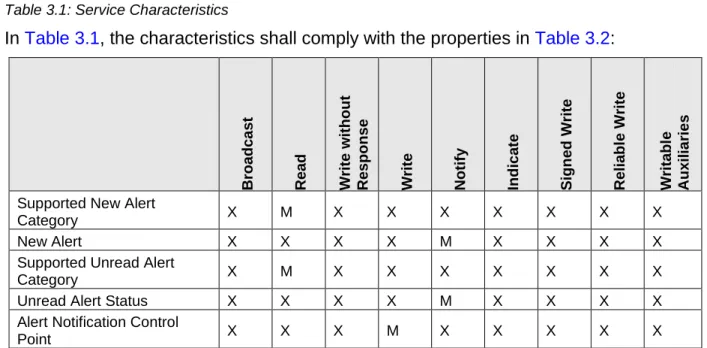
In Table 3.1, the characteristics shall comply with the properties in Table 3.2:
Broadca st Read Wr it e w it h o u t Respo n se W rit e No tif y Ind ica te S ign ed W rit e Relia b le W rit e W rit abl e Au xil ia rie s
Supported New Alert
Category X M X X X X X X X
New Alert X X X X M X X X X
Supported Unread Alert
Category X M X X X X X X X
Unread Alert Status X X X X M X X X X
Alert Notification Control
Point X X X M X X X X X
Table 3.2: Characteristic Properties
Requirements marked with ‘M’ are mandatory, ‘O’ are optional and ‘X’ are excluded (not permitted).
There shall be one instance of the Supported New Alert Category characteristic in an Alert Notification service.
There shall be one instance of the New Alert characteristic in an Alert Notification service.
There shall be one instance of the Supported Unread Alert Category characteristic in an Alert Notification service.
There shall be one instance of the Unread Alert Status characteristic in an Alert Notification service.
There shall be one instance of the Alert Notification Control Point characteristic in an Alert Notification service.
3.1 Supported New Alert Category
This characteristic is a bit map showing which categories of new alert are supported and which are not.
3.1.1 Characteristic Behavior
This characteristic can be read using the GATT Read Characteristic Value sub-procedure.
The characteristic is a bit mask with one bit for each category. For each category the server device supports, it shall set the corresponding bit in the bit mask.
The server shall support at least one category.
The value of this characteristic shall not change while in a connection. An example is shown in Appendix A.
3.2 New Alert
This characteristic provides the count of new alerts (for a given category) in the server.
3.2.1 Characteristic Behavior
This characteristic can be configured for notification using the GATT Write
Characteristic Descriptors sub-procedure on the Client Characteristic Configuration
descriptor. When configured for notification, this characteristic can be notified while in a connection; see Section 4.1.2.
3.2.2 Characteristic Descriptors 3.2.2.1 Client Characteristic Descriptor
The Client Characteristic Configuration descriptor shall be included in this characteristic. This descriptor shall be readable and writable.
This descriptor can be read using the GATT Read Characteristic Descriptors sub-procedure.
This descriptor can be written using the GATT Write Characteristic Descriptors sub-procedure.
3.3 Supported Unread Alert Category
This characteristic is a bit map showing which categories of unread alert events are supported and which are not.
3.3.1 Characteristic Behavior
This characteristic can be read using the GATT Read Characteristic Value sub-procedure.
The characteristic is a bit mask with one bit for each category. For each alert category that the server supports an unread message count, it shall set the corresponding bit in the bit mask.
The value of this characteristic shall not change while in a connection. An example is shown in Appendix A.
3.4 Unread Alert Status
This characteristic exposes the count of unread alert events existing in the server. The count of unread alert events is provided with the Category ID.
3.4.1 Characteristic Behavior
This characteristic can be configured for notification using the GATT Write
Characteristic Descriptors sub-procedure on the Client Characteristic Configuration
descriptor. When configured for notification, this characteristic can be notified while in a connection. See Section 4.1.3.
3.4.2 Characteristic Descriptors 3.4.2.1 Client Characteristic Descriptor
The Client Characteristic Configuration descriptor shall be included in this characteristic. This descriptor shall be readable and writable.
This descriptor can be read using the GATT Read Characteristic Descriptors sub-procedure.
This descriptor can be written using the GATT Write characteristic Descriptors sub-procedure.
3.5 Alert Notification Control Point
This characteristic allows the client device to enable/disable the alert notification of new alert and unread alert events more selectively than can be done by setting or clearing the notification bit in the Client Characteristic configuration for each alert characteristic.
3.5.1 Characteristic Behavior
This characteristic shall receive the command from the client when written using the GATT Write Characteristic Value sub-procedure. See Section 4.1.1.
3.5.2 Error Handling
If the server receives an invalid command, the server shall respond with the error code defined in Section 1.6 using ATTError Response.
4
Service Behaviors
4.1.1 Alert Notification Control Point Command Behavior
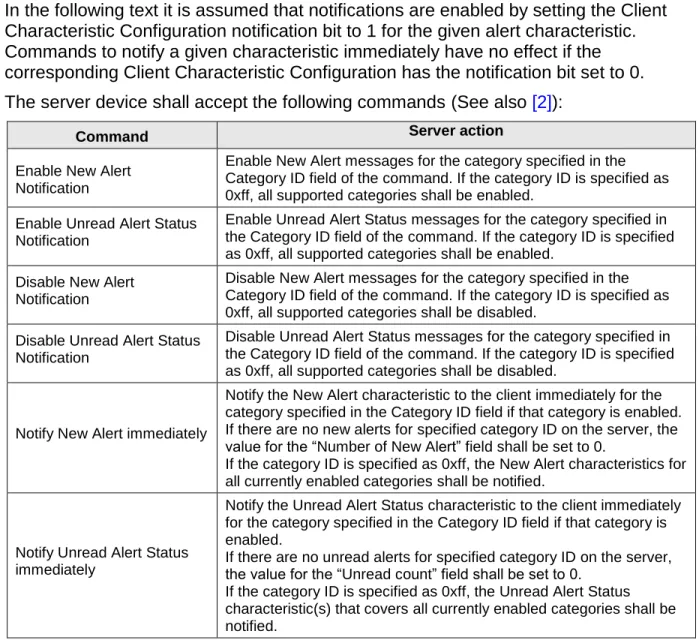
In the following text it is assumed that notifications are enabled by setting the Client Characteristic Configuration notification bit to 1 for the given alert characteristic. Commands to notify a given characteristic immediately have no effect if the corresponding Client Characteristic Configuration has the notification bit set to 0. The server device shall accept the following commands (See also [2]):
Command Server action
Enable New Alert Notification
Enable New Alert messages for the category specified in the Category ID field of the command. If the category ID is specified as 0xff, all supported categories shall be enabled.
Enable Unread Alert Status Notification
Enable Unread Alert Status messages for the category specified in the Category ID field of the command. If the category ID is specified as 0xff, all supported categories shall be enabled.
Disable New Alert Notification
Disable New Alert messages for the category specified in the Category ID field of the command. If the category ID is specified as 0xff, all supported categories shall be disabled.
Disable Unread Alert Status Notification
Disable Unread Alert Status messages for the category specified in the Category ID field of the command. If the category ID is specified as 0xff, all supported categories shall be disabled.
Notify New Alert immediately
Notify the New Alert characteristic to the client immediately for the category specified in the Category ID field if that category is enabled. If there are no new alerts for specified category ID on the server, the value for the “Number of New Alert” field shall be set to 0.
If the category ID is specified as 0xff, the New Alert characteristics for all currently enabled categories shall be notified.
Notify Unread Alert Status immediately
Notify the Unread Alert Status characteristic to the client immediately for the category specified in the Category ID field if that category is enabled.
If there are no unread alerts for specified category ID on the server, the value for the “Unread count” field shall be set to 0.
If the category ID is specified as 0xff, the Unread Alert Status characteristic(s) that covers all currently enabled categories shall be notified.
Table 4.1: Alert Notification Control Point commands
4.1.2 New Alert Notification Behavior
If a client has configured notifications on the New Alert characteristic, notifications shall be sent when the count of new alerts changes in the server for an enabled category or the server receives the command "Notify New Alert immediately" for an enabled
category via the Alert Notification Control Point.
After connection setup, the notifications for all categories shall be disabled. Control point commands (see 4.1.1) can be used to enable and disable categories.
The Number of New Alert field shall be set to the number of new alerts in the server. The Text String Information field may be set to text that is related to the last alert in the category being reported (see [2]).
If the text is longer than the maximum length defined by the characteristic definition [2], the text for the notification shall be truncated.
If multiple alert events occur in the same category, only one notification should be sent.
Figure 4.1: Number of new alerts in the New Alert characteristic
4.1.3 Unread Alert Status Notification Behavior
If a client has configured notifications on the Unread Alert Status characteristic,
notifications shall be sent when the count of unread alerts changes in the server for an enabled category or the server receives the command "Notify Unread Alert Status immediately" for an enabled category via the Alert Notification Control Point.
After connection setup, the notifications for all categories shall be disabled. Control point commands (see 4.1.1) can be used to enable and disable categories.
The Unread Alert information shall be formatted in two octets for one category as follows:
5
Acronyms and Abbreviations
Acronyms and
Abbreviations Meaning
GATT Generic Attribute Profile
LE Low Energy
ATT Attribute Protocol
6
References
[1] Bluetooth Core Specification v4.0
Appendix A
Example Implementation
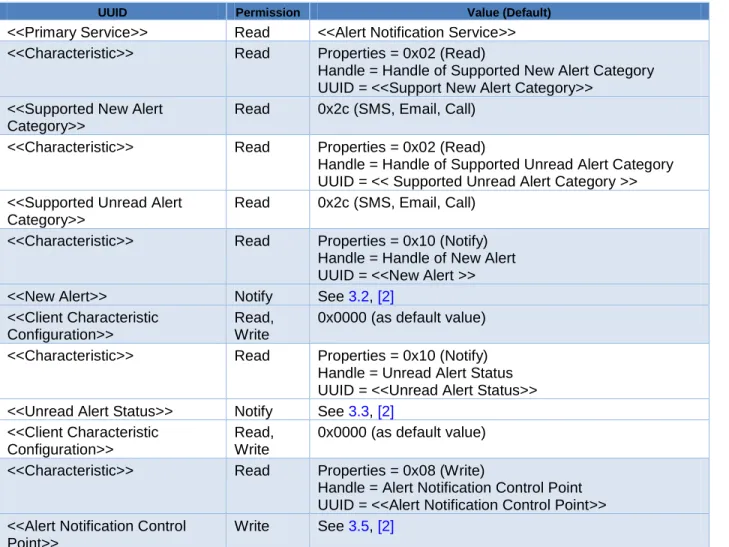
Figure 6.1 shows an example of exposing the characteristics of a device that is capable of SMS, Email and Incoming Call categories.
Table 6.1 is the attribute database for Alert Notification service shown in Figure 6.1.
UUID Permission Value (Default)
<<Primary Service>> Read <<Alert Notification Service>> <<Characteristic>> Read Properties = 0x02 (Read)
Handle = Handle of Supported New Alert Category UUID = <<Support New Alert Category>>
<<Supported New Alert Category>>
Read 0x2c (SMS, Email, Call) <<Characteristic>> Read Properties = 0x02 (Read)
Handle = Handle of Supported Unread Alert Category UUID = << Supported Unread Alert Category >> <<Supported Unread Alert
Category>>
Read 0x2c (SMS, Email, Call) <<Characteristic>> Read Properties = 0x10 (Notify)
Handle = Handle of New Alert UUID = <<New Alert >> <<New Alert>> Notify See 3.2, [2]
<<Client Characteristic Configuration>>
Read, Write
0x0000 (as default value) <<Characteristic>> Read Properties = 0x10 (Notify)
Handle = Unread Alert Status UUID = <<Unread Alert Status>> <<Unread Alert Status>> Notify See 3.3, [2]
<<Client Characteristic Configuration>>
Read, Write
0x0000 (as default value) <<Characteristic>> Read Properties = 0x08 (Write)
Handle = Alert Notification Control Point UUID = <<Alert Notification Control Point>> <<Alert Notification Control
Point>>
Write See 3.5, [2]
Appendix B
Controlling Notifications with the Client
Characteristic Configuration and Control Point Commands
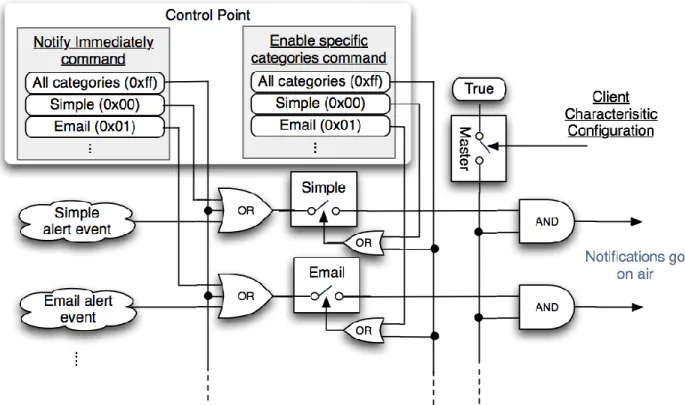
Figure 6.2 shows an overview of the relationship between the Client Characteristic Configuration descriptor and the configuration via the command from the Alert
Notification Control Point characteristic. This relationship is common for the New Alert characteristic and the Unread Alert Status characteristic.
The Client Characteristic Configuration (CCC) works as a “Master switch” for the notification. Even if the client writes the Notify Immediately commandor the count of new/unread alerts changes in the server, notifications shall not be sent to the client when the CCC is set to 0x0000.
Figure 6.2: Conceptual illustration of how notifications are controlled in the server.
The server also has a switch for each category like “Simple Alert,” “Email Alert,” and “Incoming Alert,” if the server is capable of these categories. The clients can set those switches by writing the Enable New Alert Notification command to the Alert Notification Control Point if the client wants to receive notifications of them.
If the client writes the Notify Immediately command with the value of ‘0xff’ to the Alert
Notification Control Point, notifications of categories that have been enabled by sending the Enable specific categories command are sent to the client (when the CCC is set to 0x0001 “Notify”).
Even if the client writes the Notify Immediately command to the Alert Notification Control Point for some specific categories, the server shall not send the notifications when the value of the CCC is 0x0000.
If the target category that is set by the client via the Alert Notification Control Point is not configured “Enable”, the server shall not send the notification for the category even if the CCC is set to 0x0001 “Notify”.