The Graduate School College of Education
THE RELATIONSHIP BETWEEN
WELL-STRUCTURED AND ILL-STRUCTURED
PROBLEM SOLVING IN MULTIMEDIA SIMULATION
A Thesis in Instructional Systems
by
Namsoo Shin Hong
Submitted in Partial Fulfillment of the Requirements
for the Degree of
Doctor of Philosophy
ABSTRACT
Problem solving, especially complicated ill-structured problem solving, has been a major concern in education. Research of the past decade provides qualitative ways of viewing the solving processes of ill-structured problems. Sinnott, Voss & Post, and
Jonassen suggested that ill-structured problem solving has to support new, more qualitative, components than those for solving well-structured problems.
This study set forth to test the theory that the problem-solving skills used for well-structured problems are necessary but not sufficient for solving ill-well-structured problems in the context of an ended, multimedia problem-solving environment. Two sets of open-ended questions were posed to reflect students’ solving skills in well-structured and ill-structured problems involving astronomy contexts.
Additionally, various instruments including domain-specific knowledge, structural knowledge, and justification skills were developed to measure students’ necessary cognitive components for solving problems. Finally, inventories such as science attitude, motivation in astronomy, knowledge of cognition, and regulation of cognition were employed to collect the appropriate data of metacognition and non-cognitive variables.
Generalized, judgmental scoring systems were developed using a quantitative index intended to reflect the extent to which subjects possessed solving skills as well as certain cognitive components of well-structured and ill-structured problems. The results of this study verified past research conclusions that well-structured and ill-structured problems require different necessary components for reaching successful solutions.
In overall, cognition, including domain-specific knowledge and structural
knowledge, and justification skills were critical components for successful solution in well-structured problem solving. Alternatively, metacognition, non-cognitive variables,
justification skills, as well as cognition, were found to be essential components needed to solve ill-structured problems. Implications for science education in a multimedia simulation environment, assessment on problem solving, and problem-solving research are presented.
TABLE OF CONTENTS
LIST OF TABLES VIII
LIST OF FIGURES X
ACKNOWLEDGMENTS XI
CHAPTER 1. INTRODUCTION 1
Rationale for Investigation ...1
Purpose of the Study ...1
Problem Statement...2
Confusion of Relationship between Well-Structured and Ill-Structured Problems...3
Limitations of Research Studies in Ill-Structured Problems...4
Significance of the Problem...5
Components of Well-Structured Problem Solving...8
Components of Ill-Structured Problem Solving...9
Research Questions ...9
CHAPTER 2. LITERATURE REVIEW 11 Well-Structured Problems ...11
Solving Process of Well-Structured Problems...12
Summary of Well-Structured Problem-Solving Processes ...13
Components for Solving Well-Structured Problems...14
Cognition...14
Metacognition...16
Ill-Structured Problems...17
Solving Process of Ill-Structured Problems...17
Representation Problems ...19
Solution Processes...20
Monitor and Evaluation...20
Summary of Ill-Structured Problem-Solving Processes...22
Components of Solving Ill-Structured Problems ...23
Cognition...23
Metacognition...24
Knowledge of cognition...25
Regulation of cognition...26
Non-Cognitive Variables...28
Justification Skills...29
Summary of Components for Solving Ill-Structured Problems ...30
Differences Between Well-Structured and Ill-Structured Problems...30
Research Hypotheses...33
Chapter Summary...35
CHAPTER 3. METHOD 36 Participants ...36
Research Design...37
Materials...37
Instructional Context...38
Metacognition Measures...39
Non-Cognitive Variables Measures ...41
Test of Science-Related Attitude ...41
Test of Motivation in Astronomy (TMA)...41
Problem-Solving Processes and Component Measures...43
Well-Structured Problem-Solving Processes Inventory (WPSPI)...44
Cognition Inventory (CI) ...48
Justification Inventory (JI)...48
Developing Scoring System...52
Construct Validity of Scoring System...52
Scoring of the Tests...55
Procedure...56
CHAPTER 4. RESULTS 58 Results of Well-Structured Problem Solving...58
Results of Near-Transfer Ill-Structured Problem Solving...61
Results of Far-Transfer Ill-Structured Problem Solving ...63
Summary of Results ...65
CHAPTER 5. DISCUSSION 66 Well-Structured Problem Solving...66
Ill-Structured Problem Solving ...68
Cognition...69
Metacognition...70
Non-Cognitive Variables...71
Justification Skills...72
Implication...74
Pedagogical Implication on Problem Solving...74
Assessment Implication on Problem Solving...75
Research Implication on Problem Solving ...77
REFERENCES 81
APPENDIX A. RESEARCH RECRUITMENT LETTER 92
A Recruitment Letter: Teachers...93
APPENDIX B. QUESTIONNAIRES 94 Student Questionnaire...95
How Do You Solve Problems...96
Test of Science-Related Attitude ...98
Test of Motivation in Astronomy...101
APPENDIX C. FACTOR LOADING 102 Factor Loading of How Do You Solve Problems...103
APPENDIX D. PROBLEM-SOLVING INSTRUMENTS 105 Problem-Solving Exercise Part 1: Well-Structured Problems...106
Problem-Solving Exercise Part 2: Ill-Structured Problems ...108
APPENDIX E. SCORING SYSTEMS 113 Well-Structured Problem-Solving Scoring System...114
Near-Transfer Ill-Structured Problem-Solving Scoring System...122
LIST OF TABLES
Table 1.1 Examples of Studies in Ill-Structured Problem Solving ...5
Table 1.2 Comparisons of Problem Solving, Science Processes and Scientific Inquiry...6
Table 2.1 Ill-Structured Problem-Solving Processes...21
Table 2.2 Summary of Differences between Well- and Ill-Structured Problems...32
Table 3.1 Summary of Variables...38
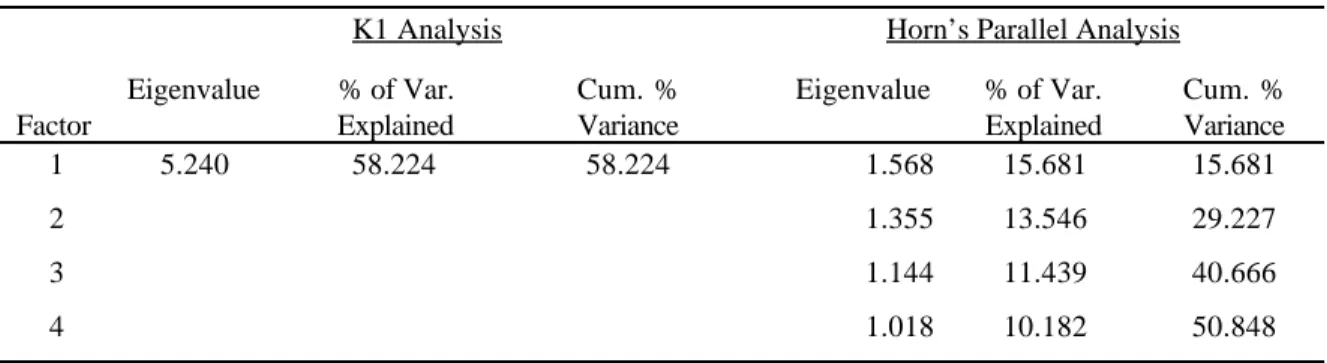
Table 3.2 Comparison Eigenvalues between K1 Analysis and Parallel Analysis in HSP (n = 118)...40
Table 3.3 Comparison Eigenvalues between K1 Analysis and Parallel Analysis in TMA (n = 118)...42
Table 3.4 Example of Well-Structured Problem Testing Items...45
Table 3.5 Example of Near-Transfer Ill-Structured Problem Testing Items...46
Table 3.6 Example of Far-Transfer Ill-Structured Problem Testing Items ...47
Table 3.7 Example of Domain-Specific Knowledge and Structural Knowledge Testing Items ...49
Table 3.8 Testing Items for Measuring Justification Skills in Well-Structured Problems...50
Table 3.9 Testing Item for Measuring Justification Skills in Near-Transfer Ill-Structured Problem ...51
Table 3.10 Testing Item for Measuring Justification Skills in Far-Transfer Ill-Structured Problem ...51
Table 3.11 Comparison between Novice and Expert Groups...54
Table 3.12 Inter-Rater Reliability between Scorers ...55
Table 3.13 Time Schedule for Instrument Administration...57
Table 4.1 Intercorrelations among the Independent Variables in Well-Structured Problem Analysis...59
Table 4.2 Summary of Simultaneous Regression Analysis for Variables Predicting Well-Structured Problem-Solving Scores (N = 118)...60
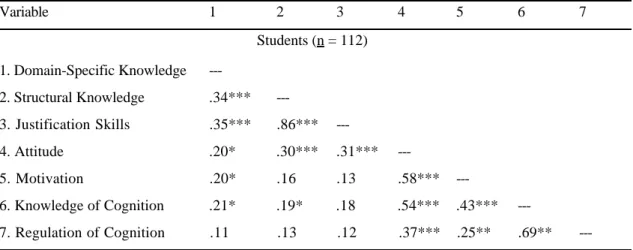
Table 4.3 Intercorrelations among the Independent Variables in Near-Transfer
Ill-Structured Problem Analysis ...61 Table 4.4 Summary of Simultaneous Regression Analysis for Variables Predicting
Near-Transfer Ill-Structured Problem-Solving Scores (N = 112)...62 Table 4.5 Intercorrelations among the Independent Variables in Far-Transfer
Ill-Structured Problem Analysis ...63 Table 4.6 Summary of Simultaneous Regression Analysis for Variables Predicting
LIST OF FIGURES
Figure 2.1 Diagram of Well-Structured Problem-Solving Processes...14 Figure 2.2 Diagram of Ill-Structured Problem-Solving Processes...22 Figure 3.1 Scree Test of the TMA Eigenvalues Plot ...42
ACKNOWLEDGMENTS
The research reported herein was supported by the Classroom of the Future (COTF), funded in part as a research and development center by the National Aeronautics and Space Administration (NASA) as well as the West Virginia Space Grant Consortium, Wheeling Jesuit University. The opinions expressed do not necessarily reflect the position or policy of NASA COTF, and no official endorsement should be inferred.
I wish to acknowledge the support and assistance of the COTF research team. They encouraged the trial and pilot, and permitted me to learn from their experiences. I am also grateful to Teresa Wiltse of the NorthWest High School for her help in the conduct of this study.
My sincere thanks are extended to David Jonassen, my thesis advisor and my mentor, for his invaluable knowledge and inspiration to my professional growth. I also wish to thank Hoi Suen for his assistance with the analysis despite his many commitments elsewhere.
My thanks go particularly to Ashear Barr for reading drafts of much of my work and to her family for their warm and faithful support.
CHAPTER 1. INTRODUCTION
Rationale for Investigation
Problem solving, especially complicated everyday problem solving, has been a major concern in education. One major goal for schools is to educate students who are able to experience the richness and excitement of knowledge about the natural world, be aware of difficult real-world problems, and use appropriate processes and principles in making personal decisions (National Science Educational Standard, 1996). In other words, students must learn ill-structured problem-solving skills by experiencing various real life situations in order to make personal decisions. Many of the problems we face in real life are ill-structured, including important social, political, economic, and scientific problems in the world (Sinnott, 1989; Voss, 1989, 1991).
Educators agree on the importance of the role of ill-structured everyday problem-solving skills in school (Helgeson, 1992). They have attempted to put forth considerable effort to enhance students’ problem solving using various teaching and learning strategies, and innovative instructional materials, such as multimedia simulation.
However, more alternative suggestions and promising directions for improving ill-structured problem solving are needed. Research efforts must include a further
understanding of the nature of ill-structured problem solving as well as a reevaluation of the methods of instruction for creating rich learning environments to promote everyday ill-structured problem solving.
Purpose of the Study
The purpose of this research study is to test the theory that the problem-solving skills used for well-structured problems are necessary but not sufficient for solving ill-structured problems (Brabeck & Wood, 1990; Kitchener & King, 1981; Mines et al., 1990; Wood, 1990; Wood & Games, 1991) and that ill-structured problem solving has to support more qualitatively new components than those for solving well-structured problems
(Reitman, 1965). Ill-structured problems are commonly faced in everyday human experience; they have various solutions and has multiple solving processes which can be derived depending on a solver’s perception.
Alternatively, problem solving has been one of the dominant fields of research in the study of human information processing over the past three decades. Research has focused on problems that are relatively well-defined or well-structured (Reitman, 1965; Simon, 1973). Well-structured problems are clearly presented with all the information needed at hand and have convergent answers and single solving processes to reach a final solution (Simon, 1978), such as long division, areas of triangles, Ohm’s law, and linear equations (Wilson & Cole, 1992). Consequently, theories of problem solving have been largely pervaded by the empirical phenomena of well-structured problems. Furthermore, instruction in problem solving generally emphasizes well-structured problems.
However, educators (Spiro, et al., 1988; Spiro & Jehng, 1990) have attempted to apply traditional theory in teaching complex and ill-structured domains (Wilson & Cole, 1992). They have realized that the traditional theory is not sufficient for enhancing ill-structured problem solving. They argued that a traditional learning environment seldom requires students to solve everyday problems. Furthermore, students are presented with single analogies or discrete procedures and rules which are oversimplified and
overgeneralized as compared to those of ill-structured problems (Wilson & Cole, 1992). Based on this contradiction, it is reasonable to question how the solving skills of well-structured problems are critically different from those of ill-structured problems which are faced by individuals in everyday life (Reitman, 1965). The specific research objectives of this study are: a) to propose ill-structured problem solving requires different essential components than those of well-structured problems, and b) to define in depth the different critical components of well-structured and ill-structured problem solving.
Problem Statement
Although educators agree on the importance of the role of ill-structured everyday problem-solving skills in school (Helgeson, 1992), there is confusion about what defines an structured problem, as well as about the relationship between well-structured and ill-structured problems.
Neisser (1976) equates everyday or real-life problems with ill-defined problems. Some educators believe all everyday human problems are ill-structured problems. Ill-structured problems differ from “ill-defined” problem spaces in that “ill-defined” problems may not allow a clear solution strategy, but may allow single correct answers about which qualified experts would agree (Hayes, 1981; Holyoak, 1990; Sternberg, 1985).
Ill-structured problems can be defined as problems which do not have known solutions. Experts in the domain do not agree regarding whether a particular solution is appropriate, because it has various solutions and solution paths (Jonassen, 1997; Reitman, 1965; Voss, 1988, 1989).
Confusion of Relationship between Well-Structured and Ill-Structured Problems
In addition to the inconsistency of the definition of ill-structured problems, more confusion exists surrounding the relationship between well-structured and ill-structured problems. Simon (1973) insisted that whether a problem is well-structured or ill-structured could only be determined by examining the problem solver, his available knowledge, and the problem to be solved. Depending on an individual’s solving ability and knowledge relating to domains, problems may be well-structured or ill-structured. Furthermore, Simon (1973) argued the processes used to solve ill-structured problems can be applied in the same way to solve well-structured problems. In other words, information-processing models that have been applied to the study of relatively well-structured problems are adequate to deal with relatively ill-structured problems.
On the contrary, Reitman (1965) argued that ill-structured problems are the central point of largest percentage of human energies, yield larger individual variability in solutions, and produce less agreement on the acceptability of solutions when compared to well-structured problems. In Reitman’s perspective, since ill-well-structured domains are less definable, and more conditional and problematic, solvers have to combine or recombine schemas in response to the requirements of each particular situation, rather than merely retrieve a schema from memory (Wilson & Cole, 1992). This nature of ill-structured domains is difficult to capture using traditional theory.
To summarize Reitman’s theory, ill-structured problem solving has obviously engaged more complicated processes than those of well-structured problem solving. Information-processing models are not sufficient to explain ill-structured problem-solving processes.
Research on ill-structured everyday problem solving (Sinnott, 1989; Voss & Post, 1988; Voss, 1991; Wood, 1994) has supported Reitman’s idea that well-structured and ill-structured problems require different components to reach solutions. Solving ill-ill-structured problems requires components such as content knowledge, structural knowledge,
domain-specific strategy, and general searching strategy, which are used to solve well-structured problems as well as those “beyond the purely cognitive” such as value/belief/attitude, evaluation/monitoring/planning, and justification skills (Sinnott, 1989). Additionally, investigators examined solution processes in solving ill-structured problems and found there are too many steps that appear to be unexplained using well-structured problem-solving processes (Sinnott, 1989; Voss & Post, 1988; Voss et al., 1991).
Limitations of Research Studies in Ill-Structured Problems
Although many studies (Sinnott, 1989; Voss & Post, 1988; Wood, 1994) have concluded that well-structured and ill-structured problem solving use different solving processes, their research lacks generalizability to other tasks. As shown in Table 1.1, the current research of ill-structured problems has concentrated on qualitative research methodology using a think-aloud protocol approach. The sample size was in the small range, using from 3 to 24 subjects who were mainly adults or college students.
Moreover, most research studies regarding ill-structured problems described the solving processes of one particular domain rather than comparing two different solving processes in the same domain (Herbert & Dionne, 1993; Korpi, 1991; Voss, 1988). Some researchers (Brabeck & Wood, 1990; Mines et al., 1991; Wood & Games, 1991) have tried to compare solving ability between two problem types. However, they used Critical
Thinking for well-structured problem solving and Reflective Judgment for ill-structured problem solving, rather than measuring solving ability of two different problems in the same domain.
The holes in past research pose at least three questions: it is difficult to clarify why well-structured problem-solving skills are not sufficient to solve ill-structured problems in the same domain; what is the relationship between well-structured and ill-structured problem solving in the same domain; and whether the results can be generalized with regard to young students, such as high school students. Because of this weak evidence, more research is necessary to determine why well-structured problem-solving skills are insufficient for solving ill-structured problems in the same domain.
Table 1. 1
Examples of Studies in Ill-Structured Problem Solving
Author Problem Domains Research
Method
Subjects Herbert & Dionne, 1993. Several practical or technical problems, and
everyday problems.
TA 24 adults
Korpi, 1991. Design instructional material. TA 3 adults Sinnott, 1989. Various everyday problems. TA 3 adults
Brabeck & Wood, 1990; Kitchener and King, 1981; Mines et al., 1990; Wood, 1990; Wood & Games, 1991.
WPS
Critical Thinking measured by WGCT Verbal ability measured by TCMT. IPS
Reflective Judgment skills measured by RJI.
TA College students
Voss, 1988; Voss, Lawrence, & Engle, 1991; Voss & Post, 1988.
Social science problems (e.g., political science problems, international relations).
TA 3 - 6 adults Note. TA = Think-Aloud Protocol, WPS = Well-Structured Problems, IPS = Ill-Structured Problems, WGCT = Watson-Glaser Critical Thinking, TCMT = Terman’s Concept Mastery Test, and RJI = Reflective Judgment Interview.
Significance of the Problem
In the science education community, a wide variety of terminology has been used to describe the dynamic solving processes in science phenomena, including science discovery, scientific method, scientific thinking, critical thinking, inquiry skills, and science processes (Champagne & Klopfer, 1981a).
Specifically, many science educators have attempted to facilitate the problem solving in science using the terminology related to science processes (Gagne, 1970; National Science Education Standard, 1996; Simon, 1981). Gagne (1970) clearly explained science processes that can be categorized under the general categories of observing, classifying, measuring, using space-time relations, using numbers, communicating, and inferring.
Additionally, the National Science Education Standard (NSES) stated that science processes can be defined as processes in which “students describe objects and events, ask questions,
acquire knowledge, construct explanations of natural phenomena, test those explanations in many different ways, and communicate their ideas to others” (1996, p 21).
Based on the above definition of science processes, the science processes can be explained in terms that have been used to explain the processes of problem solving (Simon, 1981). It has much in common with problem-solving processes.
As shown in Table 1.2, although many educators (Gane, 1970; NSES, 1996; Simon, 1981) emphasized science processes as problem solving in science, they did not make distinction between well-structured and ill-structured science processes.
Additionally, science educators have put forth considerable effort to enhance students’ science processes using various teaching and learning strategies such as scientific inquiry under the same category of well-structured and ill-structured science problems.
Table 1. 2
Comparisons of Problem Solving, Science Processes and Scientific Inquiry Problem-Solving Processes Science Processes Scientific Inquiry •Defining Problem
•Searching information •Selecting information
•Organizing selected information •Developing justification for
selection
•Describing objects and events
•Asking questions •Acquiring knowledge •Constructing explanations
of natural phenomena relationship between ideas •Describing rationale for
formulating these
relationship between ideas
•Observing •Posing questions
•Examining books and other sources of information to see what is already known
•Reviewing what is already known in light of
experimental evidence •Generating Solutions
•Suggesting potential solutions
•Testing explanations in various ways
•Predicting other natural phenomena, and ways to apply them to many events
•Planning investigation •Using tools to gather,
analyze, and interpret data •Proposing answers,
explanations and predictions
•Developing justification for solution
•Communicating their ideas to others
Scientific inquiry is emphasized as one of the primary educational strategies to be used to promote students' understanding of science processes (NSES, 1996, p 23)
(see Table 1.2). The scientific inquiry is applied to facilitate learners’ science processes in the both well-structured and ill-structured science problems in spite of the existence of clear different solving processes and components between two type of problems.
Although NSES set ill-structured everyday problem solving as a goal for science education, NSES described teaching standards, assessment in science education, and content standards under the same principles without categorizing separately well-structured and ill-structured problem solving.
This investigation intends to propose that ill-structured science problems are different in solving processes and components as compared to those of well-structured science problems. Therefore, science educators must develop different teaching and
learning strategies, as well as different assessment depending on a type of problems in order to promote students’ ill-structured science problem solving.
This study will attempt to raise the level of awareness of the relationship between well-structured and ill-structured problem-solving skills. It will also provide educators with guidance for effective design, development, and evaluation methods to facilitate students’ problem-solving skills, depending on educational goals and the nature of problems in their classroom.
Additionally, using 9th-grade high school students as subjects, the research will show the relationship between two different sets of problem-solving skills in science. It will guide the future development of effective teaching and learning environments to facilitate high school students’ ill-structured problem solving in science. Finally, since the
integration of research will be made with a larger sample and replicable method than those previously used (Brabeck & Wood, 1990; Chi, 1988; Voss, 1988, 1989), the conclusions from this study, with respect to the questions stated, may support stronger generalizations than past research.
In order to understand the nature of ill-structured problem solving, essential
components of solving ill-structured problems must be defined and described based on their solving processes. In this manner, the essential components of ill-structured problem solving can be compared to those of well-structured problem solving. Such a comparison allows us to see which components should be emphasized for teaching ill-structured problem solving.
Conclusions derived from the accumulation of past research will provide the data to define necessary components, including cognition, metacognition, non-cognitive variables, and justification skills for solving both well-structured and ill-structured problems
(Bransford, 1994; Chi, 1988; Sinnott, 1992; Voss & Post, 1989; Wood, 1993). The components will be described in depth in the literature review section. Next, these
components will be correlated with both well-structured and ill-structured problem-solving scores in science, to infer the most important components for each type of problem-solving process. Additionally, the results will be compared to analyze the differential components of well-structured and ill-structured problem solving within the same domain. Such
analysis enhances the interpretation of essential components in each problem-solving skills as well as the critically different components between well-structured and ill-structured problem solving.
Components of Well-Structured Problem Solving
First, this study will investigate the relationship between students’ well-structured problem-solving scores and components for solving well-structured problems. To solve well-structured problems, an individual commonly follows four solving processes. The processes include (a) finding out exactly what the problem is, (b) finding appropriate information from individual’s memory, or applying domain-specific or general searching strategies to solve the problem, (c) selecting the best solution by anticipating the logical consequences of each, and (d) implementing the solution and evaluating it to see if it solved the problem (Bransford & Stein, 1983; Newell & Simon, 1972).
Domain-specific knowledge plays an important role in well-structured problem solving (Glaser, 1989). However, domain-specific knowledge is not enough to solve well-structured problems. The knowledge has to be organized or integrated meaningfully in a domain to successfully solve well-structured problems. It is proposed here that structural knowledge may strongly influence well-structured problem-solving skills. Generally, cognition is more essential than other components such as metacognition including general searching strategies, planning, monitoring, and evaluating, or non-cognitive variables including value, belief, and attitude in solving well-structured problems.
Components of Ill-Structured Problem Solving
Secondly, this study will investigate the relationship between students’ ill-structured problem-solving scores and components for solving structured problems. In solving ill-structured problems, solving processes include (a) recognizing that there is a problem, (b) finding out exactly what the problem is, (c) searching and selecting some information about it, (d) developing justification by identifying alternative perspectives, (e) organizing obtained information to fit a new problem situation, (f) generating some possible solutions, (g) deciding on the best solution by the solver’s perception of problem constraints, and (h) implementing the solution and evaluating it by developing arguments and articulating personal belief or value (Voss, 1988).
Based on the analysis of ill-structured problem-solving processes, cognition, metacognition, ability to develop justification, and non-cognitive variables are important to solve ill-structured problems. As in well-structured problem solving, structural knowledge is more important than domain-specific knowledge.
From well-structured and ill-structured problem-solving processes, it can be summarized that the following components are necessary: (a) cognition including domain-specific knowledge and structural knowledge; (b) metacognition, including general
searching strategies, planning, monitoring, and evaluating; (c) non-cognitive variables, including value, belief, attitude, and motivation; (d) justification skills such as ability to develop argumentation.
Research Questions
This study focuses primarily on components necessary for solving well-structured and ill-structured problems, in order to examine the relationship between well-structured and ill-structured problem solving. The main questions include what components are needed to solve each problem type and how the required components differ between the two problem types. Thus, the research questions under the study become:
Question 1. What different components are required in solving ill-structured problems as compared to those of well-structured problems solving?
Question 2. Do well-structured problems require (a) cognition, (b) metacognition, (c) non-cognitive variables, and (d) justification skills as essential solving components?
Question 3. Do ill-structured problems require (a) cognition, (b) metacognition, (c) non-cognitive variables, and (d) justification skills as essential solving components?
In this study, these research questions will be investigated in the context of an open-ended, multimedia problem-solving environment. The National Aeronautics and Space Administration (NASA) Classroom of the Future (COTF) organization has developed a multimedia curriculum supplement software program entitled, Astronomy Village® (AV):
Investigating the Universe. This program is for high school science classrooms to teach the
processes of scientific inquiry as well as astronomical and mathematical concepts. Ten investigations cover a broad cross-section of current research areas in astronomy. Each investigation encourages students to participate in scientific inquiry as a member of a cooperative learning group.
AV, a multimedia software program will be used as an instructional environment.
During 4 weeks' science classes, the program presents a virtual mountain-top observatory interface from which students investigate contemporary problems in astronomy. During the work with AV, students are encouraged by their “virtual” mentors to conduct an activity for each of the phases of scientific research.
CHAPTER 2. LITERATURE REVIEW
The literature review focuses in depth on ill-structured problems, their solving processes as well as their solving components. At first, well-structured problems, their solving processes, and their components are briefly described. In a similar manner, ill-structured problems and their solving processes are defined and explained, based on
existing research studies. The necessary components for solving ill-structured problems are described from an analysis of the solving processes. Finally, the two problem types are compared on three levels: the nature of the problems, their solving processes, and the components necessary for solving each problem. This comparison is necessary to illustrate the differences between well-structured and ill-structured problems, and to assist in building the research design. The review explains the hypotheses of the current study and concludes with the need for the proposed study.
Well-Structured Problems
Well-structured problems include most mathematics and mathematics-related problems (e.g., solving algebra), and physics problems such as those found in undergraduate textbooks. They have a single correct, convergent answer to reach a satisfaction in a final solution (Simon 1978) so it requires a relatively small amount of information or constrained knowledge based on material presented in the textbook chapter.
A structured problem consists of all elements of the problem including a well-defined initial state, a known goal state, constrained set of logical state, and constraint parameters (Greeno, 1978). Transformation problems may be representative of a well-structured problem. It requires the application of a finite number of concepts, rules, solutions, and principles being studied to a constrained problem situation (Luszcz, 1984). Therefore, the well-structured problem-solving skills can be transferred only to similar types of problems.
Well-structured problems can be solved using various search techniques, such as recall analogical problems, means-ends analysis, decomposing and simplifying, finding sub-goals, and generate or test. The solution process generally has been agreed-upon, and varies only slightly among experts in the particular problem domain. That is, there are only
relatively small differences in the problem-related contents and a consensual agreement among experts in the field regarding the established solution (Luszcz, 1984).
Solving Process of Well-Structured Problems
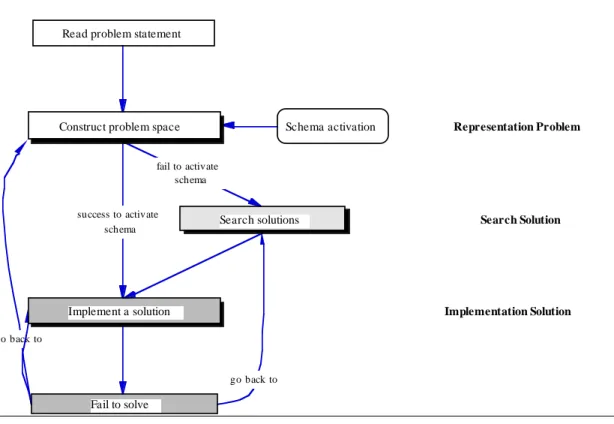
Many researchers (Bransford & Stein, 1984; Chi, 1988; Newell & Simon, 1972) have conducted studies about well-structured problems. Most research in the psychology of problem solving has analyzed problem solving using concepts of information processing (Newell & Simon, 1972), such as the classic General Problem Solving (Newell & Simon, 1972), and IDEAL problem solver (Bransford & Stein, 1984). Information-processing models of problem solving generally specify two sets of thinking processes associated with the problem-solving process: understanding processes and search processes. Based on various problem-solving models, well-structured problem solving is described in three essential processes including a) representing problems, b) searching for solution, and c) implementing a solution.
First, when solvers are faced with a problem, the solvers literally understand a task from the problem statement, which can include the following questions (Voss, et al., 1991): What is the goal? What is an acceptable solution path? and what is the final production supposed to be? After understanding a task, the solvers attempt to represent the problem in terms of the solvers' understanding of the givens, the goal, the underlying structure of the possible solutions, and any problem-solving strategies that can be used to solve this task (Voss, et al., 1991). This is known as a problem space which is constructed by a person's interpretation of the problem.
During the construction of a problem representation, certain features of the problem may activate knowledge in memory. A certain schema for that particular type of problem may then be activated. An activated schema is a cluster of knowledge related to a problem type (Greeno, 1978). The solvers are able to proceed directly to the implementation stage of problem solving and try out the activated solution depending on the representation. The quality of a problem representation directly influences the potential of solving the problem (Hayes, 1981; Newell & Simon, 1972).
If schema activation occurs during the construction of a problem representation, then the solver can proceed directly to the implementation of solution strategies with little search for solution procedures (Chi et al., 1982). This indicates that the representation phase often consists of a pattern-matching procedure. Pattern-matching refers to a situation in which the problem statement is considered in terms of its parameters and the relation between parameters, and these components are matched to a pattern in memory (Voss, 1988). If solvers have previous experience with this type of problem, they are able to perform the
match and, subsequently, provide the solution.
Second, if solvers fail in schema activation during the construction of a problem representation, the solvers have to search for a solution to the problem. In searching for a solution, the solvers are required to include the use of domain-specific strategy, as well as general searching strategies. The domain-specific strategies are specific to their respective domains. In the contrast to domain-specific strategy, the general searching strategies are more general and can be applied across a variety of domains.
The use of some general searching strategies may be constrained by domain-specific knowledge. The solvers choose appropriate searching strategies based on the content of domain as well as the type of a problem. Solvers frequently use a process of means-ends analysis, in which they try out equations that contain one or more of the parameters found in the problem statement, and eventually reach the goal by generating an appropriate sequence of equations (Larkin et al., 1980). These strategies may not guarantee solution, but serve as a guide in the problem-solving process (Mayer, 1983).
Finally, after generating appropriate equations or solutions, solvers attempt to try out the solutions. If the solution is satisfied, the task is over. If it fails, the solver goes back to an earlier stage and attempts to redefine the problem or use another method to solve it. Summary of Well-Structured Problem-Solving Processes
Well-structured problem-solving processes include a) representing problems by schema activation, b) searching solutions, and c) implementing solutions as show in Figure 2.1. Based on a review of the solving processes of well-structured problems, the
components for solving well-structured problems may be summarized as cognition and metacognition, or specifically, knowledge of cognition.
fail to activate schema
success to activate schema
go back to go back to
Schema activation Read problem statement
Construct problem space
Search solutions
Implement a solution
Representation Problem
Search Solution
Implementation Solution
Fail to solve
Figure 2. 1. Diagram of Well-Structured Problem-Solving Processes
Components for Solving Well-Structured Problems Cognition
One of critical components of well-structured problem solving is domain-specific knowledge (Glaser, 1984) which includes declarative knowledge and procedural knowledge. Declarative knowledge includes the basic concepts, facts, and principles of a particular subject matter domain (Ryle, 1949). Procedural knowledge in a particular domain is a domain-specific strategy (Ryle, 1949). The domain-specific strategies are specific to their respective domains. For example, in geometry, a strategy for proving that two triangles are congruous is to prove that they are corresponding angles of congruent triangles (Greeno, 1980). In algebra, a useful strategy to solve equations is an isolation strategy, in which the solver isolates the target variable on the left side of the equation and places all the numbers on the right side of the equation (Mayer, 1982). Therefore, domain-specific strategy is directly related to the content of the domain and depend on solvers' content knowledge.
In solving well-structured problems, if learners possess appropriate schematic driven knowledge, the learners can directly solve the problem without searching for a solution using various searching strategies. Solvers are able to work forward immediately by choosing appropriate equations leading to the goal, because they recognize each problem from their previous experience and know which moves are appropriate.
Structural knowledge is a more essential component than domain-specific
knowledge. The structural knowledge allows solvers to accurately recall the configuration of a given problem state and immediately to move toward the goal from the givens. Experts, possessing schemes allowing them to distinguish between problem states and their
associated moves, may categorize problems according to those schemes (Chi, et al., 1981). The critical role of structural knowledge can be seen in the solving process of well-structured problems. A problem representation of well-well-structured problems is a cognitive structure corresponding to a problem which intentionally links the problem to existing knowledge on the basis of solvers' domain-related knowledge and its organization (Greeno, 1978). This process is a continuously constructed schematic network based on various problem components, including the initial state, the desired goal, and the legal problem-solving operators (Chi, et al., 1981). Thus, the representation is enhanced by existing problem schemes that result from a previous experience in solving the particular type of problem.
Many researcher found that structural knowledge is important in solving well-structured problems. For example, Larkin, et al., (1980) have demonstrated that when physics experts are given a problem from a physics textbook, they develop a representation of the problem by analyzing the elements and relations of the problem, sometimes drawing a diagram in the process. Typically, such examination leads to the classification of the
problem, and once classified, the problem is solved by applying the appropriate equations (Chi, et al., 1982).
Metacognition
Knowledge of cognition.
If solvers do not have previous experience with a specific type of problem and fail to activate a correct schema from their memory, solvers require general searching strategies that may be applied across a variety of domains. Researchers have found some of strategies assist well-structured problem solving.
Analogy is one of the strategies for helping well-structured problem solving
(Jonassen, 1997). Solvers recall analogical problems, for which the solution is known, from their previous experience and apply the analogy to a new problem (Polya, 1957). Gick and Holyoak (1980) found that the analogy assists successful problem solving when students were prompted to think analogical problems.
Means-ends analysis used by General Problem Solving (Ernst & Newell, 1969), involves reducing the differences between the current state and the goal of the problem by applying appropriate problem-solving operators. This strategy is useful whenever the initial and goal states of a problem are fairly well specified (Gick, 1986). However, means-ends analysis hinder schema learning because solvers concentrate merely on eliminating discrepancies between the current state and goal state (Owen & Sweller, 1985; Sweller & Levine, 1982; Sweller, et al., 1983). When the solvers achieve the current goal by applying an operator, they ignore the goal and focus on the new goal instead of reflecting the
successful operator at the next process.
In sum, structured knowledge and domain-specific knowledge is a primary component of solving well-structured problems. When solvers do not have appropriate knowledge in a particular domain, they are required to use domain-specific strategies and general searching strategies for searching a path or a solution (Chi, et al., 1982).
Ill-Structured Problems
Ill-structured problems are faced routinely in everyday human experience. In everyday human problems situated in a specific context, the problem descriptions are vague, or the information needed to solve them is not provided in the problem statement (Chi & Glaser, 1985).
In ill-structured problems, the number of goals, which are vaguely defined, must be considered in the problem-solving process. The information available to the decision maker is usually incomplete and inaccurate or ambiguous (Wood, 1993). In these problems, it is uncertain which concepts, rules, and principles are necessary for the solution. There is an inconsistent relationship between concepts, rules, and principles among cases. Case elements are differentially important in different contexts based on the interaction of the elements with each other in a context (Spiro, et al., 1987, 1988).
Solving Process of Ill-Structured Problems
Many researchers have conducted studies to understand ill-structured problem-solving processes, applying a qualitative methodology such as think-aloud protocol. Ill-structured problems may possess multiple solutions, solution paths, or no solution at all (Kitchner, 1983); may possess multiple criteria for evaluation solutions, because there is not universal agreement on the appropriate solution (Voss, 1988); and require solvers to express personal opinions or beliefs about the problem in the process of interpretation (Meacham & Emont, 1989).
In this section, solving processes of ill-structured problems will be described based on the studies of Sinnott (1989) and Voss & Post (1988). They investigated ill-structured problems and explained each process involving ill-structured problem solving using a think-aloud protocol approach. Ill-structured solving processes will be divided into three
categories: representation problems, solution processes, and monitor and evaluation based on the two studies.
Sinnott (1989) conducted a longitudinal study with 150 respondents in order to understand ill-structured problems. Based on this study, Sinnott discussed in some depth three respondents’ solving processes of ill-structured problems using a think-aloud protocol approach. She created a model of the five main components used in solving
ill-structured problems including a) processes to construct problem space, b) processes to choose and generate solutions, c) monitors, d) memories, and e) noncognitive elements.
In her model, she described two basic sets of thinking processes in solving ill-structured problems, including processes to construct problem space, and processes to choose and generate solutions. She emphasized specific processes to choose and generate solutions. She argued that solvers must select the essence of a problem; then they must select the goal or goals; and finally a solution must be generated and selected among many possible solutions. Since ill-structured problems may have generate a large number of possible goals, Sinnott insisted that the solvers must have a mechanism for selection of the best goal or solution. She found that solvers selected goals that were suitable to the chosen problem essence, as well as goals they knew were reachable, or goals which had specific solution paths.
In sum, Sinnott’s model proposed that the solving processes of ill-structured problems engage constructing problem space, and choosing and generating a solution. Monitors, memories, and noncognitive elements are necessary components within the two solving processes.
On the basis of a study of international political science problems, Voss & Post (1988) proposed that problem-solving processes involve a) representation of the problem, b) statement of a solution, and c) evaluation. In their study, the representation problem is an extremely important process for determining the solution of ill-structured problems.
They argued that the representation problem involves processes of examining the concepts and relations of the problem, delineating the causes of the problem and its constraints, and recognizing the divergent perspectives. Once a specific representation is developed, the solution is readily predicted from the representation and is a relatively small component in establishing structure. That is, if the solvers develop a successful
representation problem, a particular solution will follow from that representation, and consequently a good solution (Voss, 1988, 1991).
Once alternative options have been identified, Voss & Post found that a solution to the problem may be proposed by alleviating or eliminating these causes. After suggesting solutions, a solution is developed using procedures which implement the solution step by step. The solution that is proposed must be evaluated with respect to its potential positive and negative effects on the solvers’ interpretation of the situation, and the prescribed course of action.
Based on the two authors’ theories, ill-structured problem solving can be summarized as three processes: a) representation problems, b) solution process, and c) monitor and evaluation. A representation problem is established by constructing a problem space which includes defining problems, searching and selecting information, and
developing justification of the selection. The solution process involves generating and selecting solutions. Finally, the monitoring and evaluating process requires assessing the solution by developing justification. The next section will describe in depth these
processes.
Representation Problems
When solvers are faced with a given problem situation, they first decide if there is a problem, because the ill-structured problem may not appear directly or may be hidden (Jonassen, 1997).
After determining the existence of a problem in a problem statement, solvers need to determine the nature of the problem (e.g., what is a kind of a problem?). In determining the nature of the problem, the solvers construct a problem space which contains all of the possible states of the problem by examining the possible causes of the problem as well as its constraints (Sinnott, 1989; Voss & Post, 1988). Since an ill-structured problem may have multiple representations or understandings of the problem, determining an appropriate problem space among the competing options is the most important process of an ill-structured problem (Jonassen, 1997).
For constructing problem space, the solvers initiate a search, either internally or externally, to obtain information appropriate to the problem (Voss & Post, 1988). The solvers attempt to find and select critical information from memory drawing on extremely large amounts of information. After the solvers determine sufficient amounts of
information have been obtained, they terminate the search immediately. This information enables the solvers to enter the next problem state. The selected information is required to determine how to fit in a new context rather than simply retrieve it from memory in the course of constructing problem space, because ill-structured problems cannot be solved by applying a constrained set of rules (Voss & Post, 1988).
Based on selecting and evaluating information, the solvers may depict the cause of the problem in a problem statement. Since ill-structured problems usually have divergent or alternative solutions, solvers must develop a justification or an argument for supporting the rationale of their selection of a particular cause. So solvers need to construct multiple
problem spaces, instead of constructing a single problem space, for providing evidences of the claims in the representation and development of an argument (Jonassen, 1997). Among competing problem spaces, the solvers must decide which of the schema is closely relevant and useful for solving (Sinnott, 1989).
Solution Processes
Selecting information allows solvers to generate and select a solution. The solvers generate solutions that alleviate the causes, relying on not only a prior knowledge but also on task-unrelated thoughts and emotions (Sinnott, 1989). After generating or developing solutions, solvers select a solution that they think may be reachable, based on their
perceptions of problem constraints. The solvers are building their own mental model of the problem to identify and select, or synthesize, a solution based on a representation problem (Jonassen, 1997). The solvers' mental model is able to propose a solution by analyzing possible causes of the problem.
Monitor and Evaluation
A problem-solving process is driven by a problem-solving control structure and an argument or reasoning structure (Voss & Post, 1988). Since a solution process is basically one of rhetoric, it is an important argument or reasoning structure which is subordinated to the problem-solving control structure (Voss & Post, 1988). Therefore, solvers must select a solution by constructing how they came to that decision. In ill-structured problems, since a good solution requires consential agreement among the community, the solvers must provide the most viable, the most defensible and the most cogent argument to support their preferred solution, and defend it against alternative solutions (Voss & Post, 1988; Jonassen, 1997).
Solvers must continuously evaluate and monitor their solving processes in order to justify their selections and a solution. In developing an argument or reasoning structure, the solution is typically justified by indicating why and how the proposed solution would work, as well as by indicating why the solution may not work (Voss, 1988). What can be done to handle possible shortcomings and objections (Voss, 1988)? If the solution is unsatisfied, a solver may "go back" and “re-present" the problem to find appropriate solutions (Voss, 1991).
completing the problem solving. During a solving process in ill-structured problems, solvers monitor their own processes, movements from state to state, selecting information and solutions, and emotional reactions (Sinnott, 1989). In addition, solvers evaluate their selection by examining and comparing other alternatives. This monitoring and evaluating process requires a wide variety of memories such as personal histories, emotional memories, problem-related memories, and abstract rules (Sinnott, 1989).
As explained above, the three essential solving processes require various
subprocesses in order to link to the next solving process. Jonassen (1997) presented and explained seven important solving processes used in the course of solving ill-structured problems. These can be categorized in three processes as shown in Table 2.1.
Table 2. 1
Ill-Structured Problem-Solving Processes
Voss & Post (1988) Sinnott (1989) Jonassen (1997) Represent problems
•Examining the concepts and relations of the problem.
•Delineating the causes of the problem and its constraints.
•Recognizing the divergent perspective.
Construct of problem spaces
•Articulate Problem space and contextual constraints. •Identify and clarify alternative
opinions, positions, and perspectives of Stakeholders.
State solution Choose and generate solutions
•Generate possible problem solutions.
Evaluate Monitor •Assess the viability of alternative solutions by construction
arguments and articulating personal beliefs.
•Monitor the problem space and solution options.
•implement and monitor the solution.
Summary of Ill-Structured Problem-Solving Processes
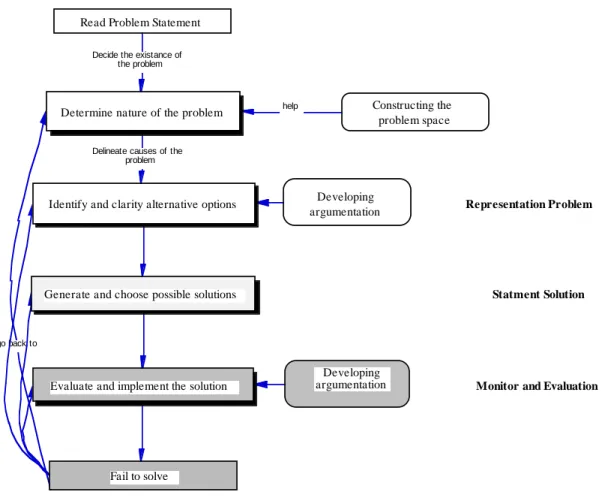
On the basis of studies of Sinnott and Voss & Post, the dynamic solving processes of ill-structured problems generally involve a) representing problems by searching and selecting information, and supporting justification, b) stating solution by generating and selecting options, and c) supporting justification of the solution by monitoring and evaluating solution processes as shown in Figure 2.2.
help
Delineate causes of the problem
go back to
Decide the existance of the problem
Constructing the problem space Read Problem Statement
Determine nature of the problem
Developing argumentation
Identify and clarity alternative options Representation Problem
Statment Solution
Monitor and Evaluation
Fail to solve
Generate and choose possible solutions
Evaluate and implement the solution
Developing argumentation
Figure 2. 2. Diagram of Ill-Structured Problem-Solving Processes
Based on an analysis of the nature of solving processes, necessary components for solving ill-structured problems can be defined. The following section will describe
important components including cognition, metacognition, non-cognitive variables, and justification skills for solving ill-structured problems.
Components of Solving Ill-Structured Problems Cognition
Well-developed domain-specific knowledge is a primary factor in solving
ill-structured problems. Domain-specific knowledge assists a solver in the selection of general operators from among many alternatives and in finding a search path of ill-structured problem solving (Roberts, 1991). Jonassen (1997) argued that although individuals have ability to solve problems, they can not transfer the prior problem-solving skills to other domains without appropriate content knowledge. In addition, Voss, et al., (1991) found that expertise in solving ill-structured problems is highly domain-specific. Better developed domain knowledge may enhance problem-solving ability in any particular domain. If the individual does not have and employ substantial knowledge of the domain in a question, the applications of the methods will lead to inadequate solutions (Voss, et al., 1991).
Although having domain-specific knowledge is, in itself, of critical importance, ill-structured problems cannot be solved by simply finding the information and applying a constrained set of rules. Since the solutions of ill-structured problems depend on situation or context, domain-specific knowledge must be integrated appropriately to fit in problem situations instead of being told in a book (Bransford, 1994; Jonassen, 1997). Therefore, ill-structured problems require structural knowledge, also referred a conceptual knowledge, in order to access meaningful information and principles rapidly when domain-specific knowledge is needed in problem solving.
Structural knowledge is the knowledge of how concepts with a domain are interrelated (Diekhoff, 1983) and engages the integration of declarative knowledge into useful knowledge structures (Jonassen, Beissner, & Yacci, 1993). Knowledge structure is an organized network of information stored in semantic or long-term memory (Champagne, et al., 1981a, p.87) and used to develop procedural knowledge for solving domain problems (Jonassen, Beissner, & Yacci, 1993).
Many researchers made assumption the ability to solve problems results from the complex interaction of the structure of knowledge in memory (Chi & Glaser, 1985; Glaser, et al., 1993; Robertson, 1990; Smith, 1992; Sugrue, 1995). In the study of Robertson’s think-aloud protocols, he found that structural knowledge predicted strongly learners’ transfer problem-solving ability in physics on a written exam (1995). Glaser’s model (1993) described the importance of structured, integrated knowledge in problem solving as well. In the model, good problem solvers store coherent chunks of information in memory
and use organized information rather than isolated facts (Glaser, et al., 1993). In addition, Smith (1992) proposed structured knowledge as one of important cognitive components of problem solving. He argued that good problem solving requires knowledge of the domain which must be adequate, organized, accessible, and integrated (Smith, 1992). Simon (1973) insisted also that the solver should have the knowledge needed to utilize the appropriate components in the organization of the problem solution. Simon points out that solving ill-structured problems requires that the solver has appropriate conceptual knowledge of the components of the problem.
The importance of structural knowledge can be found in the processes of solving ill-structured problems. The representation is established by organizing appropriate elements in which a schema guides selection, instead of recognizing and classifying problem types (Voss & Post, 1988). In Johnson's study of house officer ratings, the data showed experts are likely to have clear-cut stop rules, such that a search is terminated as soon as enough information is obtained (Voss, et al., 1991). For example, as in constructing problem space, experts have a well-defined routine for searching out critical information and ability to terminate after immediately collecting a sufficient amount of cogent information (Voss, et al., 1991). Furthermore, experts have suitable conceptual knowledge of a problem domain, especially large amounts of problem-related information, stored in a long-term memory rather than constrained by the content domains being taught in lecture (Voss, et al., 1991).
In sum, domain-specific knowledge must be accessible when it is needed in problem solving. In order to do this, the domain-specific knowledge must be organized or
assembled in a meaningful way, using some type of rule, with other concepts to result in a unique solution. Thus, for solving ill-structured problems, solvers must have structural knowledge that assembles a large amount of relevant, problem-related information from memory (Voss & Post, 1988).
Metacognition
Ill-structured problems have no clear solution and require the consideration of alternative goals as well as the handling of competing goals. Moreover, they require solvers to control and regulate the selection and execution of a solution process. That is, when goals or action alternatives are ill-defined, solvers have to organize and direct their cognitive endeavors in different ways and to a different degree. Individuals can not solve a problem in a straightforward manner. They have to use metacognitive skills such as change
Knowledge of cognition.
Along with domain-specific knowledge and structural knowledge, ill-structured problem solving requires the use of appropriate general strategies in problem situations. Since ill-structured problems do not have obvious solutions and require large amount of information in various content areas, individuals rarely have enough knowledge to solve the problems. Therefore, domain-independent general strategies which can be applied to problems, regardless of content, are required to assist making progress on unfamiliar or nonstandard problems (Schoenfeld, 1983). Domain-independent general strategies may include argumentation strategies, decomposition, and metacognitive strategies.
In the social science study of Voss et al., (1991), they found experts were flexible in that they take into account more factors than do novices in searching for information. Additionally, non-Soviet experts used strategies of argumentation more often than novices. They concluded that argumentation may be an important strategy in solving ill-structured problem (Gick, 1986).
Decomposition can be one of domain-independent general strategies as well. Problem decomposition, or breaking the problem into subproblems, is a useful general searching strategy in solving problems such as the design in architectural problems (Simon, 1973) and the design of software (Jeffries, et al., 1981). In the interesting computer model expertise study, Larkin, et al found that decomposition strategy (e.g., recursive
decomposition) were used successfully in solving problems in a variety of problem domains regardless of domain-specific knowledge (Larkin, et al., 1980). In addition, Clement (1984) found the expert scientists used decomposition, embedding the problem into a larger one, as solve unfamiliar physics problems. However, Polson & Jeffries (1985) argued that solvers must have knowledge of the techniques and domain for breaking the problem into
subproblems. Therefore, the solvers who don’t have schema in the domain, may have difficulty using the decomposition strategies (Polson & Jeffries, 1985). Further research requires to determine if the strategies used in the computer model are useful to other problem solving such as human problem solving (Gick, 1986).
Metacognitive strategies include planning, checking, and evaluation (Brown, et al., 1983). These strategies may be applied later in the solution process and involved in regulation of ill-structured problem solving. Researchers found that experts commonly used these strategies for checking the solution, or monitoring the progress, toward the goal as solving proceeds (Gick, 1986). In addition, Jonassen (1997) proposed the importance of metacognitive strategies in ill-structured problem solving. He argued that solvers have to
reflect on their own personal knowledge of a problem domain as faced unfamiliar problems. Gick (1986) described that experts have some fairly sophisticated information-gathering search strategies rather than solely general searching strategies to solve unfamiliar problems. However, there lacks of research studies about search strategies relating to unfamiliar problem solving. It is difficult to describe specific information-gathering search strategies in solving ill-structured problems.
General strategies are included in knowledge of cognition. Knowledge of cognition is one of major metacognitive components (Brown, 1987; Flavell, 1987; Jacobs & Paris, 1987). Knowledge of cognition includes three subprocesses such as “knowledge about self and about strategies, knowledge about how to use strategies, and knowledge about when and why to use strategies” (Schraw & Dennison, 1994). In solving ill-structured problems, solvers must have general strategies, as well as know how to use the general strategies. Although solvers possess these general strategies, they will employ them at inappropriate times unless they have conditional knowledge about when and why to apply. Thus, the solvers must have all three subprocesses of knowledge of cognition in order to employ general strategies effectively and appropriately in the solving ill-structured problems.
Regulation of cognition.
First, when information is obtained, either internally or externally, it is necessary for the solvers to evaluate the information with respect to its usefulness in solving a problem (Kluwe & Friedrichsen, 1985). The solver must have evaluating skills when determining the extent to which obtained information may be effectively used in the solution process, a solution process may anticipate the quality of the solution, and which selected goals may be important in a given situation (Kluwe & Friedrichsen, 1985). In Germany, Dorner and his research group show more successful problem solvers handling a complex problem by using evaluating activities as their own solution process (Dorner,
et al., 1983). They are continuously analyzing and judging their solution process and evaluating possible solution directions, states, and consequences.
Second, monitoring is a primary component of ill-structured problem solving. When ill-structured problem situations are states of uncertainty, individuals fail easily to solve a problem because they lack the necessary knowledge needed to act in such a
situation. In addition, individuals do not know how to find a solution path. In searching for the solutions to problems, this uncertainty requires monitoring of one’s own cognitive efforts, the effects of these efforts, the progress and the success of solution activity, keeping track of the solution activity and conflicts between different goals (Kluwe & Friedrichsen,
1985). Furthermore, the execution of plans must be monitored and regulated in order to insure that one’s actions are directed toward the desired goal state.
In Sinnott’s study, she argued that solvers frequently monitored their own processes, shifts, choices and styles. Successful problem solvers keep checking earlier states and initial data for enhancing and controlling their solution path of a problem, as well as ensuring they are on a promising track (Dorner, et al., 1983). In addition, the solvers also monitored their emotional reactions.
The monitoring process sometimes helped solvers stay on track and deal with their limitations, and also let them decide about the nature of the problem and the goal to choose. When solvers construct problem space, monitoring helps to link other problem spaces, regulates choice of problem essence, and maintains continuity. Successful problem solvers are significantly able to control their own cognitive process as well as apply appropriate general strategies. They monitor and check their cognitive states precisely, as well as regulate their own thinking.
Finally, planning is a primary everyday problem in the solving activity. Planning can be characterized as a dynamic transaction between lower and higher levels of decision making (Kluwe & Friedrichsen, 1985). Planning is also defined as conscious or deliberate predetermination of a sequence of actions aimed at accomplishing a problem goal (Rebok, 1989). Everyday problem solvers face a trade-off between the desire for a more complete and elaborate plan, and the need for flexibility of action. No strict separation is maintained between the planning and execution stages of problem solving. Novel plans emerge as previous goals are revised and replaced with new ones (Kluwe & Friedrichsen, 1985). These emergent constructions arise from immediate feedback on the success of completed actions, as well as from the problem solver’s reflections on the outcome of those actions.
Good solvers must be able to establish suitable decision criteria, flexibly allocate their cognitive resources, review and evaluate previous decisions, carry out alternative plans as necessary, and formulate plans at high levels of abstraction (Voss, 1989). Individual differences in knowledge structures, component cognitive processes, motivational levels and problem-solving styles may explain some of the widespread variations in planning
effectiveness (Rebok, 1989). In a study by Simon and Simon, they argued that the solution process of good problem solvers shows an increase readiness of planning, checking, and evaluation (1978).
Monitoring, evaluation, and planning are called regulation of cognition as a part of metacognition (Brown & Campione, 1981). In solving ill-structured problems,
metacognition is a critical component comprised of general strategies, monitoring, evaluating, and planning (Brown & Deloache, 1978; Herbert & Diome, 1993; Kitchner, 1983; Kluwe & Friedrichen, 1985; Rebok, 1989; Simon, 1978).
Non-Cognitive Variables
Non-cognitive variables are important components with cognition and metacognition in solving ill-structured problems. Non-cognitive variables include affect, value, motivation, emotionality and attitude. Affect is referred to as an individual’s positive or negative feeling about a particular idea, object, or event (Voss, 1989). Value is defined as a person’s belief system.
In general, ill-structured problems possess multiple representations of the problem. Among competing problem spaces, the solvers must decide which of the schema is closely relevant and useful for solving by using their cognition or affective knowledge, including emotion, value, and belief (Sinnott, 1989).
Sinnott (1989) found that emotions and task-unrelated thoughts often were the impetus for choice of goal or problem essence. In her study, she proposed that the solvers seemed to exhibit an expression of some sort of “passionate commitment” to a choice of beliefs amid ultimate uncertainty (Polanyi, 1977). This commitment seemed to take the form of choice of problem space. Schoenfeld (1983) pointed out a number of ways that control level processes such as belief systems, influence intellectual performance. In addition, Voss (1988) found that an individual constructs personal life related goals, as well as a sense by which goals are to be accomplished.
In sum, non-cognitive variables encourage the choice of goal or problem essence, select information, keep the solver going, and motivate a solver to continue through the process (Jonassen, 1997). If the feelings constitute a strong effective reward by internal criteria, values and affects increase the solvers’ persistence in the solution effort as well as keep awareness of the problem in the front of consciousness. The effect of such awareness is to be searching continuously for information that is potentially relevant to the problem. Continual awareness leads to an increase in one’s knowledge, as well as to an increase in the use of search strategies (Voss, 1989). They kept the solver going, motivating solvers to continue through the process (Herbert & Dionne, 1993; Jacobson & Spiro, 1993; Jehng, Johnson & Anderson, 1993; Schommer, 1993; Tyler & Voss, 1982).