ENTSO-E Network Code for
Requirements for Grid Connection
Applicable to all Generators
8 March 2013
Notice
This document reflects the work done by ENTSO-E in line with the ACER Framework Guidelines on Electricity Grid Connections published on 20 July 2011 after the EC mandate letter was received by ENTSO-E on 29 July 2011. This document takes into account the comments received by ENTSO-E during the public consultation of the “Draft Network Code for requirements for grid connection applicable to all generators” it has organised between 24 January and 20 March 2012 in an open and transparent manner in compliance with Article 10 of Regulation (EC) No 714/2009. It furthermore includes the outcomes of numerous bilateral and common user group meetings and working sessions with stakeholders, the DSOs Technical Expert Group, as well as bilateral/trilateral meetings with ACER and with the EC.
In addition, this document is based on the input of an extensive informal dialogue with stakeholders and of several public workshops that took place during the pilot period between the Summer of 2009 and 3 March 2011, the date on which Regulation (EC) No 714/2009 entered into force.
This document called “Network Code for Requirements for Grid Connection Applicable to all Generators” (“Network Code”) has been formally submitted to ACER for ACER’s reasoned opinion pursuant to Article 6(7) of Regulation (EC) No 714/2009, on 12 July 2012. Based on ACER’s opinion, received on 13 October 2012, and with input from a dedicated User Group and DSO Technical Expert Group, ENTSO-E has included a limited number of specific amendments to this Network Code and resubmitted it to ACER pursuant to Article 6(8) of Regulation (EC) No 714/2009, on 8 March 2013, with the aim of a recommendation to the EC that it be adopted within a reasonable time period.
PURPOSE AND OBJECTIVES
Having regard to Directive 2009/72/EC of the European Parliament and of the Council of 13 July 2009 concerning common rules for the internal market in electricity and repealing Directive 2003/54/EC;
Having regard to Regulation (EC) No 714/2009 of the European Parliament and of the Council of 13 July 2009 on conditions for access to the network for cross-border exchanges in electricity and repealing Regulation (EC) No 1228/2003 and especially Article 6;
Having regard to the priority list issued by the European Commission on 22 December 2010;
Having regard to the Framework Guidelines on Electricity Grid Connection issued by the Agency for the Cooperation of Energy Regulators (ACER) on 20 July 2011;
Whereas :
(1) Directive 2009/72/EC of the European Parliament and of the Council of 13 July 2009 concerning common rules for the internal market in electricity and repealing Directive 2003/54/CE and Regulation 714/2009 of the European Parliament and of the Council of 13 July 2009 (whereas section 6) underline the need for an increased cooperation and coordination among transmission system operators within a European network of transmission system operators for electricity (ENTSO-E) to create Network Codes for providing and managing effective and transparent access to the transmission networks across borders, and to ensure coordinated and sufficiently forward-looking planning and sound technical evolution of the transmission system in the Community, including the creation of interconnection capacities, with due regard to the environment ;
(2) Transmission system operators (TSOs) are according to Articles 2 and 12 of Directive 2009/72/EC responsible for providing and operating high and extra-high voltage networks for long-distance transmission of electricity as well as for supply of lower-level regional distribution systems and directly connected customers. Apart from this transmission and supply task it is also the TSOs’ responsibility to ensure the system security with a high level of reliability and quality;
(3) Distribution system operators (DSOs) are according to Articles 2 and 25 of Directive 2009/72/EC responsible for providing and operating low, medium and high voltage networks for regional distribution of electricity as well as for supply of lower-level distribution systems and directly connected customers. Besides the regional distribution and supply task it is also the DSOs’ responsibility to ensure the security of their networks with a high level of reliability and quality. (4) The Network Code provides for various requirements to be defined by the Relevant Network Operators. In those countries where the Transmission System Operators are entitled to define – read here to propose to the relevant bodies for its approval – the technical and instrumental operational procedures for the proper technical management of the power system or to give the necessary instructions to other entities, which need to be taken into account to ensure the necessary
coordination of the system and maintain the overall system security, the Network Code does not affect the Transmission System Operators’ competences and responsibilities.
(5) The Network Code provides for agreements by Relevant Network Operators on various technical requirements. In those countries where the Transmission System Operators are granted public authority or competence to adopt decisions when defining requirements for connecting Power Generating Modules which have to be taken into account for, and cannot be changed by, any subsequent Connection Agreement with the Relevant Network Operator, this Network Code does not affect the Transmission System Operators’ decision making powers in those countries.
(6) Secure system operation is only possible by close cooperation between Power Generating Facility Owners and Network Operators. In particular, the system behaviour in disturbed operating conditions depends upon the response of Power Generating Modules to deviations from nominal values of Voltage and Frequency. In the context of system security the Networks and the Power Generating Modules need to be considered as one entity from a systems engineering approach, respecting that the security of both parts of the system (network or generation) are interdependent of the other part. It is therefore of crucial importance that Power Generating Modules are obliged to meet the relevant technical requirements set out in the Network Code concerning system security as a prerequisite for grid connection. Appropriate dynamic behaviour of Power Generating Modules and their protection and control facilities are necessary in normal operating conditions and in a range of disturbed operating conditions in order to preserve or to re-establish system security. The close cooperation between Power Generating Facility Owners and Network Operators shall take place in due compliance with the principle of confidentiality, such as further detailed in Article 16(1) of Directive 2009/72/EC.
(7) ENTSO-E has drafted this Network Code for grid connection requirements aiming at setting out clear and objective requirements for Power Generating Modules for grid connection in order to contribute to non-discrimination, effective competition and the efficient functioning of the internal electricity market and to ensure system security.
(8) Regulation (EC) 714/2009 in its Article 9(7) defines that “the network codes shall be developed for cross-border network issues and market integration issues and shall be without prejudice to the Member States’ right to establish national network codes which do not affect cross-border trade”. For the purposes of this Network Code the definition of cross-border network issues and market integration issues is derived with due consideration to the targets of the EC 3rd legislative package for the internal electricity market, namely:
supporting the completion and functioning of the internal market in electricity and cross-border trade
facilitating the targets for penetration of renewable generation
maintaining security of supply
The interconnected transmission system establishes the wholesale platform for the internal electricity market. TSOs are responsible for maintaining, preserving and restoring security of the interconnected system with a high level of reliability and quality, which in this context is the essence in facilitating cross-border trading.
As indicated in (6) above, system security cannot be ensured independently from the technical capabilities of Power Generating Modules. Regular coordination at the level of generation and adequate performance of equipment connected to the networks with robustness to face
disturbances and to help to prevent any large disturbance or to facilitate restoration of the system after a collapse are fundamental prerequisites.
Also as stated in (6) above, secure system operation is only possible by close cooperation of Power Generating Facility Owners with Network Operators in an appropriate way. Consequently, the transmission system and the Power Generating Modules need to be considered as one entity from a systems engineering perspective. It is therefore of crucial importance that Power Generating Modules are obliged to meet the requirements and to provide the technical capabilities with relevance to system security.
To ensure system security within the interconnected transmission system and to provide adequate security level a common understanding on these requirements for Power Generating Modules is essential. All requirements that contribute to maintaining, preserving and restoring system security in order to facilitate proper functioning of the internal electricity market within and between synchronous areas, and to achieving cost efficiencies through harmonization of requirements shall be regarded as “cross-border network issues and market integration issues”.
Title 1
GENERAL PROVISIONS
Article 1 SUBJECT MATTER
This Network Code defines a common framework of grid connection requirements for Power Generating Facilities, including Synchronous Power Generating Modules, Power Park Modules and Offshore Generation Facilities. It also defines a common framework of obligations for Network Operators to appropriately make use of the Power Generating Facilities’ capabilities in a transparent and non-discriminatory manner ensuring a level-playing field throughout the European Union.
Article 2
DEFINITIONS (glossary)
For the purpose of this Network Code, the following definitions shall apply:
Active Power - is the real component of the Apparent Power at fundamental Frequency, expressed in watts or multiples thereof (e.g. kilowatts (kW) or megawatts (MW)).
Active Power Frequency Response - is an automatic response of Active Power output from a Power Generating Module, in response to a change in system Frequency from the nominal system Frequency.
Agency – The Agency for the Cooperation of Energy Regulators (ACER) as established by Regulation (EC) No 713/2009
Alternator – is a device that converts mechanical energy into electrical energy by means of a rotating magnetic field.
Apparent Power - is the product of Voltage and Current at fundamental Frequency. It is usually expressed in kilovolt-amperes (kVA) or megavolt-amperes (MVA) and consists of a real component (Active Power) and an imaginary component (Reactive Power).
Authorised Certifier - is an entity to issue Equipment Certificates. The accreditation of the Authorised Certifier shall be given from the national affiliation of the European co-operation for Accreditation (EA), established according to Regulation (EC) 765/2008.
Automatic Voltage Regulator (AVR) - is the continuously acting automatic equipment controlling the terminal Voltage of a Synchronous Power Generating Module by comparing the actual terminal Voltage with a reference value and controlling by appropriate means the output of an Excitation System, depending on the deviations.
Black Start Capability - is the capability of recovery of a Power Generating Module from a total shutdown through a dedicated auxiliary power source without any energy supply which is external to the Power Generating Facility.
Closed Distribution System Operator (CDSO) - is a natural or legal person operating, ensuring the maintenance of and, if necessary, developing a closed distribution Network according to Article 28 of Directive 2009/72/CE.
Compliance Monitoring - is the process to verify that the (technical) capabilities of Power Generating Modules are maintained compliant by the Power Generating Facility Owner with the specifications and requirements of this Network Code.
Compliance Simulation - is the process to verify that Power Generating Modules are compliant with the specifications and requirements of this Network Code, for example before starting their operation. The verification should include, inter alia, the revision of documentation, the verification of the requested capabilities of the Power Generating Module by simulation studies and the revision against actual measurements.
Compliance Testing - is the process to verify that Power Generating Modules are compliant with the specifications and requirements of this Network Code, for example before starting their operation. The verification includes, inter alia, the revision of documentation, the verification of the requested capabilities of the Power Generating Module by practical tests.
Connection Agreement - is a contract between the Relevant Network Operator and the Power Generating Facility Owner which includes the relevant site and technical specific requirements for the Power Generating Facility.
Connection Point - is the interface at which the Power Generating Module is connected to a transmission, distribution or closed distribution Network according to Article 28 of Directive 2009/72/CE as identified in the Connection Agreement.
Control Area - is a part of the interconnected electricity transmission system controlled by a single TSO.
Cost-Benefit Analysis – is a process by which the Relevant Network Operator weighs the expected costs of alternative actions aiming at the same objective against the expected benefits in order to determine the alternative with the highest net socio-economic benefit.If applicable, the alternatives include network-based and market-based actions.
Current - unless stated otherwise, Current refers to the root-mean-square value of the positive sequence of the phase Current at fundamental Frequency.
Derogation - is a time limited or indefinite (as specified) acceptance in writing of a non-compliance of a Power Generating Module with regard to identified requirements of this Network Code.
Droop - is the ratio of the steady-state change of Frequency (referred to nominal Frequency) to the steady-state change in power output (referred to Maximum Capacity).
Distribution System Operator (DSO) - is a natural or legal person responsible for operating, ensuring the maintenance of and, if necessary, developing the distribution Network in a given area and, where applicable, its interconnections with other Networks and for ensuring the long-term ability of the Network to meet reasonable demands for the distribution of electricity.
Energisation Operational Notification (EON) - is a notification issued by the Relevant Network Operator to a Power Generating Facility Owner prior to energisation of its internal Network. An EON entitles the Power Generating Facility Owner to energise its internal Network by using the grid connection.
Equipment Certificate - is a document issued by an Authorised Certifier for equipment used in Power Generating Modules confirming performance in respect of the requirements of this Network Code. In relation to those parameters, for which this Network Code defines ranges rather than definite values, the Equipment Certificate shall define the extent of its validity. This will identify its validity at a national or other level at which a specific value is selected from the range allowed at a European level. The Equipment Certificate can additionally include models confirmed against test results for the purpose of replacing specific parts of the compliance process for Type B, C and D Power Generating Modules. The Equipment Certificate will have a unique number allowing simple reference to it in the Installation Document or the Power Generating Module Document.
Excitation System - is the equipment providing the field Current of a synchronous electrical machine, including all regulating and control elements, as well as field discharge or suppression equipment and protective devices.
Existing Power Generating Module - is a Power Generating Module which is not a New Power Generating Module or which is a new Power Generating Module whose classification as an emerging technology according to Article 60 of this Network Code has been revoked according to Article 61 of this Network Code.
Final Operational Notification (FON) - is a notification issued by the Relevant Network Operator to a Power Generating Facility Owner confirming that the Power Generating Facility Owner is entitled to operate the Power Generating Module by using the grid connection because compliance with the technical design and operational criteria has been demonstrated as referred to in this Network Code. Frequency - is the Frequency of the electrical power system that can be measured in all Network areas of the synchronous system under the assumption of a coherent value for the system in the time frame of seconds (with minor differences between different measurement locations only); its nominal value is 50 Hz.
Frequency Control - is the capability of a Power Generating Module to control speed by adjusting the Active Power Output in order to maintain stable system Frequency (also acceptable as speed control for Synchronous Power Generating Modules).
Frequency Response Deadband - is used intentionally to make the Frequency Control not responsive. In contrast to (in)sensitivity, deadband has an artificial nature and basically is adjustable. Frequency Response Insensitivity - is the inherent feature of the control system defined as the minimum magnitude of the Frequency (input signal) which results in a change of output power (output signal).
Frequency Sensitive Mode (FSM) - is a Power Generating Module operating mode which will result in Active Power output changing, in response to a change in System Frequency, in a direction which assists in the recovery to Target Frequency, by operating so as to provide Frequency Response. Houseload Operation - in case of Network failures resulting in disconnection of Power Generating Modules from the Network and being tripped onto their auxiliary supplies, house-load operation ensures that Power Generating Facilities are able to continue to supply their in-house loads.
Inertia - is the fact that a rotating rigid body such as an Alternator maintains its state of uniform rotational motion. Its angular momentum is unchanged, unless an external torque is applied. In the context of this code, this definition refers to the technologies for which Alternator speed and system Frequency are coupled.
Installation Document - is a simple structured document (data/tick sheet) containing information about a Type A Power Generating Module and confirming compliance with the relevant requirements of this Network Code. The blank Installation Document shall be available from the Relevant Network Operator for the Type A Power Generating Facility Owner or alternatively the site installer on the owner’s behalf to fill in and submit to the Relevant Network Operator.
Instruction - is a command given orally, manually or by automatic remote control facilities, e. g. a Setpoint, from a Network Operator to a Power Generating Facility Owner in order to perform an action.
Interim Operational Notification (ION) - is a notification issued by the Relevant Network Operator to a Power Generating Facility Owner confirming that the Power Generating Facility Owner is entitled to operate the Power Generating Module by using the grid connection for a limited period of time and to undertake compliance tests to meet the technical design and operational criteria of this Network Code.
Island Operation - is the independent operation of a whole or a part of the Network that is isolated after its disconnection from the interconnected system, having at least one Power Generating Module supplying power to this Network and controlling the Frequency and Voltage.
Limited Frequency Sensitive Mode – Overfrequency (LFSM-O) - is a Power Generating Module operating mode which will result in Active Power output reduction in response to a change in System Frequency above a certain value.
Limited Frequency Sensitive Mode – Underfrequency (LFSM-U) - is a Power Generating Module operating mode which will result in Active Power output increase in response to a change in System Frequency below a certain value.
Limited Operational Notification (LON) - is a notification issued by the Relevant Network Operator to a Power Generating Facility Owner which has previously reached FON status, but is temporarily subject to either a significant modification or loss of capability which has resulted in non-compliance to the Network Code.
Maximum Capacity - is the maximum continuous Active Power which a Power Generating Module can feed into the Network as defined in the Connection Agreement or as agreed between the Relevant Network Operator and the Power Generating Facility Owner. It is also referred to in this Network Code as Pmax.
Minimum Regulating Level - is the minimum Active Power as defined in the Connection Agreement or as agreed between the Relevant Network Operator and the Power Generating Facility Owner, that the Power Generating Module can regulate down to and can provide Active Power control.
Minimum Stable Operating Level - is the minimum Active Power as defined in the Connection Agreement or as agreed between the Relevant Network Operator and the Power Generating Facility Owner, at which the Power Generating Module can be operated stably for unlimited time.
Network - is plant and apparatus connected together in order to transmit or distribute electrical power.
Network Operator - is an entity that operates a Network. These can be either a TSO, a DSO or CDSO. New Power Generating Module - is a Power Generating Module for which
with regard to the provisions of the initial version of this Network code, a final and binding contract of purchase of the main plant has been signed after the day, which is two years after the day of the entry into force of this Network Code, or,
with regard to the provisions of the initial version of this Network code, no confirmation is provided by the Power Generating Facility Owner, with a delay not exceeding thirty months as from the day of entry into force of this Network Code, that a final and binding contract of purchase of the main plant exists prior to the day, which is two years after the day of the entry into force of this Network Code, or,
with regard to the provisions of any subsequent amendment to this Network Code and/or after any change of thresholds pursuant to the re-assessment procedure of Article 3(6), a final and binding contract of purchase of the main plant has been signed after the day, which is two years after the entry into force of any subsequent amendment to this Network Code and/or after the entry into force of any change of thresholds pursuant to the re-assessment procedure of Article 3(6).
Offshore Connection Point - is a Connection Point located offshore.
Offshore Grid Connection System - is the complete interconnection between the Offshore Connection Point and the connection to the interconnected onshore system at the Onshore Grid Interconnection Point.
Offshore Power Park Module - is a Power Park Module located offshore with an Offshore Connection Point.
Onshore Grid Interconnection Point - is the point at which the Offshore Grid Connection System is connected to the onshore Network of the Relevant Network Operator.
Overexcitation Limiter - is a control device within the AVR which prevents the rotor of an Alternator from overload by limiting the excitation Current.
Power Factor - is the ratio of Active Power to Apparent Power.
Power Generating Facility - is a facility to convert primary energy to electrical energy which consists of one or more Power Generating Modules connected to a Network at one or more Connection Points.
Power Generating Facility Owner - is a natural or legal entity owning a Power Generating Facility. Power Generating Module - is either a
Synchronous Power Generating Module, or
a Power Park Module.
Power Generating Module Document (PGMD) - is a document issued by the Power Generating Facility Owner to the Relevant Network Operator for a Type B or C Power Generating Module. The PGMD is intended to contain information confirming that the Power Generating Module has demonstrated compliance with the technical criteria as referred to in this Network Code and provided the necessary data and statements including a Statement of Compliance.
Power Park Module (PPM) - is a unit or ensemble of units generating electricity, which
is connected to the Network non-synchronously or through power electronics, and
has a single Connection Point to a transmission, distribution or closed distribution Network. Power System Stabilizer (PSS) - is an additional functionality of the AVR of a Synchronous Power Generating Module with the purpose of damping power oscillations.
Pump-Storage - is a hydro unit in which water can be raised by means of pumps and stored to be used later for the generation of electrical energy.
P-Q-Capability Diagram - describes the Reactive Power capability of a Power Generating Module in context of varying Active Power at the Connection Point.
Reactive Power - is the imaginary component of the Apparent Power at fundamental Frequency, usually expressed in kilovar (kvar) or megavar (Mvar).
Relevant National Regulatory Authority - is the regulatory authority as referred to in Article 35(1) of Directive 2009/72/EC.
Relevant CDSO - is the CDSO to whose Network a Power Generating Module is or will be connected. Relevant DSO - is the DSO to whose Network a Power Generating Module is or will be connected. Relevant Network Operator - is the operator of the Network to which a Power Generating Module is or will be connected.
Relevant TSO - is the TSO in whose Control Area a Power Generating Module is or will be connected to the Network at any Voltage level.
Secured Fault - is defined as a fault, which is successfully cleared by Network protection according to the Network Operator’s planning criteria.
Setpoint - is a target value for any parameter typically used in control schemes.
Significant Power Generating Module - is a Power Generating Module which is deemed significant on the basis of its impact on the cross-border system performance via influence on the control area’s security of supply, which is identified according to the criteria set forth in this Network Code and falls within one of the categories provided in Article 3(6).
Slope - is the ratio of the change in Voltage, based on nominal Voltage, to a change in Reactive Power infeed from zero to maximum Reactive Power, based on maximum Reactive Power.
Statement of Compliance - is a document provided by the Power Generating Facility Owner to the Network Operator stating the current status with respect to compliance itemised for each relevant element of this Network Code.
Steady-State Stability - if the Network or a Synchronous Power Generating Module previously in the steady-state reverts to this state again following a sufficiently minor disturbance, it has Steady-State Stability.
Synchronous Compensation Operation - is the operation of an Alternator without prime mover to regulate Voltage dynamically by production or absorption of Reactive Power
Synchronous Area - means an area covered by interconnected TSOs with a common System Frequency in a steady state such as the Synchronous Areas Continental Europe (CE), Cyprus (CY), Great Britain (GB), Ireland (IRE), Northern Europe (NE) and the power systems of Lithuania, Latvia and Estonia (Baltic) as a part of a Synchronous Area.
Synchronous Power Generating Module - is an indivisible set of installations which can generate electrical energy. It is either a
a single synchronous unit generating power within a Power Generating Facility directly connected to a transmission, distribution or closed distribution Network, or
an ensemble of synchronous units generating power within a Power Generating Facility directly connected to a transmission, distribution or closed distribution Network with a common Connection Point, or
an ensemble of synchronous units generating power within a Power Generating Facility directly connected to a transmission, distribution or closed distribution Network that cannot be operated independently from each other (e. g. units generating in a combined-cycle gas turbine facility), or
a single synchronous storage device operating in electricity generation mode directly connected to a transmission, distribution or closed distribution Network, or
an ensemble of synchronous storage devices operating in electricity generation mode directly connected to a transmission, distribution or closed distribution Network with a common Connection Point.
Synthetic Inertia - is a facility provided by a Power Park Module to replicate the effect of Inertia of a Synchronous Power Generating Module to a prescribed level of performance.
Transmission System Operator (TSO) - is a natural or legal person responsible for operating, ensuring the maintenance of and, if necessary, developing the transmission system in a given area and, where applicable, its interconnections with other systems, and for ensuring the long-term ability of the system to meet reasonable demands for the transmission of electricity.
U-Q/Pmax-profile - is a profile representing the Reactive Power capability of a Power Generating
Module in context of varying Voltage at the Connection Point.
Underexcitation Limiter - is a control device within the AVR, the purpose of which is to prevent the Alternator from losing synchronism due to lack of excitation.
Voltage - unless stated otherwise, Voltage refers to the root-mean-square value of the positive sequence of the phase-to-phase Voltages at fundamental Frequency.
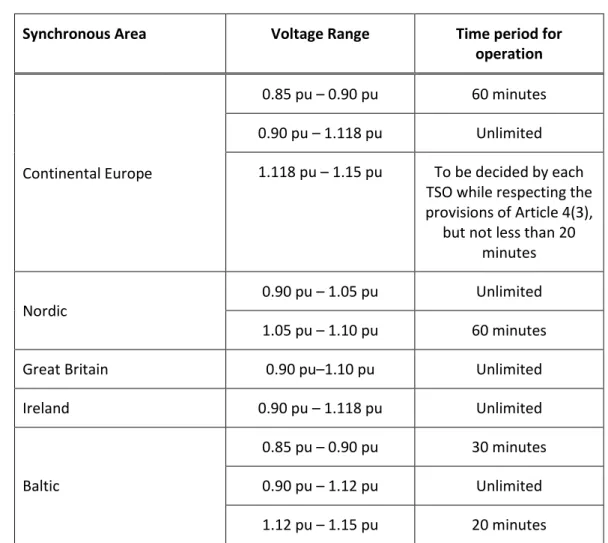
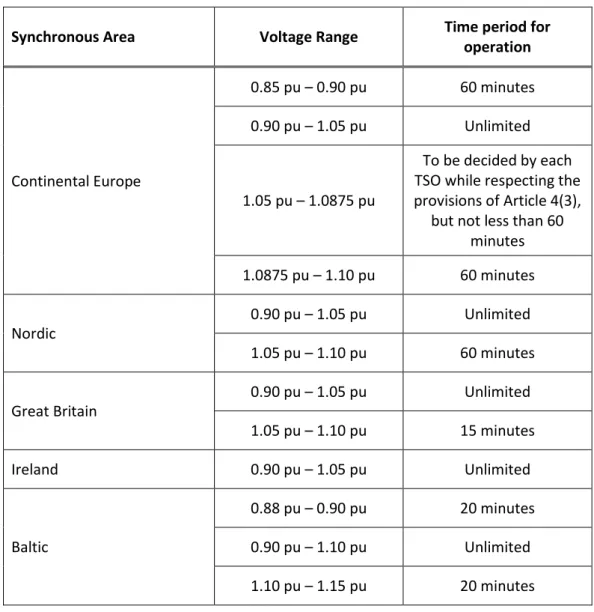
1 pu grid Voltage - for the 400 kV grid Voltage level (or alternatively commonly referred to as 380 kV level) the reference 1 pu value is 400 kV, for other grid Voltage levels the reference 1 pu Voltage may differ for each TSO in the same synchronous area i.e. the Voltage range in kV for all TSOs within a synchronous area may not be the same.
Article 3 SCOPE
1. The requirements set forth by this Network Code shall apply to New Power Generating Modules in a Member State which are significant according to the provisions of this Network Code unless otherwise provided in this Network Code.
2. The requirements set forth by this Network Code shall apply to Existing Power Generating Modules in a Member State which are significant according to the provisions of this Network Code, to the extent their applicability has been decided by the National Regulatory Authority of the Member State, and if this has been proposed by the Relevant TSO, following a public consultation. The proposal by the Relevant TSO shall be made in particular on the basis of a sound and transparent quantitative Cost-Benefit Analysis, including the costs of requiring compliance that shall demonstrate the socio-economic benefit of application of the
requirements set forth by this Network Code to Existing Power Generating Modules. The Relevant TSO shall have the right to re-assess, in case of factual change such as the evolution of system requirements (e.g. penetration of renewable energy sources, smart grids, distributed generation, demand response, etc.), the applicability of the requirements set forth by this Network Code to Existing Power Generating Modules regularly, but not more often than every three years and respecting the provisions of Article 4(3). The relevant TSO shall notify the launch of the procedure for re-assessment on its website. The date of notification on the website shall constitute the first day of the launch of the procedure for re-assessment. A public consultation shall be conducted in the frame of the procedure for re-assessment. Prior to the Relevant TSO carrying out the quantitative Cost-Benefit Analysis an initial qualitative comparison of costs and benefits shall be undertaken in order to determine the cases of sizes of Power Generating Modules or types of Power Generating Modules or locations of Power Generating Modules or clauses of this Network Code for which there may be a viable case for application to Existing Power Generating Modules. Where this preparatory stage demonstrates that a subsequent analytical Cost-Benefit Analysis has a reasonable prospect of demonstrating positive cost-benefit, the Relevant TSO may proceed with the full transparent quantitative Cost-Benefit Analysis. Where the preparatory stage or later stage demonstrate that applicability of the Network Code to Existing Power Generating Modules is not required no further action is to be undertaken.
3. Existing Power Generating Modules not covered by Article 3(2) shall continue to be bound by such technical requirements that apply to them pursuant to legislation in force in the respective Member States or contractual arrangements in force. Should national legislation be repealed or cease to be in force, the Existing Power Generation Module not covered by Article 3(2) shall continue to be bound by such technical requirements that applied to it pursuant to the respective national legislation such as it was the day prior to it ceasing to be in force.
4. With regard to Power Generating Modules not yet connected to the Network:
a) Within a delay not exceeding thirty months as from the day of entry into force of this Network Code, the Power Generating Facility Owner shall provide the Relevant Network Operator with a confirmation of final and binding contracts it has concluded for the construction, assembly or purchase of the main plant of a Power Generating Module with relevance to the provisions of this Network Code and which exists prior to the day, which is two years after the day of entry into force of this Network Code.
b) The confirmation shall at least indicate the contract title, its date of signature and of entry into force, and the specifications of the main plant to be constructed, assembled or purchased.
c) The Relevant Network Operator may demand that the National Regulatory Authority confirms the existence, relevance and finality of such a contract, i.e. that its material terms can no longer be changed by one of the parties to the contract unilaterally and that no party to the contract has the right to terminate it at will. The Power Generating Facility Owner shall supply the National Regulatory Authority with all documents the National Regulatory Authority requests in order to ascertain that a binding and final contract exists.
d) The Power Generating Module shall be considered as an Existing Power Generating Module, provided that:
1) In accordance with Article 3(4) (a) and (b) above, the Relevant Network Operator is provided with sufficient evidence of the existence of binding and final contracts for the construction, assembly or purchase of the main plant of a Power Generating Module
exists prior to the day, which is two years after the day of entry into force of this Network Code; or
2) Following the verification performed by the National Regulatory Authority in accordance with Article 3(4) (c), it is ascertained that binding and final contracts for the construction, assembly or purchase of the main plant of a Power Generating Module exist prior to the day, which is two years after the day of entry into force of this Network Code.
e) In case the Power Generating Facility Owner does not provide the Relevant Network Operator with the confirmation within the delay set forth in Article 3(4) (a), the Power Generating Module shall be considered as a New Power Generating Module.
5. The applicability and extent of the requirements a Power Generating Modules has to comply with depends on the Voltage level of their Connection Point and their Maximum Capacity according to the categories defined in Article 3 (6).
6. Power Generating Modules which are considered to be Significant Power Generating Modules within the scope of this Network Code are categorized as follows:
a) A Power Generating Module is of Type A if its Connection Point is below 110 kV and its Maximum Capacity is 0.8 kW or more. Requirements applicable to Type A Power Generating Modules are the basic level requirements, necessary to ensure capability of generation over operational ranges with limited automated response and minimal system operator control of generation. They ensure there is no wide scale loss of generation over system operational ranges, thereby minimizing critical events, and include requirements necessary for wide spread intervention during system critical events.
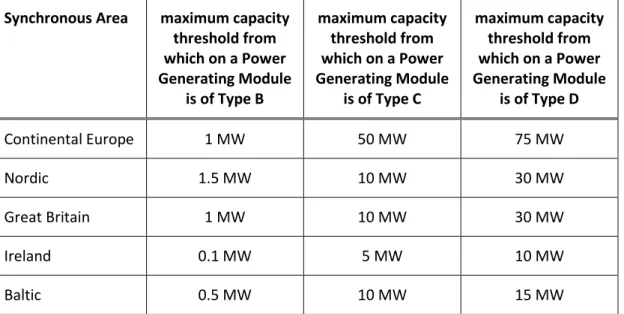
b) A Power Generating Module is of Type B if its Connection Point is below 110 kV and its Maximum Capacity is at or above a threshold defined by each Relevant TSO while respecting the provisions of Article 4(3). This threshold shall not be above the threshold for Type B Power Generating Modules according to table 1. The definition of the threshold shall be coordinated with adjacent TSOs and DSOs and shall be reviewed by the National Regulatory Authority. Power Generating Facility Owners shall assist and contribute to this determination of the threshold and provide the relevant data as requested by the Relevant TSO. The Relevant TSO shall have the right to re-assess the determination of the threshold regularly, if relevant circumstances have changed materially, but not more often than every three years and respecting the provisions of Article 4(3). A public consultation shall be conducted in the frame of the procedure for re-assessment. Following any change to thresholds any Power Generating Module that has been moved to a new type will not automatically have to comply retroactively with the additional requirements but will be subject to the same procedure as applied to Existing Power Generating Modules in line with Article 33. Requirements applicable to Type B Power Generating Modules provide a wider level of automated dynamic response with higher resilience to more specific operational events to ensure use of this higher dynamic response and a higher level system operator control and information to utilize these capabilities. They ensure automated response to alleviate and maximize dynamic generation response to system events, greater Power Generating Module resilience of these events to ensure this dynamic response and better communication and control to leverage these capabilities.
c) A Power Generating Module is of Type C if its Connection Point is below 110 kV and its Maximum Capacity is at or above a threshold defined by each Relevant TSO while respecting the provisions of Article 4(3). This threshold shall not be above the threshold for Type C Power Generating Modules according to table 1. The definition of the threshold shall be
coordinated with adjacent TSOs and DSOs and shall be reviewed by the National Regulatory Authority. Power Generating Facility Owners shall assist and contribute to this determination of the threshold and provide the relevant data as requested by the Relevant TSO. The Relevant TSO shall have the right to re-assess the determination of the threshold regularly, if relevant circumstances have changed materially, but not more often than every three years and respecting the provisions of Article 4(3). A public consultation shall be conducted in the frame of the procedure for re-assessment. Following any change to thresholds any Power Generating Module that has been moved to a new type will not automatically have to comply retroactively with the additional requirements but will be subject to the same procedure as applied to Existing Power Generating Modules in line with Article 33. Requirements applicable to Type C Power Generating Modules provide refined, stable and highly controllable (real time) dynamic response to provide principle ancillary services to ensure security of supply. These requirements cover all operational Network states with consequential detailed specification of interactions of requirements, functions, control and information to utilize these capabilities. They ensure real time system response necessary to avoid, manage and respond to system events. These requirements provide sufficient generation functionality to respond to both intact and system disturbed situations, and the need for information and control necessary to utilise this generation over this diversity of situations.
Synchronous Area maximum capacity
threshold from which on a Power Generating Module
is of Type B
maximum capacity threshold from which on a Power Generating Module
is of Type C
maximum capacity threshold from which on a Power Generating Module
is of Type D
Continental Europe 1 MW 50 MW 75 MW
Nordic 1.5 MW 10 MW 30 MW
Great Britain 1 MW 10 MW 30 MW
Ireland 0.1 MW 5 MW 10 MW
Baltic 0.5 MW 10 MW 15 MW
Table 1: Thresholds for Type B, C and D Power Generating Modules
d) A Power Generating Module is of Type D if its Connection Point is at 110 kV or above. A Synchronous Power Generating Module or Power Park Module is of Type D as well if its Connection Point is below 110 kV and its Maximum Capacity is at or above a threshold defined by each Relevant TSO while respecting the provisions of Article 4(3). This threshold shall not be above the threshold for Type D Power Generating Modules according to table 1. The definition of the threshold shall be coordinated with adjacent TSOs and DSOs and shall be reviewed by the National Regulatory Authority. Power Generating Facility Owners shall assist and contribute to this determination of the threshold and provide the relevant data as requested by the Relevant TSO. The Relevant TSO shall have the right to re-assess the determination of the threshold regularly, if relevant circumstances have changed materially, but not more often than every three years and respecting the provisions of Article 4(3). A public consultation shall be conducted in the frame of the procedure for re-assessment. Following any change to thresholds any Power Generating Module that has been moved to a
new type will not automatically have to comply retroactively with the additional requirements but will be subject to the same procedure as applied to Existing Power Generating Modules in line with Article 33. Requirements applicable to Type D Power Generating Modules are in particular specific for higher Voltage connected generation with impact on entire system control and operation. They ensure stable operation of the interconnected Network, allowing the use of ancillary services from generation Europe wide. e) For offshore connected Synchronous Power Generating Modules the requirements for onshore synchronous Power Generating Modules shall apply unless modified by the Relevant Network Operator while respecting the provisions of Article 4(3). The categories to be taken into account for Offshore Power Park Modules for the purpose of this Network Code are defined in Article 18(3).
f) Pump-storage Power Generating Modules shall fulfil all requirements in both generating and pumping operation mode. Synchronous Compensation Operation of Pump-Storage Power Generating Modules shall not be limited in time by technical design of the Power Generating Modules. Pump-Storage variable speed Power Generating Modules shall fulfil all requirements applicable to synchronous Power Generating Modules and in addition those set forth in Article 15(2) (b), if they are of Type B, C or D.
g) Without prejudice to the general applicability of the requirements set forth in this Network Code, a Power Generating Facility Owner, the Network Operator of an industrial site and the Relevant Network Operator to whose Network the Network of the industrial site is connected to, shall have the right in coordination with the Relevant TSO, with respect to Power Generation Modules which are embedded in the Networks of industrial sites, to agree while respecting the provisions of Article 4 (3) on conditions for disconnection of such Power Generating Modules together with critical loads, which secure production processes, from the Relevant Network Operator’s Network. The only objective of such an agreement shall be to secure production processes of such a site in case of disturbed conditions in the Relevant Network Operator’s Network. The requirements of this Network Code, notwithstanding such an agreement, shall apply to Power Generating Modules embedded in the Networks of such industrial sites.
h) Without prejudice to the general applicability of the requirements set forth in this Network Code, a requirement of this Network Code shall not apply to Power Generating Modules of facilities for combined heat and power production (CHP) embedded in the Networks of industrial sites in the following cumulative circumstances:
- the primary purpose of these facilities is to produce heat for production processes of this industrial site;
- the generation of heat and power are rigidly coupled to each other, i. e. any change of heat generation results inadvertently in a change of Active Power generation and vice versa;
- the Power Generating Modules are of Type A, B or C according to Article 3(6) (a) to (c); and
- the requirement is related to the capability maintain constant Active Power output or to modulate Active Power output other than Article 8(1) (c) and (e).
i) For the avoidance of doubt, combined heat and power generating facilities will be regarded on their electrical Maximum Capacity.
Article 4 REGULATORY ASPECTS
1. The requirements established in this Network Code and their applications are based on the principle of non-discrimination and transparency as well as the principle of optimisation between the highest overall efficiency and lowest total cost for all involved parties.
2. Notwithstanding the above, the application of the principles of non-discrimination and the principle of optimisation between the highest overall efficiency and lowest total costs for all involved parties shall be balanced with the aim of achieving the maximum transparency and the assignment to the real originator of the costs. This shall be reflected in objective differences in treatment of different generation technologies with different inherent characteristics as well as by avoiding unnecessary investments in some geographical areas so that their respective regional specifics are appropriately taken into account. TSOs, DSOs and CDSOs shall have the right to take into account these differences when defining requirements, in compliance with the provisions of this Network Code and their national law.
3. Where reference is made to this paragraph, the terms and conditions for connection and access to networks or their methodologies shall be established by the National Regulatory Authorities, or by the Member States in accordance with the rules of national law implementing Directive 2009/72/EC, and with the principles of transparency, proportionality and non-discrimination. 4. Any decision by a Network Operator other than the Relevant TSO and any agreement between a
Network Operator other than the Relevant TSO and a Power Generating Facility Owner shall be exercised in compliance with and respecting the Relevant TSO’s responsibility to ensure system security according to national legislation. Further details to ensure this principle may be specified either by national legislation or by agreements between the Relevant TSO and the Network Operators in its Control Area, as the case may be.
5. The allocation of tasks between the Relevant Network Operators, as well as the legal framework under which they determine the grid connections requirements under this Network Code, are established pursuant to this Network Code. TSOs granted public authority or competence according to national law can adopt decisions when defining requirements under this Network Code while respecting Directive 2009/72/EC.
Article 5 Recovery of Costs
1. The costs related to the obligations referred to in this network code which have to be borne by regulated Network Operators shall be assessed by National Regulatory Authorities.
2. Costs assessed as efficient, reasonable and proportionate shall be recovered as determined by National Regulatory Authorities
3. If requested to do so by National Regulatory Authorities, regulated Network Operators shall, within three months of such a request, use best endeavours to provide such additional
information as reasonably requested by National Regulatory Authorities to facilitate the assessment of the costs incurred.
Article 6
CONFIDENTIALITY OBLIGATIONS
1. Each Relevant Network Operator, Relevant TSO, Relevant DSO or Relevant CDSO shall preserve the confidentiality of the information and data submitted to them in fulfilment of the obligations under this Network Code and shall use them exclusively for the purpose they have been submitted in compliance with this Network Code, notably to verify the compliance of requirements set forth in this Network Code.
2. Notwithstanding the above, disclosure of such information and data may occur in case a Relevant Network Operator, a Relevant TSO, Relevant DSO or a Relevant CDSO is compelled under EU or national law to disclose it, under the conditions set forth in the relevant legislation. The disclosure shall be reported to the owner of such information and data.
3. In case of disclosure for other purposes than those described in Article 6(1) and/or (2), a Relevant Network Operator, a Relevant TSO, Relevant DSO or a Relevant CDSO shall seek the consent of the owner of such information and data. This consent cannot be unreasonably withheld.
Article 7
RELATIONSHIP WITH NATIONAL LAW PROVISIONS
This Network Code shall be without prejudice to the rights of Member States to maintain or introduce measures that contain more detailed or more stringent provisions than those set out herein, provided that these measures are compatible with the principles set forth in this Network Code.
Title 2
REQUIREMENTS
Chapter 1
GENERAL REQUIREMENTS
Article 8
GENERAL REQUIREMENTS FOR TYPE A POWER GENERATING MODULES
1. Type A Power Generating Modules shall fulfil the following requirements referring to Frequency stability:
a) With regard to Frequency ranges:
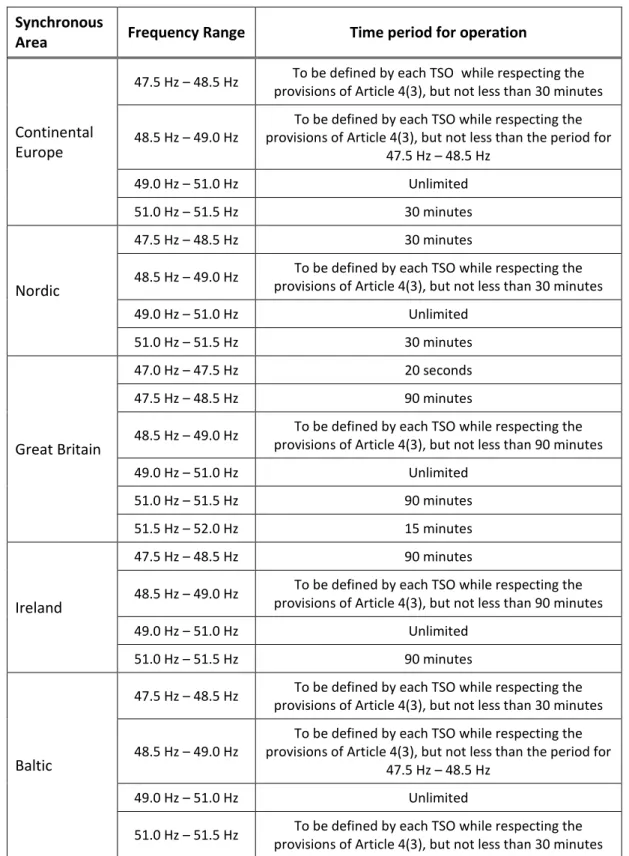
1) A Power Generating Module shall be capable of staying connected to the Network and operating within the Frequency ranges and time periods specified by table 2.
2) While respecting the provisions of Article 4(3), wider Frequency ranges or longer minimum times for operation can be agreed between the Relevant Network Operator in coordination with the Relevant TSO and the Power Generating Facility Owner to ensure the best use of the technical capabilities of a Power Generating Module if needed to preserve or to restore system security. If wider Frequency ranges or longer minimum times for operation are economically and technically feasible, the consent of the Power Generating Facility Owner shall not be unreasonably withheld.
3) While respecting the provisions of Article 8(1) (a) point 1) a Power Generating Module shall be capable of automatic disconnection at specified frequencies, if required by the Relevant Network Operator. While respecting the provisions of Article 4(3), Terms and settings for automatic disconnection shall be agreed between the Relevant Network Operator and the Power Generating Facility Owner.
b) With regard to the rate of change of Frequency withstand capability, a Power Generating Module shall be capable of staying connected to the Network and operating at rates of change of Frequency up to a value defined by the Relevant TSO while respecting the provisions of Article 4(3) other than triggered by rate-of-change-of-Frequency-type of loss of mains protection. This rate-of-change-of-Frequency-type of loss of mains protection will be defined by the Relevant Network Operator in coordination with the Relevant TSO and subject to notification to the National Regulatory Authority. The modalities of that notification shall be determined in accordance with the applicable national regulatory framework.
Synchronous
Area Frequency Range Time period for operation
Continental Europe
47.5 Hz – 48.5 Hz provisions of Article 4(3), but not less than 30 minutes To be defined by each TSO while respecting the 48.5 Hz – 49.0 Hz
To be defined by each TSO while respecting the provisions of Article 4(3), but not less than the period for
47.5 Hz – 48.5 Hz 49.0 Hz – 51.0 Hz Unlimited 51.0 Hz – 51.5 Hz 30 minutes
Nordic
47.5 Hz – 48.5 Hz 30 minutes
48.5 Hz – 49.0 Hz provisions of Article 4(3), but not less than 30 minutes To be defined by each TSO while respecting the 49.0 Hz – 51.0 Hz Unlimited
51.0 Hz – 51.5 Hz 30 minutes
Great Britain
47.0 Hz – 47.5 Hz 20 seconds 47.5 Hz – 48.5 Hz 90 minutes
48.5 Hz – 49.0 Hz To be defined by each TSO while respecting the provisions of Article 4(3), but not less than 90 minutes 49.0 Hz – 51.0 Hz Unlimited
51.0 Hz – 51.5 Hz 90 minutes 51.5 Hz – 52.0 Hz 15 minutes
Ireland
47.5 Hz – 48.5 Hz 90 minutes
48.5 Hz – 49.0 Hz To be defined by each TSO while respecting the provisions of Article 4(3), but not less than 90 minutes 49.0 Hz – 51.0 Hz Unlimited
51.0 Hz – 51.5 Hz 90 minutes
Baltic
47.5 Hz – 48.5 Hz To be defined by each TSO while respecting the provisions of Article 4(3), but not less than 30 minutes 48.5 Hz – 49.0 Hz
To be defined by each TSO while respecting the provisions of Article 4(3), but not less than the period for
47.5 Hz – 48.5 Hz 49.0 Hz – 51.0 Hz Unlimited
51.0 Hz – 51.5 Hz To be defined by each TSO while respecting the provisions of Article 4(3), but not less than 30 minutes Table 2: Minimum time periods for which a Power Generating Module shall be capable of operating for different frequencies deviating from a nominal value without disconnecting from the Network.
c) With regard to the Limited Frequency Sensitive Mode - Overfrequency (LFSM-O) the following shall apply:
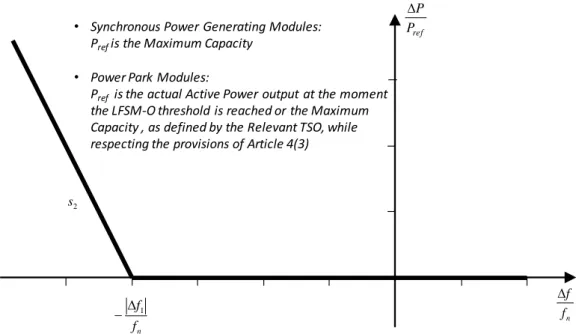
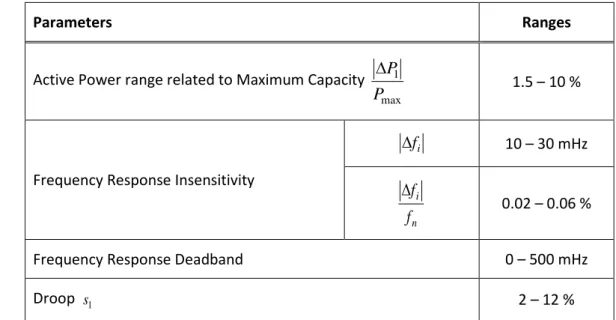
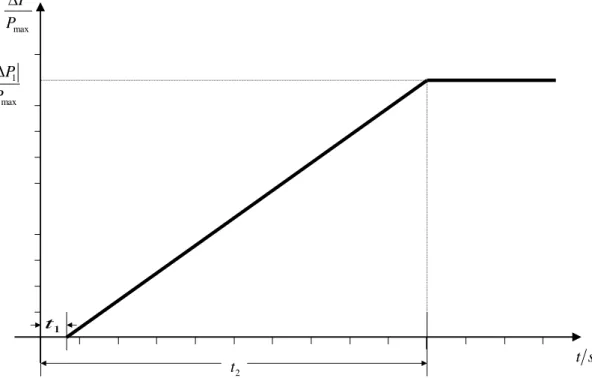
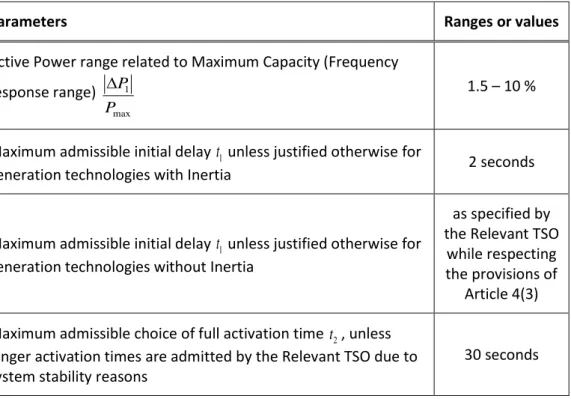
1) The Power Generating Module shall be capable of activating the provision of Active Power Frequency Response according to figure 1 at a Frequency threshold between and including 50.2 Hz and 50.5 Hz with a Droop in a range of 2 – 12 %. The actual Frequency threshold and Droop settings shall be determined by the Relevant TSO subject to notification to the National Regulatory Authority. The modalities of that notification shall be determined in accordance with the applicable national regulatory framework. The Power Generating Module shall be capable of activating Active Power Frequency Response as fast as technically feasible with an initial delay that shall be as short as possible and reasonably justified by the Power Generating Facility Owner to the Relevant TSO if greater than 2 seconds. The Power Generating Module shall be capable of either continuing operation at Minimum Regulating Level when reaching it or further decreasing Active Power output in this case, as defined by the Relevant TSO while respecting the provisions of Article 4(3).
Figure 1: Active Power Frequency Response capability of Power Generating Modules in LFSM-O. Pref is the reference Active Power to which P is related and may be defined differently for Synchronous Power Generating Modules and Power Park Modules. P is the change in Active Power output from the Power Generating Module. fn is the nominal Frequency (50 Hz) in the Network and f is the Frequency change in the Network. At overfrequencies where f is above f1 the Power Generating Module has to provide a negative Active Power output change according to the Droop S2.
2) The Power Generating Module shall be capable of stable operation during LFSM-O operation. When LFSM-O is active, the LFSM-O Setpoint will prevail over any other Active Power Setpoints.
d) The Power Generating Module shall be capable of maintaining constant output at its target Active Power value regardless of changes in Frequency, unless output shall follow the
ref P
P
n
f f
n
f f1
2
s
• Synchronous Power Generating Modules:
Prefis the Maximum Capacity
• Power Park Modules:
Pref is the actual Active Power output at the moment the LFSM-O threshold is reached or the Maximum Capacity , as defined by the Relevant TSO, while respecting the provisions of Article 4(3)
defined changes in output in the context of Article 8(1) (c), (e) or Article 10(2) (b), and Article 10(2) (c) where applicable.
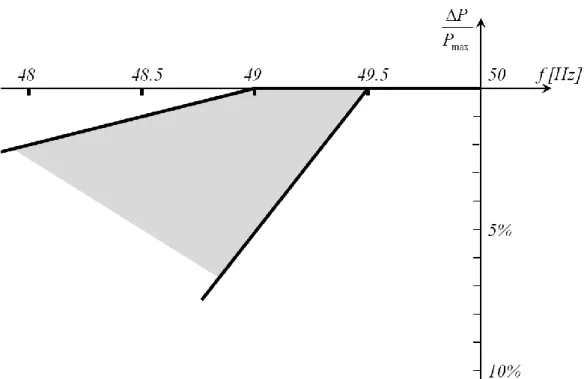
e) The Relevant TSO shall define while respecting the provisions of Article 4(3) admissible Active Power reduction from maximum output with falling Frequency within the boundaries, given by the full lines in Figure 2:
- Below 49 Hz falling by a reduction rate of 2 % of the Maximum Capacity at 50 Hz per 1 Hz Frequency drop;
- Below 49.5 Hz by a reduction rate of 10 % of the Maximum Capacity at 50 Hz per 1 Hz Frequency drop.
Applicability of this reduction is limited to a selection of affected generation technologies and may be subject to further conditions defined by the Relevant TSO while respecting the provisions of Article 4(3).
Figure 2 – Maximum power capability reduction with falling Frequency. The diagram represents the boundaries defined by the Relevant TSO while respecting the provisions of Article 4(3).
f) The Power Generating Module shall be equipped with a logic interface (input port) in order to cease Active Power output within less than 5 seconds following an Instruction from the Relevant Network Operator. The Relevant Network Operator shall have the right to define while respecting the provisions of Article 4(3) the requirements for further equipment to make this facility operable remotely.
g) The Relevant TSO shall define while respecting the provisions of Article 4(3) the conditions under which a Power Generating Module shall be capable of connecting automatically to the Network. These conditions shall include:
- Frequency ranges, within which an automatic connection is admissible, and a corresponding delay time
- maximum admissible gradient of increase of Active Power output
Automatic connection is allowed unless determined otherwise by the Relevant Network Operator in coordination with the Relevant TSO.
Article 9
GENERAL REQUIREMENTS FOR TYPE B POWER GENERATING MODULES
1. In addition to fulfilling the requirements listed in Article 8, Type B Power Generating Modules shall fulfil the requirements in this Article.
2. Type B Power Generating Modules shall fulfil the following requirements referring to Frequency stability:
a) In order to be able to control Active Power output, the Power Generating Module shall be equipped with a interface (input port) in order to be able to reduce Active Power output as instructed by the Relevant Network Operator and/or the Relevant TSO. The Relevant Network Operator shall have the right to define while respecting the provisions of Article 4(3) the requirements for further equipment to make this facility operable remotely.
3. Type B Power Generating Modules shall fulfil the following requirements referring to robustness of Power Generating Modules:
a) With regard to fault-ride-through capability of Power Generating Modules:
1) Each TSO shall define while respecting the provisions of Article 4(3) a voltage-against-time-profile according to figure 3 at the Connection Point for fault conditions which describes the conditions in which the Power Generating Module shall be capable of staying connected to the Network and continuing stable operation after the power system has been disturbed by Secured Faults on the Network.
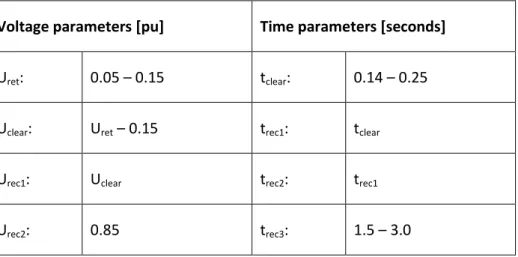
2) This voltage-against-time-profile shall be expressed by a lower limit of the course of the phase-to-phase Voltages on the Network Voltage level at the Connection Point during a symmetrical fault, as a function of time before, during and after the fault. This lower limit is defined by the TSO while respecting the provisions of Article 4(3) using parameters in figure 3 according to tables 3.1 and 3.2.
3) Each TSO shall define and make publicly available while respecting the provisions of Article 4(3) defining the pre-fault and post-fault conditions for the fault-ride-through capability in terms of:
- conditions for the calculation of the pre-fault minimum short circuit capacity at the Connection Point;
- conditions for pre-fault active and Reactive Power operating point of the Power Generating Module at the Connection Point and Voltage at the Connection Point; and
- conditions for the calculation of the post-fault minimum short circuit capacity at the Connection Point.
4) Each Relevant Network Operator shall provide on request by the Power Generating Facility Owner the pre-fault and post-fault conditions to be considered for fault-ride-through capability as an outcome of the calculations at the Connection Point as defined in Article 9 (3) (a) point 3) regarding:
- pre-fault minimum short circuit capacity at each Connection Point expressed in MVA;
- pre-fault operating point of the Power Generating Module expressed in Active Power output and Reactive Power output at the Connection Point and Voltage at the Connection Point; and
- post-fault minimum short circuit capacity at each Connection Point expressed in MVA.
Alternatively generic values for the above conditions derived from typical cases may be provided by the Relevant Network Operator.
Figure 3 – Fault-ride-through profile of a Power Generating Module. The diagram represents the lower limit of a voltage-against-time profile by the Voltage at the Connection Point, expressed by the ratio of its actual value and its nominal value in per unit before, during and after a fault. Uret is the retained Voltage at the Connection Point During a fault, tclear is the instant when the fault has been cleared. Urec1, Urec2, trec1, trec2 and trec3 specify certain points of lower limits of Voltage recovery after fault clearance.
Voltage parameters [pu] Time parameters [seconds]
Uret: 0.05 – 0.3 tclear: 0.14 – 0.25 Uclear: 0.7 – 0.9 trec1: tclear Urec1: Uclear trec2: trec1 – 0.7
0 tclear trec1 trec2 trec3
Urec1
Uclear
Uret
1.0
Urec2
t/sec U/p.u.
Urec2: 0.85 – 0.9 and ≥ Uclear trec3: trec2 – 1.5
Table 3.1 – Parameters for figure 3 for fault-ride-through capability of Synchronous Power Generating Modules.
Voltage parameters [pu] Time parameters [seconds]
Uret: 0.05 – 0.15 tclear: 0.14 – 0.25 Uclear: Uret – 0.15 trec1: tclear
Urec1: Uclear trec2: trec1
Urec2: 0.85 trec3: 1.5 – 3.0
Table 3.2 – Parameters for figure 3 for fault-ride-through capability of Power Park Modules.
5) The Power Generating Module shall be capable of staying connected to the Network and continue stable operation when the actual course of the phase-to-phase Voltages on the Network Voltage level at the Connection Point during a symmetrical fault, given the pre-fault and post-pre-fault conditions according to Article 9(3) (a) points 3) and 4), remains above the lower limit defined in Article 9(3) (a) point 2), unless the protection scheme for internal electrical faults requires the disconnection of the Power Generating Module from the Network. The protection schemes and settings for internal electrical faults shall be designed not to jeopardize fault-ride-through performance.
6) While still respecting Article 9(3) (a) point 5), undervoltage protection (either fault-ride-through capability or minimum Voltage defined at the connection point Voltage) shall be set by the Power Generating Facility Owner to the widest possible technical capability of the Power Generating Module unless the Relevant Network Operator requires less wide settings according to Article 9(5) (b). The settings shall be justified by the Power Generating Facility Owner in accordance with this principle.
7) Fault-ride-through capabilities in case of asymmetrical faults shall be defined by each TSO while respecting the provisions of Article 4(3).
4. Type B Power Generating Modules shall fulfil the following requirement referring to system restoration:
a) With regard to capability of reconnection after an incidental disconnection due to a Network disturbance, the Relevant TSO shall adopt a decision while respecting the provisions of Article 4(3) defining the conditions under which a Power Generating Module shall be capable of reconnecting to the Network after an incidental disconnection has taken place due to a Network disturbance. Installation of automatic reconnection systems shall be subject to prior authorization by the Relevant Network Operator subject to reconnection conditions specified by the Relevant TSO.
5. Type B Power Generating Modules shall fulfil the following general system management requirements:
a) With regard to control schemes and settings
1) While respecting the provisions of Article 4(3), schemes and settings of the different control devices of the Power Generating Module relevant for transmission system stability and to enable emergency actions shall be coordinated and agreed between the Relevant TSO, the Relevant Network Operator and the Power Generating Facility Owner. 2) While respecting the provisions of Article 4(3), any changes to the schemes and settings of the different control devices of the Power Generating Module, relevant for transmission system stability and to enable emergency actions, shall be coordinated and agreed between the Relevant TSO, the Relevant Network Operator and the Power Generating Facility Owner, especially if they concern the circumstances referred to under Article 9(5) (a) point 1).
b) With regard to electrical protection schemes and settings:
1) The Relevant Network Operator shall define the schemes and settings necessary to protect the Network taking into account the characteristics of the Power Generating Module. While respecting the provisions of Article 4(3), protection schemes relevant for the Power Generating Module and the Network and settings relevant for the Power Generating Module shall be coordinated and agreed between the Relevant Network Operator and the Power Generating Facility Owner. The protection schemes and settings for internal electrical faults shall be designed not to jeopardize the performance of a Power Generating Module according to this Network Code requirements otherwise. 2) Electrical protection of the Power Generating Module shall take precedence over
operational controls taking into account system security, health and safety of staff and the public and mitigation of the damage to the Power Generating Module.
3) Protection schemes can protect against the following aspects: - external and internal short circuit;
- asymmetric load (Negative Phase Sequence); - stator and rotor overload;
- over-/underexcitation;
- over-/undervoltage at the Connection Point; - over-/undervoltage at the Alternator terminals; - inter-area oscillations;
- inrush Current;
- asynchronous operation (pole slip);
- protection against inadmissible shaft torsions (for example, subsynchronous resonance);
- Power Generating Module line protection; - unit transformer protection;
- backup schemes against protection and switchgear malfunction; - overfluxing (U/f);
- inverse power;
- rate of change of Frequency; and - neutral Voltage displacement.