W I D E - R A N G E RESTRUCTURING OF
REPRESENTATIONS IN M A C H I N E
INTERMEDIATE
TRANSLATION
Taijiro Tsutsumi
IBM Research, Tokyo Research Laboratory
IBM Japan, Ltd.
5-19, Sanban-cho, Chiyoda-ku
T o k y o 102Japan
This paper describes a wide-range restructuring of intermediate representations in machine translation, which is necessary for bridging stylistic gaps between source and target languages and for generating natural target sentences.
We propose a practical way of designing machine translation systems, based on the transfer method, that deal with wide-range restructuring. The transfer component should be divided into two separate sub- components: the wide-range restructuring sub-component and the basic transfer sub-component. The first sub-component deals specifically with global reorganization of intermediate representations in order to bridge the stylistic gaps between source and target languages, and the second performs local and straightfor- ward processing, including lexicai transfer and basic structural transfer.
This approach provides us with an effective basis for improving translation quality by systematically enhancing the transfer rules without sacrificing the clarity and maintainability of the transfer component. It also guarantees that most of the translation process can be based on the augmented Context Free Grammar (CFG) formalism and the so-called compositionality principle, by which we can both systematically expand and maintain linguistic data and design the simplified process control necessary for an efficient machine translation system.
1 INTRODUCTION
Much effort has been devoted to research into, and develop- ment of, machine translation since the 1950s (Slocum 1985). However, the quality of the output sentences pro- duced by most machine translation systems is not high enough to have any marked effect on translation productiv- ity.
A machine translation system produces a variety of expressions in the target language, including good, fair, and poor expressions. In this paper, we define these distinctions as follows. "Good" sentences can be easily understood and have high readability because of their naturalness, "fair" sentences can be understood but their readability is low, and "poor" sentences cannot be understood without refer- ring to the source sentences.
To improve the quality of translation, the following major functions should be implemented:
1. selection of equivalents for words; 2. reordering of words; and
3. improvement of sentence styles.
A machine translation system that does not have Func- tion 3 often produces "good" output in the case of transla-
tion between languages in the same linguistic group if Functions 1 and 2 are appropriately achieved. However, most output will be "fair" or "poor" in the case of transla- tion between languages in different linguistic groups, be- cause of the stylistic gaps between them. We need to enhance Function 3 as well as Functions 1 and 2 in order to change "fair" or "poor" sentences to "good" or "fair" ones.
Note that in this paper,
style
means a preferable grammat-ical form that successfully conveys a correct meaning. First, let us consider how to select target language equivalents for words in the source language. An appropri- ate part of speech for a word is first determined by the grammatical constraints provided by the analysis gram- mar. Nouns and the verb in a simple sentence can then be appropriately translated according to the combinative con- straints between the case frame of the verb and the seman- tic markers of the nouns. This is a well-known mechanism for practical semantic processing in machine translation. However, this way of selecting equivalents has the limita- tion that we cannot classify verbs and nouns in sufficient detail, because of ambiguities in the definitions and usage of words. Many researchers in machine translation claim that a much more powerful semantic processing mecha-
Taijiro Tsutsumi Intermediate Representations in Machine Translation
nism with a knowledge base is required for this purpose. This is a long-range research project in the field.
Second, there seem to be few critical problems in reorder- ing words if structural transfer is appropriately carried out. In a simple sentence, for example, we can usually reorder words correctly on the basis of the case frame of the verb.
Thus, the improvement of sentence styles is one of the crucial functions required for further enhancement of the present translation quality. Even when the output is "fair" in quality, it has to be read carefully, because the readabil- ity is often low. We expect an improvement in sentence styles to result in an improvement in translation quality from "poor" or "fair" to "good." Improving sentence styles seems to be easier than selecting better equivalents for words, because there are syntactic clues to help us make the styles more natural.
This paper focuses on an approach to the improvement of sentence styles by wide-range restructuring of intermediate
representations. Wide-range restructuring in this paper
means the global restructuring of intermediate representa- tions, usually including the replacement of some class words (i.e., noun, adjective, verb, and adverb). Some pa- pers have mentioned limited restructuring of intermediate representations (Bennett and Slocum 1985; Vauquois and Boitet 1985; Isabelle and Bourbeau 1985; Nagao et al. 1985; McCord 1985; Nomura et al. 1986). For example, L M T (McCord 1985) has a restructuring function after the transfer phase, to form a bridge between the basic styles of English and German. The Mu system (Nagao et al. 1985) has two specific restructuring functions, before and after the transfer phase, mainly to handle exceptional cases.
However, few machine translation systems have so far had a comprehensive component for wide-range restructur- ing (Slocum 1985), mainly because many systems are presently designed to produce output that is at best "fair," and little effort has been devoted to obtaining "good" output or natural sentences. As a matter of fact, wide- range restructuring functions are usually scattered over the analysis, transfer, and generation phases in an ad hoc way. Because of complicated implementations, the systems come to have low maintainability and efficiency.
Few papers so far have systematically discussed the crucial stylistic gaps between languages, the importance of wide-range restructuring of intermediate representations to bridge these gaps, and effective mechanisms for restruc- turing. A restructuring mechanism is necessary even when a machine translation system is based on the semantic-level transfer or pivot method (Carbonell et al. 1981).
In this paper, we first discuss stylistic gaps between languages, and the importance of dealing with them effec- tively in order to generate natural target sentences. We then propose a restructuring mechanism that successfully bridges the stylistic gaps and preserves a high maintainabil- ity for the transfer phase of a machine translation system. Last, we discuss the implementation of the wide-range restructuring function.
2 STYLISTIC GAPS BETWEEN LANGUAGES
In discussions on the stylistic gaps between English and Japanese, it is often said that English is a HAVE-type or DO-type language, whereas Japanese is a BE-type or BE- COME-type language. This contrast corresponds to the differences in the ways people recognize things and express their ideas about them (Nitta 1986), and hence is consid- ered as a difference of viewpoint. Idioms and metaphors are heavily dependent upon each society and culture, and we sometimes have to reinterpret them to give an appropriate translation. Each language also has its own specific func- tion word constructions, which are used to express specific meanings. These specific constructions cannot be directly translated into other languages.
We categorize the major stylistic gaps as follows: (1) stylistic gaps in viewpoint, (2) stylistic gaps in idioms and metaphors, (3) stylistic gaps in specific constructions using function words, and (4) others. We will discuss these gaps in more detail in the case of English-to-Japanese transla- tion by referring to examples extracted from the literature (Bekku 1979; Anzai 1983) and slightly modified for our purpose. In each example, the first sentence is the original English and the second one is an equivalent or a rough equivalent in Japanese-like English, which will help us recognize the stylistic gaps, though some of the rewritten English is not strictly acceptable.
2.1 STYLISTIC GAPS IN VIEWPOINT
The following are some examples of stylistic gaps due to differences of viewpoint.
1. Inanimate noun + transitive verb
i) Inanimate noun + have
(I-a) The room has two tables.
(l-b) Two tables are in the room.
ii) Others
(2-a) This chapter contains the explanation.
(2-b) The explanation is contained in this chapter.
The meaning of (l-a) is that the room contains two
tables. However, an inanimate subject for the verb have is not allowed in Japanese. Japanese usually expresses the same fact as in (l-b), without using an inanimate subject. (2-a) and (2-b) show a case in which the voice is changed to avoid an inanimate subject in a Japanese sentence.
2. Gerund (intransitive verb) + o f + noun + transitive
verb
(3-a) The humming o f insects reminded me of autumn.
(3-b) Because insects were humming, it seemed to me it was autumn.
T~:is case is similar to example (I-a) in that the subject of (3-a) is inanimate. An event or action, which may be the subject of an English sentence, is usually treated as a cause or reason in a Japanese sentence.
Taijiro Tsutsumi Intermediate Representations in Machine Translation
3. Inanimate noun + allow + noun + to-infinitive
(4-a) The support allows you to write I P L procedures.
(4-b) You can write I P L procedures by using the support.
In this case, we can consider the subject as a tool or method, as explicitly rewritten in (4-b).
4. Have + adjective + noun (two-place predicate)
(5-a) The routine has a relatively low usage rate.
(5-b) The usage rate of the routine is relatively low.
The adjective low in the noun phrase low usage rate in
(5-a) is removed and used as predicative form in (5-b). Japanese often prefers predicative expressions like this.
5. Adjective + verbal noun + o f + noun
(6-a) He is a good speaker o f English.
(6-b) He speaks English well.
The noun phrase a good speaker is rewritten to form a
predicative phrase.
6. Special verb (do, make, perform, etc.) + adjective +
verbal noun + o f + noun
(7-a) The D O S / V S E S C P is designed to make efficient
use o f a hardware system.
(7-b) The D O S / V S E S C P is designed to use a hardware system efficiently.
This is also a case in which Japanese prefers a predica- tive phrase.
7. Special determiner (no, few, little, etc.) + noun
(8-a) I have no French books.
(8-b) I do not have any French books.
This is a case in which a special determiner should be removed from the noun phrase and rewritten as an adverb. I f we translate these English sentences literally into Japanese, we will have low readability for the Japanese sentences.
2.2 STYLISTIC GAPS IN IDIOMS AND METAPHORS
Idioms and metaphors should be distinguished from other phrases in a text, because they have implicit and fixed meanings. The following are some examples:
(9-a) A car drinks gasoline.
(9-b) A car requires a lot of gasoline.
(10-a) Cigarettes are time bombs. (10-b) Cigarettes gradually harm us.
(1 l-a) He burned his bridges.
(1 I-b) He destroyed his alternative options.
In case (9-a), we will face difficulty in semantic process- ing if we try to translate the sentence directly. The reason is
that the verb drink usually requires an animate subject
whereas the noun car is, in most cases, classified as an
inanimate thing.
We can translate example (10-a) literally if we want to preserve the humor conveyed by the original sentence. However, this is not often possible because of cultural differences. Example (1 l-a) is a typical case of something that we cannot translate literally into Japanese.
2.3 STYLISTIC GAPS IN SPECIAL FUNCTION WORD
CONSTRUCTIONS
The following are some examples of stylistic gaps due to special English constructions using function words.
(12-a) It is required that you specify the assignment.
(12-b) That you specify the assignment is required.
(13-a) The system operation is so impaired that the I P L
procedure has to be repeated.
(13-bl) Because the system operation is impaired very much, the I P L procedure has to be repeated. (13-b2) The system operation is impaired to the extent
that the I P L procedure has to be repeated.
(14-a) The box is too heavy for a child to carry.
(14-bl) Because the box is very heavy, a child cannot carry it.
(14-b2) The box is very heavy to the extent that a child cannot carry it.
There is no direct way to translate the examples given above, because the grammatical functions conveyed by the special constructions using function words are often ex- pressed in a very different way in a target language.
2.4 OTHERS
In addition to the stylistic gaps described above, we often see other stylistic gaps based on the meaning of a word. For
example, the verb bridge in English should be translated by
"hashi (a noun meaning a bridge) wo (a case particle
meaning an object) kakeru (a verb meaning 'install')" in
Japanese. One English verb corresponds to a noun, a case particle, and a verb in this case. A set of consecutive words
may have a fixed meaning: for example, a number o f can be
considered as many in most cases. Differences in tense,
aspect, and modality are also related to stylist gaps between languages, although we do not discuss these in detail here. So far, we have discussed four types of stylistic gaps. Generally, there are larger stylistic gaps between lan- guages belonging to different groups than between lan- guages in the same group. It is clear that if we can deal adequately with these stylistic gaps, we can further im- prove translation quality.
3 H o w TO DEAL WITH STYLISTIC GAPS
This section discusses a framework for dealing with the stylistic gaps we noted in the previous section.
3.1 THE COMPOSlTIONALITY PRINCIPLE IN MACHINE TRANSLATION
Most machine translation systems (Slocum 1985) aiming at practical use employ the transfer method, which divides
Taijiro Tsutsumi Intermediate Representations in Machine Translation
the whole process into three phases: analysis of the source language, transfer between intermediate representations, and generation of the target language. The basic concept underlying current machine translation technology is the compositionality principle (Nagao 1986). The original idea of the principle is that the meaning of a sentence can be assembled from the meaning of each of its constituents and, moreover, that the assembling process can be imple- mented by assembling the forms or syntax that convey the meanings. Montague grammar is one of the theoretical bases of the principle, and some work applying Montague grammar to machine translation has been reported (Lands- bergen 1982; Nishida and Doshita 1983). If the composi- tionality principle is applied to machine translation, we expect that it will be possible to translate a whole sentence by translating each word individually and then appropri- ately composing all the translated words.
For example, let us consider the following two sentences, which have the same meaning.
S: I drink water. (English)
JS: watashi ha mizu wo nomu. (Japanese)
(I) (water) (drink)
Let us assume that the above sentences have the syntac- tic structures shown in Figure 1 (a) and (b), based on the grammars shown in (c) and (d), respectively. Note that the parentheses in the right-hand side of the last rule in (d) denote a condition that must be met in applying the rule. These structures are also considered to be the intermediate structures (i.e. the source structure and target structure) in the transfer phase of machine translation.
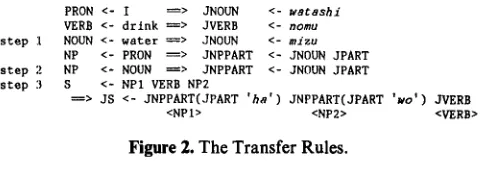
The ideal machine translation based on the composition- ality principle ensures that structure (a) is successfully transferred to structure (b) by applying the transfer rules, as shown in Figure 2.
In Figure 2, the transfer rules are symbolized for conve- nience. The left-hand sides of the rules consist of matching patterns that correspond to the grammar of the English
S J S
[ . . . + . . . 1 r . . . + . . . 1
N P I I N P 2 J N P P A R T I J N P P A R T 2 I
I I I r - - - l - - - 1 r-- -±---1 I PRON VERB NOUN / N O U N 1 J P A R T 1 J N O U N 2 J P A R T 2 J V E R B
I I I I I I I I
I d r i n k w a t e r w a t a s h i h a ~ i z u w o n o m u
(a) T h e E n g l i s h s t r u c t u r e (b) T h e J a p a n e s e s t r u c t u r e
P R O N <- I J N O U N <- w a e a s h l
V E R B <- d r i n k J P A R T <- h a
N O U N <- w a t e r / N O U N <- m i z u
N P <- P R O N J P A R T <- w o
N P <- N O U N J V E R B <- n o m u
S <- N P V E R B N P J N P P A R T <- / N O U N J P A R T J S <- J N P P A R T ( J P A R T ' h a ' )
J N P P A R T ( J P A R T ' w o ' ) J V E R B
[image:4.612.315.555.45.130.2](c) T h e E n g l i s h grammar (d) T h e J a p a n e s e g r a m m a r
Figure 1. Examples of English and Japanese Structures and Grammars.
PRON < - I = > JNOUN < - w a t a s h i
VERB < - d r i n k = > JVERB < - n o m u s t e p :[ N O U N <- w a t e r ~ > J N O U N <- m i z u
NP <- P R O N = > J N P P A R T <- J N O U N J P A R T s t e p 2 N P <- N O U N : > J N P P A R T <- J N O U N J P A R T s t e p 3 S <- N P I V E R B N P 2
= > JS <- J N P P A R T ( J P A R T 'he') J N P P A R T ( J P A R T 'wo') J V E R B
<NPI > < N P 2 > < V E R B >
Figure 2. The Transfer Rules.
sentence, and the right-hand sides consist of target patterns that correspond to the grammar of the target Japanese sentence.
The steps of the transfer process using these transfer rules are shown in Figure 3. This transfer process is done entirely in a bottom-up and left-to-right manner by using the transfer rules, and is based on the compositionality principle. The process is simple, easy to control, and easy to implement efficiently.
Let us consider the stylistic gaps mentioned in the previ- ous section. To bridge such gaps, we need to replace some words with new words and perform restructuring widely. It is important to recognize that the words involved in the rephtcement are class words (i.e. noun, adjective, verb, and adverb) rather than function words (i.e. preposition, auxil- iary verb, conjunction, relative pronoun, particle, etc.), as shown in the examples of types 2.1 and 2.2. For example, in
cases (6-a) and (6-b), good is replaced by well and speaker
is replaced by speaks. In cases (10-a) and (10-b), are time
bombs is replaced by gradually harm us. On the other hand, most words involved in the replacement are function words in the examples of type 2.3. For example, in cases
(13-a) and (13-bl), so and that are replaced by because
and very much.
The above-mentioned framework based on the composi- tionality principle cannot provide appropriate treatment for stylistic gaps of types 2.1 and 2.2, because wide-range structure handling, as well as the replacement of some class words, is necessary instead of the local and bottom-up structure handling that includes some treatment of func- tion words. For type 2.3, the above framework does not suit
S S
f .... + ... 1 f ... + ... I
NPI I NP2 NPI I NP2
l I I I I I
P R O N VERB N O U N J N O U N I JVERB J N O U N 2
I I I I I I
I d r i n k w a t e r w a t a s h l n o m u m i z u
(e) T h e original s t r u c t u r e (b) T h e s t r u c t u r e at step 1
s J S
r . . . a - r . . . 1 r . . . ± " " x . . . 1 JNPPART1 [ JNPPART2 JNPPART1 JNPPART2 [
r - - ± - - - 1 I r - - ' - - - 1 r---z---1 r--±--3 I
JNOUN1 JPART1 3VERB 3NOUN2 JPART2 3NOUN1 JPART1 3NOUN2 JPART2 JVERB
I I I I I I I I I I
wata~,;hl nomu mizu w a t a s h i he m i z u w o aomu
( c ) T h e s t r u c t u r e a t s t e p 2 ( d ) T h e s t r u c t u r e a t s t e p 3
F i g u r e 3. The Transfer Steps.
[image:4.612.59.563.510.714.2] [image:4.612.313.555.534.702.2]Taijiro Tsutsumi Intermediate Representations in Machine Translation
the treatment of the gaps if the transfer is done at the analysis-tree level and some function words exist in the source structure for the transfer. It is not difficult to handle gaps of type 2.4 except for those caused by tense, aspect, and modality, because they can be bridged only by local treatment of constituents instead of wide-range restructur- ing. For example, if a system finds the consecutive words a
number of in a sentence, the system can exceptionally treat
it as one word meaning many in the previous framework. It
is normally translated by replacing it with a target- language equivalent.
3.2 TWO-STEP TRANSFER METHOD
To deal with stylistic gaps effectively in a system based on the transfer method, we propose the incorporation of a specific sub-component for wide-range restructuring of the intermediate structures in the transfer component, as shown in Figure 4. This gives an example of a system configura-
tion for English-to-Japanese machine translation. The ba-
sic transfer consists of lexical transfer and reordering of words.
The wide-range restructuring should be done after anal- ysis of the input sentence and before the basic transfer. We take advantage of syntactic clues given in the intermediate representation for effective restructuring after analysis of the input. The wide-range restructuring, which changes the global structure as well as some class words of the sentence, should be performed not after but before the basic transfer, for the following reasons.
1. The restructuring makes the basic transfer easier and it also reduces the transfer rules, because it often contrib- utes to standardization or limitation of English sentence styles, as discussed in more detail in Section 3.3
2. The restructuring is not affected by transfer errors, which often occur because of the complexity of the transfer process.
By means of this restructuring sub-component, the inter- mediate representation of the input sentence is transformed or reinterpreted from a source-dependent expression into a
target-dependent one. We can define augmented CFGs for
analysis and generation in this framework. If we design the
E n g ] i s h Japanese
I ^
I I
r . . . 1 r . . . 1
A n a l y s i s [ I G e n e r a t i o n [
. . . J t . . . J
I I
[ r . . . T r a n s f e r . . . 1
v I I I
I n t e r m e d i a t e ---> w l d e - r a n g e ---> b a s i c ---> I n t e r m e d i a t e r e p r e s e n t a t i o n I r e s t r u c t u r i n g t r a n s f e r l r e p r e s e n t a t i o n
I I
[image:5.612.58.298.569.704.2]t . . . 1
Figure 4. A Machine Translation System Incorporating a Wide-Range Restructuring
Sub-Component.
rule appropriately and control for the wide-range restruc- turing sub-component, the output structures of both the sub-component and the basic transfer sub-component can be defined by using augmented CFGs that deal with condi- tions for rule applications. In other words, the basic trans- fer sub-component can specialize in transfer from one augmented CFG system to another, as illustrated in Figure 2.
Because wide-range restructuring, which does not suit the compositionality principle, can be performed entirely in the restructuring sub-component, and because the basic transfer can be simplified and specialized in local and bottom-up treatments of structures based on the aug- mented CFG formalism, as mentioned above, all the pro- cesses of machine translation except wide-range restructur- ing can be based on the augmented CFG formalism or the compositionality principle. This approach makes the whole system simple, easy to control, and efficient.
If a machine translation system uses analysis-tree struc- tures as intermediate structures (Lehmann et al. 1981; Nitta et al. 1982), wide-range restructuring can be intro- duced appropriately at the surface level. If the system performs deep analysis of the input sentence and creates a semantic representation such as a frame-like structure or a semantic network as an intermediate representation, wide- range restructuring may be required at the deep level. This is true whenever we handle stylistic gaps of types 2.1 and 2.2. However, gaps of type 2.3 can be handled by analysis, and no wide-range restructuring is required from the sys- tem that performs deep analysis of the input sentence.
3.3 ADVANTAGE OF THE TWO-STEP TRANSFER METHOD OVER THE SINGLE-STEP TRANSFER METHOD
Let us discuss the advantage of this approach over the conventional single-step transfer method from the stand- point of maintainability.
Technical documents contain many variants of sentence patterns. The examples in Section 2 are regarded as vari- ants from the viewpoint of English-to-Japanese translation. As a matter of fact, several different English sentences in an English technical document can often be translated by the same Japanese sentence. In other words, a wide variety of expression in English can be reduced to some extent in Japanese, because the most important concern in technical documents is that each sentence should convey technical information correctly. Therefore, we may standardize or control styles of English sentences for the sake of English- to-Japanese translation.
The two-step transfer method including wide-range re-
structuring is an appropriate way to take advantage of t h i s
phenomenon. If we encounter a new variant of a sentence pattern in English, we only have to write an English restructuring rule in the case of the two-step transfer method. On the other hand, a whole transfer rule, which is usually harder to write, is needed in the single-transfer method. If we want to modify a target Japanese sentence that corresponds to some English sentences, we only have to
Taijiro Tsutsumi Intermediate Representations in Machine Translation
modify the corresponding basic transfer rule, instead of modifying all the transfer rules for these English sentences. Consequently, it is easier to maintain the transfer rules if the system is based on the two-step transfer method, espe- cially in translating technical documents.
4 IMPLEMENTATION OF THE WIDE-RANGE
RESTRUCTURING FUNCTION
A prototype English-to-Japanese machine translation sys- tem, S H A L T (Tsutsumi 1986), is based on the two-step transfer method described in Section 3.2. So far we have developed about 500 wide-range restructuring rules to cope with the stylistic gaps exemplified in Section 2, and we have confirmed the effectiveness of the restructuring through test translation of a few IBM computer manuals.
In this section, we discuss the details of the rules for the wide-range restructuring and their applications in S H A L T , as an example. S H A L T is implemented in LISP, and the English and Japanese intermediate representations are syn- tactic-analysis tree structures.
4.1 WIDE-RANGE RESTRUCTURING RULES
AND THEIR APPLICATIONS
A wide-range restructuring rule consists of a pair of a matching pattern and a target pattern. If an input English tree structure matches a matching pattern, then a target Japanese-like English tree structure is generated according to specifications in a target pattern. A matching pattern is defined as follows. Note that * allows repetition of specifica- tions.
[ ( S T R U C T U R E - ( M A T C H I N G - E L E M E N T " ))" ]
where
S T R U C T U R E : M A T C H I N G - V A R I A B L E or 0
M A T C H I N G - E L E M E N T : M A T C H I N G - V A R I A B L E or
( M A T C H I N G - V A R I A B L E M A T C H I N G -
C O N D I T I O N * )
M A T C H I N G - C O N D I T I O N : ( L I S P - F U N C T I O N - N A M E
A R G U M E N T ' )
S T R U C T U R E specifies the tree structure to be checked. If 0 is specified, the whole input structure is treated. If M A T C H I N G - V A R I A B L E is specified, its value (i.e. part of a structure), which has already been set by M A T C H - I N G - E L E M E N T s in an earlier matching process, is a target for checking. A sequence of M A T C H I N G - E L E - M E N T s checks a sequence of daughter tree structures. If specified M A T C H I N G - C O N D I T I O N s match a structure, a specified M A T C H I N G - V A R I A B L E is set to the struc- ture. If a M A T C H I N G - E L E M E N T is a mere M A T C H - ING-VARIABLE, any structure or nil can be set for the variable. M A T C H I N G - C O N D I T I O N specifies a LISP function and its arguments. LISP functions check parts of speech, terminal symbols, or other information of a struc- ture. All specifications in a matching pattern form A N D
conditions, except arguments of LISP functions, which form OR conditions.
A target pattern specifies the required output structure by using M A T C H I N G - V A R I A B L E s where structures are already set and by adding new structures.
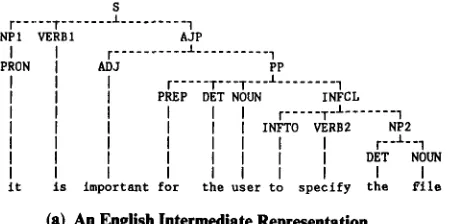
Figure 5 shows an example of a wide-range restructuring rule and its application. Figure 5 (a) shows the output of English analysis, which is the input for wide-range restruc- turing. Figure 5 (b) shows a wide-range restructuring rule and (c) gives the output of the restructuring.
The left-hand side of the restructuring rule is a matching pattern, and the right-hand side of the rule is a target pattern in Figure 5 (b). Numbers preceded by *, such as * 1, • 2, and *3, denote M A T C H I N G - V A R I A B L E s . There are four specifications of ( S T R U C T U R E - ( M A T C H I N G - E L E M E N T * ) ) in the matching pattern, such as ( 0 - (*1 ( ' 2 ( T " i t " ) ) *3 . . . * 7 ) ) a n d ( ' 6 - ( * 8 ( * 9 (P AD, J)) . . . *11)). A M A T C H I N G - C O N D I T I O N (T "it'") in the matching pattern denotes that the terminal symbol of the tree should be "it." (P ADJ) denotes that the part of speech of the root node should be ADJ (i.e., adjective). T and P are the LISP function names to perform these specific checks.
The target pattern in Figure 5 (b) specifies that the value.s of M A T C H I N G - V A R I A B L E s * 1, * 14, * 19, *3, *5,
F ... NPI VERB1
I
PRON
it is
S . . . i . . .
1 AJP
J. ...
r ... I
ADJ PP
r . . . T " - T - " - ' J " . . . I
PREP DET NOUN INFCL
I I I r ... r -± ... 1
I I l INFT0 VERB2 NP2
I I I I I r- -±--1
I I I I I DET NOUN
I I I I I I I
important for the user to specify the file
(a) An English Intermediate Representation.
[ ( 0 - ('1 (*2 (T "it")) *3 (*4 (T "is")) *5 (*6 (P AJP)) "7)) ( *6 - ('8 ('9 (P ADJ)) (*I0 (P PP)) "11))
(*I0 - ('12 ('13 (P PREP)(T "for")) *l& ('15 (P INFCL)) "16)) ('15 - ('17 (*IS (P INFTO)) "19)) ]
= >
[ *I (VP (CONPL "that")((ISN NP) "14) "19) *3 *5 ((ISN VERB)(TAPP-TERM "B3-" *9)) *7 ]
(b) A Wide-Range Restructuring Rule.
S
r ... i ... l
VP VERB3
r ... T'-i ... X ... l I
C O H P L NP3 VERB2 NP2 I
I r--i--1 I r--i--1 I
l DET NOUN [ DET NOUN l
I I I I I I I
that the user specify the file B J- important
[image:6.612.322.547.360.472.2](c) Output of the Wide-Range Restructuring.
Figure 5. An Example of the Wide-Range Restructuring Rule and Its Application.
Taijiro Tsutsumi Intermediate Representations in Machine Translation
*9, and *7 should be used and that some new tree structure should be added to form the output tree structure. We can directly specify the output tree structure by using parenthe- ses " ( " a n d " ) , " and node names, such as VP and COMPL. LISP functions can also be specified to generate new ele- ments. LISP function names are distinguished by a preced- ing "!," as in !SN. (!SN NP) results in a new node name, N P X X X (XXX is a unique number in a LISP environ- ment) for identification. (!APP-TERM "B J-" *9) denotes that a new symbol concatenating "B J-" and the value of *9 should be created. "B J-important" in Figure 5 (c) means that "important" in this case should be treated as a predica- tive adjective.
These specifications for the wide-range restructuring rules were found to be user-friendly in our experience of developing a practically sized rule set.
The wide-range restructuring rules are categorized into about 20 groups according to their functions. This categori- zation is more detailed than the one described in Section 2. These groups and rules in each group are arranged sequen- tially so that more specific and local rules can come earlier when they are checked. Checking and application of these rules are done along an input tree in top-down and left-to- right manner. If one of the rules in a group has successfully been applied to an input tree, then the rest of the rules in the same group are no longer checked, and the process goes to the next rule group. After all the groups have been checked and applied to the input tree, the process goes to the next daughter tree of the input tree. When the process goes to a new tree, the system checks the category name of its root node and thus avoids useless checking of the tree. Because all the rules are used in a fixed sequence, they can be easily maintained.
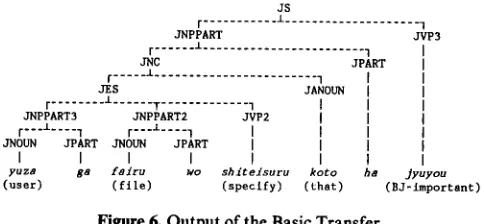
Figure 6 shows the output of the basic transfer that follows the process of the wide-range restructuring. As we compare the output of the wide-range restructuring, which is the input of the basic transfer, in Figure 5 (c) with the tree structure in Figure 6, we can see how the basic transfer is done. For example, sub-trees COMPL, NP3, VERB2, NP2, VP, and VERB3 in Figure 5 (c) are transferred to sub-trees J A N O U N , JNPPART3, JVP2, JNPPART2, JNC, and JVP3 in Figure 6, respectively. This example shows that the basic transfer is more straightforward and localized than the wide-range restructuring.
J S
r . . . L . . . 1
J N P P A R T JVP3
r . . . ± . . . 1
~ C JPART
f ... L ... 1
~ S J A N 0 ~
r . . . t . . . Y . . . 1 I
~ P P A R T 3 JNPPART2 JVP2 J
r - - - ± l .... r - - - ± l .... I I
J N O U H JPART JNOUN JPART I I
I I I I I I
yuza 8a fairu wo shiteisuru koto ha Jyuyou
[image:7.612.58.300.583.695.2](user) (file) (specify) (that) (BJ-Importent)
Figure 6. Output of the Basic Transfer.
4.2 FURTHER DISCUSSIONS ON IMPLEMENTATION
Let us discuss example (5-a) in Section 2. The wide-range
restructuring rule is as follows. If the main verb is have and
the head noun (rate) of the object is a two-place predicate
and there is an adjective (low) that modifies the head noun,
then restructure it as shown in (5-b). If the head noun of the object is classified as " A T T R I B U T E , " the restructur- ing is obligatory. Otherwise, translation without this restruc- turing is not very good, but acceptable.
The restructuring rule for case (l-a) in Section 2 is slightly complicated because we need richer information,
such as (room contains table), so as to restructure (l-a)
into the form 'NP1 be in NP2.' If the input is The table has
four legs, it will be restructured differently into the form
Four legs exist for the table because of the above con- straint. This is not standard English, but it is very similar in form to Japanese.
We have not yet implemented a way of using semantic
information, such as (room contains table), as constraint,
because the desired restructuring can be done on the basis of syntactic restrictions in the field of IBM computer manuals. However, the approach proposed in this paper can be augmented to handle semantic information without any crucial problems, if we prepare a knowledge base.
5 CONCLUSIONS
In this paper, we discuss the importance of treating stylistic gaps between languages and methods of doing so. A compre- hensive wide-range restructuring that can cope with stylis- tic gaps is indispensable for improving the quality of trans- lation, especially between languages from different linguistic groups, such as English and Japanese.
We propose a practical way of designing machine trans- lation systems. The transfer component should be divided into two separate sub-components: the wide-range restruc- turing sub-component and the basic transfer sub-compo- nent. Because the first of these deals with global reorganiza- tion of the intermediate representations, usually including the replacement of some class words, the second only has to do local, straightforward processing. This approach makes the transfer component much clearer and more maintain- able than the conventional single-step transfer method. It also guarantees that, except for the wide-range restructur- ing sub-component, all of the translation process can be based on the augmented CFG formalism and the composi- tionality principle. The ease of controlling the process makes the system efficient, which is crucial for the develop- ment of a practical machine translation system.
As a future direction, it will be necessary for us to pursue a thorough contrastive study of several languages, in terms of semantics as well as syntax. This will enable us to build more effective rules for restructuring that will further improve the quality of machine translation.
Taijiro Tsutsumi Intermediate Representations in Machine Translation
6 ACKNOWLEDGMENTS
I am grateful to D. Johnson of the IBM Thomas J. Watson Research Center for his helpful suggestions and to M. McDonald for helping me improve the readability of this paper. I also wish to thank all the people in the natural language processing group of IBM's Tokyo Research Labora- tory for constructive discussions.
RwrERwNCY~S
Anzai, T. 1983 English Viewpoint. Koodan-sha, Japan.
Bekku, S. 1979 How to Translate. Koodan-sha, Japan.
Bennett, W. S. and Slocum, J. 1985 The LRC Machine Translation
System. Computational Linguistics 11:111-119.
Carbonell, J.; Cullingford, T.; and Gershman, A. 1981 Steps toward
Knowledge-Based Machine Translation. IEEE Transactions on Pat-
tern Analysis and Machine Intelligence PAMI-3-4.
Isabelle, P. and Bourbeau, L. 1985 TAUM-AVIATION: Its Technical
Features and Some Experimental Results. Computational Linguistics
11: 18-27.
Landsbergen, J. 1982 Machine Translation Based on Logically Isomor-
phic Montague Grammars. Proceedings of COLING 82: 175-181.
Lehmann, W.; Bennett, W.; Slocum, J; Norcross, E. 1981 The METAL
System. RADC-TR 80-374.
McCord, M. C. 1985 LMT: A Prolog-Based Machine Translation Sys-
tern. Proceedings of Colgate University Conference on Machine Trans-
lation ].79-182.
Nagao, M. 1986 To What Extent Is Machine Translation Feasible? New
Sciettce Age No. 16. Iwanami-shoten, Japan.
Nagao, M.; Tsujii, J.; and Nakamura, J. 1985 The Japanese Government
Project for Machine Translation. Computational Linguistics 11: 91-
110.
Nishida, T. and Doshita, S. 1983 Application of Montague Grammar to
Engl![sh-Japanese Machine Translation. Proceedings of the Conference
on Applied Natural Language Processing: 156-165.
Nitta, Y. 1986 Idiosyncratic Gap: A Tough Problem to Structure-Bound
Mac]aine Translation. Proceedings of COLING 86:107-111.
Nitta, Y.; Okajima, A.; Yamano, F.; and Ishihara, K. 1982 A Heuristic
Approach to English-into-Japanese Machine Translation. Proceedings
of COLING 82: 283-288.
Nomura, J.; Naito, S.; Katagiri, Y.; and Shimazu, A. 1986 Translation by
Understanding: A Machine Translation System LUTE. Proceedings of
COLING 86: 621-626.
Slocum, J. 1985. A Survey of Machine Translation: Its History, Current
Status, and Future Prospects. AJCL 11(1): 1-17.
Tsutsumi, T. 1986 A Prototype English-Japanese Machine Translation
System for Translating IBM Computer Manuals. Proceedings of
COLING 86: 646-648.
Vauquois, B. and Boitet, C. 1985 Automated Translation at Grenoble
University. Computational Linguistics 11: 28-36.