Development of Smart Furnace by using IoT and its
Optimization
Pravin Chafle
1, Shubham Nandane
2, Poornima Pancheshwar
3, Akash Sune
4, Nilesh Zanzad
51, 2, 3, 4, 5UG Scholar, Department of Mechanical Engineering, JD College of Engineering and Management nagpur-441501,
Maharashtra.
Abstract: The Internet of Things is a trending evolving topic of technical, social and all other branches. This concept is very progressive in all the field of education, the future of the Internet of Things which will transform the real world objects into the intelligent virtual objects. The IOT aims to unify everything in the world under a common infrastructure, giving us not only the control of thins around us, but also keeping us inform of the state of the things. There are number of applications of IOT that makes the humans life more simpler. In this paper we discussed the new topic that is development of the smart furnace by using Internet of thins and optimisation of that smart furnace with the help of some advance technic and with help of internet of things. In this project we used the thermocouple and the microcontroller to take the input and for display the out put we are going to use laptop. In this project we make the furnace automatic and we can operate it from remote area or from some distance without the contact of it.
Keywords: furnace, relay, dimmer state, microcontroller, Arduino, wi-fi router ESP 8266,laptop etc.
I. INTRODUCTION
The “Internet of Things” (IOT) may sound complex but in actuality, is a fairly simple concept to understand. On a very high level, IOT is the ability for things that contain embedded technologies to sense, communicate, interact and collaborate with other things, thus creating a network of physical objects. Internet of Things applications can be found in every industry with a diversity of applications for smart homes, smart buildings travel and transportation health and personal care, retails and many more. Increasingly we will see the Internet of Things creating a smarter solution, programmatically adjusted to the human behaviour.
Nowadays, there is continuously grow the demand of automation and intelligent systems so that it leaves us with less intervention and smart decision-making devices. With the growing demand, which introduce the competition in that field and the competitors has force to come out with more intelligent, efficient as well as user friendly models. This is made our life very simple. With the tap of our finger we can control the everything which we connect it to the IOT. This field will be very beneficial to the people for the future point of view and make their life so easy and save their more time that they can spend on another thing.
smarter furnace with the help of IOT and we are going to optimise the furnace. In this we can operate it from the distance nearly 20 to 25 mts. We give the signal to the thermocouple by using laptop simply give the values for heating, heating time, socking, socking time and cooling which we can do with the help of other devices or instrument. Due to this smart furnace working will be easy and side effects on the human due to high temperature will be very less. It save the time also and gives the accurate readings due to optimisation. We convert the furnace and optimise it which all are going to do with the help of under the observation in the lab.
II. LITERATURE REVIEW
This project is very informative in this we use the advance technology for the development of furnace. Now we have some information about the some important instrumentation, devices and sensors etc. these all are very important instrument for the furnace development and for converting into the smart furnace. IOT is growing technology now it is very essential for the survival. There is need to advance the all old technology for reducing the time and for improving the efficiency. In this we make the furnace smart and some optimisation of furnace is also there for improvement of furnace results.
Some important key points are given below.
A. Furnace
fig 1:- furnace
B. Raspberry pI
[image:2.595.214.382.314.394.2]This board is used for multiple purpose due to its usefulness. This board consist of Broadcom BCM 2837 ARM cortex A53 quad core 1.2 GHz processor. This chip is also consist of 1GB RAM,40 pin GPIO header ,10/100 Ethernet port, Broadcom Video core IV GPU, Bluetooth 4.1, micro SD storage. This chip is easily available in the market. Its processing speed is higher as compare to earlier Raspberry pi models.
Fig 2:- Raspberry Pi
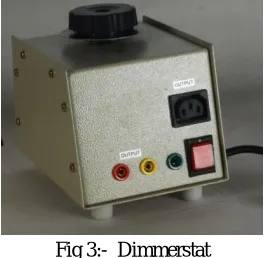
C. Dimmerstat
Dimmerstat is registered trademark of AE for continuously variable voltage auto transformer. It is most effective device for step less, break less and continuous control of AC voltage and therefore for various parameters, dependence on AC voltage.
The basic Dimmerstat is meant for operation from a nominal input voltage of 240 AC and can give the output voltage anywhere between 0 to 240 or 0 to 270 VAC by using simple transformer action. Three Dimmerstat connected electrically in star and mechanically in tandem, become suitable for operation from a nominal input voltage of 415v 3ph AC and can give output anywhere between 0 to 415V OR 0 to 470 V.
Fig 3:- Dimmerstat
D. Relay Circuit
Relay is an electro-mechanically operated switch, however other operating principles are also used in relays, such as solids state relay. A relay is generally used when it is required to control the circuit by a separate low –power signal. A type of relay that can handle the high power required to directly control an electric motor or the other loads is called contractor.
[image:2.595.232.364.519.648.2]Fig 4 :- Relay Circuit
E. WI-FI Router
[image:3.595.234.365.282.375.2]A wireless router is a device that performs the function of a router and also include the function of a wireless access point. It is used to provide access to the internet or a private computer network. Depending on the manufacture and the model, it can function in the wired local area network, in a wireless only LAN, or a mixed wired and wireless network.
Fig 6:- Wi-Fi Router
III. PROPOSED SYSTEM
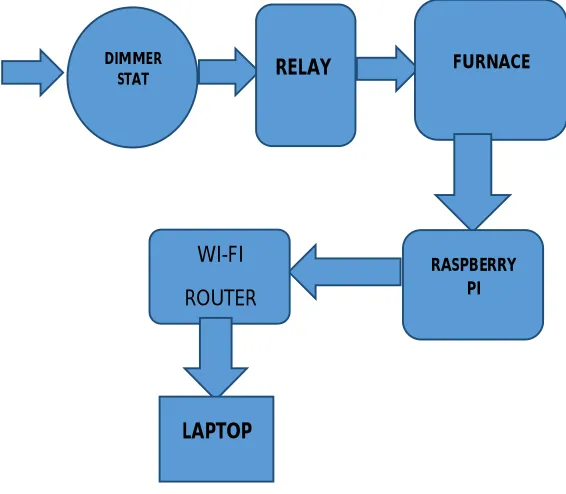
The main purpose behind this project is to reduce the efforts of the workers and students. When the furnace ON process start automatically in it. In this furnace there is two main steps that are very important that is heating and soaking After completing the process furnace is off automatically, there is no need to switch off it. And it provides the accurate reading about the material. In this Dimmer stat is use to set the range of temperature and it increase the temperature gradually.
Relay is used for trip the circuit when the temperature will be out of its fixed range, and there is Wi-Fi router is for the connection. We are going to use raspberry pi for the operation and laptop is there for giving the input and receiving the output, All the devices are connected to each other.
There is thermocouple which is attached to the furnace and by using it shows the output.
Fig :- Archietecture of System
DIMMER
STAT
RELAY
FURNACERASPBERRY PI
WI-FI
ROUTER
[image:3.595.147.430.492.739.2]IV. RESEARCH GAP
There is furnaces present in the market but this all are normal and their operation is some kind of difficult and temperature around this is also very high.
The need of smart furnace is to reduce the human efforts and protect the health from high temperature.
This furnace can operate though mobile as well as laptop operate from any remote area. According to the papers we have review IOT based furnace commercialize then it will be beneficial to operator and consumer there is still no working on the furnace by using IOT technology.
V. PRIOR WORK
In 1992, only 1,00,000 people were using IOT as a technology. till 2003 the number grow to half a billion people.As we revised a 20 papers there it all shows that the continues growth and various modification IOT technology. As there is work on a furnace but not a using IOT technology.With reference to prior work, IOT enabled furnace is not available in the market.
VI. CONCLUSION
The Internet of things is a fascinating field, which connects everyday devices to the internet, bringing life more closely to the technology.This technology is giving the opportunities in technical field and also other field to people to improve the thinking.In this we will make the normal furnace into smart furnace by using some sensors and IOT technology so that reading of furnace will be easy to take.
This technology will helpful for market purpose and for collages .it is also evident that paradigm of IOT make it own way into the market place over coming year.IOT technology will change the life because of continuous progress in this field.
REFERENCES
[1] Grådahl, S., Johansen, S., Ravary, B., Andresen, B., & Tveit, H. (2007). Reduction of emissions from ferroalloy furnaces. INFACON XI, India, 479-488. [2] Gasik, M. (Ed.). (2013). Handbook of ferroalloys: theory and technology. Butterworth-Heinemann.
[3] Khan, R., Khan, S. U., Zaheer, R., & Khan, S. (2012, December). Future internet: the internet of things architecture, possible applications and key challenges. In 2012 10th international conference on frontiers of information technology(pp. 257-260). IEEE.
[4] Atzori, L., Iera, A., & Morabito, G. (2010). The internet of things: A survey. Computer networks, 54(15), 2787-2805.
[5] Xu, Y. (2015). Recent machine learning applications to internet of things (IoT). Recent advances in networking,[online] Available at: http://www. cse. wustl. edu/~ jain/cse570-15/index. html (Last accessed on 3/8/2016).
[6] Qin, Y., Sheng, Q. Z., & Curry, E. (2015). Matching over linked data streams in the internet of things. IEEE Internet Computing, 19(3), 21-27.
[7] Yang, L., Yang, S. H., & Plotnick, L. (2013). How the internet of things technology enhances emergency response operations. Technological Forecasting and Social Change, 80(9), 1854-1867.
[8] Lee, D. J., Kaminer, I., Dobrokhodov, V., & Jones, K. (2010). Autonomous feature following for visual surveillance using a small unmanned aerial vehicle with gimbaled camera system. International Journal of Control, Automation and Systems, 8(5), 957-966
[9] Fang, S., Da Xu, L., Zhu, Y., Ahati, J., Pei, H., Yan, J., & Liu, Z. (2014). An integrated system for regional environmental monitoring and management based on internet of things. IEEE Transactions on Industrial Informatics, 10(2), 1596-1605.
[10] Saeed, F., Paul, A., Rehman, A., Hong, W., & Seo, H. (2018). IoT-based intelligent modeling of smart home environment for fire prevention and safety. Journal of Sensor and Actuator Networks, 7(1), 11.
[11] Khajenasiri, I., Estebsari, A., Verhelst, M., & Gielen, G. (2017). A review on Internet of Things solutions for intelligent energy control in buildings for smart city applications. Energy Procedia, 111, 770-779.
[12] Zhang, P., Li, F., & Bhatt, N. (2010). Next-generation monitoring, analysis, and control for the future smart control center. IEEETransactions on Smart Grid, 1(2), 186-192.
[13] Li, Y. (2013, June). Design of a key establishment protocol for smart home energy management system. In 2013 Fifth International Conference on Computational Intelligence, Communication Systems and Networks (pp. 88-93). IEEE.Chen, M., Ma, Y., Song, J., Lai, C. F., & Hu, B. (2016). Smart clothing: Connecting human with clouds and big data for sustainable health monitoring. MobileNetworks and Applications, 21(5), 825-845.
[14] Gupta, P., & Chhabra, J. (2016, February). IoT based Smart Home design using power and security management. In 2016 International Conference on Innovation and Challenges in Cyber Security (ICICCS-INBUSH) (pp. 6-10). IEEE.
[15] Patchava, V., Kandala, H. B., & Babu, P. R. (2015, December). A smart home automation technique with raspberry pi using iot. In 2015 International Conference on Smart Sensors and Systems (IC-SSS) (pp. 1-4). IEEE.
[16] Chang, C. Y., Kuo, C. H., Chen, J. C., & Wang, T. C. (2015). Design and implementation of an IoT access point for smart home. Applied Sciences, 5(4), 1882-1903.
[17] DoE, U. S. (2004). Waste Heat Reduction and Recovery for Improving Furnace Efficiency Productivity and Emissions Performance. US Department of Energy: Washington, DC, USA. Ramakrishnan, R., & Gaur, L. (2016). Application of Internet of Things (IoT) for Smart Process Manufacturing in Indian Packaging Industry. In Information Systems Design and Intelligent Applications (pp. 339-346). Springer, New Delhi
[18] Park, C. Y., Laskey, K. B., Salim, S., & Lee, J. Y. (2017, July). Predictive situation awareness model for smart manufacturing. In 2017 20th International Conference on Information Fusion (Fusion) (pp. 1-8). IEEE.
[20] Edgar, T. F., & Pistikopoulos, E. N. (2018). Smart manufacturing and energy systems. Computers & Chemical Engineering, 114, 130-144.
[21] Bates, O., & Friday, A. (2017). Beyond data in the smart city: Repurposing existing campus IoT. IEEE Pervasive Computing, 16(2), 54-60.
[22] Tsai, K. L., Leu, F. Y., & You, I. (2016). Residence energy control system based on wireless smart socket and IoT. IEEE Access, 4, 2885-2894.
[23] Lee, S. H., Kim, D. H., & Lee, H. Y. (2016). Smart IoT Hardware Control System using Secure Mobile Messenger. , 65(12), 2232-2239.
[24] Eslava, H., Rojas, L. A., & Pereira, R. (2015). Implementation of machine-to-machine solutions using mqtt protocol in internet of things (iot) environment to improve automation process for electrical distribution substations in colombia. Journal of Power and Energy Engineering, 3(04), 92.
[25] Porter, M. E., & Heppelmann, J. E. (2014). How smart, connected products are transforming competition. Harvard business review, 92(11), 64-88.
[26] Seol, S., Shin, Y., & Kim, W. (2015). Design and realization of personal IoT architecture based on mobile gateway. International Journal of Smart Home, 9(11), 133-144.
[27] SR, M. B. (2015). Automatic smart parking system using Internet of Things (IOT). International Journal of Scientific and Research Publications, 628.