Abstract—The effects of operating conditions such as initiator and monomer concentration as well as reactor temperature of polymerization reactors are studied in this work. A recently developed hybrid model for polystyrene batch reactor is utilized in simulation study. The simulation results reveal the sensitivity of polymer properties and monomer conversion to variation of process operating conditions. In the second phase of this study, the optimization problem involving minimum time optimal temperature policy is considered for control study. An advanced neural network-based model predictive controller (NN-MPC) is designed and tested online. The experimental studies reveal that the developed controller is able to track the optimal setpoint with a minor oscillation and overshoot.
Index Terms—Polymerization reactors, Optimization, Polystyrene, Batch reactor.
I. INTRODUCTION
Temperature control of a polymer reactor is still a challenging task due to the highly nonlinear process of polymerization reaction [1]. The reaction may be auto-accelerating and heat transfer rates can vary during the process. Changes in reactant feed rate often produce an inverse temperature response, because the cooling effect of the increased feed precedes the increase in the reaction rate. Changes in temperature can alter the reaction rate, resulting in poor molecular weight control, and, in severe cases, an entirely different polymer product [2]. Control of reactor temperature is also critical from a purely operational point of view [3]. If the polymerization temperature is allowed to increase, monomer conversion increases and more polymer is produced. Hence, the polymerization mixture becomes more
Manuscript received June 26, 2012; revised July 24, 2012. T his work was supported in part by the Centre for intelligent systems research (CISR), Deakin University, Australia and Chemical Engineering Department, University of Malaya, Malaysia.
M. A. Hosen is with the CISR, Deakin University, Geelong Waurn Ponds, Australia (phone: +61 3 5227 1352; fax: +61 3 5227 1046; e -mail: [email protected]).
A. Khosravi is with the CISR, Deakin University, Geelong Waurn Ponds, Australia (e-mail: [email protected]).
S. Nahavandi is with the CISR, Deakin University, Geelong Waurn Ponds, Australia (e-mail: [email protected]).
D. Creighton is with the CISR, Deakin University, Geelong Waurn Ponds, Australia (e-mail: [email protected]).
M. A. Hussain is with Chemical Engineering Department, University of Malaya, 50603 Kuala Lumpur, Malaysia (e-mail: [email protected]).
viscous and heat removal becomes difficult. Therefore, reactor temperature must be kept within the limits that allow one to carry out a safe polymerization, i.e., within the systems heat removal capabilities. The final polymer properties, such as density, melt index, impact strength, rigidity, tensile strength, chemical resistance, thermal stability, and plasticizer uptake, can be related, through empirical relationships, to the molecular and morphological properties of polymers. On the other hand, for a given reactor configuration, the molecular properties will be strongly dependent on the reactor operating conditions [4]. Therefore, the detailed knowledge about operating condition is important to control the polymerization reactor. More precisely, the study of the effects of operational conditions on the performance of batch polymerization reactor control is very important to control the polymerization reactor.
In the present work, we conduct a theoretical study for a batch styrene free radical polymerization reactor and find out which variables are more effective for polymerization reactor. Later, an optimization problem of minimum time optimal temperature policy is formulated based on work reported in [5] and solved for the solution polymerization of styrene. Finally, the generated optimal temperature profiles are used to study closed-loop control using advanced control technique which can track the process variable along the developed open-loop optimal temperature trajectory. In Section 2, we briefly describes the polystyrene models which are later used in simulation study for understanding the reactor dynamic behavior as well as calculating of optimal temperature profiles and optimal controller parameters. Section 3 illustrates the dynamic behavior of the polystyrene batch reactors with respect to three important reactor operating parameters and solves the minimum batch time problem for polymerization of styrene. The simulation study is performed to determine the optimal NN-MPC parameters in Sub-section 3.3. Sub-section 3.4 describes the real time implementation of NN-MPC with optimal setpoint tracking. Section 4 concludes the findings of the present work and the work done in this article.
II. MODELLING OF POLYSTYRENE BATCH REACTORS The success of optimization and control efforts depends very much upon the accuracy of the process models. It has been a trend to use simplified process models to determine the optimal control profiles, as the complexity of the proces s models is restricted by the methods used to determine the optimal control profiles. In this work, a simple mechanistic modeling strategy is used to develop optimal temperature profile [6]. However, a hybrid model (first principle-neural
Investigation of Process Dynamics and Control of
Polystyrene Batch Reactor Using Hybrid Model
network model) is used to design the controller to implement the optimum temperature profile.
III. RESULTS & DISCUSSION
First of all, the simulation study is performed to analyze the dynamic behavior by using previously developed hybrid model [7] and conduct the response of reactor outputs with different initial operating conditions. Secondly, optimum temperature profiles are developed and implemented based on reliable simple mathematical model [6]. Finally, an advanced controller is developed to track the optimum temperature profile.
A. Dynamic Open Loop Behavior
The following simulations are performed in order to verify the sensitivity of the control system and calculate the appropriate control and system parameters. Among the simulations are:
i. different initial initiator concentration loading to reactor (0.013, 0.016 and 0.019 mol/ltr)
ii. different heat input to reactor system with reaction (100, 120 and 150watt)
iii. different cooling water flow rates in cooling jacket chamber (0.5, 0.7 and 0.9 g/s).
In order to perform these simulations, the values of physical and chemical parameters are given in Table I.
T ABLE I
OPERAT ING CONDIT IONS AND REACT OR SPECIFICAT IONS
Name of the parameters Value Units
Reactant specific heat (Cp) 1.96886 J/g.K Coolant specific heat (Cpc) 4.29 J/g.K Heat of reaction, exothermic (H) -57766.8 J/g.K Gas constant (R) 8.314 J/mol.K
Coolant inlet temperature (Tji) 303.14 K Overall heat transfer coefficient
(U)
55.1 W/(m2.K ) Reactor volume (V) 1.2 ltr Reactor jacket volume (Vc) 1 ltr Coolant density (ρc) 998.00 g/ltr Reactant density (ρr) 983.73 g/ltr Initial initiator concentration (I0) 0.016 Mol/ltr
Initial heater power (Q) 100 Watt
Initial coolant flow rate (mc) 0.7 g/s
Reactor Dynamics with Different Initiator Load ing
One of the control objectives in controlling the batch polymerization reactor is to control the exothermic behaviour due to the extent of reaction, as the initiator is introduced to the monomer and solvent mixture in the polymerization system. It is obvious that one needs to monitor the release of heat in order to control the target specification. Moreover, the heat release may break the glass reactor depending on the temperature it can withstand. Three conditions of polymerization are used with initial initiator concentration of 0.013, 0.016 and 0.019 mol/ltr for this study. Each starting condition has to be maintained at fixed steady state condition with fixed values of others remaining initial
parameters as shown in Table I. Fig. 1 represents the time trend of temperature change in terms of different initial initiator load. In this case, polymer quality (Xn) highly
depends on the initial initiator concentration but the conversion (X) is a little affected by it.
Reactor Dynamic with Different Heat Loading
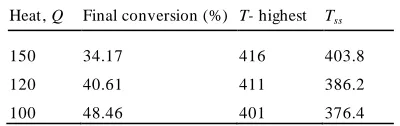
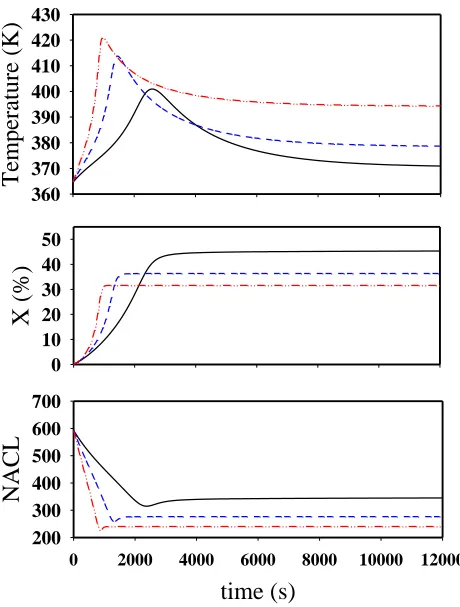
In the second task, the initial initiator is fixed at a value of 0.016 mol/ltr. Three different heat inputs simulate the reaction in the reactor with a fixed steady state temperature at 364K. Table II illustrates the conversion achieved when temperature reaches the steady state after high release of heat upon initiation. In addition, Fig. 2 clearly illustrates the transient behaviour of reactor temperature. As it can be seen from the figure, the reactor with the highest amount of heat input attains the highest overshoot. The temperature ascends from 364K to a maximum of 416K and starts descending to the steady state of 403.8K completely after 500min at a heat input 150watt. In addition, it can be seen in Fig. 2 that the final polymer quality highly d epends on the heat input. At a lower heat input, the NACL and conversion is higher than at high heat input though it requires a more reaction time.
T ABLE II
SIMULAT ION RESULT S FOR DIFFERENT HEAT INPUT S
Heat, Q Final conversion (%) T- highest Tss
150 34.17 416 403.8
120 40.61 411 386.2
100 48.46 401 376.4
Reactor Dynamic with Different Jack eted Flow Rate
In the third task, the jacketed flow-rate is varied three times (0.5, 0.7, and 0.9 g/s) with the other variables kept the same as Table I. This is done to observe the reactor dynamics. It can be seen in Fig. 3 that the final polymer quality (NACL) highly depends on the jacketed flow rate. The lower the jacketed flow rate, the larger the NACL and conversion. This means that a longer reaction time is required when the flow rate is high.
[image:2.596.327.527.361.424.2] [image:2.596.54.281.412.612.2]Tem
per
atur
e (K)
360 370 380 390 400 410
X (%)
0 10 20 30 40 50
time (s)
0 2000 4000 6000 8000 10000 12000
NAC
L
[image:3.596.49.278.54.356.2]200 300 400 500 600 700
Fig. 1. Reactor dynamics with different initiator concentration. (──) at 0.013mol/ltr, (- - -) at 0.016mol/ltr and (∙−∙−∙) at 0.019mol/ltr.
Tem
per
atur
e (K)
360 370 380 390 400 410 420 430
X (%)
0 10 20 30 40 50
time (s)
0 2000 4000 6000 8000 10000 12000
NAC
L
200 300 400 500 600 700
Fig. 2. Reactor dynamics with different heat input. (──) at 100 watt, (- - -) at 120 watt and (∙−∙−∙) at 150 watt.
Tem
per
atur
e (K)
360 370 380 390 400 410 420
X (%)
0 10 20 30 40 50 60
time (s)
0 2000 4000 6000 8000 10000 12000
NAC
L
200 300 400 500 600 700
Fig. 3. Reactor dynamics with different jacketed flow rate. (──) at 0.5g/s, (- - -) at 0.7g/s and (∙−∙−∙) at 0.9g/s
B. Minimum Time Optimal Temperature Profile
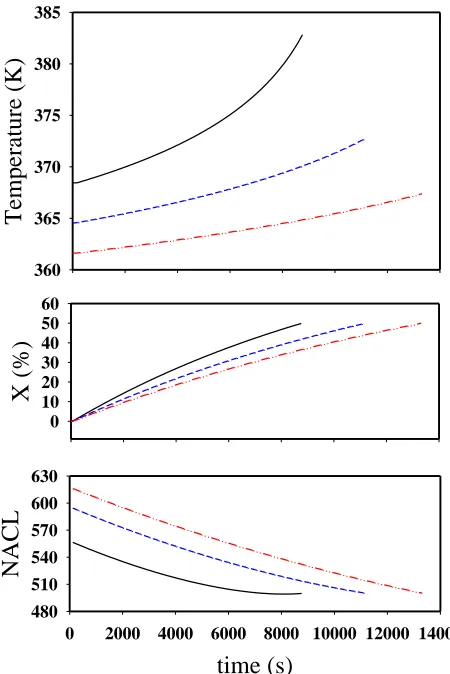
Recently, the offline or open loop minimum time optimal control policies were applied for the simulation of styrene polymerization in batch reactors [6, 8, 9]. In this work, the optimization problem involving minimum time optimal temperature policy is formulated and solved for a batch reactor for the solution polymerization of styrene based on previous work [5]. This optimal temperature profile is then used as the setpoint for controller study.
The objective of optimization problem is to calculate an optimal temperature policy for a given initial initiator and monomer concentration that minimizes the reaction time, tf,
required to achieve a desired final monomer conversion, Xd.
The performance target of a closed loop control minimum time optimal temperature tracking is to produce polystyrene with the specification of Xd =50% and NACL, Xn =500.
Polymerization temperature and initiator concentration are employed as control variables to obtain the operating conditions for minimum polymerization end-time. Since the temperature can be used to infer the end-quality of polymer, this work is devoted to produce specified polymer quality within the minimum time. The governing equation [6] for the optimal temperature profile is expressed as follows:
0.5 0.5
2
( / 2 / 2) /
2 ln
2 2
p d t
d d t
d p p
t
E E E R
T
fA E E
E p I MA E
A
(1)
The results of calculation for X= 50% and Xn =500 with
optimal temperature (T*) are shown in Fig. 4. In this work, the value for initial initiator, I0 has to be basically guessed. The
[image:3.596.307.535.59.363.2] [image:3.596.50.280.403.707.2]value. It is found that the optimal initial initiator concentration for the initial monomer concentration of
M0=6.089 mol/ltr is I0=0.016 mol/ltr. These optimal values are
achieved within the reaction time of 138 minutes. It can be noted that the reaction time (tf) increases with increasing I0.
Therefore, it is concluded that the optimal I0 can be obtained
by successively reducing the value of I0 until a limiting value
is obtained below which the desired conversion can never be reached. Furthermore, as the I0 is decreased, the gradient of
the optimal temperature (T*) becomes steeper. The optimal temperature profile for I0= 0.016 will be used for tracking the
setpoint in the control study.
Te
m
pe
ra
tur
e (
K)
360 365 370 375 380 385
X (
%)
0 10 20 30 40 50 60
time (s)
0 2000 4000 6000 8000 10000 12000 14000
NA
CL
480 510 540 570 600 630
Fig. 4. Optimum temperature profiles with different initiator concentration (I0 = 0.013 mol/l (___), I0 = 0.016 mol/l (- - -), I0 = 0.019 mol/l (∙−∙∙−∙)
C. Controller Design
In this work, an advanced neural network based model predictive controller (NN-MPC) is used to control the polystyrene reactor. The NN is trained to represent the forward dynamics of the process. The experimental data of the manipulated variable (heat load Q) and plant output (reactor temperature T) at t with two time delay units are used as inputs. The target is the reactor output temperature at t+1. The Levenberg–Marquardt method is used to train the NN model through minimization of the mean squared error (MSE) as the cost function. MSE is mathematically expressed as:
2tg N
1
1
MSE ( ) ( )
n
k
T k T k
n
(2)
where n is the number of training data, Ttg is the
target/desired reactor temperature and TN is the NN output.
After some trial and error, it is found that a NN with ten hidden nodes achieves the minimum MSE value of 5.36x10⁻⁶. The design specifications for NN model are given in Table III.
T ABLE III
DESIGN SPECIFICAT IONS OF NN MODEL
No. of input nodes 6
No. of hidden layer nodes 10 No. of output nodes 1 T otal sample size 10000
T raining function Levenberg-Marquardt Method
Sample size
Mean square error T raining data 5000 5.36 x 10⁻⁶
T esting data 2500 4.13 x 10⁻⁶
Validation 2500 4.69 x 10⁻⁶
Before implementing the MPC controller in real time, its tuning parameters should be optimized to achieve best performance. For designing a good MPC controller, it is important to specify the following controller p arameters: the sampling interval and prediction and control horizon. In this work, the developed hybrid model is utilized to determine the sampling interval and prediction and control horizon. Marlin [10] general rule is used to determine the sampling interval of MPC. The prediction and control horizon are determined by trial and error method [11].
The performance of the controlled variable is monitored for a sufficient span of process dynamics time to determine the value of the prediction and control horizon. It is observed that the prediction horizon of 24 sample intervals and the control horizon value of 4 sample intervals provide a satisfactory control performance. The other parameters of the NN-MPC controller are given in Table IV.
T ABLE IV
DESIGN SPECIFICAT ION OF MPC
Prediction horizon (N
2) 24
Control horizon (N
u) 4
Control weight factor (M) 0.09 Move suppression factor(Λ) 0.003
Minimization routine Backtracking Optimization
D. On-line optimal control of polystyrene reactor
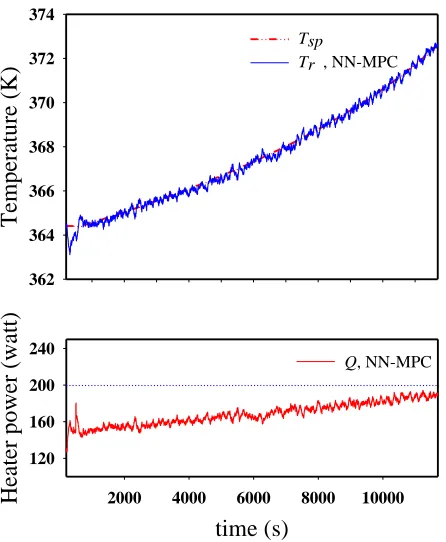
The concentration of 0.016 mol/ltr and 6.089 mol/ltr for initiator and monomer loading are chosen to produce the desired target. It is noted that the benzoyl peroxide and styrene loading can produce an NACL of 500 and monomer conversion of 50% at the end of 183 minutes polymerization period.
[image:4.596.51.276.210.547.2]introduced, the mixture temperature falls below the setpoint profile at nearly 2 K. The response is realized by the controller and it increases the heat input (Q). As a result, the temperature overshoots at a maximum of 2K. This overshoot gradually disappears in a decreasing oscillatory manner in 730 sec. An offset can be noted at less than 0.5K. This is attributed by the high exothermic load during the early course of polymerization. Nevertheless, the temperature controller performs well in tracking the temperature setpoint profile at the later stage of polymerization. Fig. 5 also shows the transient response of manipulated variable of heater. The regulation is smooth. It is worth mentioning that the heater regulation is initially at Q=150 watt and gradually increases until 200 watt at the end of the batch-run. The final NACL and conversion are 496 and 52.8% respectively which are almost the same as desired values.
Te
m
p
er
atu
re
(K
)
362 364 366 368 370 372 374
Tsp
Tr , NN-MPC
time (s)
2000 4000 6000 8000 10000
He
ate
r p
o
we
r (
wa
tt)
120 160 200 240
[image:5.596.52.275.245.516.2]Q, NN-MPC
Fig. 5. Optimal setpoint tracking using NN-MPC
IV. CONCLUSION
In this work, the first principle-NN model is utilized to study the dynamic behaviour of the polystyrene batch reactor. The effect of operating conditions on the properties of final product is investigated. An optimization algorithm is applied to optimize the reactor temperature profile based on minimal time operation. The conversion and number average chain length is considered here as the target for optimization. The optimized minimal time temperature profile is used as the setpoint for control study. An advanced controller named NN-MPC is designed and tuned for styrene polymerization batch reactor to track the optimum setpoint point experimentally. According to the experimental results demonstrated here, it can be concluded that the developed controller tracks the optimum setpoint with minor oscillations and overshoots and achieves the desired polymer quality and quantity.
REFERENCES
[1] N. Hvala, F. Aller, T . Miteva and D. Kukanja "Modelling, simulation and control of an industrial, semi-batch, emulsion-polymerization reactor," Com puters & Chem ical Engineering,
2011.
[2] P. Morales and A. Flores-T lacuahuac, "Muti-Objective Nonlinear Model Predictive Control of Semibatch Polymerization Reactors," Macrom olecular Reaction Engineering, 2012.
[3] C. Kiparissides, "Challenges in particulate polymerization reactor modeling and optimization: A population balance perspective," Journal of Process Control, vol. 16, pp. 205-224, Mar 2006.
[4] C. Kiparissides, E. Papadopoulos and J. Morris, "Real-time optimization and model-based control of polymer reactors,"
Methods of Model Based Process Control, pp. 495-530, 1995. [5] S. A. Sata, "Simulation and on-line control of polystyrene
production in a batch reactor " PhD, Department of Chemical Engineering, University of Malaya, Kuala Lumpur, 2007. [6] A. AltInten, F. Ketevanlioglu, S. Erdogan, H. Hapoglu and M.
Alpbaz, "Self-tuning PID control of jacketed batch polystyrene reactor using genetic algorithm," Chem ical Engineering Journal, vol. 138 (1-3), pp. 490-497, 2008.
[7] M. A. Hosen, M. A. Hussain and F. S. Mjalli, "Hybrid modelling and kinetic estimation for polystyrene batch reactor using Artificial Neutral Network (ANN) approach," Asia-Pacific Journal of Chem ical Engineering, vol. 6, pp. 274-287, 2011. [8] Z. Zeybek S. Centinkaya, H. Hapoglu and M. Alpbaz,
"Generalized delta rule (GDR) algorithm with generalized predictive control (GPC) for optimum temperature tracking of batch polymerization," Chem ical Engineering Science, vol. 61, pp. 6691-6700, 2006.
[9] Z. Zeybek, S. Yuce, H. Hapoglu and M. Alpbaz, "Adaptive heuristic temperature control of a batch polymerisation reactor," Chem ical Engineering and Processing, vol. 43, pp. 911-920, 2004.
[10] T . E. Marlin, Process control: design processes and control system s for dynam ic perform ance. Columbus, OH 43272: McGraw Hill Inc., 1995.
[11] D. Dougherty and D. Cooper, "A practical multiple model adaptive strategy for multivariable model predictive control,"
Control Engineering Practice, vol. 11, pp. 649-664, 2003.