140
Weird Inflects but OK: Making Sense of
Morphological Generation Errors
Kyle Gorman∗,Arya D. McCarthy†,Ryan Cotterell†,
Ekaterina Vylomova‡,Miikka Silfverberg§, andMagdalena Markowska∗ ∗The Graduate Center, City University of New York,†Johns Hopkins University,
‡University of Melbourne,§University of Helsinki
[email protected]
,[email protected]
,[email protected]
,[email protected]
,[email protected]
,[email protected]
Abstract
We conduct a manual error analysis of the CoNLL–SIGMORPHON 2017 Shared Task on Morphological Reinflection. In this task, systems are given a word in citation form (e.g.,
hug) and asked to produce the corresponding inflected form (e.g., the simple pasthugged). This design lets us analyze errors much like we might analyze children’s production errors. We propose an error taxonomy and use it to annotate errors made by the top two systems across twelve languages. Many of the ob-served errors are related to inflectional patterns sensitive to inherent linguistic properties such as animacy or affect; many others are failures to predict truly unpredictable inflectional be-haviors. We also find nearly one quarter of the residual “errors” reflect errors in the gold data.
1 Introduction
A huge amount of work in natural language pro-cessing treats words as indivisible units, but the vast majority of the world’s languages have rich word-internal structure. For instance, 80% of the languages analyzed in theWorld Atlas of Linguis-tic Structure(Dryer and Haspelmath 2013) inflect verbs for tense and 65% inflect nouns for case. Generating and processing complex words is thus crucial for multilingual speech and language tech-nologies.
Recent work on large-scale, multilingual com-putational modeling of morphology (e.g.,Durrett and DeNero 2013, Cotterell et al. 2016) targets supervised inflection generation. Such tasks re-quire variable-length outputs, so they are less constrained than earlier segmentation-based tasks (e.g.,Kurimo et al. 2010), but appear to be tractable with existing neural network–based models. For example, in the CoNLL–SIGMORPHON 2017 Shared Task (sub-task 1 and the “high-data condi-tion”), the focus of this study, the best-ranked
sys-tem generates novel inflectional forms with 90% accuracy or better for 46 out of the 52 target guages, It achieves perfect accuracy for four lan-guages (Cotterell et al. 2017).
In light of these apparent success, we examine the failure modes of existing models for morpho-logical generation. We first propose and motivate an error taxonomy for this task, inspired by sim-ilar proposals for other natural language genera-tion and processing technologies such as grammat-ical error correction (e.g., Rozovskaya and Roth 2016) and machine translation (e.g.,Popović and Ney 2011, Fishel et al. 2012, Irvine et al. 2013). We then use this taxonomy to perform a manual er-ror analysis of the CoNLL–SIGMORPHON 2017 Shared Task. Such analyses can help to identify strengths and weaknesses of existing systems, sug-gest future improvements, and guide development of strong ensemble models, but are often neglected or treated as an afterthought. This annotation also allows us to measure the quality of the gold data.
Generating morphologically complex forms is a skill typically-developing children effortlessly ac-quire, so this task, and systems’ error patterns, may have implications for the theory of language acqui-sition. While the shared task training paradigm is quite unlike human language learning, infer-ence and evaluation resemble the classicwug-test (Berko 1958), in which speakers are presented with a word—either real or nonce—in citation form and prompted to provide a particular inflectional form of that word. Therefore, one can analyze inflec-tion generainflec-tion errors much like how one might analyze errors made by a child acquiring their first language. And, one can ask whether humans’ and artificial learners’ errors are in any way alike.
2 Materials and methods
Here, we describe the shared task, data sources, and the targeted systems.
2.1 The task
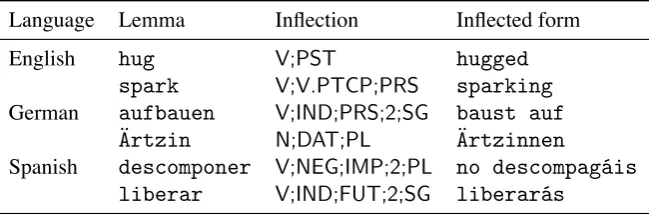
The CoNLL–SIGMORPHON 2017 Shared Task (Cotterell et al. 2017) consists of two supervised morphological generation sub-tasks across 52 lan-guages. In sub-task 1, the training data consists of triples of lemma, inflectional bundle, and inflected form, as in Table 1. At inference time, the sys-tem is given lemmata and inflectional bundles and asked to produce the appropriate inflected forms. In sub-task 2, training data consists of complete inflectional paradigms, and at inference time, the system is asked to produce full paradigms for un-seen lemmata. We focus on the results from sub-task 1, primarily because only two of the twelve teams chose to compete in sub-task 2. However, the proposed error taxonomy could easily be ap-plied to sub-task 2, or to later morphological gener-ation challenges such as sub-task 2 of the CoNLL– SIGMORPHON 2018 shared task (Cotterell et al. 2018) or sub-task 1 of the SIGMORPHON 2019 shared task (McCarthy et al. 2019).
2.1.1 Data
The data in both sub-tasks is primarily sampled from UniMorph (Kirov et al. 2016, 2018), a free morphological database. In turn, UniMorph data for our twelve languages is automatically ex-tracted from Wiktionary, a collaborative multilin-gual online dictionary. UniMorph pairs the cells of Wiktionary morphological paradigms, which bear prose labels like “genitive plural”, to fea-ture bundles in a language-independent morpho-logical schema (Sylak-Glassman et al. 2015; also see Sylak-Glassman 2016). The data consist of the aforementioned triples of lemma, inflectional bundle, and inflected form. For sub-task 1, these triples were sampled from UniMorph paradigms according to frequencies of inflected forms as es-timated from Wikipedia. Because of this sam-pling procedure, the data is sparse in the sense that there are rarely more than a few inflected forms per lemma. As such, this roughly mim-ics the statistical properties of the primary linguis-tic data encountered by child language learners (e.g., Chan 2008:71–100). Systems were evalu-ated under three training data conditions: low (100 triples), medium (1,000 triples) and high (10,000
triples). We focus on the high-data condition be-cause nearly all systems performed poorly in the low- and medium-data conditions.
2.2 Systems
In sub-task 1, systems were ranked using the macro-averaged “per form” (i.e., full-token match) accuracy across all 52 target languages.1 We ana-lyze errors made by the two top-ranked systems, briefly described below.
ue-lmu-1(Bergmanis et al. 2017) This system
uses a recurrent neural network (RNN) with a bidi-rectional gated recurrent unit (GRU) encoder, a unidirectional GRU decoder, and a standard atten-tion mechanism. It enhances a closely-related com-petitor system (Kann and Schütze 2017) by aug-menting the provided training data with identical input-output pairs so as to create a bias toward copying the input stem. It is ranked as the best-performing system on sub-task 1 (macro-average accuracy 95.32%).
cluzh-7 (Makarov et al. 2017) This system
also uses a neural encoder-decoder but replaces the “soft” attention mechanism with hard monotonic attention (Aharoni and Goldberg 2017) and special edit operations. It is ranked second-best overall on sub-task 2 (macro-average accuracy 95.12%) and also achieves the highest per form accuracy on eight languages including Hungarian and Spanish.
3 Error taxonomy
One major distinction in the proposed taxon-omy of inflection generation errors is between those errors which can be given a linguistic characterization—i.e., in terms of misapplication of inflectional patterns independently attested in the target language—from those which cannot. As such we are inspired by a long and con-tentious debate in computational morphology re-search.Rumelhart and McClelland(1986) propose an early neural network model trained to generate the phonological form of English simple past tense verbs given the present tense. They claim that under in certain conditions, their model produces errors that are similar to those made by children acquiring English, such as *catched for caught.2
1The other metric used in sub-task 1, average Levenshtein distance between word and target averaged over languages, ranks systems nearly identically (Cotterell et al. 2017:11).
Language Lemma Inflection Inflected form
English hug V;PST hugged
spark V;V.PTCP;PRS sparking
German aufbauen V;IND;PRS;2;SG baust auf
Ärtzin N;DAT;PL Ärtzinnen
Spanish descomponer V;NEG;IMP;2;PL no descompagáis
[image:3.595.137.462.63.170.2]liberar V;IND;FUT;2;SG liberarás
Table 1: Sample training data for sub-task of the CoNLL–SIGMORPHON 2017 Shared Task. Each training exam-ple maps alemma(a citation form) andinflection(a bundle of UniMorph morphosyntactic features) to aninflected form. At inference time, the inflected form is predicted given a lemma and inflection.
SILLY
TARGET ALLOMORPHY SPELLING
Free variation
Extraction
Wiktionary
Figure 1: Overview of our annotation scheme, includ-ing subcategories. Annotators are instructed to proceed through the taxonomy from left to right.
Pinker and Prince(1988) andSproat(1992:216f.) dispute this characterization, pointing out bizarre errors like *membled for mailed. More recently, Kirov and Cotterell(2018) claim that modern neu-ral network architectures—such as those used in the CoNLL–SIGMORPHON 2017 Shared Task— generalize reasonably well while largely eliminat-ing these bizarre errors. However, Corkery et al. (2019) argue that the Kirov and Cotterell model predictions align poorly with human productions, and suggest that the reported results may be unchar-acteristic due to fortuitous random seeding.
We desired a somewhat richer set of errors than this prior work. The final taxonomy— incorporating feedback from a ten-language pi-lot study—consists of four major error categories, with several additional sub-categories. The cate-gories are applied sequentially, as inFigure 1. We now describe these categories.
Target errors This category consists of cases where the gold data is incorrect or incomplete.3 We discern three sub-categories of target errors.
3This label is applied regardless of whether the predicted inflected form is correct or not, and therefore is independent of system predictions. Furthermore, it is possible that both the gold data and prediction have the same incorrect inflected form, but detecting such cases is challenging.
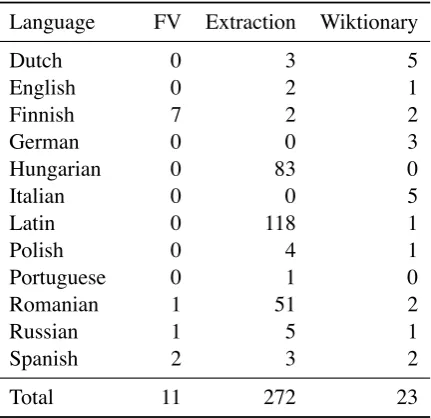
Free variation errorsoccur when more than one acceptable inflected form exists, but only one is present in the UniMorph data. Extraction er-rorsindicate flaws in UniMorph’s parsing of Wik-tionary inflectional paradigms. Wiktionary er-rorsrepresent errors in the Wiktionary data itself.
Silly errors This category consists of those “bizarre” errors which defy any purely linguistic characterization. In addition to the aforementioned case of *membled, such errors have also been re-ported for other language generation tasks such as machine translation (Arthur et al. 2016) and text normalization (Gorman and Sproat 2016, Sproat and Jaitly 2017,Zhang et al. 2019).
Allomorphy errors This category consists of those errors which are characterized by misappli-cation of existing (i.e., independently attested) al-lomorphic patterns in the target language. Our an-notation scheme recognizes four sub-categories of allomorphy error, but we set aside their their de-scription for reasons of space.
Spelling errors This category includes inflected forms that do not follow language-specific ortho-graphic conventions but are otherwise correct.
4 Results
We performed full error annotation on twelve of the 52 languages. Several other languages were initially targeted for annotation but pro-duced too few errors to draw meaningful con-clusions. Annotations were performed by the authors, all specialists in computational linguis-tics.4 Of these, four languages—English, Finnish, Polish, and Russian—were annotated by native
[image:3.595.72.290.236.331.2]speakers; the remaining eight were annotated by second-language speakers. In addition to the annotation guidelines, annotators were encour-aged to consult authoritative dictionaries and refer-ence grammars—such as theIso suomen kielioppi (Hakulinen et al. 2008) for Finnish, the Duden for German, the Oxford Latin Dictionary (Lee 1968), or the Diccionario de la lengua española for Spanish—and native speakers.Table 2reports summary statistics for fully-annotated languages.
4.1 Inter-annotator agreement
Table 3provides raw agreement and Krippendorf’s α (Artstein and Poesio 2008) for those languages known to two annotators. As mentioned above, each annotator is a specialist in computational lin-guistics, and annotated at least one other language as well. Raw agreement is high, and while chance-corrected agreement statistics like α are notori-ously difficult to interpret, α ≥ 0.8, a threshold obtained for all three double-coded languages, is generally considered to indicate substantial relia-bility (Krippendorff 2004:241f.).
4.2 Errors
Table 4provides the counts of the four major cat-egories of error for all twelve languages and for both systems. We now proceed to describe some patterns observed within these categories.
4.2.1 Target errors
Table 5gives counts for the three sub-categories of target errors.5
Free variation errors Finnish has several free variation errors, many involving vowel harmony. For example, the abessive suffix has two allo-morphs, namely the the back-harmonic-ttaand the front-harmonic-ttä. The lemma progestiini ‘pro-gestin’ can take the back allomorph, giving pro-gestiinitta, but, vowel harmony often fails to ap-ply when there are many intervening neutral vow-els (iande) between the harmonic trigger and the suffix (Hakulinen et al. 2008:§17), as is the case here. Therefore, the formprogestiinittä, predicted by both systems, is grammatical, though not the form given by UniMorph. Another type of free variation error affects allomorphs of the Finnish genitive plural (gen.pl.). For instance,omenoiden, omenoitten,omenojen,omenienandomenainare
5Some analyses conducted by Richard Sproat (p.c.) sug-gest that sub-task 2 was also highly affected by target errors.
all possible gen.pl. forms of omena ‘apple’, but only one is present in UniMorph.
Extraction errors The comparatively low accu-racy on Hungarian—cluzh-7, the best
perform-ing system on this language, achieves 89.80% per form accuracy—appears to be due to large num-ber of extraction errors. In most cases, the error comes from pairing one paradigm cell with another cell’s inflectional bundle. For instance, UniMorph incorrectly labels *lagúnákas the accusative plural (acc.pl.) forlagúna’lagoon’; it is in fact the nomi-native plural (nom.pl.). In Romanian, a header for the Wiktionary paradigms reading “definite artic-ulation” is incorrectly taken as an inflected form itself! Latin also suffers from pervasive extraction errors. This language has a robust phonemic con-trast between short and long monophthongs (e.g., malus‘unpleasant’ vs.mālus‘apple tree’). Long monophthongs are—at least in modern editions— indicated by the macron, a horizontal line above the vowel. UniMorph extraction has somehow re-moved macrons from all lemmata, though they are still present in the inflected forms. Thus, systems must attempt to predict an unpredictable phonemic contrast while mapping from lemma to inflected form. As a result, the vast majority of Latin errors concern vowel length.
Wiktionary errors Errors in the Wiktionary data itself are relatively rare and largely non-systematic. For example, in Spanish, *demarceis given as the first person singular (1sg.) present sub-junctive ofdemarcar‘to demarcate’ instead of the correct formdemarque.
4.2.2 Silly errors
Silly errors were found for all languages except English; they also appear to be somewhat more common forue-lmu-1(59) than forcluzh-7(37). ue-lmu-1 predicts praesōs as the acc.pl. of the
Latin noun praesul (a title used by Roman reli-gious leaders); there is no obvious analogue for the ul-ōsstem change. In German, cluzh-7
un-expectedly truncates the gen.pl. form of the com-pound noun Schädlingsbekämpfungsmittel ‘pesti-cide’ to produce *Schädlingsbekämpfungsmit. For the dative plural (dat.pl.) of the Russian compound noun meaning ‘forced labor’, ue-lmu-1
inexpli-cably deletes the r of rabóty ‘labor’, giving the bizarre *prinudítel’nymabótam.6And, in Spanish,
Language Noun Verb Adjective ue-lmu-1errors cluzh-7errors Overlap
Dutch 7 3 3 31 32 84%
English 7 3 7 28 32 24%
Finnish 3 3 3 49 65 44%
German 3 3 7 70 88 48%
Hungarian 3 3 7 136 132 65%
Italian 7 3 7 21 24 50%
Latin 3 3 3 187 190 56%
Polish 3 3 3 72 79 74%
Portuguese 7 3 7 9 10 73%
Romanian 3 3 3 109 122 59%
Russian 3 3 3 84 79 60%
Spanish 7 3 7 27 25 44%
Table 2: Raw error counts out of 1,000 test examples for the target languages. Checkmarks indicate whether UniMorph data was available for a given major category in that language. Error overlap is the percentage of errors made by both systems. There were 1,701 errors in total (823 fromue-lmu-1and 878 fromcluzh-7).
Language RA α
Dutch 0.949 0.907 English 0.861 0.855 Spanish 0.861 0.875
Table 3: Inter-annotator agreement statistics for three double-coded languages. RA: raw agreement.
ue-lmu-1 gives *atuengáisas the second person
plural present subjunctive ofatener‘to maintain’. There is no analogue for thise-uestem change.
4.2.3 Allomorphy errors
With the exception of Hungarian and Latin— which suffer from systematic extraction errors— allomorphy errors are the largest category of error in all languages.
Stem-final vowels in Finnish In Finnish nouns and adjectives, stem-final vowels commonly dis-appear or alternate with e or o when the plural marker i is added to the stem (Hakulinen et al. 2008:§45). For instance, the inessive plural of lasi‘glass’ islaseissa. In principle, such alterna-tions are predictable given the syllable count of the nominal stem, the stem-final consonants and the penultimate vowel, though the exact conditions are rather complex (Hakulinen et al. 2008:§46–50). For the compound noun pohjanpystykorva ‘nor-rbottenspets’ (a breed of dog),cluzh-7predicts an
incorrect gen.pl. form *pohjanpystykorvojenfor
in-it here so as to make the data accessible to a wider audience.
tendedpohjanpystykorvien; it has transformed the-stem finalatooand then selected the wrong plural marker (*-jeninstead of-ien) as a result.
Ablaut in Dutch and German Stem vowel alter-nations in the Germanic strong verbs are known as ablaut. Ablaut is robust in Dutch and German, and in both languages, is occasionally misapplied. In Dutch, for example, both systems overapply ablaut to the 1sg. preterite indicative forms ofprinten‘to print’, producing *prontinstead of printte. Sim-ilar errors are found in German. Both systems underapply ablaut to the 1sg. preterite indicative form of saufen ‘to drink’, producing *saufte in-stead of the expectedsoff, andue-lmu-1 overap-plies ablaut to the third person preterite subjunc-tive of the weak verb versenken‘to sink’, giving *versächtenin place of the expectedversenkten.
Target Silly Allomorphy Spelling
Language ue-lmu-1 cluzh-7 ue-lmu-1 cluzh-7 ue-lmu-1 cluzh-7
Dutch 8 1 1 19 16 5 7
English 3 0 0 18 18 7 11
Finnish 11 7 7 33 48 0 0
German 3 4 10 54 67 9 9
Hungarian 83 21 9 37 44 1 0
Italian 5 5 1 11 16 0 2
Latin 119 2 0 76 93 0 0
Polish 5 6 3 60 67 2 4
Portuguese 1 1 0 6 7 1 2
Romanian 54 3 5 61 69 1 2
Russian 7 7 0 48 45 23 28
Spanish 7 2 1 12 12 6 6
[image:6.595.81.515.63.291.2]Total 306 59 37 435 502 55 71
Table 4: Error type counts by language and system; target error counts are combined across the two systems.
Language FV Extraction Wiktionary
Dutch 0 3 5
English 0 2 1
Finnish 7 2 2
German 0 0 3
Hungarian 0 83 0
Italian 0 0 5
Latin 0 118 1
Polish 0 4 1
Portuguese 0 1 0
Romanian 1 51 2
Russian 1 5 1
Spanish 2 3 2
Total 11 272 23
Table 5: A breakdown of target errors by sub-category; counts are combined across the two systems. FV: free variation errors; Extraction: extraction errors; Wik-tionary: Wiktionary errors.
Einwohnerzahl‘population’, *Förmer(fromForm ‘shape’), *Neuwähle (from Neuwahl ‘re-vote’),
and *Sprösse(fromSpross‘bud’).
Consonant gradation in Finnish Many Finnish words undergo a set of unpredictable stem changes known as consonant gradation. Here, a “strong grade” of a consonant–normally a voiceless stop liket—alternates with the weak grade—a voiced stop like d—but the stop may also delete in the weak grade (Hakulinen et al. 2008:§41). Gradation
leads to inflection errors because not all lexemes participate in gradation, and because the weak grade of the stem consonant is not predictable from the lemma. For instance,cluzh-7incorrectly
ap-plies the weak grade to the negated third person singular*ei kiemurda(fromkiemurtaa‘to crawl’); the proper gradation ist-rinstead of the predicted t-d. cluzh-7also incorrectly produces the strong grade where the weak grade is required, failing to delete thek in the comitative *rikoslakein (from rikoslaki’criminal law’).
Linking vowels in Hungarian The Hungarian noun plural suffix is -k, usually preceded by a a, o, e, or ö linking vowel. For example, the nom.pl. form ofvér’blood’ isvérek. The choice of linking vowel is partly determined by vowel har-mony: back vowel stems select a or o whereas front vowel stems selecteorö. However, for back vowel stems, it is largely unpredictable whether a oro is used (Siptár and Törkenczy 2000:224f., Vago 1980:110f.), and there are several cases where one or both systems predict an incorrect link-ing vowel. For example,ue-lmu-1predicts an in-correct elative plural*masszázsakbólformasszázs ‘massage’; the correct form ismasszázsokból.
[image:6.595.74.290.331.540.2]żagli. Because fleeting vowels’ position and qual-ity are unpredictable, they cannot be analyzed as epenthetic. Instead, they are assumed to be present in the underlying form of certain roots and af-fixes, but somehow represented distinctly from the non-fleeting vowels (Lightner 1965, Rubach 1986). According to the analysis, a yer is deleted except when the following syllable also contains an yer, and the fleeting e and ie surface in the nom.sg. forms above because the masculine nom.sg. suffix is itself a yer (Gussman 1980:36f., Rubach 1984:41). It is impossible to predict the position or quality of a yer without referring to the rest of the inflectional paradigm,7 and this in-determinacy contributes to several inflectional er-rors. For instance, cluzh-7 predicts *żagieli in-stead of the expectedżagli, and both systems pre-dict *klęsek for of the expectedklęsk. Similar er-rors are also found in Russian.
Spanish diphthongization Many Spanish verbs exhibit a stem change in which mid vowelseand o in the final syllable of the stem diphthongize to ie [je] and ue [we], respectively, when they bear primary stress. Whether or not a mid vowel participates in diphthongization is largely unpre-dictable (Brame and Bordelois 1974:132f.,Harris 1969:74f.).8 For example,negar ‘to deny’ under-goes diphthongization (e.g., 1sg. present indicative niego), butpegar‘to stick’ does not (1sg. present indicative pego). Both models underapply diph-thongization in *desplegue(fromdesplegar‘to un-fold’) and *recola(fromrecolar‘to strain again’). Interestingly, these are 1st conjugation (i.e., -ar) verbs, and children acquiring Spanish tend to un-derapply diphthongization in this class (Mayol 2007). But cluzh-7 also overapplies
diphthon-gization in *atañieres (from atañer‘to concern’) and *gañieseis(fromgañir‘to yelp’). Similar er-rors occur in Portuguese, which also exhibits a stress-conditioned stem vowel alternation.
Noun plural suffixes in German German has five major noun plural suffixes, and many errors involve the use of the wrong plural. The most frequent pattern is the overapplication of the-(e)n plural—traditionally regarded as the most
produc-7Gouskova and Becker(2013) andBecker and Gouskova (2016) develop formal models of yer-deletion in Russian, but do not evaluate performance on actual held-out words.
8Albright et al.(2001) andAlbright(2003) develop a com-putational model to predict Spanish diphthongization, but do not report its performance on actual held-out verb forms.
tive plural suffix (Bech 1963,Wunderlich 1999)— as in Eosin ‘eosin’, Fußballweltmeisterschaft-squalifikationsspiel‘football world championship qualification game’, Hartung, a poetic term for ‘January’, Karbonatit ‘carbonatite’, Metallatom ‘metal atom’, andVorjahr‘last year’.
Overapplica-tion of-eis also common, as inAbonnement ‘sub-scription’,Etat ‘budget’,Funke‘spark’, Katholic ‘Catholic’, Königsgelb ‘yellow pigment’,
Reak-torbau‘reactor construction’,Prinzess ‘princess’, Toupet‘toupee’. Interestingly, both types of error are produced by children acquiring German (e.g., Clahsen 1999,Marcus et al. 1995,Szagun 2001).
Genitive singular suffixes in Polish Polish has two gen.sg. suffixes, -a and -u. It is generally impossible to predict which gen.sg. allomorph a given stem will select, and there is no evidence that one is more productive than the other (Dąbrowska 2001,2005,Kottum 1981, Maunsch 2003). This unpredictable allomorphy causes many gen.sg. er-rors to both systems, such as *ateuszuforateusza
‘atheist’, *izotopa for izotopu ‘isotope’, *krzyka
forkrzyku‘scream’, and *legaruforlegara‘joist’.
Verbal prefixes in German Some verbal pre-fixes in German are known as “separable” because they separate (i.e., are postposed) from their host verb when tensed. Others, the “inseparable” pre-fixes, are always attached to their host verb with-out exception. Finally, some prefixes, such asum-, are separable or inseparable depending on the verb, and this leads to several errors. For example, both systems predict *umkehrefor the 1sg. present in-dicative ofumkehren‘to turn around’; the correct form is the separablekehreum.
Animacy in Polish and Russian Case syn-cretisms in inanimate (i.e., non-personal) nouns are found in many Slavic languages. However, an-imacy is an inherent feature of nouns and cannot be predicted from the form of the lemma alone. In Russian, for example, cluzh-7 wrongly
sys-tems incorrectly predict a nom.pl. *katalizatorzy instead ofkatalizatory; the mutation ofrtorz be-fore the nom.pl.-yis restricted to masculine ani-mates (Feldstein 2001:27).
Aspect in Russian Russian verbal inflection is conditioned by an inherent feature known as as-pect. For instance, the perfective verbsorvat’‘to pick’ forms a synthetic future whereas the closely-related imperfective sryvat’ forms a periphrastic (i.e., multi-word) future formed using future-tense forms ofbyt’ ‘to be’. Several errors involve the wrong future form for a verb’s aspect. For exam-ple, for the perfectivesorvat’,cluzh-7incorrectly
predicts a periphrastic second person singular fu-ture *budeš’sorvat’ instead of the expected syn-theticsorvëš’.
Vowel harmony in Finnish compounds In Finnish, the first stem in a noun compound does not participate in suffix harmony (Hakulinen et al. 2008:§14). For example, the partitive singular of the compoundlapinsirri‘Temminck’s stint’ (a type of bird) is thelapinsirriä. Because this lemma is a compound of Lapin ‘of Lapland’ and sirri ‘stint’, and because all vowels in the second second stem of the compound are neutral, front harmony— the default—applies. However, cluzh-7
gener-ates *lapinsirria, a form which would be correct were the lemma not a compound.
Internal inflection in Russian compounds
Many Russian nouns in the shared task are adjective-noun or noun-noun compounds, and systems fail to appropriately inflect both com-ponents of the compound. The acc.pl. of lëgkaja promyšlennost’ ‘light industry’ is lëgkie
promyšlennosti, but ue-lmu-1 predicts *lëgkix
promyšlennosti, incorrectly placing the adjective in the genitive case. Other adjective-noun com-pounds for which one or both of the systems fail to produce proper agreement morphology include vizitnaja kartočka ‘business card’ and bulevo množestvo‘boolean domain’. Both stems of most noun-noun compounds, particularly hyphenated compounds, are inflected. For example, the prepo-sitional plural of gosudarstvo-donor‘donor state’ isgosudarstvax-donorax, but both systems predict *gosudarstvo-donorax, in which only the second stem is inflected. However, there are some cases in which one stem of a compound is not declined. For instance, in sindrom Aspergera ‘Asperger’s syndrome’, only the head nounsindromshould be
inflected becauseAspergerais a nominal modifier and already in genitive case, but both systems incorrectly inflect the second stem producing the gen.pl. *sindromov Asperger.
4.2.4 Spelling errors
Spelling errors are relatively rare overall. In Dutch, diaeresis is used to mark hiatus—adjacent vow-els in consecutive syllables—and thus the past participle of upgraden ‘to upgrade’ should be geüpgraded, not the predicted*geupgraded. Sev-eral English errors concern an orthographic dou-bling of certain final consonants; for example, both systems predict a past participle *disentered in-stead of the expecteddisenterred. There are many German spelling errors, including several concern-ing the spellconcern-ing of the gen.sg. suffix—written as -es or -s depending on context—or s, ss, and ß, all pronounced [s]. In Spanish, a g followed by ioreis read as [x], not as [g], so the verb fungir ‘to service as’ has a 1sg. future indicative spelled funjorather than the predicted *fungo. Several Por-tuguese and Spanish predictions omit the acute ac-cent used to indicate exceptional primary stress; e.g., Portuguese *influisse for the 1sg. imperfect subjunctiveinfluísse(frominfluir‘to influence’).
5 Discussion
5.1 Target errors
Target errors heavily impact performance for Hun-garian, Latin, and Romanian. Overall, nearly one fourth of our sample’s errors were target errors, and we suspect such errors also lurk in the train-ing and development data. Clearly, the UniMorph data used in this task requires further vetting.
5.2 Allomorphy errors
Overall, silly errors were far less common than allomorphy errors. Many of the allomorphy er-rors appear to result from unpredictable linguis-tic behaviors rather than failures to extract reliable generalizations. In some cases, errors reflect sys-tems’ inability to predict inherent features such as animacy and aspect in Slavic. Such features are not encoded in UniMorph, although this in-formation is often present on Wiktionary. Gener-ally speaking, these features cannot be predicted from the orthographic form of lemmata,9 but we
suspect that the relevant information could be in-duced using either contextual or type-level word embeddings. We leave this for future work.10 Systems also appear to struggle with lemmata which are themselves internally complex due to word-formation processes like prefixation or com-pounding, including prefix verbs in German and compounds in Finnish and Russian. Lemma-internal structure, once again, is not currently en-coded in UniMorph, though it could in princi-ple be extracted from Wiktionary entries. Fi-nally, we see that systems struggle with certain lexically-specific morphophonological patterns— Germanic ablaut and umlaut, Finnish consonant gradation, Hungarian linking vowels, Slavic yers, and Spanish diphthongization—and with lexically-conditioned affix selection in German and Pol-ish. We have seemingly rediscovered what lin-guists have long known: certain allomorphic pat-terns cannot be predicted from the form of lemmata alone; they must be memorized. It is unreasonable to expect any neural network, no matter how pow-erful, to predict what is truly unpredictable.
Our analysis is limited to languages included the shared task, those for which the top systems have a non-trivial number of errors, and those for which we have sufficient linguistic expertise. As a result, our final sample of twelve languages only includes two major language families, Indo-European and Uralic, the latter represented by Finnish and Hun-garian. However, this sample has some degree of grammatical diversity. Linguists traditionally dis-tinguish between two types of morphological ex-ponence. In agglutination, each morphological feature corresponds roughly to a single affix. For instance, in the Hungarian formcinkosoknak, the dat.pl. ofcinkos‘accomplice’, the-oksuffix marks plurality and the -nak suffix indicates the dative case. Infusion, on the other hand, single affixes may realize many morphological features at once. For instance, in the Russian form čabrecov, the gen.pl. of čabrec ‘thyme’, the -ov suffix is both genitive and plural (and its form also indirectly in-dicates that the stem is masculine). Agglutination is characteristic of the Uralic languages, whereas Indo-European languages makes heavy use of fu-sion. Furthermore, vowel harmony is limited to the two Uralic languages.
10Sub-task two of the SIGMORPHON 2019 Shared Task (McCarthy et al. 2019) involves lemmatization and morpho-logical analysis in sentential context, but the applicability of this to the inflection task has not yet received much attention.
6 Conclusion
We propose an error taxonomy for morphologi-cal inflection generation and apply it to the pre-dictions of the two best systems in the CoNLL– SIGMORPHON 2017 Shared Task. We estimate a lower bound for the percentage of “target” er-rors in the gold data. Over 80% of the remain-ing (non-target) errors can be understood as mis-application of language-specific morphological or spelling principles. One potential remedy is to en-rich the input linguistic representations with, e.g., compound structure and inherent grammatical fea-tures; however, this is unlikely to avoid all errors; some morphological patterns cannot be general-ized but only memorgeneral-ized.
The above analysis depends on manual annota-tion, but one might prefer to automate error classi-fication. An automated system, for example, could be integrated into a rapid development process, or used as an additional objective during training and tuning, so long as it has reasonably high agree-ment with human experts. Ideally, such a sys-tem would scale to arbitrary languages, not just those for which linguistic expertise is readily avail-able. A powerful ensemble model could help iden-tify candidate target errors, and for certain high-resource languages, it might be possible to lever-age finite-state morphological analyzers and lexi-cons to distinguish between silly, spelling, and al-lomorphy errors. We leave these and many other open questions for future work.
Acknowledgments
Ekaterina Levitskaya made substantial contribu-tions to early stages of this project. Suzanne van der Feest assisted with Dutch annotations, and Alëna Aksënova assisted with Russian annotations. Richard Sproat provided spiritual guidance and contributed an impressionistic characterization of the sub-task 2 error profiles.
Miikka Silfverberg was funded in part by the Eu-ropean Research Council (ERC) under the Euro-pean Union’s Horizon 2020 research and innova-tion programme (grant agreement no. 771113).
References
pages 2004–2015, Vancouver. Association for Com-putational Linguistics.
Adam Albright. 2003. A quantitative study of Span-ish paradigm gaps. InProceedings of the 22nd West Coast Conference on Formal Linguistics, pages 1– 14, Somerville, MA. Cascadilla.
Adam Albright, Argelia Andrade, and Bruce Hayes. 2001. Segmental environments of Spanish diph-thongization. UCLA Working Papers in Linguistics, 7:117–151.
Philip Arthur, Graham Neubig, and Satoshi Nakamura. 2016. Incorporating discrete translation lexicons into neural machine translation. InProceedings of the 2016 Conference on Empirical Methods in Natu-ral Language Processing, pages 1557–1567, Austin. Association for Computational Linguistics.
Ron Artstein and Massimo Poesio. 2008. Inter-coder agreement for computational linguistics. Computa-tional Linguistics, 34(4):555–596.
Gunnar Bech. 1963. Zur Morphologie der deutschen Substantive.Lingua, 12(1):177–189.
Michael Becker and Maria Gouskova. 2016. Source-oriented generalizations as grammar inference in Russian vowel deletion. Linguistic Inquiry, 47(3):391–425.
Toms Bergmanis, Katharina Kann, Hinrich Schütze, and Sharon Goldwater. 2017. Training data aug-mentation for low-resource morphological inflection. InProceedings of the CoNLL SIGMORPHON 2017 Shared Task: Universal Morphological Reinflection, pages 31–39, Vancouver. Association for Computa-tional Linguistics.
Jean Berko. 1958.The child’s learning of English mor-phology.Word, 14:150–177.
Michael K. Brame and Ivonne Bordelois. 1974. Some controversial questions in Spanish phonology. Lin-guistic Inquiry, 5(2):282–298.
Erwin Chan. 2008.Structures and distributions in mor-phology learning. Ph.D. thesis, University of Penn-sylvania.
Harald Clahsen. 1999. Lexical entries and rules of lan-guage: a multidisciplinary study of German inflec-tion. Behavioral and Brain Sciences, 22(6):991– 1069.
Maria Corkery, Yevgen Matusevych, and Sharon Gold-water. 2019. Are we there yet? Encoder-decoder neural networks as cognitive models of English past tense inflection. InProceedings of the 57th Annual Meeting of the Association for Computational Lin-guistics, pages 3868–3877, Florence. Association for Computational Linguistics.
Ryan Cotterell, Christo Kirov, John Sylak-Glassman, Géraldine Walther, Ekaterina Vylomova, Arya D. McCarthy, Katharina Kann, Sebastian Mielke, Gar-rett Nicolai, Miikka Silfverberg, David Yarowsky, Jason Eisner, and Mans Hulden. 2018.The CoNLL– SIGMORPHON 2018 shared task: universal mor-phological reinflection. In Proceedings of the CoNLL–SIGMORPHON 2018 Shared Task: Univer-sal Morphological Reinflection, pages 1–27, Brus-sels. Association for Computational Linguistics.
Ryan Cotterell, Christo Kirov, John Sylak-Glassman, Géraldine Walther, Ekaterina Vylomova, Patrick Xia, Manaal Faruqui, Sandra Kübler, David Yarowsky, Jason Eisner, and Mans Hulden. 2017. CoNLL– SIGMORPHON 2017 shared task: universal mor-phological reinflection in 52 languages. In Pro-ceedings of the CoNLL SIGMORPHON 2017 Shared Task: Universal Morphological Reinflection, pages 1–30, Vancouver. Association for Computational Linguistics.
Ryan Cotterell, Christo Kirov, John Sylak-Glassman, David Yarowsky, Jason Eisner, and Mans Hulden. 2016. The SIGMORPHON 2016 shared task— morphological reinflection. In Proceedings of the 14th SIGMORPHON Workshop on Computational Research in Phonetics, Phonology, and Morphology, pages 10–22, Berlin. Association for Computational Linguistics.
Matthew S. Dryer and Martin Haspelmath, editors. 2013. WALS Online. Max Planck Institute for Evo-lutionary Anthropology, Leipzig. https://wals. info/.
Dudenredaktion, editor. No date. Duden in 12 Banden. 1: Die deutsche Rechtschreibung, 27th edition. Bib-liographisches Institut, Berlin.
Greg Durrett and John DeNero. 2013.Supervised learn-ing of complete morphological paradigms. In Pro-ceedings of the 2013 Conference of the North Amer-ican Chapter of the Association for Computational Linguistics: Human Language Technologies, pages 1185–1195, Atlanta. Association for Computational Linguistics.
Ewa Dąbrowska. 2001. Learning a morphological sys-tem without a default: the Polish genitive. Journal of Child Language, 28(3):545–574.
Ewa Dąbrowska. 2005. Productivity and beyond: mas-tering the Polish genitive. Journal of Child Lan-guage, 32:191–205.
Ronald F. Feldstein. 2001. A concise Polish grammar. Slavic and East European Language Resource Cen-ter, Durham, NC.
Kyle Gorman and Richard Sproat. 2016.Minimally su-pervised number normalization. Transactions of the Association for Computational Linguistics, 4:507– 519.
Maria Gouskova and Michael Becker. 2013. Nonce words show that Russian yer alternations are gov-erned by the grammar.Natural Language & Linguis-tic Theory, 31(3):735–765.
Edmund Gussman. 1980. Studies in abstract phonol-ogy. MIT Press, Cambridge.
Auli Hakulinen, Maria Vilkuna, Riitta Korhonen, Vesa Koivisto, Tarja-Riitta Heinonen, and Irja Alho. 2008. Iso suomen kielioppi. Suomalaisen Kirjallisuuden Seura, Helsinki.
James Harris. 1969. Spanish phonology. MIT Press, Cambridge.
Jacob Hieble. 1957. What about the German umlaut? The German Quarterly, 30(4):272–274.
Ann Irvine, John Morgan, Marine Carpuat, Hal Daumé III, and Dragos Munteanu. 2013.Measuring machine translation errors in new domains. Transac-tions of the Association for Computational Linguis-tics, 1:429–440.
Katharina Kann and Hinrich Schütze. 2017. The LMU system for the CoNLL–SIGMORPHON 2017 shared task on universal morphological reinflection. InProceedings of the CoNLL SIGMORPHON 2017 Shared Task: Universal Morphological Reinflection, pages 40–48, Vancouver. Association for Computa-tional Linguistics.
Christo Kirov and Ryan Cotterell. 2018.Recurrent neu-ral networks in linguistic theory: revisiting Pinker and Prince (1988) and the past tense debate. Transac-tions of the Association for Computational Linguis-tics, 6:651–665.
Christo Kirov, Ryan Cotterell, John Sylak-Glassman, Géraldine Walther, Ekaterina Vylomova, Patrick Xia, Manaal Faruqui, Arya D. McCarthy, Sandra Kübler, David Yarowsky, Jason Eisner, and Mans Hulden. 2018.UniMorph 2.0: universal morphology. In Pro-ceedings of the 11th Language Resources and Eval-uation Conference, pages 1868–1873, Miyazaki. Eu-ropean Language Resource Association.
Christo Kirov, John Sylak-Glassman, Roger Que, and David Yarowsky. 2016. Very-large scale pars-ing and normalization of Wiktionary morphological paradigms. In Proceedings of the Tenth Interna-tional Conference on Language Resources and Eval-uation, pages 3121–3126, Portorož. European Lan-guage Resources Association.
Steiner E. Kottum. 1981. The genitive singular form of masculine nouns in Polish. Scando-Slavica, 27(1):179–186.
Klaus Krippendorff. 2004. Content analysis: an intro-duction to its methodology, 2nd edition. Sage, Thou-sand Oaks, CA.
Mikko Kurimo, Sami Virpioja, Ville Turunen, and Krista Lagus. 2010. Morpho Challenge 2005–2010: evaluations and results. InProceedings of the 11th Meeting of the ACL Special Interest Group on Com-putational Morphology and Phonology, pages 87– 95, Uppsala. Association for Computational Linguis-tics.
G. M. Lee, editor. 1968. Oxford Latin dictionary. Claredon Press, Oxford.
Theodore M. Lightner. 1965. Segmental phonology of Modern Standard Russian. Ph.D. thesis, MIT.
Peter Makarov, Tatiana Ruzsics, and Simon Clematide. 2017. Align and copy: UZH at SIGMORPHON 2017 shared task for morphological reinflection. In
Proceedings of the CoNLL SIGMORPHON 2017 Shared Task: Universal Morphological Reinflection, pages 49–57, Vancouver. Association for Computa-tional Linguistics.
Gary Marcus, Ursula Brinkmann, Harald Clahsen, Richard Wiese, and Steven Pinker. 1995. German inflection: the exception that proves the rule. Cogni-tive Psychology, 29(3):189–256.
Gary Marcus, Steven Pinker, Michael Ullman, Michelle Hollander, John Rosen, and Fei Xu. 1992. Overregularization in language acquisi-tion. Monographs of the Society for Research in Child Development. University of Chicago Press, Chicago.
Hanna Maunsch. 2003. Current alternations in inflec-tion of Polish masculine inanimate nouns in the sin-gular: a pilot study. Investigationes Linguisticae, 9:4–21.
Laia Mayol. 2007. Acquisition of irregular patterns in Spanish verbal morphology. In12th ESSLLI Student Session Proceedings, pages 185–196, Dublin. Asso-ciation for Logic, Language and Information.
Arya D. McCarthy, Ekaterina Vylomova, Shijie Wu, Chaitanya Malaviya, Lawrence Wolf-Sonkin, Gar-rett Nicolai, Christo Kirov, Miikka Silfverberg, Se-bastian J. Mielke, Jeffrey Heinz, Ryan Cotterell, and Mans Hulden. 2019. The SIGMORPHON 2019 shared task: morphological analysis in context and cross-lingual transfer for inflection. InProceedings of the 16th Workshop on Computational Research in Phonetics, Phonology, and Morphology, pages 229– 244, Florence. Association for Computational Lin-guistics.
Maja Popović and Hermann Ney. 2011. Towards au-tomatic error analysis of machine translation output.
Computational Linguistics, 37(4):657–688.
Real Academia Española, editor. 1992. Diccionario de la lengua española, 21st edition. Real Academia Es-pañola, Madrid.
Alla Rozovskaya and Dan Roth. 2016. Grammati-cal error correction: machine translation and clas-sifiers. In Proceedings of the 54th Annual Meet-ing of the Association for Computational LMeet-inguistics, pages 2205–2215, Berlin. Association for Computa-tional Linguistics.
Jerzy Rubach. 1984.Cyclic and lexical phonology: the structure of Polish. Foris, Dordrecht.
Jerzy Rubach. 1986. Abstract vowels in three-dimensional phonology: the yers.The Linguistic Re-view, 5(3):247–280.
David Rumelhart and Jay McClelland. 1986. On learning the past tenses of English verbs. In Jay McClelland, David Rumelhart, and the PDP Re-search Group, editors,Parallel distributed process-ing: explorations into the microstructure of cogni-tion. Vol. 2: Psychological and biological models, pages 216–271. Bradford Books, Cambridge.
Péter Siptár and Miklós Törkenczy. 2000. The phonol-ogy of Hungarian. Oxford University Press, Oxford.
Richard Sproat. 1992. Morphology and computation. MIT Press, Cambridge.
Richard Sproat and Navdeep Jaitly. 2017. An RNN model of text normalization. InProceedings of In-terspeech 2017, pages 754–758, Stockholm. Interna-tional Speech Communication Association.
John Sylak-Glassman. 2016. The composition and use of the universal morphological feature schema (Uni-Morph schema). Technical report, Department of Computer Science, Johns Hopkins University.
John Sylak-Glassman, Christo Kirov, David Yarowsky, and Roger Que. 2015. A language-independent fea-ture schema for inflectional morphology. In Pro-ceedings of the 53rd Annual Meeting of the Associ-ation for ComputAssoci-ational Linguistics and the 7th In-ternational Joint Conference on Natural Language Processing, pages 674–680, Beijing. Association for Computational Linguistics.
Gisela Szagun. 2001. Learning different regularities: the acquisition of noun plurals by German-speaking children.First Language, 21:109–141.
Robert M. Vago. 1980. The sound pattern of Hun-garian. Georgetown University Press, Washington, D.C.
Terence Wade. 2010. A comprehensive Russian gram-mar, 2nd edition. Wiley-Blackwell, Oxford.
Dieter Wunderlich. 1999. German noun plural recon-sidered. Behavioral & Brain Science, 22(6):1044– 1045.