Proceedings of the CoNLL 2018 Shared Task: Multilingual Parsing from Raw Text to Universal Dependencies, pages 34–44 34
CEA LIST : Processing low-resource languages for
CoNLL 2018 Shared Task
Elie Duthoo Olivier Mesnard
CEA, LIST, Laboratory of Vision and Content Engineering [email protected]
Abstract
In this paper, we describe the first CEA LIST participation at the CoNLL 2018 shared task. The submitted system is based on the state of the art parser from CoNLL 2017, that has been improved by the addition of morphological features predictions and the integration of addi-tional resources to provide accurate mod-els for low-resource languages. Our ap-proach ranked 5th of 27 participants in MLAS for building morphology aware de-pendency trees, 2ndfor morphological fea-tures only, and 3rdfor tagging (UPOS) and parsing (LAS) low-resource languages.
1 Introduction
The CoNLL 2018 Shared Task (Zeman et al.,
2018) is dedicated to developing dependency parsers on many languages, including low-resource languages. Our system uses the Stan-ford team parser1(Dozat et al.,2017) which was at the state of the art during the CoNLL 2017 shared task. We will refer to it as ”stf parser” in this arti-cle. We also used UDPipe (Straka et al.,2016) for tokenization, sentence segmentation, word align-ment, lemmas and XPOS tags. Our main pur-pose is not to propur-pose a new parser system, our approach is mainly focused on the adaptation of existing systems to low-resources languages. However, we also propose some improvements of the stf parser on multiple levels: (1) the training time is shorter and the models are more accurate for features and XPOS tags predictions (even if we didn’t use the predicted XPOS tags in the final submission) (2) we studied the hyper-parameters in order to find the best configuration (3) we
im-1https://github.com/tdozat/Parser-v2
plemented an optimal tree construction instead of a greedy one, based on Stanford team recommen-dations in their 2017 paper.
We spent five man-month to provide these results, with two additional man-month dedicated to Bre-ton corpus.
For low-resource languages, we based our ap-proach on the following available data : OPUS corpus, Wikipedia data (Wiktionary) and word embeddings.
2 Architecture
Our architecture mainly reused the proposed architecture of the 2017 state of the art system. Here is a brief reminder to explain what we used and how we used it. The model uses character embeddings, pre-trained word embeddings and post-trained word embeddings.
• Firstly, the raw text is processed by UDPipe. • Then the stf tagger annotates the data with
UPOS, XPOS and Features tags. Both the tag-ger and the parser use bi-LSTM layers on word embeddings. The tagger and the parser are sep-arately trained models even if the models struc-tures are really close.
• Finally, for each word, the parser concatenates one word level embedding (which is the sum of chars + pre-trained + trained embeddings) with one POS tag level embedding (UPOS + XPOS + features). POS tag embeddings are also learned during the training. We didn’t use lemmas. The stf parser is graph-based.
the case for the features) and could thus contribute more to the word embedding. For almost all lan-guages, the parser is based on three bi-LSTM lay-ers (300neurons/layer) and the tagger on two bi-LSTM layers(200neurons/layer). The tagger ends with a 120 neurons lReLU layer. The parser ends with a 500 neurons lReLU layer for learning arc probabilities, and a 170 neurons lReLU layer for predicting the labels of the dependencies. For lan-guages with less than 1500 sentences, we used a parser composed of only one bi-LSTM layer and smaller lReLU layers.
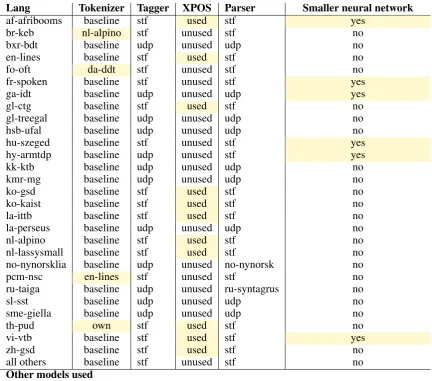
We only kept the best system evaluated on dev data for each language on each of the last two steps. Our measure for the tagger was the combination of UPOS and Features annotations (like Alltags with-out XPOS), if UDPipe was better than stf, we used UDPipe. Our measure for the parser was the LAS. For the evaluation, the predicted XPOS tags were removed from the parsed file and changed to the UDPipe ones, however the predicted XPOS were used by the parser when they were predicted by the tagger. We didn’t evaluate the XPOS tags as we needed to sort the sub-XPOS tags (these sub-POS tags are sorted in alphabetical order for features which is really more convenient). The problem was only that we had to sort the sub-XPOS tags in order to have a score on them, but sorting them is not required to have them used in the parser. A table has been produced to summarize the con-figuration (cf table1).
3 Enhancements
3.1 Features
The initial architecture provided by Stanford team was restricted to predicting UPOS tags only, or UPOS tags and XPOS tags. We added a third type of tagger to predict UPOS tags, XPOS tags and morphological features at the same time.
As we said earlier, the tagger takes into account characters by using a LSTM on each character and using a linear attention layer on the LSTM outputs, so we did expect great results on features. However, POS tags are heterogeneously for-matted: the UPOS tag represents only one information, but a feature tag generally contains many sub-tags, and XPOS tags may also contain sub-tags depending on the treebank. The original architecture didn’t tackle this problem and was processing all tags as if they were unary tags.
It means, for example, that for Latin-ITTB, the tagger ended with a lReLU layer that was choosing the best class between 3129 classes. We added a lReLU layer for each sub-class at the end of the network so that the backpropagation only backpropagates error on a subclass level, thus being more accurate when building character embeddings. This architecture was extended to XPOS tags, as they may also contains subclasses. Finally the score that was used to stop the training and keep the best model was the ”UPOS and Features” score, counting a word ok only if it had the exact UPOS tag and the exact features tags.
To sum up, for each sub-category (for exam-ple, the tense of a verb), a different lReLU layer determines if the word corresponds to one of the sub-category possible values (none, present,
future,past..).
3.2 Hyperparameters
In order to understand the impact of the param-eters on the architecture, we performed some random search optimization on hyperparameters, for a subset of languages (Russian, Hebrew, French, Uyghur, Vietnamese, Ancient Greek and Bulgarian) that we considered representative. We studied the following parameters: dropout on word embeddings, dropout on character embeddings, word embeddings merging strategy (whether to sum or concatenate the word embed-ding coming from characters and the pre/post trained word embeddings), case sensitivity, number of bi-LSTM layers, number of neurons for bi-LSTM, lReLU layers sizes, lReLU layers dropout, and some optimizer parameters like the learning rate.
• number of bi-LSTM The number of bi-LSTM layers deeply affects the score probably because of the vanishing gradient problem. Best scores were achieved for one to three bi-LSTM. With four layers, some models fail to converge and with five layers, no converging model is found. • dropoutFor dropout on character embeddings,
we found that is wasn’t useful (initial value was 0.5 (50%) but optimal value was between 0 and 0.1). Other dropout did not have a clear influ-ence.
Lang Tokenizer Tagger XPOS Parser Smaller neural network
af-afribooms baseline stf used stf yes
br-keb nl-alpino stf unused stf no
bxr-bdt baseline udp unused udp no
en-lines baseline stf used stf no
fo-oft da-ddt stf unused stf no
fr-spoken baseline stf unused stf yes
ga-idt baseline udp unused udp yes
gl-ctg baseline stf used stf no
gl-treegal baseline udp unused udp no
hsb-ufal baseline udp unused udp no
hu-szeged baseline stf unused stf yes
hy-armtdp baseline udp unused stf yes
kk-ktb baseline udp unused udp no
kmr-mg baseline udp unused udp no
ko-gsd baseline stf used stf no
ko-kaist baseline stf used stf no
la-ittb baseline stf used stf no
la-perseus baseline udp unused udp no
nl-alpino baseline stf used stf no
nl-lassysmall baseline stf used stf no
no-nynorsklia baseline udp unused no-nynorsk no
pcm-nsc en-lines stf unused stf no
ru-taiga baseline udp unused ru-syntagrus no
sl-sst baseline udp unused udp no
sme-giella baseline udp unused udp no
th-pud own stf used stf no
vi-vtb baseline stf used stf yes
zh-gsd baseline stf used stf no
all others baseline stf unused stf no
Other models used
[image:3.595.83.516.60.441.2]cs-pud & cs-pdt, sv-pud & sv-lines, fi-pud & fi-tdt, ja-modern & ja-gsd (udp), en-pud & en-gum pcm-nsc en-lines (stf without post-trained embeddings)
Table 1: Summary table of specific configurations per languages. udp = UDPipe architecture
both tasks didn’t have the same optimal archi-tecture.
• other parameters Other parameters did not have a clear empirical influence on the score, such as the number of neurons on each layer (from 50 to 500) and other parameters of the op-timizer.
3.3 Stopping criteria
Depending on the model (tagger/parser), the stop-ping criteria was based on UPOSandFeats score or LAS. The first thing we did with the parser was to improve the training time. The previous algorithm stopped the training only if the model didn’t im-prove at all for 5000 iterations (which could cor-respond to 2 hours on our environment), or after a maximum number of iterations. This means that the training would go on even for an improvement of 0.01% each hour. In practice, with this
config-uration, the longest model took 24 hours to train. We added two stopping criteria:
- The first is the time, the training time shouldn’t exceed 2 hours. The training time depends on the architecture so we chose the value depending on our experiments
- The second is the average progression of the sys-tem per hour during the last 20 validations (we set one validation each 120 iteration). If the system was under 0.1% per hour, we stopped the training. With these criteria, almost all models are con-verging really fast (in 30 minutes they were al-ready close by 1% to their best score).
3.4 Optimal directed spanning tree
op-timal algorithm to provide non-projective depen-dency trees as a lot of treebanks contains at least one non-projective tree.
In fact, 99% of all trees are projectives (non-weighted average across all proportions in all tree-banks). But building the optimal non-projective spanning tree based on probabilities should also help in building projective trees (as projective trees are a subset of non-projective trees), and some treebanks contain a lot more of non-projective trees (10% for Ancient Greek Perseus).
We implemented the Chu-Liu-Edmonds algorithm (Edmonds, 1967) and evaluated the result. We didn’t notice a great improvement (less than 0.1%), we suppose that the probabilities were high enough so that a greedy algorithm doesn’t have troubles predicting the optimal tree by always choosing the highest probability.
Empirically, the stf parser does build more nonpro-jective trees than in the training set, one could con-sider implementing the Eisner algorithm (Eisner,
1996) and make a compromise between Edmonds and Eisner algorithms based on the probabilities in each tree and on the non-projective proportion wished.
3.5 Including an embedding from the tagger in the parser
In the stf parser, the tagger and the parser are sepa-rated. The parser builds its own UPOS tag embed-dings but do not take into account the probabilities of each tag proposed by the tagger. The fact that one word has one tag instead of another could be subjective in some circumstances and as the tag-ger doesn’t get 100% in UPOS tag prediction, the parser should get the information that the tag it is reading is just a choice over many others, based on probabilities.
For some languages like French, the tagger could confuse verbs and auxiliaries. For these tags, the probability could be something like 70% verb and 30% auxiliary, and the tagger will label the word as a ”verb”. Making a mistake on which word is a verb and which one is an auxiliary affects the de-pendency tree. We therefore extracted these prob-abilities from the tagger to introduce them in the parser.
This experiment didn’t show a clear improvement in the results. We think that the parser has trouble learning from these probabilities because they are almost always at one (the tagger rarely makes mis-takes). Maybe one could improve the system by
not adding the probabilities directly but the output of the layer before the softmax. This improvement was not included in the final submission.
4 Cross-lingual transfer for low-resource languages
The rest of our work was focused on cross-lingual transfer methods and data mining to address the problem of low-resource languages. The main idea of our models is to build an artificial treebank on which we could learn a tagger / parser. As exposed by (Tiedemann and Agi´c, 2016), many techniques may be used to build artificial tree-banks. They identified mainly 1) model transfer (for example, building a delexicalized parser from a rich-resource language and using it directly on a target language corpus annotated beforehand with POS tags), 2) direct annotation projection (relying on word alignments of a bitext to project POS annotation), 3) treebank translation and 4) cross-lingual word embeddings. The use of partial annotations with dictionary may complete these four techniques. We relied on quality of available data to choose the best suited technique. Our analysis started on all low-resource languages but we applied our process to only 3 languages: Breton, Faroese and Thai because of the lack of valuable data for others2. Extending the capacities of our models is certainly doable but a lot of regularization on data should be done. We present a summary of our choices in table2.
4.1 Breton
Breton treebank has been built with direct an-notation projection (Tiedemann and Agi´c,2016). There were neither training nor evaluation tree-bank for Breton. Breton is member of Celtic lan-guage family but no large treebank exists in this family (Irish IDT is a 1020 only sentences cor-pus). We decided to use the most valuable and available resources for Breton: Wiktionary, word embeddings from Facebook3, combined as in Wis-niewski et al.(2014) with cross-lingual projection from a larger parallel corpus to build our own arti-ficial learning corpus.
We selected OfisPublik from OPUS (Tiedemann,
2009) site as parallel corpus for cross lingual
2
We also had results on Upper Sorbian but failed to submit the model.
Role Breton Thai Faroese
Tokenization model transfer dictionary model transfer
POS annotation projection+Wiktionary annotation projection+Wiktionary model transfer (*)
[image:5.595.68.562.59.114.2]Dependencies annotation projection model transfer (*) model transfer (*)
Table 2: choices made to build our artificial treebanks for low-resource languages (*) with cross-lingual embeddings
transfer. This corpus is composed of more than 60.000 sentences dumped from a bilingual institu-tional site about Breton language4.
We proceeded as follow:
Statistics on parse tree: We computed some statistics on Irish treebank: the counts of occur-rences of all types of arc, indexed by triples (head UPOS, dependency UPOS, arc label) to setup a prior distribution probability.
Lexicon: We built a lexicon of form-category from the most recent brwiktionary dump (20/05/2018). We obtain 26650 entries with mostly one category. When there are more than one category, we preserved the order, assessing that the most frequent category is the first men-tioned in Wiktionary. Using links to other Wik-tionaries we manually translated the 53 categories into UPOS tag.
Parallel corpus:We filtered the parallel corpus and excluded some sentences: those with less than 3 words (br or fr), those with more than 30 words (br or fr) and those whose ratio of size of origi-nal sentence upon translated sentence is not in the range [1/3,3].
Tokenization: We used UDPipe with Dutch model to tokenize the Breton side of the paral-lel corpus. We chose Dutch because it preserves ”c’h” sequence of character which is the transcript of a very frequent consonant in Breton.
Word Alignment: We built a word alignment of the tokenized parallel corpus with efmaral5. We used forward and reverse alignment and combined them withatoolsfrom fastalign6 with grow-diag-final-andmode.
Annotation: We used UDPipe to annotate the French side corpus with baseline UDPipe model for French.
POS tagging:We have performed UPOS anno-tation within four steps.
1. Use our lexicon to annotate supposedly non ambiguous tokens with word type: when the
4
http://www.fr.brezhoneg.bzh
5
https://github.com/robertostling/efmaral
6https://github.com/clab/fast align
form of a token has an entry with only one cat-egory, the value is used as UPOS.
2. Use our lexicon to annotate ambiguous tokens with hypotheses of word type : when a form has an entry with more than one category, the set of values is associated to the token within theupos lexiconattribute.
3. Used bre2fre alignment to collect hypotheses of token type: when a token is in the bre2fre mapping, we collect the UPOS of all tokens in French side within theupos alignmentattribute 4. Intersect upos alignment and upos lexicon to
select most likely UPOS.
At the end of the process, sentences without complete POS tagging are discarded.
Lemma:We have not built any specific solution for lemmatisation and we reproduce the form as value for lemma.
Features: We have projected features from the French side. Because there is no features in our lexicon, features comes only from cross-lingual projection. At the end of first pass we collect all features annotation and we add this data to our lex-icon. Then, we use this enhanced lexicon as source to annotate tokens with features when this infor-mation exists in the lexicon.
Head and label: We walk through French de-pendency tree starting from root node, and use alignment fre2bre to project dependency annota-tion (arc and label) when structures of French and Breton seem to be the same. We initialize a stack with the pair (root of French tree, root of Breton tree), the second member is chosen as the word aligned with root of French tree.
As long as the stack is not empty: • pop a pair (fre head,bre head)
• get fre children from fre head and get UPOS from eachfre child
• for eachbre nodein fre2bre alignment of each
fre child
• if many conditions are met (there is only one
bre node aligned with fre child, fre child and
and label, i.e. head ofbre nodeisbre head, la-bel is lala-bel of arc (fre child,fre head).
• when such conditions are not met, we create hy-pothesis of dependency with most likely pair of nodes:bre nodewithbre headbut also with all siblings ofbre node. We use statistics to asso-ciate a probability to each of these hypotheses. • add to stack (fre child,bre node)
Finally, we build the parse tree with Chu-Edmonds algorithm from the set of hypotheses.
Learning and prediction:We use this artificial treebank to learn the UDPipe tagger and the stf parser. We use the UDPipe tokenizer with Dutch model to preprocess the raw test text.
Evaluation: Because no evaluation data ex-ists, we relied on another language pair (French-German) to experiment the cross-lingual projec-tion process. We build a lexicon from dewik-tionary with a mapping from Wikdewik-tionary tags to UPOS tags. We select the 15.000 most frequent forms in German based on word embeddings or-der. We use PUD French and PUD German tree-banks as parallel corpus. We get a F1 measure of 72% on UPOS on and 28% on LAS which let us hope similar results with French-Breton pair. These figures are not far from our official results 75% in UPOS and 38% in LAS.
4.2 Faroese, Thai, and all other low-resource languages
We started by exploring all the data we had avail-able for the shared task: Wikipedia, word embed-dings and parallel corpus, to build a low-resource language strategy.
We used cross-lingual word representations for building lexicalized taggers and parsers through model transfer and annotation projection for tag disambiguation.
4.2.1 Tokenizing Thai
The Thai language agglutinates a lot of words so it can’t be tokenized with spaces. Dictionary Based Longest Matching yielded good enough results (Haruechaiyasak et al., 2008), so we built a dic-tionary for Thai based on all words from the em-beddings and the Wiktionary. Then we tokenized the opus Thai corpus with dictionary, and learned an UDPipe model on it to facilitate the integration of the model in the final submission.
However, we didn’t know how to define the end of each sentence in Thai, knowing that UD-Pipe won’t define an end based on words or on
sentences lengths. We tried to build our own tokenizer based on word embeddings, sentence lengths, word lengths and eventually a dictionary to improve the ”only character embedding based” model. Even if we lacked the time to finalize this contribution, we did manage to reach a f1 score close to UDPipe with random forest classifier on English LinES corpus (0.2% tokens, -5% sentences). The tokenization score for Thai is 64.17%.
4.2.2 Building word alignment on sentences and a bilingual dictionary with OPUS
We used efmaral (Ostling and Tiedemann¨ , 2016) to get word alignment on OPUS. As we needed to be extremely confident on the built alignments, the null-prior parameter was set to 0.95 (it doesn’t stop the word aligner from making mistakes on some words).
The dictionary was built based on aligned words.
4.2.3 Tagging Thai
Three sources of information are available for tag-ging without annotated data:
• OPUS : tagging a rich-resource language and transferring tags to the low-resource language • Embeddings alignment : aligning embeddings
from one embedding cloud to another. Then us-ing the source tagger on the aligned embeddus-ings • Data mining : parsing the Wiktionary to find the
possible tags of each word
We can combine these methods to do disambigua-tion. The Thai language was tagged by using the same method as Breton. We extracted a list of each possible tags (UPOS) from the Wiktionary. Then we used annotated parallel corpus from Korean to disambiguate Thai tags. We weren’t aware of a close enough language to Thai so we were only able to transfer from a distant language.
4.2.4 Embeddings alignment : tagging and parsing Faroese
the embedding contrary to MUSE (Lample et al.,
2017). We found out that the HIT team had a sim-ilar approach in 2015 (Guo et al.,2015).
The Faroese language is close to three other lan-guages : Danish, Norwegian and Swedish. The strategy was to build a bilingual tagger and a bilin-gual lexicalized parser for Swedish-Norwegian, evaluate our approach on Danish and export it on Faroese. All embeddings (Swedish, Danish and Faroese) were aligned in the Norwegian embed-ding cloud. The architecture used was the Stan-ford one, we only used gold and aligned embed-dings (pretrained) and character embedembed-dings (no post-trained embeddings as they are highly lan-guage dependent and based on word’s form and not word’s embedding position in the cloud).
The algorithm of the mapper is described in Al-gorithm 1: it uses the built bilingual dictionary (1,n) to (1,n) and all tokens of common form in embeddings as input, as well as the embeddings of the two languages.
Then, each embedding of the source language is aligned with the embeddings of the target lan-guage. The general case is the 1 to n relation, for which the source token is assigned an average of each of the n tokens in the target language. So if we have a 1 to 1 relation, the source token embed-ding is equal to the target token embedembed-ding. The dictionary was filtered by removing entries with cardinality above 4.
For words that are not in the dictionary, we use the n-closest embeddings in the source cloud which are in the dictionary. Each of these tokens has an alignment in the target cloud, so we do a weighted average of their aligned embeddings in the target cloud based on their distance in the source cloud to find the embedding of the token which is not in the dictionary.
This approach could be enhanced by taking into account the direction to go from each of the word in the source cloud to the target cloud, and averag-ing these informations to locate the unknown point in the target cloud (algorithm1).
At this point we have cross-lingual embeddings. Building a bilingual corpus should help to reduce the bias of a monolingual model as well as learn-ing with both original (Norwegian) and potentially biased aligned (Swedish) embeddings. We built a corpus based on UD ones (Nivre et al., 2017), merging the same number of sentences from Nor-wegian and Swedish into one file.We then trained a
Data:Source embeddings; target embeddings;
dictionaries (opus + similar words)
Result:source aligned with target init: define n closest words parameter;
foreach source embedding s of token tsdo
let e be the embedding of ts in target;
ifts in dictionarythen
ss = target words for ts in dic; es = embeddings of ss; e = avg(es);
else
cs = closest n word embeddings to s which are in dic;
es = embeddings of the n closest word in target;
e = weighted avg(es, dist(cs,s));
Algorithm 1: Close-points embedding align-ment algorithm; the n parameter was set to 5
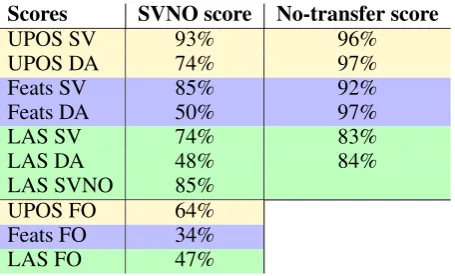
bilingual tagger and parser on this corpus without post-trained embeddings and evaluated it (cf table
3). SVNO : Swedish+Norwegian. DA : Danish. FO : Faroese.
We then used this bilingual model on Faroese Wikipedia sentences to have a treebank, annotat-ing it by usannotat-ing aligned Faroese embeddannotat-ings, and we trained a Faroese model on this treebank with original embeddings, hoping it could fix some in-consistencies coming from the alignment as the final model will use regularizations on original Facebook embeddings. In the end, we have a Faroese tagger and a Faroese parser.
4.2.5 Other languages
The method described in the previous section has been tested on other languages but did not pro-duce results significantly better than the baseline. Not counting Thai, Faroese and Breton, there are 6 low-resource languages:
• For Buryat and Kurmanji we didn’t find a close enough language to do unsupervised embedding alignment as no parallel corpus / Wiktionary were available.
• For Kazakh, we tried to build a Turkish-Russian model, ending with around 50% in UPOS. • For Armenian, we tried a Persian-Greek model
Scores SVNO score No-transfer score
UPOS SV 93% 96%
UPOS DA 74% 97%
Feats SV 85% 92%
Feats DA 50% 97%
LAS SV 74% 83%
LAS DA 48% 84%
LAS SVNO 85%
UPOS FO 64%
Feats FO 34%
[image:8.595.187.415.61.199.2]LAS FO 47%
Table 3: SVNO models results, compared to stf model trained on monolingual gold data.
don’t include character embeddings, you can’t distinguish some proper noun from numbers).
• For Naija, no data
(OPUS/embedding/Wiktionary) was found, so we used English models.
• Finally for Upper Sorbian we had better results with a Polish-Czech model, ending with 75% UPOS and 37% LAS (evaluated on the 23 avail-able sentences as we don’t need training sen-tences), but we lacked of time to upload the model and finalize our contribution to the task. We tried to use embeddings alignment from MUSE on Upper Sorbian, but it didn’t provide results as there wasn’t enough Upper Sorbian embeddings.
5 Training
For the final submission, we trained around 190 models (including bilingual ones) which took 3 days on 3 GPU NVIDIA 1080 Ti. We did this full training 4 times, each time changing a pa-rameter: whether to include language specific de-pendency annotation in the training, case-sensitive parser or to change the tokenization used (refer-ence tokenization or UDPipe tokenization as val-idation set). The submitted result was the best model out of the four runs.
6 Results
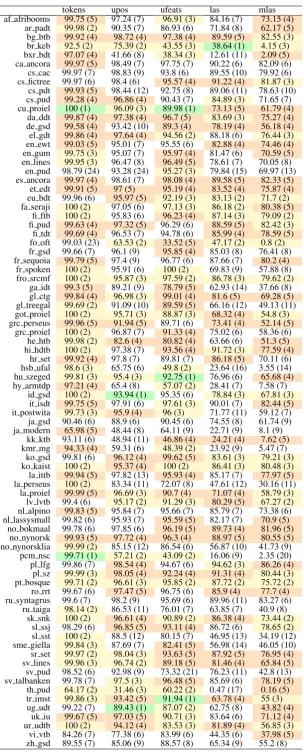
We’ll only detail some results. A summary ta-ble for low-resource languages we worked on has been produced (cf table4).
We got some good ranks on the total average, but these scores were deeply affected by our rank in low-resource languages. For example, getting +64 points in Thai (with just a dictionary approach based on known words) is the same as getting 0.8
points on each other treebanks which is far more harder.
Still, we ranked 2nd in morphological features, showing that the stf architecture was able to han-dle morphological informations.
We ranked 2nd in tokenization (low-resource and global) because of our work on the Thai language (the 5 teams that got more than the baseline in Thai ended up in the top 5 on the global tokenization score). However our score for Thai tokenization (64%) is far more bellow other scores for tokeniz-ing Thai in literature, based on other corpus which weren’t available for this shared task.
We also ranked 3rd in UPOS (low-resource and global). We think that learning morphological fea-tures during the training help a model to get bet-ter results in UPOS as it could use the embed-dings learned with morphological features to pre-dict UPOS tags as well.
For big treebanks, we ranked 5th in UPOS prob-ably because we took the SOTA and improved it. We also stand below TurkuNLP for morphological features on big treebanks (93.68% for 93.82%), they also used the biLSTM architecture but they inferred tags without sub-categories.
Finally we ranked 5thin MLAS which seems to be the more representative score overall as it evalu-ates morphology and dependency as a whole, and it doesn’t give much importance to low-resource languages because a cumulative low score in UPOS and LAS results in a close to 0 MLAS. A summary table can be found at the end of the article.
7 Conclusion
Tokens UPOS LAS
Lang Base Our Best Base Our Best Base Our Best
Thai 8.56 64.17 69.93 5.86 31.46 39.42 0.70 0.47 13.70
Faroese 99.51 99.03 99.51 44.66 63.53 65.54 25.19 47.17 49.43
[image:9.595.107.493.60.126.2]Breton 92.26 92.50 94.49 30.74 75.39 85.01 10.25 38.64 38.64
Table 4: Summary score table for 3 low-resource languages
open the road to an universal parser (as long as we have embeddings and a dictionary for a language) with improved performance over the mixed model provided for the shared task.
However, multiple steps are required in order to achieve a unique model. First, one should merge the tagger and the parser into one unique model, by learning the parser with representation learned by the tagger, and by eventually allowing the tagger to complete POS tags based on dependency learned embeddings.
Our transfer methods should be evaluated more carefully. Because we didn’t have much time, we didn’t find a way to evaluate our embeddings mapper in an other way than through the UPOS and dependency scores of our bilingual models. Multiple strategies are still available from our work: how to select the best languages for transfer? How much languages should be used? How does these parameters change from one low-resource language to another ? etc.
Finally, to build an universal parser, we should distinguish multiple embeddings. The post-trained embeddings should be divided in two categories, the universal post-trained embeddings which changes the pretrained embeddings values based on their position into the embeddings cloud; and the language specific post-trained embed-dings which should be based on the form and the language of the token. Including pretrained character embeddings and post-trained character embeddings could also help for languages with specific characters, for which we could at least map punctuations and numbers characters for tagging.
References
Timothy Dozat, Peng Qi, and Christoper Manning. 2017. Stanford’s graph-based neural dependency parser at the conll 2017 shared task pages 20–30.
Jack Edmonds. 1967. Optimum branching. In
Jour-nal of Research of the natioJour-nal Bureau of Standards B71(4). pages 233–240.
Jason Eisner. 1996. Three new probabilistic
models for dependency parsing: An
explo-ration. In Proceedings of the 16th
Interna-tional Conference on ComputaInterna-tional Linguistics.
http://aclweb.org/anthology/C96-1058.
Jiang Guo, Wanxiang Che, David Yarowsky, Haifeng Wang, and Ting Liu. 2015. Cross-lingual depen-dency parsing based on distributed representations. In Proceedings of the 53rd Annual Meeting of the Association for Computational Linguistics and the 7th International Joint Conference on Natural Lan-guage Processing (Volume 1: Long Papers). Asso-ciation for Computational Linguistics, pages 1234– 1244.https://doi.org/10.3115/v1/P15-1119.
Choochart Haruechaiyasak, Sarawoot Kongyoung, and Matthew Dailey. 2008. A comparative study on thai word segmentation approaches 1:125 – 128.
Guillaume Lample, Alexis Conneau, Ludovic Denoyer, and Marc’Aurelio Ranzato. 2017. Unsupervised machine translation using monolingual corpora only. arXiv preprint arXiv:1711.00043.
Joakim Nivre et al. 2017. Universal Dependencies 2.0. LINDAT/CLARIN digital library at the Insti-tute of Formal and Applied Linguistics, Charles Uni-versity, Prague, http://hdl.handle.net/ 11234/1-1983. http://hdl.handle.net/11234/1-1983.
Robert ¨Ostling and J¨org Tiedemann. 2016. Effi-cient word alignment with Markov Chain Monte Carlo. Prague Bulletin of Mathematical Linguistics 106:125–146. http://ufal.mff.cuni.cz/pbml/106/art-ostling-tiedemann.pdf.
Milan Straka, Jan Hajiˇc, and Jana Strakov´a. 2016. UD-Pipe: trainable pipeline for processing CoNLL-U files performing tokenization, morphological anal-ysis, POS tagging and parsing. In Proceedings of the 10th International Conference on Language Resources and Evaluation (LREC 2016). European Language Resources Association, Portoro, Slovenia.
J¨org Tiedemann and Zeljko Agi´c. 2016. Synthetic tree-banking for cross-lingual dependency parsing. Jour-nal of Artificial Intelligence Research55:209–248.
Guillaume Wisniewski, Nicolas Pcheux, Souhir Gahbiche-braham, Franc¸ois Yvon, and Univer-sit´e Paris Sud. 2014. Cross-lingual part-of-speech tagging through ambiguous learning. InIn Proceed-ings of the 2014 Conference on Empirical Methods in Natural Language Processing. pages 1779–1785.
44
tokens upos ufeats las mlas
af afribooms 99.75 (5) 97.24 (7) 96.91 (3) 84.16 (7) 73.15 (4) ar padt 99.98 (2) 90.35 (7) 86.93 (6) 71.84 (8) 62.17 (5) bg btb 99.92 (4) 98.72 (4) 97.38 (4) 89.59 (5) 82.55 (3) br keb 92.5 (2) 75.39 (2) 43.55 (3) 38.64 (1) 4.15 (3) bxr bdt 97.07 (4) 41.66 (8) 38.34 (3) 12.61 (11) 2.09 (5) ca ancora 99.97 (5) 98.49 (7) 97.75 (7) 90.22 (6) 82.09 (6) cs cac 99.97 (7) 98.83 (9) 93.8 (6) 89.55 (10) 79.92 (6) cs fictree 99.97 (6) 98.4 (6) 95.57 (4) 91.22 (4) 81.87 (3)
cs pdt 99.93 (5) 98.44 (12) 92.75 (8) 89.06 (11) 78.63 (10) cs pud 99.28 (4) 96.86 (4) 90.43 (7) 84.89 (3) 71.65 (7) cu proiel 100 (1) 96.09 (3) 89.98 (1) 73.13 (5) 61.79 (4)
da ddt 99.87 (4) 97.38 (4) 96.7 (5) 83.69 (3) 75.27 (4) de gsd 99.58 (4) 93.42 (10) 89.3 (4) 78.19 (4) 56.18 (4) el gdt 99.86 (4) 97.64 (4) 94.56 (2) 88.18 (6) 76.44 (3) en ewt 99.03 (5) 95.01 (7) 95.55 (6) 82.88 (4) 74.46 (4) en gum 99.75 (3) 95.07 (7) 95.97 (4) 81.47 (6) 70.59 (5) en lines 99.95 (3) 96.47 (8) 96.49 (5) 78.61 (7) 70.05 (8)
en pud 98.79 (24) 93.28 (24) 95.27 (3) 79.84 (15) 69.97 (13) es ancora 99.97 (4) 98.61 (7) 98.08 (4) 89.58 (5) 82.33 (5)
et edt 99.91 (5) 97 (5) 95.19 (4) 83.52 (4) 75.87 (4) eu bdt 99.96 (6) 95.97 (5) 92.19 (3) 83.13 (2) 71.7 (2) fa seraji 100 (2) 97.05 (6) 97.13 (3) 86.18 (2) 80.38 (5)
fi ftb 100 (2) 95.83 (6) 96.23 (4) 87.14 (3) 79.09 (2) fi pud 99.63 (4) 97.32 (5) 96.29 (6) 88.59 (5) 82.42 (3) fi tdt 99.69 (4) 96.53 (7) 94.78 (6) 85.99 (4) 78.59 (5) fo oft 99.03 (23) 63.53 (2) 33.52 (5) 47.17 (2) 0.8 (2) fr gsd 99.66 (7) 96.1 (9) 95.85 (4) 85.03 (8) 76.41 (8) fr sequoia 99.79 (5) 97.4 (9) 96.77 (6) 87.66 (7) 80.2 (4) fr spoken 100 (2) 95.91 (6) 100 (2) 69.83 (9) 57.88 (8) fro srcmf 100 (2) 95.87 (3) 97.59 (2) 86.78 (3) 79.62 (2)
ga idt 99.3 (5) 89.21 (9) 78.79 (5) 62.93 (14) 37.66 (8) gl ctg 99.84 (4) 96.98 (3) 99.01 (4) 81.6 (5) 69.28 (5) gl treegal 99.69 (2) 91.09 (10) 89.59 (5) 66.16 (12) 49.13 (11) got proiel 100 (2) 95.71 (3) 88.87 (3) 68.32 (4) 54.8 (3) grc perseus 99.96 (5) 91.94 (5) 89.71 (6) 73.41 (4) 52.14 (5)
grc proiel 100 (2) 96.87 (7) 91.33 (4) 75.02 (6) 58.36 (6) he htb 99.98 (2) 82.6 (4) 80.82 (4) 63.66 (6) 51.3 (5) hi hdtb 100 (2) 97.38 (7) 93.56 (4) 91.72 (3) 77.59 (4)
hr set 99.92 (4) 97.8 (7) 89.81 (7) 86.18 (5) 70.11 (6) hsb ufal 98.6 (3) 65.75 (6) 49.8 (2) 23.64 (16) 3.55 (14) hu szeged 99.81 (3) 95.4 (3) 92.75 (1) 76.96 (6) 65.68 (4) hy armtdp 97.21 (4) 65.4 (8) 57.07 (2) 28.41 (7) 7.58 (7)
id gsd 100 (2) 93.94 (1) 95.35 (6) 78.84 (3) 67.81 (3) it isdt 99.75 (5) 97.91 (6) 97.61 (3) 90.01 (7) 82.44 (5) it postwita 99.73 (3) 95.9 (4) 96 (3) 71.77 (11) 59.12 (7)
ja gsd 90.46 (6) 88.9 (6) 90.45 (6) 74.55 (8) 61.74 (9) ja modern 65.98 (5) 48.44 (8) 64.11 (9) 22.71 (9) 8.1 (9)
kk ktb 93.11 (6) 48.94 (11) 46.86 (4) 24.21 (4) 7.62 (5) kmr mg 94.33 (4) 59.31 (6) 48.39 (2) 23.92 (9) 5.47 (7)
ko gsd 99.81 (6) 96.12 (4) 99.62 (5) 83.61 (3) 79.21 (3) ko kaist 100 (2) 95.37 (4) 100 (2) 86.41 (3) 80.48 (3) la ittb 99.94 (5) 97.82 (13) 95.93 (4) 85.17 (7) 77.97 (5) la perseus 100 (2) 83.34 (11) 72.07 (8) 47.61 (12) 30.16 (11)
la proiel 99.99 (5) 96.69 (3) 90.7 (4) 71.07 (4) 58.79 (3) lv lvtb 99.4 (6) 95.17 (2) 91.29 (3) 80.29 (5) 67.27 (2) nl alpino 99.83 (5) 95.84 (7) 95.66 (7) 85.79 (7) 73.38 (6) nl lassysmall 99.82 (6) 95.93 (7) 95.59 (5) 82.17 (7) 70.9 (5) no bokmaal 99.78 (6) 97.85 (6) 96.19 (5) 89.73 (4) 81.96 (5)
no nynorsk 99.93 (5) 97.72 (4) 96.3 (4) 88.97 (5) 80.55 (5) no nynorsklia 99.99 (2) 85.15 (12) 86.54 (6) 56.87 (10) 41.73 (9)
pcm nsc 99.71 (1) 57.21 (2) 43.09 (2) 16.06 (9) 2.35 (20) pl lfg 99.86 (7) 98.54 (4) 94.67 (6) 94.62 (3) 86.26 (4)
pl sz 99.99 (3) 98.05 (4) 92.24 (4) 91.31 (4) 80.44 (3) pt bosque 99.71 (2) 96.61 (3) 95.85 (2) 87.72 (2) 75.72 (2) ro rrt 99.67 (6) 97.47 (5) 96.75 (6) 85.9 (4) 77.7 (4) ru syntagrus 99.6 (7) 98.2 (9) 95.69 (6) 89.96 (11) 83.27 (6) ru taiga 98.14 (2) 86.53 (11) 76.01 (7) 63.85 (7) 40.9 (8)
sk snk 100 (2) 96.61 (4) 90.89 (2) 86.38 (4) 73.44 (2) sl ssj 98.29 (6) 96.85 (5) 93.11 (4) 86.72 (6) 78.65 (2) sl sst 100 (2) 88.5 (12) 80.15 (7) 46.95 (13) 34.19 (12) sme giella 99.84 (3) 87.69 (7) 82.41 (5) 56.98 (14) 46.05 (10) sr set 99.97 (2) 98.04 (3) 93.63 (5) 87.92 (5) 76.95 (4) sv lines 99.96 (3) 96.74 (2) 89.18 (5) 81.46 (4) 65.84 (5) sv pud 98.52 (6) 92.98 (9) 73.32 (21) 76.23 (11) 42.8 (13) sv talbanken 99.78 (7) 97.5 (3) 96.48 (5) 85.69 (6) 78.19 (5)
th pud 64.17 (2) 31.46 (3) 60.22 (2) 0.47 (17) 0.16 (5) tr imst 99.86 (3) 93.42 (5) 91.94 (1) 63.78 (4) 55 (3) ug udt 99.22 (7) 89.43 (1) 87.07 (2) 62.75 (8) 43.82 (4)
[image:11.595.150.455.57.814.2]