Abstract:— The interdisciplinary applications of various engineering materials in the contemporary world engender a sustainable advancement on infrastructural systems. Indeed, the economic framework of both the developed and developing countries rests on the basic infrastructural network to include roads, railways and airports amongst other systems. Infrastructural arrangement fosters economic simulation and sustainable development by providing services (inputs) to other productive processes and (outputs) to consumption. These fundamental indices have long been recognized as a key element that provides the enabling environment for economic expansion. Industrialization and urban sprawls within the built environment have greater impacts on the social, economic, and environmental resources. Accordingly, these developments have negatively promoted the resources reduction crisis. This paper presents the appraisal of an engineering material used in roads and airfields construction towards sustainable infrastructural growth. In this study, a thorough research was conducted using a polymer modified bituminous (PMB) superflex material under a three point
bending analysis. Findingsrevealed that fatigue cracking
developedin roads and airfields flexible pavement is due
to poor materials mix, rain water penetration and repeated traffic loading. However, the research has established 91% correlation of the materials behaviour as explained by the variations in the applied loads and the number of cycles to produce a failure.
Index terms— Development, engineering materials, infrastructural systems, sustainability
I. INTRODUCTION
Engineering materials are predominantly applicable in the construction of basic infrastructural systems and subsystems within the globe. The increasingly use of these materials varies with their purposes and requirements for the intended (roads and airfields) pavement construction. Transport infrastructure facilitates the efficiency of markets by reducing transaction costs and extending the area across which goods, people, ideas and other services can be exchanged [1]. Therefore, the ultimate goal of predicting a suitable engineering material in this perspective will deliver the issue
Bassey Okon, Formerly an M.Sc Engineering Student with the Mechanical and Aerospace Engineering Department, University of Liverpool, UK. email:
of sustainable development and infrastructural expansion. However, [2] noted that sustainable development, especially ever since the 1992 United Nations Conference on Environment and Development at Rio de Janeiro, has become an important theme. The impact of this summit has gathered momentum in the local, national, world politics and turn into a central matter for the engineering professions around the world.Furthermore, the sustainable development concept requires a more holistic consideration widely than before on lives and of the infrastructural network. With infrastructure and engineering products and processes becoming increasingly complex, engineers need to integrate consideration of whole-life economic, environmental and social impacts. Additionally, the World Commission on Environment and Development (WCED)’s report titled “Our Common Future” focused on enhancing quality of life therefore, allowing people to live in a healthy environment and improve social, economic and environmental conditions for the present and future generations [3].
Nonetheless, further indication is that sustainable development at all times should be viewed with the five guiding equity central principles. These are; physical, social, political, economical and environmental values for the present and the future generations [4]. Although, [2] argued that sustainable development generally is the process of moving human activities to a pattern that can be sustained in perpetuity. It is an approach to environmental and development issues that seek to reconcile human needs with the capacity of the planet to cope with the consequences of human activities. In this case, the three dimensions of sustainable development focus on the economic, social and environmental values. As a result, a Venn diagram relationship among these three dimensions of sustainability elements will promote suitable infrastructure and engineering development.
Contextually, an engineering material (polymer modified bituminous superflex) used for pavement construction was selected for a three-point bending fatigue investigation. Fatigue is commonly described as the process which causes premature failure or internal physical damage of a material subjected to repetitive cyclic loading. The process is quite complicated in nature and difficult to accurately describe in some materials which makes it challenging especially in engineering materials situation [5, 6]. Material fatigue leading to cracking is due to repeated traffic loading in asphalt pavement. In fact, these cracks may start as micro-cracks that later combine to form macro-cracks that propagates due to tensile, shear stress or combination of both on the pavement [7]. As a result, the pavement serviceability is reduced as these cracks propagate. The application of traffic load to the pavement surface generates tensile stresses
Mechanical Prediction of Materials Behaviour:
Towards a Sustainable Infrastructural Growth
at the bottom of the asphalt layer. On this premise, since the tensile strength of the asphalt is typically larger than the stress caused by the traffic loading, the material will remain without cracks for a number of loads applications. The condition will remain for sometime without failure but eventually collapse will occur.
However, with the continuous repetition of load applications, fatigue cracking initiating at weak spots at the bottom of the asphalt layer encourages this phenomenon [8]. These cracks will then propagate through the asphalt (pavement) until they reach the surface. Therefore, the intensity of cracking reaching a certain unacceptable level, rehabilitation becomes necessary. Basically, [9] indicates that failure criteria based on fracture mechanics have been developed and ideally the pavement surface layer can be designed to provide sufficient cracking résistance. This development is to address the fatigue phenomena throughout the design lifecycle of the pavement for sustainability. [10] Observed that, once cracking has spread from the bottom of the pavement to the surface, rainwater can penetrate the crack and infiltrate the asphalt and underlying unbound layers. Therefore, the interaction of the water with heavy traffic loading is typically responsible for the rapid increase in damage and the cost of structural capacity restoration. Nevertheless, a major distress in this case needs to be examined for sustainable infrastructural growth.
Sustainability awareness and its application has been a major focus within the contemporary construction industry and infrastructural expansion. Then, numerous research efforts in contemporary society have been inclined towards the exploration of this notion based on the rate of consumption of available resources in the environment. Consequently, development efforts which seek to address social needs while minimizing potentially negative environmental impact make up the sustainable development; given the fact that the concept of sustainable infrastructure development has been open to a wider range of interpretations globally. Within the built structures (road) is also part of the living environment which affects our living conditions and social well-being generally. As a consequence, it is important to explore the environmental, economical and sound design improvement techniques to ensure that roads infrastructure are sustainable and safe for operation [11].
In this case, a typical model of how sustainable infrastructure services contribute to the economic development is shown in Fig. 1. The causality between infrastructure services, growth and social products like the millennium development goals (MDG) operate through multiple channels as illustrated in Fig. 1. The deliveries of services like enlarge markets benefiting enterprises thereby improving welfare of citizenry. Also, the road infrastructural services will promote growth, low cost and benefits household at large. [12]. In addition, through sustainable management of the associated resources, quality services (welfare) can be improved and expanded for socio-economic transformation. Accordingly, [12] observed that sustainable infrastructural expansion fosters the resulting gains and competitiveness in production perception, thereby, driving the economic growth and ultimate welfare. Infrastructural development commonly have very significant impact on sustainability, then promoting environmentally sustainable
and eco-efficient infrastructure is an important objective for the economic expansion of any nation.
[image:2.595.319.546.200.441.2]A sustainable infrastructure then can be described as “infrastructure in harmony with the continuation of social, economic and environmental sustainability”. In view of the trio sustainability stand point, a more pragmatic effort is desired in the road construction industry and other corporate organizations. Interestingly, a holistic approach is to establish the necessity in infrastructural development and management of any system towards sound principles and decision making.
Fig. 1 The contribution of sustainable infrastructure to economic growth [12].
Therefore, this will encourage improved performances by focusing on the utility management systems, such as environmental management systems (EMS) and asset management (AM). Indeed these ultimately will stimulate capacity development, selection of innovative and cost-effective technologies in managing the infrastructural systems. [13, 14].
II. METHODOLOGYOFSTUDY
digital camera linked to the measuring system was used to take photographs of the specimen at different stages during the test. The photographs were further analyzed to determine crack growth lengths.
Furthermore, the crack growth appraisal from fracture mechanics approach was to identify the crack driving force. As a result, suitable correlation of the average crack growth rate can be achieved in Eqn. (1). Fig. 2 depicts a mode I tensile loading method applied in this study.
dY/dX = AKn (1) Where;
K= stress intensity factor,
[image:3.595.85.275.278.365.2]Parameters (A & n) denote the empirical material constants, and (Y&X) representing the crack depth and load cycle, respectively.
Fig. 2 Mode I, tensile load method [15]. In addition, during the investigation the linear elastic fracture mechanics concept and the stress intensity factor were employed to determine the crack growth rate by means of the popular Paris Law principle which is given by the following expressions:
da/dN = A(ΔK1)n (2) Hence;
da/dN = crack growth rate
ΔK1 = mode I stress intensity factor range (Kmax-Kmin) A,n = constants depending on the material and on the test conditions, therefore;
a = crack length
N = number of cycles
Basically, the research specimens were in a semi-circular pattern, thus, Eqn. (3) was applied for the research evaluation. Then for the SCB specimen, the mode I stress intensity factor range, ΔK1, is given as:
Y
a
rt
P
K
1 12
(3)Where:
ΔP = applied load range (Pmax –Pmin) r = specimen radius
t = specimen thickness
a = crack length
Y1 = normalized mode I stress intensity factor
Nevertheless, for the evaluation of stress intensity factor, K, the methodology used was according to [15] in this report.
1
Y
a
K
o
(4)Where,
a = notch (crack length) also,
rt
P
o2
(5)The following expressions are applied for Eqns. (4) and (5). Thus,
K = mode I stress intensity factor, P = applied load
t = specimen thickness of the samples Y1 = normalized stress intensity factor r = specimen radius
Outcomes of the study from the adopted approach are as presented in the results and discussion section.
III. SUSTAINABILITYINDEX
In this investigation, a sustainability index as a function of system variables probabilities was developed for assessing the material practicability. Accordingly, the index summaries the social economic and environmental values (as sets of system goals) for the sustainability values (Suv) success. Moreover, it normalizes sustainability to be within ranges of 0 ≤ Suv ≤ 1 by applying the probability (P) and set theory model into sustainability. Consequently, accurate and reliable indices of sustainability can be qualified and quantified. For an ideal situation, the Suv is 1. Although, this is not viable in the real engineering projects condition [16].
The study however applied Eqn. (6) to express the existing relationship regarding the sustainability concept within any healthy infrastructural network. The integration of probability Eqn. (7) and sustainability in this case will yield a mathematical model for a sustainable development. Hence; n(Ecv ∩Env ∩Sov) = n(Suv) (6)
Also,
P(E) = P(Ecv ∩ Env ∩ Sov)
P(Suv) (7) The following defines Eqn. (6) and (7) respectively; Sov – Social values,Env – Environmental values, Ecv – Economic values, Suv – Sustainability values, P – Probability,
E – Elements of sustainability.
However, the developed probability models will give a realistic sustainability value (Suv) factor within the ranges of 0 ≤ Suv ≤ 1 in viable road construction projects [16].
IV.RESULTSANDDISCUSSION
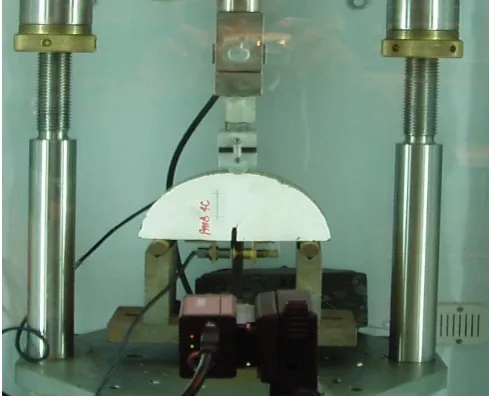
(PMB) superflex specimens. From Fig.3, fatigue analyses were conducted with four specimens. The testing equipment apparatus for the dynamic SCB specimen under a three point bending is indicated in Fig. 4. The equipment (NU-14) machine is programmed with a defined software package and cyclic frequencies monitor. During the investigation, the specimens were mounted on the universal servo-pneumatic testing machine a with camera linked mechanism connected to a computer interface. This camera records sequence photographs of the material (asphalt) specimens as the crack growth propagates.
[image:4.595.46.293.198.390.2]Fig. 3 Semi-circular PMB specimens
[image:4.595.308.549.272.444.2]Fig. 4 The dynamic SCB test set-up with camera linked Consequently, the SCB test in Fig. 5 depicts a typical specimen during the study under photograph record. In this experiment, the crack length (a) was determined through a linear measurement from the tip of the specimen notch to the cracking end before failure occurred. Nonetheless, these results vary in each case with different specimens and also due to the various loads application of (2.5, 3.5 and 4.5) kN respectively. However, this correlation of finding is portrayed in Fig. 7.
Fig. 5 Typical photograph taken during SCB test
0 10 20 30 40 50 60 70 80
0 5000 10000 15000 20000
Number of Cycles (N)
M
ea
su
red
c
rack
len
gt
h,
a (
mm)
PMB_1a_2.5kN
Fig. 6 Measured crack length with number of cycles
In Fig. 6, a typical PMB specimen is displayed during the study. Further indication is that the measured crack lengths (a) mm with the number of cycles (N) were conducted in this manner for other three specimens. These results yielded graphical plots for the materials examination.
Fig.7 Applied loads versus number of cycles
[image:4.595.46.292.427.625.2] [image:4.595.307.552.554.743.2]From Fig. 7, about 91% of the materials behaviour and the number of cycles to failure can be explained by the variations in the applied loads. As a result, the number of cycles to create failure (N) decreases with increase in applied load (kN). Also, the outcome explained in practical terms how this engineering material (asphalt) behaves within this context. Observably, smaller cars or aircrafts impact less on the pavement. Similarly, trucks and cargo aircrafts impact much more on the pavement. Therefore, the finding has established a strong degree of correlation among the examined (specimens) materials in this perspective.
The investigation noted that infrastructural systems (roads and airfields) without sustainability accomplishment can have more negative consequences on the service delivery. In this case, a more holistic effort towards sustainability awareness is desired. This is with a view to addressing successful growth builds on the trio (economic, social and environmental) pillars of sustainability for sustainable development.
IV. CONCLUSION
The research re-examines (polymer modified bituminous superflex) asphalt under cyclic loading in roads and airfields construction within the United Kingdom. In this study, the results of findings disclose differences in each case with the investigated specimens. The research has presented and examined the aim of investigation, background literature, methodology and results on the engineering materials used for roads and airfields pavement construction. Accordingly, from a careful literature exploration which provided an in-depth analysis regarding the prediction of engineering materials behaviour within this background, the results were obtained. Therefore, a sustainability index as a function of system variables probabilities was developed for assessing this material practicability.
A dynamic SCB assessment was conducted with specimens under the three points bending for fatigue test. This was performed mechanically through the application of the universal servo-pneumatic testing machine with a camera linked mechanism to record photographs of crack growth propagation. The experiment was repeated with four different specimens and the results acquired for the three load applications.
Quintessentially, three different loads amplitudes of (2.5, 3.5 and 4.5) kN were evaluated. Accordingly, about 91% of the materials behaviour and the number of cycles to produce a failure can be explained by the variations in the applied loads. In this perspective, the number of cycles to produce a failure (kN) decreases with increase in applied loads (kN). On the whole, a good degree of correlation of the PMB specimens was found during the study. However, the analysis of this work will form a suitable ground to develop a proper prediction on the material behaviour towards a sustainable infrastructural development.
ACKNOWLEDGMENT
The author hereby acknowledges the support of the Akwa Ibom State University of Technology (AKUTECH), Nigeria for their continued sponsorship.
REFERENCES
[1] Clough, P., Duncan, I., Steel, D., Smith and Yeabsley, J. (2004), Sustainable infrastructure: A policy framework. NZIER Authoritative Analysis, Ministry of Economic Development Report.
[2] Borers, L. (2005),Engineering for Sustainable Development: Guiding Principles, The Royal Academy Engineering, London, UK.
[3] WCED (1987), World Commission on Environment and Development –“Our Common Future”, 42 Session A (42) 427, World Commission on Environment and Development, United Nations W.-Chen Linear Network and Systems (Book style) Belmont, C. A: Wadsworth, pp. 123-135.
[4] Sattertherwaite, D. (2001). “In The Earthscan Reader in sustainable Cities”.
[5] Matthew, C.(2006), Engineers’ Data Book, third edition, The Cromwell Press,Trowbridge, Wilts, UK.
[6] Broek, D.(1997), The Practical use of fracture mechanics, Kluwer Academy Publisher, Netherlands.
[7] Molenarr, J.M.M and Molenaar, A.A.A. (2000), Fracture toughness of asphalts in the semi-circular bending. 2nd Europhalt &Eurobitume Congress, Barcelona, pp.505-517.
[8] Hunter, N.R. (1994), Bituminous Mixtures in Road Construction. Thomas Telford Services Ltd., Heron Quay, London.
[9] Illston, J.M. (1994), Construction Materials Their nature and behaviour. E & FN SPON 2-6 Boundary Row, London.
[10] Read, J. and Whiteoak, D. (2003), The Shell Bitumen Handbook, Fifth Edition, Thomas Telford Services Ltd, London.
[11] Hill, R. C. and Bowen, P. A. (1997), “Sustainable Construction: Principles and Framework for Attainment.” Journal of Construction management and Economics, 15 pp. 223-239.
[12] Prudhomme, R. (2004), Infrastructure and Development Washington DC, Paper prepared for the ABCDE (Annual Bank Conference on Development Economics), May 3-5.
[13] Grigg, N. S. (1988). “Infrastructure Engineering and Management.” John Wiley & Sons Incorporated, Canada.
[14] Steffen, W. and Tyson, P. (2001), Global Change and The Earth System: A planet under pressure. The Global Environmental programmes International Geosphere Biosphere Programmes, Stockholm.
[15] Lim, I.L., Johnson , I.W. and Choi, S.K. (1993), Stress intensity factors for semi-circular Specimens under three-point bending Engineering fracture mechanics, 44 (3) pp.363-382.
[16] Okon, B., Ekpo, S. and Elhag, T. (2010), A Sustainable Engineering Infrastructure Model for the 21st Century. Proceedings of the ICME, 298, World Congress on Engineering (WCE), London, United Kingdom.
![Fig. 1 The contribution of sustainable infrastructure to economic growth [12].](https://thumb-us.123doks.com/thumbv2/123dok_us/1292133.658382/2.595.319.546.200.441/fig-contribution-sustainable-infrastructure-economic-growth.webp)
![Fig. 2 Mode I, tensile load method [15].](https://thumb-us.123doks.com/thumbv2/123dok_us/1292133.658382/3.595.85.275.278.365/fig-mode-tensile-load-method.webp)