
539
©IJRASET: All Rights are Reserved
Hyperloop: Advance Mode of Transportation
System and Optimize Solution on Traffic
Congestion
Sanket R. Kale1, Yogesh N. Laghane2, Akash K. Kharade3, Supriya B. Kadus4 1
Tata Technologies Limited, Pune, India 2
Surya Spring Pvt. Ltd. Aurangabad, India 3
FEB Tech Industries, Aurangabad, India 4
Special Tools Pvt. Ltd. Pune, India
Abstract: Globalization is a main factor behind increasing use of transportation. Every country is facing problem of transportation. Tom-Tom is leading Dutch company, manufacturer of traffic and mapping products. After surveyed as many 390 cities, in 48 countries and six continents the results were found that some countries like Mexico, Thailand, Indonesia, China and Romania facing a huge transportation problem. Some cities of India like Mumbai, Pune, Kolkata, Bangalore and Delhi dealing with the same. Cities are spine of the economy. The conventional unique modes of transportation are road, rail, water and air used by people. These modes of transport has very common sets of problem i.e. safety, security of structure, space, time required for travelling, money, environmental crisis etc. This Existing modes of transportation technology are either relatively slow, expensive or a combination of the both. Hyperloop is a future new mode of transportation that travels quickly, safely, on-demand and direct from passenger origin to destination. An innovation such as Hyperloop is a new future mode of transportation which will change this pattern by being both fast and less expensive for people and goods. Hyperloop is a faster alternative to existing transportation road, rail and air travel mode, will help to connect major cities to integrate labour and commercial market places. Hyperloop consist of low-energy potential which will not only help to alleviate existing and growing travel demand but also reduce congestion and carbon emission of existing transportation modes. The Hyperloop is a proposed mode of passenger and freight transport that would propel a pods or capsule-like vehicle through a near-vacuum tube which will be more than airline speed. The pods or capsule levitate with the help of air bearing, same as how pucks travel across an air hockey table. A liner electric motor accelerates the pods at massive speeds projected up to 1200 km/hr, with so little friction in the tunnel. Tunnels/ tubes used in Hyperloop would be constructed either below or above the ground level, which will help to occupy the less area than traditional road and rail. Throughout the length of the low pressure tube capsules would transport at both high and low speeds. Cushion of air would support the Capsule, featuring pressurized air and aerodynamic lift. Passengers may enter and exit Hyperloop stations, which are located either at the ends of the tube, or branches along the tube length. Hyperloop system has an extremely fast, inexpensive, eco-friendly design, which would powering the pressure pumps with clean convention energy source such as solar and the future face of transportation. It has some potential issues like economics, safety and passenger comfort of Hyperloop which need to overcome. We have focus in this paper on travel time, capacity, land implications, energy demand, cost, safety, passenger comfort, design, ergonomics and some key gaps in knowledge which require further research. The purpose of this paper is not only review k verify the principles on which the proposed Hyperloop plans to operate but also presents a prototype with additional modifications and contributions. Hyperloop is a concept which believed to be originated from 20th century’s sci-fi, which shifts paradigm of transport.
Keywords: Hyperloop, Transportation, Capsules, Pods, Propels, Vacuum tube, Air Bearing, Magnetic Levitation, Compressor Fan, Kantrowitz, Fluid Mechanics, Thermodynamics, Electromagnetism, Suspensions, Safety.
I. PROBLEMDESCRIPTION
540
©IJRASET: All Rights are Reserved
like road and rail. Compare to road and rail the chances of accidents are less in water mode. Air mode is also less expensive & safer mode but the travelling cost is still high compare to other modes. To cover a distance less than 900 miles/hr, by supersonic travel is unfeasible. Hyperloop aims to make high speed transportation system by considering travel cost for use moderate distance. Solar Panels are installed on the roof of Hyperloop tubes, allowing for a clean and self powering system. Many countries facing a problem of transportation and traffic congestion are USA, France, India, Saudi Arabia, Russia, Sweden, China and the UK which are trying to develop and implement Hyperloop system Feasibility of research and development are going on in these countries to overcome above problems.
II. HISTORYANDBACKGROUND
A. In 1799, inventor George Medhurst proposed an idea to move goods by using air pressure through cast-iron pipes. In 1844, he
constructed a railway station (for passenger carriages) in London that relied on pneumatics until 1847.
B. In the mid-1860s, South London constructed the Crystal Palace atmospheric railway, which ran through a park. A 22 feet diameter fan propelled the train. At the time of return journey, the fan's blades reversed, sucking the carriage backwards. Throughout the mid-1850s, several more railways were built in Dublin, London, and Paris which was working on pneumatic. The London Pneumatic Dispatch system was meant to transport parcels, but it was large enough to carry people, too. To mark its opening, the Duke of Buckingham traveled through it in 1865.
C. The Beach Pneumatic Transit, which operated in Manhattan from 1870 to 1873, was New York City's earliest subway predecessor. Alfred Ely Beach designed a one-car shuttle had one stop that used compressed air to move riders.
D. In 1910, American rocket pioneer Robert Goddard designed a train that would go from Boston to New York in just 12 minutes.
Though it was never built, it would've floated on magnets inside a vacuum-sealed tunnel. Most major cities used pneumatic tube systems to transport mail and other messages by the end of the 19th century. Some are still exist today in banks, hospitals, and factories.
E. Throughout the 20th century, scientists and science fiction writers imagined transit systems that would work like a Hyperloop. Sci-Fi author Robert Heinlein wrote about the "vacutubes" in the 1956 story "Double Star."
F. Researchers at MIT designed a vacuum-tube train system for a 45-minute trip from New York City to Boston in the early 1990s. Like Elon Musk's plan, the developed design called for a magnetic track.
G. In the early 2000s, transportation startup ET3 designed a pneumatic-and-maglev train. The design features car-sized pods that would travel in elevated tubes.
H. Three years later, Elon Musk published his proposal for the Hyperloop in a 57-page white paper. According to his design, sealed pods containing 28 people each would whisk through tubes. As recently tweeted by Elon, A trip from NYC to DC would take 29 minutes. Hyperloop Transportation Technologies had started creating Musk's concept a 5-mile test track for a Hyperloop system in Quay Valley, California. The construction already began in 2016, and the company is targeting for the train to reach at speed of 760 mph.
I. In 2013, Elon Musk, the famed entrepreneur and CEO of Tesla and Space X, came up with an idea for a
vacuum-and-maglev-powered super-fast train that would travel through a tube. It would be called the Hyperloop. In a research paper, he outlined its potential and challenged other tech companies to develop it for commercialization. Two startups, Shervin Pishevar's Hyperloop One and Dirk Ahlborn's Hyperloop Transportation Technologies, are perhaps the closest to making the Hyperloop a reality. (Musk hinted in July that he is working on his own system and tweeted that he "received verbal government approval" to build stops in Washington, DC and New York City.)[2] But Musk is not the first person who suggested air pressure-driven transportation. The concept behind the Hyperloop System originated in the late 17th century with the invention of the world's first artificial vacuum, which would led to designs for "underground rapid transit systems"
J. A group of Chinese scientists want to construct a pneumatic train underwater. Researchers from the Chinese Academy of Sciences proposed a concept of submarine rail project which would run at a theoretical speed of 1,240 mph, which would much faster than Musk's Hyperloop concept in 2017.
K. In July 2017, a startup called Hyperloop One successfully tested a full-scale system on its Develop test track in Nevada. Using maglevs, the vehicle reached a top speed of 70 mph. The company hopes to reach 250 mph.
541
©IJRASET: All Rights are Reserved
III. INTRODUCTION
Wheel is great and most important initial invention invented by human. As we have progressed in science & technology and entered is modern era of 21st century, we have gained transportation means like motorcycle, car, trucks, ships, airplanes etc.
Today’s type of transportations includes:
A. Roadways (Cheap, Time Consuming, Not so eco-friendly)
B. Railways (not cheap, time consuming, relatively much more eco-friendly than others)
C. Airways (not Cheap, time saving, not eco-friendly)
Alternative transportation mode consists of comfortable with passenger, cheap as road ways, time saving as air ways, eco-friendly and more secure, so which would overcome negative aspects of present transportation condition.
The Hyperloop is a new concept & alternative mode for high speed transportation, consisting of capsules traveling at high speeds in a tube with near vacuum pressure. The concept was firstly proposed by Elon Musk and a team of engineer from Tesla Motors and the Space Exploration Technologies Corporation in a white paper published by SpaceX in August 2013 [2] as an alternative to the high-speed rail system, currently being developed between Los Angeles and San Francisco an alternative to the proposed California High Speed Rail development. Robert Goddard’s Vactrain has drawn a heavily design, sealed tubes or pipes through which a pod or capsules would travel free without air resistance or friction carrying people or objects at very high speed, i.e. less than sound speed with being very efficient. The main aim of Hyperloop is travelling a people & carrying good from one place to another place in capsule which would propels at a very high speed.
Traditional modes like Road, Rail or Airplane are not only too slow but also uneconomical; this problem is overcome by Hyperloop. The Hyperloop would fulfils this growing need and provide solution for an alternative transportation mode for distance. Hyperloop is an alternative for high-speed trains like bullet or maglev trains and powered by renewable source of energy solar. It is nothing but magnetically levitated train which carries pods or capsules runs inside a long low pressure tube or pipe that would transport pods at both low and high speed. It is driven by axial compressor and linear induction motor. Each pod or capsule carrying capacity is 28 passengers. For propulsion along the length of the tube magnetic accelerators are provided for propelling the pods in forward direction. Like a puck gliding over an air hockey table, the pods move safely at high speed in tube house at low pressure environment with the help of cushion of air. The tube would suffer from pressure buildup in front of the pod. To overcome this problem, tube will require a system which will avoid and minimize air pressure building up in this way. Elon Musk design recommends that, if an air compressor assembled on the front of the pod that would easily move an air from the front to the tail, keeping it aloft and prevent from pressure building up because of air displacement. Traveling time of one way trip in Hyperloop is projected up to 35 minutes (for extinguish, traveling the same distance by car takes roughly more than six hours, rail takes more than two hours and airplane will take near about one hour). Stations in Hyperloop are located at the ends of the tube or branches along the length of the tube, so passengers may enter and exit.
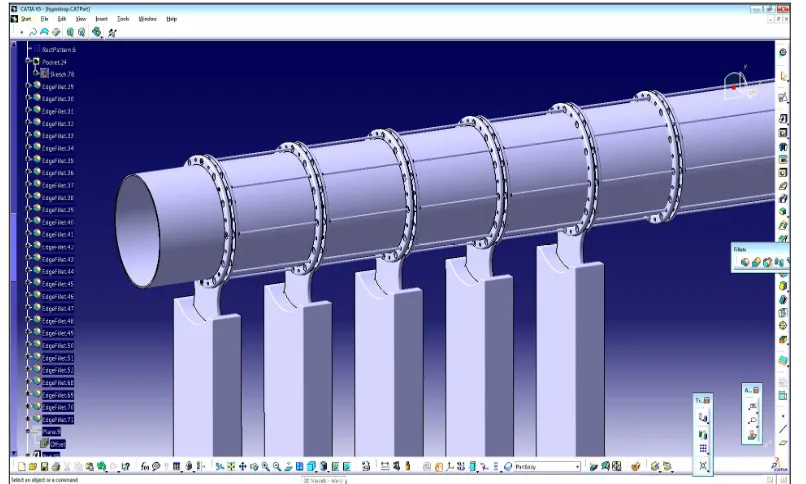
Fig. 1 Hyperloop capsule and tube mounted on pillars
542
©IJRASET: All Rights are Reserved
Nevada desert in US. Even Virgin Hyperloop One's are planning to begin testing of full-sized Hyperloop systems by 2021. Elon Musk's Boring Company and Hyperloop Transportation Technologies are two other companies carrying out a feasibility study to start Hyperloop systems [2]. Experts say Hyperloop may be a commercial reality by 2030 and it may cost about $121 million for a mile. The Hyperloop movement is gaining momentum, attracting a large number of start-ups dedicating themselves towards making it a success. Richard Bransons’ Virgin Group is planning to construct a Hyperloop Transportation System between Mumbai & Pune [12].
A number of companies across the world such as Virgin Hyperloop One and Hyperloop Transport Technologies are targeting to commercialize it by 2021. Rob Lloyd, CEO of Virgin Hyperloop One, stated “we will move people and goods at very high speeds, with very little energy, no noise pollution and a very small footprint, all of which gives us something that is ultimately faster, safer, cheaper and greener than other current transportation alternatives. It is thought that Hyperloop could disrupt the transportation market in much the same way as Uber did for taxis. The value proposition of Hyperloop is to provide high speed terrestrial-based travel for small ticket prices and low energy that can rival trans-national flights and rail. But is Hyperloop a revolutionary development in mass transit, or just another beneficiary of the Elon Musk effect?
IV. LITERATURESURVEY
Elon Musk, (July 2012) pitched an idea for a fifth mode of transport which would operate on combined principles of a Concorde, an air hockey table and a rail gun. He took patent under this concept the name – Hyperloop, in which he published an open sourced white paper. In his words, Hyperloop incorporates reduced-pressure tubes in which pressurized capsules ride on air bearings, accelerated by linear induction motors [2].
N. Kayela, (2014) investigated that the Hyperloop is a fifth mode of transportation except cars, trains, airplanes and boats. He discussed about the railway tracks and stations for the Hyperloop. Also, discussed about the two version of capsule in Hyperloop system is passenger only version and another is passenger plus vehicle version [3].
Jeffrey C. Chin, Justin S. Gray, Scott M. Jones, Jeffrey J. Berton, in their paper, conferred about the Open-Source Conceptual Sizing Models for the travelling capsules of the Hyperloop. A thorough analysis two major aspects led them to a conclusion. Firstly, a direct relation between the tube cross sectional area and the pod travel speed was found, the tube size to be to be approximately twice the diameter of the original specification and calculation for the pod to reach the desired speed or value. Secondly in addition to this, the steady-state tube temperature is independent of the heat generated by the pod compression system and is dominated by ambient thermal interactions [4].
Mark Sakowski (2016) demonstrated that not only evaluation of the current maglev but also evacuated tube technology and concluded that Hyperloop is feasible if properly designed. In terms of energy usage it has the potential to be much more efficient of pods traversing down the tube. It has the potential to be much more efficient in terms of energy usage of pods traversing down the tube [5].
Mohammed Imran (2016) focused his study element on the Hyperloop technology (the passenger transport system). He discussed about the two version of Hyperloop in that first is only passenger version and second is passenger plus vehicle version of Hyperloop System [6].
Ahmed Hodaib, Samar F. Abdel Fattah (May 2016), for propulsion of the Hyperloop capsule, linear induction motor would use which can be used for speeding, boosting and braking of the capsule or pod. The study demonstrated that the linear induction motor runs on 3-phase power same as synchronous motor can run and support very high speed. Although rotary induction motors are more energy efficient, there are end effects that reduce the motor's thrust force, thus proving that linear induction motors are much more suitable for the required force output. Further research was also made about the study and manufacturing of the induction motor with reference to the Hyperloop [7].
V. BASICPRINCIPLE
543
©IJRASET: All Rights are Reserved
An air bearing works on same basic principle of air hockey table, as we know wheels would not function well at required high speeds (1200km/hr). The capsule works on battery power and would be propelled by an external linear electric motor which plays vital role in propulsion of capsule, which produce motion in straight line than rotational motion. Liner induction motor propels the pod to near sonic velocity, which is comparatively slower than the sound speed however still fast enough for movement of capsule and having capacity to re-boost about every 120kms. Hyperloop propulsion system proves that, the required cost is equal to or as little as 1 percent of the tube length i.e. less costly. Construction of Hyperloop tubes on pillars above the ground having advantages like saving money, provision of protection from earthquakes, snowfall and rainfall, assembled with solar panels placed on the top. The energy obtained from these solar panels more than satisfy the operational need of the Hyperloop. Stored energy in battery packs would be used for operation during cloudy, rainy condition and during night time.
VI. CONSTRUCTION
Hyperloop is basically a train, which runs inside tube with low air pressure. While designing and developing the Hyperloop system having too many questions, how this theoretical research will come into the practical. There were some initial problems while illustrating, where Kantrowitz limit [1], such as friction and power source which were answered very smartly by mechanism and components of Hyperloop. The practically implemented prototype of Hyperloop consists of the following fundamental parts which answer the questions:
A. Tube
[image:5.612.106.509.470.712.2]The first major part of Hyperloop system is Tube made up of mild steel. System consist of two tubes welded side by side, both opposite to each other and unidirectional as well acting such as highway. According to theoretical research vacuum inside tubes is able to remove a resistance offered by air in the direction of train travel, however practically it is not possible for long travel or distance. Thus, capsule consists of very low pressure air, offers very negligible resistance. (Fig.3) This could be possible by installing compressor or vacuum/pressure pumps at regular intervals throughout the length of the tubes. When capsule is travelling the air in front of it get compressed and increased pressure would offer to Kontrowitz limit, which help to stop the train. When capsules are in ideal condition, the energy used for propulsion can be regenerate. Evacuated tubes increase Hyperloop 50 times more efficiency per kWh than electric cars or trains. Solar panels are installed over the top roof of the Hyperloop capsules that will provide power to the system. Energy generated by the solar system is much more than consumption of Hyperloop propulsion system and evacuating pumps. The tubes are laid freeways for easy and efficient transportation of capsules from origin to destination of passengers. The capsule carries goods and passengers in tubes. The tube construction cost 1/10th cost of High Speed Rail Track or 1/4th the cost of a freeway.
544
©IJRASET: All Rights are Reserved
B. Capsule
Normal railway’s have bogeys which also called as wagons or coaches. The capsule or pod is the main component of Hyperloop system, responsible for transportation of passengers and goods within the evacuated tubes at very high speed. It consist of Capsules which are divided into two types,
1. Hyperloop passenger capsule 2. Hyperloop passenger with capsule
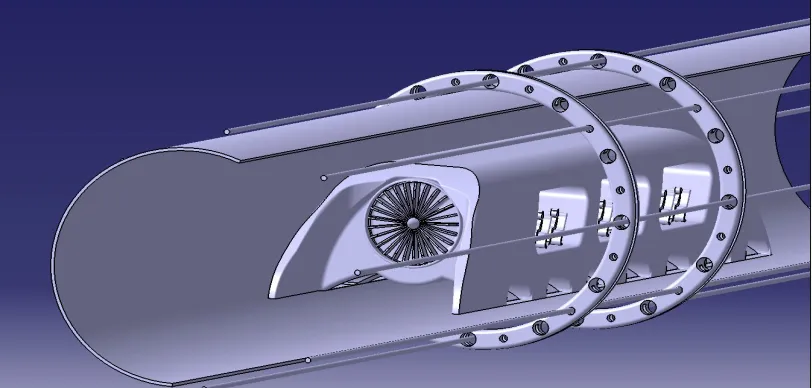
[image:6.612.72.558.287.395.2]To minimize the air drag and friction certain geometrical changes are brought in capsule design to increase the speed and efficiency of Hyperloop system, which help to make travel comfortable for passengers. (Fig. 3) To reduce drag the system is streamline. While designing Hyperloop system Interior design played vital role for comfort of passengers. Seats are designed with the help of Modern Science, Engineering Solution and Technology to nullify high speed acceleration. Hyperloop will travel at high speed so wheels cannot be used because vaporization of the rubber tires would be occurs. At a time capsule can carry 28 passengers at a very high speed and levitated by pressure air cushion. Aerodynamic design of capsule is design like streamlined to offer minimum resistance to air drag during movement of Hyperloop system. Only design considerations are not enough to achieve high speed. Air accumulates at the front of the capsule, when the capsule travels, because of the minimum air gap between the tube and the capsule.
Fig. 3 Hyperloop Passenger Capsule Subsystem Notional Locations
As pressure build up because of air hinders decrease the movement of capsule. This is analogous to the Syringe Effect, technically known as the Kantrowitz Effect. This affects the system, as it forces to either go slowly or have a super huge diameter tube. Air pressure in front of the capsule can be relieved by installing compressor fan and creating vents in the bottom side of the capsule. Compressor fan guide the air flowing through the vents of capsule at high speed. When high pressure air is pumped between two surfaces, an air bearing is formed which offers zero friction to the movement of the surface. The concept of air bearing can be understood by air hockey table. The compressor fan driven through batteries installed inside the capsules.
[image:6.612.104.510.522.716.2]545
©IJRASET: All Rights are Reserved
C. Compressor Fan
The compressor is installed at the front side of the capsule. It used to move or displace the air in various applications. Compressor used to supply the air to air bearing which further supports the weight of the capsule. The compressor would allow the low pressure tube without choking the air flow that travels between tube walls and capsule. Hyperloop system would demands to new innovation to solve this problem, known as Kantrowitz Limit. Compressor fans are used to nullify the effects created by Kantrowitz Limit. Compressor fan sucks low pressure air from front side of the system, compresses it at very high pressure and exhale it to air bearing of the system. Hence resistance is removed and no further choking occurs because of Kantrowitz limit.
D. Propulsion
The capsule would require high velocity accelerator for launching from its station. A coil gun can be used to achieve high velocity. A coil gun consists of coil used as an electromagnet analogous for acceleration such as how a linear motor accelerates a ferromagnetic projectile to high velocity. By using a 18 gauge enameled copper wire wound over a Poly vinyl chloride (PVC) pipe, the coil gun was supplied an impulse voltage of 300 volts through charged capacitors. Current passing through the coil guns needs to be high for maximum acceleration. Capacitors were connected in parallel as they charged held by them when discharged in parallel fashion output a high current at the voltage of a single capacitor. Inside the coil gun the projectile was inserted which accelerates at high velocities pushing the Hyperloop capsules. Force produce by the projectile is enough to launch the capsule which fulfils the function of coil gun as a propulsion device. A coil gun generates massive amounts of magnetism. For safe operation of system it would require magnetic shield, which is much costly. However implementation of a coil gun on a large scale is not practical and feasible as well.
Fig.5. Coil Gun Schematic
A safer and more feasible option for propulsion is Liner Induction Motor which accelerates and decelerates the capsules of the Hyperloop system [7]. It has some advantages over a permanent magnet motor. Manufacturer of cars “Tesla” are using same linear induction motor in cars which in Hyperloop can produce velocity of 20000 meter per second. The moving motor installed on the capsule for weight reduction and power requirement as well. At the same time tube will incorporate the stationary motor elements (stator) which power the stators [2]. The stators will be laid along sections of the tube – long enough to accelerate and decelerate the capsule between 480 and 1,220 km/h and to accelerate at 1g. Stator would be installed near stations and at booster points along the line. Only about 1% of the tube’s length of system would require to be installed with stators. The three-phase stators, laid out symmetrically on either side of the rotor, will have one slot per pole per phase.
A variable number of turns per slot provided to allow the inverter to operate at a nearly constant phase voltage, which simplifies the design of the power electronics. Two inverters are provided at each terminal of the station- one to accelerate outgoing capsules and another to capture the energy from incoming capsules as they slow down, allow for regenerative braking. The inverters will supply power only those sections of the track occupied by the capsule, hence power factor will be increase.
E. Cost
The overall cost of the tube, pillars construction, vacuum pumps and stations building is thus expected to be around $4.06 billion USD for the passenger version of Hyperloop. This does not including the cost of the propulsion linear motors or solar panels. The tube represents approximately 70% of the total budge of the system.
546
©IJRASET: All Rights are Reserved
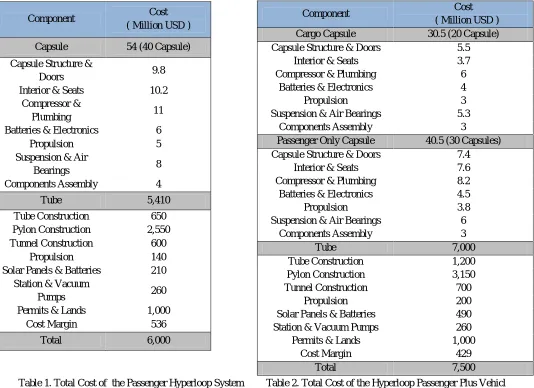
This minimal cost increase would be allowing a much more versatile Hyperloop system. The total cost of Hyperloop system passenger only version is as follows (Table 1&2).
[image:8.612.44.578.110.498.2]
Table 1. Total Cost of the Passenger Hyperloop System Table 2. Total Cost of the Hyperloop Passenger Plus Vehicl TransportationSystem
F. Air Bearing
Travelling at very high speed Hyperloop system has friction problem, which can be overcome by minimizing the surface contact between the capsule and tube i.e. capsule should be float in the air within the tube. Air bearings are installed on surface of capsules; the air inhaled by front side of capsule’s compressor fan is transfer to rear side of the capsule exhaled by air bearing providing it hovering and levitation. For smooth traveling of the Hyperloop system air bearing also provide suspension to capsules.
G. Power Source
Hyperloop system would require abundant power. Increasing demand of fuel due to globalization, limited energy sources and sky high fuel prices was the main problem for Hyperloop system. However this problem is overcome by the conventional solar energy. Throughout the length of the tube’s roof covered with solar panel, which produces more energy than needed by whole Hyperloop setup without consuming drop of petrol, diesel or kerosene. Extra amount of energy stored in large batteries, which can be used in cloudy days when sun not shines. It is self-sufficient environment friendly and modern technology.
H. Suspension
Air bearing suspension offers not only stability but also extremely low drag at a feasible cost. While traveling at a very high speed suspension provides comfort to passengers. A stiff air bearing suspension provides good reliability and safety. When there is a gap between ski and tube wall is high, which shows the nonlinear reaction and which results in large restoring pressure.
Component Cost
( Million USD )
Cargo Capsule 30.5 (20 Capsule)
Capsule Structure & Doors 5.5
Interior & Seats 3.7
Compressor & Plumbing 6
Batteries & Electronics 4
Propulsion 3
Suspension & Air Bearings 5.3
Components Assembly 3
Passenger Only Capsule 40.5 (30 Capsules)
Capsule Structure & Doors 7.4
Interior & Seats 7.6
Compressor & Plumbing 8.2
Batteries & Electronics 4.5
Propulsion 3.8
Suspension & Air Bearings 6
Components Assembly 3
Tube 7,000
Tube Construction 1,200
Pylon Construction 3,150
Tunnel Construction 700
Propulsion 200
Solar Panels & Batteries 490
Station & Vacuum Pumps 260
Permits & Lands 1,000
Cost Margin 429
Total 7,500
Component Cost
( Million USD )
Capsule 54 (40 Capsule)
Capsule Structure &
Doors 9.8
Interior & Seats 10.2
Compressor &
Plumbing 11
Batteries & Electronics 6
Propulsion 5
Suspension & Air
Bearings 8
Components Assembly 4
Tube 5,410
Tube Construction 650
Pylon Construction 2,550
Tunnel Construction 600
Propulsion 140
Solar Panels & Batteries 210
Station & Vacuum
Pumps 260
Permits & Lands 1,000
Cost Margin 536
547
©IJRASET: All Rights are Reserved
Fig.6. Schematic of Air Bearing Skis that Support the Capsule [2]
I. Safety and Reliability
Levitation of air bearing produces excellent suspension and earthquake cannot produce any damage to capsules. Since levitation of air bearing produces excellent suspension, earthquakes cannot produce any damage to capsules. The supporting structures of Hyperloop tubes have foot print of size of telephone pole so they can sway in worst off cases and again without any possible damage to the capsule. Most of the accidents are happen due to human factors or error but there is less or no involvement of human factor in the system. Since everything is controlled and atomized by computers, so chances of accidents are next to impossible.
J. Interior
While designing the interior of the capsule is specifically with passenger safety and comfort consider in mind. During traveling at very high speed accelerations, seats conform well to the body to maintain comfort. Passengers will have access their own personal entertainment system and Wi-Fi in the each cabin with beautiful landscape. The Hyperloop passenger capsule (Fig. 10) overall interior weight of system is expected to be near 5,500 lb (2,500 kg) including the seats, restraint systems, interior and door panels, luggage compartments, Wi-Fi and entertainment displays [2]. The overall cost of the interior components is aimed to be no more than $255,000. The Hyperloop passenger plus vehicle capsule overall interior weight is expected to be near about 6,000 lb (2,700 kg) including the seats, restraint systems, interior and door panels, luggage compartments, Wi-Fi and entertainment displays. The overall cost of the interior components is targeted to be no more than $185,000 [2].
VII. WORKING
Hyperloop system’s is working based on the magnetic levitation principle. The passenger pod travel through low pressure tube which is supported by pylon-tube. Compressor fan installed in front side of the capsule which sucks the air. Air compressor sucks the low pressure air, compresses it to high pressures and transfers to rear side of the capsule; it propels the pad. Capsule is suspended within the tube because air cushion created by compress air. Capsule propels by the linear induction motor which works on principle of magnetic levitation. With the help of Linear Induction Motor principle capsule travel from one place to another place at subsonic velocity which is little bit slower than the speed of sound. Solar panels are installed on top surface of the tube which makes Hyperloop System self-powered. Excess energy created by solar panels would store in large capacity batteries. To operate at night time and in cloudy weather already stored excess amount of energy would be used from batteries. The system would also stored energy collected from the compress air. The air gap between the capsules acts as a cushion to prevent two capsules from colliding within the tube.
548
©IJRASET: All Rights are Reserved
As shown is above figure air through the compressor is transfer to a bypass nozzle at the rear end of the capsule. If capsule is covering too much area of the tube then, the air will not flow around capsule, ultimately result the entire column of air in the tube is being pushed ahead of the capsule and because of this reason there is friction between the air and tube walls is increases tremendously. Therefore to avoid this kind of problem the compressor is installed at the front side of the capsule through which the air will not flow around the capsule and send it to bypass nozzle.
VIII. HYPERLOOPTRAVELTIME
Elon Musk claimed that Hyperloop could operate at top speeds of 760mph, however while travelling at this speed some factors like gradual acceleration and deceleration affects the speeds, which would average 600mph 1. Hyperloop system is 2-3 times faster than high speed rail and 10-15 times faster than traditional rail at these projected speeds. It can be act as a faster alternative to short haul flights (c.250 to 500 miles).
The Hyperloop concept is still within the developing phase has achieved only a top speed of 240mph. According to the evidence, station to station travel time of Hyperloop system would be the faster than current mode (i.e. road, rail & short-haul flights). Table 3 outlines the station to station travel times for both Musk’s original route and the London to Edinburgh Route proposed by Virgin Hyperloop One – both of which demonstrate the speed advantage of Hyperloop.
Route Company Distance Hyperloop High Speed Rail Air
Los Angeles to San Francisco
Space X
(Elon Musk) 382 miles 35 minutes 5 2 hours 35
1 hour 20 minutes
London to Edinburgh
Virgin Hyperloop
One 414 miles 50 minutes 6 3 hours 38 minutes 7
[image:10.612.61.554.278.614.2]1 hour 10 minutes 8
Table 3. Station to Station Travel Time [2]
Fig.8. Energy cost per passenger for a journey between Los Angeles and San Francisco for various modes of transport.
549
©IJRASET: All Rights are Reserved
It has been suggested that an economic option would be to run out of airports to utilise existing infrastructure and enable easier access via cars10. In the latter case, transit time would be significant (up to 2 hours) and serve to undermine the overall speed advantage of Hyperloop. Transit time is similarly relevant for flights, whereas stations for rail are located within city centres. Current travel time, distance, travel cost between Pune to Mumbai via different transportation mode is described in below table.
Transportation Mode Travel Time (approx.) Distance Travel Cost (Rs.)
Cab (Road) 2 hr 54 Min 148 Km 2000 onwards
Bus (Road) 2 hr 57 Min 148 Km 400 onwards
Train (Rail) 3 hr 22 Min 92 Km 70 onwards
Flight (Aerial) 55 Min 118 Km 9200 onwards
Table 4. Extinguish between Pune to Mumbai Travel Time, Distance & Cost
[image:11.612.166.454.306.462.2]The Travel Time varies because of traffic congestion, route and weather. Cost depends on mode of transport, features, facilities and travelling company. Train is cheaper among Cab and Bus but slower in time and crowded, whereas Cab or Bus faster than Train. Time required from Pune to Mumbai by fastest Flight is around 45-55 Min but the cost of travel by Aerial is very expensive.
Fig.9. Pie Chart of Passengers Reviews
As per one survey out of 32 reviews shared by passengers 20% prefers by Bus, 7% Train, 71% Cab/Car, whereas 2% prefers Flight respectively.
IX. SYSTEM&RELIABILITY
The design of Hyperloop has been focused on safety. Unlike other transportation modes, Hyperloop is a single system that incorporates the vehicle, energy management, propulsion system, timing, and route. Capsules travel in a carefully controlled and maintained tube environment. The system will resist to wind, ice, fog, and rain. If human control error and unpredictable weather condition removed from the system, very few safety concerns will remains in Hyperloop. In many cases Hyperloop is intrinsically safer than airplanes, trains, or automobiles.
A. Onboard Passenger Emergency
In case of emergencies all capsules would have direct radio contact with station operators that allow passengers to report any incident, to request help and to receive assistance. In addition, First aid equipment would be installed in all capsules by considering passengers safety in mind. Hyperloop system would be a high profile asset and therefore there are risks of terrorist activities; so that continuous monitoring and security screening is required to manage safety risks.
550
©IJRASET: All Rights are Reserved
B. Power Outage
Capsule does not require continuous power to travel. Two or more redundant Lithium Ion battery pack will power the capsule life support and so would be unaffected by a power outage. All linear accelerators would be equipped with enough energy storage so that all capsules will bring in Hyperloop tube safely. Hyperloop capsules would be installed with a Mechanical Braking system to bring capsules safely to a stop at their destination.
C. Capsule Depressurization
Hyperloop capsules will be designed by considering highest safety standards and manufactured with extensive quality checks to ensure their integrity. As in Airplanes oxygen masks would be deployed in the case of more significant depressurization. When the capsule reached to the destination safely it would be removed from service. Safety of the onboard air supply in Hyperloop system would be very similar to aircraft, and can take advantage of decades of development in similar systems.
D. Structural Integrity of the Tube in Jeopardy
A minor depressurization of the tube is can affect Hyperloop capsules or passengers and would be overcome by increased vacuum pump power. If any minor tube leakage found then it can be repaired during standard maintenance. In case of a large scale leak from system of Hyperloop capsule pressure sensors located along the tube would automatically communicate with all capsules to deploy their emergency mechanical braking systems to avoid accident.
E. Earthquakes
Hyperloop system is design by considering earthquakes in mind. Hyperloop would be no different with the entire tube length built with the necessary flexibility to withstand the earthquake motions while maintaining the Hyperloop tube alignment [2]. Hyperloop capsules would be run remotely to actuate their mechanical braking systems in case of emergency.
F. Human Related Incidents
Hyperloop would feature the same high level of security which is used at airports. However the departure at Hyperloop station would be steadier and flow of passengers through security screening compared to airport. Tubes located on pylons would limit access to the critical elements of the system. Multiple redundant power sources and vacuum pumps are provided to avoid impact of any single incident.
G. Reliability
The Hyperloop system is design by considerations like mechanical, electrical, solar energy, softwares, passengers comfort, security and all infrastructure so that reliable, durable and fault tolerant over its service life (100 years), while maintaining safety levels ensure that it should match or exceed the safety standard of commercial air transportation.
551
©IJRASET: All Rights are Reserved
X. PRESENT/FUTUREWORK
A. Present Work
Presently Hyperloop concept was proposed for route between San Francisco, California and Los Angeles in 35 minutes. In India there are many metro cities like Delhi, Mumbai, Bangalore, Chennai and Pune with huge population. In 2017 Maharashtra government proposed a route between Mumbai-Pune, which will take 20-25 minutes to cover distance of 140km.
B. Future Work
Hyperloop is a modern advance transportation technology. Since the system is in its rudimentary and developing stage has too many problems. Many worldwide companies are interested to invest in Hyperloop system.
1) Improve the passenger capacity.
2) Detailed station designs with loading and unloading of passenger, goods as well.
3) Safety features, propulsion of capsule and passenger comfort improvement, has a large future scope.
4) It can be used in material handling devices.
5) Hyperloop system will fulfill the increase demand of transportation by reducing traffic congestion.
One of the major challenges for Hyperloop is its adaptability to topography – sharp turns and change in altitudes. The current carrying capacity of capsule allows only 28 passengers to commute at a time. Research can be focused on improving the design such that the numbers of passengers is more. Technology we comes further development for inventors. Hyperloop also conducted a worldwide competition for building it which would award by building Hyperloop in winning nation [2].
Fig.11. Mumbai-Pune proposed Hyperloop route and Satellite View [15]
It is proposed 1000km/hr Hyperloop system that will take 20-25 minutes compared to current 3 hours to commute between Mumbai-Pune, carrying capacity 10,000 commuters per hours (5,000 in each direction). ‘Hyperloop One’, the firm proposing the route, believes that it is feasible and can be complete by 2026 as per its Detailed Project Report submitted to Pune Metropolitan Region Development Authority (PMRDA) in January 2018. Hyperloop One propose three possible terminal end points option in Mumbai, namely Dadar, Santacruz and the Mumbai International Airport. Currently, 300,000 commute daily between these two cities daily in 110,000 vehicles (including 80,000 cars and 6,000 buses) [15].
The Andhra Pradesh state government is currently studying the feasibility of the project of 40km from Vijayawada to Amravati will cover in just six minutes. AP Economic Developing Board (AP-EDB) and US-based Hyperloop Transportation Technologies (HTT) have signed a memorandum of understanding (MoU) for the same [15]. Los Angeles based Hyperloop One, has signed a MoU with Karnataka State Government to study feasibility of the route between Bangalore-Chennai will reduce travel time to 20 minutes between the two cities [15].
552
©IJRASET: All Rights are Reserved
XI. ADVANTAGES&DISADVANTAGES
A new mode of transport is needed that has benefits of the current modes without the negative aspects of each. This new high speed transportation system has the following advantages & disadvantages:
A. Advantages
1) Fast, inexpensive and advance mode of transportation.
2) Environmentally friendly and pollution free as it powered by regenerative energy source solar.
3) Time consuming and best solution on traffic congestion problems.
4) Resistance to earthquakes. It can travel in any kind of weather.
5) At very high speed system provides better comfort to passengers at low travel cost.
6) More convenient and ready to travel when passengers are ready.
B. Disadvantages
1) Construction cost of Hyperloop tubes and capsule is very high.
2) As Hyperloop tube are longer in length so sharp turning is critical.
3) Capsules are compact in size so that less moveable space for passengers.
4) Punctured tunnel could cause shockwaves.
5) System is high profile asset so continuous screening and monitoring is required to manage safety risks & terrorist activities.
6) High speed might cause dizziness in some passenger.
XII. CONCLUSIONS
A high speed advance transportation system is known as Hyperloop has been studied in this paper. Hyperloop system is advance, rapid and innovative alternative solution over the conventional modes of transportation which are road, rail water and air. The Hyperloop system has two versions: a passenger only version and a passenger plus vehicle version. Hyperloop could transport people, vehicles, goods and freight between Los Angeles and San Francisco in 35 minutes. Additional technological design, developments and further optimization could likely reduce this price. Hyperloop would rival both rail and transnational air travel in relation to speed, however due to the limitation regarding a single point origin and destination for Hyperloop system. Hyperloop would provide solutions to current airport capacity by utilizing airport capacity to overcome the construction of additional runways. Hyperloop would connect major cities supported by rail providing inter modal connections to Hyperloop hubs and fulfills existing as well as growing travel demand on the current transport infrastructure. Hyperloop low energy design may help to reduce the impact of carbon and other air pollutants; however the full energy demand of the proposed systems is yet to be determined until a real-world demonstration is established. Whilst the value proposition for Hyperloop is currently limited in the UK context, this technology is being progressed at a rapid pace by many other countries across the world. For example, India is exploring the potential of implementing Hyperloop to link the capital city Mumbai to Pune, their major commercial hub. Also in Saudi Arabia Hyperloop system is in developing phase from capital city Riyadh to Jeddah. The strong political and economic support, combined with the country’s landscape, make the opportunities for the implementation of Hyperloop more favorable.
REFERENCES
[1] A. Kantrowitz, “Proceeding of International Conference of lasers ‘87” F. J. Duarte, Ed. (STS Press, Mc Lean, VA, 1988). [2] Musk, Elon (August 12, 2013). "Hyperloop Alpha"(PDF). SpaceX. Retrieved August 13, 2013.
[3] N. Kayela, editor of scientific and technical department, “Hyperloop: A Fifth Mode of Transportation”, 2014
[4] Chin, Jeffrey C.; Gray, Justin S.; Jones, Scott M.; Breton, Jeffrey J. (January 2015). Open-Source Conceptual Sizing Models for the Hyperloop Passenger Pod (PDF). 56th AIAA/ASCE/AHS/ASC Structures, Structural Dynamics, and Materials Conference. January 5–9, 2015. Kissimmee, Florida. doi:10.2514/6.2015-1587.
[5] Mark Sakowski, “The Next Contender in High Speed Transport Elon Musks Hyperloop”, 2016 [6] Mohammed Imran, international journal of engineering research, 2016
[7] Ahmed Hodaib, Samar, et al, International Journal of Mechanical, Aerospace, Industrial, Mechatronics and Manufacturing Engg. Vol:10 No:5, (May’16) [8] Compressor:https://patrickenewman.files.wordpress.com/2016/03/compressoriso.png
[9] Stefan Lundström, Stockholm-Helsinki prefeasibility study, KPMG, 2016.
[10] Operating principle of hyperloop http://web-japan.org/kidsweb/hitech/maglev/images/004.jpg [11] https://upload.wikimedia.org/wikipedia/commons/thumb/8/86/Hyperloop.jpg/220px-Hyperloop.jpg [12] “Hyperloop One”. Hyperloop One. Retrieved November 25, 2016.
[13] https://hyperloop-one.com/blog/addressing-congestion-indias-most-bustling-corridor-pune-mumbai. [14] Roseline Walker “Hyperloop: Cutting Through The Hyp”, (June 2018).
![Table 3. Station to Station Travel Time [2]](https://thumb-us.123doks.com/thumbv2/123dok_us/1235899.649187/10.612.61.554.278.614/table-station-to-station-travel-time.webp)

