Creating flexible data quality validation
processes using Business Rules
Joris Scheppers
Name J.J.R. Scheppers
Number 0075337
Place Deventer
Period August 2008 - February 2009
Institute University of Twente, Enschede, The Netherlands
Faculties Electrical Engineering, Mathematics and Computer Science Management and Governance
Programmes Telematics
Industrial Engineering and Management
Company Topicus, Deventer
Committee dr. M.E. Iacob
1st university supervisor
Management and Governance
dr. ir. M. van Sinderen 2nd university supervisor
Electrical Engineering, Mathematics and Computer Science
J. Willems
1st company supervisor
Topicus
W. de Jong
2nd company supervisor
Abstract
Over the past few years, the quality of data has become increasingly important to organ-isations. This is caused by the fact that these organisations rely more and more on the data they collect to make decisions and to react to an ever faster changing environment. Changes in this environment mean changes in the internal processes of an organisation, which in turn puts more emphasis on the need for high quality data. Organisations such as those in the Dutch Health Care system have learned that using high quality data is of major importance. Yet the change in demands on this data is not being met by flexibility of the processes within these organisations.
Topicus is currently developing an application to automate the handling of electronic claim messages. The demand on the quality of these claims changes often, and must be met by a flexible validation process. However, this is currently not the case: the validation methods that are available have been implemented hard-code, which makes the process very inflexible to changes. This problem was the justification for this thesis: the application of the Business Rules approach to a data validation process to increase its flexibility and thereby its ability to react to changing demands from the environment. The concept of data quality is explored in detail to ensure a good understanding of what causes data quality to be poor and with which methods and tools the quality of data can be assessed and influenced. The Business Rules approach is also extensively explored to be able to effectively apply this approach to the data validation process. The result is a combined approach to the validation of the quality of data using checks stated in Business Rules and evaluated using a Business Rule Engine from ILOG.
List of Figures
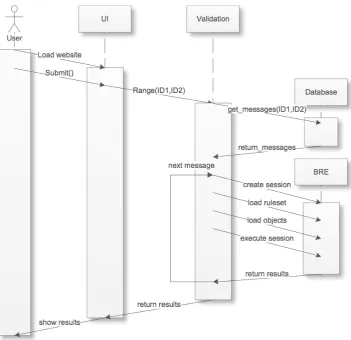
1.1 Dutch health care chain (UML Communication Diagram notation) . . . . 3 1.2 Graphical representation of HA304 message . . . 5 1.3 Black-box view of Claim Factory (BizzDesigner / ISDL notation) . . . 8 1.4 Inner processes of Claim Factory (BizzDesigner / ISDL notation) . . . 10 1.5 Research model (based on [Verschuren], chapter numbers between brackets) 15 1.6 Document structure (chapter numbers between brackets) . . . 16
5.1 Prototype class diagram (UML class diagram notation) . . . 40 5.2 Message evaluation sequence diagram (UML sequence diagram notation) . 43 5.3 Inner processes of Claim Factory with validation process (BizzDesigner /
List of acronyms
ACErules Attempto Controlled English Rules
AGB Algemeen Gegevensbeheer (General Data Management) BPMS Business Process Management System
BRE Business Rule Engine
BRG Business Rule Group
CHA ClearingHouse Apothekers
DFD Data Flow Diagram
ECA Event Condition Action
EI Externe Integratie (External Integration) ERP Enterprise Resource Planning
HA Huisartsen (General Practitioners)
HTML HyperText Markup Language
IS Information System
NDB Nedasco Declaratie Bericht (Nedasco Claim Message)
OMG Object Modeling Group
R2ML REWERSE Rule Markup Language
RDF Resource Description Framework
RS Real-world System
RuleML Rule Markup Language
SBVR Semantics of Business Vocabulary and Business Rules SOA Service Oriented Architecture
UI User Interface
Contents
1 Introduction 1
1.1 Care Chain . . . 1
1.1.1 Overview . . . 1
1.1.2 Vektis and VECOZO details . . . 3
1.1.3 Problems . . . 6
1.2 Case . . . 7
1.2.1 Introduction . . . 7
1.2.2 As-is situation . . . 7
1.2.3 Problems . . . 11
1.2.4 Flexibility . . . 12
1.3 Research . . . 12
1.3.1 Objectives . . . 12
1.3.2 Questions . . . 13
1.3.2.1 Central research question . . . 13
1.3.2.2 Sub questions . . . 14
1.3.3 Approach . . . 14
1.3.4 Thesis structure . . . 15
2 Data quality 17 2.1 Need for data quality . . . 17
2.2 Defining data quality . . . 17
2.3 Determining data quality . . . 18
2.3.1 Validation methods . . . 19
2.4 Summary . . . 19
2.5 Relation to case . . . 20
2.5.1 Data Quality Assurance . . . 20
3 Business Rules 23 3.1 History . . . 23
3.2 Definition . . . 23
3.3 Classification . . . 24
3.3.1 Fundamental classification . . . 24
3.3.1.1 Structural assertions . . . 24
3.3.1.2 Action assertions . . . 25
3.3.1.3 Derivations . . . 25
3.3.2.1 Integrity Maintenance rules . . . 26
3.3.2.2 Service composition rules . . . 26
3.3.2.3 Business Process integration rules . . . 26
3.3.2.4 Event-Condition-Action (ECA) rules . . . 27
3.4 Specification . . . 27
3.4.1 Classic specification methods . . . 28
3.4.2 Contemporary specification methods . . . 28
3.4.2.1 Near-natural languages . . . 28
3.4.2.2 Extensible Markup Language (XML)-based languages . . 29
3.4.2.3 Rule Engine specific languages . . . 29
3.4.3 Applicability . . . 30
3.4.4 System components . . . 30
3.4.4.1 Business Rule Engine . . . 30
3.4.4.2 Business Rule Repository . . . 30
3.4.4.3 Business Rule authoring tools . . . 31
3.5 Summary . . . 31
3.6 Relation to case . . . 31
4 Combination method 34 4.1 Assuring data quality using Business Rules . . . 34
4.2 Creating flexibility in Data Quality validation processes . . . 34
4.3 Other researches . . . 35
4.4 Summary . . . 36
5 Prototype 38 5.1 Design . . . 38
5.1.1 Environment . . . 38
5.1.2 User Interface . . . 38
5.1.3 Object Model . . . 39
5.1.4 Rules . . . 39
5.1.5 Rule sets and -flow . . . 40
5.1.6 System components . . . 41
5.1.7 Validator class . . . 42
5.1.8 Execution sequence . . . 42
5.2 Implementation . . . 42
5.2.1 Environment . . . 42
5.2.2 System components . . . 44
5.2.3 Object model . . . 44
5.2.4 Rule project . . . 46
5.2.4.1 Rule set parameters . . . 46
5.2.4.2 Rules . . . 46
5.2.4.3 Rule Flow . . . 48
5.2.5 Validator class . . . 48
5.4 Summary . . . 51
6 Validation proposition 52 6.1 Criteria . . . 52
6.2 Performance. . . 53
6.2.1 Indicators . . . 53
6.3 Summary . . . 54
7 Conclusions and recommendations 55 7.1 Conclusions . . . 55
7.2 Recommendations . . . 57
7.3 Open issues . . . 57
I Appendices 63
A 64
B 66
C 68
1 Introduction
This chapter provides background information on this thesis, outlines the research and introduces the case study and its problems.
1.1 Care Chain
In the Supply Chain Management concept, the management of a network of intercon-nected businesses involved in the ultimate provision of product and service packages, the coordination of supply and demand is what gives one supply chain the competitive advantage over another. The exchange of information between supplying and consuming participants in the chain is a very important activity. This communication can only be done effectively if some pre-defined way of information exchange is used. In a typical supply chain, most participants will have ERP-like software applications to manage as-pects like inventory and production quantities and will communicate with supplier(s) and consumer(s) using some protocol definition.
1.1.1 Overview
Though the Dutch Health Care chain (called ’care chain’ in the remainder of this docu-ment) is not a typical supply chain, it does have similar features: the care chain contains multiple participants who collectively provide a product or service, there is a ’producing’ and ’consuming’ side of the care chain and communication between participants in the care chain is vital for correct delivery of health care.
The producing and consuming participants in the care chain are the persons and organ-isations providing health care and the patient who receive the health care, respectively. Because The Netherlands has a Social Security system, every person that lives in The Netherlands has an obligation to pay insurance fees and every Dutch insurance company has the obligation to accept any person who wants to be insured. This adds a third party to the Health Care chain: the insurance company. The so-called ’Basic Insurance Law’ (Basisverzekeringswet) defines for which types of care the costs are being paid by the insurance companies.
There are exceptions to this pattern, for example in dental care. When a patient receives dental care, that patient must first pay the invoice he/she gets from the care provider before issuing a claim with his/her insurance company.
With each issued claim a return message is constructed by the participant that eval-uates the claim, which contains information about the actions that were taken to come to the amount that is being payed. Using the information in that return message the care provider that initially issued the claim can update its administration. Except for the invoicing, all the communication is done electronically.
Because the Basic Insurance Law was designed to transform the care chain to a free market system, a lot of new insurance companies have entered the Dutch Health Care market. The law also allows these insurance companies to establish contracts with care providers of their choice to agree on more favorable care rates. This causes one insurance company to provide the same care for a smaller premium than another insurance company who does not have a contract with this care provider and thus create a better competitive position for itself. Also, every person in The Netherlands who falls under the Basic Insurance Law has a right to change insurance companies once per year, at the end of the year.
All these issues put enormous pressure on the exchange of information regarding pa-tient’s insurance, provided care to patients and contracts between insurance companies and health care providers. Errors in this exchange of information results in incorrect pay-ments to care providers or patients, incorrect contractual terms between care providers and insurance companies or even (often irreversible) errors in provided health care.
The only way all the participants in the care chain can effectively exchange informa-tion is by using some predefined and mutually agreed-upon protocol. For this reason, the Dutch government has instated two additional participants in the chain: Vektis and VE-COZO. Vektis is an organisation set-up by the Dutch government to create and maintain the protocol message standards. The VECOZO platform was created by a joint-effort of insurance companies. This platform acts as a central hub for communication between health care providers and insurance companies. The details of these two organisations are described later.
There are two additional types of participants that are present in the care chain: agencies and intermediaries. These participants mainly provide services to health care providers and insurance companies to outsource respectively the issuing and the handling of Health Care claims. The agencies operate on the ’producing’ side of the care chain, the intermediaries operate on the ’consuming’ side.
Specific health care specialisation groups1 have agencies that handle the issuing of
claims for the different providers within a health care specialisation group. For example, CHA (Clearing House Apothekers) handles claim issuing for pharmacies. This has an advantage for individual health care providers, who can now concentrate more on their patients and less on the administrative processes.
On the consuming side of the care chain, certain intermediaries take over the handling of claims for one or more insurance companies. In most cases, one such intermediary
Figure 1.1: Dutch health care chain (UML Communication Diagram notation)
handles the claim evaluation for multiple insurance companies. The intermediary pro-vides overviews (reports) of handled claims to the insurance company and often issues payment assignments.
An overview of the care chain is shown in figure 1.1. It shows the flow of claims and return messages between health care providers and insurance companies as well as the position of Vektis and VECOZO. The flow of payment traffic (invoices and payments) is not shown in this figure.
1.1.2 Vektis and VECOZO details
Vektis As described in section 1.1.1, Vektis is the organisation that creates and main-tains the protocol message standards with which electronic health care claims are ex-changed. These message standards describe the information that is needed to specify a claim for a certain health care specialisation group. Almost every care group has its own set of message standards. A set of standards consists of a claim message standard and a return message standard. The claim message is used to specify the actual claim, the return message is used to specify the status of that claim. The return message contains the same message as the original claim it was based on, with the addition of a number of status fields at the end of each record. These fields are used to specify feedback infor-mation, such as errors in the message that were observed during the evaluation process of the receiving participant.
message standard.
Each record consists of a number of elements that can (and in most cases have to)be used to specify the claim. These elements are called ’fields’. The standard dictates the position and the length (in number of characters) in the record that the different fields should occupy and whether they are mandatory, conditional or optional. Mandatory and conditional fields have to be filled with specific information, for example a date or a code from a list of possible treatments2. These lists are also maintained by Vektis. Optional
fields may contain any type of information..
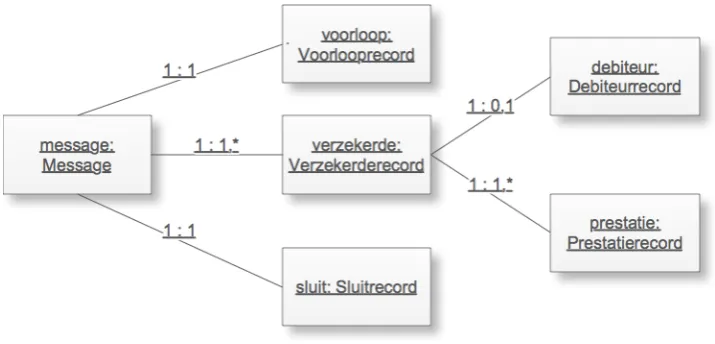
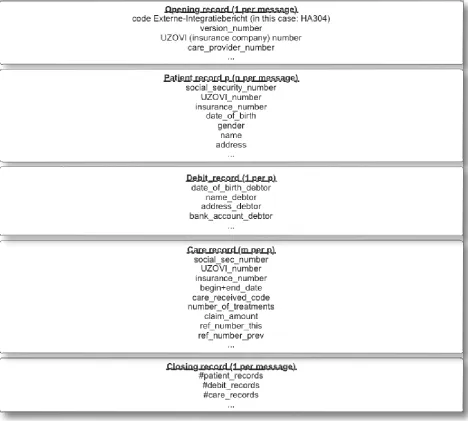
Figure 1.2 shows a graphical representation of one of the message standards: the General Practitioner’s EI-standard message ’HA’. Only a small selection of fields is shown, the actual standard consists of 5 different record types which in total consist of 104 different fields. Some records can have multiple instances within one message, as shown in the figure. The HA-message consists of one Opening and one Closing record. The message must contain 1 or more (denoted by ’n’) Patient-records, which are denoted in the figure by ’p’. Each Patient-record is associated with at most 1 Debit-record (denoted by ’1 per p’). Each Patient-record is associated with at least one (denoted by ’m’) Treatment-record. The value for ’m’ is not necessarily the same for each Patient-record. The message itself is encoded using an ASCII String representation before it is elec-tronically transported between participants in the care chain. Details about the field definitions and their possible values are located at the Vektis website[Vektis]
VECOZO As described in section 1.1.1, the VECOZO-platform is a central participant in the care chain, as most electronic claims pass through it. At the moment, VECOZO provides the following services[VECOZO]
• Claim handling: health care providers can submit claims directly through an
Elec-tronic Claim Portal. These claims will be encrypted and sent to the concerning insurance company. This service is mostly used by the provider’s local software suite to automatically send the claims to VECOZO. VECOZO will then ensure that the claim is sent to the right insurance company.
• Insurance Rights look-up: VECOZO provides a possibility to check a patient’s
insurance details on-line. These details may include where the patient is insured and the kind of insurance policy. This service can also be integrated in the provider’s local software suite.
• Secure message exchange: messages can be sent between health care providers and
insurance companies using certificates to ensure security.
• AGB (Algemeen Gegevensbeheer, General Data Management) consulting: through
this service, certain Health Care provider’s information (i.e. addresses) can be acquired by insurance companies. This service also provides a way to check which providers have contracts with which insurance companies.
• Digital contracting: certain Health Care providers don’t receive the contracts from
insurance companies on paper, but instead do this digitally through the VECOZO portal.
1.1.3 Problems
In theory, the communication between care providers and insurance companies should be flawless because of the protocol standards and the central VECOZO platform. However, in practice, there are some problems that occur within the care chain. Some of these problems are described below:
1. Currently, some parties (such as big insurance companies) have formed their own interpretation of the standards, because some elements in the standards can be interpreted in different ways. These parties have such a strong financial and or-ganisational position that they can enforce the use of ’their’ standard on every participant that communicates with them. This defeats the purpose of having one universal communication standard, as some parties have to be able to interpret multiple ’dialects’ instead of just one ’language’. The cause of this problem is the fact that there is no central authority that enforces the use of one version of the standard.
2. Health Care insurance companies still have to be able to handle paper claims is-sued by individual patients. These paper claims exist because some health care specialisation groups do not have an EI-standard. One such health care specialisa-tion group is Alternative Health Care. Most insurance companies provide (partial) compensation for the alternative treatments, but because no EI-standard exists for these types of treatments, a paper claim is issued manually. Other health care providers simply do not support the electronic claiming and still send their invoice directly to the patient. The patient has to pay the invoice in advance and can claim their restitution by sending the invoice to their insurance company.
The total number of these paper claims take up around 20 percent of the total number of issued claims. The insurance companies have to be able to handle these claims, or else they face the risk of losing a lot of clients. A lot of insurance companies have whole departments whose only responsibility it is to insert paper claims into the digital system. The conversion from paper to electronic claim is a time-consuming and error-prone activity.
3. Because the government changes the legislation concerning Health Care from time to time, a new version of the message standards is issued by Vektis each time important changes are made in the legislation. When this happens, the software that handles claims at each participant in the health care chain has to be updated as well. This can be a time-consuming and thus costly activity.
where another participant does not yet comply. This could result in communication problems and thus in a lot of incorrect claim acceptances/denials.
1.2 Case
1.2.1 Introduction
Topicus is an innovative ICT Service Provider which focuses mainly on chain integration in the Finance, Education and Health Care sectors. This chain integration is achieved by providing multiple participants in the chain with ’Software as a Service’ solutions to improve administrative processes. One of Topicus’ clients is Nedasco, a financial intermediary, which has the authority to handle Health Care claims for a number of Dutch Health Insurance companies. Nedasco’s position in the care chain is shown in figure 1.1 as ’intermediary’. Topicus is currently developing the so-called ’Claim Factory’ (’Declaratiefabriek’), a software suite that enables Nedasco to automatically evaluate and process the claims it receives.
During the development of the Claim Factory, Topicus encountered a number of is-sues. These issues are mainly related to the validation of received claim messages. The validation process is a process which checks if a received claim message complies to the message standard it claims to be constructed with.
When a new version of the message standard is released by Vektis, the validation process has to be updated to be able to successfully validate message constructed in this new message standard version3. In this case a simplified view on the Claim Factory is
used. In reality, besides the digital VECOZO-messages the Claim Factory also receives claims directly from CHA(described in section 1.1.1) and paper claims. Details about the Claim Factory and the validation process in particular are described below.
1.2.2 As-is situation
In this section the current architecture of the Claim Factory is explored.
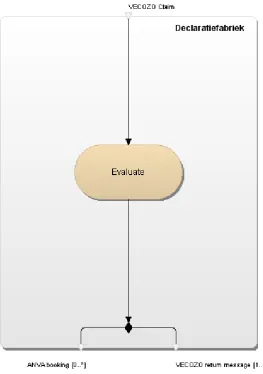
Black-box Claim Factory The Claim Factory evaluates the amount of money that will be reimbursed by looking at the client’s insurance policy and the treatment that patient has received. It uses theVECOZO claim messageas input and produces areturn message
and 0 or morebookings (payment order) as output. This black-box view is shown in figure 1.3.
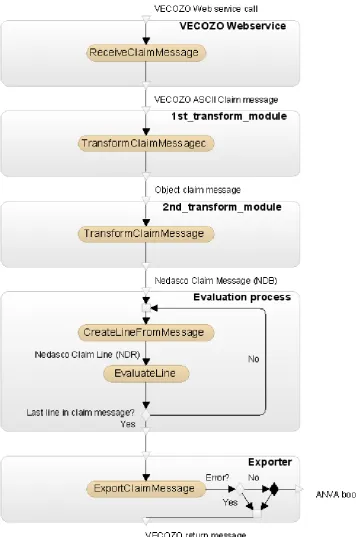
Inner processes Claim Factory When this black-box is opened, the inner processes of the Claim Factory are visible. When VECOZO sends a claim message to the Claim Factory, it is received by a web service component. This component then transfers the message to the first transformation module. This module transforms the ASCII String
3The validation process is not the only part of the Claim Factory that has to be updated when a new
model into a predefined Object model using a mapping from ASCII to Object notation. This mapping only knows three data-types to make the mapping: DATETIME (to model dates and time, although the TIME-component is not used), STRING (to represent any combination of characters) and INTEGER (which represents a natural number). The Object model is then used as input for the second transformation module. During this transformation information in the message is ’enriched’ with information known by Nedasco about the participants which are present in the claim message, for example the claim history of a patient. This module transforms the first Object model into another Object model called the Nedasco Claim Message (’Nedasco Declaratie Bericht’) orNDB. This model is only used within Nedasco.
The next step is the Evaluation process. The evaluation process performs the actual evaluation and determines which amount has to be paid. The actual evaluation is per-formed on so-called claim ’lines’. One such line contains one Patient-record combined with one treatment-record. The reason for this division into lines is that a claim mes-sage can contain several claims for several different patients and every patient-treament-combination is evaluated independently4. When every treatment record is evaluated, all
the claim lines are assembled to form the original message.
The exporter process waits for all the lines in a message to be evaluated. If no error has occurred that would be a reason to reject the claim, a booking is created for each line in the claim. This set of bookings is then sent to ANVA, the Back Office application responsible for the payouts by Nedasco. When every step described in this paragraph is executed correctly, a return message (which is based on the original claim message) is constructed by the exporter module. This message describes how much and because of what reason the amount is paid out. This amount can of course be zero, for instance when a patient’s insurance policy did not cover the treatment at all, or if some information was not correctly specified in the claim. If something wentwrong in the evaluation process, a return message is constructed describing the part of the claim where the error was detected. Of course, in this situation no payment orders are issued.
In both situations (correct or erroneous claim) the return message which contains the original claim message with the comments from the evaluation process attached to the fields,(which provide feedback for the participant that issued the claim) is sent back to the participant who issued the claim. This participant’s information system will register this return message and, in the case of a rejected claim message, will most likely correct the error(s) and re-send the claim.
The inner processes of the Claim Factory are shown in figure 1.4.
As described in section 1.1, a successful exchange of messages can only occur when both parties in the exchange use the same definition of the message standard. The message standard dictates the conditions the information inside the message must comply to in order to eliminate any dispute about what is meant with the information stated in the message.
1.2.3 Problems
The validation process mentioned in section 1.2.1 is not an explicitly defined process, it is therefor not present in figure 1.4. However, it is a process in the sense that it is a collection of related activities that produce a specific service, namely that of the validation of the quality of a claim message. From here on, this thesis defines the ’validation process’ as the collection of related activities that take place to verify the conformance of a claim message to the corresponding message standard.
The validation process brings about two related problems, which are related to problem 3 stated in section 1.1.3:
1. The validation process is very complicated. It has to validate different types of message standards as well as different versions per type. Also, all message stan-dards contain conditional fields which are hard to validate. Because of time con-straints and design decisions, Topicus has implemented a limited number of vali-dation checks in different parts of the Claim Factory, primarily in the evaluation processes. These checks are also hard-coded in the implementation, which makes the validation process hard to update when a new message standard is released, and costs a lot of time.
Also, Topicus only concentrated on the implementation of validation of manda-tory fields of a claim message. This decision could result in messages that pass the validation process which are not constructed in the way the message standard describes. It could be the case that this error is noticed later on in the evaluation process, where such errors are much more costly.
2. Currently no procedure exists to automatically update the software in the health care chain when a new version of the message standard is released. Vektis does have a channel to which an organisation can subscribe which broadcasts information about upcoming releases, but the update process itself is still done manually. This costs a lot of time and money.
The urgency for a solution to the second problem is less than that of the first problem, because at this point in time an ad-hoc solution for problem 2 already exists, using a script to translate the standard definition stated in HTML from the Vektis website to an Object model which can be used to update the first transformation module described in section 1.2.2. This results in a mapping from ASCII to the Object model, which can be used to automate the updating of the first transformation module described in section 1.2.2.
The need for a more flexible validation process is a lot higher because the validation process is the most thorough check that is performed on every claim that is handled by the Claim Factory. If the validation process lets a message pass which should not get passed, it means that it will cause a problem later on in the evaluation process. Thus increasing the flexibility of the validation process has a big impact on the system as a whole.
prac-tically every participant in the care chain and can therefore have a very large impact on the performance in every participant in the care chain. Used in cooperation with the update script described above, this provides a partial solution to the second stated problem.
In conclusion, this thesis will be based on solving problem 1. The formal specification of the research and its objective is given in section 1.3.
1.2.4 Flexibility
The previous sections mentioned the concept of flexibility. Because this concept plays an important part in this research, the concept must be explored and defined. Van Eijnd-hoven researched flexibility in business processes[EijndEijnd-hoven2008]. He noticed that the term was often mentioned, but was rarely properly defined and measured. Van Eijnd-hoven adopted the dimensions of flexibility expressed by Kasi and Tang in [Kasi2005]. These dimensions are:
1. Time - the time it takes to adapt the process to a change in the environment 2. Cost - the cost that is related to changing the process
3. Ease - the easiness with which the process is changed
Combining these three dimensions results in a method to measure the flexibility of a process, where a process is more flexible if it can be changed in less time, with less cost and with more ease relative to another process. The first two dimensions, Time and Cost, are easily measured, while the Ease-dimension is a bit harder. Van Eijndhoven defined indicators for the Ease-dimension as the number of items that have to be changed and the necessary steps that have to be taken to translate the requirements of a process to the actual implementation.
To make business processes more flexible, the concept of Business Rules has been developed. As stated by the BRG, the Business Rules Group, in [BRG2000], the appliance of the Business Rules concept generally increases the flexibility of business processes. Some other recent research projects, such as [vonHalle2002, Vasilecas2007, Chanana2007, Eijndhoven2008], have come to this conclusion as well. The application of Business Rules to the problem stated before could increase the flexibility of the claim evaluation process. That is why this thesis concentrates on the appliance of Business Rules to the problem stated in section 1.1.3.
1.3 Research
1.3.1 Objectives
To find a method to increase the flexibility of message validation in the Dutch health care chain by using Business Rules and to demonstrate this in a pro-totype.
To be able to reach this objective, a number of research steps are taken. These steps are:
• creating an overview of various Business Rules concepts and technologies • creating an overview of various data quality validation concepts and techniques • researching a way to combine the previous two steps, i.e. to assure data quality
using Business Rules
• creating a prototype to demonstrate the applicability of the previously stated
con-cept to the case
1.3.2 Questions
With the problem definition of section 1.2.3 and research objectives of section 1.3.1 in mind, the following central research question is defined:
1.3.2.1 Central research question
How can Business Rules be used in a process that validates messages con-structed using some standard to increase the flexibility in handling changes in this standard?
To be able to answer this central research question there are several aspects of the problem area that need to be researched. This leads to a decomposition of the central research question into several subquestions, which are answered independently throughout this report.
The first set of subquestions is centered on the concept of data quality. As mentioned in section 1.2.3 the quality of a claim message has to be determined before it can be processed. The notion of data quality is rather intuitive, but greater knowledge of data quality is necessary to be able to better understand what causes data quality to be poor and how the quality of data can be determined and influenced. The data quality subquestions explore the concept of data quality and methods to determine the quality of data.
The second set of subquestions is centered on the concept of Business Rules. As mentioned in section 1.2.4 business processes can be made more flexible by applying the Business Rules concept. The Business Rules subquestions explore the concept of Business Rules, the way they are classified and specified and the way they can be created and stored.
1.3.2.2 Sub questions Data quality
• What is data quality?
• How is data quality determined?
• How can the quality of messages constructed in some message standard be vali-dated?
Business Rules
• What are Business Rules?
• What technologies are available to classify and specify Business Rules?
• What technologies are available to create and store Business Rules and sets of
Business Rules?
Using Business Rules techniques in data quality assurance
• How can Business Rules techniques be used to assure data quality?
• How can Business Rules techniques increase the flexibility of a data quality
valida-tion processes?
Data quality assurance using Business Rules in practice
• Can Business Rules be applied effectively to enhance the flexibility of the Claim
Factory?
• What burdens and/or benefits does this combined approach have in the context of
the Claim Factory?
• What future research has to be undertaken to enhance the solution to the flexibility
problem?
1.3.3 Approach
Figure 1.5: Research model (based on [Verschuren], chapter numbers between brackets)
the improvement in flexibility as a performance criterion. The feasibility is determined by using the stability or decrease of average time a claim message spends in the Claim Factory and the stability or decrease of number of false positives and false negatives as feasibility constraints.
1.3.4 Thesis structure
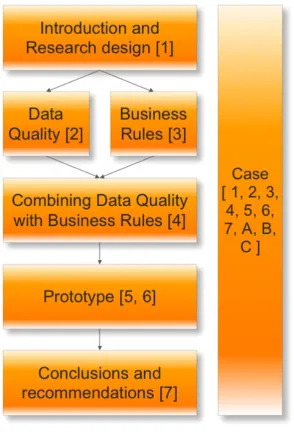
The structure of this BSc thesis report is represented graphically in figure 1.6.
• In the first chapter of this document the research is introduced and the design of the research is outlined.
• In chapter two and three, the two major elements of this research (namely data quality and Business Rules) are explored.
• In chapter four the method that combines data quality validation and Business
Rules is discussed.
• Chapter five describes the design and implementation of the prototype which
demonstrates the method discussed in chapter four.
• Chapter six discusses the validation of the method.
• Chapter seven provides conclusions and recommendations as well as some future
research proposals.
2 Data quality
This chapter explores the concept of data quality. It provides the definition used in this thesis, lists means to measure the quality of data and proposes a way to measure the quality of the messages used in the case study.
2.1 Need for data quality
The need for ’clean’, high quality data has been universally identified. High quality data “can be a major business asset, a unique source of competitive advantage”[Herzog2007] while on the other side, poor quality data “can reduce customer satisfaction, [...] lower employee job satisfaction, [...] and also breed organisational mistrust and make it hard to mount efforts that lead to needed improvements” [Herzog2007]. Poor data quality also “inhibits good data-driven decision making”[vonHalle2002, Chanana2007]. In conclusion, data quality has impact on every process in an organisation. It is therefore of great importance to keep the quality of data high.
In order to gain more insight in the quality of data, the concept must first be explored. data quality is the term that is used to encapsulate multiple requirements of data used in any system. There is much literature available on data quality, and most of them have their own definition of the term. Most literature on data quality focuses on the use of data in a survey context. As surveys are mostly statistical in nature, the probabilistic checks that are proposed and described in the literature are concentrated on probability and (automated) error correction (’imputation’). These types of checks and error corrections are not part of the scope of this research and will therefore not be investigated.
2.2 Defining data quality
One definition of data quality, used by the International Association for Information and data quality[IQDS] is stated as “the degree to which information consistently meets the requirements and expectations of all knowledge workers who require it to perform their processes”. This definition uses the fact that there are one or more ’knowledge workers’ that have to handle the correct data in order to do their job right.
agreement can be reached on the desired attributes of data quality used in the exchange between the producer(s) and the consumer(s) of data.
This last definition is adopted in this research, because it uses a set of standards to measure data quality, which is what is used in the case of the Claim Factory.
2.3 Determining data quality
The determination of the quality of data is also known as ’data quality assurance’. Ac-cording to Wang et al.[Wang1995], data quality assurance “includes all those planned and systematic actions necessary to provide adequate confidence that a data product will sat-isfy a given set of quality requirements”. This means that to be able to determine the quality of some set of data, that set must be reviewed using a given set of requirements. As Herzog et al. [Herzog2007] state: “Consistency checks can be highly effective in detecting data quality problems within data systems”. To be able to make any claim about the quality of data, the data has to be ’edited’. This term is widely used in the literature and usually references the error-detection and error-correction of survey results. As stated in section 2.1, this thesis does not focus on the (automated) correction of errors in data, just on the detection of errors.
The error-detection phase is also called ’validation’. This validation process is re-ferred to as “a process that consists of an examination of all the data collected, in order to identify and single out all the elements that could be the result of errors or malfunctioning”[Bandini2002, Vasilecas2007]. This means that some number of checks have to be performed on the data to be able to determine its quality. These checks can be performed on single entities of data as well as collections of data.
Herzog et al.[Herzog2007] identify a number of deterministic tests that can be per-formed on individual fields or on sets of data. These tests include:
• Range test: The check is made if the value of a single data element is an element
of some pre-determined set of values. This can be a deterministic set (i.e. {A, B, C, D}) or a continuous set (i.e. decimal numbers from 0 to 100). Note that the deterministic set can also consist of just one element, so the range check will effectively be just an equation.
• If-Then(-Else) test: This test checks if, in the case that a certain condition involving
element A is true, some (other) condition involving element B must also be true.
• Ratio Control test: the ratio of two numerical data elements can be used as an
input value for a range test described above
• Zero Control test: this test is usually performed for control or ’checksum’ purposes.
It can be performed on two or more data elements and is usually checked as ’the sum of data elements 1 through 10 has to be in range A’.
• Null constraints: a check to see if mandatory values are present
• Cross checks: this type of check is the ’parent’ of the ratio- and zero control tests states above. It checks the conformance to some constraint relation between dif-ferent items.
• Type check: this check determines if the value of a data element is of the correct type (i.e. a Date)
• Format check: a check that determines if a data element is present in the right
format (i.e. a Date element has to be stated in ’year-month-day’-format)
When all defined checks run against a set of data and the outcome of all checks proves to be positive, that set of data is validated and the quality is assured. The degree by which the quality of data drops depends on the weight of the checks. In turn, this weight depends on a number of different variables, such as the environment the checks are placed in as well as the importance of the data being validated.
2.3.1 Validation methods
There are several moments in time when data can be validated. Herzog et al. [Herzog2007] define three scenarios:
1. Prevent: The recommended scenario: check incoming data for errors before it reaches a process where its quality is important.
2. Detect: Run periodic checks on data already in the production process and detect and possibly repair the errors that are found
3. Repair: Don’t do anything proactively, just detect and try to repair errors as they occur in the production process. This is by far the most costly scenario.
As Herzog et al. [Herzog2007] state: “It is usually less expensive to find and correct errors early in the process than it is in the later stages”. “Editing is well-suited for identifying fatal errors because the editing process can be so easily automated. Perform this activity as quickly and as expeditiously as possible.” It is clear that the validation of data is best performed according to scenario 1.
2.4 Summary
It has been identified that the earlier in the data handling process the quality of the data is assessed, the less costly it is. This is caused by the fact that data errors that are detected later on in the process have a larger impact on the process itself and therefore are more costly to correct.
2.5 Relation to case
2.5.1 Data Quality Assurance
Using the data quality validation checks described in section 2.3, the quality of data can be determined. As described in section 2.2, the more a piece of data (in this case, a claim message) differs from the applicable standard, the lower the quality is. The degree of quality is measured by the number of checks and their weights the data fails on, as described in section 2.3. The next step in measuring the quality of a message is defining these checks for a given message standard.
The Vektis platform offers, besides public access to the message standard definitions and documents, a testing platform called PORTES. This platform contains a set of documents designed for developers. This set contains information about the levels of control an entity that handles claim messages can perform on the messages it creates or receives.
However, this set is not complete in the sense that it covers every possible indicator of poor data quality. That’s why these documents can only be used as a reference on which types of checks are identified by Vektis and not as a step-by-step guide to the requirements on the quality of data.
Vektis identifies five levels of control in PORTES[Portes]: 1. Physical file
a) File not found b) File not readable
c) Message standard specification does not exist d) Incorrect file format
2. File fields
a) Record type is incorrect
b) Record type not part of message standard c) Record type sequence error
d) Record identification number not ascending e) Record length incorrect
f) Opening record not in correct place g) Opening record not present
j) More than one closing record
k) Comment record has no corresponding detail record
l) Record which can exist 0 or 1 times in a record exist twice or more 3. Field format
a) Numeric field has alphanumeric value b) Incorrect field format (Date)
c) Mandatory field not present
d) Value summary fields in closing record not correct 4. Field content
a) Field value does not correspond to code list
b) Field value does not correspond to regular expression
5. Field inter-relation. This level contains many possible checks. Because of the focus on the HA standard in this case, the following list is a selection of checks from the PORTES documents on the HA message standard made on control level 5. The complete list of the HA-checks can be found in Appendix A, the complete list for all message standards can be found on the Vektis website [Vektis]
a) If field 0106 "Code information system software vendor" is filled in, then field 0107 "Version information system software vendor" is mandatory.
b) If field 0113 "identification code payment to" is filled in with value 03 (= practice) then field 0111 "Practice code" is mandatory.
c) If field 0111 "Practice code" is filled in, then field 0110 "Care provider code" is mandatory.
d) The value of field 0115 "End date claim period" must be greater or equal to the value of field 0114 "Begin date claim period".
e) The value of field 0205 "Patient insurance number" must be unique in the message.
f) The value of field 0222 "Debit number" must be equal to the value of field 0303 "Debit number".
g) If field 0223 "Indication client deceased" is filled in with value 1, then field 0326 "Relation type debit account" is mandatory.
h) If field 9907 "Total claim amount" equals zero then field 9908 "Indication debit/credit" must be filled with value ’D’.
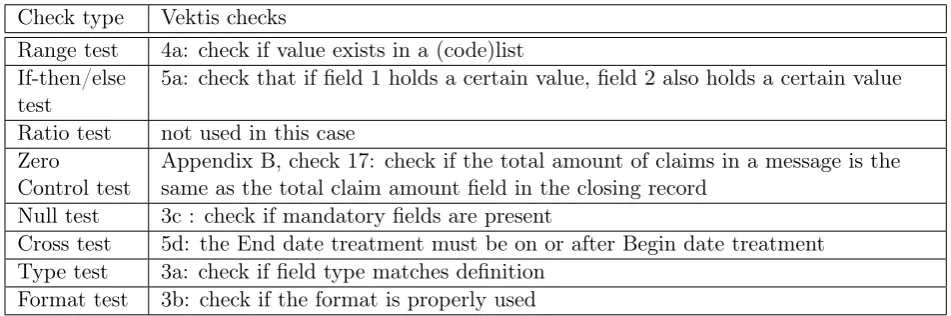
After analysing the case information obtained from Topicus and the documents from the PORTES and Vektis websites, the conclusion was drawn that the level 5 checks from the PORTES documents were not complete. Some additional checks had to be defined, using the check types from section 2.3. The complete list is shown in Appendix B
Check type Vektis checks
Range test 4a: check if value exists in a (code)list If-then/else
test 5a: check that if field 1 holds a certain value, field 2 also holds a certain value Ratio test not used in this case
Zero
Control test Appendix B, check 17: check if the total amount of claims in a message is thesame as the total claim amount field in the closing record Null test 3c : check if mandatory fields are present
Cross test 5d: the End date treatment must be on or after Begin date treatment Type test 3a: check if field type matches definition
[image:31.595.87.563.82.240.2]Format test 3b: check if the format is properly used
Table 2.1: Vektis checks mapping
3 Business Rules
This chapter provides an overview of what Business Rules are, how they are formalised and how they can be used to create flexibility in processes. The Business Rules concept is then applied to the case.
3.1 History
Since 1989, the Business Rules Group (formally known as the GUIDE Business Rules Project) has been developing the Business Rules concept. The need for Business Rules arose because system analysts had tended to neglect the explicit identification of con-straints under which an organisation operates[BRG2000]. These constrains were not formally specified until the moment had come that they had to be translated into pro-gramming code. Also, the modeling techniques that were used to model processes put implicit constraints on the designed model.
If these constraints were made explicit in the design phase, the otherwise unnoticed and possibly inappropriate constraints would become known to the analysts. Another advantage of this approach was that when the process model had to be changed, the constraints would not implicitly change as well. This creates flexibility in the development process.
Knolmayer and Herbst[Knolmayer1993] also identified the importance of Business Rules in the development of Information Systems by stating that “there are strong arguments for a non-redundant, (at least logically) centralized implementation of the IS-relevant Business Rules in the database.”
3.2 Definition
The Business Rules Group (BRG) defines Business Rules as “a statement that defines or constrains some aspect of the business. It is intended to assert business structure or to control or influence the behavior of the business. The Business Rules which concern the project are atomic; that is, they cannot be broken down further”[BRG2000]. In other words, Business Rules are atomic statements that steer or limit the behaviour of some aspect of an organisation.
the information system perspective deals with rules on the behaviour of data. The in-formation system perspective is preferred because it was already possible to understand and model Business Rules as constraints on data.
Although there are many different applications of Business Rules, the concept remains the same: capture knowledge of constraints in an organisation. By extracting the rules from the processes in an organisation, the rules are made explicit and visible. Moreover, when they are stored in a central place, they can be easily maintained and reused across multiple organisational units.
3.3 Classification
As the Business Rule approach is applicable in many different fields, many different classification of Business Rules exists. This section provides insight in some of the most commonly used classification methods.
3.3.1 Fundamental classification
The goal of the BRG was “to formalize an approach for identifying and articulating the rules which define the structure and control the operation of an enterprise”[BRG2000]. The research done by the BRG resulted in the definitions and descriptions of Business Rules and associated concepts. These results were used to create a conceptual model of Business Rules and how to express them. The research done by the BRG provides fundamental insight in the business rule concept.
In [BRG2000], the BRG identified three types of Business Rules: 1. Structural assertions
2. Action assertions 3. Derivations
3.3.1.1 Structural assertions
Structural assertions are defined as “a statement that something of importance to the business either exists as a concept of interest or exists in relationship to another thing of interest. It details a specific, static aspect of the business, expressing things known or how known things fit together”[BRG2000]. The definition portrays two aspects: the ’known thing of interest’ (from now on called ’term’) and the relationship between these terms (from now on called ’facts’).
Terms can be divided into two types: common terms and business terms:
2. Business terms are terms which are specific for that business and its meaning is not clear by the term alone. They have to be explicitly defined in facts.
An example of a business term is ’reservation’. It is not immediately clear what is meant by this term.
The fact ’a reservation is the exchange of a car for cash between a rental office and a
customer, designated to take place on a certain futuredate’ makes clear what is meant by the term ’reservation’ and at the same time relates the terms’reservation’, ’car’, ’rental office’, ’customer’ and ’date’ together. Facts can usually be stated in multiple ways while still having the same meaning. A fact can also relate other facts together, this is called a
compound fact. Facts can also be classified as ’base facts’ and ’derived facts’. Base facts are facts that are elementary true, derived facts are derived from other facts,
The following example clarifies the terms base fact, compound fact and derived fact: 1. Base facts are: ’a car has a class’ and ’a class has abase rental rate’
2. A compound fact would be: ’a car has aclass and abase rental rate’
3. Using the base facts stated above, the fact ’the base rental price of a car is equal to the base rental rate of theclass of the car’ can be derived
3.3.1.2 Action assertions
As described in 3.2, Business Rules steer and limit behaviour. Where structural assertions steers the behaviour, action assertions limits it. They put constraints on the results of actions. Action assertions are classified in three types by the BRG[BRG2000]:
1. Condition: a condition is applied when another specified business rule is evaluated as true.
Example: ’if a car does not have aregistration number, nocustomer can rent it’ 2. Integrity constraints: an integrity constraint specifies a condition that always has
to be true. This prohibits actions from happening if the result would cause the condition to be false.
Example: ’acar can have one and only oneregistration number’
3. Authorization: authorizations limit certain actions from being triggered by certain ’users’.
Example: ’only themanager of a rental officemay change thebase rental rate of a
car class’
3.3.1.3 Derivations
1. Calculated derivation: the derivation is based on some mathematical calculation Example: ’total rental amount equals base rental rate of the class of the car mul-tiplied byrental days minus discount for preferred customer’
2. Inferred derivation: the derivation is based logical induction or deduction on other Business Rules
Example: see section 3.3.1.1
3.3.2 Other classifications
When put in an Information System or Database System context, additional distinctions between Business Rule classifications can be made.
3.3.2.1 Integrity Maintenance rules
Urban et al. [Urban1992] based their classifications on the difference between consistency (integrity constraints on valid database states) and activity (the actions or operation sequences) rules. Within the consistency rule classification, the distinction can be made between active rules (which maintain consistency by manipulating data) and passive rules (which prevent actions that may result in inconsistent database states from happening).
3.3.2.2 Service composition rules
Van Eijndhoven[Eijndhoven2008] describes additional Business Rule classifications. These classifications are usable in specific situations, such as the integration with business pro-cesses and the composition of web services. For the latter purpose, Orriens et al. identi-fied the following classification[Orriens2003]:
• Structure rules: this type of rule is used to restrict the transition possibilities of activities in a process flow.
• Data rules: this type of rule is used to model relations between the in- and outputs of different processes and put constraints on the message flow between them.
• Constraint rules: this type of rule is used to put constraints on message integrity. • Resource rules: this type of rule is used in the dynamic selection of service
connec-tors in a service composition
• Exception rules: this type of rule is used to model exceptional behaviour of a web service
3.3.2.3 Business Process integration rules
• Integrity rules (structural assertions): this type of rule is used to guard the integrity
of processes and process elements. In the case of a processes as a whole, the structural assertion acts as a process invariant. In the case of a process element, it acts as a guard condition to restrict the flow from one state to another.
• Computation rules (derivations): this type of rule is used to calculate a value of a
term based on other terms or values/constants.
• Inference rules (derivations): this type of rule is used to create rules based on the
knowledge of other rules and enables the capturing of the value of a rule into a variable.
• Reaction rules (action assertions): this type of rule is used to model the so-called Event-Condition-Action-rule. The basic operation is that when an event happens a condition is evaluated after which, if the evaluation return true, the action com-ponent is executed.
• Deontic assignments (action assertions): this type of rule is used to restrict access
to certain process components for certain users.
3.3.2.4 Event-Condition-Action (ECA) rules
Because of their frequent use in recent studies ([Taveter2001, Charfi2004]), ECA rules will be further explained. As described in section 3.3.2, the ECA rules are of the ’reaction rules’ type. This means that there must be some event that triggers this rule. This happening is defined as the Event. This can be an explicitly called event (such as: ’rule number 1 must now be executed’) or some condition (such as ’the moment a customer
arrives’).
The Condition component of an ECA rule defines what property must evaluate to ’true’ in order to activate the Action component of an ECA rule. ECA rules can be ’linked’ by letting the Action component trigger another rule’s Event-component. Herbst identified several sources that portray the need for an extended version of the ECA rules[Herbst1995]. This extension adds an ’alternative action’ or Else-Then component. This specifies which Action will be performed when the Condition does not evaluate to ’true’.
ECA rules are especially applicable in modeling process flows.
3.4 Specification
3.4.1 Classic specification methods
Herbst et al. provide an overview of classical modeling techniques to represent Busi-ness Rules constructs[Herbst1994]. Among the reviewed modeling techniques are Data Flow Diagrams, the Merise framework, State Transition Diagrams, Petri Nets, Entity Relationship Models, Entity Life History and Object Oriented methodologies. His work concludes that none of the techniques that were reviewed provide enough support for accurate Business Rule modeling. The most common problem is that the technique does not provide enough support for elemental rule constructs (Events, Conditions, Actions).
3.4.2 Contemporary specification methods
3.4.2.1 Near-natural languages
The near-natural language for specifying Business Rules is by far the easiest method to use and to comprehend. This allows a domain expert (who is not necessarily an IT expert) to create the rules, instead of just specifying them in natural language and letting the IT expert convert them to the used rule specification language. In the latter case, information may be lost in the translation and thus introduce errors in the information system.
Semantics of Business Vocabulary and Business Rules (SBVR) The Object Man-agement Group (OMG) defines SBVR as [OMG2006]: “The vocabulary and rules for documenting the semantics of business vocabulary, business facts and Business Rules; as well as an XMI schema for the interchange of business vocabularies and Business Rules among organisations and between software tools”. The SBVR are used to define the meaning of things, specifically the concepts of a vocabulary that accurately describes Business Rules. To allow the vocabularies and Business Rules to be specified in near-natural language, the SBVR uses a “structured English” language.
Example of a business rule stated in SBVR (from [Eijndhoven2008]): “It is obligatory that each rental car is owned by exactly one branch”
Attempto Controlled English Rules (AceRules) Another method to specify Business Rules in near-natural language is the AceRules system, which is based on the Attempto Controlled English language specification[Fuchs1990, Kuhn2007]. The goal of this sys-tem is “to show that controlled natural languages can be used to represent and execute formal rule systems”. In order to be able to execute the rules specified in AceRules, the constructed statements need to be converted into a form of predicate logic, after which it can be converted to an executable programming language. Fundamental rule types, as described in section 3.3.1, can be directly represented using this system.
3.4.2.2 Extensible Markup Language (XML)-based languages
Rule Markup Language (RuleML) Since XML was developed, the language is widely used in systems and applications where an interchangeable data format is a key issue. Research [Wagner2002, Wagner2006]has indicated that there is a need for an interchange-able business rule specification format. One of the efforts to create an interchangeinterchange-able rule format is made by the RuleML initiative. Their website states that their goal is to “develop RuleML as the canonical Web language for rules using XML markup, formal semantics, and efficient implementations”[RuleML]. Their approach is to create a rule interoperability between the various industry standards to specify Business Rules that exist today.
Example of a business rule stated in RuleML (from [Eijndhoven2008]):
<!– “Peter Miller’s spending has been min 5000 euro in the previous year.” –>
<Atom>
<Rel> spending </Rel> <Ind> Peter Miller </Ind> <Ind> min 5000 euro </Ind> <Ind> previous year </Ind> </Atom>
The REWERSE Rule Markup Language (R2ML) was developed with the same goal as RuleML, but has a richer syntax. This is necessary to be able to support lossless interchange of rule specification languages. As opposed to RuleML, R2ML does support all constructs of different rule languages[Wagner2006]. As a downside, the resulting XML document becomes a lot more complicated than when stated in RuleML.
A different approach is taken by various researches which developed prototypes to record rules into XML documents, like XML/RDF[Boley2001, Wagner2004]. These XML-documents can then be translated or imported for use in other rule engines.
3.4.2.3 Rule Engine specific languages
As described in section 3.4.4.1, there are several different Business Rule engines available to execute Business Rules. Most of these engines use their own proprietary rule specifi-cation language. Others allow for rules to be stated in several languages, including open source languages such as RuleML.
The main difference between these engine specific languages lies in the types of rules they support, but also in the way rules are recorded. Some engines allow the user to import or export the rules to another format to allow for interchanging of rules. There is even an initiative that allows rule editors to specify their rules using Microsoft Excel[OpenRules] or Microsoft Word[ILOG].
If
’the question’ is “how_do_you_feel_today” then
set ’the answer’ to “good”;
3.4.3 Applicability
Today, the Business Rules approach is widely adopted by software vendors who provide business process modeling tools with the ability to explicitly define the constraints that are put on these business processes. Among them are Oracle’s SOA Suite[SOASuite], which provides a very rich business process modeling environment as well as business rule integration. Microsoft has a similar product called Microsoft BizzTalk Server[BizTalk], which in its most recent version incorporates a Business Rules engine.
Apart from these large software vendors, some smaller vendors have also released their Business Rules capable products. Some examples are Mendix[Mendix](based on Mi-crosoft’s .NET language) and ILOG JRules (based on Java). There are also open source initiatives such as the Java Rule Engine[JavaRuleEngine] developed by Sun Microsys-tems.
3.4.4 System components
3.4.4.1 Business Rule Engine
The core of a Business Rule information system is the Business Rule Engine (BRE). The main task of the BRE is the execution of rules. This execution can be triggered by multiple means. The BRE is usually integrated in a Business Process Management System (BPMS), which describes the process flow of some aspect of a business. The flow usually consists of states and there exist a number of transitions between states. Business Rules in a BPMS restrict the number of transitions of one state to other states. The BRE determines what transitions are available based on the current state and possibly external data sources. Besides the executing of rules, most BREs support the registering, classification and management of rules as well as consistency verification, as there should be no rules that contradict each other, though this functionality is often seen in Business Rule authoring tools, described in section 3.4.4.3.
3.4.4.2 Business Rule Repository
3.4.4.3 Business Rule authoring tools
Some vendors of Business Rule applications supply tools to author the rules used in the BRE. Depending on the complexity level of the languages supported by the BRE, these tools allow different types of users (i.e. IT personnel as well as domain experts) to create, edit and audit Business Rules. Some of these tools also incorporate rule verification methods to ensure the rules are stated correctly. An example of such an authoring tool is ILOG’s IntelliRule editor[ILOG].
3.5 Summary
There are several different classifications of Business Rules. Each classification represents some form of application of the Business Rules concept, such as the composition of (web)services, the orchestration of processes and the maintenance of data integrity.
The languages to specify Business Rules are abundant. Some are very formalised, others use a more readable format. There is even a language that supports the constructs of most specification languages available. Every language imposes some constraints on the specification of Business Rules
The most important benefit of the Business Rules approach is the flexibility it creates in the authoring, execution and maintenance of process logic that would normally be ’embedded’ in the model or programming code.
3.6 Relation to case
As described in the previous sections, there exist a lot of different methods to classify and specify Business Rules. This means that a choice has to be made which classification and specification method is used in this case. First, a choice has to be made on which set of classification concepts are used to model the checks mentioned above. The following list shows the classification concepts with some pros and cons:
• Fundamental classification:
– Pros: These classification concepts define the very basis of Business Rules and are applicable in most applications of Business Rules
– Cons: The downside of the general applicability of the fundamental concepts is that in a data quality context the different concepts lack specific constructs to model different types of checks. They will all fall under one category, namely ’Integrity constraints’. Although the fundamental classification is certainly not useless in this case, there are better alternatives.
• Integrity Maintenance
state in the real world), i.e. a Patient with a name that does not equal the real name of that patient.
– Cons: In the case of a claim message, the passive consistency rules concepts have to be used, as the claim message itself should only be validated, not
manipulated. This means that the active consistency rules concepts are not used. This does not mean that the classification method is useless, it means that it is not the best fit
• Service composition
– Pros: As the name implies, this classification is used in the composition of services. The resource rules can be used to route messages of different types (HA, ZH etc) to different rule sets. The constraint-rules can be used to model data quality rules.
– Cons: As is the case with the classic classification method, the service com-position classification is applicable to the data quality validation concept, but there are alternatives that better fit the profile.
• Business Process integration
– Pros: The only construct in this classification that is remotely applicable to the data quality validation concept is the integrity rule, which would implicate the modeling of a process for every data quality check.
– Cons: This classification method does not contain any construct that is di-rectly applicable in the data quality validation concept. This means a lot of modifications have to be made to apply this classification method to the case.
• Event-Condition-Action
In conclusion, the most appropriate Business Rule classification method to be used in this case is the Event-Condition-Action classification.
For the choice of specification method, the following reasoning is used: one of the most commonly observed burdens of Business Rule authoring is the difficulty of authoring rules in a difficult to comprehend rule language. As Business Rules are commonly applied to specific domains, not all domain experts are IT experts and vice versa. This portrays the need for a rule specification language that non-IT-personnel can use to author Business Rules.
4 Combination method
This chapter discusses the proposed method for combining the data quality checks dis-cussed in chapter 2 with the Business Rules concept disdis-cussed in chapter 3 and also discusses how the flexibility of the data validation process is increased.
4.1 Assuring data quality using Business Rules
The combination of data quality concepts with the Business Rules approach results in a method to assess the quality of data by translating the complete set of necessary data quality checks to a set of Business Rules. Each rule represents an exception to the norm. In other words, an indicator that a certain piece of the data set does not conform to the appropriate standard.
As described in section 3.6, the ECA-rules classification method is used in the com-bination method. The basic operation of every rule is the Condition-Action pair. The Condition-part describes what property or properties have to be true to execute the Action-part of a rule. This means that when the Condition-element of a rule is executed and found to be true (the rule is ’fired’), the quality of the data goes down. The Action-part contains the amount by which the quality of the data decreases when that Action-particular rule fires. The more rules are fired for a single set of data, the more the quality of that set is lowered.
In a pure binary system, each fired rule reduces the quality by 1. When at the end of the execution of some (sub)set of rules the quality reduction is higher than 0, the data is labeled as ’low quality’. In other cases, the amounts of quality reduction are added up to come to a conclusion about the degree of quality of the data. This degree can then be used to determine if the quality of the data is enough to pass the validation.
4.2 Creating flexibility in Data Quality validation processes
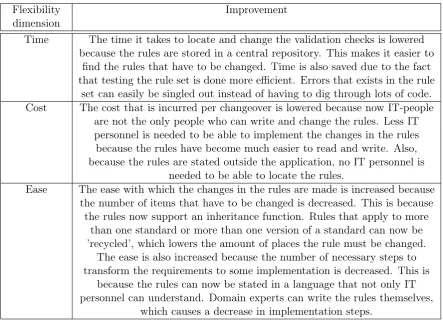
As described in section 1.2.4, the flexibility of a process is increased by decreasing the time that is necessary to change the process, decreasing the cost that is necessary to change the process, decreasing the number of items in the process that have to be changed and/or decreasing the number of steps that have to be taken to transform the requirements of a process to an implementation. The solution to the research problem proposed in the previous section increases the flexibility of data quality assurance processes by attacking these four dimensions of flexibility.

![Figure 1.5: Research model (based on [Verschuren], chapter numbers between brackets)](https://thumb-us.123doks.com/thumbv2/123dok_us/1222201.646380/24.595.90.534.81.217/figure-research-model-based-verschuren-chapter-numbers-brackets.webp)