©IJRASET: All Rights are Reserved
504
Traffic Control System using Image Processing
Ms.Kiran Israni1, Rheann Sequeira2, Ankitha Rai3, Heli Shah4, Shivani Sawant5
1
Associate Professor (Information Technology), 2, 3, 4, 5BE (Information Technology), St. Francis Institute of Technology Mumbai, India
Abstract: The current traffic control system in Indian cities can be improved as it does not take into consideration the randomness in the traffic density. A large amount of time is being wasted at the signal even though there is no traffic because the timings for red and green light are fixed for all the lanes, irrespective of the traffic density. Currently the traffic signals have fixed signal timings which change every 30sec to 120sec. Such timings which are predetermined are inadequate for real time applications of the traffic control system. In order to control the traffic in efficient way we use image processing to analyze the traffic density on a particular lane and accordingly change the signal time.
Keywords: MATLAB, Image processing, traffic density, signal timings.
I. INTRODUCTION
The traffic signal time in the current traffic control system is preset according to the different types of roads in the city. These preset timings remain fixed and do not vary in response to the traffic density on the lanes at that point of time. This may lead to piling up of vehicles on the road at the signal.
Traffic pile up eventually leads to wastage of useful work hours leading to damage of economic growth. According to a study conducted by Boston Consultancy Group(BCG), the economical loss due to traffic congestion in the four major cities namely- Mumbai, Kolkata, Delhi and Bengaluru- is estimated to be 1.47 lakh crore [1]. On an average the commuters in these cities spend 1.5hours more as compared to other Asian cities during peak hours[2].
Adding to this, the improved standard of living has led to people purchasing more private vehicles, further increasing the traffic. The Traffic Monitoring authorities have to identify better methods to solve traffic problem and to develop an efficient traffic control system.
If we are able to calculate the density of traffic on the lanes and give signal times accordingly, the waiting times of vehicles at the signal can be decreased. This can be done by identifying the lane
which lane has the maximum number of vehicles passing through the junction at a particular time .The aim of this project is to acquire and analyze the traffic images to decide signal timings based on traffic density using image processing.
Firstly the images of the lanes will be captured. These captured images will be compared with a reference image i.e. the empty road, to determine the count of vehicles on each of the lanes. According to the count obtained, traffic will be classified into different categories (eg. high, low and medium density traffic). Based on the different categories the green signal time for the lanes will be assigned.
A. MATLAB
MATLAB is a high performance language used for technical computing, it integrates all the necessary computation, visualization and even programming of the system where the solution’s to an system is expressed in a familiar mathematical notations [5]. MATLAB is a standard tool used for computational analysis in the cases of inventory and advanced courses of science and engineering which is the best tool for computational by the researchers. A variety of process approved within MATLAB contains control concerning the matrix, purpose as well as plotting of data, execution regarding algorithms, design of user interface, as well as integrating by means of programs formed within other languages like C, C++, and java. Specifically MATLAB permit intended for matrix estimation as well as thus can be intended for image processing.
II. LITERATUREREVIEW
505
©IJRASET: All Rights are Reserved
TABLE I. . LITERATURE REVIEW
Sr no Author name Year Title Work done
1 Pallavi Chaudekar,
Sayanti Banerjee,
M.K.Muju
2011 Implementation of
Image Processing in
Real Time Traffic
Control.
Reduce the traffic congestion and avoids the time being wasted by a green light on an empty road.
2 Shahebgauda
Halladamani, Radha R C
2017 Development of Closed
Loop Traffic Control
System using Image Processing.
Continuously monitoring the traffic and counting no. of vehicles.
3 Pranav Maheshwari,
Deepanshu Suneja,
Praneet Singh,
Yogeshwar Mutneja
2015 Smart Traffic
Optimization Using
Image Processing.
Dynamic system which uses cameras installed at the red lights and intersections to
monitor the traffic
dynamically.
4 Md. Munir Hasan,
Gobinda Saha,
Aminul Hoque, Md. Badruddoja
Majumder
2014 Smart Traffic Control
System with
Application of Image Processing Techniques
Real time monitoring of roads. Sobel edge detection method is used which is simple to implement.
Block Diagram Of Proposed System
III. METHODOLOGY
1) Image Acquisition: Generally realtime images are captured using webcam but since it is not feasible to do so, input is given in the form of images from the database.
2) Gray-Scale Conversion: The RGB image is converted into gray-scale image. Grayscale images are composed of shades of gray, varying from black at the weakest intensity to white at the strongest. Methods for Gray scale conversion:
a) Average Method: Grayscale = (R + G + B / 3) ...(1)
b) Weighted Method or Luminosity Method: Grayscale image= ((0.3*R)+(0.59*G)+(0.11*B)) ...(2)
3) Background Subtraction: The background subtraction is used to remove unwanted objects in the image. This is done to eliminate the background portion in the image and to extract only the vehicles. This process is also known as ROI extraction.
506
©IJRASET: All Rights are Reserved
5) Object Extraction: In this stage object/features will be extracted from input image to count the exact number of vehicles on a lane.
6) Density Calculation: Each vehicle is considered as one object. After object extraction stage, the objects at each lane will be displayed. We need to count the number of objects using object counting method. Based on the vehicle count of each lane, the lanes will be classified into various categories of traffic density (eg. low, high and medium). The green light will be given for more time to the lane with higher density of vehicles and comparatively less time will be given to the lanes with lower density of vehicles.
7) Output: According to the density calculated, timer for each lane will be displayed.
[image:3.612.213.399.199.427.2]IV. RESULTS
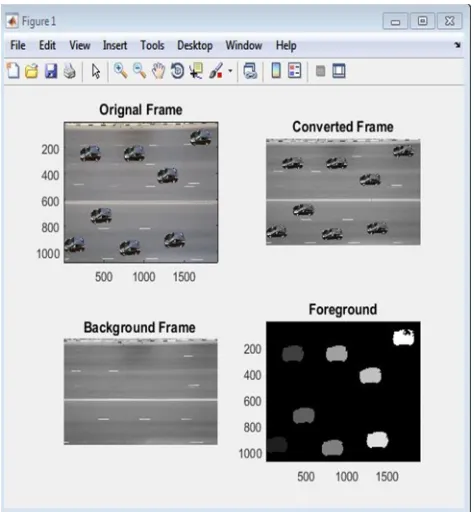
Fig 1: Input images of lane1 and lane2
[image:3.612.195.432.454.710.2]507
[image:4.612.200.459.67.710.2]©IJRASET: All Rights are Reserved
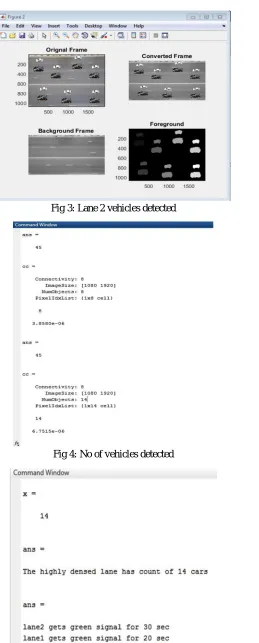
[image:4.612.196.431.89.445.2]Fig 3: Lane 2 vehicles detected
Fig 4: No of vehicles detected
508
©IJRASET: All Rights are Reserved
V. CONCLUSION
The aim of this project is to implement “traffic control system using image processing” by evaluating the traffic on each lane. This system overcomes the limitations of the earlier systems for controlling traffic. The current traffic control system has a drawback of using fixed timers which leads to wastage of time on empty lanes. Major advantage of this proposed system is the variation in signal time by calculating traffic density using image processing and adjusting the signal time according to the density.
VI. FUTUREENHANCEMENT
In future, this system can be modified to identify the vehicles as they pass by, giving preference to emergency vehicles and assisting in surveillance on a large scale.
REFERENCES
[1] https://timesofindia.indiatimes.com/india/traffic-congestion-costs-four-major-indian-cities-rs-1-5-lakh-crore-a-year/articleshow/63918040.cms [2] https://scroll.in/article/876209/traffic-jams-in-indian-cities-arent-just-frustrating-theyre-also-expensive
[3] Ms.Pallavi Choudekar , Ms. Sayanti Banerjee , Prof .M.K.Muju , “Implementation of Image Processing in Real Time Traffic Light Control”, pp. 94-98,IEEE 2011 .
[4] ] Shahebgouda Halladamani,Radha R C , ”Development of Closed Loop Trac Control System using Image Processing”, International Conference on Energy, Communication, Data Analytics and Soft Computing ,pp. 3036-3040,IEEE 2017 .
[5] Pranav Maheshwari , Deepanshu Suneja, Praneet Singh , Yogeshwar Mutneja ,” Smart Traffic Optimization Using Image Processing ” ,3rd International Conference on MOOCs, Innovation and Technology in Education (MITE), pp. 1-4, IEEE 2015.