5G Implementation using Millimeter Wave
Vishal Ramesh Sonawane1, Prof. Sonali Ajankar2
1, 2
Department of Computer Science, VJTI College, Mumbai
Abstract: This paper discusses some of the open research topics that are important for the implementation of 5G mobile communication. Shortage of bandwidth has caused demand to change the architecture to support mobile communication which is currently used for 4G implementation. This architectural change includes the use of millimeter wave, MIMO and dense architecture. Use of millimeter wave is encouraged because it has been underutilized and offers more bandwidth but the drawback is the propagation of millimeter wave is limited due to its less penetration power. So use of Hybrid antenna can be used to provide spherical coverage. Hybrid antenna combines Antenna in package and Antenna on display to steer the antenna main lobe in the end-fire and broadside direction. Use of repeater which enables to regenerate lost energy of millimeter wave after fixed distance. Use of patch antenna for transmission of mmwave.
Keywords: 5G, millimeter wave, mimo, dense architecture, hybrid antenna, repeater, patch antenna
I. INTRODUCTION
With the increasing demand of more bandwidth and speed has given rise to the need of 5G. The first stage implementation of 5G is expected to be operational in late 2019s. 5G is supposed to be designed to work well with IoT network which means that more users will be connected to the network most of the time and they will utilise bandwidth much more which is not compatible with existing 4G network mobile communication. 4G uses radio communication so in 5G it is being given a chance to explore beyond radio waves which is millimetre wave. Millimeter wave is considered best for implementation because of its able to resolve issues that are related to limited bandwidth, number of users connected in network, congestion in network, channel capacity. Future 5G architecture is expected as highly-dense, diversified, versatile as well as a unified technology with an extra-ordinary bandwidth availability for almost unlimited upgradation. Antenna design is one of the major considerations to realise mm-wave based 5G front-ends. Patch antennas have made a massive contribution in wireless cellular networks and regarded as the most optimal choice in mobile phones and smart devices because of the planar structures [1]. Another factor that contributes in implementation of 5G is use of multiple input and multiple output. Using MIMO in 5G implementation base stations at source and receiver can have multiple antennas for sending and receiving signals which reduces error. Another factor that will play crucial role in implementation of 5G implementation using mmWave is Dense architecture. Dense architecture is important factor because of limitations that mmWave has like less penetration power, getting deflected by obstacles. So in dense architecture as name suggests there will be multiple base stations which will be of small size, which will cover more region allowing transmission of mmwave. Use of hybrid antenna is considered in implementation of 5G as patch antenna combined with MIMO, dense architecture and MMwave can be the solution which we are looking for. Hybrid antenna can be used as patch antenna, Antenna in Package, Antenna on display which is more useful because of the increase use of mobile devices and this antenna can be used with cellular devices which allows effective implementation of millimeter wave.
These paper is structured as follow: Section II is about the key factors that are required for 5G implementation. Section III describes characteristics of mmWave with its advantage and disadvantages. Section IV is about the comparison of technologies that are proposed for 5G. Section V is about proposed architecture. Section VI is about future scope.
II. KEYFACTORFOR5GIMPLEMENTATION
Current 4G communication has obstacles of bandwidth shortage, loss of connection, loss of data so considering all these factors while implementing 5G we have to consider bandwidth which will be sufficient to provide service to a large number of users, to avoid any loss of data packet and provide high uplink and downlink speed. For this 5G architecture aspects that need to be considered are MIMO, Millimeter wave, Dense architecture this 3 factors when combined can provide better service than existing 4G communication.
A. Millimeter Wave
1) Advantages of Millimeter Wave a) Low latency
b) High bandwidth
c) Higher upload and download speed
d) Support to more number of user
By using millimeter wave in 5G communication it can overcome problems that are associated with 4G communication. High latency in 4G means time taken for information to be received by user after it is sent from sender is high which is very less in 5G, because mmWave focuses majorly on line of sight transmission. Millimeter wave has a higher bandwidth which causes less traffic and therefore leads to less loss of packets in communication.
Other major advantage over 4G is upload and download speed which is provided by mmWave is significantly higher as compare to 4G approximately 20 times faster.
Because of the higher bandwidth that is provided by mmWave more user can connect in one pocket area and can utilize mmWave without any hindrance.
2) Disadvantages of Millimeter Wave a) Path loss
b) Blockage
c) Atmospheric and rain absorption
d) Less coverage of area
Path loss is dependent on carrier frequency. As frequency increases it reduces the size of antenna because of this reduction in size of antenna adds path loss for frequency. However by keeping aperture constant at both end will allow to minimize path loss from changing [2].
Millemeter wave when faced with blockage such as building walls can cause reduced in power. Millimeter wave have very less penetration power which causes them to be more useful for line of sight communication. With the increase in the transmitter and receiver distance the path loss increases to 20 dB/decade under line-of-sight propagation, but descents to 40 dB/decade plus an added blocking loss of 15-40 dB for non-line of sight [2].
Atmospheric and rain absorption causes attenuation in millimeter wave that leads to loss of energy. Atmospheric attenuation because of oxygen or heavy rain can be of order 10-20 dB/km.
To overcome this issues regarding millimeter wave other factors such as dense architecture and MIMO can be very useful when combined with mmWave.
B. Desnse Architecture
Dense architecture as name suggests means having high number of cell station in a given area. For millemeter wave to work efficiently it is required to have a dense architecture. Since millimeter wave have high frequency the overall size of antenna that is required for transmission is small. These small size cells are called as femto cells. Femto cells because of small size are perfect for architecture of 5G. Femto cells are suitable to carry mmwave and continue to provide high speed and they are cost friendly.
Dense architecture is useful because of loss of power that millimeter wave faces because of blockage and absorption can be overcome using this solution. As having multiple cell station in nearby location can help in reduction of loss of frequency and result in smooth transmission of mmwave.
C. MIMO
MIMO an abbreviation for Multiple input and multiple output means that there will multiple antennas that are located at the both end of receiver and sender. These antennas must be synchronized in order to minimize the errors and increase efficiency of transmission. Because of MIMO antenna link capacity is multiplied which is useful when implemented in dense architecture. Simple working of MIMO is that it has multiple input on sender side and multiple antennas at receiver end. Antenna at the both ends are able to send and receive signals on the same frequency. This antenna can send similar or different data. Data can be differentiated by using multi path technology which allows data separation on receiver end. Whenever there is obstacles or line of sight communication is not possible then MIMO can be very useful. For 5G implementation a massive MIMO is required. As millimeter wave is sensitive to obstacles therefore massive mimo can be useful because of multi path and multiple antennas it will allow propagation of wave.
III. COMPARISON OF CURRENTLY PROPOSED SOLUTION
Currently there are many architectures on how to efficiently implement 5G, out of which some of the architecture that uses millimeter wave as a communication medium are considered. Millimeter wave as a building block all three solutions compared have use alternative ways to overcome drawback of millimeter wave.
A. 5G low Cost Repeater
This architecture uses two wireless link in millimeter wave a shorter one at 28 GHz which can be used as either for line of sight communication or non-line-of-sight communication and other one 39 GHz for line of sight communication [3].
[image:3.612.216.412.607.719.2]Working of this proposed solution is based on this two range of millimeter wave and use of repeater to overcome drawback of millimeter wave. Repeater basically consists of local oscillator which will convert 39 GHz signal to 28 GHz and convert 28 GHz signal to 39 GHz.
Fig 1. Block diagram of system scenario
28 GHz signal is used for connecting hub to a central repeater. When signal is received at repeater it will convert it to 39 GHz signal and repeat the signal towards the receiver which will be line of sight communication. While from sending signal from user to hub it repeater will convert 39 GHz to 28 GHz for non-line-of-sight communication.
With this setup it can achieve almost 270m front haul link length. By using repeater and oscillator this architecture has overcome the issues which are associated with millimeter wave which are path loss and blockage.
1) Advantages of Architecture: This technology allows to utilize and oscillate between 28 GHz and 39 GHz while transmission in progress. 28 GHz which is less susceptible to noise is used for long range transmission while 39 GHz is used for line of sight communication. Repeaters used at the interval are of low cost and feasible solution for millimeter wave.
2) Disadvantages of Architecture: When this solution is used in dense urban area it will require more number of repeaters for a proper communicationIn areas where population is scattered it will require repeater at places where it won’t be used to its fullest.
B. Hybrid Antenna Using Beamforming Technology
This architecture focuses on use of 28 GHz millimeter wave with hybrid antenna to form spherical beam steering coverage which is compatible with present cellular devices. This hybrid antenna concept also employs Antenna in package and Antenna on display [4]. This architecture proposes Antenna on display which will be embodied in cellular devices which are compatible. This antenna will have 28 GHz horizontally polarized end fire array which is implemented using mesh grids. The mesh grid is formed by 6 metal layers which are electronically connected structure consisting stacked vias and capture pads.
This proposed solution uses this hybrid module on both end of cellular device which maximizes beam steering coverage. Maximum gain is observed for 28 GHz at angle = 0 degree. With this solution cellular devices can act as a cell station to other devices that are present in near vicinity. This architecture overcomes drawback of millimeter wave by having multiple cell stations which will be active cellular devices so signals can be reformed at each cellular device.
1) Advantages of Architecture: Hybrid antenna almost resolves all the issues regarding millimeter wave.Hybrid antenna concept proposed is used with cellular devices which makes it more efficient to use because almost everybody has a smart phone which is capable enough to support Antenna On Display technology.
2) Disadvantages of Architecture:Major drawback of this concept is that it uses module which are embedded in cellular devices. So for it to work cellular devices need to have specifications which will be increase the cost of cellular phone.It will put extra load on cellular device resulting in bad performance of phones and draining resources. Thus user may not be willing to go for such kind of technology.
C. Integrated Antenna And Power Amplifier Solution
This architecture proposes use of 28 GHz millimeter wave with the use of patch antenna and power amplifier. By using patch antenna as it will be useful for providing a good range of area for carrying millimeter wave, beamforming of wave and by using power amplifier in the setup allows to regenerate millimeter wave at cell stations placed at the rooftop [5].
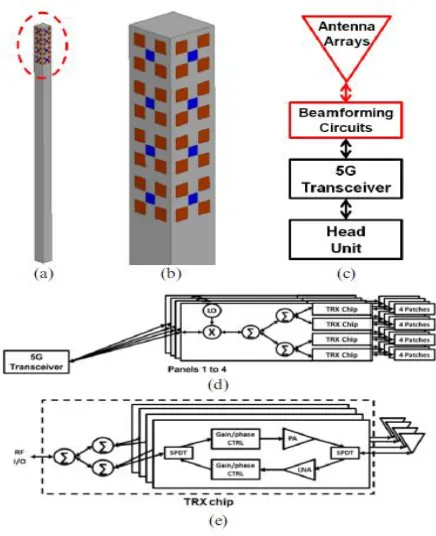
[image:4.612.189.407.300.568.2]This architecture comprises of a two major element a rooftop scalable beamforming system which radiating elements are placed at the four faces of quadrangular top most antenna rod, which allows it to cover spherical ground. Each of this four equal array has radiating element which are placed at front panel. Second important part is power amplifier which is used to deliver maximum power. Power amplifier used plays crucial role because of the drawbacks of millimeter wave, so when signals are transmitted from antenna they are amplified for travelling further more.
Fig 3. System architecture of system.
1) Automative antenna rod
2) Details of topmostend where beamfoeming is mounted
3) System diagram
4) Beamforming circuit block diagram
5) Trx chip block diagram
a) Advantages of Architecture: 28 GHz signals are used with patch antenna which are providing 360-degree coverage. Power amplifier used will regenerate signals at cell station which allows millimeter wave to travel without power drop.
IV. FUTURE SCOPE
For implementation of 5G in pocket area it is beneficial to use millimeter wave as it provides much better service.
An improvised solution for the hybrid antenna module which uses antenna in package and antenna on display with 28 GHz millimeter wave is that instead of using antennas in the cellular device same setup can be used in a modified power bank. Modification that power bank will require is a need of a processor capable enough to handle all the activities. Rest all the setup will be same to that of the proposed system. Use pf power bank will be beneficiary over cellular device because it will take of the load from cellular device of extra processing required also power bank have large battery capacity which can provide much longer service. Even though setup will be much higher price than what is commonly available power bank is but it is definitely an option to be considered while implementing.
V. CONCLUSION
Using millimeter wave for implementation of 5G is the most efficient way. Even though millimeter wave has its own problems but combining with other factors can result a better performance. High speed, more user connected to network are achievable only through use of millimeter wave. Implementation of 5G could be achieve using either one or all the proposed solution that is one pocket could use patch antenna with power amplifier other pocket could use repeater some area could use hybrid antenna.
REFERENCES
[1] Syeda Fizzah Jilani, Qammer H. Abbasi, Akram Alomainy, “Inkjet-Printed Millimetre-Wave PET-Based Flexible Antenna for 5G Wireless Applications School of Electronic Engineering and Computer Science, Queen Mary University of London, E1 4NS, London, UK (978-1-5386-1197-5/18/$31.00 ©2018 IEEE) [2] Raed Shubair, Fatima Al-Ogaili, Millimeter-Wave Mobile Communications for 5G: Challenges and Opportunities Massachusetts Institute of Technology, [3] Simone Maier, Heinz Schlesinger, Wolfgang Templ, Harish Viswanathan Long distance and high bandwidth wireless link tests for a 39 GHz to 28 GHz 5G
low-cost repeater, Nokia bell labs.
[4] Junho Park, Seung Yoon Lee, Yeonwoo Kim, Jaeyeong Lee and Wonbin Hong Hybrid Antenna Module Concept for 28 GHz 5G Beamsteering Cellular Devices, Department of Electrical Engineering, Pohang University.