A Novel Approach towards Patient Centric Clinical
Decision Support System by using Naive Bayesian
Classification based on Cloud Computing
Jaishree M. Kamble 1, Prof. D. G. Vyavhare2 1
Student of Computer Science and Engineering Department, AEC, Amravati University, India
2
HOD of Computer Science and Engineering Department, AEC, Amravati University, India
Abstract: In the today’s world of digitalization large amount of data getting generated from health care industry. For making proper decision using advanced data mining techniques that helps clinician to make proper decisions, Clinical decision support system is important. Clinical decision support system improves diagnosis accuracy and reduces diagnosis time. As the clinical data is of very large amount for performing any operation on it, some data mining techniques needs to be used. Here, to improve Clinical decision support system, navie bayesian classification algorithm can be utilized to extract useful information. CDSS is promising still it is facing many challenges including information security and privacy concerns. In this paper, We describe patient health related document generation and integration open API service based on cloud computing ,through which hospitals are conveniently generate a patient health related document without having to purchase any proprietary software. It propose a privacy-preserving patient-centric clinical decision support system by using encryption and data mining techniques. Historical data of past patients can be used to train the naive Bayesian classifier without leaking any individual patient data. This will helps clinician to diagnose risk of patient's disease.
Keywords: CDSS
I. INTRODUCTION
The recent advancement in all the storage and mining techniques can be exploited in healthcare to provide efficient and accurate decision support as a service. This service could be utilized by any clinician in a flexible manner such as on-demand basis. Healthcare field has the global scope to provide health services for patients that has to face with such a massive amounts of electronic data or experienced such a sharp growth rate of data today. Over the past two decades, the great evolution of data mining technique has imposed a major impact on the revolution of human’s lifestyle by predicting behaviors and future trends on everything which can convert stored data into meaningful information [1]. These techniques are well suitable for providing decision support in the healthcare field. For speeding up the diagnosis time and improving the diagnosis accuracy, a new system in data mining in support to healthcare industry should be develop to provide a much cheaper and faster way for diagnosis. For that, the Clinical Decision Support System (CDSS) [1], with various data mining techniques being applied to assist physicians in diagnosing patient diseases with similar symptoms, has received a great attention recently.
The Clinical Decision Support System has been works as an “active knowledge systems”, which use more than one items of patient’s data for generating case related advice. This implies that a CDSS is a decision support system that is focused on knowledge management in such a way to achieve clinical advice for patient care based on number of items related to patient’s data[9]. This will helps clinicians. This means that clinicians interact with a CDSS to help to analyze, and reach a diagnosis based
on patient data. For the purpose of data mining, Naive Bayesian classifier, as one of the popular machine learning tools, serves
effective to predict various diseases in CDSS [2]. It is a simple and more appropriate for medical diagnosis in healthcare than some sophisticated techniques.[3]. As the medical data contains some sensitive attributes, it creates the need to keep patient’s medical data away from unauthorized disclosure. \
II. LITERATURE SURVEY
A. Background History
In healthcare, we have large volumes of data coming in from EMRs. Most of that data is collected for recreational purposes according to Brent James, of Intermountain Healthcare [4]. But neither the volume nor the velocity of data in healthcare is truly high enough to require for suggesting proper healthcare prescriptions. The work done with health systems shows that only a small fraction of work is done that serves irrelevant to the current practice of medicine and its corresponding analytics use case5]s. So, the vast majority of the data collection in healthcare today could be considered recreational. Although that data may have value down the road as the number of use cases expands, But as the data mining and security techniques are growing on increasing it is necessary to develop for the getting useful results.
B. Existing System
The first operational Bayesian CDSS for the diagnosis of congenital heart diseases is developed based on history, physical exam, and cardiac catheterization findings [5]. After that Schurink, discussed computer-based decision-support systems to assist Intensive Care Unit (ICU) physicians in the management of infectious diseases. As the privacy of the patient’s information becomes more and more important, naive Bayesian classification were considered as a challenge to privacy-preservation due to their natural tendency to use sensitive information about individuals[6].
C. Drawbacks of Existing Systems
Paper Title Year of
Publishing
Limitations
Computer assisted
decision support for the diagnosis and treatment of infectious
diseases in intensive care units,
2005 It faces challenge
to privacy-preservation due to their natural tendency to use
Sensitive information about individuals[8]. Heart Disease Prediction System
using Naive Bayes
2013 1. The system is only work for Heart diseases only.
2. Accuracy of the system is not always same and vary
on algorithm and database used[9]. e-Health
Cloud: Privacy Concerns and Mitigation Strategies
2015 1.Outsourcing the sensitive health information to the
third-party cloud providers can result in serious privacy concerns.
2. Applying number of Cryptographic techniques makes it time consuming[10]
Heart Disease Prediction System using Data Mining Techniques and Intelligent Fuzzy Approach: A Review
2016 1.Success rate depends upon the parameters consider
2.Accuracy depends on tools used for
implementation[11]
III.PROPOSED SYSTEM
A. Problem Definition
One difficult question is, how to securely extract useful information important for healthcare industry from large amount of datasets, and to design and implement framework for e-healthcare to properly maintain balance in the facilities of their users. As we moving on, from traditional record based healthcare to E-Healthcare, using health datasets that has become so large and complex that they are difficult to manage with traditional software or hardware. So, to maintain the balance with growing diseases and understanding the todays need we have to transform our healthcare to Preserving Patient-Centric Clinical Decision Support System in terms of computation cost and communication overhead.
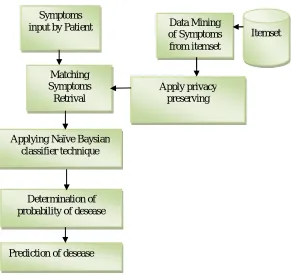
B. Proposed Workflow
Fig. 1: Flow diagram of working System
C. Working of Proposed System
1) Patient will send his/her symptoms as input in the encrypted format, using his/her public key.
2) Using Dataset will provide the historical medical data present in our database in encrypted format using homomorphic
encryption technique.
3) At the time of processing it will decrypt this data and sends to Naïve Basian classifier for training. Once the training will be
done the disease risk will be calculated based on the symptoms provided by the undiagnosed patient and the training result.
4) After calculation, the predicted result will be send to the next level. On this level the probability of predicted disease risk will be
calculated.
5) If the patient wants predicted disease names then they can give their own preferences accordingly.
6) In this algorithm the maximum probability disease risk will be calculated.
7) Once the encrypted diagnosis result will get reached at the client side, the undiagnosed patient will decrypt these results by
using his/her private key.
8) Finally, proper predicted diseases will be diagnose, this will help to give proper prescription to the patients more effectively.
IV.SYSTEM IMPLEMENTATION
A. Doctor Registration Module
Fig.(1.1) Doctor Registration Symptoms
input by Patient
Matching Symptoms
Retrival
Applying Naïve Baysian classifier technique
Determination of probability of desease
Prediction of desease
Apply privacy preserving
Itemset Data Mining
[image:3.612.203.407.605.724.2]This is module provided to add a new user access to the system This is contain a simple registration form which is associated with the database this add new user parameters to the system and helps to maintain the information of the doctors. This module will behave same as that of normal registration process.
B. Login Module
Fig(2.1) Login Page
This is module provided for the Login access to the authorized user this is first filter that has been added for the security check. This is first filter to restrict the unauthorized users. Here the password is in encrypted form the password is going to check with encryption and decryption technique.
C. Patient Data Uploading Module
Fig.(3.1)Patient Data uploading
This module will help the user i.e. doctor to upload the data on to the co centric data base in which the all patient information will be uploaded to the centralize server. The patient information like contact details, Address details are taking as input which is confidential information of the user.
D. Privacy Preserving Implementation Module
After uploading the information by doctor the privacy preserving will be applied onto the user confidential information the data will be stored with the encrypted form into the database with the encryption keys . which is latterly use for decryption by the doctor.
E. User Dashboard
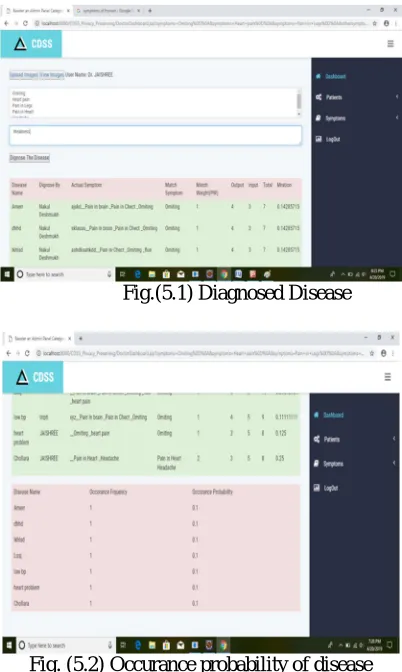
Fig.(5.1) Diagnosed Disease
Fig. (5.2) Occurance probability of disease
This is module which will compose the user dashboard contain the all data like user information uploaded by doctor the prescription and all details.
F. Symptoms
[image:5.612.206.407.124.460.2] [image:5.612.203.416.521.664.2]Fig.(6.2) Update Symptoms
Fig.(6.3) Search Symptoms
Fig.(6.4) Remove Symptoms
G. Data Encryption Module
In this module the user data will need to maintain encrypted so that we are developing the encryption module which will helps to maintain the information confidentiality over the datasets . This will encrypted data and maintain the keys use over encryption.
H. Data Decryption Module
In this module the decryption keys will be extracted from the stored location and used for the decryption in this the data will hand over to the authorized user into decrypted form only.
I. Clinical decision making Module
In this module the decision making will be implemented over the all records of the database in which the naïve Bayesian method will be implemented for the decision supports.
J. Information Retrieval Module
Flowchart
Fig. (a)
Start
Authentication
CDSS
Privacy preserving With retrived data
Naïve baysian classifier
Desease Prediction
Finish
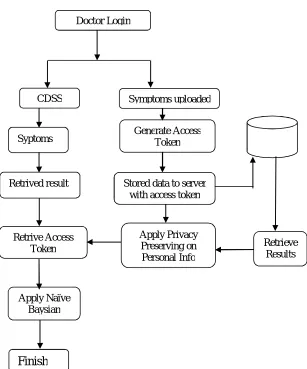
Fig. (b) Flowchart of Doctor Login Module
For Comparative Analysis
Processes Existing Proposed
Focused Privacy Preserving Privacy Preserving + Clinical
Decision Making
Location Based Decision Making No Yes
Bandwidth. issues Yes No because will going to filter
the record over decision making with priorities
Client side Decryption of database Yes No
Security for the database at client side
No Yes
Is support query based retrieval Yes Yes
Is support UI based retrieval No Yes
V. CONCLUSION AND FUTURE SCOPE
We developed an application to improve interaoperability between hospital it also reduce time and provide patient safety when number of users log in at same time.
In future we are makes the numerous change like improvement in naïve basically classifier we are added the term that is symptoms with residency . In this the residency area of the client has taken in consideration while implementing the CDSS at primary decision making.
Doctor Login
CDSS Symptoms uploaded
Syptoms
Retrived result
Retrive Access Token
Apply Naïve Baysian
Finish
Generate Access Token
Stored data to server with access token
Apply Privacy Preserving on Personal Info
[image:8.612.194.501.79.448.2]REFERENCES
[1] Ximeng Liu,Student Member, IEEE, Rongxing Lu, Member, IEEE, Jianfeng Ma, Member, IEEE, Le Chen, and Baodong Qin, ”Privacy- Preserving Patient-Centric Clinical Decision Support System on Naïve Bayesian Classification”, IEEE JOURNAL OF BIOMEDICAL AND HEALTH INFORMATICS, VOL. XX, NO. XX, DECEMBER 2014.
[2] K.M.Ruba Malini. R.Lakshmi, “A Secure Decision Making Process in Health Care System Using Naive Bayes Classifier”, INTERNATIONAL JOURNAL FOR TRENDS IN ENGINEERING & TECHNOLOGY VOLUME 4 ISSUE 1 – APRIL 2015 - ISSN: 2349 – 9303.
[3] Manodnya Shitole, M.A.Wakchaure, “Survey: Techniques Of Data Mining For Clinical Decision Support System”, Vol-2 Issue-1 2016 IJARIIE-ISSN(O)-2395-4396.
www.ijariie.com.
[4] R. Lu, H. Zhu, X. Liu, J. K. Liu, and J. Shao, “Toward efficient and privacy-preserving computing in big data era,” IEEE Network, vol. 28, no. 4, pp. 46–50, 2014.
[5] H. R. Warner, A. F. Toronto, L. G. Veasey, and R. Stephenson, “A mathematical approach to medical diagnosis: application to congenital heart disease,” Jama, vol. 177, no. 3, pp. 177–183, 1961.
[6] A. Abbas and S. U. Khan, “A review on the state-of-the-art privacy preserving approaches in the e-health clouds,” IEEE J. Biomedical and Health Informatics, vol. 18, no. 4, pp. 1431–1441, 2014.
[7] Y. Tong, J. Sun, S. S. M. Chow, and P. Li, “Cloud-assisted mobile-access of health data with privacy and auditability,” IEEE J. Biomedical and Health Informatics, vol. 18, no. 2, pp. 419–429, 2014.
[8] C. Schurink, P. Lucas, I. Hoepelman, and M. Bonten, “Computer assisted decision support for the diagnosis and treatment of infectious diseases in intensive care units,” The Lancet infectious diseases, vol. 5, no. 5, pp. 305–312, 2005.
[9] Dhanashree S. Medhekar, Mayur P. Bote, Shruti D. Deshmukh, “Heart Disease Prediction System using Naive Bayes”, INTERNATIONAL JOURNAL OF ENHANCED RESEARCH IN SCIENCE TECHNOLOGY & ENGINEERING, VOL. 2 ISSUE 3, MARCH.-2013 ISSN NO: 2319-7463
[10] Assad Abbas, Samee U. Khan, “e-Health Cloud: Privacy Concerns and Mitigation Strategies”.