SECOND-ORDER OLFACTORY AND VISUAL
LEARNING IN THE OPTIC TECTUM OF
THE GOLDFISH
BY F. K. SANDERS
Department of Zoology and Comparative Anatomy, University Museum, Oxford
(Received 10 September 1940)
(With Eight Text-figures)
INTRODUCTION
MANY investigations of the effect of removal of portions of the brain on the powers of learning have been made by observation of the changes in the reaction given to a particular stimulus during a period of training in which the stimulus is associated with food as "reward" (see Lashley, 1937; Jacobsen, 1939). More complex learned reactions, such as conditioned reflexes of the second order (see Pavlov, 1927), have been little used in studies of this kind. In such second-order experiments, instead of food being given as "reward" during training, a second sensory stimulus of a different character is given, which has been associated with food during a pre-liminary training period. Removal of the sensory areas concerned from the brain of an animal trained in this way, should throw light on the type of mechanism whereby second-order learning is set up. For this purpose the most suitable con-dition is one in which the sensory centres are sufficiently widely separated for lesions to be made interrupting the connexion between them.
The brain of the Teleostei provides an opportunity for an experimental in-vestigation of this type, since the areas receiving primary olfactory and optic fibres are widely separated. Also there are no projections forward from the midbrain and dorsal thalamus into the telencephalon (see Kappers et al. 1936), and interaction of olfactory and optic impulses cannot therefore take place any further forward than in the midbrain roof.
The experiments described in this paper were designed, firstly, to discover whether second-order olfactory learning with optic stimulation as "reward" is possible in the goldfish, and, secondly, whether injury to the optic tectum inter-feres in any way with this learned response.
PREVIOUS WORK ON LEARNING IN TELEOSTEI
Further instances of learning in fishes have been reported by a great many workers. Thorndike (1899), Churchill (1916), Szymanski (1918) record maze learning, Russell (1931) the learning, by six specimens of Gasterosteus, of a detour into a glass pot to obtain food, and Spooner (1936) a fuller investigation of detour learning in the case of the wrasse Crenilabrus, giving numerical data in the form of learning curves. Bull (1928-37), in a series of papers, gives a great mass of data on conditioned responses to food and shock in a variety of teleostean species. Con-firming the results of Froloff (1925, 1928), he was able to establish conditioned responses in Labrus, Crenilabrus, and Blennius to visual stimuli; by differential training the fish could be taught to discriminate between monochromatic green, yellow, and violet, but not intensity differences. In Crenilabrus, Anguilla, and a number of teleostean species, conditioned responses to vibratory stimuli were possible, as were responses to gustatory stimuli and to changes in temperature and salinity. From such data Bull was able to obtain knowledge of the powers of discrimination shown by certain teleosts in these modalities, but failed to establish a response in Blennius to an artificial olfactory stimulus.
A number of other workers have also used the learning method in the in-vestigation of the sensory capacities of the Teleostei: Trudel (1929) and Klenk (1930)—taste; Herter (1929, 1930)—optic training to size, brightness, form, and colour differences—tactile training to surface texture.
Schiller (1933) claims to have shown "intersensorielle transposition" in
Phoxinus. The animals, first trained to select the lighter of a simultaneously
pre-sented pair of lights, were then given a pair of smells (a "lighter" and a "darker" in the sense of Hornbostels, 1931), and chose the "lighter".
Nolte (1932) studied the localization of learned associations in the fish brain. In partially or totally decerebrated Phoxinus and Gasterosteus he found no gross motor disturbances. When these fish were trained to give a feeding response to the presentation of a certain colour, decerebration or removal of the habenular ganglion failed either to abolish the learning, or to impair visual form discrimination. Nolte concluded that in these species the forebrain is mostly concerned in olfaction. Hosch (1936) also found in Phoxinus and Gobio that .learned visual form dis-criminations are unaffected by total forebrain removal, but Noble (1936, 1937) and Wielbalck (1937) have found forebrain lesions to affect mating and schooling behaviour in certain species of Teleostei. In fact, as Meader (1939) suggests, there is probably as much variation in the forebrain physiology of Teleostei as there is in forebrain anatomy. For example, in some species olfaction may be paramount while the eyes are poor; in schooling species the forebrain may effect the co-ordination necessary for this type of behaviour; in species with complex breeding habits and a predominantly "visual" mode of life the forebrain may be concerned in breeding behaviour, and the large hypothalamo-telencephalic tract conduct forward the necessary impulses from visceral centres.
Sears (1934) studied the effect of lesions of the optic tectum upon purely visual conditioned reflexes in the goldfish. A jet of water was used as the unconditioned stimulus and light as the conditioned. An associated response was set up within
fifty trials, and removal of large areas of the tectum did not abolish it or destroy the capacity for relearning. Large portions of the tectum were left intact laterally, however, and the possibility that this form of learning is mediated by these re-maining portions is not excluded.
MATERIAL AND OPERATIVE TECHNIQUE
Eleven specimens of the goldfish (Carassius auraius) were used in this work, kept throughout the experiments in glass aquaria provided with running water from the laboratory supply, and transferred daily to the experimental room and back again. The temperatures of the aquaria and the experimental tank were taken before each day's set of trials, and approximately equated by the addition of either hot or cold water to the latter. During an experiment the animals were not fed except when in the experimental tank. The food used was ant pupae, since this was easy to standardize in quantity.
Operations were performed under 2 % urethane anaesthesia on animals taken out of the water and wrapped in a wet cloth. Incisions were made into the dorsal aspect of the head with a small scalpel, and a longitudinal rectangle of skin and skull either turned back or removed altogether. Cuts were made in the optic tectum with either a very small pair of scissors, or a cornea knife. The brain is very easy of access. There was no excessive bleeding, and recovery was rapid. The skull flap was not always replaced, as the wound became stopped by a plug of coagulated blood, but in spite of the absence of aseptic precautions the fish all survived until killed for histological examination. Each fish was killed by decapitation, and the whole head fixed in a solution of 4 parts of formaldehyde in 96 parts of water. After some days in the fixative the brains were removed and prepared for sectioning and staining by the modified Weigert technique described by Sheldon (1912). The sections were used to determine accurately the extent of the lesions made (see Fig. 7 below). In order to map the lesions, the total number of sections (T.S.) occupied by the optic lobes was counted and divided by nine. The extent of the lesion in sections corresponding to each of eight equidistant points through the lobes was then measured, and plotted on to standard outlines of the midbrain. Three views of the midbrain in outline were used: a dorsal, a left lateral, and a right lateral. These were obtained by reconstruction from suitable series of normal brains.
THE ABSENCE OF MOTOR DEFECTS AFTER FOREBRAIN AND TECTAL LESIONS
A number of workers have investigated the effect of forebrain and midbrain lesions in Teleosts upon the movements of swimming and equilibrium (see Ten Cate, 1935).
Lesions of the base of the midbrain (interpeduncular region) cause forced movements (Ten Cate, 1935). Reisinger (1926) found profound disturbances of movement and equilibrium after lesions of the valvula cerebelli. This result is confirmed by Tuge (1934). Rizzo (1932) concluded that lesions of the midbrain as well as of the cerebellum have an effect upon muscle tonus, locomotion, and equilibrium, but Ten Cate (1935) criticizes his results on the grounds that his operative methods did not allow of a sharply localized lesion. In fact, there is reason to believe that superficial midbrain lesions in the Teleost, where only the tectum and not the underlying valvula cerebelli is involved, produce little dis-turbance of locomotion or equilibrium. In the present work, unilateral removal of the tectum without damage to the valvula was attained in two animals: they swam and fed normally. In two further animals, where more or less severe damage to the valvula had occurred, circling movements similar to those recorded by Tuge (1934) occurred. In all the four animals used for the critical experiment, where the tectum had been variously damaged without damage to the valvula, no disturbances were observed.
METHOD OF TRAINING
Fish were trained in a tank divided into three compartments. The final reaction in each trial was passage from one compartment into the next through a hole in the partition separating them, and in no case was a trial ended until this reaction had been made. In the first-order learning situation the fish was placed in a com-partment and the optic stimulus presented until the fish passed into the next compartment, where it was given food as "reward". After a period of training in this way with light and food the fish was trained in the second-order situation. It was placed in a third compartment and the olfactory stimulus presented. It eventually passed through the partition hole into the next compartment. This compartment was the one in which the optic stimulus was presented in the previous training, and this stimulus was given therefore instead of food as "reward".
At the beginning of every experiment the fish1 passed through the hole at random, but, as learning proceeded, passage through the hole became more frequently a result of the presentation of the stimulus. As an index of the course of learning the time elapsing between the presentation of the stimulus and the passage of the fish through the partition hole (reaction time) was taken for every trial. As the fish learnt, this became on the average shorter for each successive day's group of trials. Disturbances of learning appeared as considerable increases in average reaction time.
APPARATUS
This consisted of a galvanized iron tank 35 x 23 x 18 in., divided primarily into a larger and a smaller compartment by a partition 12 in. from one end (Fig. 1, A and E). In the midline of this partition, 6 in. from the floor of the tank, was a hole 3 in. in diameter (Fig. 1, D). The tank was kept filled with water to a depth of 9 in. In compartment B a 60-watt electric light bulb (Fig. 1, G) was fixed by means of a wire frame at the level of the rim of the tank, exactly in the centre of the
partment. In compartment A a similar bulb, enclosed in a 3 in. diameter tube, the mouth of which was covered by a disk of stretched white paper (Fig. 1, F), hung on the partition vertically above the hole D. The paper disk at the end of the tube was exactly 1 in. above the water level. The whole of the inside of the tank was painted a dull black.
B ,G
[
F
)
A
1
E
c
—"rr
G
1
\ •' / \ ' /
\ ' /
X
[
/ B \F
) ( * ) A ,
H I 1 1 1
U
; c
Fig. i. Diagram of experimental tank: (a) elevation; (b) plan. Explanation in the text. A, B, main compartments of tank. C, removable glass-fronted compartment. D, hole in partition between compartments A and B. E, hole in glass front of compartment C. F, tube with illuminated disk at its lower end. G, lamp illuminating compartment B. H, pipette on inner wall of compartment C. Dotted line shows water level in tank.
The third compartment (Fig. 1, C), used in the experiments involving olfactory stimulation, consisted of a black iron box 8£ x 9 x 9^ in., open at the top, and one of whose sides consisted of a glass plate, in the exact centre of which was a hole 2 in. in diameter (Fig. 1, E), the thickness of the glass in the hole being painted black. Compartment C stood in compartment A, the glass front facing the partition between compartments A and B, and the hole in the glass exactly on a line with the hole D in this partition. The back of compartment C rested against the end wall of compartment A. Attached to the side wall of compartment C was a small pipette, used to introduce the odorous substance when olfactory stimuli were in use.
run, apart from the lamps in the tank, was that provided by a faint red bulb. The behaviour of the fish during a trial was watched from as far away as was compatible with seeing the fish pass through hole D, great care being taken not to make un-necessary movements during the trial.
Prior to each day's trials, each fish was taken from the aquarium, placed in a large white dish in the experimental room, and left to become dark-adapted.
Hafen (1935) has shown in Phoxinus that rate of learning does not depend upon the number of trials given per day, but only on the absolute number of trials given. Thus no effort was made to keep rigidly to a definite number of trials per day. A maximum of six and a minimum of four was given. The fish seemed dis-inclined to feed after six trials.
RECORDING
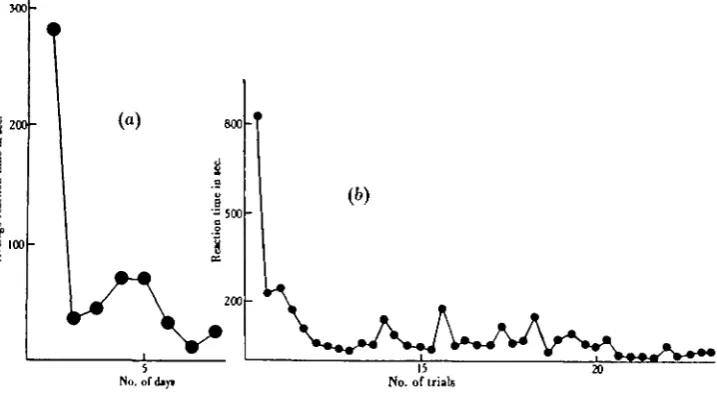
The results are given in the form of learning curves. In these curves the average reaction time1 of each fish for each successive day of the experiment is plotted against the duration of the experiment in days. When these curves are compared
jj 200
.3
100
[image:6.451.48.407.313.510.2]No. ofdiyi
Fig. a. Comparison of curves obtained by plotting: (a) average reaction time per day against number of days of experiment, and (6) reaction time per trial against number of trials.
with those obtained by plotting individual reaction times against number of trials (see Fig. 2), it is found that the day-average curves still preserve the general shape and more striking features of the plot of individual trials, while the irregularities of trial-to-trial variation are smoothed out.
1
Average reaction lime in «ec
300
LEARNING IN RESPONSE TO A VISUAL STIMULUS
The experiments described in this section were made in order to discover whether it was possible for the goldfish to learn to associate food in compartment B of the experimental tank with the visual stimulus provided by the illuminated disk in compartment A.
Experimental procedure. Compartment C (see Fig. i) was not used in this
series of experiments and was not placed in the tank. In every trial the light in compartment B was first switched on, and the fish transferred from the white dish in the experimental room direct to compartment A and left for 10 min. During this time it rarely passed through the hole. Then the disk was illuminated by switching on the lamp in tube F, and the stop-clock started. As soon as the fish passed into compartment B, four ant
pupae were supplied to it and the reac-tion time recorded. At the end of each trial the fish was removed from the tank and replaced in the dish, being captured in either compartment at random, so that it should not associate capture with any particular region of the tank. Any excess food was then removed from the tank, and further trials given at intervals of half an hour.
Results. Four fishes were used. The
results are shown in Fig. 3. These learn-ing curves show an initial marked de-crease in average reaction time, which subsequently varies between lower and narrower limits. The initial decrease shows that after a number of presenta-tions of the illuminated disk in com-partment A in association with food in compartment B, the fishes pass more quickly into compartment B upon pre-sentation of the illuminated disk than
200
100
5 No. of Hays Fig. 3. Learning in response to a visual stimulus, they did at the beginning of the experi- Day-average curves for animals B, C, D, E. ment.
Individual animals show great differences in the form of the curve after the first decrease. So many unknown factors may be involved here, that it seems unprofitable to consider individual variations in this region of the curve.
These experiments were made as preliminaries to those described below, solely to ascertain whether visual learning of this type was possible in the goldfish, and so no tests of retention, or of the form of the curve of experimental extinction, were made.
LEARNING IN RESPONSE TO A COMBINATION OF VISUAL AND OLFACTORY STIMULI
A more complex association was then set up between food and combined optic and olfactory stimuli.
Strieck (1925) has shown in Phoxinus that gustatory response can be set up only to the four primary taste qualities apparent to man. Operative removal of the forebrain did not upset a discrimination learned between any one of these tastes and any other, but in the case of a discrimination learned between any one of the substances scatol, cumarin, artificial musk, and any other, this operation destroyed the discrimination. In intact animals this second discrimination could be made at much more dilute concentrations than the former. Strieck concludes that Phoxinus tastes and smells the same classes of substances as man.
In the present work amyl acetate was used as an olfactory stimulus. It was found that lesions anterior to the known mesencephalo-bulbar connexions abolished the learned reaction (the gustatory centres are situated in the medulla oblongata), and, since a small concentration was used, it seems safe to conclude that the effective stimulus was olfactory rather than gustatory.
Experimental procedure. Compartment C was necessary for this series of
experi-ments, and the experimental procedure described in the preceding section con-sequently modified.
The illuminated disk in compartment A provided the visual stimulus. To serve as olfactory stimulus a constant small volume of amyl acetate (£ c.c.) was introduced into compartment C at every "smell" trial through the small pipette fastened to its wall. In order to control the possibility that this very small stream of fluid might act as a stimulus in itself, the pipette was used in all trials; in those in which an olfactory stimulus was not required, amyl acetate was replaced by water.
Thus the procedure for these experiments was as follows: (1) Filling and placing compartment C in compartment A.
(2) Introduction of the fish into compartment C and leaving for 10 min. (3) Removal of the glass plate.
(4) Switching on the illumination of the disk, starting the clock, and releasing fluid from the pipette in compartment C.
(5) Supply of four ant pupae to the fish in compartment B at the completion of the reaction, and recording the reaction time.
Results. Two fish only were used. The results are shown in Fig. 4. Two measures
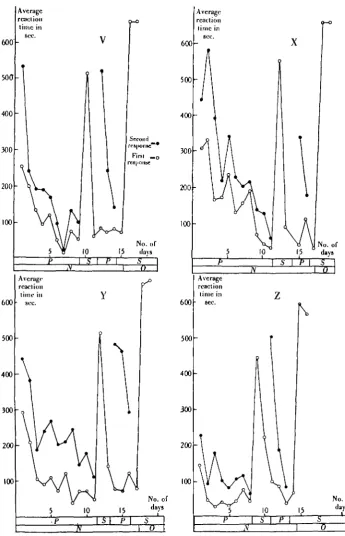
of the reaction were taken: first, the time taken by the fish to pass from compart-ment C into compartcompart-ment A (first response), and secondly, the total time from the beginning of the trial to the passage of the fish from compartment A into com-partment B (second response). These two responses are plotted as day averages on the same graph in Fig. 4. In this and all subsequent experiments, after the initial drop in the learning curve had been recorded, and disturbances of learning were being investigated, trials were not proceeded with after 11 min. had elapsed without reaction. These trials are plotted on the curves as points on an "eleven minute plateau".
The fishes were first trained to make both first and second responses to the visual stimulus of the illuminated disk. When a good response was established, they were presented for 3 days with amyl acetate in compartment C as an additional stimulus. Then a return was made to the visual stimulus alone for a further 2 days. In both fishes this removal of the olfactory stimulus gave a rise in the curve, denoting disturbance of the learning. The olfactory stimulus had thus come to play some part in the complex of stimuli necessary to call forth the learned response. Next the visual stimulus was omitted during the trials of 2 days, and another rise in the curve was obtained. Then the fishes were given 3 days of trials in which the full complex of optic and olfactory stimuli was given together with food to reinforce the learning. Finally, the full complex of stimuli was presented for a further 3 days, only no food was given. These trials were accompanied by ascent of the curve to the "eleven minute plateau". The ascending curve of experimental extinction so obtained has a more gradual incidence than the ascent observed upon omission of either the olfactory or the optic stimulus. The sharp rises obtained in these cases are thus due directly to the omission of a part of the stimulus complex to which the fishes have been trained to respond, and not simply to experimental extinction.
SECOND-ORDER OLFACTORY-OPTIC LEARNING
It has thus been shown that there is a mechanism in the brain of the goldfish whereby a learned state can be established to a specific pattern of olfactory and optic stimulation in association with food as "reward".
Animals were then trained in a preliminary experiment to associate an optic stimulus with food as "reward". Then, in a second experiment, these animals were trained to associate an olfactory stimulus with the same optic stimulus as "reward", and no food was given. As the time of reaction to olfactory stimulation declined upon repetition, the light must have been acting as a "substitute reward" as a prelude to feeding.
Experimental procedure. This was essentially the same as in the preceding series
of experiments, except as regards the time of presentation of the stimuli. The animals were first trained (first-order situation) to make both first and second responses to the illumination of the disk in compartment A, food being given at the completion of the second response. Then the animals were presented with the second-order situation, that is to say first amyl acetate in compartment C with the disk being illuminated as soon as they came out into compartment A, and then removal from the tank before they could pass through into compartment B. No food was given in any trial in the second-order situation.
Results. Five fishes were used. The day-average curves for the complete
experi-ment are shown in Fig. 5, and curves illustrating the course of the second-order learning, plotted from the reaction times recorded only in the trials in the second-order situation, are shown in Fig. 6.
After each fish had been trained in the first-order situation (i.e. with the light only) until a good response was obtained, it was trained for 2 days in the second-order situation. Then a return was made to the first-second-order situation for 3 days to reinforce the first-order learning. The animals were then trained in the second-order situation for a further day and so on.
The curves of Figs. 5 and 6 show that the first trials in the second-order situation were accompanied by a large rise in the curve of the first response (the second response was of course not recorded in second-order trials, as the fish were not allowed to go into compartment B). During succeeding trials, however, the response dropped steeply down, and the curves of Fig. 6 have the form of learning curves. It is necessary to emphasize that in no second-order trial was food given. In all cases optic stimulation was given as a "substitute reward". Also it seems unlikely that the fishes were simply learning to come out of C as a response to a distasteful stimulus (amyl acetate) since:
(a) In no trial did they come out in the preliminary waiting period.
(b) An equally distasteful stimulus was provided outside compartment C by
almost immediate capture in compartment A. This should, if anything, cause the fishes to learn to remain in compartment C.
600
500
400
300
200
100
600
500
400
300
200
100
rS
No. of days
P
J Q_
600
500
400
300
200
100
600
500
400
300
200
100
Average reaction lime in sec.
X
r
\ j M \l No. of 5 I0 15 ° days
P A' /» I S
N o
Average reaction
time in 2 sec. •
-^ T IP I5 -^ P I S P I S
,V 0
[image:12.451.48.394.83.620.2]disk, by virtue of its association with food in the first-order training, can be a substitute for feeding in the subsequent olfactory training. This is an effect com-parable to second-order conditioned reflexes (see Pavlov, 1927).
600
500
400
300
200
100
Average reaction time in - sec.
-I 1
VY
p
1
I
\
V10
s p
AA
/V
s
control
I
P
curve)
' No. of
20 dap
S
N 0
Fig. s b.
. Second-order olfactory-optic learning. Day-average curves of both first and second responses
™ ™v complete experiment in animals V, X, Y, Z, AA. Changes in the experimental situation, and the time of operation, shown diagrammatically below each curve. P = first-order situation, S = second-order situation, N= normal, O — operated.
Olfactory and
Visual
Learning
in
the Optic Tectum
of
the GoldfLh
429
430
Figs. 5 and 6 show the form of the second-order learning curves for these five animals before and after operation. In all cases except the control animal, there was maximal disturbance of the learned state upon operation. The control curve
V
Y
A A
Fig. 7. Chart of the tectal areas removed in animals V, X, Y, Z, AA. The extent of the lesions are shown black.
The swimming movements of the operated animals were essentially normal. Thus the delay in performance of the learned response was due to a disturbance of the learned state, and not to interference with mechanisms responsible for swimming or orientation.
DISCUSSION
From these experiments it is clear that the goldfish is capable of more complex types of learning than the simple conditioned reflex. Fishes which have been trained to associate feeding in a certain compartment of the experimental tank with the display of an illuminated disk in another compartment can then be taught to associate a "smell" in yet a third compartment with the illuminated disk. Thus there exists in the Teleost brain a higher nervous centre where:
(1) As a result of repetitive optic stimulation in association with the presence of food, a state of activity is set up so that optic stimulation thereafter calls forth a reaction previously unconnected with if.
(2) The activity produced by (1) provides the opportunity for a further state of activity as a result of repetitive olfactory stimulation in association with the newly "significant" optic stimulation, whereby an olfactory stimulus can call forth a reaction previously not elicitable by it.
Extirpation of large areas of the sheet of tissue forming the roof of the optic lobes, or cuts made at their anterior border, abolish the capacity of olfactory stimulation to elicit this reaction. At first it might appear that this is due to a dis-turbance of the "state" in the olfactory system as a result of the interruption of an essential flow of impulses from the optic lobes. But in the Teleost there is no proof of the existence of forward projections from the optic lobes into the olfactory centres (see Kappers et al. 1936), and thus the flow of impulses interrupted must be from the telencephalon into the optic lobes, and not vice versa. The change of "state" during second-order learning must therefore take place in the optic lobes and not in the forebrain, and some of the essential pathways involved enter the tectum at its anterior border, since comparatively local cuts made in this region, as well as extirpation of areas of the tectum, interfered with the learned state.
432
tracts (see Fig. 8). Possible cyclic connexions of several different types are present, and learning can be conceived as a complex of activity in the tectum, maintained by these cycles, and producing a constant state of facilitation of the efferent cells to various specific patterns of afferent impulses. Thus a pattern of afferent stimu-lation including, say, optic and visceral sensory impulses, could be conceived as setting up cyclic activities within the tectum which would maintain efferent thres-holds at such a level that subsequent afferent stimulation would be able to produce a motor response of which it was not previously capable. Visual learning would consist in the production of a constantly maintained facilitation of specific tectal efferents to a specific pattern of optic stimulation, by its association with concurrent
Fig. 8. Diagram of the probable types of cyclic cell connexion within the teleostean tectum (very much simplified from Kappers et al. 1936). opt. = afferent optic tract fibre, ate. = ascending afferent fibre, 7 = pyramidal cell, 3 = cell with a recurrent axon running back superficially and giving col-laterals to all intervening cell layers. These cells are the main vehicles of cyclic connexion. Following the excitation of cell 1 by optic tract impulses, the following cycles of activity can be set up under appropriate conditions: 1, 2, 3, 4, 1: 1, 2, 3, 4, 7, 3, 4, 1: 1, 2, 3, 5, 2: 1, 2, 8, 9, 10, 8: i, 2, 3, 5, 2, 8, 9, io, 8. The anatomical bases for cycles of even greater complexity are present.
visceral sensory impulses. Second-order olfactory learning would consist in the cyclically maintained facilitation of efferent cells to olfactory stimulation, by its previous association with a specific pattern of optic stimulation, to which there was already a facilitation of the tectal efferents through earlier association with visceral sensory stimulation.
olfactory learning must thus appear as a local response of a very large area of the optic tectum.
Ablation of areas of the tectum is not likely to give a great deal of information on the actual neural mechanism involved in visual and second-order olfactory learning. In Sepia (Young, 1938) the cyclic mechanism involves large numbers of cells with similar connexions, lying in two masses in different lobes of the supra-oesophageal ganglion, so that cuts can be made between the lobes which interrupt the cycle, without damage to neurons concerned with other functions (Sanders & Young, 1940). In the teleostean tectum the whole mechanism lies within the thick-ness of the tectum, and such a complex system of interconnected neurons exists, that present operative methods are not sufficiently accurate to interrupt specific cycles, and at the same time to exclude other variables. Yet a great complexity of patterns of activity must be a constant feature of these higher centres during the life of the animal, and the roof of the midbrain, in the Teleostei, must occupy a position in relation to the regulation of "higher" activities, analogous to that of the cortex of a mammal.
SUMMARY
1. The goldfish (Carasstus auratus) learns to swim to concealed food when an illuminated disk is presented.
2. The presentation of an olfactory stimulus at the same time as the optic stimulus, during reinforcement of this visual learning, results in the addition of the olfactory stimulus to the stimulus complex necessary to call forth the learned reaction.
3. Five animals learned to react to a situation in which—after preliminary training with an optic stimulus with food as reward—amyl acetate was given as olfactory stimulus and the optic stimulus as reward. This effect is termed second-order learning. It is comparable to second-second-order conditioned reflexes.
4. In four animals trained in this way operations involving removal of large areas of the optic tectum, or cuts made at its anterior border, caused disturbances in the second-order learning.
5. There exists, therefore, in the Teleostean optic tectum a mechanism capable of second-order olfactory-optic learning.
6. The connexion between the telencephalic primary olfactory centre and the tectum involved in this learning passes into the tectum at its anterior border, since cuts made in this region interfered with the learning while leaving a great deal of the tectum intact.
The author is greatly indebted to Mr J. Z. Young for his helpful criticism and advice throughout the course of the work.
REFERENCES BULL, H. O. (1918). J. mar. biol. Ast. U.K. 15, 485.
(1930). J. mar. biol. Ass. U.K. 16, 615. (i935>- J- mar. biol. Ast. U.K. 20, 347. (1936). J. mar. biol. Att. U.K. 21, 1.
(r937)- Report of the Dove Marine Laboratory, Third Series, No. 5, 19.
CHURCHILL, E. D. (1916). J. Aram. Bthav. 6, 247.. FROLOFF, G. P. (1925). Pflilg. Arch. get. Phytiol. 208, 261.
(1928). PflOg. Arch. get. Physiol. 220, 339.
HAFEN, G. (1935). Z. vergl. Physiol. 22, 192. HHRTER, K. (1929). Z. vergl. Physiol. 10, 688.
(1930). Z. vergl. Physiol. 11, 730.
HORNBOSTELS, E. M. (1931). PflQg. Arch. ges. Physiol. 227, 517.
HOSCH, G. (1936). Zool. Jb. Abt. AUg. Zool. Physiol. 57, 57.
JACOBSEN, C. F. (1939). Physiol. Rev. 19, 303.
KAPPERS, A., HUBKR, C. & CROSBY, E. (1936). The Comparative Anatomy of the Nervous System of Vertebrates. New York.
KLENK, F. (1930). Z. vergl. Physiol. 13, 359.
LASHLBY, K. S. (1934). Chapter in Handbook of General Experimental Psychology. Oxford. (i937)- Arch. Neurol. Psychiat., Chicago, 38, 371.
LORHNTE DE N6, R. (1938). J. Neurophysiol. 1, 207.
(!938). In Fulton, Physiology of the Nervous System, pp. 291-325. Oxford. MEADER, R. G. (1939). Zoologica, N.Y., 24, n .
M O B I U S , K . (1873). Schr. Naturw. Ver. Schl. Hoist. 1 , 113. NOBLE, G. K. (1936). Anat. Rec. 64, Suppl. 34.
(IO37)- Anat. Rec. 70, Suppl. 58. NOLTE, W. (1932). Z. vergl. Physiol. 18, 255. PAVLOV, I. (1927). Conditioned Reflexes. Oxford. REBINCER, L. (1926). Biol. Centralb. 46, 436. Rizzo, C. (1932). Arch. di. Fisiol. 31, 398. RUSSELL, E. S. (1931). Brit. J. exp. Biol. 8, 393.
SANDERS, F. K. & YOUNG, J. Z. (1940). J. Neurophysiol. (in the Press). SCHILLER, P. v. (1933). Z. vergl. Physiol. 19, 304.
SEARS, R. R. (1934). J. comp. Psychol. 17, 233. SHELDON, R. E. (1912). J. comp. Neurol. 22, 177. SPOONER, G. M. (1936). J. mar. biol. Ass. U.K. 21, 497. STRIECK, F. (1925). Z. vergl. Physiol. 2, 122.
SZYMANSKI, J. S. (1918). Pflilg. Arch. ges. Physiol. 170, 1. TEN CATE, J. (1935). Ergebn. Biol. 11, 335.
THORNDIKE, E. I. (1899). Amer. Nat. 33, 923. TRIPLETT, N. (1901). Amer.J. Psychol. 12, 354. TRUDEL, P. J. (1929). Z. vergl. Physiol. 10, 367. TUGE, H. (1934). J. comp. Neurol. 60, 201. WDILBALCK, U. (1937). Zool. Anz. 117, 325.