Spatial Ability in Primary School: Effects of the
Tridio® Learning Material.
Marjoke Bakker
Master Thesis of Psychology
University of Twente, Enschede
Spatial Ability in Primary School: Effects of the
Tridio® Learning Material.
Marjoke Bakker November 2008
Instructional Technology
Faculty of Behavioral Sciences University of Twente
Enschede
The Netherlands
Committee:
dr. Casper D. Hulshof Instructional Technology, University of Twente Jan-Maarten Luursema Cognitive Psychology and Ergonomics, University of
Twente
External advisor:
Table of Contents
Abstract ... 7
Samenvatting ... 9
Introduction ... 11
PILOT STUDY ... 27
Method ... 27
Participants... 27
Materials... 27
Procedure... 31
Results and Discussion... 33
Conclusions... 35
MAIN STUDY ... 37
Method ... 37
Participants... 37
Materials... 38
Procedure... 44
Results ... 53
General Discussion... 61
Conclusions... 68
Practical implications... 68
Future research... 69
References ... 71
Acknowledgements ... 75
Appendix A. The Tridio® learning material... 77
Appendix B. Paper Folding practice items... 79
Abstract
Samenvatting
Het leermateriaal Tridio, dat bestaat uit kubussen en mozaiekstukjes en bijbehorende opdrachten met isometrische en orthogonale projecties, is ontwikkeld om het ruimtelijk inzicht van kinderen te verhogen. In deze studie is het effect van Tridio op het ruimtelijk inzicht van leerlingen van groep 7 (11-jarigen) van de basisschool onderzocht. Ruimtelijk inzicht werd hierbij onderverdeeld in J. B. Carroll's (1993) factoren spatial relations (SR) en
visualization (VZ). Er is gebruik gemaakt van een matched-pairs pretest-posttest onderzoek (25 paren). De experimentele groep werd getraind met Tridio, gedurende vijf individuele sessies van 30 minuten. SR werd gemeten met de Card Rotations test en de Flags test; de Paper Folding test en de Mental Rotations test werden gebruikt als VZ tests. Deze tests werden eerst in een pilot studie onderzocht op hun geschiktheid voor 11-jarigen. Verder werd er een content-specifieke Tridio prestatietest afgenomen. Partiële correlaties tussen de
Introduction
Spatial ability is the ability to construct, retain, retrieve, and manipulate visual images of two- and three-dimensional objects (Lohman, 1993). This ability has been found to be related to mathematics and science achievement (e.g., Guay & McDaniel, 1977; Hegarty & Waller, 2005; Tracy, 1987, 1990), and is even argued to be essential to scientific and mathematical thinking (Clements & Battista, 1992). Furthermore, spatial ability has been linked to success in several occupations, such as piloting, mechanics, engineering drawing and surgery (Hegarty & Waller). Therefore, it seems important to teach spatial skills in schools. The National Council of Teachers of Mathematics (NCTM) acknowledged the importance of spatial ability by including spatial skills in the US curriculum standards for primary and secondary school geometry education (NCTM, n.d.). Also, the TAL-team, which established learning trajectories and achievement targets for Dutch primary school by order of the government, identified several spatial activities as being important in primary school education (Gravemeijer et al., 2007; Van den Heuvel-Panhuizen & Buys, 2005).
In the Netherlands, the learning material Tridio® was developed with the aim of enhancing primary school children's spatial ability (Productief B.V., 2006b, 2006c). The material consists of cubes and mosaic pieces (see Appendix A), which can be used in different types of exercises. Currently, around 40% of primary schools in the Netherlands have purchased the Tridio material (as estimated by M. van Herel at Productief B.V., personal communication, January 10, 2008), in part because of its assumed benefits for advancing children's spatial skills. Interestingly, however, the effect of Tridio on children's spatial ability has never been tested experimentally. Studying this effect was the primary goal of the reported research.
Categorization of spatial abilities
To be able to measure the effect of Tridio on spatial ability, we needed a clear sense of what spatial ability is. Ability in general can be defined as a person's current capabilities on a certain class of tasks. When discussing ability, we have to distinguish between achievement and aptitude. Achievement deals with the outcomes of prior learning, and can thus be improved by training. Aptitude, on the other hand, is the potential of future learning: If an ability helps in predicting future learning in addition to a prediction from a measure of current achievement, it can be considered as an aptitude (Carroll, 1993). Researchers do not agree on whether a person's aptitude can be improved: Carroll, for example, considers aptitude as a relatively constant attribute, whereas Snow and Swanson (1992) assume that it can be developed through education. Since Tridio is aimed at improving children's spatial capacities, and not necessarily their future learning potential, this study primarily focuses on spatial ability in the sense of achievement, thus on the current level of spatial performance as determined by prior learning. We aim to discover whether this level is increased by working with Tridio. Of course, children's spatial aptitudes prior to working with Tridio play a role in whether and how much their spatial ability can be improved.
When defining spatial ability, most researchers do not consider it as a unitary trait. Rather, they think of it as consisting of different abilities or categories (e.g., Carroll, 1993; Hegarty & Waller, 2005, Linn & Petersen, 1985). As noted by Linn and Petersen, such categorizations can be based on a psychometric or a cognitive perspective. In the psychometric tradition, factor analysis is employed to divide spatial ability into categories on the basis of correlations between scores on different tests. In the cognitive perspective, categories are based on similarities in the processes used to solve several spatial tasks.
factor spatial relations loads on simple speeded tests, such as Cards, Figures, and Flags (Thurstone & Thurstone, 1941), in which two-dimensional figures have to be mentally rotated. In tests of closure speed, the task mainly is to identify a not previously specified spatial form that is “in some way disguised or obscured by a ‘noisy’ or distracting context” (p. 310). In closure flexibility tests, the subjects are required to search a visual field with a distracting context to find a previously specified spatial form, as is the case in the Hidden Figures test (Ekstrom et al.). Finally, the perceptual speed factor comprises simple searching and comparison tasks: searching for a prespecified spatial form in the absence of a distracting context or deciding if two or more visual presentations are identical. The factors visualization and spatial relations can be considered as the most “spatial” in nature: the tasks require mental manipulation of spatial forms. The other three factors load on tasks with less spatial characteristics, mainly involving visual searching.
Linn and Petersen (1985) used a primarily cognitive perspective in their frequently cited categorization. They identified three categories of spatial ability: spatial perception, mental rotation, and spatial visualization. Spatial perception is defined as the ability to “determine spatial relationships with respect to the orientation of their own body” (p. 1482). An example of a spatial perception test is the Water Level task, in which the subject has to indicate a horizontal water line in a picture of a tilted glass (Piaget & Inhelder, 1956). The mental rotation category includes both two-dimensional and three-dimensional mental rotation tasks, such as Cards, Figures, and Flags, appearing in Carroll's SR factor, and Vandenberg & Kuse's (1978) Mental Rotations test, included in Carroll's VZ factor. Spatial visualization comprises spatial tasks that involve multistep, analytic procedures, and require flexibility in strategy selection. This category consists of tasks from both Carroll's VZ factor (excluding three-dimensional mental rotation) and his CF factor.
Training spatial ability
An important question for a study on the effects of a learning material on spatial ability is, of course, whether spatial ability can be trained. If spatial ability were an innate capacity that is unlikely to change much, an intervention of relatively short duration would not be able to affect it.
In a meta-analysis, Baenninger and Newcombe (1989) found that spatial test scores typically improve by both practice (test-retest) and training. Furthermore, for training to be more effective than mere practice, the training has to be of at least medium duration, consisting of more than one training session during more than three weeks. Test-specific training, focusing on a specific spatial measure, was found to be most effective. However, since such training merely provides practice with one specific spatial task (e.g., mental rotation), effects of test-specific training may not generalize to other spatial tasks. More general spatial ability training was also found to be helpful in improving spatial ability: General training groups improved more than control groups. Later studies have largely supported this finding (e.g., Alias, Black, & Gray, 2002; Clements, Battista, Sarama, & Swaminathan, 1997; Kwon, 2003; Lord, 1985; Sanz de Acedo Lizarraga & García Ganuza, 2003), but the lengthy training by Shavalier (2004) did not improve performance on spatial ability tests.
In the case of test-specific training, one can speak of a content-specific training effect when it improves the intended test performance: The skill that is taught is improved. With more general types of training, however, effects on spatial ability test scores would be a case of transfer: improvement on skills related to, but not exactly similar to, the training content. The Tridio activities can be seen as a more general type of training, because the exercises are of various types and do not focus on specific spatial tests. A question to be answered with the current study, then, is whether training with Tridio produces transfer effects, in addition to content-specific effects on children's performance on Tridio exercises.
employed by Ben-Chaim, Lappan, and Houang (1988). In their study, 5th- to 8th-grade students received a 3-week training consisting of activities like constructing cube buildings corresponding to isometric or orthogonal views, and drawing isometric and orthogonal views of cube buildings. This training resulted in significant improvements on an author-constructed spatial visualization test, but since no control group was included in the study, it is unclear whether these improvements were actually caused by the training. Furthermore, because the test scores were composed of performance on both training-related items (i.e., content-specific or “near” transfer items; Mayer, as cited in Ben-Chaim et al.) and transfer items, one can not be sure whether the score gains indicate a content-specific or a more general training effect. To improve on the design of the Ben-Chaim et al. study, the current study used a control group and separate tests of content-specific performance and general spatial ability.
The Tridio learning material
The exercises can be seen as a kind of puzzle or game: Children usually think they are fun (M. van Herel, personal communication, September 10, 2007). Originally, Tridio had been developed for use in the higher grades of primary school (grades 3-6). Later on, the exercises were modified and extended to allow for a broader target group, including highly gifted children.
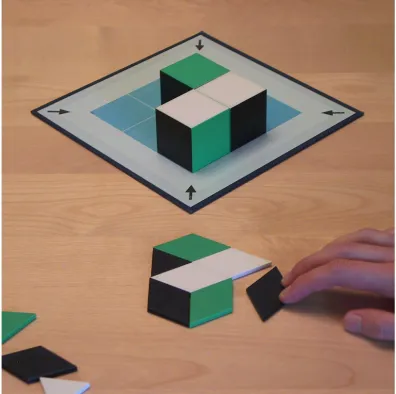
Figure 1. The Tridio® learning material, consisting of cubes, mosaic pieces and a board. Here, an isometric view
of the cube building on the board is being constructed using the mosaic pieces.
Tridio and spatial ability. Spatial ability can be expected to play a role in completing Tridio exercises, since these exercises require children to form and manipulate mental images. In many exercise types, the student has to construct three-dimensional cube buildings corresponding to two-dimensional representations of them (either isometric or orthogonal views), or translate two-dimensional views to three-dimensional cube buildings. This requires the student to mentally convert the given two- or three-dimensional object to the three- or two-dimensional structure to be produced. In addition, the task of constructing the isometric view of a cube building when viewed from another viewpoint requires mental rotation of the cube building. Furthermore, for some exercise types multistep mental manipulations are required, for example when a student has to directly create an isometric view of the cube building corresponding to three orthogonal views, without first constructing the cube building. Since the Tridio exercises, thus, provide practice in forming and manipulating mental images, they may be helpful in improving spatial ability.
and mentally manipulating spatial forms” (Carroll, 1993, p. 309). Therefore, one can expect Tridio to most likely affect the corresponding visualization ability.
An interesting question for this study is whether Tridio adds to the standard school curriculum in offering practice in spatial skills. As mentioned earlier, spatial ability plays a role in mathematics and science, which are, of course, also part of the school curriculum. If Tridio exercises are not more related to spatial ability than is the standard school curriculum, including math and science, they may not have an additional value in improving spatial ability. Before investigating the effects of Tridio on spatial ability, then, it is useful to study the relationship between children's Tridio performance and their spatial ability, controlling for school performance.
In which grade to use Tridio?
Tridio is not aimed at a specific age group or school grade (M. van Herel at Productief B.V., personal communication, September 10, 2007). Therefore, it was unclear on what age group the current study had to focus. To get a better idea about the grade for which Tridio (including all types of exercise) is most appropriate, we looked at the current use of Tridio in schools, Tridio-related learning goals appearing in curriculum standards, and Tridio-like activities proposed in literature.
Current use of Tridio. To examine in what grades Tridio is currently being used, telephone interviews were held with 15 (remedial) teachers who use the Tridio material in school. These teachers were contacted using customer data obtained from Productief B.V.
From the interviews, it became clear that Tridio is mainly being used in primary schools, but also some secondary schools make use of it. In secondary schools, Tridio is mostly employed in the earlier grades (grades 7 and 8; ages 13-14 years). It is used as a physical aid in understanding specific mathematical topics, like views, and not directly to enhance students' spatial abilities. In contrast, many primary school teachers mentioned some broader aim of using Tridio, like enhancing general math abilities or improving spatial knowledge.
Thus, there is no uniform policy in what grade to use Tridio. However, it seems that Tridio as a means to enhance spatial abilities fits better in the primary than in the secondary school curriculum, since in primary school there is more room and interest for “extra” subject matter, not specifically aimed at supporting the teaching of the school subjects. Because in this study we want to include all types of Tridio exercises (i.e., easy and more difficult ones), and since the most difficult exercise types are mainly employed in the higher grades of primary school, it appears that we have to focus on the upper grades of primary school (i.e., grades 3-6).
Curriculum standards. As a second source for deciding on the optimal grade for the Tridio training, we consulted curriculum standards for mathematics education, searching for learning goals related to the Tridio exercises. When looking at the Dutch attainment targets for primary school mathematics education, put forward by the TAL-team (Gravemeijer et al., 2007; Van den Heuvel-Panhuizen & Buys, 2005), Tridio seems most appropriate for grades 5 and 6. For these grades, the attainment targets include being able to relate three-dimensional objects to two-dimensional ones, knowledge about views and projection methods with which three-dimensional objects can be represented in two dimensions, and being able to operate on two- and three-dimensional objects and to predict and analyze the consequences of these operations. In the mathematics standards by the US National Council of Teachers of Mathematics (NCTM), the standards that are most related to Tridio can be found for grades 3-5. In these grades, students should, among others: “create … mental images of objects … ; identify and build a three-dimensional object from two-dimensional representations of that object; [and] identify and draw a two-dimensional representation of a three-dimensional object” (NCTM, n.d.).
isometric or orthogonal views of them, drawing orthogonal views, and constructing isometric views using rhombuses. Furthermore, Spiegel and Spiegel (2003) suggested several activities for 4th-graders, in which students have to reason about cube buildings displayed isometrically.
Taking into account the arguments from all three sources, i.e., the current use of Tridio in schools (grade 3-6), the curriculum standards (Netherlands: grades 5-6; US: grades 3-5), and the recommendations from literature (grade 4-7), we concluded that, in the Dutch situation, 5th grade would be optimal for a Tridio training consisting of all exercise types. Thus, we chose to work with 5th-grade, i.e., 11-year-old, students in our experiment.
Measuring spatial abilities
To examine the effect of Tridio on 5th-graders spatial ability, we needed an appropriate measure of spatial ability. As mentioned before, the Tridio activities can be expected to have greatest effects on the visualization (VZ) ability. The other “spatial” factor from Carroll's factor analysis, spatial relations (SR), focuses more on speed and less on power than does the VZ factor. It is interesting to study effects of Tridio on this factor, too, as a measure of “farther” transfer. Thus, we decided to include in the experiment tests of both VZ and SR.
adapting some of their tests, Vederhus and Krekling also reduced the number of response alternatives.
Modified versions of adult spatial tests can, thus, be used with children. However, some modifications may alter the nature of the task. For example, Kerns and Berenbaum (1991) adapted the MRT by using real, three-dimensional wooden cube objects as test items. In this way, the task probably requires less mental manipulation, since participants do not have to mentally translate a two-dimensional picture to a three-dimensional object. Furthermore, a test's nature may change when the number of response alternatives is reduced, as in this case the role of guessing increases.
To be able to accurately measure Carroll's factors, it is best to use test variants that resemble as closely as possible the original tests on which the factor structure was based. Thus, adult SR and VZ tests may be adjusted to children by clarifying the test instructions – for example by reading aloud instructions and showing model items – but preferably not by removing response alternatives or changing the task's nature. Little research has been done on the appropriateness of adult spatial tests adapted for children by instructional changes alone (Shavalier [2004] did administer tests in this way, but did not report on the success of this method). Therefore, a pilot study was conducted to investigate whether several adult SR and VZ tests, with the use of read-aloud instructions and model items, are appropriate for 5th grade students. This pilot study was also used to examine whether the original tests' time limits are suitable for this age group.
regular pencil (Johnson & Meade, 1985). Alternatively, the test's original scoring method can be used on the regular-pencil items. The power score is determined as a proportion-correct score over all attempted items, both the ones marked with regular pencil and with red pencil (Johnson & Meade, 1985).
Gender differences in spatial ability
The topic of gender differences in spatial ability is highly recurring in literature. Males typically outperform females on several spatial tasks (e.g., Halpern & Collaer, 2005). In accordance with this research tradition, an additional aim of the current study was to examine boy-girl differences in spatial ability.
Although male advantages have been found on various spatial tests, between different spatial tasks large variation exists in the size of these gender differences (Linn & Petersen, 1985; Voyer et al., 1995). For some VZ tests, like the Paper Folding test, usually no significant gender differences are found (Halpern & Collaer, 2005). On SR tests, moderate effect sizes of gender are present, of approximately .4 standard deviations (Voyer et al.). The largest and most robust gender differences exist on Vanderberg & Kuse's MRT. On this test, effect sizes between .7 and 1.0 standard deviations have been found, depending on the scoring method used (Voyer et al.).
Gender differences in children. Although gender differences in spatial ability have frequently been found for adults, they are not always observed in children. Johnson and Meade (1987) conducted a large study on the onset of gender differences on a composite measure of spatial skill. On this measure, they found gender differences to be present from the age of 10.
Others noticed that the age at which gender differences appear varies with the tests administered. In a meta-analysis, Voyer et al. (1995) found gender differences to be significant from 10 years on the generic mental rotation task (Shepard & Metzler, 1971) and the PMA Spatial Relations test (two-dimensional mental rotation) and from age 13 on the DAT Spatial Relations (deciding what a shape would look like when folded, a VZ task). On the Vandenberg and Kuse MRT, gender differences were found in 5th- and 6th-graders (11- and 12-year-olds) by Geiser, Lehmann, Corth, and Eid (2007). In Richmond's (1980) study with 10-year-olds, boys outperformed girls on Thurstone's (1941) Cards, Figures, and Flags (SR tests).
The absence of gender differences at younger ages may be related to the hormonal explanation of these differences, because hormonal differences between genders greatly increase at puberty. Another explanation for the lack of gender differences in younger children may be the inappropriateness of several of the tests for children (e.g., Voyer et al., 1995). Some researchers have, therefore, used adapted adult spatial tests in examining gender differences in children, like Johnson and Meade (1987) did in their previously cited study. Kerns and Berenbaum (1991) and Vederhus and Krekling (1996) used adapted versions of the MRT and of two-dimensional mental rotation tests with 9- and 10-year-olds and 9- to 13-year-olds respectively, and found significant gender differences in favor of boys on these tests. Shavalier (2004), in her study with 4th- to 6th-grade students, found gender differences on the Eliot-Price Test (a relatively unknown perspective taking test, probably measuring the VZ factor), but not on the MRT and the Paper Folding test.
Concluding, in our study with 5th-grade (11-year-old) students, we can expect to find boys outscoring girls on SR tests (two-dimensional mental rotation). For VZ tests, the picture is less clear, depending on the actual tests used. The MRT may display gender differences, as well as the Eliot-Price Test, but on other VZ tests, such as the DAT Spatial Relations and the Paper Folding test, probably no gender differences will be found.
received a lot of training by experience and thus already perform close to their maximum potential, whereas females have more room to improve (Baenninger & Newcombe, 1989). To a less extent, this may also apply to 11-year-olds, since at this age boys and girls may already differ in their toy-playing, sports, and scouting experiences. A meta-analysis by Baenninger and Newcombe, however, did not reveal significant gender differences in training effects. More recent studies also failed to find differences in training effects between males and females (Ben-Chaim et al., 1988; Casey et al., 2008; Clements et al., 1997; Sanz de Acedo Lizarraga & García Ganuza, 2003; Shavalier, 2004), thus not supporting the experiential hypothesis.
The current study
First, a pilot study was conducted to examine the appropriateness of some SR and VZ tests for 5th-grade students, and to determine suitable time limits for these tests.
Of the main study, the primary goal was to investigate the effects of the Tridio learning material on children's spatial ability. This was done by a matched pairs control group design with pre- and posttests of the SR and VZ factors of spatial ability. Matched pairs were used to increase the power of the study to detect effects on spatial ability (Cohen, 1988). Children's spatial ability pretest scores were used as the primary matching criterion, since these were expected to be related to their gain scores: Children with higher spatial ability may have less room for improvement than children having lower levels of spatial ability, whereas another hypothesis is that the spatial ability pretests may, additionally to being a measure of spatial achievement, be seen as measures of spatial aptitude, thus being predictive of future learning. From each obtained pair, one child was randomly assigned to the experimental condition and the other to the control condition. The experimental group was trained with Tridio during five sessions that spanned approximately three weeks, as recommended by Baenninger and Newcombe (1989) from the results of their meta-analysis of effects of spatial training. The control group received no intervention. The effects of the Tridio training could then be studied by comparing the gains from pretest to posttest of the experimental group children with those of their control group pairmates. In addition, the spatial ability pretest scores were used to examine gender differences in spatial ability.
children's Tridio performance with their spatial ability, as measured by the spatial ability pretests. In this way, insight could be developed into the role spatial ability plays in the Tridio exercises, which may give a clearer picture of the potential of Tridio in enhancing spatial ability. To be able to examine how much focus on spatial ability Tridio adds to the standard curriculum, we controlled for math and general school performance in investigating these relations.
The main study was aimed at answering the following research questions, for 5th-grade (11-year-old) children:
a) Is Tridio performance related to spatial ability, when controlling for school performance?
b) Does spatial ability increase by working with Tridio (i.e., is there a transfer effect)? c) Does Tridio performance improve by working with Tridio (i.e., is there a
content-specific learning effect)?
d) Is there a gender difference in spatial ability?
e) Is there a gender difference in the effect of the Tridio training on spatial ability?
Newcombe, 1989; Kass et al., 1998). However, in accordance with the findings of Baenninger and Newcombe and others (Ben-Chaim et al., 1988; Casey et al., 2008; Clements et al., 1997; Sanz de Acedo Lizarraga & García Ganuza, 2003; Shavalier, 2004), this gender difference was not expected to be found.
PILOT STUDY
The objective of the pilot study was to examine what spatial ability tests would be appropriate for 5th-grade (11-year-old) students and what time limits on these tests would be most suitable for these children. The results were used to decide what tests to administer in the main study.
Method
Participants
The pilot test was administered in a “groep 7”(grade 5) class at a Roman Catholic primary school in Enschede, a city in the east of the Netherlands. The participants were 22 children, mean age 11.1 (range 10.4 to 12.1), of which 7 were boys and 15 were girls.
Materials
The pilot test session consisted of six spatial ability tests (a seventh test was planned to be included, but due to time limits this test was not administered). As tests of Carroll's (1993) SR factor, the Card Rotations test (Ekstrom et al., 1976) and the Flags test (Thurstone & Thurstone, 1941) were administered. To measure VZ, we selected the Paper Folding test (Ekstrom et al., 1976), the Cubes test (Johnson & Meade, 1987), and two types of Mental Rotations tests both based on Shepard and Metzler's (1971) three-dimensional objects: the Vandenberg and Kuse (1978) version and the mental rotations test employed by Johnson and Meade. These are all timed paper-and-pencil tests. The test instructions were translated into Dutch and to make the instructions comprehensible for 11-year-olds, some complex sentences were simplified and difficult words were avoided.
card is different (i.e., its mirror image). In the Dutch translation we decided to use a box for each item, which has to be marked only if the card is the same as the target card, as shown in Figure 2.
Figure 2. Sample row of items from the Dutch translation of Ekstrom et al.'s (1976) Card Rotations test. The
cards that can be rotated to look the same as the leftmost card have been marked.
Flags test. In the Flags test, the task is to decide whether a pictured American flag is the same as a target flag. Each of the items shows a row of five flags, as can be seen in Figure 3. The leftmost flag is the target flag; the others are either rotations or (rotated) mirror images of the target. The participant is required to mark every flag that can be rotated to look the same as the target flag.
Figure 3. Sample item from the Flags test (Thurstone & Thurstone, 1941). The correct answers, the flags that
can be rotated to look the same as the leftmost flag, have been marked.
[image:28.595.75.439.408.480.2]Figure 4. Sample item from the redrawn version of Ekstrom et al.'s (1976) Paper Folding test. The second
picture correctly shows how the paper on the right would look after it is unfolded.
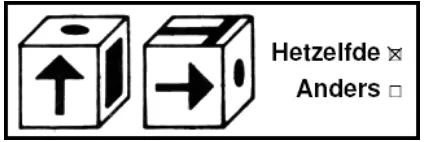
Cubes test. In the Cubes test, a test adapted for children by Johnson and Meade (1987), each item contains two pictures of a cube. The task is to decide whether these can both be pictures of the same cube or not, by marking an “S” (same) or a “D” (different) respectively. When translating this test into Dutch, these letters were replaced by the full Dutch words for same
(hetzelfde) and different (anders), since using only the first letter of these words would probably be confusing for the current age group (see Figure 5).
Figure 5. Sample item from the Dutch translation of the Cubes test used by Johnson and Meade (1987).
“Hetzelfde” (same) has been marked instead of “Anders” (different), because the two pictures can be of the same
cube.
Mental Rotations tests. The Mental Rotations test (MRT), based on the cube objects by Shepard and Metzler (1971), is probably the most studied test of spatial ability. Different versions of this test have been developed, the most well-known of which is the one by Vandenberg and Kuse (1978), which has been redrawn by Peters et al. (1995). Each item on this test consists of a target object on the left and four objects on the right (see Figure 6). Two of the objects on the right are rotated versions of the target object, whereas the other two are different objects. The participant's task is to mark those two objects that are the same as the target object.
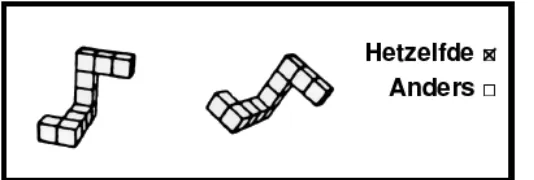
[image:29.595.79.523.71.117.2] [image:29.595.69.282.315.386.2]“D” respectively. These letters were translated into Dutch in the same way as was done for the Cubes test (see Figure 7).
[image:30.595.76.506.132.222.2]
Figure 6. Sample item from the redrawn Vandenberg and Kuse Mental Rotations test (Peters et al., 1995). The
second and third picture in the row of four are the correct answers, because they show a rotation of the leftmost
object.
Figure 7. Sample item from the Dutch translation of the Mental Rotations test used by Johnson and Meade
(1987). “Hetzelfde” (same) has been marked instead of “Anders” (different), because the two pictures display the
same object.
[image:30.595.78.345.298.388.2]Table 1. Pilot Test Characteristics.
Test
Number
of items Score formulaa
Score
range
Time limitb (min:sec)
Flags test 32 number correctly marked – number incorrectly markedc 0-60 5:00
JM Mental Rotations test 28 number correct / total number of items 0-1 2:40
VK Mental Rotations test 12 number correct 0-12 3:00
Card Rotations test 80 number correct – number incorrect 0-80 3:00
Paper Folding test 10 number correct – ¼ * number incorrect 0-10 3:00
Cubes Test 16 number correct / total number of items 0-1 1:30
Note. JM = Johnson & Meade; VK = Vandenberg & Kuse.
a
Drawn from the tests’ manuals. bDerived from the tests’ manuals. For tests of which only part of the items was administered, the time limit was altered accordingly. cUnmarked items are not considered.
Procedure
The children were tested in their regular class setting, in one session in the morning. This session lasted approximately 1.5 hours. The class teacher was present while the experimenter (the author) administered the tests.
Red pencil method. To try the red pencil method proposed by Johnson and Meade (1987, 2008) for use in the main study, this method was also employed in the pilot study. In this case colored pencils (not necessarily red) were used. According to the method, on each test the children were asked to start working with a regular pencil, and to switch to a colored pencil when instructed to (i.e., after a certain time limit). While working with the regular pencil, the students were allowed to correct answers using an eraser; when working with the colored pencil, correcting was no longer allowed. To avoid confusion, the participants were asked to put on the floor the writing material that was not in use (Johnson & Meade, 2008).
completed all items before the second time limit was reached. In this way, the second time limit disadvantaged fast children, since they could have obtained a higher score if more items were present. Since this is much less the case for the first time limit, the two time limits could, unfortunately, not be compared. However, the appropriateness of the first (original) time limits could be assessed.
Test instructions and administration. The children were asked to place their desks apart from each other. The experimenter told them that they would be doing a test on spatial ability, which would have no influence on their school grades. It was explained that spatial ability is the ability to imagine how things look, for example when objects are rotated in the mind. All children were given a regular lead pencil with an eraser on the back, and a colored pencil. Then, the experimenter read aloud the general test instructions. These instructions explained that the children always had to look carefully at the bottom of each page whether they were allowed to turn the page or had to wait until the experimenter told them to. Also, the children were instructed not to rotate the test booklet. The use of the two pencils was explained. The students were told to switch to the colored pencil when instructed to; the use of time limits was not mentioned. Finally, the children were asked to work as quickly as possible, but to keep working accurately. They were told guessing would be of no use, because wrong answers would be subtracted from their score.
square piece of paper was used. This was folded and a hole was cut in it, in the same way as was displayed in the example item. Subsequently, it was shown how this piece of paper looked when unfolded again. The example items of the Cubes test, finally, were illustrated using cardboard versions of the cubes appearing in the example items. These cubes were rotated to demonstrate that they could or could not be the same.
After the instructions to each test had been read and the model items had been shown, the participants completed the test's practice items, and their answers were checked. Students' questions were answered. The solution to the second practice item of the PFT was demonstrated with a piece of paper, because many children found this item difficult. The students were told that, when they would have finished the test, they had to wait quietly until everyone had finished. They were allowed to read a book in the meantime.
When there were no further questions, the children were instructed to start with the test items. A stopwatch was used for timing. When the test's time limit was reached, the participants were asked to put their regular pencil on the floor and to continue working with the colored pencil.
Because of the limited time available, for the Cubes test only a regular-pencil period was employed.
Results and Discussion
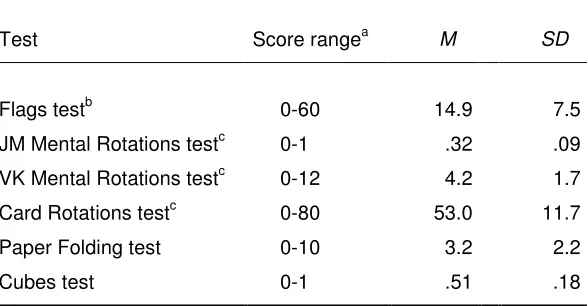
As mentioned before, the second time limits could not be compared to the first ones. Therefore, we only report the scores corresponding to the first (original) time limit of each test, i.e., including only the items marked with the regular pencil. The means and standard deviations of these scores are displayed in Table 2. To study the appropriateness of the tests and their time limits, boxplots were examined for floor and ceiling effects. A floor effect indicates that a test is too difficult or its time limit too strict, whereas in the unlikely case of a ceiling effect, the test can be considered as too easy or the time limit as too loose.
understanding the instructions. When looking at the ratio of correctly answered items to attempted items, the mean of this ratio was only .65, which does not exceed very much the chance proportion of .5. The apparent difficulty of this test agrees with Johnson and Meade's (1987) advise not to use the Cubes test below grade 6.
Table 2. Descriptive Statistics of the First Score of the Pilot Tests (n = 22).
Test Score rangea M SD
Flags testb 0-60 14.9 7.5
JM Mental Rotations testc 0-1 .32 .09
VK Mental Rotations testc 0-12 4.2 1.7
Card Rotations testc 0-80 53.0 11.7
Paper Folding test 0-10 3.2 2.2
Cubes test 0-1 .51 .18
Note. JM = Johnson & Meade; VK = Vandenberg & Kuse.
a
Range of possible scores. bTwo children seemed to have misunderstood the test. After eliminating these cases, the following values were obtained: first score: M = 16.2, SD = 6.5; second score: M = 27.3, SD = 10.9. cBefore computing these values, one outlier had been eliminated.
test manual (Peters, 1995), a time limit of 4 min for each part may be used instead of the standard 3 min. Although Geiser et al. (2007) successfully used the MRT-VK with the 3 min time limit with 5th- and 6th-grade children, the less strict time limit of 4 min might be more appropriate for children of this age, since the test had originally been constructed for use with adults.
Conclusions
Using read-aloud instructions and model test items in illustrating these instructions, all tests in the current study were found to be appropriate for 5th-graders, except the Cubes test, which was too difficult.
Both the MRT-JM and the MRT-VK can be used with this age group. The MRT-VK is preferred over the MRT-JM, since the former is more generally used and more reliable.
For the MRT-VK, a time limit of 4 min for each part seems appropriate for children of this age. On the PFT, the CRT, and the Flags tests, the original time limits can be used with 5th-graders.
MAIN STUDY
Method
Participants
Power analysis
To determine the number of participants required for the study to have sufficient power to detect possible transfer effects of the Tridio training on spatial ability, a power analysis was performed using the software program G*Power 3 (Faul, Erdfelder, Lang, & Buchner, 2007). As an estimate of the effect size, the medium value of .5 (Cohen, 1988) was chosen. For some earlier studies on transfer effects of training on spatial ability, effect sizes were reported or could be computed following Cohen. These effect sizes are all very high: Brinkmann (1966) found an effect size of .85; for Kwon's (2003) study, effect sizes of .81 and .97 were computed; and Sanz de Acedo Lizarraga and García Ganuza (2003) reported an effect size of .92. This makes an estimate of .5 for the effect size reasonably conservative.
When entering an α level of .05, a power of .80 (the convention proposed by Cohen,
1988), and an effect size of .5, a required sample size of 27 pairs was obtained for a one-tailed test.
Participants in the study
The experiment was conducted at a Roman Catholic primary school in Oldenzaal, a small town in the east of the Netherlands. All three classes of “groep 7” (grade 5) participated in the study. In total this amounted to 62 children. After a permission letter had been returned by the parents, two children were excluded from the study due to parent refusal. Another child was excluded, because she was absent during the spatial ability pretest week. This resulted in a total of 59 participants, mean age 11.1 (range 10.4 to 12.3), of which 27 were boys and 32 were girls.
contained 13 boys and 12 girls, mean age 11.1, and the control group comprised 11 boys and 14 girls, mean age 11.1. The remaining, non-matched children received the same treatment as the matched control group. For some of the analyses, the total group of 59 participants was used. This will be indicated where relevant.
Materials
Spatial ability tests
To measure children's spatial ability both before and after the intervention, four spatial ability tests were administered: two measuring SR and two measuring VZ. The tests were selected based on the conclusions of the pilot study: For measuring SR, the Card Rotations test (CRT) and the Flags test were employed, and as tests of VZ we used the Paper Folding test (PFT) and the Vanderberg and Kuse Mental Rotations test (MRT-VK).
Ja Nee Ja Nee Ja Nee Ja Nee Ja Nee Ja Nee Ja Nee Ja Nee
Figure 8. Sample row of items from the adapted Dutch translation of Ekstrom et al.'s (1976) Card Rotations test.
The correct answers have been marked. “Ja” (yes) has been marked if the card can be rotated to look the same as
the leftmost card; “No” (nee) has been chosen if this is not the case.
Splitting the tests. The original tests could easily be split into two halves, to be used as a pretest and a posttest. The original versions of the MRT-VK, CRT and PFT already consisted of two parts, both having the same number of items and the same time limit. The Flags test could be divided into two parts by taking the first 16 items as the first half and the last 16 items as the second half. For each of the four tests, the two halves seemed reasonably similar in difficulty. However, since no literature was found on the similarity of the two parts of any of the tests, exact similarity could not be assumed. The use of a control group, however, overcomes this problem.
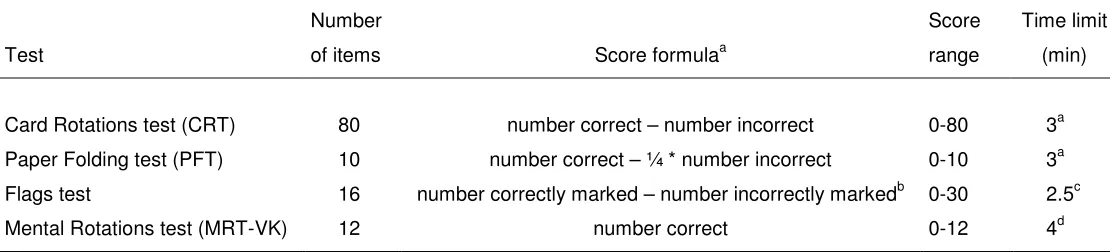
The first half of each test was used as a pretest and the second half as a posttest. The tests' instructions and practice items were given both at the pretest and at the posttest, in exactly the same form1. The characteristics of the thus obtained pretests and posttests are given in Table 3, including the time limits used for each test, which were based on the findings of the pilot study.
Test scores. For all four spatial ability tests, two scores were determined: a speed score and a power score. The speed score was computed following the test's original scoring method (Table 4), only taking into account the items completed within the time limit. After the time limit, the participants were allowed to finish the remaining items at their own pace. The computation of the power score included both the items completed within the time limit and those finished after time was up. This score was determined as the proportion of attempted items that was marked correctly.
1
One exception was the PFT. After administering the Paper Folding pretest, we discovered that the
second practice item closely resembled the seventh test item. To increase comparability of pre- and posttest, in
the posttest the second practice item was replaced by one that was highly similar to the seventh posttest item (see
Table 3. Characteristics of Spatial Ability Pre- and Posttests.
Test
Number
of items Score formulaa
Score
range
Time limit
(min)
Card Rotations test (CRT) 80 number correct – number incorrect 0-80 3a
Paper Folding test (PFT) 10 number correct – ¼ * number incorrect 0-10 3a
Flags test 16 number correctly marked – number incorrectly markedb 0-30 2.5c
Mental Rotations test (MRT-VK) 12 number correct 0-12 4d
aDrawn from the tests’ manuals. bUnmarked items are not considered. cHalf of the original test’s time limit was taken for half of the items. d
A 4 min time limit, which, according to the manual (Peters, 1995), can be used instead of the standard time limit of 3 min, was considered to be more appropriate for the current age group.
Tridio test
To be able to measure content-specific effects of the Tridio training and to study the relationship between Tridio performance and spatial ability, a test was developed to measure children's performance in working with Tridio. To determine how Tridio performance could best be operationalized, the existing Tridio exercise sets were analyzed. Six frequently found types of tasks were selected as being the core problem types of Tridio. One of these types can be seen as a combination of two other types: the two steps of going from orthogonal views to a three-dimensional cube building and from a cube building to an isometric view have to be taken at once. This problem type was supposed to be suitable only for children who have considerable experience with Tridio exercises. As at the time of the Tridio pretest the children were assumed to never have worked with Tridio before, it was decided not to include tasks of this type in the test. The other core problem types were considered to be appropriate for 11-year-old Tridio novices. This was confirmed by pilot sessions with two children of approximately this age. The Tridio test, then, was constructed to consist of five subtests, each measuring children's performance on one of these types of problems (see Figure 9 for an example of each problem type):
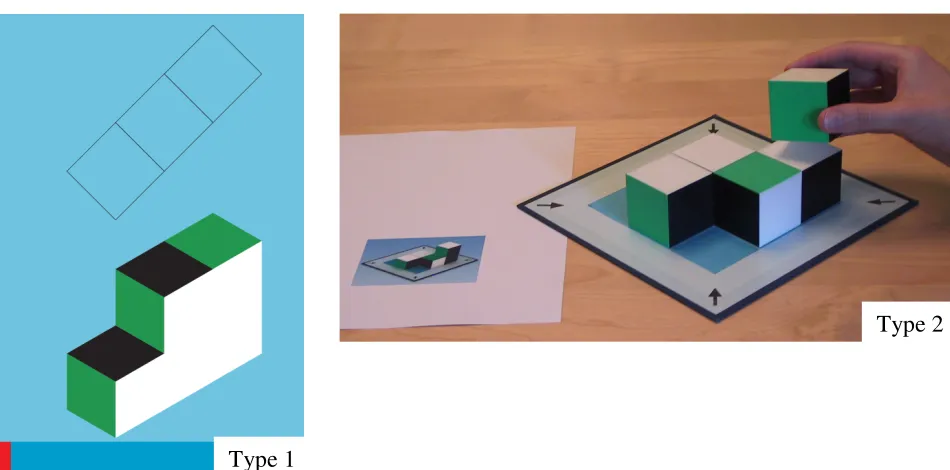
Type 1. The student is given an A4-sized book page on which an isometric view of a cube building is displayed. The task is to construct this cube building by placing cubes on the squares pictured at the top of the page, which have the same size as the cubes.
building is built on a cardboard board. This feature makes the task more difficult than a Type 1 task, since the positions of the cubes on the board have to be taken into account as well.
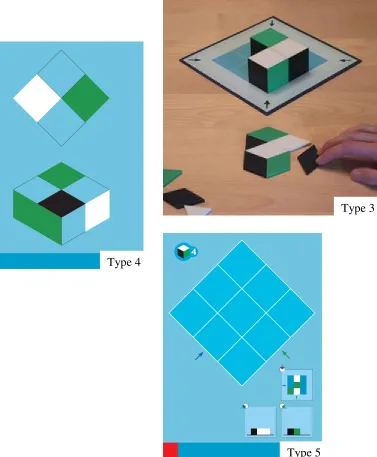
Type 3. The child is given a book page similar to those of Type 1 problems, but now some of the cube edges in the isometric view are uncolored, whereas some of the squares in the top picture do have a color. The colors of the squares indicate the colors of the cube building when viewed from the top. The task is to place cubes on the squares and to place mosaic pieces on the uncolored pieces of the isometric view picture – in which they fit exactly – in order to create a cube building and its isometric view.
Type 4. A cube building on the cardboard board is shown. The student has to construct a two-dimensional mosaic pattern corresponding to the isometric view of this building.
[image:41.595.63.538.388.623.2] [image:41.595.214.539.394.558.2]Type 5. The student is given a book page containing pictures of three orthogonal views of a cube building: a top view and two adjacent side views. Also, a board is displayed diagonally on the page, with a blue and a green arrow pointing to the sides of which the side views are given. By placing cubes on this board, the child is supposed to create a cube building that matches the three views.
Figure 9. Sample problems of each problem type in the Tridio test. In Type 1 problems, the task is to construct
the pictured cube building by placing cubes on the squares. Type 2 tasks require the child to create a cube
building on the board, corresponding to the isometric picture (continued on next page).
Type 1
Figure 9 (continued). In Type 3, the task is to put mosaic pieces in the empty spaces in the bottom picture and
cubes on the squares in the upper picture, such as to create a cube building and an isometric view that look the
same (continued on next page).In problems of Type 4, the student has to create a mosaic pattern representing the
isometric view of the presented cube building. In Type 5 tasks, the child is asked to construct a cube building on
the pictured board, corresponding to the pictures of two orthogonal side views (displayed at the bottom) and the
top view (the upper picture). A blue and a green arrow indicate the positions of the side views and the orientation
of the top view. On the top left of the page, the number of cubes to be used is given.
In the Tridio exercise sets, the problems of Type 5 were also found in another form: using the cardboard board instead of a board displayed on a book page. This makes the task unnecessarily complicated, as in the absence of the blue and green arrows confusion about the
Type 5
Type 3
[image:42.595.115.492.72.529.2]orientation of the different views can easily arise. Therefore, it was decided to use the book page version of these assignments.
Scoring method. A scoring method based on judging the degree of correctness of completed Tridio assignments would probably be arbitrary, because it is unclear what aspects of a child's solution are most important. Therefore, it was decided to measure performance on each subtest by determining the number of correctly completed assignments within a time limit. For this method to produce reasonable variation between children, time limits had to be long enough for highly performing children to be able to finish a fair number of tasks (approximately 5 on each subtest). Also, all problems of a certain type had to take similar amounts of time to be solved. The number of cubes or mosaic pieces involved in a certain assignment can be seen as reasonable predictor of the time it takes to solve it. Obviously, it takes longer to construct cube buildings or mosaic patterns when they consist of more pieces. In addition, problems involving larger buildings or patterns usually are more difficult, thus requiring more time.
Exercises. From the existing Tridio exercise sets (Productief B.V., 2003, 2005, 2006a, 2006b, 2006c, 2006d, 2006e), several problems of each type were selected, each involving roughly the same number of cubes or mosaic pieces and thus expectedly requiring similar amounts of time to be solved. Problems were selected that were considered to be easy enough to allow inexperienced students to solve them and, at the same time, difficult enough to be able to produce some variation between children. In cases where the exercise sets did not contain enough appropriate exercises, additional problems were created. For the problems of Type 4, the material delivered to the student consists of cube buildings constructed by the experimenter. For each of these tasks, the form of the cube building was prespecified, but the positions of the colors were not, as this would inhibit fast construction of the cube buildings during test administration.
In this way, for each subtest a set of tasks was composed. These sets were pilot-tested with a 10-year-old and a 12-year-old with no previous Tridio experience. The tasks were found to be suitable for these children.
as was found in the pilot sessions. Also, similar problem types (Type 1 and 2, and Type 3 and 4) followed each other, which probably decreased the amount of instruction needed.
From the results of the pilot tests, time limits for each subtest were determined that would allow for a fair amount of exercises to be completed by high-performance students (one of the pilot children could be considered as highly performing). Subtests 1 and 2 were allotted 2 min time; for Subtests 3, 4, and 5, the time limit was set to 3 min. The number of assignments in each subtest was chosen to be high enough for any child to be unable to complete them all within the given time limit. Subtests 1, 2, and 3 consisted of 8 assignments each, whereas Subtests 4 and 5 both had 10.
Each subtest started with the task that was considered to be easiest. The remaining tasks were randomly ordered in advance. Thus, the order of the assignments within each subtest was the same for all participants, which made test scores comparable. An easy practice problem was included for every subtest. For each subtest (except for Subtest 4), the assignments were put together in a folder, each on a separate page, starting with the practice problem.
Posttest. The tasks for the Tridio posttest were adapted from those of the pretest. For Type 1 and Type 3 assignments, the mirror image was taken and the edge colors were systematically exchanged. Problems of Type 2 and 4 were only mirrored (in the format of Type 2 exercises, changing colors was not possible, while Type 4 problems did not have predefined colors). Type 5 assignments were modified by rotating the top view picture by 180°, adapting the side view pictures accordingly, and exchanging colors. Both the order of the subtests and the order of the tasks within each subtest were kept the same as in the pretest.
Procedure
schedule, this test was only administered to the experimental group. Finally, all children completed a questionnaire on their attitudes towards the tests and Tridio.
Table 4. Phases of the Experiment.
Phase
Experimental
group
Control group and
non-matched
children Period
Spatial ability pretests * * week 1
Tridio pretest * * week 2-3
Tridio training * week 3-6
Spatial ability posttests * * week 7
Tridio posttest * week 7
Questionnaire * * week 7
Note. The * symbols indicate which participant group(s) was/were involved in each
phase of the experiment.
Spatial ability tests
The four spatial ability tests were divided over two sessions, each containing an SR test and a VZ test. The SR tests were given first in both sessions, as these were considered to be easiest. In the first session the CRT and then the PFT were administered, while the second session consisted of the Flags test and the MRT-VK. The order of the tests was the same for pretest and posttest. The two tests of each session were put together in a booklet. The first page of each booklet was a title page, on which the children had to fill out their names; the second page contained general instructions to the test session, which were the same as in the pilot study and were repeated for each test session.
The tests were administered using the same procedure as in the pilot study. To be able to compute both speed and power scores, the red pencil method described by Johnson and Meade (1987, 2008) was used, although in this case pens were used instead of red pencils. In the current study, every child was allowed to fully complete each test, to minimize the influence of children's working speed on their power scores. The model items used in the pilot test were again employed in illustrating the test instructions. For the MRT-VK, models of the example items were shown in the same way as was done for the MRT-JM in the pilot study. At the end of each test session, the children were asked not to discuss the test with the children in the other classes.
Three children were absent during one or both of the pretest sessions. To two of them the missed test sessions could be administered later in the same week. The other child was excluded from the study, because she was absent the entire week. On the posttest sessions, all students were present, except for one child on the first session. This child took the missed session later that week.
Matching procedure
controlled for. But to answer the research question whether the effect of Tridio on spatial ability differs by gender, same-gender pairs would be useful.
To be able to make pairs on the basis of pretest scores, a combined pretest score had to be determined. This was done by first standardizing all eight pretest scores (i.e., four speed scores and four power scores), and then computing the median of the obtained Z-scores for each child. The median was chosen instead of the mean, because this measure of centre is more resistant to outliers than is the mean. In this context, this means that the median does not give extra weight to extreme scores compared to less extreme scores, whereas the mean does. As a compromise, the mean Z-score was also taken into account: Children whose mean Z -scores were too far apart were not matched to each other.
It was not possible to create enough pairs matching on all three criteria. Therefore, we decided to use the criteria in the order described above, first matching on combined pretest score and then, if possible, on class and gender. This matching procedure resulted in 25 pairs. The median Z-scores of paired children differed at most 0.15 from each other. The maximum difference between mean Z-scores was 0.35. Of the pairs, 22 consisted of two children from the same class, whereas in 3 pairs the children were from different classes. The matching on gender was less successful: Ten of the pairs were same-gender pairs, while in 15 of them the pairmates had different genders.
From each pair, one of the children was randomly assigned to the experimental condition and the other one to the control condition.
Tridio test
Because of the tactile nature of the Tridio tasks and the transience of its solutions, in-class administration of the Tridio test was not feasible, since this would not allow for checking the correctness of all children's answers. Also, cheating would probably be a problem. Therefore, the Tridio pretests and posttests were administered individually, in a separate room in the school. The children were taken out of their classes one by one to do the test.
Before starting each subtest, the practice assignment was shown to the child and it was explained what had to be done. Then, the child was asked to make this assignment. When problems arose, the child was helped in solving them. Mistakes were corrected. It was made sure the student understood the task. Next, the most important features of the problem type were briefly repeated. Participants were instructed to state they were ready whenever they would have finished an assignment, and not to turn the page to the next exercise until the experimenter said so. For Subtest 4, in which the tasks were not printed on book pages, the children were told that when they said they were ready, the experimenter would quickly construct the next cube building.
The students were instructed not discuss the test with other participants.
Test administration. Each child was observed while working on the assignments. When the child reported being ready, the experimenter asked if it was sure about its answer. This was done because, as had become clear in the pilot sessions, children easily overlook minor mistakes in their solutions, such as one cube edge having a wrong color. Explicitly asking if they were sure encouraged the children to have a second look at their answer and to detect possible errors. Several children actually discovered mistakes after this question was asked. Children were allowed to change their answer if they wished. When they were satisfied with their solution, they were told to go on with the next problem (or, in Subtest 4, the experimenter built the next cube building). Without the child seeing it, the experimenter wrote down whether the answers were correct.
All test sessions were videotaped (except in cases where the child or its parents refused this), to allow for a qualitative analysis to be conducted in a future study. Also, this created the possibility of rechecking the answers.
The time was kept with a kitchen timer, which beeped when time was up. If at that moment the child had nearly finished the current problem, it was asked to complete it. Otherwise, the child had to stop. For children who were not being filmed, the amount of extra time they needed to finish the last assignment was recorded.
To check children's previous experience with Tridio, they were asked if they had ever worked with the material before. All children answered “No” to this question.
sessions reserved for that class. For the posttest sessions, a semi-random order was used, sometimes exchanging test sessions to accommodate to the classes' teaching schedules. If a child was absent on the day it was supposed to be tested, its session was swapped with that of another child yet to be tested, so that no time was lost. In this way, none of the children missed their test session.
Scoring. The score on each of the Tridio subtests was determined by the number of tasks correctly completed within the time limit. The timing onset was not very precise: Some children slowly turned the page to the first problem when they were instructed to start, others quickly did so; sometimes something went wrong in starting the timer. Therefore, it seemed fair to include in the score those exercises that had been finished just after time was up. This can be seen as a sort of rounding: When an exercise is correctly completed just after the time limit has been reached, more than half of it has probably been done within the allotted time, in which case the number of correctly completed exercises can be rounded upwards. It was decided that tasks that were finished within an extra time of at most 5% of the time limit would be considered on time. Thus, for Subtests 1 and 2 all problems that were completed within 6 seconds after time was up were included in the score, whereas for Subtests 3, 4, and 5, assignments were allowed to be finished at most 9 seconds beyond the time limit. Whether an exercise had been completed within this 5% extra time, was decided by watching the test session videos, or, for the participants who were not filmed, using the recorded amount of extra time needed.
The subtest scores were not summed up to obtain a single Tridio test score, because, since mean scores varied between subtests, this would not give equal weights to all scores. Instead, the test scores were analyzed separately for each subtest.
Tridio training
the Tridio training had to be an adaptive one, in which the sequence of exercises would depend on the child's needs. This would give the opportunity of thoroughly practicing exercises with children who experience many problems with them. On the other hand, faster children would be able to go through easier exercises more quickly, and to continue with more challenging ones, which would likely keep them motivated.
Training sessions. For the training to be adaptive and to allow for help and assistance, the Tridio training had to consist of individual sessions with a trainer. This corresponds to the current use of Tridio in some primary schools, as examined by the telephone interviews mentioned in the Introduction section, held with 11 primary school teachers. Although most schools (8) use Tridio as a self-working in-class activity, some (3) treat it in individual sessions with a remedial teacher. One teacher remarked that Tridio was not very suitable to work on without support, because children found it difficult or tended to skip exercises.
Another lesson learned from the pilot study is that the training had to take at least 2 hours to cover all core types of Tridio exercises. To be on the safe side, the total duration of the training was decided to be 2.5 hours. Because long training sessions would probably be detrimental to children's motivation, and because repetition would probably improve the effectiveness of the training (Baenninger and Newcombe, 1989), the 2.5 hours were split up into five sessions of 30 minutes each.
Exercises. In the Tridio training sessions, all problem types that were part of the Tridio tests were treated, accompanied by several other types of exercises found in the Tridio exercise sets. Some extra problem types not present in the original exercise sets were added, because they were assumed to be helpful in understanding some other task types. The exercise types appearing in the Tridio training are listed in Appendix C.
The order in which the exercise types appeared in the training was based on increasing difficulty. For the exercise types that were considered most important, repetition was built in: Exercises of these types appeared in two consecutive training sessions. Furthermore, exercise types involving only isometric views were treated separately from problem types dealing with orthogonal views. The exact distribution of the exercise types over the training sessions is given in Appendix C.