THE MITOTIC INDEX AND INTERPHASE PROCESSES
BY P. M. B. WALKER
Biophysics Research Unit, King's College, London
{Received 14 November 1952)
The mitotic index of a cell population, defined by Champy as the per mille propor-tion of the populapropor-tion in any mitotic stage, has long been regarded as an important criterion of the growth and multiplication of tissues. It is commonly measured in fixed and stained specimens, and therefore represents the stage of the material at the time of filing only. However, cells grown in tissue culture may be observed and photographed for a considerable period before any measurement is made; such observations, which have been reported elsewhere (Walker & Yates, 1952a, b), show that some cytochemical results may require reinterpretation.
In recent years the distribution of DNA (desoxyribonucleic acid) has been one of the principal subjects of investigation in cytochemistry, and it is clearly interesting to study the synthesis of a material so closely associated with the chromosomes in as many cell types as possible. However, although the errors in the cytochemical procedures involved have been often discussed (Caspersson, 1936; Wilkins, 1950; Glick, Engstrdm & Malmstrom, 1951; Ornstein, 1952; Davies & Walker, 1953), the presentation of the results and the conclusions that may legitimately be drawn from them have not been so completely studied. Further, the conditions in which the mitotic index may be correlated with any synthesis during interphase do not appear to have been fully considered.
On the assumption that mitoses occur at random intervals, the mitotic index and the measured duration of mitosis have been used to calculate the length of inter-phase (Olivo & Delorenzi, 1932; Hughes, 1952). More recently, quantitative cytochemical methods applicable to single cells have been employed to study DNA synthesis during the interphase of dividing cells (Pasteels & Lison, 1950; Swift, 1950; Walker & Yates, 19526); these latter methods had already supplied evidence which supported the hypothesis of DNA constancy for diploid non-dividing cells which had been deduced from the results of nucleic acid extraction from counted nuclei (Boivin, Vendrely & Vendrely, 1948; Mirsky & Ris, 1949). These cyto-chemical techniques are photometric, and the total amount of naturally occurring absorption or of stain is measured as the product of mean extinction and projected area. The usual method of presenting the results has been in the form of a frequency histogram, in which the amount of the substance, plotted along the abscissa, is divided into equal intervals, and the height of each section corresponds to the number of cells falling within the interval.
The mitotic index and interphase processes 9
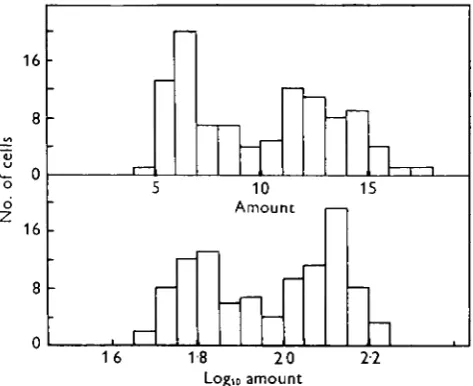
1949; Leuchtenberger, Vendrely & Vendrely, 1951). In certain tissues containing polyploid nuclei, the values fall into unimodal classes, the mean values of which are multiples of one another. A second type of distribution has a wider range of values, which is sometimes bimodal and in which the mean of one mode is approximately twice that of the other (Fig. 1 a). This type is found in dividing tissues and we have shown by direct observation that in the nuclei of certain tissue culture cells it is associated with the synthesis of the measured substance during interphase. There are thus intermediate values not accounted for by any overlap between the modal distributions.
o Z
16
8
16
8
0
-—
T
5 10 Amount
: J
1 \V^
1—1
15
1
16 1-8 20
i amount
[image:2.595.181.418.272.465.2]22
Fig. 1. Histogram summarizing the quantity of Feulgen staining material in tissue culture interphase nuclei, plotted with equal linear (a) and logarithmic (6) intervals dividing the histogram groups.
total population will have increased to 121. Thus, as these twenty cells get older they form a progressively smaller fraction of the total population, reaching 10% at about the eighth hour.
The above example is illustrated graphically in Fig. 2. Since the mitotic index, interphase and mitotic times are interrelated, the decrease in the height of the groups will be the same for any constant mitotic index after the appropriate changes in the units have been made. A rising mitotic index will cause a more rapid decrease with increasing age, and the converse will occur with a falling index.
acio
n
ndo
d
0
V
DO
Percent
a
18
14
10
•
-•
0 2 4 6 8 Age in hours
Fig. 2. Histogram showing the percentage of the cell population in different age-groups, where the mitotic index is 10 % and the length of mitosis i hr.
It is obvious that allowance should be made for the unequal size of the different age-groups when calculating the shape of the synthesis curve. I am indebted to Prof. Longuet-Higgins, both for indicating the presence of this higher proportion of younger cells and for deriving the following expression relating the fraction of the population in each histogram group to the fraction of the generation time (interphase and mitosis) required for the measured quantity to increase between the limits of this group. It is assumed that growth in the whole population is logarithmic (i.e. that the mitotic index is constant) and that the quantity of substance synthesized after any fraction of the generation time (which however may itself vary) is the same for all cells.
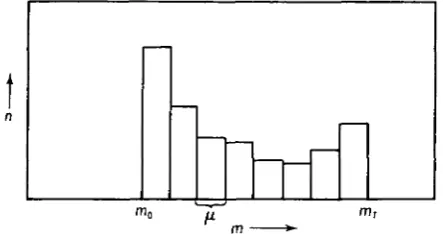
Let us consider the histogram shown in Fig. 3, in which the ordinate represents the number of cells (w) and the abscissa the amount of substance in the cell, which ranges from m0 to mT, where mT=2tn0. T is the total generation time of the cell.
The histogram is divided into v groups each of equal increments /x of the substance measured. A series of difference equations may now be derived for each histogram group employing the subscript notation of the difference calculus:
2-o(m0+/.)/T _ 2-aimt)IT = _ ^ (
(3) <f> is the fraction of the total population in the designated histogram group and a(m)
quan-The mitotic index and interphase processes 11
tity m. a(m0) in equation (i) is zero, so 2~°(m°)/T becomes unity and it is therefore
possible to solve this equation knowing either <f> or a\T. This result may then be substituted in equation (2), and the process repeated until a/T becomes unity and the synthesis curve or histogram is complete.
It appears from the above equations that it is unnecessary to know the generation time and that a lengthening of this period will not affect the histogram shape provided that the initial assumptions are valid.
Tf
[image:4.595.189.411.250.367.2]m
Fig. 3. An ideal histogram, where m^ and ntr are the quantities of substance present at the beginning and end of each cell generation. n is the extent of the interval limits and v =
5-These calculations are also necessarily based on the premise that the sample included in the histogram is representative not only of the population but also of all stages in synthesis. This cannot be so for cells that are not synthesizing the measured substance and whose generation time is infinite. In the rapidly dividing nuclei of chick fibroblasts grown in vitro we find variations both in interphase times and in rates of synthesis, and a proportion of cells that are not synthesizing DNA. Clearly this proportion of 'non-participating' cells will have to be deducted from the group m0 (Fig. 3) before the difference equations can be applied.
Another factor, which in practice is found to influence the shape of the histo-gram, is the spread of values above and below the theoretical limits m0 and mT.
This spread, which also occurs in the unimodal distributions found for non-dividing tissues, is usually ascribed to experimental error although it is also possible that individual nuclei show variation. It has the effect of artificially flattening the higher end of the histogram to a greater extent than the lower, since, while the error is probably proportional to the quantity measured, the histogram intervals are normally constant linear increments. The apparent change in shape arising from this spread of results is illustrated by the two histograms in Fig. 1, in which the same values are plotted with both linear and logarithmic increments dividing the groups.
whose values have been obtained from other evidence, fall on the dividing lines between the groups. It is assumed that the values outside these limits are due to experimental error,* and they have, as an approximation, been added to those groups within the limits as shown in Fig. 4B. The synthesis curves derived from the corrected histogram and for the same histogram with 20 % non-participating cells are shown in Fig. 4C. This proportion of non-participating cells does not therefore materially affect the shape of this synthesis curve. If the increase had occurred earlier, the effect would have been more marked.
16 •
8
-= 0
8
-n rr
A 12
10
B 6 ;
4
2
Nuclea
r V
content
s
4 6 8 10 12 0 Nuclear contents 10~1!g. nucleic acid
02 0 4 0-6 0-8 Fraction of interphase time 10
Fig. 4. A, experimentally determined histogram for the ultra-violet absorbing contents of chick tissue-culture nuclei. B, the corrected histogram. C, the synthesis curves derived from histogram B if ( x ) all cells are participating in the cell cycle, and (O) if 20 % of the population are not so participating.
It is also possible to derive a histogram from the shape of the synthesis curve. This converse procedure may be particularly useful in determining whether the results of biochemical extraction procedures, which measure the average amount of substance in a large sample of dividing cells, are compatible with a proposed synthesis curve for that substance. Thus if we consider the synthesis curve illustrated in Fig. 5 A, then the histogram in Fig. 5B will represent a random sample of the population if all the cells are participating in the whole cell cycle. The average nuclear content of a population of cells so distributed is approximately 6-6. This is 132 % of 5-0, the latter being the average nuclear content of a cell population which is similar in all respects to the population previously considered except in that none of the cells is participating in the cycle. If a fraction of the population is non-participating the proportion of nuclei within the histogram group 5-5-5 will be
The ntitotic index and interphase processes 13
correspondingly increased and the average amount of substance in the whole population decreased. If this non-participating fraction is 20% the average nuclear content will be 6-4, which is 128% of 5-0. Hence the mean value measured in practice may be used to check the validity of a proposed synthesis curve.
It has been implicit in the preceding sections that the wide spread of results reported from photometric measurements on dividing tissue nuclei reflects an increase during interphase of the measured substance (DNA). This view has, as we have seen, been supported both by our own results obtained by direct measurement and by Swift (1950) employing photometric methods, and by other workers with different techniques (Howard & Pelc, 1950; Price & Laird, 1950). Recently,
how-Fraction of Interphase time
6 7 8 Nuclear contents
Fig. 5. A, theoretical synthesis curve for nuclear contents in arbitrary units. B, the histogram derived from A.
ever, Moore (1952) has sought to show that this interpretation is invalid, and that the spread of values found in her material is some function of differentiation. She bases this view on her observations that in the embryonic tissues of Rana pipiens similar histograms are obtained from tissues with a very different mitotic index. Moore considered that if Swift's data are to be interpreted as demonstrating inter-phase synthesis of DNA, then there should be a positive correlation between the mitotic index and the range of values found in a frequency histogram during interphase. This is not so. If DNA doubles during interphase in dividing cells, any random sample will (experimental errors being neglected) fall within a fixed range
MQ—mT, where m0 is the amount of DNA in the post-telophase nucleus. The
(equations (i)-(3)) and is, as we have shown, independent of the total generation time. The mitotic index, on the other hand, depends on two factors; first the proportion of the cell population which participates in the whole cycle of interphase leading to division, and secondly, the relative lengths of interphase and recognizable mitotic stages. If the participating fraction does not vary, the mitotic index will remain constant provided that the ratio of interphase to mitotic time does not alter. On the other hand, if interphase time doubles while the mitotic time remains the same, the mitotic index will be halved without changing the shape of the histogram. The essence of the confusion lies in our inability to distinguish (in material other than tissue cultures) between the two immediate causes of variation in the mitotic index. So long as interphase was treated as a resting stage and no difference could be detected between interphase cells, it did not matter whether a declining mitotic index was the result of a lengthening of interphase without a corresponding increase in the mitotic period, or whether a proportion of the cells ceased to divide while others continued to do so at the original rate. However, this distinction must be made if interphase processes are to be investigated, since a mitotic index change caused by variations in interphase and mitotic times alone will not alter the shape of the measured histogram, while a change due to an increasing proportion of non-participating cells will result in a histogram with a larger fraction of cells at m0.
In this short discussion we have considered certain theoretical aspects of mitotic indices and the indirect derivation of rates and times of synthesis during interphase. Clearly it would be most satisfactory if the synthesis of a substance could be followed by consecutive measurements on the same cell. This would be a laborious and slow process even if the possibility of radiation damage in ultra-violet micro-spectrography (Davies, 1950) did not at present make this an unreliable procedure. Photographing a culture over a period prior to making the measurements is one direct method of obtaining most of the necessary information, although variation in interphase time among the cells measured can make interpretation difficult.
In any event, it would appear that further information about the behaviour of tissue cells is necessary before synthesis curves may be accurately deduced or the weight of Moore's criticism assessed. Unfortunately, direct observation is neces-sarily confined to the study of cells grown in vitro, and the conditions found in tissue culture may not hold for tissues in vivo. The methods now being developed by Howard & Pelc (personal communication) employing the autoradiographic technique, may make it possible to infer the length of interphase and the proportion of participating cells in other materials. It should then be practicable to investigate how far the factors that we have discussed above apply to materials other than tissue cultures. Deductions as to the times and rates of synthesis and their correlation with the mitotic index will then rest on a surer foundation.
SUMMARY
The mitotic index and interphase processes 15
substance in a single cell may be derived from the histogram, provided certain assumptions hold. Appropriate formulae are presented.
3. The significance of the mitotic index in relation to interphase processes is also considered. It is concluded that the relation between the shape of a histogram and the mitotic index of the tissue cannot be defined unless the durations of interphase and mitosis and the proportion of cells participating in the interphase-mitotic cycle are known.
4. The difficulty of obtaining the latter information from any material other than tissue cultures is discussed.
As mentioned in the text, my thanks are particularly due to Prof. H. C. Longuet-Higgins. I would also like to thank Dr H. B. Fell, F.R.S., Miss H. B. Yates and Dr H. G. Davies for their critical and helpful comments on the manuscript.
REFERENCES
BorviN, A.,VENDRELY, R. & VENDKELY, C. (1948). L'acide desoxyribosenucleique du noyan cellulaire, dgpositaire des characteres hereditaires; argument d'ordre analytique. C.R. Acad. Set., Paris,
336, 1061-3.
CASPERSSON, T. (1936). Uber den chemischen Aufbau der Strukturen des Zellkerns. Skand. Arch. Phytiol. 73, (Suppl. 8).
DAVIES, H. G. (1950). Ultraviolet microspectrography of living tissue culture cells, part I. Disc. Faraday Soc. no. 9, 442-9.
DAVIES, H. G. & WALKER, P. M. B. (1953). Microspectrometry of living and fixed cells. Progress in Biophysics (ed. Butler and Randall), 3, 195-236.
GLICK, D., ENGSTROM, A. & MALMSTROM, B. G. (1951). A critical evaluation of quantitative histo-chemical and cytohisto-chemical microscopic techniques. Science, 114, 253-8.
HOWARD, A. & PELC, S. R. (1950). Nuclear incorporation of P " as demonstrated by Autoradio-graphs. Exp. Cell Res. 3, 178-87.
HUGHES, A. F. (1952). The Mitotic Cycle. London: Butterworth.
LEUCHTENBBRGER, C , VBNDRKLY, R. & VENDRELY, C. (1951). A comparison of the content of
desoxyribosenucleic acid (DNA) in isolated animal nuclei by cytochemical and chemical methods. Proc. Nat. Acad. Set., Wash., 37, 33-8.
MIRSKY, A. E. & RiS, H. (1949). Variable and constant components of chromosomes. Nature, Lond., 168, 666-7.
MOORE, B. C. (1952). Desoxyribose nucleic acid in embryonic diploid and haploid tissues, Chromo-soma, 4, 563-76.
OLIVO, O. M. & DELORENZI, E. (1932). Ricerche aulla velocita di accrescimento delle cellule e degli organi. III. Arch. exp. Zellforsch. 13, 221-57.
ORNSTEIN, L. (1952). The distributional error in microspectrophotometry. Lab. Invest. 1, 250—62. PASTEELS, J. & LISON, L. (1950). Recherches histophotometrique sur le teneur en acide
desoxy-ribosenucleique au cours de mitoses somatiques. Arch. Biol., Paris, 61, 445-74.
PRICE, J. M. & LAIRD, A. K. (1950). A comparison of the intracellukr composition of regenerating liver and induced liver tumors. Cancer Res. 10, 650-8.
Ris, H. & MJRSKY, A. E. (1949). Quantitative cytochemical determination of desoxyribonucleic acid with the Feulgen nuclear reagent. J. Gen. Physiol. 33, 125-45.
SWIFT, H. H. (1950). The desoxyribose nucleic acid content of animal nuclei. Physiol. Zool. 33, 169-98.
WAUKER.P.M. B. & YATES, H. B. (1952a). Ultraviolet absorption of living cell nuclei during growth and division. Symp. Soc. Exp. Biol. 6, 265—76.
WAUCER, P. M. B. & YATES, H. B. (19526). Nuclear components of dividing cells. Proc. Roy. Soc. B, MO.