[ 553 ]
THE SWIMBLADDER AND THE VERTICAL MOVEMENTS
OF TELEOSTEAN FISHES
I. PHYSICAL FACTORS
BY F. R. HARDEN JONES
Department of Zoology, Queen Mary College, University of London (Received 20 April 1951)
(With Three Text-figures)
CONTENTS
PAGE
I n t r o d u c t i o n . . . . . . 5 5 3 T h e r e l a t i v e v o l u m e o f t h e s w i m b l a d d e r . . . - 5 5 4 T h e c h a n g e i n d e n s i t y . . . . 5 5 5 T h e r e s t r i c t i o n t o r a p i d v e r t i c a l m o v e m e n t s . . . - 5 5 5 T h e r e s t r i c t i o n t o s l o w v e r t i c a l m o v e m e n t s . . . - 5 5 6 T h e e x p e r i m e n t a l w o r k . . . 5 5 7 P h y s i c a l f a c t o r s 5 5 8 T h e r e s i s t a n c e o f f e r e d t o t h e e x p a n s i o n o f t h e s w i m b l a d d e r g a s . . . 5 5 8 T h e p e r c e n t a g e v o l u m e o f t h e s w i m b l a d d e r . . . 5 6 0 D e n s i t y d e t e r m i n a t i o n s . . . 5 6 1 R u p t u r e o f t h e b l a d d e r w a l l 5 6 2 D i s c u s s i o n 5 6 3 S u m m a r y 5 6 4 R e f e r e n c e s 5 6 5
INTRODUCTION
enlarge-554 F- R- HARDEN JONES
ment of the bladder may lead to the eversion of the stomach through the moutff (Hickling, 1927) or to a rupture of the bladder wall (Graham, 1924). Moreau believed that this danger would be less for a physostome than for a physoclist, as while the former could get rid of the excess gas rapidly by using the pneumatic duct as an escape valve, the latter could do so by the slower process of gas resorption which may take several hours. He concluded that a swimbladder, and in particular a closed one, would restrict the vertical movements of a teleost by confining it at any given moment to a definite bathymetrical range.
There is very little information available from which any conclusions can be drawn about the extent to which the presence of a swimbladder restricts the vertical movements of a teleost. The problem is of interest as it is known that various teleosts undertake diurnal, seasonal or other periodic migrations involving vertical displacements (Murray & Hjort, 1912; Vedel Taning, 1918; Pearse & Achtenberg, 1918; Hickling, 1925; Johansen, 1925; Russell, 1928; Southern & Gardiner, 1932; Allen, 1935; Hasler & Bardach, 1949). Does the swimbladder restrict the magnitude or speed of these movements? Furthermore, it has been suggested that fish may be the scatterers responsible for the diurnal migration shown by the deep scattering layer (Chapman, 1947; Dietz, 1948; Hersey & Moore, 1948; Johnson, 1948; Moore, 1950; Boden, 1950). If an estimate could be made of the restriction that the swim-bladder imposes on vertical movements the information might be of interest in connexion with this and other scattering layers.
In the present paper an attempt is made to determine the extent to which the presence of the swimbladder restricts the vertical movement of the perch, Perca fluviatilis Lin. Before passing on. to the experimental work the problem is first considered from a theoretical point of view, and it is shown how the swimbladder might restrict the vertical movements of a teleost and on what factors the extent of the restriction will depend.
The relative volume of the swimbladder
The average density of a fish, excluding the swimbladder, may be taken as 1-076 (Taylor, 1921). A fresh-water physoclistous fish in hydrostatic equilibrium with water of density 1 -ooo and occupying a total volume of 100 ml. can be shown to have a swimbladder of approximately 7 ml. For if x is the volume of the swimbladder then
1-076 (100 — x)=ioo,
# = 7-06, say 7 ml.
554 F- R- HARDEN JONES
ment of the bladder may lead to the eversion of the stomach through the moutlP (Hickling, 1927) or to a rupture of the bladder wall (Graham, 1924). Moreau believed that this danger would be less for a physostome than for a physoclist, as while the former could get rid of the excess gas rapidly by using the pneumatic duct as an escape valve, the latter could do so by the slower process of gas resorption which may take several hours. He concluded that a swimbladder, and in particular a closed one, would restrict the vertical movements of a teleost by confining it at any given moment to a definite bathymetrical range.
There is very little information available from which any conclusions can be drawn about the extent to which the presence of a swimbladder restricts the vertical movements of a teleost. The problem is of interest as it is known that various teleosts undertake diurnal, seasonal or other periodic migrations involving vertical displacements (Murray & Hjort, 1912; Vedel Taning, 1918; Pearse & Achtenberg, 1918; Hickling, 1925; Johansen, 1925; Russell, 1928; Southern & Gardiner, 1932; Allen, 1935; Hasler & Bardach, 1949). Does the swimbladder restrict the magnitude or speed of these movements? Furthermore, it has been suggested that fish may be the scatterers responsible for the diurnal migration shown by the deep scattering layer (Chapman, 1947; Dietz, 1948; Hersey & Moore, 1948; Johnson, 1948; Moore, 1950; Boden, 1950). If an estimate could be made of the restriction that the swim-bladder imposes on vertical movements the information might be of interest in connexion with this and other scattering layers.
In the present paper an attempt is made to determine the extent to which the presence of the swimbladder restricts the vertical movement of the perch, Perca fluviatilis Lin. Before passing on. to the experimental work the problem is first considered from a theoretical point of view, and it is shown how the swimbladder might restrict the vertical movements of a teleost and on what factors the extent of the restriction will depend.
The relative volume of the swimbladder
The average density of a fish, excluding the swimbladder, may be taken as 1-076 (Taylor, 1921). A fresh-water physoclistous fish in hydrostatic equilibrium with water of density 1 -ooo and occupying a total volume of 100 ml. can be shown to have a swimbladder of approximately 7 ml. For if x is the volume of the swimbladder then
1-076 (100 — x)=ioo,
# = 7-06, say 7 ml.
The swimb\adder and the vertical movements of teleostean fishes 555
The change in density
A fresh-water fish in hydrostatic equilibrium at a depth of 20 m. is under a total pressure of 3 atm.; the 20 m. level may be called the fish's plane of equilibrium. According to Moreau, when the fish swims up, the swimbladder and thus the volume of the fish as a whole increases, with the result that its density decreases. Whether or not the gas obeys Boyle's law will depend on the passive resistance that the bladder wall and surrounding tissues offer to its expansion and on the degree to which the fish can actively control the volume of its swimbladder by muscles lying in or about the bladder wall. If resistance is offered to the expansion of the swim-bladder gas, the density change will be less than that which would occur if the gas were to expand unhindered.
The restriction to rapid vertical movements
Confining the argument to movements which the fish might make above its plane of equilibrium, a distinction can be made between rapid movements characteristic of normal locomotion, and slow movements which occur during the course of diurnal, seasonal or other periodic migrations. By a rapid movement is meant one during which the fish moves so quickly from one level to another that it will be unable to make any appreciable adjustment in the volume of its swimblad,der.
If a fish moves rapidly above its plane of equilibrium for a small distance, its volume increases and its density decreases. To maintain its station at the new and higher level the fish must resist its buoyancy by the action of its fins until its density has been restored to that of the environment by the removal of the excess gas from the swimbladder. But the force that the fish can resist by the compensatory move-ments of its fins is limited. So that the fish would be carried to the surface if it made a rapid movement that produced, through the decrease in density, a force greater than that which could be resisted by the fins. Furthermore, a large pressure reduction might lead to a rupture of the bladder wall. The limit to a rapid ascent will therefore depend on the force that can be resisted by the compensatory swimming movements. The pressure reduction which produces the critical force will depend on the change in the density of the fish. This in turn will depend on the resistance offered to the expansion of the bladder gas, and the amount by which the gas expands will also depend on the original volume of the swimbladder. And other things being equal, as the swimbladder is relatively greater in fresh-water than in marine teleosts, its presence will impose a greater restriction on the movements of the former than on those of the latter.
556 F. R. HARDEN JONES
density decreases for which it could compensate satisfactorily. It could then remaiH at the new level. There would then be a narrow zone within which the fish could swim freely and a wider zone into which it would make only temporary excursions.
The restriction to slow vertical movements
If the fish were to migrate from deep to shallow water it must move fairly slowly from one level to another. Suppose the fish is in hydrostatic equilibrium at a depth of y m. below the surface. The pressure P in atmospheres at that depth will be given by the equation P = ky+i (1)
where k is a constant for the increase in pressure with depth. If the fish moves up through the small distance — 8y, then the pressure change SP will be
SP=k8y, (2)
. . . dP kdy
and in the limit - T T = I — — . (1)
P ky+i u /
If the fish is to remain in hydrostatic equilibrium as it moves up, the rate of gas resorption must keep pace with that of the vertical movement. The time dT that it will take the fish to pass through the distance — Sy will therefore depend on B, the rate at which it can adjust its density when subjected to the relative pressure reduction -dPjP,
dT=-BT (4)
= - 5 ^ . (5)
If the fish is considered as moving from a low to a higher level in a series of little steps, then the total time T taken to pass from a depth ^ of pressure Px to a shallower depth 4 of pressure Ps is given by the equation
g
(6)
Integrating between the limits ly and /g
S
(8)
^ . (9)
The swimbladder and the vertical movements of teleostean fishes 557
TOtisfactorily. If the fish were migrating from deep to shallow water the fastest way in which it could complete the movement would be to swim up for this distance rapidly and then to proceed slowly, adapting the volume of its swimbladder to avoid any further decrease in density. For example, suppose the fish could maintain its station when the total pressure to which it was adapted was reduced by one-tenth. If it swims up for this distance rapidly, it is no longer adapting itself to the pressure difference between Px and P2 but to the smaller difference between x^Px and P2. Substituting for P1 in equation (9),
T=B l o g . ^1 (10)
= 2 M o g . £ - l o g . ^ , (11)
p
or in a general form T=B log, -j^— C, (12) where B and C are constants for a particular fish, B being a iactor for the rate of adaptation to a reduction in pressure and C being a correction for the initial rapid movement of the fish.
So for a physoclist there are two restrictions which the presence of the swimbladder might impose to vertical movements involving a reduction in pressure. First, a restriction on the extent of a rapid movement, and secondly, a restriction on the speed with which the fish can migrate from one level to another. In a similar way it can be shown that the swimbladder restricts movements involving an increase in pressure. So the fish may be considered as having a definite bathymetrical range within which it can pass rapidly from one level to another. But if it were to move outside its range, the speed with which it could swim up or down would depend on the rate at which it could adjust the volume of its swimbladder when subjected to changes in hydrostatic pressure. On the other hand, a physostome would be able to move freely above its plane of equilibrium, but its descents would be restricted in the same way as those of a physoclist.
The experimental work
The restriction that the swimbladder imposes to vertical movements involving a reduction in pressure will depend on physical factors such as
(1) The resistance jhat the bladder and body wall offer to the expansion of the bladder gas.
(2) The percentage volume of the swimbladder and the density change of the fish when it is subjected to a reduction in pressure.
558 F. R. HARDEN JONES
CalUonymus lyra, which has no swimbladder. Experiments on the restriction rapid and slow movements were confined to perch. These experiments could only be made with reductions in pressure. When subjected to an increase in pressure the perch would rest quietly on the bottom of the tank and no observations could be made on their behaviour or rate of gas secretion. But with decreases in pressure everything was quite satisfactory and results were obtained.
The experimental work is presented in three sections: (1) Physical factors.
(2) The restriction to rapid movements. (3) The restriction to slow movements.
Section 1 is included here, while the other two appear in a following paper.
PHYSICAL FACTORS
As Jacobs (1933) has shown that the perch is unable to control the volume of its swimbladder by muscular action, experiments were made to determine what passive resistance might be offered to the bladder gas in this fish. The percentage volume of the swimbladder was found in the perch, wrasse and rockling and the results correlated with the density changes shown by these fish when they were subjected to reductions in pressure. Experiments were made with perch to determine the pressure reduction that led to the rupture of the bladder wall.
The density measurements of the perch were made in London with fish obtained from dealers. Other experiments with this species were made at Wray Castle on perch trapped in Windermere. The work with the marine species was done at the Plymouth Laboratory. All the fish used were about 10 cm. long.
The resistance offered to the expansion of the swimbladder gas Method
A perch was subjected to a pressure reduction and the volume change measured. The fish was then killed and the volume of the swimbladder determined. By expressing the observed volume changes as percentages of the original volume of the swimbladder, the experimental results may be compared directly with those that would be obtained with a gas expanding freely under the same conditions. If any resistance was offered to the expansion of the bladder gas, the experimental results would be less than those calculated from Boyle's law.
The swimbladder and the vertical movements of teleostean fishes 559
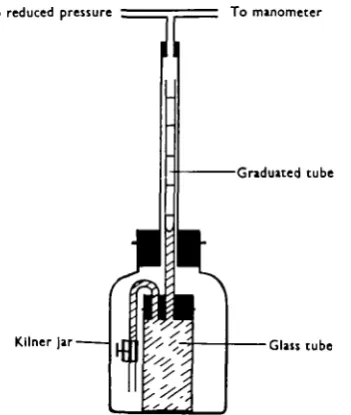
The volume of the swmbladder. The volume of the swimbladder could not be found directly by displacement as it was too delicate to remove easily. So the fish was killed, gutted and the head and tail removed leaving the bladder attached to the trunk of the fish. The trunk and bladder were put into a density bottle improvised from a 100 ml. weighing bottle. The bottle, water, trunk and bladder were weighed to the nearest o-i g. The trunk was then removed, the bladder torn away and a second weighing made with the trunk in the bottle. The difference between the two weighings gave the weight of water displaced by the swimbladder.
The passive resistance offered to the expansion of the bladder gas was calculated from the results of experiments made on ten perch.
To reduced pressure
Kllner
jar-To manometer
Graduated tube
Glass tube
[image:8.451.146.322.218.426.2]Fig. 1. Apparatus to measure the change in volume of a fish subjected to a reduction in pressure.
Table 1. Volume changes of perch when subjected to different pressure reductions
expressed as a percentage of the original volume of the swimbladder
Pressure reduction in cm. Hg
Volume change expected (%)
Volume change found (%), mean of ten experiments
5
7 7
1 0
15 15
15
25 23
2 0
36
31 25
49 42
3O
65
52
Results
560 F. R. HARDEN JONES
The percentage volume of the swimbladder Method
The percentage volume of the swimbladder was found after determining the volume of the fish and that of its swimbladder. Experiments were made with perch, wrasse and rockling.
70
-60
50
40
5> 30
20
10
10 15 20 25 30
Pressure reduction In cm. Hg
Pig. 2. Percentage change in volume of the perch's swimbladder at different pressure reductions. Expected and experimental results. Data from Table i.
The volume of the fish. This was found by displacement. After a standard drying procedure a fish was dropped into a measuring cylinder holding a known amount of water. The cylinder was then filled up to the top mark. Knowing the amount of water added to fill the cylinder and that already in it, the volume of the fish was found by subtracting the sum of the two volumes from the capacity of the cylinder. This roundabout method was better than dropping the fish into the cylinder and noting the change in meniscus level directly. If there is sufficient water to cover the fish some is always lost by the splashing of the tail as it enters the water.
The volume of the swimbladder. The volume of the perch's swimbladder was found in the manner described earlier. In the case of the wrasse and the rockling it was found by collecting and measuring the volume of the gas in the bladder.
The swimbladder and the vertical movements of teleostean fishes 561
esults
[image:10.451.65.387.113.191.2]The results are set out in Table 2 below.
Table 2. The percentage volume of the swimbladder
No. of determinations Mean(%) -Standard deviation
Perca fluviatUii
29
7-S
09
CrenUabrus melops
20
49
0-7
Onos mustela
16
I - I
o-8
Density determinations Methods
Experiments were made with perch, wrasse, rockling and dragonet to determine the density changes undergone by these fish when they were subjected to pressure reductions. The density of a fish was found by determining its weight and volume at a known temperature. The fish was then subjected to a reduction in pressure and the increase in its volume measured. Its volume at a given pressure reduction was found by adding the observed volume change to the original volume of the fish. Assuming its weight to remain constant, the density of the fish at different pressures may then be calculated. Before a determination a fish was kept for 24 hr. in a tank filled with water to a depth of 60 cm. As this head of water exerts a pressure equivalent to about 4 cm. Hg on the bottom, the fish were considered as being adapted to a total pressure of 76 + 4 = 80 cm. Hg.
Density determinations. Lowndes's (1937, 1941) displacement method was used for the wrasse, rockling and dragonet. A density bottle of known volume was weighed full of sea water, a fish inserted and the bottle weighed again. To find the volume of the fish the density bottle was filled with sea water and the contents washed into a 200 ml. volumetric flask which was made up to the mark with distilled water. The halide solution was titrated with silver nitrate. The density bottle was again filled with sea water and the fish inserted. The water and washings, made with isotonic sodium nitrate, were poured into a second 200 ml. flask. A second titration was made which is less than the first. The volume of the fish can be calculated from the results of the two titrations. Dr Lowndes very kindly loaned a calibrated density bottle and the use of a balance for these experiments.
While the principle of Lowndes's method is applicable to fresh-water animals (Lowndes, 1937) it was found more convenient to use a simpler method for the perch. It is less accurate than that devised by Lowndes but adequate for the purpose of the experiments. A density bottle was made from a 100 ml. weighing bottle, and its weight full of water was consistent to o-oi g. The bottle was partly filled with water and weighed. After a standard drying procedure a perch was inserted and the bottle weighed again. The weight of the fish was found by subtraction. The density bottle was then filled with water and a third weighing made with the fish inside. The density of the fish could then be calculated. The weighings were made to the nearest
01 g.
562 F. R. HARDEN JONES
The volume of the fish. After a density determination a fish was subjected a reduction in pressure and the increase in its volume measured. The apparatus and method have already been described. The pressure was reduced by 30 cm. Hg, readings of the meniscus level being taken after every 5 or 10 cm. reduction.
From the results of the two series of experiments the density of a fish could be calculated at a given pressure reduction. Experiments were made with five fish of each species.
The sinking factor. The densities of fresh-water and marine animals may be compared by mean of the sinking factor (or s.f.), a term introduced by Lowndes (1937) which is numerically equal to 1000 times the quotient obtained by dividing the density of the animal by that of its environment. When a fish is in hydrostatic equilibrium the sinking factor will be 1000. From the experimental results the snaking factor of eacn fish was calculated, and for this purpose the density of Plymouth sea water was taken as 1-026 and that of fresh water as i-ooo.
Results
The results are set out in Table 3, where the densities, sinking factors and changes in sinking factors are given for different pressure retiuctions. As might be expected, Callionymus, lacking a swimbladder, showed no change. The perch with the largest swimbladder showed the most change, while the rockling with the smallest swim-bladder showed the least. This can be seen in Fig. 3, where the change in sinking factor is plotted against the pressure reduction.
Table 3. Densities, sinking factors and change in sinking factors for perch,
wrasse, rockling and dragonet at different pressure reductions
Pressure reduction in cm. Hg ...
Perca fluviatilis, five experi-ments Crenilabnu melops, five experiments Onos musUla, five experiments Callionymus lyra, five experiments Density Standard dev. Sinking factor Change in s.f. Density Standard dev. Sinking factor Change in s.f. Density Standard dev. Sinking factor Change in s.f. Density Standard dev. Sinking factor Change in s.f.
0 1-005 0-005 1005 0 1-032 O-O02 I0O7 O I-O5O O-0O5 IO24 O I-O83 0-016 1056 S i-ooo O-OO5 IOOO 5 1-029 0-0O2 IOO3 4 1 0 O-99S 0-005 995 1 0 1-026 0-003 IOOO 7 1-048 0-005 1022 2 1 5 0-988 0-005 988 17 I-O2I 0-002 995 1 2 No change No change No change 2 0 0-982 0-004 982 23 1-017 0-003 991 16 1-046 0-006 1020 4 observed observed observed 25 0-975 0-005 975 3° I-OI2 O-OO3 986 2 1 30 0968 0-005 968 37 1-007 0-004 9 8 2
25
1-O43 0-007 1016
8
Rupture of the bladder wall
miesults
The szoimbladder and the vertical movements of teleostean fishes 563
From Table 4 it will be seen that the swimbladders of male perch ruptured when the pressure was reduced by 43 cm. Hg and those of females at a reduction of 45 cm. Hg. The difference has no statistical significance ('t' test, o-2>P>o-i), and pooling the data the mean pressure reduction comes to 44 cm. Hg. As the perch were adapted to a total pressure of 77 cm. Hg this reduction is approximately three-fifths of the total pressure to which they were adapted.
40
30
o S
n
? 20
_c
4> _C
c 10
10
Dragonet swimbladder absent
I I I I I I
25 30
[image:12.451.101.358.187.390.2]5 10 15 20 Pressure reduction in cm. Hg
Fig. 3. Change in sinking factor for perch, wrasse, rockling and dragonet subjected to pressure reductions. Data from Table 3.
Table 4. Pressure reduction required to rupture the swimbladder wall of male and female perch adapted to a total pressure of 77 cm. Hg
Sex
Males Females
No. of experiments
20 12
Pressure reduction in
cm. Hg
43 45
Standard deviation
4
4
Discussion
When the swimbladder functions as a hydrostatic organ it should occupy a volume of about 7 % in a fresh-water teleost and about 5 % in a marine species. The correla-tion between a large swimbladder and a low sinking factor in the perch and the wrasse and a high sinking factor and a small swimbladder or its absence in the rockling and the dragonet was therefore to be expected. In the rockling the swim-bladder would not appear to function as a hydrostatic organ, and both this fish and the dragonet swim with difficulty.
[image:12.451.52.406.424.514.2]564 F. R. HARDEN JONES
The changes in the sinking factors of the perch, wrasse, rockling and. dragonet pressure reductions of 10, 20 and 30 cm. Hgare in the average ratio of 7-5:5-2:1-5:0, while the relative sizes of their swimbladders are in the very similar ratio of 7-5.-4-9:1-i :o. As can be seen in Fig. 3 there is a relation between the size of the bladder and the amount by which the sinking factor decreases when the fish are subjected to reductions in pressure. Other things being equal the larger the swim-bladder, the greater the change in sinking factor. And as the swimbladder tends to be relatively larger in fresh-water than in marine teleosts, the experimental results show, as suggested earlier, that its presence might therefore restrict the movements of the former more than those of the latter. But any means by which the volume of the swimbladder might be reduced and the sinking factor still kept low, such as increasing the average fat content of the tissues (Taylor, 1921), would reduce its restrictive influence and thus be of advantage to a pelagic fish. A swimbladder with a thick wall capable of resisting the expansion of the bladder gas would have a similar effect. But the bladder wall of the perch is thin and offers little resistance to the expansion of the bladder gas, and the density of the fish changes considerably when it is subjected to a pressure reduction.
The swimbladder of the perch burst when the total pressure to which it is adapted is reduced by three-fifths. The results of these experiments have been confirmed by those of a series of trapping experiments made in Windermere (Jones, 1949), in which the bladders of over 600 perch were examined after the fish had been hauled rapidly to the surface from different depths. Fish brought to the surface from a depth of 13-7 m. (45 ft.) are subjected to a pressure reduction of three-fifths, and from the results of the laboratory experiments it would be expected that all the fish taken from a depth of 13-7 m. or more would have broken bladders, while those taken from shallower water would have their bladders intact. This was generally so. Now the rupture of the bladder wall is probably fatal, and about 90 % of the fish taken from deep water soon die. It is therefore reasonable to suppose that in normal circumstances a perch would not make a rapid ascent that led to the rupture of its bladder wall.
To summarize the discussion: Experiments show that there is a relation between the relative size of the swimbladder and the change in the density of a fish when it is subjected to a reduction in pressure; that the bladder and body wall of the perch offer little resistance to the expansion of the bladder gas; and that the danger of the bladder wall rupturing might restrict the extent of a rapid movement.
SUMMARY
The vertical movements of a teleostean fish may be restricted by the presence of the swimbladder, which will increase or decrease in volume when the fish moves up or down in the water.
It is shown that the restriction that the swimbladder imposes to vertical movements involving a reduction in pressure will depend on physical factors such as
The swimbladder and the vertical movements of teleostean fishes 565
(2) The percentage volume of the swimbladder and the density change of the fish when it is subjected to a reduction in pressure.
(3) The pressure reduction that leads to the rupture of the bladder wall. A distinction is made between rapid and slow movements. In the former the compensatory ability of the fish must be considered and in the latter the speed with which the fish can accommodate itself to pressure changes.
An equation is derived from which the minimum speed at which a physoclist can migrate from deep to shallow water can be calculated. To solve the equation two factors must be determined experimentally.
Various experiments are described which were made on the perch, Percafluviatilis, the wrasse, Crenilabrus melopSj the rockling, Onos mustela and the dragonet, Callio-nymus lyra. The results showed that there was a relation between the relative size of the swimbladder and the change in the density of a fish when it is subjected to a reduction in pressure; that the bladder and body wall of the perch offer little resistance to the expansion of the bladder gas; and that the danger of the bladder wall rupturing might restrict the extent of rapid movements made by the perch.
Experiments on the restriction that the swimbladder imposes to the rapid and slow vertical movements of the perch will be described in .a following paper.
My thanks are due to Prof. A. J. Grove, under whose supervision the work was carried out. I am grateful to Dr G. Chapman and other friends for help with the typescript and to the Director and staff of both the Freshwater and the Marine Biological Associations for advice and assistance. Dr C. W. Kilmister kindly helped with the mathematics. Finally, I must thank Dr A. G. Lowndes for advice about the density experiments. I am grateful to London University, Queen Mary College and the D.S.I.R. for financial support while the work was in progress.
REFERENCES
ALLEN, K. R. (1935). The food and migration of the perch (PercaflttviatUis) in Windermere. J. Amm.
Ecol. 4, 264-73.
BODEN, B. (1950). Plankton organisms in the deep scattering layer. Rep. U.S. Navy Electronics Lab. no. 186.
CHAPMAN, W. M. (1947). The wealth of the oceans. Sri. Mm., N.Y., 66, 192-7.
DIETZ, R. S. (1948). Deep scattering layer in the Pacific and Antarctic Oceans. J. Mar. Res. 7,
430-42.
GRAHAM, M. (1924). The annual cycle in the life of the mature cod in the North Sea. Fish Invest. ser. 2, 6, no. 6.
HASLER, A. D. & BARDACH, J. E. (1949). Daily migrations of perch in Lake Mendota, Wisconsin.
% Wildl. Mgt. 13, 40-51.
HERSEY, J. B. & MOORE, H. B. (1948). Progress report on scattering layer observations in the Atlantic Ocean. Tram. Amer. Geophys. Un. 39, 341-54.
HICKLING, C. F. (1925). Notes on euphausids. J. Mar. Biol. Ass. U.K. 13, 735-45.
HICKLING, C. F. (1927). The natural history of the hake. Parts I & II. Fish Invest, ser. 2, 10, no. 2. JACOBS, W. (1933). Untersuchungen zur Physiologie der Schwimmblase der Fische. II. Die
Volum-regulation in der Schwimmblase des Flussbarsches. Z. vergl. Physiol. 18, 125—56.
JOHANSEN, A. C. (1925). On the diurnal vertical movements of the young of some fishes in Danish waters. Medd. Komm. Havunderseg., Kbh., Fiskeri, 8, no. 2.
JOHNSON, M. W. (1948). Sound as a tool in marine ecology, from data on biological noises and the deep scattering layer. J. Mar. Res. 7, 443-58.
566 F. R. HARDEN JONES
LOWNDES, A. G. (1937). The density of some living aquatic organisms. Proc. Linn. Soc. 150th session, part 2, 62-73.
LOWNBES, A. G. (1041). The displacement method of weighing living aquatic organisms. J. Mar.
Biol. Ass. U.K. Z5, 555-74.
MOORE, H. B. (1950). The relation between the scattering layer and the Euphausiacea. Biol. Bull.
Woods Hole, 99, 181-212.
MOREAU, A. (1876). Recherches exp^rimentales sur les fonctions de la vessie natatoire. Arm. Sci.
not. Zool. ser. 6, 4, 1-85.
MURRAY, SIR J. & HJORT, J. (1912). The Depths of the Oceans. 821 pp. Macmillan, London. PEARSE, A. S. & ACHTENBERG, H. (1918). Habits of the yellow perch in Wisconsin Lakes. Bull. U.S.
Bur. Fish. 36, 294-366.
PLATTNER, W. (1941). Etudes sur la fonction hydrostatique de la vessie natatoire des poissons. Rev.
suisse Zool. 48, 201-338.
RUSSELL, F. S. (1928). Vertical distribution of Marine Macroplankton. VIII. Further observations on the diurnal behaviour of the pelagic young of teleostean fishes in the Plymouth Area. J. Mar.
Biol. Ass. U.K. 15, 829-50.
SOUTHERN, R. & GARDINER, A. C. (1932). The diurnal migrations of the Crustacea of the plankton in Lough Derg. Proc. R. Irish Acad. B, 60, 121-59.
TANTNG, A- VEDEL (1918). Mediterranean Scopelidae. Rep. Danish Oceanogr. Exped. Medit., Biol. a, A, 7.