Punching Shear Strength Development of Bubble
Deck Using FRP Stirrups
Guruprabha S
1, Athira Das
21 PG Scholar, Department of Civil Engineering, Sri Vellapally Natesan College of Engineering 2Asst.Professor, Department of Civil Engineering, Sri Vellapally Natesan College of Engineering
Abstract: Bubble deck slab is a method of virtually eliminating all concrete from the middle of a floor slab, which is not performing any structural function, thereby dramatically reducing structural dead weight. High density polyethylene hollow spheres replace the in-effective concrete in the centre of the slab, thus decreasing the dead weight and increasing the efficiency of the floor. By introducing the gaps, it leads to 30 to 50% lighter slab which reduces the loads on the columns, walls and foundations, and of course of the entire building. In slabs, thickness of compressed concrete is only a small proportion of the slab depth and this means it involves only the concrete between the surface and ball. So there is no sensible difference between the behaviour of a solid
slab and bubble deck. But weight of bubble deck slab is low compared to solid slab, so punching shear capacity of bubble deck is very low. This study deals with what will be the effect of strengthening system such as CFRP and GFRP to improve the load carrying capacity of bubble deck slab and to find which FRP is better. Finite element software ANSYS 16.0 is used for nonlinear analysis of bubble deck slab.
.Keywords: Bubble deck slab, Polyethylene, CFRP, GFRP, Punching shear.
I. INTRODUCTION
The bubble deck slab is a revolutionary biaxial concrete floor system developed in Europe. High-density polyethylene hollow spheres replace the ineffective concrete in the centre of the slab, thus decreasing the dead weight and increasing the efficiency of the floor. For the construction of bubble deck slab it requires three main materials. They are steel, plastic spheres and concrete. This slab have many advantages over a normal solid slab such as lower total cost, reduced material use, improve structural efficiency, construction time decreased, and is a green technology. When the load is act on a structure compressive force is fully taken by concrete above neutral axis and tensile force is taken by steel in tension zone, so there is no sensible difference between flexural strength of solid slab and bubble deck slab. But punching shear capacity of bubble deck slab is a crucial problem. Bubble deck slab have low weight compared to solid slab. Thus punching shear capacity of bubble deck slab is low. Punching shear is a type of failure in flat slabs due to localized forces. In flat slab this occurs at column support points. The failure occurs due to shear. It is a catastrophic failure because no visible signs are shown prior to failure. In this study bubble deck slab is strengthened with CFRP in different schemes. Compared to GFRP, CFRP have more tensile strength. ANSYS 16.0 is used for analysis.
II. NEED FOR THE STUDY
Bubble deck slab is a revolutionary biaxial concrete floor system, it eliminate concrete in centre of slab which is not performing any structural action. In slabs, thickness of compressed concrete is only a small proportion of the slab depth and this means it involves only the concrete between the surface and ball. So there is no sensible difference between the behaviour of a solid slab and bubble deck. But weight of bubble deck slab is low compared to solid slab, so punching shear capacity of bubble deck is very low. This study deals with what will be the effect of strengthening system such as CFRP and GFRP strips to improve the load carrying capacity of bubble deck slab. Finite element software ANSYS 16.0 is used for nonlinear analysis of bubble deck slab.
III.SCOPE AND OBJECTIVES
The scope of the study is to investigate the effect of CFRP strips and GFRP strips to increase punching shear capacity of bubble deck slab and their comparison using ANSYS 16.0.The objectives are:
A. To compare conventional and bubble deck slab using ANSYS workbench 16.0.
B. To study the punching shear development of bubble deck slab by providing CFRP and GFRP strips in different schemes
IV.METHODOLOGY
In this study a solid slab and bubble deck slab was modelled. Bubble deck with FRP’s in different scheme was also modelled.
A. Modelling of Solid and Bubble Deck Slab
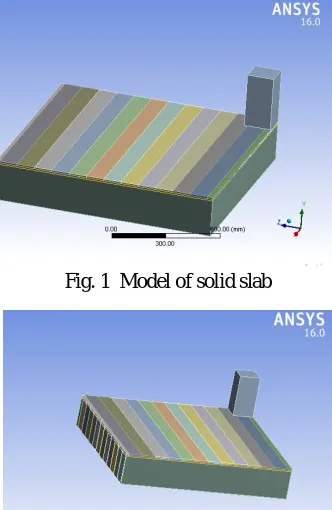
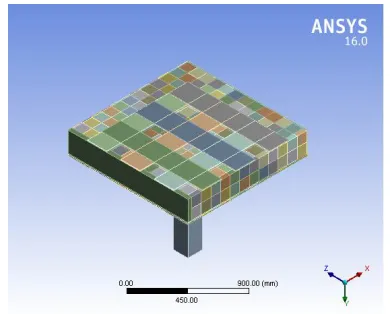
[image:2.595.215.382.279.416.2] [image:2.595.214.380.285.540.2]Solid slab and bubble deck slab were modelled using ANSYS 16.0. 8 mm diameter steel reinforcement bars was used and no shear reinforcement is provided. Difference between solid and bubble deck slab is that in bubble deck slab concrete in the centre portion is removed and replace with 180 mm diameter HDPE balls were used. Solid slab with one column stub is modelled. Dimension of slab specimen is 2500 x 2500 x 230 mm. A column in structural engineering is a structural element that transmits, through compression, the weight of the structure above to other structural elements below. In other word a column is a compression member. A stub column is a column whose length is sufficiently small to prevent failure as a column, but long enough to contain the same residual stress pattern that exists in the column itself. A stub column is column which does not have any base which provided only for stiffness purpose of the member. Dimension of Column stub used was 300 x300 mm. Modeling of solid and bubble deck slab is shown in Fig. 1 and Fig. 2.
Fig. 1 Model of solid slab
Fig. 1 Model of bubble deck slab
B. Modelling of Bubble Deck Slab with CFRP scheme 1& 2 and with GFRP scheme 1 & 2
CFRP and GFRP having length of 2100mm and breadth 200mm and thickness 2mm was provided. Three layers were provided. Model of the bubble deck slab with CFRP scheme 1and Scheme 2 is shown in Fig. 3 and Fig. 4.
Bubble deck mainly composed of three main materials Concrete: M25 grade of concrete is used. Modulus of elasticity of concrete used is 25000 MPa. Poisson’s ratio is 0.2 .element type used for modeling of concrete is solid 65. Steel: element type used for steel is link 180. Modulus of elasticity 2X10^5 ,Poison’s ratio 0.3 ,yield stresses 415HDPE BALLS: 180 mm diameter balls. Modulus of elasticity 1030 MPa, Poison’s ratio 0.4, and shell 181 element type was used. GFRP STRIPS: Length of GFRP is 2100 mm, width 200mm and thickness is 2 mm. Number of layers used is 3, Modulus of elasticity is 20.23 GPa, Poisons ratio 0.223. CFRP strips: Length of GFRP is 2100 mm, width 200mm and thickness is 2 mm, Number of layers used is 3, Modulus of elasticity is 259 GPa,
Fig. 3 Model of bubble deck slab with CFRP scheme 1
Fig. 4 Model of bubble deck slab with GFRP scheme 1
V. RESULTS AND DISCUSSION
Bubble deck slab with CFRP and GFRP is modelled and analysed. Non linear static analysis was done using ANSYS 16.
A. Deformation of Solid Slab, Bubble deck without FRP, with CFRP scheme 1& 2, and GFRP scheme 1 & 2
Deformation is the change in the shape of a body caused by the application of a force or stress. Deformation obtained for solid slab is low compared to bubble deck slab. Therefore load carrying capacity of solid slab is more for solid slab itself. The deformation values obtained for solid slab, bubble deck slab without FRP, bubble deck slab with CFRP scheme 1 & 2 and with GFRP scheme1 & 2 is shown in table. 1.. From the table. 1, while comparing the deformation of solid and bubble deck slab without FRP its clear that deformation is more for solid slab. On comparing deformations of bubble deck with CFRP, the deformation is more for CFRP with scheme1. Similarly on comparing GFRP, deformation is more for Scheme 1 itself.
B. Load carrying capacity of slabs
The load carrying capacity of solid slab is more compared to bubble deck slab without FRP. The stress strain theory is used to determine the load carrying capacity of slab. The time corresponding to the permissible equivalent strain (0.003) is noted and force corresponding to that time is taken as the load carrying capacity of slab. Load carrying capacity of solid and bubble deck slab is shown in table 2.
TABLEI
DEFORMATIONS OF SLAB
Deformation (mm/)
Solid slab Bubble deck
slab without strengthening
Bubble deck with CFRP
scheme 1
Bubble deck with CFRP
scheme 2
Bubble deck with GFRP
scheme 1
Bubble deck with GFRP
scheme 2
2.17 2.39 2.34 2.25 1.87 1.74
TABLEII
LOAD CARRYING CAPACITY OF SLABS
Fig. 5 Comparison of results
VI.CONCLUSIONS
Bubble deck slab and solid slab without FRP was compared. Also bubble deck with CFRP and GFRP in different schemes were also compared using the load carrying capacity of slab.
A. On comparing the load carrying capacity of bubble deck slab and solid slab, solid slab have more load carrying capacity.
B. The bubble deck with CFRP scheme 2 is more better compared to scheme 1, since the load carrying capacity of scheme 1 is
low compared to scheme 2.Similarly GFRP with scheme 2 is more better.
C. On comparing the FRP’s CFRP is more better.SO we can conclude that for developing punching shear strength of bubble deck
slabs, CFRP with scheme 2 is better.
VII. ACKNOWLEDGMENT
We are really thankful to all the teaching and non-teaching staff of Sri Vellapally Natesan College of Engineering for supporting us throughout this work.
Solid slab Bubble deck slab
without strengthening
Bubble deck with CFRP
scheme 1
Bubble deck with CFRP
scheme 2
Bubble deck with GFRP
scheme 1
Bubble deck with GFRP
scheme 2 Load carrying
capacity of slab 260 190 230 250 210 240
% increase in the load carrying
REFERENCES
[1] Ali, S, and Kumar, M, (2017), Analytical study of conventional slab and bubble deck slab under various support and loading conditions using ansys workbench14.0, International Research Journal of Engineering and Technology, 4, 1467-1472.
[2] Anamiya et al (2018), Bubble deck slab, International Journal of Advance Engineering and Research Development, 5,2012-2015.
[3] Ibrahim et al (2013), Flexural capacities of reinforced concrete two-way bubble deck slabs of plastic spherical voids, Diyala Journal of Engineering Sciences, 6, 9-20.
[4] Jamal, J and Jolly, J (2017) A study on structural behaviour of bubble deck slab using spherical and elliptical balls, International Research Journal of Engineering and Technology, 4, 2090-2095.
[5] John, R, and Varghese, j (2015), A study of bubble deck slab using ansys, International Journal of Innovative Science, Engineering and Technology, 2, 560-563.
[6] Kitture et al, Experimental study on voided biaxial slab and its application, International Journal of Trend in Scientific Research and Development, 2, 1224-1228.
[7] Mathew, R and Binu, P (2015), CFRP strips on punching shear strength development of bubble deck slab, International Journal of Advanced Research Trends in Engineering and Technology, 2, 1-5.Mathew, R and Binu, P (2015). Punching shear strength development of bubble deck slab using GFRP stirrups. IOSR Journal of Mechanical and Civil Engineering, 1-6.
[8] Naik, R.S and Joshi, d (2017), A vided slab and conventional slab; A comparative study, International Journal of Science Technology and Engineering, 4, 44-50.
[9] Omar, A (2018), A State of the art of review on reinforced concrete voided slabs, APRN International Journal of Engineering and Applied Science, 13, 1683-1700.
[10] Pandkar, S.M and Narule, G.P (2017), Comparative study of experimentation on voided slab uning ansys workbench 14.5, International Journal for Research and Development in Technology, 7, 382-383.
[11] Purushottam, Y.j (2016), Analytical study of solid flat slab and voided slab using ansys workbench, International Journal and Magazine of Engineering, Technology, Management and Research, 3, 261-264.
[12] Sankar, L.S and Manoj,M(2017), Seismic performance of a conventional slab system over a bubble deck cobiax slab system, International Journal of Applied Sceinces, Engineering and Management, 6, 103-109.
[13] Shetkar, A and Hanche, N (2015), An experimental study on bubble deck system with elliptical balls, Proceeding of NCRIET-2015 and Indian J.Sci.Res, 12(1), 21-27.
[14] Singh, S and Narayanan ,D.k (2018), Analysis of bubble deck slab using different materials, International Journal of Engineering Research in Mechanical and Civil Engineering, 3, 27-29.
[15] Subramanian, K and Bhuvaneswari, P (2015), Finite element analysis of voided slab with high density polypropelene voids formers, International Journal of ChemTech Research, 8, 746-753.
[16] Surendar, M and Ranjitham, M (2016), Numerical and experimental study of bubble deck slab, International Journal of Engineering Science and Computing, 6, 5959-5962.
[17] Terec, L.R and Terec, M.A (2013), The bubble deck floor system ;A beif presentation, Construction II, 2, 33-40.
[18] Tiwari, N and Zafar, S (2016), Structural behavior of bubble deck slab and its application; Main paper, International Journal for Scientific Research and Development, 4, 433-437.