Intelligence Tool for Campus Drive using K Means
Clustering
Sakshi Sanjay Wagare
1, Aishwarya Pradeep Raj
2, Prof. Sonali S Patil
31, 2, 3Department of CSE, SRTTC, Kamshet
Abstract:Generally, now a day’s every college is conducting placement drives to provide maximum employment for the students so conducting placement drives is not only necessary but we also need to make the reach of that drives to students. So this Campus Intelligence Tool application provides the solution. In this paper the intelligence tool gives data concerning the various
pool campus or drives which are going to be held by colleges or companies. This system is beneficial for college students,
various companies visiting the campus for recruitment and even the college placement officer. It allows the students to create their profiles and upload all their details including their marks by using google forms. The admin can check each student details and can send e-mails to the eligible students according to the companies’ criteria. In this work K means clustering algorithm to classify a given data set through a certain number of clusters.
Keywords: Campus Intelligence Tool, K-Means clustering.
I. INTRODUCTION
To introduce intelligence tool for campus within which the training and placement cell can retrieve information about recruitment on the basis of criteria concerning enlisting from varied websites like academic sites, company sites etc. To match the students database according to companies criteria and send notification to eligible students.
Intelligence tool is a total management and informative system, which provides the up-to-date information of all the students in a particular college. Intelligence tool overcomes the difficulty in keeping records of hundreds and thousands of students and searching for a student eligibility based on recruitment criteria. It eases the best coordination between Placement Cell Officer and Students. Maintaining Student records, Updating Curriculum details and retrieving eligibility students list based on the company’s criteria. In our proposed system you will save time as well as money as its web based application. We can collect information of all students and fetch them
according to criteria given by company. There are two modules i.e. the admin module (TPO) and the student module. Our proposed system is vital to use in Colleges for better Services in Placement.
A. K-Means Clustering Algorithm
K-means is one of the simplest unsupervised learning algorithms that solve the well-known clustering problem. The procedure follows a simple and easy way to classify a given data set through a certain number of clusters (assume k clusters) . The main idea is to define k centers, one for each cluster. These centers should be placed in a cunning way because of different location causes different result. So, the better choice is to place them as much as possible far away from each other. The next step is to take each point belonging to a given data set and associate it to the nearest center. When no point is pending, the first step is completed and an early group age is done. At this point we need to re-calculate k new centroids as barycentre of the clusters resulting from the previous step. After we have these k new centroids, a new binding has to be done between the same data set points and the nearest new center. A loop has been generated. As a result of this loop we may notice that the k centers change their location step by step until no more changes are done or in other words centers do not move any more. Finally, this algorithm aims at minimizing an objective function know as squared error function given by:
where ‘||xi - vj||’ is the Euclidean distance between xi and vj..
‘ci’ is the number of data points in ith cluster.
1) Objectives
a) To save the time from manually selecting the students based on eligibility criteria. b) To update the student’s personal and curriculum details on their own.
c) To retrieve the eligibility students list automatically. 2) Need
a) Placement Officer can easily collect the student’s details and approve the details provided by them.
b) Instead of short listing manually, eligible students list can be retrieved automatically using K-Means clustering.
II. LITERATURE SURVEY
1) “Design Paper on Online Training and Placement System(OTaP)”, E. Mr. Nilesh T. Rathod, Prof. Seema Shah: In this system they provide a online training and placement process. The admin of the system can see the user information and will validate it. The admin also generates the student list based on the company criteria and company details are also provided to the all users. Searching and sorting can be done, and reports can be generated. Overall, all the process of the training and placement department is done automatically. We minimize the human intervention. But the drawback of proposed system is here all is done online. No message sending is provided. And also maintaining is little bit complicated.
2) “An Interactive Online Training and Placement System”, F. Mr. Nilesh Rathod, Dr. Seema Shah, Prof. Kavita Shirsat: In this
paper they describe the solution for the problems which occurred in existing manual systems. This proposed system gives automation in all processes like update, registration, and searching of the student’s data. Also if students are eligible for any company criteria then the student can directly apply for that company by only single clicking on apply button.
3) “Design Paper on Online Training and Placement System”, G. Prof. Seema Shah Assistant Professor, Mr Nilesh Rathod: In
this paper they describes the objective about the users and their authority. This makes the application more attractive and simple for using . In this system they provide mainly two users: TPO (administrator) and second is student. The admin is the master user of this system. Admin has the number of responsibilities and priorities than the other users that is students. There are number of different functions involved like as updating, approval. Student that is second user can register and view or edit their profile details.
4) “An Improved K-Means Clustering Algorithm”, Anupama Chadha, Suresh Kumar: In this paper we have proposed a modified
K-means algorithm which classifies the input data set into appropriate clusters without taking number of clusters K as input, as it was required in the case of K-means. The proposed algorithm does not require the number of clusters K as input.
5) “Notification System to Students using a web application”, May H. Riadh Assistant Prof Zarqa University Jordan AlZarqa: It is used to design a notification system using Web application to connect it to the educational web site. It achieves high and quick organize between instructor and students, save time, effort by connecting Web application to the educational database.
III. COMPARISON OF EXISTING PREDICTION TECHNIQUES
In an existing system, all the processes are handled manually. This process is difficult when the number of users increases. The administrator should refer all the files kept for years ago to simply known the details. This is time consuming and uninteresting job. There are so many limitations for the existing systems. In manual Placement, all the work done by hum-an intervention due to which there were so many chances of errors. The interface of administer
and student is maximum which makes the system time consuming. Students created and submitted their Resumes early in the year, quite they chilled in time. Lists were created for each company, and students had to regularly go in to review the notice board. The process was slowing; valuable academic time was diverted from the activities that
IV. PROPOSED SYSTEM
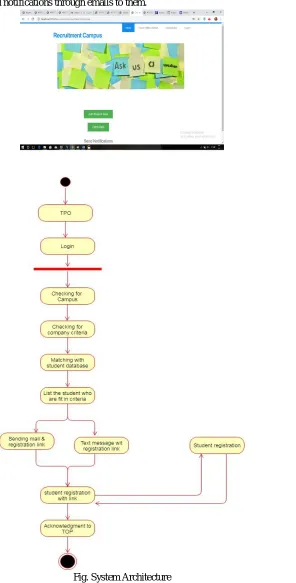
The aim of the proposed system is to develop a system with improved facilities. The proposed system can overcome all the limitation of the existing system. Such as student’s information is maintained in the database, it gives more security to data, ensures data accuracy, reduces paper work and save time, only eligible students get chance, it makes information flow efficient and paves way for easy report generation, reduce the space. Proposed system is cost effective.
A. Login Module
Login Module provides the secure communication between users and Training and Placement Cell application. Each Student has their own username and password to access the application. Placement Officer acts as an administrator who has complete control over the application.
B. Student Module
C. Administrator Module
[image:4.595.176.472.153.736.2]V. ALGORITHM
A. Algorithmic Steps For K-Means Clustering
Let X = {x1,x2,x3,……..,xn} be the set of data points and V = {v1,v2,…….,vc} be the set of centers.
1) Randomly select ‘c’ cluster centers.
2) Calculate the distance between each data point and cluster centers.
3) Assign the data point to the cluster center whose distance from the cluster center is minimum of all the cluster centers.. 4) Recalculate the new cluster center using:
where, ‘ci’ represents the number of data points in ith cluster.
5) Recalculate the distance between each data point and new obtained cluster centers. 6) If no data point was reassigned then stop, otherwise repeat from step 3).
VII. CONCLUSION
In the existing system, largest work goes in paper by humans and it is error prone system, and this system takes time for any changes in the system. The most critical problem is the searching; sorting and updating of the student data and no any method for notification available for giving information to student expect the notice board. This intelligence tool supplies automation in all the processes. The project will be useful for several students as well as the training and placement office to search different jobs. The TPO can decide which students are eligible for the job according to criteria .
REFERENCE
[1] Design Paper on Online Training and Placement System(OTaP), E. Mr Nilesh T. Rathod, Prof. Seema Shah. [2] An Interactive Online Training and Placement System, F. Mr. Nilesh Rathod, Dr. Seema Shah, Prof. Kavita Shirsat. [3] Design Paper on Online Training and Placement System,G. Prof. Seema Shah Assistant Professor, Mr Nilesh Rathod. [4] An Improved K-Means Clustering Algorithm”, Anupama Chadha, Suresh Kumar.