context2vec:
Learning Generic Context Embedding
with Bidirectional LSTM
Oren Melamud Computer Science Dept.
Bar-Ilan University [email protected]
Jacob Goldberger Faculty of Engineering
Bar-Ilan University [email protected]
Ido Dagan Computer Science Dept.
Bar-Ilan University [email protected]
Abstract
Context representations are central to vari-ous NLP tasks, such as word sense disam-biguation, named entity recognition, co-reference resolution, and many more. In this work we present a neural model for efficiently learning a generic context em-bedding function from large corpora, us-ing bidirectional LSTM. With a very sim-ple application of our context represen-tations, we manage to surpass or nearly reach state-of-the-art results on sentence completion, lexical substitution and word sense disambiguation tasks, while sub-stantially outperforming the popular con-text representation of averaged word em-beddings. We release our code and pre-trained models, suggesting they could be useful in a wide variety of NLP tasks.
1 Introduction
Generic word embeddings capture semantic and syntactic information about individual words in a compact low-dimensional representation. While they are trained to optimize a generic task-independent objective function, word embeddings were found useful in a broad range of NLP tasks, making an overall huge impact in recent years. A major advancement in this field was the in-troduction of highly efficient models, such as
word2vec(Mikolov et al., 2013a) andGloVe (Pen-nington et al., 2014), for learning generic word embeddings from very large corpora. Capturing information from such corpora substantially in-creased the value of word embeddings to both un-supervised and semi-un-supervised NLP tasks.
To make inferences regarding a concrete target word instance, good representations of both the target word type and the given context are help-ful. For example, in the sentence “I can’t find
[April]”, we need to consider both the target word
Apriland its context “I can’t find[ ]” to infer that
Aprilprobably refers to a person. This principle applies to various tasks, including word sense dis-ambiguation, co-reference resolution and named entity recognition (NER).
Like target words, contexts are commonly rep-resented via word embeddings. In an unsupervised setting, such representations were found useful for measuring context-sensitive similarity (Huang et al., 2012), word sense disambiguation (Chen et al., 2014), word sense induction (K˚ageb¨ack et al., 2015), lexical substitution (Melamud et al., 2015b), sentence completion (Liu et al., 2015) and more. The context representations used in such tasks are commonly just a simple collection of the individual embeddings of the neighboring words in a window around the target word, or a (sometimes weighted) average of these embed-dings. We note that such approaches do not in-clude any mechanism for optimizing the represen-tation of the entire sentential context as a whole.
In supervised settings, various NLP systems use labeled data to learn how to consider context word representations in a more optimized task-specific way. This was done in tasks, such as chunking, NER, semantic role labeling, and co-reference res-olution (Turian et al., 2010; Collobert et al., 2011; Melamud et al., 2016), mostly by considering the embeddings of words in a window around the tar-get of interest. More recently, bidirectional re-current neural networks, and specifically bidirec-tional LSTMs, were used in such tasks to learn
internal representations of wider sentential con-texts (Zhou and Xu, 2015; Lample et al., 2016). Since supervised data is usually limited in size, it has been shown that training such systems, us-ing word embeddus-ings that were pre-trained on large corpora, improves performance significantly. Yet, pre-trained word embeddings carry limited information regarding the inter-dependencies be-tween target words and their sentential context as a whole. To model this (and more), the supervised systems still need to rely heavily on their albeit limited supervised data.
In this work we present context2vec, an unsu-pervised model and toolkit1for efficiently learning
genericcontext embedding of wide sentential con-texts, using bidirectional LSTM. Essentially, we use large plain text corpora to learn a neural model that embeds entire sentential contexts and target words in the same low-dimensional space, which is optimized to reflect inter-dependencies between targets and their entire sentential context as a whole. To demonstrate their high quality, we show that with a very simple application of our context representations, we are able to surpass or nearly reach state-of-the-art results on sentence comple-tion, lexical substitution and word sense disam-biguation tasks, while substantially outperforming the common average-of-word-embeddings repre-sentation (denotedAWE). We further hypothesize that both unsupervised and semi-supervised sys-tems may benefit from using our pre-trained mod-els, instead or in addition to individual pre-trained word embeddings.
2 Context2vec’s Neural Model
2.1 Model Overview
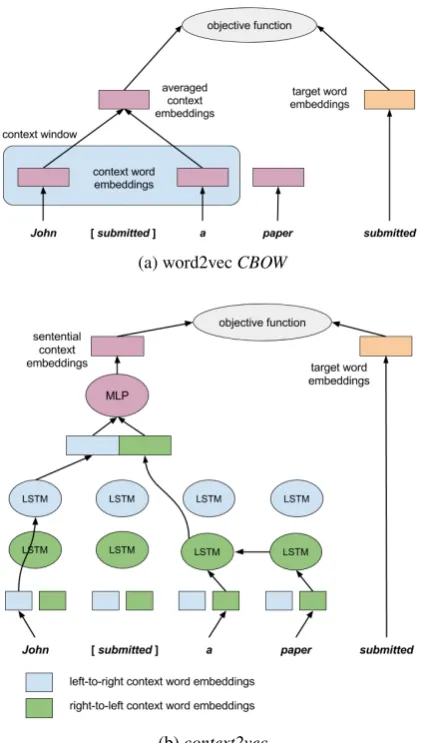
The main goal of our model is to learn a generic task-independent embedding function for variable-length sentential contexts around target words. To do this, we propose a neural network architecture, which is based onword2vec’sCBOW
architecture (Mikolov et al., 2013a), but replaces its naive context modeling of averaged word em-beddings in a fixed window, with a much more powerful neural model, using bidirectional LSTM. Our proposed architecture is illustrated in Fig-ure 1, together with the analogical word2vec ar-chitecture. Both models learn context and target
1Source code and pre-trained models are available
at: http://www.cs.biu.ac.il/nlp/resources/ downloads/context2vec/
(a) word2vecCBOW
[image:2.595.311.522.64.436.2](b)context2vec
Figure 1:word2vecandcontext2vecarchitectures.
word representations at the same time, by embed-ding them into the same low-dimensional space, with the objective of having the context predict the target word via a log linear model. However, we utilize a much more powerful parametric model to capture the essence of sentential context.
The left-hand side of Figure 1b illustrates how
information in the sentential context, even when it is remote from the target word. Next, we feed this concatenated vector into a multi-layer per-ceptron to be capable of representing non-trivial dependencies between the two sides of the con-text. We consider the output of this layer as the embedding of the entire joint sentential context around the target word. At the same time, the tar-get word itself (right-hand side of Figure 1b) is represented with its own embedding, equal in di-mensionality to that of the sentential context. We note that the only (yet crucial) difference between our model and word2vec’sCBOW (Figure 1a) is thatCBOWrepresents the context around a target word as a simple average of the embeddings of the context words in a window around it, while con-text2vecutilizes a full-sentence neural representa-tion of context.
Finally, to learn the parameters of our network, we use word2vec’s negative sampling objective function, with a positive pair being a target word and its entire sentential context, and respectivek
negative pairs as random target words, sampled from a (smoothed) unigram distribution over the vocabulary, paired with the same context. With this, we learn both the context embedding network parameters and the target word embeddings.
In contrast to word2vec and similar word em-bedding models that use context modeling mostly internally and consider the target word embed-dings as their main output, our primary focus is the context representation. Our model achieves its objective by assigning similar embeddings to sen-tential contexts and their associated target words. Further, similar to the case in word2vec models, this indirectly results in assigning similar embed-dings to target words that are associated with sim-ilar sentential contexts, and conversely to senten-tial contexts that are associated with similar tar-get words. We will show in the following sections how these properties make our model useful.
2.2 Formal Specification and Analysis
We use a bidirectional LSTM recurrent neural net-work to obtain a sentence-level context represen-tation. Let lLS be an LSTM reading the words of a given sentence from left to right, and let rLS be a reverse one reading the words from right to left. Given a sentencew1:n, our ‘shallow’ bidirectional LSTM context representation for the target wi is
defined as the following vector concatenation:
biLS(w1:n, i) =lLS(l1:i−1)⊕rLS(rn:i+1)
where l/r represent distinct left-to-right/right-to-left word embeddings of the sentence words.2 This definition is a bit different than standard bidi-rectional LSTM, as we do not feed the LSTMs with the target word itself (i.e. the word in po-sitioni). Next, we apply the following non-linear function on the concatenation of the left and right context representations:
MLP(x) =L2(ReLU(L1(x)))
where MLP stands for Multi Layer Percep-tron, ReLU is the Rectified Linear Unit acti-vation function, and Li(x) = Wix + bi is a fully connected linear operation. Let c = (w1, ..., wi−1,−, wi+1, ..., wn) be the sentential context of the word in positioni. We define con-text2vec’s representation ofcas:
~c=MLP(biLS(w1:n, i)).
Next, we denote the embedding of a target word
tas~t. We use the same embedding dimensionality for target and sentential context representations. To learn target word and context representations, we use theword2vecnegative sampling objective function (Mikolov et al., 2013b):
S=X
t,c
logσ(~t·~c) +Xk
i=1
logσ(−~ti·~c)
(1)
where the summation goes over each word token
tin the training corpus and its corresponding (sin-gle) sentential contextc, andσis the sigmoid func-tion. t1, ..., tk are the negative samples, indepen-dently sampled from a smoothed version of the tar-get words unigram distribution: pα(t) ∝ (#t)α, such that0≤α <1 is a smoothing factor, which increases the probability of rare words.
Levy and Goldberg (2014b) proved that when the objective function in Equation (1) is applied to single-word contexts, it is optimized when:
~t·~c=PMIα(t, c)−log(k) (2)
where PMI(t, c) = logpαp(t,c)(t)p(c) is the pointwise mutual information between the target wordtand
2We pad every input sentence with special BOS and EOS
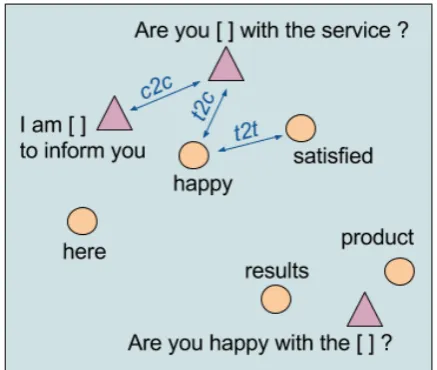
Figure 2: A 2D illustration ofcontext2vec’s em-bedded space and similarity metrics. Triangles and circles denote sentential context embeddings and target word embeddings, respectively.
the context word c. The analysis presented in Levy and Goldberg (2014b) is valid for every co-occurrence matrix that describes the joint distribu-tion of two random variables. Specifically, it can be applied to our case, where the context is not just a single word but an entire sentential context of a target word. Accordingly, we can view the target-context embedding obtained by our algorithm as a factorization of the PMI matrix between all possi-ble target words and all possipossi-ble different senten-tial contexts. Unlike the case of single-word con-texts, it is not feasible to explicitly compute here this PMI matrix due to the exponential number of possible sentential contexts. However, the objec-tive function that we optimize still aims to best ap-proximate it. Based on the above analysis, we can expect the inner-product of our target and context embeddings to approximate PMIα(c, t). We note that accordingly, with larger values ofα, there will be more bias towards placing rare words closer to their associated contexts in this space.
2.3 Model Illustration
To demonstrate the qualities of the embedded space learned by context2vec, we illustrate three types of similarity metrics in that space: target-to-context (t2c), context-to-context (c2c) and target-to-target (t2t). All these are measured by the vec-tor cosine value between the respective embedding representations. Only the latter target-to-target metric is the one typically used when illustrating
and evaluating word embedding models, such as
word2vec. Figure 2 provides a 2D illustration of such a space and respective metrics.
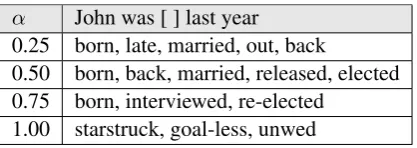
In Table 1 we show sentential contexts and the target words that are closest to them, using the target-to-context similarity metric with con-text2vec embeddings. As can be seen, the bidi-rectional LSTM modeling ofcontext2vecis indeed capable in this case to capture long range depen-dencies, as well as to take both sides of the con-text into account. In Table 2 we show the clos-est target words to given contexts, using different
context2vecmodels, each learned with a different negative sampling smoothing parameter α. This illustrates the bias that highαvalues introduce to-wards rare words, as predicted with the analysis in section 2.2.
Next, to illustrate the context-to-context sim-ilarity metric, we took the set of contexts for the target lemma add from the training set of Senseval-3 (Mihalcea et al., 2004). In Table 3 we show an example for a ‘query’ context from that set and the other two most similar contexts to it, based oncontext2vec andAWE (average of Skip-gram word embeddings) context representa-tions. Melamud et al. (2015a) argues that since contexts induce meanings (or senses) for target words, a good context similarity measure should assign high similarity values to contexts that in-duce similar senses for the same target word. As can be seen in this example,AWE’s similarity mea-sure seems to be influenced by the presence of the location names in the contexts, even though they have little effect on the perceived meaning ofaddin the sentences. Indeed, the sense ofadd
in the closest contexts retrieved byAWEis differ-ent than that in the ‘query’ context. In this case,
context2vec’s similarity measure was robust to this problem.
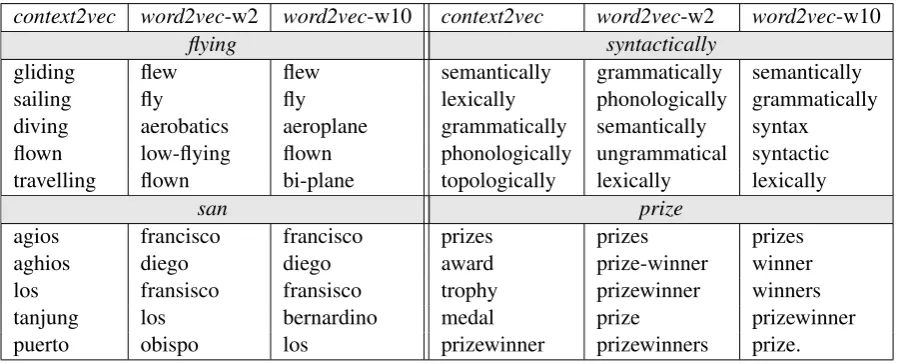
Finally, in Table 4, we show the closest tar-get words to a few given tartar-get words, based on the target-to-target similarity metric. We compare
Sentential Context Closest target words
This [ ] is due item, fact-sheet, offer, pack, card
This [ ] is due not just to mere luck offer, suggestion, announcement, item, prize This [ ] is due not just to mere luck, award, prize, turnabout, offer, gift
but to outstanding work and dedication
[image:5.595.105.497.62.160.2][ ] is due not just to mere luck, it, success, this, victory, prize-money but to outstanding work and dedication
Table 1: Closest target words to various sentential contexts, illustratingcontext2vec’s sensitivity to long range dependencies, and both sides of the target word.
α John was [ ] last year
0.25 born, late, married, out, back
0.50 born, back, married, released, elected 0.75 born, interviewed, re-elected
1.00 starstruck, goal-less, unwed
Table 2: Closest target words to a given sentential context using differentαvalues incontext2vec.
around the target word and therefore may find, for instance, the contexts of san andfranciscoto be very similar. In contrast, our model considers only entire sentential contexts, taking context word or-der and position into consior-deration. Melamud et al. (2016) showed that target word embeddings, learned from context representations that are gen-erated usingn-gram language models, also exhibit function-preserving similarities, which is consis-tent with our observations.
2.4 Relation to Language Models
Our model is closely related to language models, as can be seen in section 2.2 and tables 1 and 2. In particular, it has a lot in common with LSTM-based language models, as both train LSTM neu-ral networks with the objective to predict target words based on their (short and long range) con-text, and both use techniques, such as negative sampling, to address large vocabulary computa-tional challenges during training (Jozefowicz et al., 2016). The main difference is that LSTM lan-guage models are mainly concerned with optimiz-ing predictions of conditional probabilities for tar-get words given their history, while our model is focused on deriving generally useful representa-tions to whole history-and-future contexts of target words. We followword2vec’s learning framework as it is known to produce high-quality representa-tions for single words. It does so by having~t·~c
approximate PMI(t, c)rather thanlogp(t|c).
3 Evaluation Settings
We intend context2vec’s generic context embed-ding function to be integrated into various more optimized task-specific systems. However, to demonstrate its qualities independently, we ad-dress three different types of tasks by the sim-ple means of measuring cosine distances between its embedded representations. Yet, we compare our performance against the state-of-the-art results of highly competitive task-optimized systems on each task. In addition we use AWE as a base-line representing a commonly used generic con-text representation, which like ours, can represent variable-length contexts with a fixed-size vector. Our evaluation includes the following tasks: sen-tence completion, lexical substitution and super-vised word sense disambiguation (WSD).
3.1 Learning corpus
With the exception of the sentence completion task (MSCC), which comes with its own learning cor-pus, we used the two billion word ukWaC (Fer-raresi et al., 2008) as our learning corpus. To speed-up the training ofcontext2vec, we discarded all sentences that are longer than 64 words, reduc-ing the size of the corpus by∼10%. However, we train the embeddings used in theAWEbaseline on the full corpus to not penalize it on account of our model. We lower-cased all text and considered any token with fewer than 100 occurrences as an un-known word. This yielded a vocabulary of a lit-tle over 180K words for the full corpus, and 160K words for the trimmed version.
3.2 Compared Methods
[image:5.595.78.287.212.286.2]Query Furthermore our work in Uganda and Romania [ adds ] a wider perspective. ... themes in art have a fascination , since they [ add ] a subject interest
context2vec to a viewer’s enjoyment of artistic qualities.
closest Richard is joining us every month to pass on tips , ideas and news from the world of horticulture , and [ add ] a touch of humour too
... the foreign ministers said political and economic reforms in Poland and Hungary
AWE had made considerable progress but [ added ] : the process remains fragile ... closest ... Germany had announced the solution as a humanitarian act by the government,
[image:6.595.78.522.62.186.2][ adding ] that it hoped Bonn in future would run its embassies in normal manner...
Table 3: An example for a given ‘query’ context and the two closest contexts to it, as ‘retrieved’ by
context2vecsimilarity andAWEsimilarity.
context2vec word2vec-w2 word2vec-w10 context2vec word2vec-w2 word2vec-w10
flying syntactically
gliding flew flew semantically grammatically semantically
sailing fly fly lexically phonologically grammatically
diving aerobatics aeroplane grammatically semantically syntax flown low-flying flown phonologically ungrammatical syntactic travelling flown bi-plane topologically lexically lexically
san prize
agios francisco francisco prizes prizes prizes
aghios diego diego award prize-winner winner
los fransisco fransisco trophy prizewinner winners
tanjung los bernardino medal prize prizewinner
puerto obispo los prizewinner prizewinners prize.
Table 4: Top-5 closest target words to a few given target words.
assigned to the same batch. We discuss the hyper-parameters tuning of our model in section 4.1.
AWE We learned word embeddings with the popular word2vec Skip-gram model using stan-dard hyperparameters: 600 dimensions, 10 nega-tive samples, window-size 10 and 3/5 iterations for the ukWaC/MSCC learning corpora, respectively. Then we used a simple average of these embed-dings as ourAWEcontext representation.3 In ad-dition, we experimented with the following vari-ations: (1) ignoring stopwords (2) performing a weighted average of the words in the context using tf-idf weights (3) considering just the 5-word win-dow around the target word instead of the whole sentence. Specifically, in the WSD experiment the context provided for the target words is a full para-graph. Though it could be extended,context2vec
is currently not designed to take advantage of such large context and therefore ignores all context
out-3We made some preliminary experiments using word
em-beddings learned withword2vec’sCBOWmodel, instead of Skip-gram, but this yielded worse results.
side of the sentence of the target word. However, forAWEwe also experimented with the option of generating the context representation based on the entire paragraph. In all cases, the size (dimension-ality) of theAWEcontext representation was equal to that of context2vec, and the context-to-target and context-to-context similarities were computed using vector cosine between the respective embed-ding representations, as withcontext2vec.
3.3 Sentence Completion Challenge
The Microsoft Sentence Completion Challenge (MSCC) (Zweig and Burges, 2011) includes 1,040 items. Each item is a sentence with one word re-placed by a gap, and the challenge is to identify the word, out of five choices, that is most meaningful and coherent as the gap-filler. While there is no official dev/test split for this dataset, we followed previous work (Mirowski and Vlachos, 2015) and used the first 520 sentences for parameter tuning and the rest as the test set.4
4Mikolov et al. (2013a) did not specify their dev/test split
[image:6.595.75.530.231.413.2]The MSCC includes a learning corpus of 50 million words. To use this corpus for training our models, we first discarded all sentences longer than 128 words, which resulted in a negligible re-duction of∼1% in the size of the corpus. Then, we converted all text to lowercase and considered all words with frequency less than 3 as unknown, yielding a vocabulary of about 100K word types.
Finally, as the gap-filler, we simply choose the word whose target word embedding is the most similar to the embedding of the given context us-ing the target-to-context similarity metric. We re-port the accuracy achieved in this task.
3.4 Lexical Substitution Task
The lexical substitution task requires finding a substitute word for a given target word in sen-tential context. The difference between this and the sentence completion task is that the substi-tute word needs not only to be coherent with the sentential context, but also preserve the meaning of the original word in that context. Most re-cent works evaluated their performance on a rank-ing variant of the lexical substitution task, which uses predefined candidate lists provided with the gold standard, and requires to rank them consid-ering the sentential context. Performance in this task is reported with generalized average precision (GAP).5 As in MSCC, in this evaluation we rank lexical substitutes according to the measured sim-ilarity between their target word embeddings and the embedding of the given sentential context.
We used two lexical substitution datasets in our experiments. The first is the dataset introduced in the lexical substitution task of SemEval 2007 (Mc-Carthy and Navigli, 2007), denoted LST-07, split into 300 dev sentences and 1,710 test sentences. The second is a more recent ‘all-words ’ dataset (Kremer et al., 2014), denoted LST-14, with over 15K target word instances. It comes with a prede-fined 35%/65% split. We used the smaller set as the dev set for parameter tuning and the larger one as our test set.
3.5 Supervised WSD
In supervised WSD tasks, the goal is to determine the correct sense of words in context, based on a manually tagged training set. To classify a test word instance in context, we consider all of the
5See Melamud et al. (2015a) for more of their setting
de-tails, which we followed here.
[image:7.595.333.500.61.160.2]context word units 300 LSTM hidden/output units 600 MLP input units 1200 MLP hidden units 1200 sentential context units 600 target word units 600 negative samples 10
Table 5:context2vechyperparameters
tagged instances of the same word lemma in the training set, and find the instance whose context embedding is the most similar to the context em-bedding of the test instance using the context-to-context similarity metric. Then, we use the tagged senses6 of that instance. We note that this is es-sentially the simplest form of ak-nearest-neighbor algorithm, withk= 1.
As our supervised WSD dataset we used the Senseval-3 lexical sample dataset (Mihalcea et al., 2004), denoted SE-3, which includes 7,860 train and 3,944 test instances. We used the training set for parameter tuning and report accuracy results on the test set.
4 Results
4.1 Development Experiments
The hyperparameters used in our reported exper-iments with context2vec are summarized in Ta-ble 5. In preliminary development experiments, we used only 200 units for representing sentential contexts, and then saw significant improvement in results, when moving to 600 units. Increasing the representation size to 1,000 units did not seem to further improve results.
With mini-batches of 1,000 sentences at a time, we started by training our models with a single iteration over the 2-billion-word ukWaC corpus. This took ∼30 hours, using a single Tesla K80 GPU. For the smaller 50-million-word MSCC learning corpus, a full iteration with a batch size of 100 took only about 3 hours. For this corpus, we started with 5 training iterations.
To explore the rare-word bias effect of the vo-cabulary smoothing factor α, we varied its value in our development experiments. The results ap-pear in Table 6 on the left hand side. Since we preferred to keep our model as simple as possi-ble, based on these results, we chose the single
context2vec AWE
[image:8.595.99.501.62.160.2]neg sampling parameterα iters+ best best worst worst 0.25 0.50 0.75 1.00 0.75 config result config result MSCC-dev 52.5 56.5 60.0 52.7 66.2 sent+stop 51.0 W5 36.5 LST-07-dev 50.1 52.9 53.6 54.3 55.4 W5+stop 45.8 sent 40.0 LST-14-dev 48.2 48.9 48.0 46.1 48.3 sent+stop 40.4 sent 39.2 SE-3-dev 72.1 72.4 71.6 72.5 72.6 W5+tf-idf 62.4 sent 57.3
Table 6: Development set results. iters+ denotes the best model found when running more training iterations with α = 0.75. AWE config: W5/sent denotes using a 5-word-window/full-sentence, and
stop/tf-idf denotes ignoring stop words or using tf-idf weights, respectively.
valueα= 0.75for all of our test sets experiments. With this choice, we also tried training our mod-els with more iterations and found that with 3 it-erations over the ukWaC corpus and 10 itit-erations over the MSCC corpus we can obtain some further improvement in results, seeiters+in Table 6.
The results of our experiments with all of the
AWE variants, described in section 3.2, appear on the right hand side of Table 6. For brevity, we report only the best and worst configuration for each benchmark. As can be seen, in two out of four benchmarks, a window of 5 words yields better performance than a full sentential context, suggesting that theAWErepresentation is not very successful in leveraging effectively long range information. Removing stop words or us-ing tf-idf weights improves performance signifi-cantly. However, the results are still much lower than the ones achieved withcontext2vec. To raise the bar, in each test-set experiment we used the bestAWEconfiguration found for the correspond-ing development-set experiment.
4.2 Test Sets Results
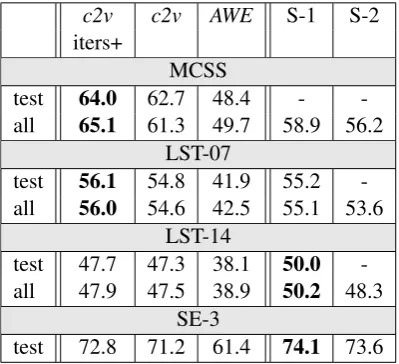
The test set results are summarized in Table 7. First, we see that context2vec substantially out-performs AWE across all benchmarks. This sug-gests that our context representations are much better optimized for capturing sentential context information than AWE, at least for these tasks. Further, we see that with context2vec we either surpass or almost reach the state-of-the-art on all benchmarks. This is quite impressive, consider-ing that all we did was measure cosine distances betweencontext2vec’s representations to compete with more complex and task-optimized systems.
More specifically, in the sentence completion task (MSCC) the prior state-of-the-art result is due to Mikolov et al. (2013a) and was achieved by a
c2v c2v AWE S-1 S-2
iters+
MCSS
test 64.0 62.7 48.4 - -all 65.1 61.3 49.7 58.9 56.2
LST-07
test 56.1 54.8 41.9 55.2 -all 56.0 54.6 42.5 55.1 53.6
LST-14
test 47.7 47.3 38.1 50.0 -all 47.9 47.5 38.9 50.2 48.3
SE-3
test 72.8 71.2 61.4 74.1 73.6
Table 7: Results on test sets. c2v iscontext2vec
anditers+denotes the model that was trained with more iterations. S-1/S-2 stand for the best/second-best prior result reported for the benchmark.
weighted combination of scores from two differ-ent models: a recurrdiffer-ent neural network language model, and a Skip-gram model. The second-best result is due to Liu et al. (2015) and is based on word embeddings that are learned based on both corpora and structured knowledge resources, such as WordNet. context2vecoutperforms both of them. In the lexical substitution tasks, the best prior results are due to Melamud et al. (2015a).7 They employ an exemplar-based approach that re-quires keeping thousands of exemplar contexts for every target word type. The second-best is due to Melamud et al. (2015b). They propose a simple approach, but it requires dependency-parsed text as input. context2vecachieves comparable results with these works, using the same learning corpus. In the Senseval-3 supervised WSD task, the best result is due to Ando (2006) and the second-best to
7Szarvas et al. (2013) achieved almost the same result, but
[image:8.595.317.517.227.409.2]Rothe and Sch¨utze (2015). context2vecis almost on par with these results, which were achieved with dedicated feature engineering and supervised machine learning models.
5 Related Work
Substitute vectors (Yuret, 2012) represent contexts as a probabilistic distribution over the potential gap-filler words for the target slot, pruned to its top-kmost probable words. While using this rep-resentation showed interesting potential (Yatbaz et al., 2012; Melamud et al., 2015a), it can cur-rently be generated efficiently only with n-gram language models and hence is limited to fixed-size context windows. It is also high dimensional and sparse, in contrast to our proposed representations. Syntactic dependency context embeddings have been proposed recently (Levy and Goldberg, 2014a; Bansal et al., 2014). They depend on the availability of a high-quality dependency parser, and can be viewed as a ‘bag-of-dependencies’ rather than a single representation for the entire sentential context. However, we believe that in-corporating such dependency-based information in our model is an interesting future direction.
A couple of recent works extendedword2vec’s
CBOW by replacing its internal context represen-tation. Ling et al. (2015b) proposed a continu-ous window, which is a simple linear projection of the context window embeddings into a low dimen-sional vector. Ling et al. (2015a) proposed ‘CBOW with attention’, which is used for finding the rel-evant features in a context window. In contrast to our model, both approaches confine the context to a fixed-size window. Furthermore, they limit their scope to using these context representations only internally to improve the learning of target words embeddings, rather than evaluate the benefit of us-ing them directly in NLP tasks, as we do.
Kawakami and Dyer (2016) represent words in context using bidirectional LSTMs and multilin-gual supervision. In contrast, our model is fo-cused on representing the context alone. Yet, as shown in our lexical substitution and word sense disambiguation evaluations, it can easily be used for modeling the meaning of words in context as well.
Finally, there is considerable work on using recurrent neural networks to represent word se-quences, such as phrases or sentences (Socher et al., 2011; Kiros et al., 2015). We note that the
techniques used for learning sentence representa-tions have much in common with those we use for sentential context representations. Yet, sentential context representations aim to reflect the informa-tion in the sentence only inasmuch as it is relevant to the target slot. Specifically, different target po-sitions in the same sentence can yield completely different context representations. In contrast, sen-tence representations aim to reflect the entire con-tents of the sentence.
6 Conclusions and Future Potential We presented context2vec, a neural model that learns a generic embedding function for variable-length contexts of target words. We demonstrated that it can be trained in a reasonable time over billions of words and generate high quality con-text representations, which substantially outper-form the traditional average-of-word-embeddings approach on three different tasks. As such, we hy-pothesize that it could contribute to various NLP systems that model context. Specifically, semi-supervised systems may benefit from using our model, as it may carry more useful information learned from large corpora, than individual pre-trained word embeddings do.
Acknowledgments
We thank our anonymous reviewers for their use-ful comments. This work was partially supported by the Israel Science Foundation grant 880/12 and the German Research Foundation through the German-Israeli Project Cooperation (DIP, grant DA 1600/1-1).
References
Rie Kubota Ando. 2006. Applying alternating struc-ture optimization to word sense disambiguation. In Proceedings of the Tenth Conference on Compu-tational Natural Language Learning, pages 77–84. Association for Computational Linguistics.
Mohit Bansal, Kevin Gimpel, and Karen Livescu. 2014. Tailoring continuous word representations for dependency parsing. InProceedings of the Annual Meeting of the Association for Computational Lin-guistics.
Xinxiong Chen, Zhiyuan Liu, and Maosong Sun. 2014. A unified model for word sense representation and disambiguation. InProceedings of EMNLP. Ronan Collobert, Jason Weston, L´eon Bottou, Michael
2011. Natural language processing (almost) from scratch. The Journal of Machine Learning Re-search, 12:2493–2537.
Adriano Ferraresi, Eros Zanchetta, Marco Baroni, and Silvia Bernardini. 2008. Introducing and evaluating ukwac, a very large web-derived corpus of English. InProceedings of the 4th Web as Corpus Workshop (WAC-4).
Eric H. Huang, Richard Socher, Christopher D. Man-ning, and Andrew Y. Ng. 2012. Improving word representations via global context and multiple word prototypes. InProceedings of ACL.
Rafal Jozefowicz, Oriol Vinyals, Mike Schuster, Noam Shazeer, and Yonghui Wu. 2016. Exploring the limits of language modeling. arXiv preprint arXiv:1602.02410.
Mikael K˚ageb¨ack, Fredrik Johansson, Richard Johans-son, and Devdatt Dubhashi. 2015. Neural context embeddings for automatic discovery of word senses. InProceedings of NAACL.
Kazuya Kawakami and Chris Dyer. 2016. Learning to represent words in context with multilingual super-vision. InWorkshop in ICLR.
Diederik Kingma and Jimmy Ba. 2014. Adam: A method for stochastic optimization. arXiv preprint arXiv:1412.6980.
Ryan Kiros, Yukun Zhu, Ruslan R Salakhutdinov, Richard Zemel, Raquel Urtasun, Antonio Torralba, and Sanja Fidler. 2015. Skip-thought vectors. In Proceedings of NIPS.
Gerhard Kremer, Katrin Erk, Sebastian Pad´o, and Ste-fan Thater. 2014. What substitutes tell us-analysis of an all-words lexical substitution corpus. In Pro-ceedings of EACL.
Guillaume Lample, Miguel Ballesteros, Sandeep Sub-ramanian, Kazuya Kawakami, and Chris Dyer. 2016. Neural architectures for named entity recog-nition.arXiv preprint arXiv:1603.01360.
Omer Levy and Yoav Goldberg. 2014a. Dependency-based word embeddings. InProceedings of ACL.
Omer Levy and Yoav Goldberg. 2014b. Neural word embeddings as implicit matrix factorization. In Pro-ceedings of NIPS.
Wang Ling, Lin Chu-Cheng, Yulia Tsvetkov, and Silvio Amir. 2015a. Not all contexts are created equal: Better word representations with variable attention. InProceedings of EMNLP.
Wang Ling, Chris Dyer, Alan Black, and Isabel Tran-coso. 2015b. Two/too simple adaptations of word2vec for syntax problems. In Proceedings of NAACL.
Quan Liu, Hui Jiang, Si Wei, Zhen-Hua Ling, and Yu Hu. 2015. Learning semantic word embeddings based on ordinal knowledge constraints. Proceed-ings of ACL.
Diana McCarthy and Roberto Navigli. 2007. Semeval-2007 task 10: English lexical substitution task. In Proceedings of SemEval.
Oren Melamud, Ido Dagan, and Jacob Goldberger. 2015a. Modeling word meaning in context with sub-stitute vectors. InProceedings of ACL.
Oren Melamud, Omer Levy, and Ido Dagan. 2015b. A simple word embedding model for lexical substitu-tion. InProceedings of Workshop on Vector Space Modeling for NLP (VSM).
Oren Melamud, David McClosky, Siddharth Patward-han, and Mohit Bansal. 2016. The role of context types and dimensionality in learning word embed-dings. InProceedings of NAACL.
Rada Mihalcea, Timothy Anatolievich Chklovski, and Adam Kilgarriff. 2004. The senseval-3 english lex-ical sample task. ACL.
Tomas Mikolov, Kai Chen, Greg Corrado, and Jef-frey Dean. 2013a. Efficient estimation of word representations in vector space. arXiv preprint arXiv:1301.3781.
Tomas Mikolov, Ilya Sutskever, Kai Chen, Greg S Cor-rado, and Jeff Dean. 2013b. Distributed representa-tions of words and phrases and their compositional-ity. InProceedings of NIPS.
Piotr Mirowski and Andreas Vlachos. 2015. Depen-dency recurrent neural language models for sentence completion. arXiv preprint arXiv:1507.01193.
Jeffrey Pennington, Richard Socher, and Christopher D Manning. 2014. Glove: Global vectors for word representation. InProceedings EMNLP.
Sascha Rothe and Hinrich Sch¨utze. 2015. Autoex-tend: Extending word embeddings to embeddings for synsets and lexemes.Proceedings of ACL.
Richard Socher, Jeffrey Pennington, Eric H Huang, Andrew Y Ng, and Christopher D Manning. 2011. Semi-supervised recursive autoencoders for predict-ing sentiment distributions. In Proceedings of EMNLP.
Gy¨orgy Szarvas, R´obert Busa-Fekete, and Eyke H¨ullermeier. 2013. Learning to rank lexical sub-stitutions. InProceedings of EMNLP.
Joseph Turian, Lev Ratinov, and Yoshua Bengio. 2010. Word representations: A simple and general method for semisupervised learning. InProceedings of ACL. Mehmet Ali Yatbaz, Enis Sert, and Deniz Yuret. 2012. Learning syntactic categories using paradigmatic representations of word context. In Proceedings EMNLP.
Deniz Yuret. 2012. FASTSUBS: An efficient and ex-act procedure for finding the most likely lexical sub-stitutes based on ann-gram language model.Signal Processing Letters, IEEE, 19(11):725–728.
Jie Zhou and Wei Xu. 2015. End-to-end learning of semantic role labeling using recurrent neural net-works. InProceedings of ACL.