Domain-Specific Image Captioning
Rebecca Mason and Eugene Charniak
Brown Laboratory for Linguistic Information Processing (BLLIP) Brown University, Providence, RI 02912
{rebecca,ec}@cs.brown.edu
Abstract
We present a data-driven framework for image caption generation which incorpo-rates visual and textual features with vary-ing degrees of spatial structure. We pro-pose the task of domain-specific image captioning, where many relevant visual details cannot be captured by off-the-shelf general-domain entity detectors. We ex-tract previously-written descriptions from a database and adapt them to new query images, using a joint visual and textual bag-of-words model to determine the cor-rectness of individual words. We imple-ment our model using a large, unlabeled dataset of women’s shoes images and nat-ural language descriptions (Berg et al., 2010). Using both automatic and human evaluations, we show that our caption-ing method effectively deletes inaccurate words from extracted captions while main-taining a high level of detail in the gener-ated output.
1 Introduction
Broadly, the task of image captioning is: given a query image, generate a natural language descrip-tion of the image’s visual content. Both the im-age understanding and languim-age generation com-ponents of this task are challenging open problems in their respective fields. A wide variety of ap-proaches have been proposed in the literature, for both the specific task of caption generation as well as related problems in understanding images and text.
Typically, image understanding systems use su-pervised algorithms to detect visual entities and concepts in images. However, these typically re-quire accurate hand-labeled training data, which is not available in most specific domains. Ideally,
1. Extract existing human-authored caption according to similarity of coarse visual features.
Query Image Nearest-Neighbor
Nearest-neighbor caption: This sporty sneaker clog keeps foot cool and comfortable and fully supported.
2. Estimate correctness of extracted words using domain-specific joint model of text and visual bag-of-word features. Thissporty sneakerclogkeeps footcoolandcomfortableand fullysupported.
3. Compress extracted caption to adapt its content while maintaining grammatical correctness.
Output:This clog keeps foot comfortable and supported.
a domain-specific image captioning system would learn in a less supervised fashion, using captioned images found on the web.
This paper focuses on image caption genera-tion for a specific domain – images of women’s shoes, collected from online shopping websites. Our framework has three main components. We extract an existing description from a database of human-captions, by projecting query images into a multi-dimensional space where structurally similar images are near each other. We also train a joint topic model to discover the latent topics which generate both captions and images. We combine these two approaches usingsentence compressionto delete modifying details in the ex-tracted caption which are not relevant to the query image.
Our captioning framework is inspired by sev-eral recent approaches at the intersection of Nat-ural Language Processing and Computer Vision. Previous work such as Farhadi et al. (2010) and Ordonez et al. (2011) explore extractive methods for image captioning, but these rely on general-domain visual detection systems, and only
ate extractive captions. Other models learn corre-spondences between domain-specific images and natural language captions (Berg et al., 2010; Feng and Lapata, 2010b) but cannot generate descrip-tions for new images without the use of auxil-iary text. Kuznetsova et al. (2013) propose a sentence compression model for editing image captions, but their compression objective is not conditioned on a query image, and their system also requires general-domain visual detections. This paper proposes an image captioning frame-work which extends these ideas and culminates in the first domain-specific image caption generation system.
More broadly, our goal for image caption gener-ation is to work toward less supervised captioning methods which could be used to generate detailed and accurate descriptions for a variety of long-tail domains of captioned image data, such as in nature and medicine.
2 Related Work
Our framework for domain-specific image cap-tioning consists of three main components: ex-tractive caption generation, image understanding through topic modeling, and sentence compres-sion. 1 These methods have previously been
ap-plied individually to related tasks such as gen-eral domain image captioning and annotation. We briefly describe some of the related work:
2.1 Extractive Caption Generation
In previous work on image caption extraction, cap-tions are generated by retrieving human-authored descriptions from visually similar images. Farhadi et al. (2010) and Ordonez et al. (2011) retrieve whole captions to apply to a query image, while Kuznetsova et al. (2012) generate captions using text retrieved from multiple sources. The descrip-tions are related to visual concepts in the query image, but these models use visual similarity to approximate textual relevance; they do not model image and textual features jointly.
2.2 Image Understanding
Recent improvements in state-of-the-art visual ob-ject class detections (Felzenszwalb et al., 2010)
1A research proposal for this framework and other image captioning ideas was previously presented at NAACL Stu-dent Research Workshop in 2013 (Mason, 2013). This paper presents a completed project including implementation de-tails and experimental results.
have enabled much recent work in image caption generation (Farhadi et al., 2010; Ordonez et al., 2011; Kulkarni et al., 2011; Yang et al., 2011; Mitchell et al., 2012; Yu and Siskind, 2013). How-ever, these systems typically rely on a small num-ber of detection types, e.g. the twenty object cate-gories from the PASCAL VOC challenge.2 These
object categories include entities which are com-monly described in general domain images (peo-ple, cars, cats, etc) but these require labeled train-ing data which is not typically available for the vi-sually relevant entities in specific domains.
Our caption generation system employs a multi-modal topic model from our previous work (Ma-son and Charniak, 2013) which generates descrip-tive words, but lacks the spatial structure needed to generate a full sentence caption. Other previ-ous work uses topic models to learn the semantic correspondence between images and labels (e.g. Blei and Jordan (2003)), but learning from natural language descriptions is considerably more diffi-cult because of polysemy, hypernymy, and mis-alginment between the visual content of an im-age and the content humans choose to describe. The MixLDA model (Feng and Lapata, 2010b; Feng and Lapata, 2010a) learns from news images and natural language descriptions, but to generate words for a new image it requires both a query image and query text in the form of a news arti-cle. Berg et al. (2010) use discriminative models to discover visual attributes from online shopping images and captions, but their models do not gen-erate descriptive words for unseen images.
2.3 Sentence Compression
Typical models for sentence compression (Knight and Marcu, 2002; Furui et al., 2004; Turner and Charniak, 2005; Clarke and Lapata, 2008) have a summarization objective: reduce the length of a source sentence without changing its meaning. In contrast, our objective is to change the meaning of the source sentence, letting its overall correctness relative to the query image determine the length of the output. Our objective differs from that of Kuznetsova et al. (2013), who compress image caption sentences with the objective of creating a corpus of generally transferrable image captions. Their compression objective is to maximize the probability of a caption conditioned on the source
2http://pascallin.ecs.soton.ac.uk/
Two adjustable buckle straps top a classic rubber rain boot grounded by a thick lug sole for excellent wet-weather traction.
Available in Plus Size. Faux snake skin flats with a large crossover buckle at the toe. Padded insole for a comfort-able all day fit.
Glitter-covered elastic up-per in a two-piece dress san-dal style with round open toe. Single vamp strap with contrasting trim matching elasticized heel strap criss-crosses at instep.
[image:3.595.97.511.59.246.2]Explosive! These white leather joggers are sure to make a big impression. De-tails count, including a toe overlay, millennium trim and lightweight raised sole.
Table 1: Example data from the Attribute Discovery Dataset (Berg et al., 2010). See Section 3.
image, while our objective is conditioned on the query image that we are generating a caption for. Additionally, their model also relies on general-domain trained visual detections.
3 Dataset and Preprocessing
The dataset we use is the women’s shoes sec-tion of the publicly available Attribute Discov-ery Dataset3 from Berg et al. (2010), which
con-sists of product images and captions scraped from the shopping website Like.com. We use the women’s shoes section of the dataset which has 14764 captioned images. Product descriptions de-scribe many different attributes such as styles, col-ors, fabrics, patterns, decorations, and affordances (activities that can be performed while wearing the shoe). Some examples are shown in Table 1.
For preprocessing in our framework, we first de-termine an 80/20% train test split. We define a tex-tual vocabulary of “descriptive words”, which are non-function words – adjectives, adverbs, nouns (except proper nouns), and verbs. This gives us a total of 9578 descriptive words in the training set, with an average of 16.33 descriptive words per caption.
4 Image Captioning Framework 4.1 Extraction
To repeat, our overall process is to first find a cap-tion sentence from our database to use as a tem-plate, and then correct the template sentences us-ing sentence compresion. We compress by
remov-3http://tamaraberg.com/
attributesDataset/index.html
ing details that are probably not correct for the test image. For example, if the sentence describes “a red slipper” but the shoe in the query image is yel-low, we want to remove “red” and keep the rest.
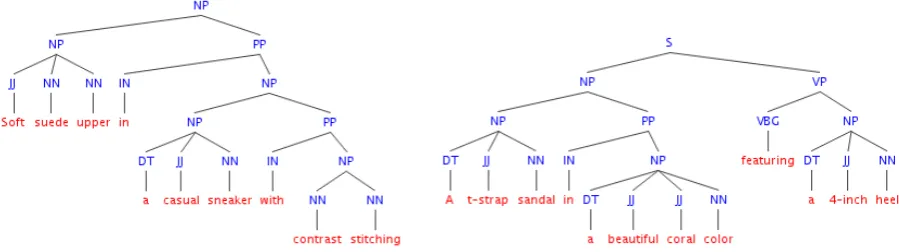
As in this simple example, the basic paradigm for compression is to keep the head words of phrases (“slipper”) and remove modifiers. Thus we want to extraction stage of our scheme to be more likely to find a candidate sentence with cor-rect head words, figuring that the compression stage can edit the mistakes. Our hypothesis is that headwords tend to describe more spatially struc-tured visual concepts, while modifier words de-scribe those that are more easily represented using local or unstructured features.4 Table 2 contains
additional example captions with parses.
GIST (Oliva and Torralba, 2001) is a com-monly used feature in Computer Vision which coarsely localizes perceptual attributes (e.g. rough vs smooth, natural vs manmade). By computing the GIST of the images, we project them into a multi-dimensional Euclidean space where images with semantically similar structures are located near each other. Thus the extraction stage of our caption generation process selects a sentence from the GIST nearest-neighbor to the query image.5
4.2 Joint Topic Model
The second component of our framework incorpo-rates visual and textual features using a less struc-tured model. We use a multi-modal topic model
4For example, the color “red” can be described using a bag of random pixels, while a “slipper” is a spatial configura-tion of parts in relaconfigura-tionship to each other.
Table 2: Example parses of women’s shoes descriptions. Our hypothesis is that the headwords in phrases are more likely to describe visual concepts which rely on spatial locations or relationships, while modi-fiers words can be represented using less-structured visual bag-of-words features.
to learn the latent topics which generate bag-of-words features for an image and its caption.
The bag-of-words model for Computer Vision represents images as a mixture of topics. Mea-sures of shape, color, texture, and intensity are computed at various points on the image and clus-tered into discrete “codewords” using thek-means algorithm.6Unlike text words, an individual
code-word has little meaning on its own, but distri-butions of codewords can provide a meaningful, though unstructured, representation of an image.
An image and its caption do not express exactly the same information, but they are topically re-lated. We employ the Polylingual Topic Model (Mimno et al., 2009), which is originally used to model corresponding documents in different lan-guages that are topically comparable, but not par-allel translations. In particular, we employ our previous work (Mason and Charniak, 2013) which extends this model to topically similar images and natural language captions. The generative process for a captioned image starts with a single topic distribution drawn from concentration parameter
αand base measurem:
θ∼Dir(θ, αm) (1)
Modality-specific latent topic assignments zimg andztxtare drawn for each of the text words and codewords:
zimg∼P(zimg|θ) =Y
n
θzimg
n (2)
6While space limits a more detailed explanation of visual bag-of-word features, Section 5.2 provides a brief overview of the specific visual attributes used in this model.
ztxt∼P(ztxt|θ) =Y n
θzntxt (3)
Observed words are generated according to their probabilities in the modality-specific topics:
wimg∼P(wimg|zimg,Φimg) =φimg
wimgn |zimgn (4)
wtxt∼P(wtxt|ztxt,Φtxt) =φtxtwtxtn |zntxt (5)
Given the uncaptioned query image qimg and the trained multi-modal topic model, it is now pos-sible to infer the shared topic proportion forqimg using Gibbs sampling:
P(zn=t|qimg, z\n,Φimg, αm)
∝φimgqimg n |t
(Nt)\n+αmt
P
tNt−1 +α (6)
4.3 Sentence Compression
Let w = w1, w2, ..., wn be the words in the ex-tracted caption for qimg. For each word, we de-fine a binary decision variableδ, such thatδi = 1 if wi is included in the output compression, and
δi = 0otherwise. Our objective is to find values of δ which generate a caption for qimg which is both semantically and grammatically correct.
4.3.1 Objective
The ILP objective is a weighted linear combina-tion of two measures which represent the correct-ness and fluency of the output compression:
Correctness: Recall in Section 3 we defined words as either descriptive words or function words. For each descriptive word, we estimate
P(wi|qimg), using topic proportions estimated us-ing Equation 6:
P(wi|qimg) =
X
t
P(wi|zttxt)P(zt|qimg) (7)
This is used to findI(wi), a function of the likeli-hood of each word in the extracted caption:
I(wi) =
(
P(wi|qimg)−P(wi), if descriptive
0, function word
(8) This function considers the prior probability ofwi because frequent words often have a high posterior probability even when they are inaccurate. Thus the sumPni=1δi·I(wi)is the overall measure of the correctness of a proposed caption conditioned onqimg.
Fluency: We formulate a trigram language model as an ILP, which requires additional binary decision variables: αi = 1 if wi begins the out-put compression,βij = 1if the bigram sequence
wi, wj ends the compression, γijk = 1if the tri-gram sequence wi, wj, wk is in the compression, and a special “start token”δ0 = 1. This language model favors shorter sentences, which is not nec-essarily the objective for image captioning, so we introduce a weighting factor, λ, to lessen the ef-fect.
Here is the combined objective, usingP to rep-resentlogP:
maxz = Xn
i=1
αi·P(wi|start)
+nX−2
i=1 n−1
X
j=i+1 n
X
k=j+1
γijk·P(wk|wi, wj)
+nX−1
i=0 n
X
j=i+1
βij ·P(end|wi, wj)
!
·λ
+
n
X
i=1
δi·I(wi) (9)
Sequential
1.)P iαi= 1 2.)δk−αk−Pk−2
i=0Pkj=1−1γijk= 0
∀k:k∈1...n 3.)δj−Pj−1
i=0
Pn
k=j+1γijk−
Pj−1 i=0βij= 0
∀j:j∈1...n 4.) Pn−1
j=i+1
Pn
k=j+1γijk−
Pn
j=i+1βij−
Pi−1
h=0βhi−δi= 0
∀i:i∈1...n 5.)Pn−1
i=0 Pnj=i+1βij= 1
Modifier 1. If head of the extracted sentenceδi= 1 =wi, then
2. Ifwiis head of a noun phrase, thenδi= 1
3. Punctuation and coordinating conjunctions follow special rules (below). Otherwise, if headof(wi) =wj, thenδi≤δj
Other 1.Piδi≥3
[image:5.595.305.539.61.258.2]2. Define valid use of puncutation and coordi-nating conjunctions.
Table 3: Summary of ILP constraints.
4.3.2 ILP Constraints
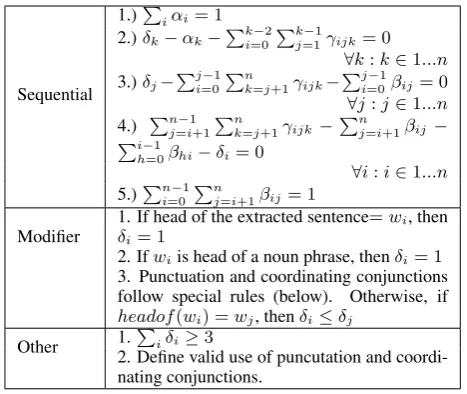
The ILP constraints ensure both the mathematical validity of the model, and the grammatical correct-ness of its output. Table 3 summarizes the list of constraints. Sequential constraints are defined as in Clarke (2008) ensure that the ordering of the tri-grams is valid, and that the mathematical validity of the model holds.
5 Implementation Details
5.1 Extraction
GIST features are computed using code by Oliva and Torralba (2001)7. GIST is computed with
im-ages converted to grayscale; since color features tend to act as modifiers in this domain. Nearest-neighbors are selected according to minimum dis-tance fromqimgto both a regularly-oriented and a horizontally-flipped training image.
Only one sentence from the first nearest-neighbor caption is extracted. In the case of multi-sentence captions, we select the first suitable sen-tence according to the following criteria 1.) has at least five tokens, 2.) does not contain NNP or NNPS (brand names), 3.) does not fail to parse using Stanford Parser (Klein and Manning, 2003). If the nearest-neighbor caption does not have any sentences meeting these criteria, caption sentences from the next nearest-neighbor(s) are considered.
7http://people.csail.mit.edu/torralba/
5.2 Joint Topic Model
We use the Joint Topic Model that we imple-mented in our previous work; please see Mason and Charniak (2013) for the full model and imple-mentation details. The topic model is trained with 200 topics using the polylingual topic model im-plementation from MALLET8. Briefly, the
code-words represent the following attributes:
SHAPE: SIFT (Lowe, 1999) describes the
shapes of detected edges in the image, using de-scriptors which are invariant to changes in rotation and scale.
COLOR: RGB (red, green, blue) and HSV (hue,
saturation, value) pixel values are sampled from a central area of the image to represent colors.
TEXTURE: Textons (Leung and Malik, 2001)
are computed by convolving images with Gabor filters at multiple orientations and scales, then sampling the outputs at random locations.
INTENSITY: HOG (histogram of gradients)
(Dalal and Triggs, 2005) describes the direction and intensity of changes in light. These features are computed on the image over a densely sam-pled grid.
5.3 Compression
The sentence compression ILP is implemented us-ing the CPLEX optimization toolkit9. The
lan-guage model weighting factor in the objective is
λ = 10−3, which was hand-tuned according to observed output. The trigram language model is trained on training set captions using Berke-leyLM (Pauls and Klein, 2011) with Kneser-Ney smoothing. For the constraints, we use parses from Stanford Parser (Klein and Manning, 2003) and the “semantic head” variation of the Collins headfinder Collins (1999).
6 Evaluation 6.1 Setup
We compare the following systems and baselines: KL (EXTRACTION): The top performing
ex-tractive model from Feng and Lapata (2010a), and the second-best captioning model overall. Using estimated topic distributions from our joint model, we extract the source with minimum KL Diver-gence fromqimg.
8http://mallet.cs.umass.edu/ 9http://www-01.ibm.com/
software/integration/optimization/ cplex-optimization-studio/
ROUGE-2 Average 95% Confidence int. KL (EXTRACTION)
P .06114 ( .05690 - .06554 ) R .02499 ( .02325 - .02686) F .03360 ( .03133 - .03600 ) GIST (EXTRACTION)
P .10894 ( .09934 - .11921 ) R .05474 ( .04926 - .06045) F .06863 ( .06207 - .07534) LM-ONLY(COMPRESSION)
P .13782 ( .12602 - .14864 ) R .02437 ( .02193 - .02700 ) F .03864 ( .03512 - .04229) SYSTEM(COMPRESSION)
[image:6.595.310.524.61.308.2]P .16752 (.15679 -.17882 ) R .05060 ( .04675 - .05524 ) F .07204 ( .06685 - .07802 )
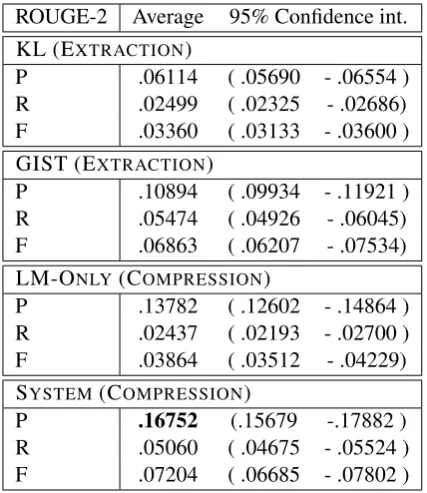
Table 4: ROUGE-2 (bigram) scores. The pre-cision of our system compression (bolded) sig-nificantly improves over the caption that it com-presses (GIST), without a significant decrease in recall.
GIST (EXTRACTION): The sentence extracted
using GIST nearest-neighbors, and the uncom-pressed source for the compression systems.
LM-ONLY (COMPRESSION): We include this
baseline to demonstrate that our model is effec-tively conditioning output compressions on qimg, as opposed to simply generalizing captions as in Kuznetsova et al. (2013)10. We modify the
com-pression ILP to ignore the content objective and only maximize the trigram language model (still subject to the constraints).
SYSTEM(COMPRESSION): Our full system.
Unfortunately, we cannot compare our system against prior work in general-domain image cap-tioning, because those models use visual detec-tion systems which train on labeled data that is not available in our domain.
6.2 Automatic Evaluation
We perform automatic evaluation using similar-ity measures between automatically generated and human-authored captions. Note that currently our system and baselines only generate single-sentence captions, but we compare against entire
BLEU@1 KL (EXTRACTION) .2098
GIST (EXTRACTION) .4259
LM-ONLY(COMPRESSION) .4780
[image:7.595.80.284.60.135.2]SYSTEM(COMPRESSION) .4841
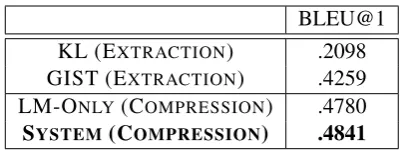
Table 5: BLEU@1 scores of generated captions against human authored captions. Our model (bolded) has the highest BLEU@1 score with sig-nificance.
held-out captions in order to increase the amount of text we have to compare against.
ROUGE (Lin, 2004) is a summarization uation metric which has also been used to eval-uate image captions (Yang et al., 2011). It is usually a recall-oriented measure, but we also re-port precision and f-measure because our sen-tence compressions do not improve recall. Table 4 shows ROUGE-2 (bigram) scores computed with-out stopwords.
We observe that our system very significantly improves ROUGE-2 precision of the GIST ex-tracted caption, without significantly reducing re-call. While LM-Only also improves precision against GIST extraction, it indiscriminately re-moves some words which are relevant to the query image. We also observe that GIST extrac-tion strongly outperforms the KL model, which demonstrates the importance of visual structure.
We also report BLEU (Papineni et al., 2002) scores, which are the most popularly accepted au-tomatic metric for captioning evaluation (Farhadi et al., 2010; Kulkarni et al., 2011; Ordonez et al., 2011; Kuznetsova et al., 2012; Kuznetsova et al., 2013). Results are very similar to the ROUGE-2 precision scores, except the difference between our system and LM-Only is less pro-nounced because BLEU counts function words, while ROUGE does not.
6.3 Human Evaluation
We perform human evaluation of compressions generated by our system and LM-Only. Users are shown the query image, the original uncompressed caption, and a compressed caption, and are asked two questions: does the compression improve the accuracy of the caption, and is the compression grammatical.
We collect 553 judgments from six women who are native English-speakers and knowledgeable
Query Image GIST Nearest-Neighbor
Extraction:Shimmeringsnake-embossed leatherupper in a slingback evening dress sandal style with a round open toe.
Compression: Shimmering upper in a slingback evening dress sandal style with a round open toe.
Query Image GIST Nearest-Neighbor
Extraction: Thissporty sneakerclog keeps foot cool and comfortable andfullysupported.
Compression: This clog keeps foot comfortable and sup-ported.
Query Image GIST Nearest-Neighbor
Extraction:Italian patentleatherpeep-toeballet flat with a signature tailored grosgrain bow.
Compression: leather ballet flat with a signature tailored grosgrain bow.
Query Image GIST Nearest-Neighbor
Extraction:Platform high heel open toe pump with horsebit available insilver guccissimaleather with nickel hardware with leather sole.
[image:7.595.310.535.82.175.2]Compression: Platform high heel open toe pump with horsebit available in leather with nickel hardware with leather sole.
SYSTEM LM-ONLY
Yes No Yes No
Compression improves accuracy
63.2% 36.8% 42.6% 57.4%
Compression is
[image:8.595.305.536.60.268.2]grammatical 73.1% 26.9% 82.2% 17.8%
Table 7: Human evaluation results.
about fashion.11 Users were recruited via email
and did the study over the internet.
Table 7 reports the results of the human evalu-ation. Users report 63.2% of SYSTEM
compres-sions improve accuracy over the original, while the other 36.8% did not improve accuracy. (Keep in mind that a bad compression does not make the caption less accurate, just less descriptive.) LM-ONLYimproves accuracy for less than half of the
captions, which is significantly worse than SYS -TEM captions (Fisher exact test, two-tailedp less
than 0.01).
Users find LM-Only compressions to be slightly more grammatical than System compressions, but the difference is not significant. (p >0.05)
7 Conclusion
We introduce the task of domain-specific image captioning and propose a captioning system which is trained on online shopping images and natu-ral language descriptions. We learn a joint topic model of vision and text to estimate the correct-ness of extracted captions, and use a sentence compression model to propose a more accurate output caption. Our model exploits the connection between image and sentence structure, and can be used to improve the accuracy of extracted image captions.
The task of domain-specific image caption generation has been overlooked in favor of the general-domain case, but we believe the domain-specific case deserves more attention. While image captioning can be viewed as a complex grounding problem, a good image caption should do more than label the objects in the image. When an expert looks at images in a specific domain, he or she makes inferences that would not be made by a expert. Providing this information to
non-11About 15% of output compressions are the same for both systems, and about 10% have no deleted words in the output compression. We include the former in the human evaluation, but not the latter.
Query Image GIST Nearest-Neighbor
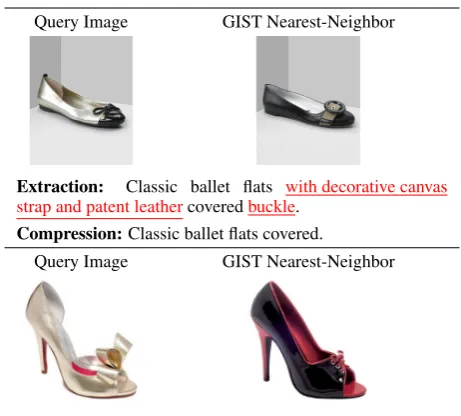
Extraction: Classic ballet flats with decorative canvas strap and patent leathercoveredbuckle.
Compression:Classic ballet flats covered.
Query Image GIST Nearest-Neighbor
Extraction: This shoe is the perfect shoe for you , fea-turing an open toe and a lace up upper with a high heel , and a two tone color.
Compression:This shoe is the shoe , featuring an open toe and upper with a high heel .
Table 8: Examples of bad performance. The top example is a parse error, while the bottom exam-ple deletes modifiers that are not part of the image description.
expert users in the form of an image caption will greatly expand the utility for automatic image cap-tioning.
References
Tamara L. Berg, Alexander C. Berg, and Jonathan Shih. 2010. Automatic attribute discovery and charac-terization from noisy web data. InProceedings of the 11th European conference on Computer vision: Part I, ECCV’10, pages 663–676, Berlin, Heidel-berg. Springer-Verlag.
David M. Blei and Michael I. Jordan. 2003. Modeling annotated data. InProceedings of the 26th annual international ACM SIGIR conference on Research and development in informaion retrieval, SIGIR ’03, pages 127–134, New York, NY, USA. ACM. James Clarke and Mirella Lapata. 2008. Global
infer-ence for sentinfer-ence compression an integer linear pro-gramming approach. J. Artif. Int. Res., 31(1):399– 429, March.
James Clarke. 2008. Global Inference for Sentence Compression: An Integer Linear Programming Ap-proach. Dissertation, University of Edinburgh. Michael John Collins. 1999. Head-driven statistical
[image:8.595.74.289.62.153.2]N. Dalal and B. Triggs. 2005. Histograms of oriented gradients for human detection. InComputer Vision and Pattern Recognition, 2005. CVPR 2005. IEEE Computer Society Conference on, volume 1, pages 886 –893 vol. 1, june.
Ali Farhadi, Mohsen Hejrati, Mohammad Amin Sadeghi, Peter Young, Cyrus Rashtchian, Julia Hockenmaier, and David Forsyth. 2010. Every pic-ture tells a story: generating sentences from images. InProceedings of the 11th European conference on Computer vision: Part IV, ECCV’10, pages 15–29, Berlin, Heidelberg. Springer-Verlag.
P. F. Felzenszwalb, R. B. Girshick, D. McAllester, and D. Ramanan. 2010. Object detection with discrim-inatively trained part based models. IEEE Transac-tions on Pattern Analysis and Machine Intelligence, 32(9):1627–1645.
Yansong Feng and Mirella Lapata. 2010a. How many words is a picture worth? automatic caption genera-tion for news images. InProceedings of the 48th An-nual Meeting of the Association for Computational Linguistics, ACL ’10, pages 1239–1249, Strouds-burg, PA, USA. Association for Computational Lin-guistics.
Yansong Feng and Mirella Lapata. 2010b. Topic mod-els for image annotation and text illustration. In
HLT-NAACL, pages 831–839.
Sadaoki Furui, Tomonori Kikuchi, Yousuke Shinnaka, and Chiori Hori. 2004. Speech-to-text and speech-to-speech summarization of spontaneous speech.
IEEE TRANS. ON SPEECH AND AUDIO PRO-CESSING, 12(4):401–408.
Dan Klein and Christopher D. Manning. 2003. Ac-curate unlexicalized parsing. InProceedings of the 41st Annual Meeting on Association for Computa-tional Linguistics - Volume 1, ACL ’03, pages 423– 430, Stroudsburg, PA, USA. Association for Com-putational Linguistics.
Kevin Knight and Daniel Marcu. 2002. Summa-rization beyond sentence extraction: a probabilis-tic approach to sentence compression. Artif. Intell., 139(1):91–107, July.
Girish Kulkarni, Visruth Premraj, Sagnik Dhar, Siming Li, Yejin Choi, Alexander C. Berg, and Tamara L. Berg. 2011. Baby talk: Understanding and gener-ating simple image descriptions. In CVPR, pages 1601–1608.
Polina Kuznetsova, Vicente Ordonez, Alexander C. Berg, Tamara L. Berg, and Yejin Choi. 2012. Col-lective generation of natural image descriptions. In
ACL.
Polina Kuznetsova, Vicente Ordonez, Alexander Berg, Tamara Berg, and Yejin Choi. 2013. Generalizing image captions for image-text parallel corpus. In
ACL.
T. Leung and J. Malik. 2001. Representing and rec-ognizing the visual appearance of materials using three-dimensional textons. International Journal of Computer Vision, 43(1):29–44.
Chin-Yew Lin. 2004. Rouge: A package for auto-matic evaluation of summaries. In Stan Szpakowicz Marie-Francine Moens, editor, Text Summarization Branches Out: Proceedings of the ACL-04 Work-shop, pages 74–81, Barcelona, Spain, July. Associa-tion for ComputaAssocia-tional Linguistics.
D.G. Lowe. 1999. Object recognition from local scale-invariant features. In Computer Vision, 1999. The Proceedings of the Seventh IEEE International Con-ference on, volume 2, pages 1150 –1157 vol.2. Andr´e F. T. Martins and Noah A. Smith. 2009.
Sum-marization with a joint model for sentence extraction and compression. InProceedings of the Workshop on Integer Linear Programming for Natural Lan-gauge Processing, ILP ’09, pages 1–9, Stroudsburg, PA, USA. Association for Computational Linguis-tics.
R. Mason and E. Charniak. 2013. Annotation of online shopping images without labeled training examples. Workshop on Vision and Language (WVL). Rebecca Mason. 2013. Domain-independent
caption-ing of domain-specific images. NAACL Student Re-search Workshop.
David Mimno, Hanna M. Wallach, Jason Naradowsky, David A. Smith, and Andrew McCallum. 2009. Polylingual topic models. In Proceedings of the 2009 Conference on Empirical Methods in Nat-ural Language Processing: Volume 2 - Volume 2, EMNLP ’09, pages 880–889, Stroudsburg, PA, USA. Association for Computational Linguistics. Margaret Mitchell, Jesse Dodge, Amit Goyal, Kota
Ya-maguchi, Karl Stratos, Xufeng Han, Alyssa Men-sch, Alexander C. Berg, Tamara L. Berg, and Hal Daum´e III. 2012. Midge: Generating image de-scriptions from computer vision detections. In Euro-pean Chapter of the Association for Computational Linguistics (EACL).
Aude Oliva and Antonio Torralba. 2001. Modeling the shape of the scene: A holistic representation of the spatial envelope. International Journal of Computer Vision, 42:145–175.
V. Ordonez, G. Kulkarni, and T.L. Berg. 2011. Im2text: Describing images using 1 million cap-tioned photographs. InNIPS.
Adam Pauls and Dan Klein. 2011. Faster and smaller n-gram language models. In Proceedings of ACL, Portland, Oregon, June. Association for Computa-tional Linguistics.
Jenine Turner and Eugene Charniak. 2005. Super-vised and unsuperSuper-vised learning for sentence com-pression. InProceedings of the 43rd Annual Meet-ing on Association for Computational LMeet-inguistics, ACL ’05, pages 290–297, Stroudsburg, PA, USA. Association for Computational Linguistics.
Yezhou Yang, Ching Lik Teo, Hal Daum´e III, and Yian-nis Aloimonos. 2011. Corpus-guided sentence gen-eration of natural images. In Empirical Methods in Natural Language Processing (EMNLP), Edin-burgh, Scotland.